
If you are researching what do full dental implants cost, the short answer is that full dental implant treatment can range from several thousand to tens of thousands of dollars depending on the number of implants required, the type of restoration selected, the condition of your jawbone, and whether additional procedures are necessary before treatment begins. While many people search online hoping to find a single price, the reality is that there is no universal fee because every patient’s oral health situation is different.
Understanding what do full dental implants cost starts with understanding what is actually included in treatment. A full dental implant solution is designed to replace most or all teeth in one or both arches. The overall treatment plan may include diagnostic imaging, clinical examinations, implant placement surgery, temporary restorations, final prosthetic teeth, follow-up appointments, and long-term maintenance recommendations. Because these components vary from patient to patient, final treatment costs can only be determined after a professional assessment.
Many patients asking what do full dental implants cost are not simply looking for a number. They are trying to decide whether treatment is realistic, whether it fits their budget, and whether it offers value compared to other tooth replacement options. In many cases, full dental implants can provide improved chewing function, greater stability, and a more natural feel compared to removable dentures. However, these potential benefits must be weighed against the investment required and the individual’s oral health needs.
When evaluating what do full dental implants cost, it is important to remember that treatment plans can differ significantly. Some patients may require only a limited number of strategically placed implants to support a full arch restoration, while others may need more implants because of anatomical factors or treatment goals. Bone grafting, sinus augmentation, extractions, and periodontal treatment can also influence the overall cost.
Another factor affecting discussions about what do full dental implants cost is location. Dental treatment fees often vary between countries, cities, clinics, and providers. A treatment plan prepared in one region may not be directly comparable to a treatment plan prepared elsewhere. For this reason, online averages should be viewed as general references rather than exact predictions of your personal expenses.
If you currently wear dentures, have multiple failing teeth, or are struggling with extensive tooth loss, researching what do full dental implants cost is a practical first step. However, cost alone should not determine your decision. The suitability of your jawbone, your general health, your oral hygiene habits, and your long-term expectations all play important roles in determining whether full dental implants are appropriate for you.
Patients are often surprised to learn that the answer to what do full dental implants cost can only be accurately estimated after detailed diagnostics. Modern dental planning commonly involves digital scans, panoramic imaging, or three-dimensional imaging that helps clinicians evaluate bone volume, implant positioning, and potential challenges before treatment begins. This planning process is essential because it improves treatment accuracy and helps create a personalized recommendation.
For some individuals, the most important question is not only what do full dental implants cost but also whether the treatment is worth considering. If missing teeth are affecting your ability to eat comfortably, speak clearly, smile confidently, or maintain quality of life, a professional consultation may help you understand the potential benefits and limitations of implant-supported restorations. Every patient has different priorities, and a customized evaluation can help align treatment recommendations with those priorities.
Reliable information is also important when comparing treatment options. Educational resources from organizations such as the American Dental Association can help patients better understand implant dentistry and oral health considerations. Combining trustworthy information with a clinical examination provides a stronger foundation for making an informed decision.
At clinics such as Redent Klinik, treatment planning is typically based on the patient’s specific dental condition rather than a one-size-fits-all approach. This is important because two patients searching for what do full dental implants cost may receive very different recommendations depending on bone quality, tooth loss patterns, and restoration goals.
Practical Next Step: If you are seriously considering full dental implants, gather any recent dental X-rays or records you may have and schedule a professional consultation. During the appointment, ask what is included in the proposed treatment plan, whether additional procedures may be required, and what long-term maintenance should be expected. If you would like a personalized assessment, you can request further information through the Redent Klinik Contact Page. A personalized examination is the most reliable way to determine what full dental implant treatment may involve in your specific situation and what costs may reasonably be expected.
What Do Full Dental Implants Cost and What Is Included in the Price?
One of the most common questions patients ask before beginning treatment is what do full dental implants cost and exactly what they are paying for. While many online articles focus only on price ranges, understanding what is included in the treatment plan is often more important than focusing on a single number. Two treatment plans may appear similar at first glance, yet the services, materials, technology, and long-term support included can be significantly different.
If you are researching what do full dental implants cost, it is important to know that the total investment usually includes multiple stages rather than a single procedure. Full dental implant treatment is typically a comprehensive restoration process designed to replace most or all missing teeth while restoring function, comfort, and appearance. Because every patient starts from a different oral health condition, treatment plans are customized rather than standardized.
Understanding the Main Components of Full Dental Implant Costs
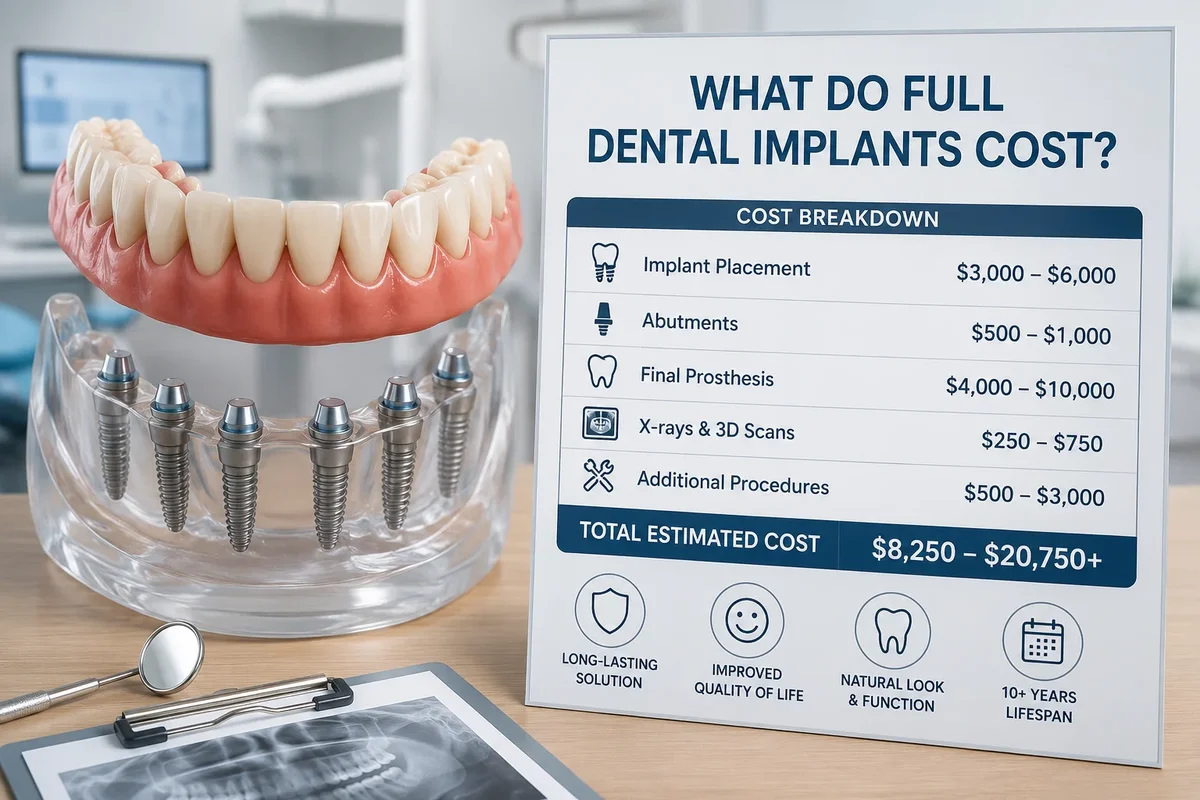
When evaluating what do full dental implants cost, patients should first understand the individual components that may be included in a treatment proposal. A complete treatment plan often contains several professional services and clinical procedures.
Initial Consultation and Treatment Planning
The first stage usually involves a clinical examination, discussion of treatment goals, and diagnostic planning. Dentists evaluate oral health, bone levels, gum condition, bite function, and any existing dental problems that may affect treatment success.
This planning phase is a critical part of determining what do full dental implants cost because it helps identify potential complications before treatment begins. Comprehensive planning may reduce surprises later in the process and provide a clearer understanding of the overall investment.
Diagnostic Imaging
Modern implant dentistry frequently uses advanced imaging technology. Digital X-rays and three-dimensional scans help clinicians assess bone quality, anatomical structures, and implant positioning.
When patients ask what do full dental implants cost, they sometimes overlook the value of detailed diagnostics. However, precise imaging can play a significant role in treatment accuracy and safety.
Dental Implant Placement
The implant fixtures themselves are often one of the most significant components of the overall treatment cost. These titanium or similar biocompatible structures are surgically placed into the jawbone and serve as artificial tooth roots.
The number of implants required can directly influence what do full dental implants cost. Some full-arch solutions use fewer implants strategically positioned to support a complete restoration, while others may require additional implants depending on the patient’s anatomy and treatment goals.
Temporary Restorations
Many treatment plans include temporary teeth that allow patients to maintain appearance and function during healing. These temporary restorations may be included in some treatment proposals and separate in others.
For this reason, patients comparing clinics should not only ask what do full dental implants cost but also whether temporary restorations are included in the quoted treatment plan.
Final Prosthetic Teeth
The final restoration is another major factor influencing what do full dental implants cost. Materials, manufacturing methods, durability expectations, and aesthetic requirements can all affect pricing.
Different restorative options may be available depending on the patient’s priorities. Some individuals prioritize durability and strength, while others focus primarily on aesthetics and natural appearance.
Additional Procedures That May Affect Costs
One reason why answers to what do full dental implants cost vary so widely is that some patients require additional procedures before implant placement can occur.
Tooth Extractions
If damaged or failing teeth remain in the mouth, extractions may be necessary before implants can be placed. The complexity of extraction procedures can influence the overall treatment plan.
Bone Grafting
Bone volume plays an important role in implant stability. Patients who have experienced long-term tooth loss sometimes require bone augmentation procedures before implants can be placed.
Because of this possibility, the answer to what do full dental implants cost may change after detailed imaging reveals the current condition of the jawbone.
Gum Treatment
Healthy gums support long-term implant health. If periodontal disease is present, treatment may be recommended before implant placement begins.
Why Comparing Price Alone Can Be Misleading
Patients often search online for the lowest answer to what do full dental implants cost, but focusing solely on price may not provide the complete picture. A lower quote does not necessarily include the same services, materials, laboratory work, follow-up visits, or diagnostic procedures as another treatment plan.
Instead of comparing only total fees, patients should compare treatment scope, restoration materials, implant systems, warranty policies if offered, maintenance requirements, and the experience of the treating team.
This approach can help create a more meaningful comparison than simply searching for the cheapest answer to what do full dental implants cost.
How to Make a Better Treatment Decision
If you are currently evaluating what do full dental implants cost, consider asking the following questions during consultations:
- What procedures are included in the quoted treatment plan?
- Are temporary restorations included?
- Will additional imaging be required?
- Could bone grafting or extractions become necessary?
- What type of final restoration is recommended?
- How many follow-up appointments are expected?
- What maintenance requirements should be anticipated?
These questions often provide more useful information than focusing exclusively on the final number.
When to Request Professional Advice
If you have multiple missing teeth, failing dental work, loose dentures, difficulty chewing, or concerns about long-term tooth replacement options, a professional consultation is usually the best next step. The most accurate answer to what do full dental implants cost can only be provided after a clinical examination, diagnostic imaging, and personalized treatment planning. Before making a decision, ask for a detailed breakdown of what is included in the proposed treatment so you can compare options confidently and understand exactly what your investment covers.
Factors That Influence What Do Full Dental Implants Cost
When patients begin researching what do full dental implants cost, they often discover that prices can vary significantly from one treatment plan to another. This variation is not random. Multiple clinical, technical, and personal factors influence the final investment required for full dental implant treatment. Understanding these variables can help you make a more informed decision and avoid comparing treatment plans based solely on headline prices.
If you have been searching for what do full dental implants cost, it is important to understand that implant dentistry is highly personalized. Two patients with similar tooth loss may receive very different recommendations because their oral health conditions, bone structure, treatment goals, and restorative needs are not identical. The most accurate way to evaluate treatment value is to understand what drives the cost and how those factors relate to your specific situation.
The Number of Implants Required
One of the most important factors affecting what do full dental implants cost is the number of implants needed to support the restoration. Some treatment concepts use a smaller number of strategically positioned implants to support a full arch of teeth, while other cases may require additional implants because of bone availability, bite forces, or restoration design.
Patients sometimes assume that every full-mouth case requires the same number of implants, but this is not always true. The number recommended by a dentist is based on clinical findings and long-term treatment objectives. As a result, the answer to what do full dental implants cost often begins with determining how many implants are appropriate for your situation.
Bone Quality and Bone Volume
Why Bone Structure Matters
Healthy bone is essential for supporting dental implants. When teeth have been missing for a long period, the jawbone may gradually lose volume. Reduced bone density can affect treatment planning and may require additional procedures before implant placement.
This is one reason why online searches for what do full dental implants cost can be misleading. A patient with strong bone support may require a simpler treatment plan than someone who has experienced significant bone loss over many years.
Potential Need for Bone Grafting
Bone grafting procedures may be recommended when existing bone levels are insufficient to support implants. These procedures can increase treatment complexity, extend treatment timelines, and influence the overall cost structure.
Therefore, when considering what do full dental implants cost, patients should understand that the final treatment proposal may change after diagnostic imaging reveals the true condition of the jawbone.
Type of Final Restoration
The restoration attached to the implants is another major factor affecting what do full dental implants cost. Full-arch restorations can be manufactured using different materials and techniques. Each option offers its own balance of aesthetics, durability, maintenance requirements, and cost considerations.
Patients who prioritize a highly natural appearance may receive different recommendations than those primarily focused on strength and functionality. Material selection can therefore play a significant role in determining what do full dental implants cost for a specific case.
Diagnostic Technology and Treatment Planning
Advanced Imaging
Modern implant dentistry often relies on digital technology for treatment planning. Three-dimensional scans, digital impressions, and computer-guided planning systems may be used to improve accuracy and predictability.
While these technologies can contribute to treatment costs, they may also enhance planning precision. Patients evaluating what do full dental implants cost should consider whether advanced diagnostics are included in the proposed treatment plan.
Customized Surgical Planning
Some cases require extensive planning to accommodate anatomical limitations, bite corrections, or complex restorative needs. More advanced planning may increase professional time and laboratory involvement, which can influence overall fees.
Existing Oral Health Conditions
Another factor influencing what do full dental implants cost is the patient’s current oral health status. Existing infections, untreated gum disease, damaged teeth, or bite-related issues may need to be addressed before implant treatment can proceed.
Although these preparatory treatments may add to the initial investment, they often play an important role in creating a healthier foundation for long-term implant support.
Clinic Experience and Treatment Team
Patients comparing treatment options often focus only on the total price. However, experience, training, technology, laboratory partnerships, and treatment planning protocols may also contribute to differences in treatment fees.
When researching what do full dental implants cost, it is helpful to evaluate the overall treatment approach rather than viewing implant treatment as a standardized product. A comprehensive consultation can help clarify what is included and why recommendations may vary between providers.
Geographic Location
Location can have a substantial impact on what do full dental implants cost. Treatment fees may vary between countries, regions, and cities due to differences in operating expenses, laboratory costs, staffing requirements, and healthcare markets.
This is why patients frequently encounter very different price ranges while conducting online research. Comparing prices without considering location and treatment scope can sometimes create unrealistic expectations.
Long-Term Value Versus Initial Cost
Many patients focus primarily on the immediate answer to what do full dental implants cost. However, long-term value is equally important. Factors such as restoration durability, maintenance requirements, comfort, function, and quality of life may influence whether a treatment option represents good value for a particular individual.
A lower initial cost may not always represent the most suitable long-term solution, just as a higher price does not automatically indicate superior treatment. Careful evaluation of benefits, limitations, and maintenance expectations is essential.
How to Use This Information When Making a Decision
If you are comparing treatment options and trying to understand what do full dental implants cost, focus on obtaining detailed treatment plans rather than requesting a simple price estimate. Ask whether diagnostic imaging, temporary restorations, implant surgery, final prosthetic teeth, follow-up visits, and maintenance recommendations are included.
What to Check Before Requesting Professional Advice: Review your history of tooth loss, determine whether you currently wear dentures, note any previous bone grafting or gum disease treatment, and gather recent dental records if available. If you have missing teeth, loose dentures, failing dental work, or concerns about bone loss, a professional implant consultation is recommended. Only a comprehensive examination and diagnostic assessment can accurately identify the factors that influence what full dental implant treatment may involve and what costs may reasonably apply to your individual case.
Who Is a Good Candidate for Full Dental Implants?
Many people begin their research by asking what do full dental implants cost, but an equally important question is whether full dental implants are the right solution for their specific situation. Cost matters, but suitability should always come first. A treatment option that works well for one patient may not be ideal for another, even if both individuals have multiple missing teeth. Understanding candidacy can help you avoid unrealistic expectations and make a more informed decision before investing time and money into treatment planning.
If you have been searching for what do full dental implants cost, it is worth remembering that the final treatment recommendation depends heavily on your oral health, bone condition, medical history, and treatment goals. Before discussing specific prices, dental professionals usually determine whether full dental implants are clinically appropriate and what type of implant-supported restoration would best meet your needs.
Patients with Multiple Missing Teeth
One of the most common groups researching what do full dental implants cost includes individuals who have already lost most or all of their natural teeth. Full dental implants are often considered when extensive tooth loss affects chewing ability, speech, appearance, or overall quality of life.
For these patients, implant-supported restorations may provide improved stability compared to conventional removable dentures. However, suitability depends on several factors beyond the number of missing teeth. A detailed evaluation is necessary to determine whether implants can be safely and predictably placed.
Patients with Failing Teeth
When Remaining Teeth Cannot Be Predictably Saved
Some individuals researching what do full dental implants cost still have natural teeth, but many of those teeth may be severely damaged, mobile, decayed, or affected by advanced periodontal disease. In certain situations, a comprehensive full-mouth restoration may be discussed as one of several treatment options.
This does not mean every failing tooth should automatically be replaced with implants. In many cases, preserving healthy natural teeth remains the preferred approach. A qualified dental professional can help determine whether restoration, extraction, or a combination of treatments is most appropriate.
Balancing Preservation and Replacement
When evaluating what do full dental implants cost, patients should ask whether all existing teeth truly require replacement. Sometimes a less extensive treatment plan may achieve acceptable function while preserving healthy structures.
The best decision is usually based on long-term prognosis rather than short-term convenience.
Bone Health and Implant Suitability
Bone quality is one of the most important factors affecting candidacy. Many patients who search for what do full dental implants cost assume implants can be placed in every situation, but sufficient bone support is required for successful implant integration.
Patients who have experienced tooth loss for many years may have reduced bone volume. This does not automatically exclude them from treatment, but additional procedures such as bone grafting may be discussed during treatment planning.
Advanced imaging helps clinicians evaluate bone availability and determine whether implants can be placed safely. This assessment often occurs before any meaningful discussion of final treatment costs.
General Health Considerations
Medical Conditions
When researching what do full dental implants cost, patients sometimes focus entirely on financial considerations while overlooking overall health factors. Certain medical conditions may influence healing, treatment timing, or surgical planning.
Conditions affecting immune response, bone metabolism, or wound healing may require additional evaluation before implant treatment proceeds. This does not necessarily prevent treatment, but it may influence the treatment approach.
Lifestyle Factors
Smoking, poor oral hygiene, and inconsistent dental care habits can also affect long-term implant outcomes. Patients considering full dental implants should be prepared to commit to regular maintenance and follow-up care.
The answer to what do full dental implants cost should always be considered alongside the long-term responsibility of maintaining implant-supported restorations.
Patients Who Struggle with Traditional Dentures
Many individuals searching for what do full dental implants cost currently wear removable dentures and are dissatisfied with their stability. Common complaints include slipping, discomfort, difficulty eating certain foods, and reduced confidence while speaking.
Implant-supported restorations may offer improved retention and function for suitable candidates. However, not every denture wearer requires a fixed full-arch solution. Different levels of implant support may be available depending on the patient’s goals and anatomy.
Understanding Treatment Expectations
A good candidate is not only someone who meets clinical requirements. Expectations also matter. Patients researching what do full dental implants cost should understand that treatment typically involves multiple appointments, healing periods, maintenance requirements, and financial considerations.
Individuals who expect an immediate, permanent solution without ongoing care may need additional education before proceeding. Successful treatment planning often depends on realistic expectations regarding both the process and the long-term commitment involved.
When Full Dental Implants May Not Be the First Recommendation
There are situations where full dental implants may not be the preferred initial option. Some patients may benefit from preserving existing teeth, treating gum disease, improving oral hygiene, or considering alternative restorations before pursuing a full-arch implant solution.
For this reason, patients should avoid assuming that researching what do full dental implants cost automatically means implants are the best answer. A comprehensive consultation helps identify all available treatment options and their respective advantages and limitations.
Making the Right Decision for Your Situation
If you are comparing options and wondering what do full dental implants cost, focus first on determining whether you are a suitable candidate. The most effective treatment is not always the most expensive or the most advanced—it is the one that best matches your oral health needs, lifestyle, expectations, and long-term goals.
Clinics such as Redent Klinik often begin the process with a detailed assessment rather than an immediate cost estimate because candidacy directly affects treatment planning and overall investment requirements.
What to Check Before Requesting Professional Advice
Before scheduling a consultation, make a note of how many teeth are missing, whether you currently wear dentures, how long tooth loss has been present, and whether you have any history of gum disease, bone grafting, or significant medical conditions. If you experience difficulty chewing, loose dentures, multiple failing teeth, or concerns about bone loss, it is advisable to request a professional implant evaluation. A personalized examination can determine whether full dental implants are appropriate for your needs and provide a more accurate understanding of the treatment options available to you.
The Full Dental Implant Procedure Step by Step
Many patients begin their research by asking what do full dental implants cost, but understanding the treatment process is equally important. The overall investment, treatment timeline, and suitability for your situation are closely connected to the clinical steps involved. By learning how the procedure works from consultation to final restoration, you can make a more informed decision and better understand why treatment plans differ from one patient to another.
If you are exploring what do full dental implants cost, it helps to know that full dental implant treatment is usually completed in stages rather than during a single appointment. While treatment timelines vary depending on individual circumstances, most patients follow a similar sequence of evaluation, planning, surgery, healing, and restoration.
Step 1: Initial Consultation and Evaluation
Understanding Your Oral Health Condition
The first stage of treatment involves a comprehensive dental assessment. During this appointment, the dental team evaluates your current oral health, reviews your medical history, discusses your goals, and examines factors that may influence treatment planning.
Patients often arrive focused on what do full dental implants cost, but dentists must first determine whether full dental implants are appropriate and what type of restoration may best suit the patient’s needs.
Questions discussed during this stage may include:
- How many teeth are missing?
- How long has tooth loss been present?
- Are dentures currently being worn?
- Are there any existing dental infections?
- What are the patient’s expectations regarding appearance and function?
Diagnostic Imaging
Modern implant planning frequently includes panoramic imaging and three-dimensional scans. These images help assess bone volume, anatomical structures, and implant placement opportunities.
The information gathered during this stage directly affects treatment planning and contributes to determining what do full dental implants cost for a specific patient.
Step 2: Personalized Treatment Planning
After diagnostic information is collected, a customized treatment plan is created. This stage is one reason why online searches for what do full dental implants cost often produce wide-ranging answers. Every patient requires a unique approach based on their oral health condition.
During treatment planning, clinicians determine:
- The number of implants required
- Whether extractions are necessary
- Whether bone grafting may be recommended
- The type of temporary restoration
- The material used for the final restoration
- The expected treatment timeline
Only after these details are evaluated can a meaningful treatment estimate be provided.
Step 3: Preparatory Procedures
Tooth Extractions
Some patients still have damaged or failing teeth that need to be removed before implant treatment can begin. The complexity of these procedures varies from patient to patient.
When patients ask what do full dental implants cost, they should understand that preparatory procedures may influence the overall treatment plan.
Bone Grafting When Necessary
If significant bone loss is present, bone augmentation procedures may be recommended before implant placement. These procedures are designed to improve the available support for implants.
Not every patient requires grafting, which is why answers to what do full dental implants cost can differ substantially between individuals.
Step 4: Implant Placement Surgery
The implant placement procedure is often the stage patients associate most closely with treatment. During surgery, dental implants are inserted into the jawbone according to the treatment plan developed during the diagnostic phase.
The exact surgical process varies depending on the number of implants, bone quality, and restoration design. Some treatment approaches may allow temporary teeth to be attached relatively soon after surgery, while others may require a longer healing period before the final restoration is placed.
Understanding these differences helps patients evaluate what do full dental implants cost in relation to the overall complexity of treatment.
Step 5: Healing and Osseointegration
Why Healing Matters
Following implant placement, the jawbone gradually integrates with the implant surface through a biological process known as osseointegration. This healing phase is one of the most important parts of treatment.
Patients researching what do full dental implants cost sometimes focus primarily on surgery, but successful treatment depends heavily on proper healing and follow-up care.
Temporary Restorations During Healing
Many patients receive temporary restorations while implants heal. These temporary teeth help maintain appearance and function throughout the treatment process.
Whether temporary restorations are included can influence treatment planning and should be discussed when comparing proposals related to what do full dental implants cost.
Step 6: Final Restoration Placement
After sufficient healing has occurred, the final prosthetic restoration is attached to the implants. This stage transforms the implant foundations into a functional full-arch restoration.
The final restoration is often one of the most visible aspects of treatment and may significantly influence what do full dental implants cost depending on the materials selected and the complexity of fabrication.
The goal is to create a restoration that supports comfortable function, aesthetics, and long-term maintenance.
Step 7: Long-Term Maintenance and Follow-Up
Many patients are surprised to learn that treatment does not end when the final teeth are delivered. Regular maintenance appointments play an important role in monitoring implant health and preserving long-term function.
When evaluating what do full dental implants cost, patients should also consider future maintenance requirements, professional cleanings, and periodic evaluations as part of responsible long-term care.
How the Procedure Helps You Make a Better Decision
Understanding the full treatment sequence allows patients to look beyond simple price comparisons. Instead of asking only what do full dental implants cost, it becomes possible to evaluate the quality of planning, diagnostic procedures, surgical protocols, restoration design, and long-term support included in the treatment plan.
Clinics such as Redent Klinik typically focus on comprehensive planning because each stage of the process contributes to the overall treatment outcome and patient experience.
What to Check Before Requesting Professional Advice
Before scheduling a consultation, determine whether you currently wear dentures, have failing teeth, or have experienced bone loss due to long-term tooth absence. Gather any recent dental records, scans, or X-rays that may assist with evaluation. If you are uncertain about your suitability, treatment timeline, or expected procedures, request a professional implant consultation. A detailed examination can explain which steps may apply to your situation and provide a personalized understanding of what full dental implant treatment may involve.
Risks, Limitations, and Long-Term Considerations
When researching what do full dental implants cost, many patients focus primarily on treatment fees, financing options, and aesthetic outcomes. While these topics are important, understanding the potential risks, limitations, and long-term responsibilities associated with full dental implants is equally essential. A well-informed decision should consider not only the benefits of treatment but also the challenges that may arise before, during, and after the procedure.
If you are evaluating what do full dental implants cost, remember that successful treatment depends on more than the surgical placement of implants. Long-term results are influenced by oral hygiene, bone quality, lifestyle habits, maintenance routines, and regular professional care. Understanding these factors can help you decide whether full dental implants align with your expectations and long-term goals.
Understanding the Difference Between Risks and Complications
Every medical and dental procedure carries some level of risk. This does not mean complications will occur, but patients should be aware of potential challenges before making treatment decisions.
When comparing treatment options and asking what do full dental implants cost, it is helpful to think beyond the initial investment and consider the commitment required to maintain the restoration over time.
Short-Term Surgical Risks
As with many surgical procedures, temporary swelling, discomfort, bruising, and sensitivity may occur after implant placement. Recovery experiences vary from patient to patient and depend on factors such as treatment complexity, overall health, and adherence to post-operative instructions.
Patients researching what do full dental implants cost should understand that healing is a normal part of the treatment process and may require multiple follow-up appointments to monitor progress.
Healing Variability
Not every patient heals at the same rate. Bone quality, age, medical history, smoking habits, and oral hygiene practices can influence healing timelines and treatment progression.
This variability is one reason why providers avoid offering identical answers to what do full dental implants cost without first conducting a detailed examination.
Bone and Implant Integration Challenges
One of the most important stages of treatment is the biological process in which the jawbone integrates with the implant surface. Although implant dentistry has a long history of successful outcomes, successful integration cannot be assumed in every situation.
Patients evaluating what do full dental implants cost should understand that treatment planning is designed to reduce risk by carefully assessing bone quality and anatomical conditions before surgery.
Bone Loss Considerations
Long-term tooth loss may lead to changes in bone volume. Reduced bone support can influence treatment planning and may require additional procedures before implants are placed.
Understanding bone health is often just as important as understanding what do full dental implants cost because bone availability directly affects treatment options.
Maintenance Responsibilities After Treatment
Daily Oral Hygiene
Some patients mistakenly believe implant-supported restorations require little or no maintenance. In reality, consistent oral hygiene remains extremely important after treatment.
Individuals asking what do full dental implants cost should also ask what long-term maintenance responsibilities will be required. Proper cleaning routines help support healthy gums and surrounding tissues.
Professional Follow-Up Care
Regular dental visits remain important after treatment completion. Professional examinations allow clinicians to evaluate implant health, restoration condition, bite function, and oral hygiene effectiveness.
When considering what do full dental implants cost, patients should factor long-term maintenance into their overall treatment planning rather than focusing solely on initial fees.
Lifestyle Factors That Can Influence Outcomes
Several personal habits can affect the long-term performance of implant-supported restorations. These factors do not automatically prevent treatment, but they may influence recommendations and maintenance requirements.
Smoking
Smoking has long been recognized as a factor that may influence oral health and healing. Patients who smoke should discuss their habits openly during treatment planning so appropriate recommendations can be made.
Teeth Grinding and Clenching
Excessive bite forces caused by grinding or clenching may affect restorative materials over time. Protective measures may be recommended depending on the patient’s specific situation.
For this reason, evaluating what do full dental implants cost should include a discussion of long-term maintenance and protective strategies rather than focusing only on surgery.
Financial Considerations Beyond Initial Treatment
Patients often focus on the immediate answer to what do full dental implants cost, but long-term ownership costs are also worth considering. Periodic maintenance, professional cleanings, replacement of worn components when necessary, and future restorative updates may become part of long-term care.
This does not mean future expenses are inevitable or excessive, but responsible planning involves understanding that implant treatment is an ongoing healthcare investment rather than a one-time transaction.
Limitations of Full Dental Implants
Although full dental implants can offer significant functional and aesthetic benefits for many patients, they are not necessarily the ideal solution for every individual. Medical conditions, anatomical limitations, financial considerations, or personal preferences may lead some patients to explore alternative treatment options.
When researching what do full dental implants cost, it is important to remain open to professional recommendations that may involve alternative approaches better suited to your circumstances.
Balancing Benefits and Risks
The best treatment decisions are rarely based on cost alone. While many people begin by asking what do full dental implants cost, the more important question is whether the potential benefits justify the investment, treatment process, and maintenance requirements for their specific needs.
A balanced evaluation considers function, comfort, appearance, long-term care requirements, overall oral health, and realistic expectations. Comprehensive treatment planning helps ensure these factors are discussed before any final decision is made.
Clinics such as Redent Klinik often emphasize patient education because understanding both advantages and limitations allows patients to make decisions with greater confidence.
What to Check Before Requesting Professional Advice
Before attending a consultation, consider your oral hygiene habits, smoking status, history of gum disease, and willingness to attend regular follow-up appointments. Think about whether your primary goal is improved chewing ability, enhanced stability, better aesthetics, or replacement of failing teeth. If you have concerns about healing, bone loss, medical conditions, or long-term maintenance responsibilities, request a professional evaluation. A personalized consultation can help clarify potential risks, limitations, and long-term considerations that may apply to your specific treatment situation.
Alternatives to Full Dental Implants and Their Costs
Many patients begin their research by asking what do full dental implants cost, but cost is only one part of the decision-making process. Before committing to any treatment plan, it is important to understand the alternatives that may be available. While full dental implants can be an effective solution for many individuals with extensive tooth loss, they are not the only option. Depending on your oral health condition, budget, expectations, and long-term goals, alternative treatments may deserve consideration.
If you are comparing options and wondering what do full dental implants cost, learning about alternative solutions can help you determine whether the benefits of implant-supported restorations justify the additional investment compared to other forms of tooth replacement.
Why Compare Alternatives Before Making a Decision?
Patients often focus exclusively on what do full dental implants cost without fully evaluating other treatment possibilities. However, every option has advantages, limitations, maintenance requirements, and financial considerations.
The goal is not necessarily to find the cheapest solution. Instead, the objective should be identifying the treatment that best matches your oral health needs, lifestyle preferences, and long-term expectations.
Traditional Removable Dentures
What Are Traditional Dentures?
Traditional dentures are removable prosthetic devices designed to replace missing teeth and surrounding tissues. They have been used for many decades and remain a common treatment option for patients experiencing complete tooth loss.
When comparing alternatives to what do full dental implants cost, removable dentures are often viewed as one of the most affordable treatment options.
Advantages of Traditional Dentures
- Typically lower initial cost compared to implant-supported restorations
- Non-surgical treatment approach
- Can replace a full arch of missing teeth
- Available for many patients regardless of bone volume
Potential Limitations
- May move during speaking or eating
- Can require periodic adjustments
- Bone changes over time may affect fit
- Some patients report reduced chewing efficiency
Patients comparing dentures with what do full dental implants cost often prioritize comfort, stability, and long-term functionality when making their decision.
Implant-Supported Overdentures
A Middle Ground Between Dentures and Fixed Implants
Implant-supported overdentures combine features of removable dentures and implant treatment. Instead of relying solely on gum support, the denture attaches to a smaller number of implants placed in the jaw.
For patients concerned about what do full dental implants cost, this option may provide improved stability while requiring fewer implants than some fixed full-arch solutions.
Advantages of Implant-Supported Overdentures
- Greater retention than conventional dentures
- May improve chewing confidence
- Often requires fewer implants
- Can be easier to clean because the appliance is removable
Many patients who struggle with loose dentures explore this option before deciding whether a fixed restoration is necessary.
Partial Dentures
Not every patient researching what do full dental implants cost has lost all of their teeth. Some individuals still have several healthy teeth that can be preserved.
In these situations, a removable partial denture may be considered. This type of restoration fills gaps while utilizing remaining natural teeth for support.
Although partial dentures generally involve lower costs than full implant rehabilitation, they may not provide the same stability, function, or long-term experience as implant-supported options.
Dental Bridges
When Bridges May Be Appropriate
For patients missing a limited number of teeth, dental bridges may be considered as an alternative. Bridges use adjacent teeth for support and can restore function and appearance without implant surgery.
Individuals asking what do full dental implants cost sometimes discover that a bridge may be appropriate if tooth loss is localized rather than extensive.
Limitations of Bridges for Full Mouth Rehabilitation
While bridges can be highly effective in selected situations, they are not always practical for replacing an entire arch of missing teeth. Treatment suitability depends on the number and condition of remaining natural teeth.
Preserving Existing Teeth Whenever Possible
Some patients assume that researching what do full dental implants cost means all remaining teeth should be removed and replaced. In reality, preserving healthy natural teeth is often a priority whenever clinically appropriate.
Depending on the condition of the remaining dentition, treatments such as crowns, periodontal therapy, root canal treatment, or localized restorations may help maintain natural teeth for many years.
This is why comprehensive diagnosis is essential before deciding on a full-mouth implant solution.
Comparing Long-Term Value Rather Than Initial Cost
One of the most common mistakes patients make when evaluating what do full dental implants cost is comparing treatments solely by their initial price. While upfront costs are important, long-term maintenance, comfort, durability, and quality-of-life considerations also deserve attention.
A less expensive treatment may meet a patient’s needs perfectly, while another individual may prioritize stability and chewing performance enough to justify a larger investment. The right decision depends on personal goals rather than a universal formula.
How to Choose the Right Alternative
The best treatment option depends on multiple factors, including:
- The number of missing teeth
- The condition of remaining teeth
- Bone availability
- Budget considerations
- Comfort preferences
- Maintenance expectations
- Long-term treatment goals
When comparing alternatives to what do full dental implants cost, focus on how each option fits your lifestyle rather than selecting solely based on price.
At clinics such as Redent Klinik, treatment recommendations are typically based on comprehensive evaluation rather than a predetermined preference for one solution. This allows patients to understand the full range of available options before making a decision.
What to Check Before Requesting Professional Advice
Before attending a consultation, determine how many natural teeth remain, whether those teeth are healthy, and whether you currently wear dentures. Consider your priorities regarding stability, comfort, aesthetics, maintenance, and budget. If you are unsure whether implants, overdentures, bridges, or conventional dentures are most appropriate, request a professional assessment. A detailed examination can help identify which treatment options are realistic for your situation and explain the advantages and limitations of each approach before you commit to a final decision.
Financing Options for Full Dental Implant Treatment
For many patients, the first question is what do full dental implants cost, but the second question is often just as important: how can the treatment be paid for? Full dental implant rehabilitation can represent a significant financial commitment, and understanding available financing strategies can help patients make practical decisions without feeling pressured to rush into treatment.
If you have been researching what do full dental implants cost, it is important to remember that the financial discussion should not begin and end with the total treatment fee. The right approach is to evaluate affordability, timing, long-term value, and available payment solutions while considering your overall oral health goals.
Many patients delay treatment because they assume the entire cost must be paid immediately. In reality, financing structures, phased treatment plans, and payment arrangements may be available depending on the provider, location, and treatment complexity.
Why Financing Matters When Considering Full Dental Implants
When evaluating what do full dental implants cost, many people focus exclusively on the final number presented during consultation. However, affordability is often determined by how treatment costs are distributed over time rather than by the total amount alone.
Financing options can help patients move forward with treatment when delaying care could potentially lead to additional oral health challenges. While financial considerations should never be ignored, they should be balanced with treatment needs and long-term objectives.
Payment Plans Offered by Dental Clinics
Structured Installment Options
Some dental providers offer installment-based payment arrangements that allow treatment costs to be divided into multiple payments. The specific structure varies depending on local regulations, clinic policies, and treatment timelines.
Patients researching what do full dental implants cost often find that payment flexibility makes treatment more manageable than initially expected.
Treatment Stage Payments
Because full dental implant treatment is usually completed in phases, some clinics divide costs according to major treatment milestones. For example, separate payments may correspond to diagnostics, implant placement, healing phases, and final restoration delivery.
This approach can help patients better manage the financial aspects of what do full dental implants cost while aligning payments with treatment progress.
Personal Savings and Planned Budgeting
For some individuals, the preferred approach is gradual financial preparation before treatment begins. Patients who are not facing urgent dental concerns sometimes choose to create a savings strategy that allows them to move forward when financially comfortable.
If you are currently exploring what do full dental implants cost, developing a realistic treatment budget can provide greater confidence and reduce financial stress during the decision-making process.
A savings-based approach may be particularly attractive for patients who prefer avoiding financing agreements or additional financial obligations.
Health Insurance Considerations
Understanding Coverage Limitations
Many patients ask whether insurance covers treatment when researching what do full dental implants cost. Coverage policies vary significantly depending on the provider, plan type, country, and specific treatment components.
In some situations, certain diagnostic procedures, extractions, or restorative services may be eligible for partial coverage, while implant-related procedures may have different reimbursement rules.
Reviewing Your Policy Carefully
Before making assumptions about coverage, review your policy documentation and speak directly with your insurance provider. Understanding what may or may not be included can help you create a more accurate financial plan.
Insurance questions should be clarified before finalizing treatment decisions related to what do full dental implants cost.
Comparing Value Instead of Focusing Only on Price
One of the most important financial principles involves looking beyond the lowest available quote. Patients researching what do full dental implants cost sometimes compare providers solely on price, but treatment value includes many additional factors.
Important considerations include:
- Diagnostic technology used during planning
- Experience of the treatment team
- Quality of restorative materials
- Follow-up care protocols
- Maintenance recommendations
- Comprehensiveness of the treatment plan
Understanding these factors can help patients evaluate overall value rather than focusing exclusively on initial costs.
Should Treatment Be Delayed to Save Money?
Patients frequently ask whether they should postpone treatment while continuing to research what do full dental implants cost. The answer depends on individual circumstances.
In some cases, delaying treatment may have little impact. In other situations, ongoing tooth loss, bone changes, oral discomfort, or declining dental function may influence future treatment planning.
This is why financial planning should be discussed alongside clinical considerations rather than viewed as a completely separate issue.
Questions to Ask During a Consultation
If financing is an important concern, consider discussing the following questions during your consultation:
- What services are included in the treatment plan?
- Are treatment phases billed separately?
- Are installment options available?
- How long is the expected treatment timeline?
- Could additional procedures affect the final estimate?
- Are maintenance visits expected after treatment?
- What factors could influence future costs?
These questions often provide more useful guidance than simply asking what do full dental implants cost without discussing payment structure and treatment scope.
Making a Financially Responsible Decision
The best financial decision is not necessarily choosing the least expensive treatment option. Instead, it involves balancing affordability with treatment suitability, long-term oral health goals, and realistic expectations.
When evaluating what do full dental implants cost, consider how the treatment fits into your broader healthcare priorities. A personalized consultation can help clarify whether the proposed treatment aligns with both your clinical needs and financial circumstances.
Clinics such as Redent Klinik often encourage patients to discuss financial concerns openly during treatment planning so realistic options can be explored without pressure.
What to Check Before Requesting Professional Advice
Before scheduling a consultation, review your available budget, any insurance documentation, and your preferred payment approach. Determine whether treatment timing is flexible or whether oral health concerns require more immediate attention. If you are unsure how treatment costs may be structured or whether financing options are available, request a professional consultation and ask for a detailed breakdown of fees, treatment phases, and payment arrangements. A personalized discussion can help you understand both the clinical and financial aspects of full dental implant treatment before making a final decision.
Frequently Asked Questions About What Do Full Dental Implants Cost
Patients researching what do full dental implants cost often encounter a large amount of information online, much of which can be confusing or inconsistent. This is understandable because full dental implant treatment is highly individualized. Questions about cost are often connected to concerns about suitability, treatment timelines, maintenance requirements, and long-term value.
This frequently asked questions section addresses some of the most common concerns patients have when trying to understand what do full dental implants cost and whether treatment may be appropriate for their needs.
Is There a Standard Price for Full Dental Implants?
No. One of the most important things to understand about what do full dental implants cost is that there is no universal price that applies to every patient.
Several factors influence treatment planning, including:
- The number of implants required
- Bone quality and quantity
- The need for extractions
- Whether bone grafting is recommended
- The type of restoration selected
- Diagnostic imaging requirements
- The complexity of the case
Because treatment plans vary, accurate cost estimates generally require a clinical examination and diagnostic evaluation.
Why Do Online Price Estimates Vary So Much?
Many patients become frustrated because different websites provide dramatically different answers to what do full dental implants cost. This variation often occurs because treatment plans are not standardized.
Some published estimates may include only implant placement, while others may include consultations, imaging, temporary restorations, final prosthetic teeth, and follow-up care. Without understanding exactly what is included, direct comparisons can be misleading.
Whenever reviewing online information, focus on treatment scope rather than isolated numbers.
Are Full Dental Implants Worth the Cost?
Value Depends on Individual Priorities
Patients frequently ask whether the investment associated with what do full dental implants cost is worthwhile. There is no single answer because value depends on personal goals and expectations.
Some individuals prioritize:
- Improved chewing ability
- Greater denture stability
- Enhanced comfort
- Long-term tooth replacement solutions
- Improved confidence when smiling and speaking
Others may be satisfied with less complex treatment options. Determining value requires balancing treatment benefits against financial and maintenance considerations.
Comparing Cost and Quality of Life
Rather than asking only what do full dental implants cost, patients may find it more useful to ask how treatment could affect daily function, comfort, and oral health over time.
How Long Does Full Dental Implant Treatment Take?
Treatment timelines vary considerably. Some patients complete treatment more quickly than others depending on healing requirements, bone conditions, and restorative planning.
When researching what do full dental implants cost, it is important to remember that treatment duration can influence overall planning and financial arrangements. Additional procedures such as bone grafting may extend timelines in some situations.
Your dentist can provide a more personalized estimate after completing a comprehensive evaluation.
Can Anyone Receive Full Dental Implants?
Not necessarily. Suitability depends on multiple factors, including oral health status, bone support, medical history, and treatment goals.
Patients searching for what do full dental implants cost should first determine whether they are suitable candidates. A consultation allows clinicians to evaluate bone quality, gum health, existing dental conditions, and other factors that influence treatment recommendations.
In some cases, preparatory procedures may be recommended before implant placement can be considered.
Do Full Dental Implants Require Maintenance?
Daily Care Remains Important
Yes. A common misconception is that implant-supported restorations require little maintenance after placement. In reality, ongoing oral hygiene remains essential.
Patients investigating what do full dental implants cost should understand that long-term success is supported by regular cleaning and professional follow-up care.
Professional Monitoring
Routine dental examinations help monitor the condition of implants, surrounding tissues, and restorations. Maintenance recommendations vary based on individual needs and oral health history.
Are There Less Expensive Alternatives?
Yes. Alternatives such as removable dentures, implant-supported overdentures, dental bridges, and tooth-preserving treatments may be available depending on the patient’s condition.
When evaluating what do full dental implants cost, it is often beneficial to compare all suitable treatment options rather than focusing on implants alone.
A comprehensive consultation can help determine which alternatives are realistic and how they compare in terms of function, maintenance, and long-term expectations.
Can Treatment Be Customized?
Absolutely. One reason answers to what do full dental implants cost vary is that treatment plans are highly personalized.
Customization may involve:
- The number of implants used
- The restoration design
- The restorative material selected
- Preparatory procedures
- Treatment timelines
- Maintenance recommendations
A personalized approach allows treatment planning to reflect the patient’s clinical needs and priorities rather than applying a one-size-fits-all solution.
What Questions Should You Ask During a Consultation?
If you are serious about understanding what do full dental implants cost, consider asking:
- What procedures are included in the treatment plan?
- Will additional imaging be required?
- Could extractions or bone grafting be necessary?
- What type of restoration is recommended?
- What maintenance requirements should be expected?
- What alternatives may also be appropriate?
These questions often provide more meaningful information than simply requesting a price estimate.
Making a Confident Decision
Understanding what do full dental implants cost involves more than identifying a number. Patients benefit from understanding treatment scope, suitability, alternatives, maintenance expectations, and long-term considerations before making a final decision.
Clinics such as Redent Klinik often encourage patients to view treatment planning as an educational process rather than a simple purchasing decision. This helps ensure that the selected treatment aligns with both oral health needs and personal goals.
What to Check Before Requesting Professional Advice
Before scheduling a consultation, write down your primary concerns, treatment goals, and financial questions. Consider whether your priorities involve comfort, chewing ability, aesthetics, denture stability, or long-term tooth replacement. If online information about what do full dental implants cost has left you confused, a professional examination is the best way to receive personalized answers. A detailed consultation can clarify your suitability, available treatment options, expected procedures, and the factors that may influence overall treatment planning.
Your Next Step: How to Get a Personalized Full Dental Implant Cost Estimate
After spending time researching what do full dental implants cost, many patients reach a point where they realize online information can only take them so far. Articles, average price ranges, and general treatment descriptions can provide valuable background knowledge, but they cannot accurately predict the cost, suitability, or treatment requirements for a specific individual. The most important next step is obtaining a personalized evaluation that reflects your unique oral health situation.
If you have been searching for what do full dental implants cost, you have likely noticed that price estimates vary significantly from one source to another. This variation occurs because full dental implant treatment is customized. Factors such as bone condition, existing teeth, restorative goals, medical history, and treatment complexity all influence planning decisions. Because of this, personalized assessment is often the most efficient path toward obtaining reliable information.
Why Online Estimates Have Limits
Many websites attempt to answer what do full dental implants cost by providing broad price ranges. While these estimates may offer a general starting point, they cannot account for the specific clinical factors present in your mouth.
For example, two patients with similar levels of tooth loss may receive very different treatment recommendations because:
- Bone quality differs
- Gum health differs
- Remaining teeth differ
- Treatment goals differ
- Restoration preferences differ
- Medical considerations differ
This is why generalized online figures should be viewed as educational references rather than personalized treatment estimates.
What Happens During a Personalized Evaluation?
Clinical Examination
A comprehensive consultation begins with an assessment of your oral health condition. Dentists evaluate existing teeth, gums, bite function, jaw structure, and any conditions that may influence treatment planning.
Patients researching what do full dental implants cost often discover during consultation that treatment possibilities are broader than they originally expected.
Diagnostic Imaging
Advanced imaging is commonly used to evaluate bone support and anatomical structures. This information helps determine implant positioning possibilities and identify any challenges that may affect treatment recommendations.
Accurate imaging is one of the reasons clinicians cannot reliably answer what do full dental implants cost without first gathering diagnostic information.
Questions You Should Ask During Your Consultation
To make the most of your appointment, prepare questions in advance. While many patients focus only on what do full dental implants cost, additional questions can provide a more complete understanding of the treatment process.
Consider asking:
- Am I a suitable candidate for full dental implants?
- Are alternative treatments available?
- How many implants are likely to be recommended?
- Will bone grafting or extractions be necessary?
- What type of restoration is planned?
- What maintenance requirements should I expect?
- How long may treatment take?
These discussions can help clarify both clinical and financial expectations before any decisions are made.
Comparing Multiple Treatment Plans
Look Beyond the Price
Patients comparing providers often focus exclusively on what do full dental implants cost. While cost is important, comparing treatment plans solely by price can be misleading.
Instead, evaluate:
- The procedures included
- The type of restoration proposed
- The diagnostic process
- The follow-up care structure
- The maintenance recommendations
- The overall treatment philosophy
A comprehensive treatment plan may provide more value than a lower-cost proposal that excludes important services.
Request Written Treatment Information
Whenever possible, request a written summary of recommendations. This makes it easier to compare options objectively and understand the factors influencing what do full dental implants cost in your particular case.
Preparing for Your Consultation
Before your appointment, gather any information that may assist the evaluation process. Helpful documents may include:
- Recent dental X-rays
- Previous treatment records
- Medical history information
- Medication lists
- Insurance documentation if applicable
Having these records available may help streamline discussions about what do full dental implants cost and potential treatment pathways.
When Should You Schedule a Consultation?
Some patients postpone evaluation because they are still researching what do full dental implants cost. While learning about treatment is valuable, there comes a point where professional assessment provides more useful information than additional online searching.
You should consider scheduling a consultation if you:
- Have lost most or all of your teeth
- Wear dentures and struggle with stability
- Have multiple failing teeth
- Experience difficulty chewing
- Are concerned about ongoing bone loss
- Want a clearer understanding of your treatment options
Early evaluation does not obligate you to proceed with treatment. It simply provides more accurate information for decision-making.
Using Cost Information Wisely
The goal of researching what do full dental implants cost should not be finding the lowest number available online. Instead, the goal should be understanding what treatment may involve, whether you are a suitable candidate, and how different treatment options compare in terms of function, maintenance, comfort, and long-term expectations.
A personalized treatment plan provides significantly more value than generic cost estimates because it reflects your actual oral health needs rather than averages derived from unrelated cases.
At Redent Klinik, consultations are designed to help patients understand their options, evaluate treatment suitability, and receive recommendations tailored to their specific circumstances. Personalized planning allows patients to make decisions based on clinical facts rather than assumptions.
What to Check Before Requesting Professional Advice
Before arranging a consultation, think carefully about your goals. Determine whether your priorities involve restoring chewing ability, replacing dentures, improving appearance, preserving remaining teeth, or exploring long-term tooth replacement options. Gather any available dental records and make a list of questions regarding treatment, maintenance, and costs. If you have extensive tooth loss, unstable dentures, failing dental work, or uncertainty about your options, a professional evaluation is the most reliable next step. A personalized examination can help clarify what treatment may be appropriate for your situation and provide a realistic understanding of the factors that influence what full dental implant treatment may involve.