
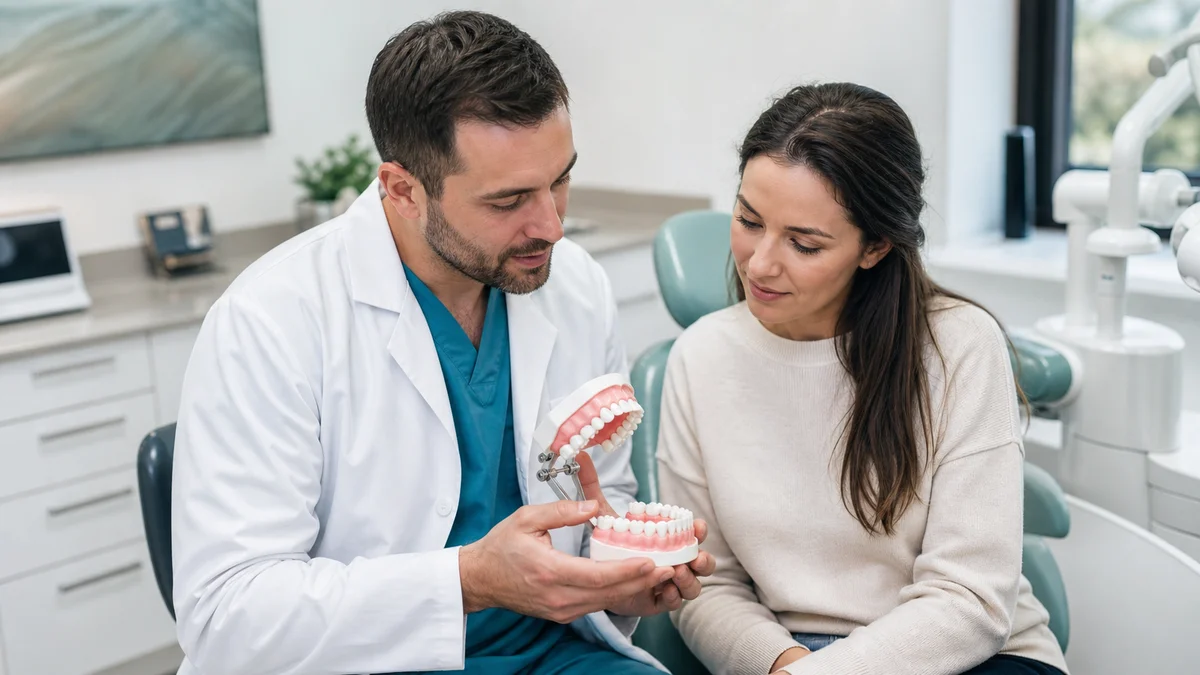
What is an arch in dentistry? A dental arch is the curved arrangement of teeth and supporting ridge in one jaw. The upper, or maxillary, arch sits in the upper jaw; the lower, or mandibular, arch sits in the lower jaw. Dentists use “arch” to describe anatomy, records, dentures, orthodontics, implants, and treatment scope.
If you are asking what is an arch in dentistry, picture the horseshoe-shaped row formed by the teeth in the upper jaw or the teeth in the lower jaw. The American Dental Association defines a dental arch as the curved composite structure of the natural dentition and the residual ridge that remains after some or all natural teeth are lost. This means the term can still apply when an arch has missing teeth or no natural teeth.
The question what is an arch in dentistry often appears when a treatment plan says “upper arch,” “lower arch,” “full arch,” “per arch,” or “both arches.” These phrases identify an anatomical region or treatment scope; they do not by themselves state a diagnosis, fixed tooth count, technique, or price. A patient should ask exactly which teeth and tissues are involved and why.
This guide explains dental terminology for patient education. It cannot determine whether your arch form, tooth position, bite, missing teeth, or supporting tissues are healthy. Individual assessment may include a dental and medical history, examination, periodontal evaluation, photographs, impressions or scans, and radiographs only when clinically justified.
1. What is an arch in dentistry: the official definition
The simplest answer to what is an arch in dentistry is “one curved dental row together with its supporting ridge.” The U.S. National Library of Medicine’s MeSH vocabulary describes the superior dental arch as the one formed by the maxillary teeth and the inferior dental arch as the one formed by the mandibular teeth. “Superior” and “inferior” here mean upper and lower.
The ADA definition adds an important clinical detail: the arch includes the natural dentition and the residual ridge, or what remains of that supporting ridge after teeth have been lost. Therefore, a dentist may discuss an edentulous upper arch even when no upper teeth remain. A denture, implant plan, or scan can still be described by arch.
Why the arch is curved
When people ask what is an arch in dentistry, they may assume “arch” refers to a separate bone shaped like a bridge. The name instead reflects the curved path of the tooth row and supporting alveolar process. Arch shape and dimensions vary among people and across growth, tooth eruption, tooth movement, wear, tooth loss, and restorative treatment. Variation alone is not a diagnosis.
2. Upper arch versus lower arch
A complete response to what is an arch in dentistry distinguishes two dental arches. The upper arch is the maxillary arch, associated with the maxilla. The lower arch is the mandibular arch, associated with the mandible. The maxilla is relatively fixed within the facial skeleton, while the mandible moves at the temporomandibular joints during opening, closing, chewing, speech, and other functions.
When answering what is an arch in dentistry, the relationship between the upper and lower arches also matters: when teeth come together, it contributes to occlusion, commonly called the bite. Dentists assess how teeth contact and guide movement, not only whether each arch appears straight by itself. An arch can look visually regular while still having functional contact issues, and an irregular-looking arch may not always require treatment.
- Maxillary arch: the curved tooth row and supporting ridge in the upper jaw.
- Mandibular arch: the curved tooth row and supporting ridge in the lower jaw.
- Both arches: a scope that involves upper and lower regions, but not necessarily every tooth.
- Arch relationship: how upper and lower teeth align and contact.
- Residual ridge: the ridge remaining after natural teeth are lost.
3. Is a dental arch the same as a jaw?
The answer to what is an arch in dentistry is not identical to the answer to “what is a jaw?” A jaw is a bony anatomical structure: the maxilla above and the mandible below. A dental arch refers more specifically to the curved dentition and supporting ridge. In everyday clinic conversation, people sometimes use “upper jaw” and “upper arch” loosely, but treatment documents may require more precision.
For example, a jaw procedure can involve bone beyond the tooth-bearing arch. In the context of what is an arch in dentistry, a full-arch prosthesis replaces or restores a dental row but does not replace the whole jaw. Likewise, an implant placed in jawbone can support an individual crown, a short bridge, an overdenture, or a full-arch prosthesis. “Implant in the jaw” does not automatically mean “full-arch implants.”
Dental arch versus alveolar ridge
Another useful distinction when researching what is an arch in dentistry is between the arch and the alveolar ridge. The alveolar process is the tooth-supporting part of the jaw. After teeth are lost, the remaining contour is often called a residual ridge. The broader dental arch concept can include that ridge, but clinicians may name the ridge specifically when evaluating denture support, bone shape, healing, or implant planning.
4. How many teeth are in one dental arch?
The phrase what is an arch in dentistry does not carry one guaranteed tooth count. A typical complete primary dentition has 20 teeth divided between the two arches, commonly 10 upper and 10 lower. A typical complete permanent dentition has 32 teeth divided between the arches, commonly 16 upper and 16 lower when all third molars are present. Real patients may have fewer because of development, previous extraction, trauma, disease, or absent wisdom teeth; some may have additional teeth.
Tooth count also changes during mixed dentition, when primary teeth are being replaced by permanent teeth. A person asking what is an arch in dentistry can have a recognizable dental arch despite spaces, unerupted teeth, implants, bridges, or dentures. Therefore, “one arch” should not be translated automatically into “16 treated teeth.” The treatment plan must name the actual teeth or edentulous region.
Tooth groups within each permanent arch
In a complete permanent quadrant beginning at the midline, there are typically two incisors, one canine, two premolars, and three molars including the third molar. Because each arch has right and left halves, these groups repeat across the midline. This pattern helps answer what is an arch in dentistry, but individual anatomy and eruption vary.
- Incisors help cut food and contribute strongly to smile appearance and speech.
- Canines sit near the transition between front and back segments and help guide function.
- Premolars assist with tearing and grinding and connect anterior and posterior segments.
- Molars provide broad chewing surfaces and important posterior support.
- Third molars, or wisdom teeth, may be present, absent, unerupted, partially erupted, or previously removed.
5. Arch, quadrant, sextant, and full mouth are different
A patient learning what is an arch in dentistry may also see “quadrant” and “sextant.” The ADA defines a quadrant as one of four sections of the dental arches, extending from the midline toward the last tooth. In practical terms, the mouth can be described as upper right, upper left, lower left, and lower right quadrants. A quadrant is therefore smaller than an arch.
A sextant is one of six sections used in some examinations and periodontal charting. In a what is an arch in dentistry discussion, “full mouth” usually refers to both arches or the oral cavity as a whole, although a specific procedure may define the scope more narrowly. Because coding and benefit language can be technical, ask the provider to point out the area on a diagram or list tooth numbers.
Why the midline matters
When explaining what is an arch in dentistry, dentists often use the midline as a reference. The midline separates the right and left halves of an arch. Tooth surfaces closer to the midline are described as mesial; surfaces farther from it are distal. The dental midlines may not coincide perfectly with each other or with the facial midline, and a difference does not alone prove a problem.
6. How dentists record an arch
Understanding what is an arch in dentistry also means understanding how it is documented. A dentist may record missing and present teeth, restorations, decay, wear, mobility, gum measurements, bite contacts, spacing, crowding, and arch form. Clinical photographs, impressions, or digital scans can capture surface anatomy and tooth relationships. Radiographs show information that surface records cannot, but they should be selected according to clinical need.
For someone researching what is an arch in dentistry, an intraoral scan can create a digital surface model of one or both arches and the way they meet. It does not by itself show every crack, cavity, bone level, root condition, nerve, infection, or soft-tissue diagnosis. Similarly, a panoramic image provides a broad radiographic view but is not the same as a three-dimensional surface scan. Each record answers different questions.
Common measurements and observations
A clinician considering what is an arch in dentistry may evaluate arch width, length, symmetry, tooth size, available space, curve, midline, overjet, overbite, crossbite, open bite, crowding, spacing, and the relationship between upper and lower teeth. These observations must be interpreted with age, growth, periodontal health, function, habits, and patient concerns. A single measurement rarely determines treatment on its own.
7. Decision table: what “arch” means in common dental contexts
The phrase what is an arch in dentistry can mean slightly different practical scopes depending on the service. The anatomy stays the same, but the clinical question changes.
| Context | What “arch” usually identifies | What it does not guarantee | Useful patient question |
|---|---|---|---|
| Routine examination | Upper or lower tooth row and supporting tissues | That every tooth in the arch has the same condition | Which specific teeth or tissues need attention? |
| Orthodontics | Tooth arrangement, available space, form, and upper-lower relationship | That one arch can be changed independently without bite effects | How will changing this arch affect the opposing arch and retention? |
| Complete denture | An edentulous upper or lower ridge and its replacement dentition | Specific retention, comfort, chewing ability, or adaptation | What supports and stabilizes the denture in this arch? |
| Full-arch implant prosthesis | A prosthesis replacing a broad upper or lower dental row | A fixed implant number, material, immediate loading, or eligibility | Which teeth are replaced, how is hygiene managed, and who provides maintenance? |
| Whitening tray or retainer | An appliance made for one upper or lower tooth row | That all teeth are covered, moving, or expected to change color | Which teeth are included and how should the appliance fit? |
| Insurance or estimate “per arch” | A billing or service unit for upper or lower treatment | A universal technique, tooth count, coverage, or final price | What exact procedure, components, exclusions, and tooth areas are included? |
8. What does “full-arch” treatment mean?
One reason people search what is an arch in dentistry is that they have seen “full-arch” dentures, bridges, or implants. Full-arch generally means that the planned prosthesis or treatment addresses a broad upper or lower dental row. It does not name one device, one surgical method, one material, one implant count, or one loading schedule.
A complete removable denture, implant-retained overdenture, and fixed implant-supported prosthesis can all involve an entire arch but differ substantially in examination, surgery, support, removability, hygiene, repair, sensation, maintenance, risk, and cost. This is why what is an arch in dentistry must be answered before comparing full-arch offers. Natural teeth may be retained in some designs and absent in others. The words “full-arch” should lead to more questions, not fewer.
Does full-arch mean all teeth must be removed?
No. The question what is an arch in dentistry should not be interpreted as an extraction recommendation. Whether any tooth can be maintained depends on its condition, periodontal support, restorability, position, function, symptoms, and the overall plan. Removing teeth is irreversible. An independent second opinion is reasonable before extensive extractions, especially when symptoms are limited or alternative staged treatment may exist.
9. What does “per arch” mean on an estimate?
In a fee estimate, what is an arch in dentistry may become a billing question. “Per arch” usually means the listed service and fee apply separately to the upper or lower region. If both arches are treated, the amount may be applied twice, but patients should not assume simple multiplication. Records, anesthesia, laboratory work, surgery, temporaries, maintenance, and follow-up may be combined, separate, conditional, or excluded.
After asking what is an arch in dentistry, request an itemized written estimate identifying the procedure, arch, exact teeth or edentulous area, professional and facility components, laboratory or material charges, review visits, maintenance, and circumstances that could change the plan. Insurance coverage should be verified with the insurer because “per arch” wording does not guarantee a benefit or fixed out-of-pocket amount.
- Is the fee for the maxillary arch, mandibular arch, or either one?
- Does it include examination, records, imaging, temporaries, laboratory work, and reviews?
- Which teeth are retained, treated, or replaced?
- Are surgical, sedation, facility, medication, and maintenance fees separate?
- What happens if findings require a different scope or staged approach?
10. How orthodontics uses arch terminology
For orthodontic patients, what is an arch in dentistry includes alignment and the relationship between arches. Braces or aligners may be placed on one or both arches, but changing one tooth row can affect how it meets the other. A plan should account for bite goals, periodontal health, growth where relevant, tooth movement limits, attachments or auxiliaries, and retention.
“Single-arch orthodontics” is not automatically simpler or appropriate. A clear what is an arch in dentistry explanation should show that treating only upper teeth for appearance, for example, could change contacts with the lower teeth. That does not mean single-arch treatment is never used; it means the dentist or orthodontist should explain why it is suitable, what will and will not change, and the possibility of future treatment.
Arch expansion is not one universal procedure
Another phrase linked to what is an arch in dentistry is “arch expansion.” It can refer to different dental or skeletal changes achieved with different appliances and at different ages. The mechanism, amount, stability, periodontal effects, and limits depend on anatomy and growth. Marketing claims about “making room” or changing the face should not replace an individual diagnosis and risk discussion.
11. How tooth loss changes an arch
A useful answer to what is an arch in dentistry continues after tooth loss. The space, neighboring teeth, opposing teeth, gum tissues, and residual ridge can change over time. Teeth may drift or tip, an opposing tooth may move into an empty space, and the ridge can remodel. The pattern and clinical significance vary; not every gap produces the same consequence.
In the context of what is an arch in dentistry, replacement options may include no immediate replacement with monitoring, a removable partial denture, bridge, implant-supported crown, overdenture, or broader prosthesis depending on the case. A dentist should discuss benefits, limitations, tissue support, cleaning, maintenance, and consequences of waiting. A missing tooth in one arch also affects how the opposing arch functions.
12. When arch questions need a clinical examination
Reading what is an arch in dentistry can clarify vocabulary, but it cannot diagnose crowding, crossbite, gum disease, bone loss, impacted teeth, temporomandibular disorders, or suitability for a full-arch prosthesis. Arrange a dental assessment if you have pain, swelling, bleeding gums, loose teeth, a changed bite, difficulty chewing, a broken appliance, or concerns about tooth movement.
Seek urgent local dental or medical help for significant facial swelling, trauma, uncontrolled bleeding, fever with worsening oral symptoms, or difficulty breathing or swallowing. Do not delay urgent care while comparing elective full-arch offers or waiting for travel. Online records and photographs cannot safely assess every emergency.
Patient checklist after asking what is an arch in dentistry
Once you understand what is an arch in dentistry, translate the treatment language into a concrete plan. Ask the dentist to identify upper, lower, or both arches; show the exact teeth or missing-tooth region; explain the diagnosis; and distinguish arch-wide steps from tooth-specific treatment. Request reasonable alternatives and the consequence of waiting.
For extensive, irreversible, or high-cost care, verify the treating clinician’s license, ask who performs each stage, and obtain an itemized written estimate. Confirm records, materials, temporary care, hygiene access, repairs, emergencies, and long-term maintenance. A second opinion can be valuable before full-arch extraction or reconstruction.
Redent Klinik provides this explanation for general education and does not use what is an arch in dentistry as a diagnosis. Patients independently exploring treatment in Türkiye can review the Redent Klinik English information page and use the Redent Klinik contact page to ask which arch, teeth, records, stages, and aftercare a proposed plan involves. A remote discussion may support preparation but cannot replace an examination when one is clinically required.
Frequently asked questions: what is an arch in dentistry?
How many dental arches does a person have?
A person has two dental arches: the upper maxillary arch and lower mandibular arch. Each is a curved tooth row with supporting tissues. The term remains useful when teeth are missing or an arch is edentulous because the residual ridge and planned prosthetic space still form an upper or lower arch.
Is one arch always 16 teeth?
No. A typical complete permanent arch may contain 16 teeth when all third molars are present, but individual counts vary with age, development, absent or unerupted teeth, previous extraction, trauma, and treatment. Mixed and primary dentitions have different counts. A treatment plan must identify actual teeth rather than assume a number.
What is the difference between upper arch and upper jaw?
The upper jaw is the maxilla, a bone of the facial skeleton. The upper dental arch is the curved upper tooth row and supporting ridge. The terms may be used loosely in conversation, but surgery, implants, orthodontics, and prosthetic plans may require the distinction.
Is a quadrant the same as an arch?
No. An arch is the full upper or lower curved row. A quadrant is a right or left portion extending from the midline toward the back of an arch. The mouth is commonly described as four quadrants: upper right, upper left, lower left, and lower right.
What does a dentist mean by “both arches”?
“Both arches” means the plan involves upper and lower regions. It does not necessarily mean every tooth receives the same procedure. Ask which teeth, tissues, appliances, or prostheses are involved in each arch and how the upper-lower bite relationship will be managed.
What does full-arch dental implants mean?
The phrase usually describes an implant-supported prosthetic plan replacing a broad upper or lower dental row. It does not define one implant number, material, surgical technique, loading schedule, or eligibility. Examination, imaging when justified, bone and soft-tissue assessment, medical review, hygiene planning, and maintenance are necessary.
Does “per arch” include all appointments and materials?
Not necessarily. “Per arch” identifies a billing unit, not a universal package. Ask whether examination, records, surgery, anesthesia, facility use, temporaries, laboratory fabrication, final prosthesis, reviews, maintenance, repairs, and complication management are included or billed separately.
Can the shape of a dental arch change?
Yes. Growth, eruption, tooth movement, wear, periodontal changes, tooth loss, orthodontics, restorations, and prostheses can alter the apparent or measured arch. Change is not automatically harmful or beneficial. A clinician must interpret it with health, function, age, stability, and patient goals.
Can an online photo show whether my arch is healthy?
No. A photograph may show some tooth position and visible gum features, but it cannot assess every surface, periodontal pocket, bone level, root, crack, bite contact, or hidden lesion. Photos can support a preliminary conversation; diagnosis and treatment planning may require an in-person examination and appropriate records.
Sources and terminology reviewed
- American Dental Association — professional and patient oral-health resources.
- American Dental Association: Glossary of Dental Terms — definitions of dental arch, quadrant, sextant, dentition, and related clinical terminology.
- U.S. National Library of Medicine MeSH: Dental Arch — superior/maxillary and inferior/mandibular arch definition.
- NCBI Bookshelf: Anatomy, Head and Neck, Teeth — overview of tooth attachment, upper and lower jaws, and dentition.
- ADA MouthHealthy: Eruption Charts — primary and permanent tooth eruption resources.
- World Health Organization: Oral health fact sheet — global oral-health context and prevention.
Terminology and evidence last reviewed: 31 July 2026. Clinical findings, treatment scope, coding, and benefit rules vary; confirm your individual plan with the treating dentist and relevant authority.