
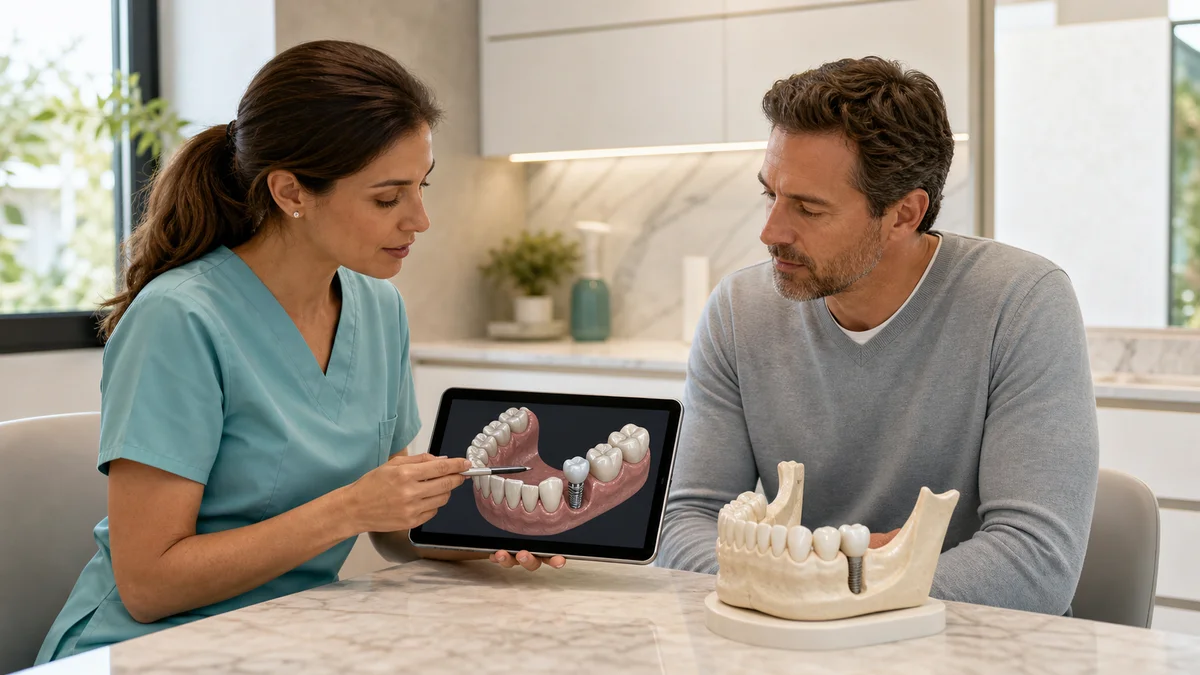
There is no single dependable national figure for what is the average cost of a molar implant. A complete estimate may combine examination and imaging, extraction, bone or gum preparation, implant surgery, abutment, custom crown, anesthesia, temporary replacement, and follow-up. Compare written totals for the same clinical scope; an implant-only advertisement is not a full molar-replacement price.
People searching what is the average cost of a molar implant usually want a useful budget, not a vague warning that “every case is different.” The honest answer starts by defining what is being purchased. In everyday language, “a dental implant” often means the finished replacement tooth. Clinically, however, the implant body is the part placed in bone; an abutment connects it to the visible crown. Imaging, surgery, laboratory work and maintenance may involve different clinicians and separate charges.
That distinction explains why two advertised figures can look far apart even when the final treatment plans are similar. One figure may cover only the implant fixture. Another may include the abutment and crown but exclude extraction, grafting, sedation or follow-up. In practical terms, what is the average cost of a molar implant means matching all of those parts. A reliable comparison therefore asks, “What is the total expected cost for my diagnosed site, and what is included?” This guide is educational and cannot determine whether an implant is appropriate for you. A dentist must assess the tooth, gums, bone, bite, health history and alternatives.
What Is the Average Cost of a Molar Implant in 2026?
No US government agency publishes a universal retail average that can be applied safely to an individual molar. Fees vary by location, clinician, facility, laboratory, implant system, restoration design and clinical complexity. Insurance contracts also use their own negotiated fees, annual limits, waiting periods and exclusions. This is why what is the average cost of a molar implant has no responsible one-line national answer. Quoting one number as though it covered every patient would conceal those differences and could create a false expectation.
The most useful “average” is therefore a patient-specific, all-in estimate for a defined scope. For a patient, what is the average cost of a molar implant becomes a question about that complete scope. It should state whether the figure includes diagnosis, extraction if needed, grafting if needed, implant placement, the connecting abutment, the definitive molar crown, temporary options and post-treatment checks. If a stage is not yet predictable, the estimate should identify the condition that could add it rather than quietly treating it as inevitable.
The US Food and Drug Administration describes a dental implant system as an implant body, an abutment and, in some systems, an abutment fixation screw; the artificial tooth is supported above those components. That official definition is a practical reason not to compare a “fixture-only” promotion with a complete tooth replacement. The answer to what is the average cost of a molar implant becomes meaningful only after every quote uses the same endpoints.
What a Complete Single-Molar Estimate May Include
A missing first or second molar is not restored by purchasing one screw. Treatment can span diagnostic, surgical and restorative phases. That broader pathway is central to what is the average cost of a molar implant. Some patients need only the core stages; others need preparatory care because of infection, bone loss, gum conditions or anatomy near the sinus or a nerve. None of those additions should be assumed before examination.
| Cost component | Why it may be needed | Question for an itemized estimate |
|---|---|---|
| Consultation and diagnosis | Confirms whether the tooth can be saved and whether an implant, bridge or another option is reasonable. | Are the clinical examination and written treatment plan included? |
| Imaging | Shows available bone and important anatomy; the type of imaging should be justified for the case. | Which images are required, and can recent diagnostic images be reviewed? |
| Extraction and site care | Applies only if a failing molar remains and removal is part of the plan. | Does the estimate include extraction, socket care and any pathology-related work? |
| Bone or soft-tissue procedure | May be recommended when the site lacks suitable volume, contour or tissue conditions. | Is augmentation confirmed, optional or only a contingency after examination? |
| Implant surgery | Places the implant body and may include a healing component. | Are the implant, surgical supplies, local anesthesia and routine checks included? |
| Abutment and definitive crown | Creates the connection and chewing surface that complete a single-tooth replacement. | Are the abutment, crown material, laboratory work and delivery visits included? |
| Temporary replacement | May support appearance or function during healing, depending on site and loading conditions. | Is a temporary tooth planned, and is it included or separately charged? |
| Maintenance and complications | Implants require cleaning and professional monitoring; unexpected treatment is not always part of the original fee. | Which follow-ups are included, for how long, and what is excluded? |
Ask for the implant manufacturer and model for your records. The FDA specifically recommends that patients keep this information. Documentation also makes what is the average cost of a molar implant easier to interpret because the quoted system is identifiable. A recognizable system is not a promise of success, but documentation can help if a component later needs identification, servicing or replacement. The same logic applies to the crown material, abutment type and laboratory prescription.
Why a Molar Site Can Change the Total
Molars handle substantial chewing loads and sit near anatomy that may affect planning. The upper posterior jaw can be close to the maxillary sinus. The lower posterior jaw can be close to the nerve canal. These site differences help explain why what is the average cost of a molar implant cannot be calculated from tooth position alone. The remaining bone height, width and density are individual findings; they cannot be inferred from an online photo or price calculator. Imaging is used when clinically indicated to understand those relationships.
A molar crown also needs an appropriate contact with neighboring teeth and a bite design that can be cleaned and withstand function. Crown design therefore belongs in any answer to what is the average cost of a molar implant. The position is less visible than a front tooth, but aesthetics still matter when smiling or opening widely. Bruxism, a strong bite, limited space, tilted neighboring teeth or an opposing tooth that has moved may influence the restoration and protective recommendations.
Common variables that can change the treatment scope—and therefore change the answer to what is the average cost of a molar implant—include:
- whether the molar is already missing or still needs extraction;
- whether infection or periodontal disease needs control first;
- available bone and soft-tissue conditions at the site;
- upper-jaw sinus anatomy or lower-jaw nerve position;
- whether the implant and crown can be delivered in one sequence or require staged healing;
- the abutment, crown material and laboratory design;
- local anesthesia, sedation or facility needs based on the agreed plan;
- the number of clinicians, laboratories or facilities involved;
- insurance network rules and the timing of benefits; and
- follow-up, hygiene and any protective night guard recommended for a diagnosed risk.
More treatment is not automatically better. A graft, sedation service, surgical guide or custom component should have a clinical reason and an explained alternative. Conversely, the lowest estimate is not automatically efficient if it omits a necessary stage. A safe discussion of what is the average cost of a molar implant tests both over-treatment and missing treatment. The goal is a proportionate plan whose scope, risks and financial assumptions are understandable before consent.
Diagnosis Comes Before the Price Comparison
A painful or badly damaged molar is not automatically an extraction-and-implant case. Before asking what is the average cost of a molar implant, establish whether an implant is actually indicated. Depending on the diagnosis, alternatives may include repair, a crown, root canal treatment with restoration, periodontal treatment, a tooth-supported bridge, a removable partial denture or monitored space. Each has different biological trade-offs, maintenance needs and costs. Saving a restorable natural tooth may be appropriate; removing a tooth that cannot be predictably restored may also be appropriate. Only an examination can separate those situations.
A pre-implant assessment supplies the clinical facts needed to answer what is the average cost of a molar implant and commonly reviews:
- the reason the tooth is missing or failing;
- gum health, plaque control and history of periodontal disease;
- bone and soft-tissue anatomy;
- neighboring and opposing teeth;
- bite forces, clenching or grinding;
- medications, allergies and relevant medical conditions;
- tobacco or nicotine exposure and healing considerations;
- the patient’s functional priorities, schedule and budget; and
- the ability to clean and attend long-term reviews.
The FDA advises patients to discuss general health, healing, benefits and risks with the dental provider. Health-related preparation can affect what is the average cost of a molar implant without making every medical condition an automatic extra charge. The FDA notes that smoking may impair healing and that uncontrolled diabetes can be associated with a higher risk of certain complications. These are not automatic disqualifiers in every situation, and this guide does not diagnose candidacy. They are reasons for individual risk assessment and, where appropriate, coordination with a medical professional.
How the Treatment Timeline Affects Cash Flow
Implant care often occurs in stages rather than in one appointment. The schedule is part of what is the average cost of a molar implant because different stages may be billed at different times. An extraction might be performed before or at implant placement. Healing may take months, and the visible crown may be delivered later. The ADA’s patient information explains that bone healing around the implant—osseointegration—takes time, although selected patients may follow different protocols. A temporary replacement may or may not be advisable during that interval.
For budgeting, ask when each payment is due and what clinical milestone it covers. A cash-flow view of what is the average cost of a molar implant should still show the complete expected total. A treatment plan can separate diagnostic, surgical and restorative fees without being misleading, provided it also shows that total. Staging can make cash flow easier, but it should not hide the remaining commitment. Ask whether the laboratory fee is due when the crown is ordered, whether follow-up visits are bundled and how a changed clinical finding would be authorized.
Immediate placement or immediate loading can sound faster, but neither is suitable for everyone. A same-day advertisement does not by itself answer what is the average cost of a molar implant. Stability, infection status, bone conditions, bite and restoration design matter. A faster timeline is not a result guarantee, and a longer timeline is not proof of poor care. The appropriate sequence is a clinical decision made after assessment.
Implant, Bridge or Removable Option: Compare Like With Like
A single-tooth implant can replace a molar without preparing neighboring teeth for bridge retainers. Still, what is the average cost of a molar implant should be considered alongside the costs and trade-offs of reasonable alternatives. A conventional bridge may avoid implant surgery but usually relies on adjacent teeth. A removable partial denture can replace one or more teeth and is taken out for cleaning. Leaving a space may be considered in selected situations, but possible effects on chewing, tooth movement and the opposing tooth require discussion.
The American Academy of Periodontology describes a single-tooth implant as replacing the missing tooth and root while avoiding the need to grind neighboring teeth for a tooth-supported bridge. That context improves the usefulness of what is the average cost of a molar implant. It is a potential advantage, not a command to choose an implant. If neighboring teeth already need crowns, if surgery is unsuitable, or if time and finances favor another route, the balance may change.
To place what is the average cost of a molar implant in a fair decision framework, compare options across the same criteria:
- which natural tooth tissue is altered;
- whether surgery is involved;
- expected treatment stages and temporary needs;
- cleaning access and manual dexterity;
- repair paths if a component chips, loosens or fails;
- effects on neighboring teeth and supporting tissues;
- insurance coverage and personal payment; and
- the patient’s informed preferences after risks and alternatives are explained.
A lifetime-cost answer to what is the average cost of a molar implant cannot be converted into a promise that one option will last a specific number of years. Natural teeth, bridges and implants can all need maintenance or further treatment. Individual disease risk, hygiene, bite, materials and attendance influence what happens over time.
Dental Insurance, Medicare and Marketplace Plans in 2026
Coverage is contract-specific, so insurance changes the personal answer to what is the average cost of a molar implant. A plan may cover some diagnostic or surgical codes, exclude implants, apply a waiting period, use an annual maximum, require preauthorization, restrict the network or classify the crown separately. “Implant coverage” does not necessarily mean the whole finished molar is paid. Before treatment, request a written benefit estimate and ask the insurer how the implant body, abutment, crown, grafting and imaging are treated.
For 2026, the official Medicare coverage page states that Original Medicare does not cover routine dental services or items such as dentures and implants in most cases. For a Medicare beneficiary asking what is the average cost of a molar implant, that general exclusion is an important starting point. Limited dental services may be covered when they are directly connected to the success of certain Medicare-covered medical treatments or when specific inpatient conditions apply. Some Medicare Advantage plans may offer dental benefits, but the details must be checked with the plan.
HealthCare.gov states that adult dental coverage is not an essential health benefit. Marketplace dental coverage may be embedded in a health plan or offered through a separate dental plan, and adult plans can have waiting periods. Therefore, what is the average cost of a molar implant cannot be reduced to a standard Marketplace benefit. Buying a plan after a molar problem appears does not guarantee immediate implant coverage. Read the evidence-of-coverage document and confirm the effective date, missing-tooth provisions, waiting period, network, annual limit and preauthorization rules directly with the insurer.
When insurance affects what is the average cost of a molar implant, useful questions for the plan include:
- Is a single-tooth implant a covered benefit for my diagnosis?
- Are the implant body, abutment and crown separate benefit categories?
- Do extraction, grafting or imaging require prior authorization?
- Is there a waiting period or missing-tooth clause?
- What is my remaining annual maximum and deductible?
- Does an out-of-network dentist change reimbursement?
- Will benefits reset between surgical and restorative stages?
- Can I receive a written pre-treatment estimate without treating it as a guarantee?
Insurance estimates are not clinical approval and are not always payment guarantees. The personal answer to what is the average cost of a molar implant may change when a claim is processed. A dentist decides what is clinically recommended; an insurer decides what the contract pays. Keep those two decisions separate.
How to Get an Itemized Good Faith Estimate
If you are uninsured or plan to self-pay in the United States, CMS explains that a health care provider generally must provide a Good Faith Estimate when you request one or schedule care at least three business days in advance. This is a practical tool for answering what is the average cost of a molar implant for a defined self-pay plan. The estimate should be itemized. It may cover only one provider or facility, so a surgical clinician, restorative dentist, laboratory-related provider or facility may require separate information.
Ask the practice to label confirmed services, possible contingencies and excluded items. A useful estimate for what is the average cost of a molar implant should distinguish the expected treatment from “only if needed” services. It should also state how long the estimate is valid, the payment schedule and the process for approving a material change.
CMS also provides a patient-provider dispute process for certain uninsured or self-pay bills that substantially exceed a qualifying Good Faith Estimate. That protection is relevant when the expected answer to what is the average cost of a molar implant differs materially from a later eligible bill. Eligibility and deadlines matter, so consult the current CMS page rather than relying on a blog summary. State consumer protections or professional requirements may add other rights.
How to Compare Two Molar Implant Quotes Safely
Put both estimates into the same checklist before looking at the total. This is the only fair way to compare answers to what is the average cost of a molar implant. If one quote includes a definitive crown and the other stops after surgery, they are not competing prices for the same outcome. If one assumes grafting and the other has not reviewed imaging, ask both clinicians to explain the difference rather than automatically choosing either.
- Confirm the diagnosis. Do both plans agree that the tooth cannot or should not be restored, and have alternatives been explained?
- Define the endpoint. Does “complete” mean a functioning definitive molar crown, or only an implant in bone?
- Match every stage. Compare extraction, grafting, implant, abutment, crown, temporary care, imaging, anesthesia and reviews.
- Separate expected from contingent. A possible additional procedure should not be presented as certain without evidence.
- Identify every provider. Ask who performs surgery, who restores the implant, who manages complications and who holds the records.
- Review materials and documentation. Record the implant system, crown design and warranty terms without treating a brand as a guarantee.
- Check insurance yourself. Verify network status and coverage with the plan, not only with a marketing coordinator.
- Read financing terms. Compare annual percentage rate, deferred interest, fees, late-payment consequences and total repayment.
The Consumer Financial Protection Bureau warns that medical credit cards and financing plans can add significant interest or fees, especially when deferred-interest terms are misunderstood. Financing can therefore change the final answer to what is the average cost of a molar implant. A monthly payment is not the same as a low total cost. Ask whether the clinic offers a direct payment schedule, then compare that with independent financing and your ability to repay.
Safety, Consent and Red Flags Behind a Low Price
Dental implants can restore chewing and help support surrounding structures, but complications are possible. A complete answer to what is the average cost of a molar implant should never omit risk management. The FDA lists risks including injury to nearby tissues or teeth, infection, implant or component failure, bite problems, difficulty cleaning and nerve-related symptoms. The AAP explains that plaque-associated inflammation can affect tissues around implants and that periodontal history, poor plaque control, smoking and diabetes are relevant risk factors.
Seek prompt professional advice if an implant becomes painful, loose, swollen, drains, bleeds persistently or feels different in the bite. Follow-up access is part of evaluating what is the average cost of a molar implant. Those signs do not establish a diagnosis, but they should not be managed with household glue or delayed because follow-up is inconvenient.
When a promotion claims to settle what is the average cost of a molar implant before assessment, pause before accepting the plan if you encounter:
- a guaranteed result or guaranteed lifetime without clear limitations;
- a price that cannot be connected to a written clinical scope;
- pressure to pay before diagnosis, alternatives and material risks are discussed;
- no explanation of who will provide the crown after implant surgery;
- automatic grafting or sedation with no case-specific rationale;
- refusal to identify the implant system or provide records;
- a treatment timeline that ignores healing or contingency planning;
- no reachable clinician for postoperative concerns; or
- financing promoted through a monthly payment while interest and total repayment remain unclear.
Informed consent should cover reasonable alternatives, material risks, expected stages, uncertainties, responsibilities and costs. Consent gives clinical meaning to what is the average cost of a molar implant. It is not a formality or a sales signature. A second opinion can be valuable when the diagnosis, graft recommendation or financial scope differs substantially.
Maintenance Is Part of the Long-Term Cost
An implant crown cannot develop tooth decay, but the tissues around an implant can become inflamed or lose support, and mechanical parts can loosen, wear or fracture. Maintenance belongs in a long-term answer to what is the average cost of a molar implant. Neighboring natural teeth remain vulnerable to decay and gum disease. Long-term planning therefore includes daily plaque control, individualized interdental cleaning, professional reviews and management of diagnosed bite risks.
The FDA recommends following hygiene instructions and attending regular dental visits. Those recurring needs matter when considering what is the average cost of a molar implant. The AAP likewise advises brushing, interdental cleaning and periodic professional monitoring. No maintenance schedule fits everyone; recall intervals should reflect disease risk, implant condition, dexterity and the rest of the mouth.
Ask whether routine postoperative checks are included in the initial fee and when ordinary maintenance begins. That distinction refines what is the average cost of a molar implant beyond the day of crown delivery. Also ask how the practice handles a chipped crown, loosened screw or lost access filling. A repairable complication is different from loss of the implant body, and the possible pathways should be explained without promising that repair will always be possible.
Patients considering coordinated care abroad can review options through Redent Klinik’s English patient information and use the Redent Klinik contact page to request an individualized assessment. For cross-border care, what is the average cost of a molar implant must include travel-related responsibilities as well as treatment. Travel does not replace diagnosis. A written plan should identify the treating clinicians, number and timing of visits, temporary restoration, records, emergency contact, travel-related contingencies and who will provide maintenance after returning home.
Frequently Asked Questions About Molar Implant Cost
Does the quoted implant price normally include the crown?
Not necessarily. “Implant” may mean only the fixture placed in bone, while the abutment and visible molar crown are billed later. That is the most common scope problem in answering what is the average cost of a molar implant. Ask for a written endpoint and an itemized total. A useful estimate names each component, provider and excluded service.
Why can an upper molar implant cost differ from a lower molar?
The anatomy is different. An upper posterior site may be near the sinus, while a lower posterior site may be near a nerve canal. This is why what is the average cost of a molar implant may have different site-specific answers. Bone dimensions, previous infection and restoration space vary by person. These findings can change imaging, surgical planning or whether augmentation is recommended; location alone does not prove an extra procedure is needed.
Is bone grafting always required for a molar implant?
No. Grafting depends on the available bone, defect shape, implant plan and timing. It may be unnecessary, recommended before placement, performed at placement or reconsidered after further assessment. Ask the clinician to show the finding that supports the recommendation and to explain alternatives.
Will dental insurance pay for a single molar implant?
Some plans may contribute to some stages, while others exclude implants or limit payment through waiting periods, networks, deductibles and annual maximums. Confirm the implant body, abutment and crown separately. A pre-treatment estimate is helpful but may not guarantee the final benefit.
Does Medicare cover a molar implant in 2026?
Original Medicare generally does not cover routine dental services or items such as implants. Narrow exceptions exist for dental care directly linked to certain covered medical services, and some Medicare Advantage plans add dental benefits. Check the current Medicare page and your specific plan before treatment.
Can the implant and crown be completed in one visit?
Selected cases may permit immediate placement or a temporary restoration, but a definitive same-day result is not suitable for every patient. Stability, bone, infection, bite and restoration design matter. The ADA notes that osseointegration takes time, and treatment sequences should be individualized.
What is the best way to answer what is the average cost of a molar implant for my case?
Obtain a diagnosis and request an itemized, all-in estimate that ends with a definitive functioning molar crown. Compare the same stages across quotes, mark contingent services, verify insurance directly and review financing terms. The personalized total is more decision-useful than an unsupported national average.
Is the lowest quote the best value?
Not automatically. A low total may reflect an efficient plan, but it may also omit the abutment, crown, imaging, temporary care or follow-up. Compare scope, clinician responsibility, documentation, maintenance access and risk management. A higher quote is not proof of better care either.
A Practical Next-Step Checklist
Before committing, make sure you can answer these questions in your own words:
- What is the diagnosis, and can the natural molar reasonably be restored?
- Which replacement alternatives were discussed?
- What does the written total include from assessment through definitive crown?
- Which services are confirmed, optional or contingent?
- Who performs each stage and manages urgent concerns?
- What implant system and restoration will be documented?
- What does insurance state in writing, and what remains my responsibility?
- What are the full financing terms, not just the monthly payment?
- What cleaning, monitoring and future repair pathways are expected?
- What symptoms should prompt an urgent call?
The safest answer to what is the average cost of a molar implant is not a headline number. It is a transparent, comparable treatment total tied to your diagnosis, a defined finished result and a realistic maintenance plan. This article is designed for review by Dentist Esma Çevrük Çakır and prioritizes evidence-based, patient-safe decision-making; it does not replace an examination, diagnosis or individualized consent discussion.
Official and Professional Sources
- US Food and Drug Administration — Dental Implants: What You Should Know
- American Dental Association — Official Website
- American Dental Association, MouthHealthy — Implants
- American Academy of Periodontology — Single-Tooth Dental Implants
- American Academy of Periodontology — Peri-Implant Diseases
- Medicare.gov — Dental Service Coverage
- HealthCare.gov — Dental Coverage in the Marketplace
- Centers for Medicare & Medicaid Services — Good Faith Estimates
- Consumer Financial Protection Bureau — Medical Credit Cards and Payment Plans
- World Health Organization — Oral Health Fact Sheet