
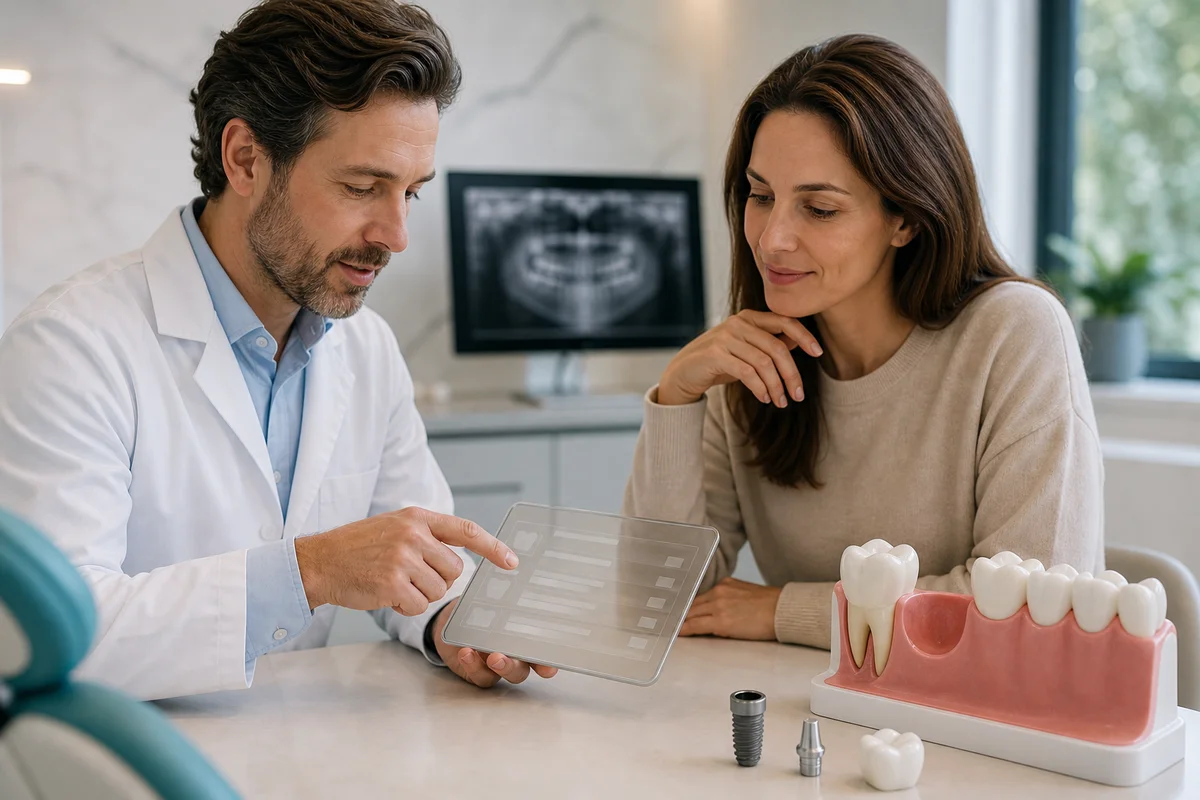
Quick answer: what is the average cost of dental implants per tooth has no reliable universal dollar answer because quotes may include different services. Compare the implant fixture, abutment, crown, imaging, surgery, temporary tooth, grafting if needed, follow-up, and maintenance. Ask for an itemized treatment plan, then apply your deductible, coinsurance, annual maximum, exclusions, and financing charges to estimate your own total.
People asking what is the average cost of dental implants per tooth usually want a practical number for budgeting. The problem is that a “per-tooth implant price” can describe only the implant fixture, or it can describe a more complete single-tooth restoration that includes the fixture, abutment, and crown. It may or may not include the examination, scans, extraction, temporary tooth, bone graft, anesthesia, laboratory work, follow-up, and long-term maintenance. A national-looking average cannot correct for those differences.
This guide answers the question without presenting a fixed fee, a guaranteed package, or a diagnosis. It shows how to compare like with like, how clinical findings change the scope, and how insurance rules affect the amount a patient actually pays. A personalized figure requires an examination and an itemized plan. To learn how Redent Klinik approaches restorative planning, visit the English clinic overview; for an individual assessment, use the contact page.
1. what is the average cost of dental implants per tooth really measuring?
A dental implant is not the same thing as an entire replacement tooth. The U.S. Food and Drug Administration explains that an implant system includes an implant body placed in the jaw and an abutment that connects to the replacement tooth; a fixation screw may also be part of the system. For a single missing tooth, a custom crown usually completes the visible restoration. If a quote lists “implant” without identifying these parts, it is not yet possible to know what the total represents.
When someone asks what is the average cost of dental implants per tooth, three different calculations are often mixed together. The first is the fee for the surgical fixture only. The second is the fee for the fixture plus surgical placement. The third is the end-to-end cost of restoring one missing tooth, including the prosthetic phase. Advertised prices may use any of these definitions. A trustworthy comparison begins by defining the endpoint: a functioning final crown, not merely a device in the bone.
Location, practice overhead, clinician training, laboratory design, implant system, restorative material, and the number of visits can influence a quote. More importantly, patients do not arrive with identical bone, gum, bite, medical history, or neighboring teeth. A fee that is reasonable for a straightforward healed site may not describe a site with infection, bone loss, a difficult extraction, or an esthetic challenge. These are scope differences, not proof that one practice is automatically better or worse.
2. what is the average cost of dental implants per tooth when all components are included?
For a fair comparison, request a written breakdown from initial diagnosis through delivery of the final tooth. The plan should identify whether each component is included, excluded, optional, or dependent on findings. It should also state which dentist is responsible for the surgical phase and which dentist is responsible for the crown. If care is divided between practices, confirm how records, parts, and complications are coordinated.
A complete response to what is the average cost of dental implants per tooth should account for these categories:
- Comprehensive examination, periodontal assessment, and review of medical and dental history.
- Diagnostic imaging and, when clinically justified, three-dimensional planning.
- Removal of a non-restorable tooth, socket care, or treatment of active infection when required.
- Implant fixture, surgical placement, cover screw or healing component, and the implant system used.
- Local anesthesia and any separately planned sedation, facility, or monitoring service.
- Bone or soft-tissue grafting only when indicated after clinical assessment.
- Temporary tooth or removable interim appliance, including repairs or replacements.
- Implant-level impression or digital scan, custom or stock abutment, laboratory work, and final crown.
- Follow-up visits, postoperative imaging when justified, and management of routine healing.
- Long-term hygiene, examination, imaging, repair, and replacement of worn prosthetic components.
The word “all-inclusive” is not sufficiently precise. Ask whether it includes taxes, medications, a temporary restoration, graft material, membrane, custom abutment, crown material, and post-delivery adjustments. Also ask which events would trigger a revised estimate. An itemized plan does not guarantee that biology will follow the original timeline, but it makes the financial assumptions visible.
3. what is the average cost of dental implants per tooth after an examination?
The cost question is downstream from the treatment question. A clinician first needs to determine whether implant treatment is appropriate and whether another option could meet the patient’s goals. The examination usually considers gum health, decay, the condition of adjacent teeth, available bone, the bite, space for the replacement crown, smile line, hygiene, tobacco use, and relevant health conditions or medications. Imaging should be selected for the clinical need rather than sold as an automatic upgrade.
The FDA notes that overall health affects candidacy and healing, and that smoking may interfere with healing. The agency also advises patients to ask for the brand and model of the implant system and keep that information in their records. These points matter financially because delayed healing, additional visits, or a need to change the plan can affect both timing and expense. No online calculator can safely determine those variables for an individual.
Therefore, what is the average cost of dental implants per tooth is best treated as a pre-consultation budgeting question, not a treatment authorization. A preliminary estimate should be labeled as such. The final plan should follow a clinical assessment, explain reasonable alternatives, and identify any unresolved conditions. A quote issued from a photograph alone may overlook periodontal disease, root fragments, sinus anatomy, nerve position, or restorative space.
4. what is the average cost of dental implants per tooth versus the implant fixture?
One of the most common pricing errors is comparing a fixture-only advertisement with a fixture-abutment-crown treatment plan. The fixture is the portion placed in the bone. The abutment connects the implant to the prosthetic tooth. The crown is the part that restores shape, contact, appearance, and chewing surface. Each phase includes clinical and laboratory work, and each may be billed at a different time.
When reviewing what is the average cost of dental implants per tooth, ask the practice to write the implant system, fixture size decision process, abutment type, crown material, laboratory, and warranty or repair terms. A custom abutment may be recommended in some situations; a stock component may be suitable in others. The most expensive component is not automatically the best for every case, and material choice should not be made from price alone.
Ask whether the quote includes placing the crown and adjusting the bite after delivery. Clarify who pays if the crown needs laboratory modification before acceptance. Also distinguish a device manufacturer’s limited product warranty from the clinician’s responsibility for care. A warranty cannot promise osseointegration, prevent gum disease, or guarantee that a crown will never chip or loosen.
5. what is the average cost of dental implants per tooth with extraction or grafting?
Some missing-tooth sites are already healed and have adequate bone. Others require removal of a tooth, management of infection, ridge preservation, bone augmentation, sinus-related planning, or soft-tissue treatment. These are not universal add-ons. They should be recommended because of clinical findings and explained with alternatives, expected benefits, limitations, timing, and separate fees.
A response to what is the average cost of dental implants per tooth cannot responsibly assume that every patient needs a graft. Equally, it should not assume that no graft is needed. Request documentation of why augmentation is proposed and whether it can occur at the same appointment as implant placement or requires a staged approach. A staged plan may involve more visits, healing time, imaging, and temporary-tooth management.
Extraction complexity also varies. A simple removal is different from a fractured root, proximity to important anatomy, or a site with significant infection. If an advertisement includes “free extraction,” ask what types are included and who decides whether the case falls outside that category. Clinical necessity should drive the procedure; a promotional bundle should not encourage avoidable treatment.
6. what is the average cost of dental implants per tooth over the treatment timeline?
Implant care often occurs in phases. The ADA’s MouthHealthy resource describes placement of the implant, a period of bone healing called osseointegration, and placement of the artificial tooth. The FDA likewise states that healing may take several months or longer. Immediate placement or immediate provisionalization may be appropriate in selected cases, but “same day” marketing does not mean every patient receives a definitive tooth in one visit.
For what is the average cost of dental implants per tooth, request a payment calendar tied to clinical milestones. It might separate diagnostic records, surgery, grafting if needed, temporary restoration, impression or scan, abutment, and final crown. Ask what happens to deposits if the clinical plan changes before surgery, if the implant is not placed, or if the restorative phase is delayed.
Time has a cost even when it is not on the dental invoice. Patients may need leave from work, transportation, childcare, accommodation, or multiple trips. A temporary tooth may require adjustment or replacement during healing. Comparing two plans should include these foreseeable non-clinical expenses without claiming that every person will incur them.
7. what is the average cost of dental implants per tooth? A decision table
Use the table below to normalize quotes. It is not a fee schedule. Enter the written answer from each practice and calculate a total only after the scopes match.
| Decision area | What the written quote should state | Common comparison error | Why it matters |
|---|---|---|---|
| Diagnosis | Examination, gum assessment, imaging, and alternatives | Comparing a photo-based estimate with an examined plan | Determines whether treatment and added procedures are appropriate |
| Implant phase | Fixture, placement, healing components, implant system | Assuming “implant” means a complete tooth | Reveals the surgical scope |
| Restorative phase | Abutment, crown material, laboratory, placement, adjustments | Leaving the crown out of the advertised price | Defines the functional endpoint |
| Site preparation | Extraction or graft only if indicated, with separate conditions | Adding a universal graft fee without findings | Can change visits, healing, and total cost |
| Temporary tooth | Type, delivery, repairs, and replacement conditions | Assuming a same-day final crown | Affects appearance and function during healing |
| Insurance | Predetermination, allowed amount, deductible, coinsurance, maximum | Calling an estimate a guarantee of payment | Determines the patient’s likely net cost |
| Maintenance | Recall, hygiene, imaging, screw or crown repair terms | Stopping the budget at crown delivery | Implants require ongoing professional and home care |
After completing the table, ask each practice to identify the assumptions behind its answer to what is the average cost of dental implants per tooth. A lower quote may be complete and appropriate; a higher quote may include more services. Price alone cannot reveal which plan fits the diagnosis.
8. what is the average cost of dental implants per tooth after dental insurance?
Dental insurance is a contract, not a universal percentage. Plans can differ in whether implants are covered, whether a missing-tooth clause applies, whether a waiting period must be completed, whether preauthorization is required, and whether the surgeon, restorative dentist, laboratory, or facility is in network. Annual maximums, deductibles, coinsurance, frequency limits, alternative-benefit provisions, and replacement intervals can all change the payment.
HealthCare.gov states that adult dental coverage is not an essential health benefit and Marketplace medical plans do not have to offer it. Separate adult dental plans may have waiting periods. This means a medical-plan card does not prove implant coverage. Before relying on a benefit, obtain the plan document and ask the insurer to evaluate the itemized treatment codes.
To estimate what is the average cost of dental implants per tooth for your policy, request a written predetermination. Review the allowed amount rather than only the office’s submitted fee. Apply the remaining deductible, coinsurance, annual maximum, excluded services, and any network difference. A predetermination is usually an estimate, not a guarantee: eligibility, remaining benefits, clinical documentation, and plan status can change before the claim is processed.
9. what is the average cost of dental implants per tooth with Medicare?
Original Medicare generally does not cover routine dental care or items such as dentures and implants. Medicare.gov explains that limited dental services may be covered when they are closely related to certain covered medical services, such as specific organ transplant, heart valve, cancer-treatment, or dialysis circumstances. Those narrow medical exceptions should not be interpreted as routine implant coverage.
For a Medicare beneficiary asking what is the average cost of dental implants per tooth, the starting assumption should not be “Medicare pays.” Check the exact coverage pathway before care. A Medicare Advantage plan may offer additional dental benefits, but the benefit design, network, annual allowance, prior authorization, and implant exclusions vary by plan. Contact the plan directly and request written details.
Medigap generally supplements cost-sharing for Medicare-covered services rather than creating broad routine dental coverage. Other coverage, Medicaid rules, retiree benefits, Veterans Affairs eligibility, or employer plans may affect an individual case. Do not submit inaccurate medical coding to make a non-covered dental service appear covered; the clinical record and claim must truthfully describe the service.
10. what is the average cost of dental implants per tooth with financing?
Financing changes cash flow, not the clinical fee. A monthly payment advertisement may omit the annual percentage rate, term, deferred-interest condition, origination fee, late fee, or down payment. A low monthly payment can produce a higher total if the term is long or promotional interest expires. Request the total of payments and compare it with the cash or phased-payment option.
When calculating what is the average cost of dental implants per tooth, keep four figures separate: the office’s total treatment fee, the insurer’s estimated payment, the amount financed, and the total financing cost. Do not count an uncertain insurance payment as cash until the claim is adjudicated. Ask whether a refund would go to you or to the lender if a planned service is not performed.
Health savings accounts and flexible spending arrangements have their own eligibility and documentation rules. IRS Publication 502 describes qualifying medical and dental expenses in tax terms, but tax treatment depends on the expense, the account, and the taxpayer’s circumstances. A dental office should not promise a deduction. Keep itemized invoices and consult the plan administrator or a qualified tax professional.
11. what is the average cost of dental implants per tooth abroad?
International quotes may appear lower because of local wages, overhead, exchange rates, or other market factors. A safe comparison still requires the same clinical scope. Add travel, lodging, time away from work, extra visits, local emergency care, record translation, payment fees, exchange-rate movement, and the possibility that a crown or component needs adjustment after returning home.
For what is the average cost of dental implants per tooth abroad, verify the clinic’s legal authorization, the treating dentist’s credentials, the implant system, product traceability, informed-consent language, complaint route, data handling, and professional liability arrangements. Ask who will provide maintenance at home. A local dentist is not automatically responsible for treatment begun elsewhere and may charge for assessment or repair.
Do not choose a flight schedule that leaves no room for examination, informed consent, or plan changes. A remote estimate should remain conditional until a face-to-face assessment. “Guaranteed success,” “no risk,” universal candidacy, or pressure to pay immediately are warning signs. A travel package cannot remove the biological uncertainties of surgery and healing.
12. what is the average cost of dental implants per tooth over its lifetime?
The final crown is not the end of care. The FDA recommends careful hygiene and regular dental visits, and advises patients to contact a provider if an implant feels loose or painful. Professional maintenance may include examination of gum tissues, cleaning with appropriate instruments, monitoring the bite, and imaging when clinically indicated. Home care must be adapted to the implant and neighboring teeth.
A lifetime answer to what is the average cost of dental implants per tooth should reserve funds for maintenance and possible repair. A crown can chip or wear, an abutment screw can loosen, or soft-tissue conditions can change. These events do not happen to every patient, and their timing cannot be predicted from a national average. Ask the clinic which component is covered by any limited warranty, what is excluded, and how maintenance affects the terms.
Implant complications can occur early or later. The FDA lists risks including injury to surrounding structures, infection, altered bite, component loosening, implant-body failure, hygiene difficulty, and nerve-related symptoms. This does not mean implants are inappropriate; it means consent and budgeting should include the possibility of additional care. No fee can purchase a biological guarantee.
Red flags when comparing a per-tooth implant quote
Marketing can simplify a complex treatment until the number no longer describes the care. Pause and seek clarification if a quote is paired with any of the following:
- A final diagnosis, fixed package, or success guarantee based only on a photograph or message.
- An “implant” price that does not say whether the abutment and final crown are included.
- Routine grafting or extractions presented as mandatory before an examination.
- No written name, brand, model, or traceability information for the implant system.
- Pressure to pay a non-refundable deposit before the clinical scope and refund policy are clear.
- A claim that every insurer, Medicare, or a health plan will cover the treatment.
- Before-and-after images presented as proof that your outcome will be identical.
- No plan for temporary teeth, complications, maintenance, or care after travel.
- An estimate that excludes the restorative dentist or laboratory without saying so.
- Financing promoted only as a monthly payment, without APR and total repayment.
These signs do not prove wrongdoing, but they show that the answer to what is the average cost of dental implants per tooth is incomplete. Ask for clarification and consider an independent second opinion when the diagnosis, alternatives, or scope is uncertain.
In other words, what is the average cost of dental implants per tooth becomes useful only after every quote reaches the same clinical endpoint: a planned, restored, maintainable tooth with exclusions stated in writing.
Questions to take to an implant consultation
A written checklist keeps the conversation focused on clinical value rather than a headline price. Ask:
- What findings make an implant appropriate for this specific site, and what alternatives are reasonable?
- Which records and imaging are necessary, and how will they change the plan?
- Does the quote include the fixture, placement, abutment, crown, laboratory, and adjustments?
- Could I need extraction, grafting, a membrane, or soft-tissue treatment, and why?
- What temporary tooth is planned during healing, and what are its limitations?
- Which implant brand and model will be used, and will I receive that information?
- Who manages the surgical phase, the crown, emergencies, and long-term maintenance?
- What events can change the estimate, timeline, or number of visits?
- What are the cancellation, refund, financing, and laboratory-remake terms?
- What insurance predetermination can be requested, and which amounts remain uncertain?
Use the same questions at every consultation. That method produces a more useful answer than asking only what is the average cost of dental implants per tooth, because it exposes the scope behind each total.
Once the scopes match, what is the average cost of dental implants per tooth can be answered from documented treatment plans rather than an advertisement that may omit a necessary phase.
what is the average cost of dental implants per tooth: FAQs
what is the average cost of dental implants per tooth if I already lost the tooth?
A healed site may avoid an extraction fee, but that does not show whether the bone and soft tissue are adequate. The examination may identify a need for site development, or it may confirm that no graft is indicated. Compare the implant, abutment, crown, imaging, temporary tooth, and follow-up rather than assuming a healed site has a standard price.
what is the average cost of dental implants per tooth if the crown is separate?
There is no responsible universal total because crown fees vary by material, laboratory, abutment design, location, and clinical complexity. Ask for two clearly labeled subtotals: the surgical implant phase and the restorative abutment-crown phase. Add diagnostic, temporary, and follow-up services only after confirming whether they are included.
what is the average cost of dental implants per tooth with a bone graft?
The answer depends on the type and extent of the defect, graft material, membrane, surgical approach, and whether grafting is done with implant placement or in a separate stage. A graft should not be assumed from an online question. Request the clinical reason, alternatives, timing, and itemized fee after examination.
what is the average cost of dental implants per tooth with insurance?
Your net amount depends on whether implants are covered, network status, allowed amounts, deductible, coinsurance, annual maximum, waiting period, missing-tooth rule, and excluded related services. Ask the practice to submit a predetermination, but treat it as an estimate rather than guaranteed payment. Verify current eligibility before each phase.
what is the average cost of dental implants per tooth with Medicare Advantage?
Medicare Advantage dental benefits vary by plan. Some may provide an allowance or limited implant-related coverage; others may exclude implants, restrict networks, require authorization, or apply an annual maximum. Review the current Evidence of Coverage and obtain a written response from the plan. Original Medicare generally does not cover routine implants.
what is the average cost of dental implants per tooth for several missing teeth?
Multiplying a single-tooth total by the number of missing teeth may be misleading. Several teeth can sometimes be restored with an implant-supported bridge using fewer implants, while other patterns require different designs. The condition of remaining teeth, bone, bite, hygiene access, and prosthetic plan determine the appropriate configuration after examination.
what is the average cost of dental implants per tooth compared with a bridge?
Compare complete treatment and long-term maintenance, not only initial fees. A conventional bridge may involve preparing adjacent teeth; an implant involves surgery and healing. Each has indications, risks, repair patterns, and hygiene needs. The best-value option depends on the missing-tooth site, neighboring teeth, bone, health, preferences, and clinician assessment.
what is the average cost of dental implants per tooth in another country?
There is no single international average. Compare the complete clinical scope and add travel, accommodation, exchange fees, time away from work, extra visits, local follow-up, and possible repair. Verify provider authorization, implant traceability, records, consent, complaint procedures, and who will manage complications after you return home.
what is the average cost of dental implants per tooth if advertised as same day?
“Same day” can refer to implant placement and a temporary tooth, not necessarily delivery of the definitive crown. Immediate protocols are suitable only for selected cases and still require healing and follow-up. Ask what is delivered that day, what remains temporary, when the final restoration is planned, and which services are included.
what is the average cost of dental implants per tooth including maintenance?
No practice can predict a lifetime total. Budget for regular examinations and hygiene, clinically justified imaging, and possible repair or replacement of prosthetic components. Ask how the implant and crown should be cleaned, how often they will be reviewed, and which maintenance requirements apply to any limited product or service warranty.
Conclusion: calculate your complete, comparable cost
The safest answer to what is the average cost of dental implants per tooth is not a borrowed national figure. It is a patient-specific, itemized total in which the implant fixture, surgery, abutment, crown, diagnostics, temporary care, site development, follow-up, and maintenance are visible. Only then can insurance estimates, travel expenses, and financing terms be applied.
Bring the comparison table and consultation questions to your dentist. Ask why each service is recommended, what alternatives exist, and what could change after treatment begins. Keep copies of your imaging, consent, implant brand and model, invoices, laboratory information, and follow-up plan. If the diagnosis or scope is unclear, an independent second opinion can help before irreversible treatment or payment.
Record your final answer to what is the average cost of dental implants per tooth as a range of documented scenarios—planned care, an indicated added procedure, and long-term maintenance—not as a promised universal package.
Official and professional sources
- U.S. Food and Drug Administration: Dental Implants—What You Should Know
- American Dental Association MouthHealthy: Implants and the stages of treatment
- American Dental Association: professional and patient resources
- Medicare.gov: dental services, routine exclusions, and limited medical exceptions
- Medicare.gov: services Original Medicare generally does not cover
- HealthCare.gov: adult dental coverage and Marketplace dental-plan rules
- Internal Revenue Service: Publication 502, Medical and Dental Expenses
- World Health Organization: oral health fact sheet