
Quick answer: if you are asking what is the cost for full mouth dental implants, expect full-mouth treatment to commonly cost tens of thousands of dollars, but there is no responsible one-price answer for every patient. As a broad United States budgeting range, a fixed full-arch restoration may cost about $15,000 to $40,000 per arch, so treating both upper and lower arches may total roughly $30,000 to $80,000 or more. Complex surgery, premium materials, and additional procedures can raise the total, while fees in other countries may differ significantly. The accurate answer to what is the cost for full mouth dental implants comes from an examination and an itemized treatment plan, not an advertised starting price.
The phrase “full mouth implants” can describe different treatments. One patient may receive a fixed bridge supported by four or six implants in each arch, while another may need an implant-retained removable denture. A third may still have natural teeth worth preserving. Because these plans use different numbers of implants, laboratory stages, and materials, two people asking what is the cost for full mouth dental implants can receive very different estimates even when their smiles appear similar.
First, confirm whether a quoted amount covers one arch or both arches. An arch means the complete upper jaw or complete lower jaw. A low headline figure may include only implant placement, temporary teeth, or one arch. When comparing what is the cost for full mouth dental implants, ask whether the total includes scans, extractions, grafting, sedation, implant fixtures, abutments, temporary teeth, the final prosthesis, laboratory work, medication, follow-up visits, and adjustments. An itemized total is more useful than the cheapest advertised number.
Your oral condition can change what is the cost for full mouth dental implants. Adequate healthy jawbone may allow a straightforward plan, while significant bone loss may require grafting or a modified approach. Active gum disease, infected teeth, bite problems, and failing dental work can affect the sequence and timing of care. The number of implants and the final restoration material also matter. Acrylic-based and zirconia teeth may differ in price, repair needs, weight, appearance, and clinical suitability. This is why what is the cost for full mouth dental implants cannot be separated from diagnosis and treatment planning.
For your own situation, full-arch implants may be worth discussing when most teeth are missing, dentures are unstable, chewing is difficult, or many teeth have a poor long-term outlook. However, searching what is the cost for full mouth dental implants should not automatically lead to removing every remaining tooth. A careful clinician should first assess whether some natural teeth can be treated and maintained. General information from the American Dental Association can help you prepare questions, but only a dental examination can determine whether implants, implant-supported dentures, conventional dentures, or tooth-preserving care best fits you.
Suitability affects both cost and safety. Your dentist should review your medical history, medications, gum health, jawbone volume, oral hygiene, smoking or nicotine use, and ability to attend maintenance visits. Uncontrolled health conditions, untreated periodontal disease, or heavy smoking may increase risk and may need attention before surgery. This does not mean one issue automatically rules out treatment. It means what is the cost for full mouth dental implants should be discussed alongside your individual risk factors, healing potential, and long-term maintenance needs.
A professional consultation is necessary before relying on any online answer to what is the cost for full mouth dental implants. Arrange prompt dental care if you have persistent pain, swelling, bleeding gums, loose teeth, recurring infection, or difficulty eating. The first priority may be controlling disease or preserving treatable teeth. After the mouth is assessed, the clinician can explain whether implants are suitable, whether temporary fixed teeth may be possible, and how long healing could take. Same-day temporary teeth are not appropriate for every patient.
During the evaluation, expect a clinical examination and appropriate imaging. Ask how many implants are proposed, why that number is recommended, whether grafting or extraction is expected, and which type of final teeth is included. When asking what is the cost for full mouth dental implants, request a written breakdown separating surgery, temporary teeth, final teeth, and follow-up care. The answer to what is the cost for full mouth dental implants should also explain which fees could change, what maintenance is required, and how future repairs or replacement parts would be handled.
If you are considering treatment abroad, the real answer to what is the cost for full mouth dental implants includes more than the procedure fee. Add travel, accommodation, return visits, healing-stage appointments, and local care after you return. Ask who performs the surgery, who designs the final restoration, which implant system is used, and what happens if additional care becomes necessary. Redent Klinik can review these questions through the Redent Klinik Contact Page, without assuming that a published package will match your clinical needs.
Ultimately, what is the cost for full mouth dental implants depends on the treatment that is safe, suitable, and maintainable for you. Use broad price ranges only as an initial budget. If a quote is unusually low, ask what is excluded; if a plan is beyond your budget, ask whether a simpler fixed or removable option could meet your goals. The best next step is a personalized evaluation that connects what is the cost for full mouth dental implants with your examination findings, treatment choices, expected timeline, and long-term care.
What Is the Cost for Full Mouth Dental Implants—and What Changes It?
When comparing treatment plans, the most important point is that what is the cost for full mouth dental implants depends on exactly what the proposed fee includes. Two estimates can look very different while covering completely different treatments. One quotation may include only the implant surgery and temporary teeth, while another may include diagnostic imaging, extractions, sedation, final teeth, follow-up appointments, and future adjustments. Before deciding whether a price is reasonable, ask for an itemized plan that clearly separates every clinical and laboratory stage.
The total is usually influenced by the number of arches being treated, the number of implants required, the condition of the jawbone and gums, the type of final restoration, and whether preliminary procedures are necessary. Therefore, the answer to what is the cost for full mouth dental implants should be based on your examination rather than a standard package alone. A published starting price may be useful for initial budgeting, but it should not be treated as a guaranteed final amount.
Are You Treating One Arch or the Entire Mouth?
A full arch refers to all the teeth in either the upper jaw or the lower jaw. Full-mouth treatment normally involves both arches, but advertisements do not always use these terms consistently. When researching what is the cost for full mouth dental implants, confirm whether the displayed figure is for one arch or for both the upper and lower arches.
This distinction can substantially affect your budget. You may also discover that only one arch needs implant treatment. For example, the upper jaw may require a fixed implant-supported bridge while the lower jaw still has maintainable natural teeth. A dentist should assess each tooth before recommending extraction. Choosing treatment for both arches solely because it appears in a package could increase cost and remove teeth that may still have a reasonable prognosis.
How Many Implants Are Included?
The number of implants can change both the surgical fee and the design of the restoration. Some fixed full-arch bridges are supported by four implants, while other plans may use five, six, or more. The right number depends on available bone, bite forces, jaw shape, implant positions, medical considerations, and the type of final teeth. This is one reason what is the cost for full mouth dental implants cannot be determined safely from photographs or a short online questionnaire alone.
More implants do not automatically mean a better plan, and fewer implants do not automatically mean better value. Ask the clinician why a particular number has been selected and what would happen if one implant did not integrate successfully. The explanation should connect the implant count to your anatomy and restoration design rather than presenting it as a universal rule.
Will Extractions or Bone Procedures Be Needed?
Existing teeth may need to be removed when they cannot be predictably restored, but extractions should follow a complete assessment. Bone grafting, sinus-related procedures, infection management, or gum treatment may also be recommended before or during implant placement. These procedures can affect what is the cost for full mouth dental implants, the length of treatment, and whether temporary fixed teeth can be provided immediately.
Ask whether each additional procedure is essential, optional, or dependent on findings during surgery. You should also request an explanation of the expected benefit, recovery period, and possible alternatives. If your case includes severe bone loss, active infection, uncontrolled gum disease, or significant medical conditions, professional advice is needed before comparing package prices because the safest treatment sequence may be more important than obtaining the lowest initial quote.
What Type of Teeth Will You Receive?
The restoration placed on the implants is a major part of what is the cost for full mouth dental implants. Temporary teeth and final teeth are not the same product. Temporary restorations are generally designed to support appearance and basic function during healing, while the final bridge is produced after the implants and tissues have stabilized.
Final restorations may use acrylic-based materials, reinforced composite materials, zirconia, or a combination of materials. Each option can differ in appearance, strength, weight, repairability, maintenance needs, and price. A more expensive material is not automatically the best choice for every patient. Your bite, available space, implant positions, cleaning ability, and tendency to grind your teeth should influence the decision.
Questions to Ask About the Final Restoration
- Does the quotation include both temporary and final teeth?
- Which material will be used for the final bridge?
- Is the restoration fixed or removable by the patient?
- How will the bridge be cleaned at home?
- What repairs or maintenance may be needed over time?
- Are protective night guards or replacement components included?
Are Diagnostics, Sedation, and Aftercare Included?
Consultations, three-dimensional scans, digital planning, blood tests when indicated, anesthesia, sedation, medication, and follow-up visits can all influence what is the cost for full mouth dental implants. Some clinics combine these services into one treatment fee, while others charge separately. Neither approach is necessarily wrong, but the quotation should make the arrangement clear.
Aftercare is equally important. Implant treatment does not end when the final teeth are fitted. Professional cleaning, examinations, bite checks, imaging when appropriate, and maintenance of the prosthesis help identify problems early. The American Dental Association offers general oral-health information, but your treating dental team should provide maintenance instructions tailored to your implant system and restoration.
Does the Estimate Include Travel and Future Visits?
For patients considering care in another city or country, what is the cost for full mouth dental implants should include travel-related expenses as well as the clinical fee. Flights, accommodation, transfers, meals, time away from work, and return appointments can change the real total. Some treatments require more than one visit because the implants need time to heal before the final bridge is made.
Ask who will manage routine care after you return home and what support is available if a temporary tooth breaks, your bite requires adjustment, or healing takes longer than expected. Redent Klinik can discuss the expected stages and required visits through the Redent Klinik Contact Page, but a personalized estimate should only follow a review of your dental records, health history, imaging, and clinical needs.
How to Compare Quotes and Make the Right Decision
Do not compare estimates by looking only at the final number. To understand what is the cost for full mouth dental implants, place each written plan side by side and check whether it includes the same number of arches, implants, extractions, bone procedures, temporary teeth, final materials, sedation, follow-up appointments, and maintenance services. Also confirm the qualifications of the clinicians, the implant system being used, and who is responsible for the final prosthesis.
Request professional advice when you have loose teeth, swelling, recurring infection, significant bone loss, ongoing gum disease, complex medical conditions, or uncertainty about whether your remaining teeth can be preserved. Before accepting a treatment plan, check that you have received a clinical diagnosis, suitable imaging, a written cost breakdown, an estimated timeline, an explanation of alternatives, and clear aftercare arrangements. The most useful answer to what is the cost for full mouth dental implants is not simply the lowest figure; it is a transparent plan that matches your oral condition, health, expectations, and realistic long-term budget.
What Is the Cost for Full Mouth Dental Implants If You Are a Suitable Candidate?
Before deciding whether treatment fits your budget, you need to know whether it fits your oral health, general health, expectations, and ability to maintain the result. When patients ask what is the cost for full mouth dental implants, the most useful answer begins with suitability. Treatment may be considered when most teeth are missing, severely damaged, unstable, or unlikely to remain functional with predictable care. It may also help some people whose removable dentures move or make chewing difficult. However, extensive dental problems do not automatically mean that every remaining tooth should be removed.
Your condition affects the design, timing, risks, and estimate. Someone with healthy gums and adequate bone may need a different plan from a patient with gum disease, major bone loss, or complex medical needs. Therefore, what is the cost for full mouth dental implants cannot be determined responsibly from an advertisement or photographs alone. A clinical examination, appropriate imaging, and a review of your health history are normally needed.
Who Is Suitable When Considering What Is the Cost for Full Mouth Dental Implants?
You may be a potential candidate if you have lost many teeth, cannot use conventional dentures comfortably, have repeated failures of large bridges, or have several teeth with a poor long-term outlook. Even then, the suitable option could be a fixed full-arch bridge, an implant-retained removable denture, treatment for only one arch, or a plan that preserves selected natural teeth. Asking what is the cost for full mouth dental implants should therefore lead to a comparison of appropriate options rather than an immediate commitment to the most extensive procedure.
Ask the dentist to assess every remaining tooth. Some teeth affected by wear, decay, or gum problems may still be treatable, while others may not provide reliable long-term support. The clinician should explain which teeth can reasonably be preserved, which may need extraction, and how each choice affects function, maintenance, timing, and what is the cost for full mouth dental implants. Consider a second professional opinion if removal of all teeth is recommended and you remain uncertain.
How Bone and Gum Health Affect What Is the Cost for Full Mouth Dental Implants
Implants need healthy supporting tissues and suitable positions in the jaw. The dentist will evaluate bone volume, bone quality, gum condition, bite forces, and nearby nerves or sinuses. If bone is limited, grafting, angled implants, a different number of implants, or another restoration design may be considered. These choices can change what is the cost for full mouth dental implants as well as the treatment schedule.
Active gum disease or infection should also be addressed. Bleeding gums, swelling, persistent bad breath, loose teeth, or pus are reasons to request an assessment. A low package price should not persuade you to skip disease control, because poor hygiene and untreated infection may increase the risk of complications. Before focusing on what is the cost for full mouth dental implants, ask what needs to be stabilized and how the final teeth will be cleaned.
Questions to Ask Before Estimating What Is the Cost for Full Mouth Dental Implants
- Can any of my natural teeth be preserved?
- Do I have gum disease or infection that needs treatment first?
- Is there enough bone in the proposed implant positions?
- Could grafting be required, and is it included in the estimate?
- Would a removable implant-supported option be easier to maintain?
How Health Conditions Influence What Is the Cost for Full Mouth Dental Implants
Medical conditions do not always prevent implant treatment, but they can alter risk and planning. Diabetes control, cardiovascular conditions, immune disorders, bleeding concerns, previous radiotherapy, osteoporosis treatment, and medications that affect bone or healing should be discussed openly. Smoking and nicotine use may also affect healing and long-term implant health. These considerations may influence precautions, timing, additional care, and what is the cost for full mouth dental implants.
Bring a current medication list and describe any previous surgical or healing problems. Do not stop prescribed medication without advice from the relevant healthcare professional. Your dentist may need to coordinate with your physician. If a health issue is not well controlled, delaying elective surgery or choosing a less invasive alternative may be safer than proceeding because a promotional price is available.
Maintenance Beyond What Is the Cost for Full Mouth Dental Implants
Suitability is not only about placing implants. Fixed full-arch teeth still require daily cleaning beneath the bridge, professional maintenance, bite checks, and periodic examinations. Teeth, screws, or other components can wear, loosen, chip, or require replacement. For this reason, the long-term answer to what is the cost for full mouth dental implants should include expected maintenance rather than only surgery and the first final bridge.
Consider your ability to use cleaning aids, attend follow-up visits, and budget for future care. If cleaning beneath a fixed bridge would be difficult, an implant-retained removable denture may provide easier access and a different cost profile. The right choice is the restoration you can maintain consistently, not necessarily the one that appears most advanced.
Timing When Reviewing What Is the Cost for Full Mouth Dental Implants
Some patients expect permanent fixed teeth immediately after surgery. Same-day temporary teeth may be possible in selected cases, but they are not appropriate for everyone. Bone quality, implant stability, infection, bite pressure, and grafting needs all matter. Even when temporary teeth are fitted quickly, the final restoration is often made after healing. Consequently, what is the cost for full mouth dental implants should be considered alongside the number of visits, healing stages, dietary restrictions, and the possibility that timing may change.
Tell the dentist what matters most to you, including appearance, chewing comfort, fixed versus removable teeth, easier maintenance, fewer journeys, or budget. If treatment is planned abroad, include travel, accommodation, return appointments, and local follow-up in your decision. Redent Klinik can explain its evaluation process through the Redent Klinik Contact Page, but a final plan and estimate should depend on suitable records, imaging, and clinical assessment.
Alternatives to Consider After Reviewing What Is the Cost for Full Mouth Dental Implants
After discussing what is the cost for full mouth dental implants, request at least one reasonable alternative. Options may include preserving strategic natural teeth, conventional dentures, implant-retained removable dentures, or treating only the upper or lower arch. Each option can provide a different balance of stability, cleaning access, repairability, treatment time, surgical complexity, and long-term expense.
A removable implant-supported denture may require fewer implants than some fixed full-arch designs, although suitability and pricing still depend on individual findings. Preserving selected natural teeth may also be appropriate when those teeth have a reasonable prognosis. The purpose of comparing alternatives is not simply to find the lowest fee. It is to understand what you may gain or give up in comfort, function, appearance, maintenance, and future treatment needs.
Ask the clinician why the recommended option is preferred over the alternatives. The explanation should address your oral condition, not just the clinic’s standard treatment package. A responsible answer to what is the cost for full mouth dental implants should also state whether the estimate includes extractions, temporary teeth, the final restoration, possible grafting, follow-up appointments, and expected adjustments.
What to Check After Learning What Is the Cost for Full Mouth Dental Implants
Before accepting a plan, check that the clinician has reviewed your gums, bone, bite, remaining teeth, medical history, medications, smoking status, and ability to maintain the restoration. Request a written plan explaining which teeth will be preserved or removed, how many implants are proposed, why that number is recommended, whether grafting may be needed, and what type of temporary and final teeth are included.
You should also check which parts of the estimate are fixed and which could change after further examination or during treatment. Ask about the likely number of appointments, healing periods, food restrictions, maintenance schedule, repair arrangements, and who will provide care if you live far from the clinic. These practical details can be as important as what is the cost for full mouth dental implants because they influence the real time and financial commitment.
Seek prompt professional advice if you have facial swelling, persistent pain, pus, fever, uncontrolled bleeding, rapidly loosening teeth, or difficulty swallowing or breathing. For routine planning, arrange a comprehensive implant consultation before relying on online estimates or promotional packages. The most useful answer to what is the cost for full mouth dental implants is one connected to your diagnosis, suitable alternatives, health risks, expected timeline, maintenance responsibilities, and realistic long-term budget.
How the Procedure Affects What Is the Cost for Full Mouth Dental Implants
Understanding the treatment process is essential when asking what is the cost for full mouth dental implants. The total is rarely one charge for implant surgery. It may include consultation, scans, planning, extractions, bone or gum procedures, implant placement, temporary teeth, healing reviews, the final restoration, and maintenance. A low-looking quotation may cover only some of these stages, so check exactly what is included before comparing clinics.
The sequence differs for every patient. Some people can have unsuitable teeth removed, implants placed, and temporary teeth fitted during one planned phase. Others first need infection control, gum treatment, or bone grafting. These differences affect both timing and what is the cost for full mouth dental implants. A personalized estimate should therefore follow appropriate imaging, a clinical examination, and a review of your health history.
Assessment and What Is the Cost for Full Mouth Dental Implants
The first stage should assess each remaining tooth, your gums, jawbone, bite, smile line, existing restorations, and ability to clean a future bridge. X-rays or three-dimensional scans may be recommended to identify available bone, nearby nerves and sinuses, infection, and possible implant positions.
This evaluation directly influences what is the cost for full mouth dental implants. It establishes whether one arch or both require treatment, whether natural teeth can be preserved, and whether additional procedures may be needed. This makes what is the cost for full mouth dental implants a treatment-planning question rather than a figure that can be confirmed from photographs or an advertisement alone.
Bring a current medication list and disclose relevant conditions such as diabetes, heart disease, bleeding problems, immune disorders, previous radiotherapy, or treatment affecting bone metabolism. Do not stop prescribed medicine without professional guidance. Your dentist may need information from another healthcare professional before deciding whether surgery is appropriate or whether additional precautions are advisable.
Request a written plan showing the proposed implant number, temporary teeth, final material, expected visits, and possible extra charges. If removal of all remaining teeth is recommended, ask why each tooth cannot be maintained. A second professional opinion may be sensible when you are uncertain about an irreversible decision.
Preparatory Care and What Is the Cost for Full Mouth Dental Implants
Some patients need professional cleaning, gum treatment, extraction of unrestorable teeth, infection management, or bone grafting before or during implant placement. Not everyone requires these procedures, but they can change what is the cost for full mouth dental implants and extend treatment time.
Ask whether each procedure is expected, optional, or dependent on findings during surgery. Confirm whether extractions, grafting materials, sedation, medication, and temporary teeth are included. Also ask whether preparatory care could affect your eligibility for immediate temporary fixed teeth. A cheaper package may offer poor value if essential stages are excluded.
Questions to Ask About What Is the Cost for Full Mouth Dental Implants Before Surgery
- Can any natural teeth be preserved?
- Is gum disease or infection present?
- Are extractions or bone procedures likely?
- Which anesthesia or sedation option is planned?
- Will temporary teeth be fixed or removable?
- Which fees could change after further examination or surgery?
Implant Placement and What Is the Cost for Full Mouth Dental Implants
During surgery, implants are placed in planned jaw positions. The number used depends on bone availability, jaw shape, bite forces, and restoration design. Some full-arch bridges may use four implants, while others need a different number. More implants are not automatically better, and fewer are not automatically better value. The clinician should explain why the proposed design suits your anatomy and long-term restoration.
Surgery is a major part of what is the cost for full mouth dental implants, but it is not the whole amount. Fees may also reflect digital planning, the implant system, surgical guides when indicated, anesthesia, laboratory work, and temporary teeth. For that reason, what is the cost for full mouth dental implants should always be discussed alongside the complete list of included clinical and laboratory services.
Confirm who performs each stage and whether the quotation covers the upper arch, lower arch, or both. Also ask whether the stated implant number is fixed or whether the plan could change if bone quality or implant stability differs from what was expected.
Temporary fixed teeth may sometimes be attached soon after placement when initial implant stability and other conditions are favorable. This is often called immediate loading. It is not suitable for everyone, and “same-day teeth” usually means temporary rather than final teeth. A removable temporary restoration may be safer in some cases.
Healing and What Is the Cost for Full Mouth Dental Implants
After surgery, implants and surrounding tissues need time to heal. You may need a softer diet, careful cleaning, reduced pressure on temporary teeth, avoidance of smoking or nicotine, and review visits. Healing time varies with bone quality, the extent of surgery, grafting, general health, and individual response.
Follow-up visits affect what is the cost for full mouth dental implants, especially when several journeys or temporary-bridge adjustments are required. If travelling abroad, add flights, accommodation, time away from work, and possible return visits to the real budget. Ask who will assist if the temporary restoration chips, loosens, or changes your bite after you return home.
Contact the treating clinic promptly if swelling increases rather than improves, bleeding persists, pain worsens, fever or pus develops, the temporary teeth move, or altered sensation does not improve as expected. Difficulty breathing or swallowing requires urgent medical attention. These symptoms do not confirm a particular diagnosis, but they need professional assessment rather than online reassurance.
Final Teeth and What Is the Cost for Full Mouth Dental Implants
After suitable healing, the team records implant positions and designs the final restoration. This phase may include digital scans or impressions, bite records, trial teeth, and checks of appearance, speech, comfort, and cleaning access. Final bridges may use acrylic-based materials, reinforced composite, metal frameworks, zirconia, or combinations of these materials.
Material choice can influence what is the cost for full mouth dental implants, but the most expensive material is not automatically best. Your bite, available space, implant positions, tooth-grinding habits, cleaning ability, appearance goals, and future repair needs should guide the choice. Confirm whether try-ins, fitting, bite adjustments, a night guard when advised, and early follow-up are included.
A quotation should also distinguish temporary from final teeth. Ask how long the temporary restoration may be used, what final material is planned, and what happens if healing changes the design. A responsible answer to what is the cost for full mouth dental implants should explain clinical uncertainty without suggesting that every possible additional procedure will be necessary.
Maintenance and What Is the Cost for Full Mouth Dental Implants
Implant-supported teeth still need daily cleaning and professional care. Artificial teeth do not decay like natural enamel, but plaque can collect around implants and beneath bridges, contributing to inflammation and problems with supporting tissues. Maintenance is therefore part of the long-term answer to what is the cost for full mouth dental implants.
Ask which cleaning tools you will need, how often reviews are recommended, whether the bridge may require professional removal for servicing, and how repairs are charged. Components can wear, loosen, chip, or need replacement, and future care may not be included initially. General guidance from the American Dental Association may support your understanding, but your dental team should personalize your cleaning and maintenance routine.
How to Decide After Asking What Is the Cost for Full Mouth Dental Implants
When considering what is the cost for full mouth dental implants, compare the complete treatment journey rather than the surgery fee alone. The plan should fit your health, budget, travel availability, treatment tolerance, preference for fixed or removable teeth, cleaning ability, and willingness to attend long-term reviews.
Redent Klinik can outline possible treatment stages and required records through the Redent Klinik Contact Page. However, photographs alone may not reveal bone volume, gum health, infection, bite forces, or whether existing teeth can be preserved. A final estimate should follow appropriate assessment and personalized treatment planning.
What to Check After Asking What Is the Cost for Full Mouth Dental Implants
- Confirm whether the estimate covers one arch or both arches.
- Check that scans, extractions, grafting, sedation, implants, temporary teeth, final teeth, and reviews are itemized.
- Ask which fees are expected and which could change after new clinical findings.
- Confirm the required visits, healing stages, travel needs, maintenance, and aftercare arrangements.
- Request professional advice if you have infection, loose teeth, significant health conditions, healing concerns, or uncertainty about removing natural teeth.
Ultimately, what is the cost for full mouth dental implants should be answered by a transparent plan linking each fee to a specific treatment stage. Before agreeing to treatment, check that you understand the alternatives, expected timing, temporary restoration, final material, possible risks, maintenance responsibilities, and support available if the plan changes.
Arrange a comprehensive consultation when the answer to what is the cost for full mouth dental implants relies only on a promotional price, important services are unclear, or your dental and medical history has not been properly reviewed. Professional advice is also appropriate when you are unsure whether your remaining teeth should be preserved, whether bone procedures are necessary, or whether a fixed full-arch restoration is the most suitable option for your needs.
Risks to Consider When Asking What Is the Cost for Full Mouth Dental Implants
When researching what is the cost for full mouth dental implants, it is important to consider more than the initial treatment fee. Full-mouth implant treatment involves surgery, healing, a temporary restoration, final teeth, and long-term maintenance. Although many patients complete treatment without serious problems, no responsible dental professional can promise a risk-free procedure or guarantee that implants will last for a particular number of years. Understanding possible complications helps you compare treatment plans more realistically and decide whether the expected benefits justify the financial, medical, and maintenance commitments.
Risk does not mean that a complication will occur. It means that your dentist should identify factors that may increase the likelihood of a problem and explain how those factors will be managed. Your gum condition, jawbone, medical history, medications, smoking or nicotine use, bite forces, oral hygiene, and ability to attend follow-up visits can all influence treatment. These issues may also affect what is the cost for full mouth dental implants because additional planning, treatment, monitoring, or repairs may be required.
Surgical Risks and What Is the Cost for Full Mouth Dental Implants
Implant placement is a surgical procedure. Expected short-term effects can include swelling, bruising, tenderness, and minor bleeding. Possible complications include infection, delayed healing, damage to nearby teeth, sinus-related problems in the upper jaw, or altered sensation if a nerve is irritated in the lower jaw. Appropriate imaging and careful planning may reduce certain risks, but they cannot remove every uncertainty.
When comparing what is the cost for full mouth dental implants, ask whether the estimate includes three-dimensional imaging, surgical planning, anesthesia or sedation, prescribed medication, and post-operative reviews. A lower quotation may exclude services that another clinic includes. Cost alone does not prove the quality or safety of a treatment plan, so ask how implant positions were selected and what precautions are recommended for your anatomy.
Professional assessment is especially important if you have significant bone loss, previous jaw surgery, sinus disease, a history of difficult healing, or medications that affect bleeding or bone metabolism. Do not change or stop prescribed medication unless the appropriate healthcare professional advises you to do so.
Implant Healing and Integration Problems
After placement, the bone needs to heal around the implants. This biological process is often called osseointegration. In some cases, an implant may not become sufficiently stable and may need to be removed, replaced later, or managed with a different restoration design. Infection, poor bone quality, excessive bite pressure, smoking, uncontrolled health conditions, and failure to follow post-operative instructions may affect healing.
This possibility matters when evaluating what is the cost for full mouth dental implants. Ask what the clinic’s written policy says if an implant does not integrate. Confirm whether removal, replacement, additional grafting, a temporary removable restoration, or extra appointments would involve separate charges. Avoid assuming that every clinic provides the same type or duration of support.
Questions to Ask About Healing Risks
- Which personal factors may affect my healing?
- Will I need to stop smoking or using nicotine before treatment?
- What food and activity restrictions should I follow after surgery?
- How will implant stability be checked before the final teeth are made?
- What happens clinically and financially if an implant does not integrate?
Risks Associated With Immediate Temporary Teeth
Some patients may receive temporary fixed teeth soon after implant placement. This can provide appearance and basic function during healing, but immediate loading is not appropriate for every case. The implants need suitable initial stability, and the temporary bridge must be designed to limit damaging pressure. Bone quality, implant position, grafting, grinding habits, and the opposing teeth can affect the decision.
When asking what is the cost for full mouth dental implants, clarify whether “same-day teeth” refers to a temporary bridge or the final restoration. Temporary teeth may chip, loosen, feel bulky, or require bite adjustments while the tissues change. Ask whether these adjustments are included and whether a removable temporary option may be recommended if implant stability is lower than expected.
Do not choose a clinic solely because it promises immediate fixed teeth. A responsible clinician should be willing to change the temporary plan if conditions during surgery make immediate loading unsuitable. Flexibility based on clinical findings is safer than an inflexible promise.
Long-Term Gum and Bone Complications
Implants cannot develop tooth decay, but the tissues around them can become inflamed. Plaque accumulation may contribute to inflammation around an implant, and in some cases supporting bone can be affected. Warning signs may include bleeding, swelling, an unpleasant taste, discharge, tenderness, or a change in how the bridge feels. Problems can sometimes develop without severe pain, which is why routine professional reviews remain important.
Long-term maintenance should be included in your understanding of what is the cost for full mouth dental implants. Ask how often professional cleaning and implant examinations are recommended, which home-cleaning tools you will need, and whether the bridge must occasionally be removed by a dentist for servicing. Maintenance fees are commonly separate from the original treatment estimate.
Your ability to clean beneath a fixed bridge should influence whether a fixed restoration is right for you. If hand movement, eyesight, access, or daily cleaning routines make this difficult, an implant-retained removable denture may be easier to maintain. The most suitable design is not necessarily the most expensive or the most heavily advertised.
Mechanical Problems With the Implant Teeth
The implants may remain stable while components of the restoration require attention. Screws can loosen, acrylic or composite teeth can wear, a bridge may chip, and a protective night guard may eventually need replacement. Zirconia and other strong materials also require appropriate design and bite control. No restorative material is completely free from wear or possible damage.
These future needs affect the complete answer to what is the cost for full mouth dental implants. Ask which repairs are covered during an initial period and which will be charged separately. Confirm whether repair work can be completed locally if you receive treatment abroad. Also ask how long you might be without the bridge if it needs laboratory servicing.
People who grind or clench their teeth may place greater stress on implant components and the final restoration. A dentist may recommend bite adjustments or a protective appliance. That recommendation should be based on your individual findings rather than presented as a guarantee against breakage.
Appearance, Speech, and Adaptation Risks
Full-arch implant teeth can create a major change in tooth shape, lip support, bite, and speech. Most patients need an adaptation period, and temporary teeth may be adjusted before the final bridge is produced. However, expectations should be discussed before treatment. Photographs of another patient cannot guarantee the same appearance for you because facial proportions, gum display, bone loss, and smile lines differ.
When considering what is the cost for full mouth dental implants, check whether the plan includes trial stages for tooth shape, shade, bite, and speech. Ask how much input you will have before the final restoration is completed. Changes may be easier during a temporary or trial stage than after the final bridge has been manufactured.
A professional consultation is particularly useful if you have a high smile line, substantial loss of gum and bone volume, strong aesthetic expectations, or previous difficulty adapting to dentures. The clinician should explain whether the final restoration will replace only teeth or both teeth and missing gum tissue.
How Medical and Lifestyle Factors Change Risk
Your general health can influence treatment planning. Diabetes control, immune conditions, cardiovascular disease, bleeding disorders, previous radiotherapy, and some medications may require additional assessment or coordination with another healthcare professional. Smoking and nicotine use may also affect healing and long-term tissue health.
These considerations can change treatment timing and what is the cost for full mouth dental implants, but they do not automatically mean that treatment is impossible. The correct decision depends on the severity and control of the condition, the proposed procedure, and professional assessment. Be open about your medical history and avoid withholding information because you are concerned that treatment may be delayed.
If a clinic offers a final plan without asking about your health, medications, smoking status, or previous dental problems, request a more complete evaluation before proceeding. A detailed history is part of responsible treatment planning.
Balancing Risks, Benefits, and Total Cost
The goal is not to avoid every treatment that carries risk. It is to decide whether full-mouth implants offer a suitable balance of function, comfort, appearance, maintenance, and cost for your situation. Alternatives may include preserving selected natural teeth, conventional dentures, implant-retained removable dentures, or treating only one arch. Each option has its own benefits, limitations, risks, and long-term expenses.
When comparing what is the cost for full mouth dental implants, ask the clinician to explain what may happen if you choose an alternative or delay treatment. Some conditions may remain stable for a period, while active infection, severe pain, or rapidly deteriorating teeth may require earlier attention. The correct timing should be based on clinical need rather than pressure from a limited-time promotion.
Redent Klinik can discuss evaluation requirements, treatment stages, and possible follow-up arrangements through the Redent Klinik Contact Page. However, an accurate risk assessment and personalized estimate require suitable dental records, health information, imaging, and professional examination.
What to Check Before Accepting a Treatment Plan
- Check that your medical history, medications, gum health, bone levels, and bite have been reviewed.
- Ask which risks are most relevant to your individual case and how they will be managed.
- Confirm what happens if an implant does not integrate or the temporary teeth need repair.
- Request written information about maintenance, future repairs, follow-up visits, and possible additional fees.
- Compare at least one suitable alternative before agreeing to irreversible extraction of remaining teeth.
Request prompt professional advice if you develop increasing swelling, persistent bleeding, worsening pain, fever, pus, a loose implant-supported bridge, or numbness that does not improve as expected. Difficulty breathing or swallowing requires urgent medical attention. Before treatment, seek a comprehensive consultation if you have active gum disease, significant medical conditions, heavy nicotine use, severe bone loss, or uncertainty about removing natural teeth.
Ultimately, what is the cost for full mouth dental implants should include the cost of reducing risk, monitoring healing, maintaining the restoration, and managing possible complications—not only the day of surgery. Check that the proposed plan is transparent, clinically justified, maintainable, and supported by clear aftercare before making your decision.
Alternatives When Asking What Is the Cost for Full Mouth Dental Implants
When asking what is the cost for full mouth dental implants, compare the proposed treatment with realistic alternatives before making an irreversible decision. A fixed full-arch restoration may provide strong stability for a suitable patient, but it is not the only way to replace missing or failing teeth. Your remaining teeth, gum health, jawbone, medical history, cleaning ability, expectations, and budget may make a less extensive option more appropriate.
The choice is not simply implants or no treatment. Alternatives may include preserving selected natural teeth, treating only one arch, using an implant-retained removable denture, choosing conventional dentures, or completing care in carefully planned stages. Each option changes what is the cost for full mouth dental implants, the amount of surgery required, the treatment timeline, and the maintenance you may need. A clinical examination and suitable imaging are necessary before deciding which alternatives are genuinely available in your situation.
Can Some Natural Teeth Be Preserved?
Before agreeing to remove all remaining teeth, ask for the prognosis of each tooth. Some teeth affected by decay, wear, or gum problems may still be treatable, while others may be too damaged, infected, loose, or structurally weak to maintain predictably. Preserving suitable teeth may reduce surgery and change what is the cost for full mouth dental implants, but keeping teeth with a poor outlook can lead to repeated procedures and additional expense.
Ask what treatment each retained tooth would require, how long it may reasonably remain functional, and how preserving it would affect the final restoration. A dentist should explain whether a tooth needs a filling, crown, root canal treatment, gum therapy, or ongoing monitoring. The cost and long-term outlook of preserving teeth should then be compared with the proposed implant plan.
If complete extraction is recommended and the explanation is unclear, request a second professional opinion before proceeding. Removing natural teeth is irreversible. The decision should be based on examination findings, appropriate imaging, gum support, structural condition, and likely long-term function rather than a promotional package or a general answer to what is the cost for full mouth dental implants.
Would Treating Only One Arch Be Enough?
Some patients require full-arch treatment only in the upper or lower jaw. Treating one arch rather than both can significantly affect what is the cost for full mouth dental implants. However, the clinician must also evaluate the opposing natural teeth, crowns, denture, or implants because the two arches must function together.
A one-arch plan is not automatically simple. Natural teeth and implant-supported teeth may respond differently to pressure, while strong bite forces or tooth grinding can contribute to wear or damage. Ask whether the opposing teeth need treatment, whether the proposed materials are compatible, and whether a protective night guard may be recommended.
The goal should be to avoid unnecessary treatment while creating a stable and maintainable bite. Do not assume that treating both arches is automatically better simply because it is presented as a complete package. When evaluating what is the cost for full mouth dental implants, confirm whether the quoted amount is for one arch or both and whether your clinical condition truly requires full-mouth treatment.
Implant-Retained Removable Dentures
An implant-retained removable denture uses implants to improve stability while allowing the restoration to be removed for cleaning. It may require fewer implants than some fixed full-arch designs and may be easier to maintain for people who find it difficult to clean beneath a fixed bridge. This can change what is the cost for full mouth dental implants while still offering greater retention than a conventional denture.
The restoration remains removable, and attachments that connect the denture to the implants can wear over time. Relining, attachment replacement, cleaning appointments, and denture repairs may also be needed. Ask whether these services are included in the initial estimate and how future maintenance would be charged. A lower starting fee is useful only when you also understand the likely ongoing costs.
When a Removable Implant Option May Be Practical
- You want improved denture stability but need a less extensive treatment plan.
- You prefer easier access for cleaning around the implants.
- Your bone condition or health history makes a fixed full-arch design less suitable.
- You are comfortable removing the restoration for daily hygiene.
- You understand that attachments and denture components may require maintenance.
An implant-retained removable denture should not be selected based on price alone. The number and position of implants, available bone, shape of the jaw, space for the restoration, and your ability to handle and clean the denture all matter. These factors influence both suitability and what is the cost for full mouth dental implants.
Conventional Full Dentures
Conventional dentures generally have a lower initial cost and do not require implant surgery. They may be worth considering when surgery is not desired, medical risk needs to be limited, or finances make implant treatment impractical. When comparing what is the cost for full mouth dental implants, dentures provide a useful baseline for evaluating cost, treatment time, and invasiveness.
The trade-off is that dentures may move, particularly in the lower jaw, and chewing efficiency may be reduced compared with a stable implant-supported restoration. They can also require adjustments or relining as the gums and jawbone change. Some patients adapt well, while others experience continuing difficulty with comfort, speech, retention, or eating certain foods.
Ask the dentist what conventional dentures may realistically achieve in your mouth. The shape of your jaw, saliva, muscle control, gum condition, and previous denture experience can all influence the result. A lower-cost option may be appropriate, but it should still match your expectations and ability to use it comfortably.
Can Treatment Be Completed in Stages?
Staged treatment may help when both arches require care but completing everything at once is not practical. One arch may be treated first, active disease may be controlled before implant placement, or a removable restoration may be used temporarily. Staging can spread payments and change the immediate answer to what is the cost for full mouth dental implants.
However, staged care does not always reduce the final total. Temporary restorations, repeated scans, additional laboratory work, and more appointments may increase long-term expense. Delaying treatment in one arch may also affect the bite or limit the final restoration design. Ask whether each stage will contribute directly to the completed plan or whether some temporary work will eventually need to be replaced.
Before choosing staged treatment, request a written timeline and separate estimate for each phase. Confirm which stages are essential, which can reasonably be delayed, and whether delaying care could allow decay, gum disease, infection, or bone loss to progress.
Could Smaller Bridges or Partial Treatment Work?
Traditional bridges, partial dentures, or smaller implant-supported restorations may be suitable when only certain teeth are missing and the remaining teeth have adequate support. They are not direct substitutes for full-arch treatment when nearly all teeth are failing. However, they matter when researching what is the cost for full mouth dental implants because your mouth may not require complete replacement.
A traditional bridge normally relies on neighboring teeth for support, which may require those teeth to be reshaped. A partial denture may replace several teeth without implant surgery but may be less stable than a fixed restoration. Smaller implant bridges can replace limited spaces while preserving unrelated healthy teeth. Each choice has different implications for cleaning, repairs, supporting teeth, treatment time, and future costs.
Ask how the supporting teeth will be affected, how the restoration can be cleaned, and what may happen if one supporting tooth fails later. A less extensive option may preserve more natural tissue, but it should also have a reasonable clinical outlook. Compare expected maintenance rather than considering only today’s price.
How to Compare the Real Cost of Each Alternative
A fair comparison includes more than the initial treatment fee. The practical answer to what is the cost for full mouth dental implants should account for examinations, scans, surgery, extractions, temporary teeth, final teeth, maintenance, professional cleaning, repairs, travel, and time away from work. Apply the same method to dentures, bridges, and staged treatment.
Also compare stability, chewing ability, appearance, cleaning access, treatment time, reversibility, and future repair needs. The lowest initial price may not create the lowest long-term expense, while the most expensive plan may not provide the best match for your circumstances. General information from the American Dental Association can support your research, but a dental professional must interpret the options in relation to your examination findings.
If you are considering care abroad, include flights, accommodation, return appointments, and local aftercare when calculating what is the cost for full mouth dental implants. Ask who will manage adjustments, maintenance, or complications after you return home. Redent Klinik can explain possible treatment pathways and the records needed for an initial review through the Redent Klinik Contact Page, although a final recommendation and price should follow personalized clinical assessment.
What to Check Before Choosing an Alternative
Before deciding, check whether the proposed option preserves maintainable teeth, controls active disease, fits your cleaning ability, and creates a stable bite. Confirm whether the written estimate includes diagnostics, extractions, temporary restorations, final materials, adjustments, and follow-up care. Ask which costs are expected and which could change after further examination or treatment findings.
- Ask for the prognosis of every remaining natural tooth.
- Confirm whether treatment is required in one arch or both arches.
- Compare fixed, removable, conventional, and staged options.
- Check future cleaning, repair, and replacement requirements.
- Request an itemized estimate rather than relying on a headline price.
- Consider a second opinion before agreeing to complete extraction.
Request professional advice if you have pain, swelling, bleeding gums, loose teeth, repeated denture problems, significant bone loss, or health conditions that may affect surgery or healing. You should also arrange a consultation before removing natural teeth, selecting treatment based only on price, or assuming that fixed teeth are automatically better than a removable option.
Ultimately, what is the cost for full mouth dental implants is only one part of the decision. Check that you have been shown at least one clinically suitable alternative and that its advantages, limitations, maintenance requirements, timeline, and expected costs have been explained. Professional advice is especially important when the proposed treatment is irreversible, the quotation does not clearly show what is included, or you are uncertain whether a simpler option could reasonably meet your needs.
Financing Options After Asking What Is the Cost for Full Mouth Dental Implants
After learning what is the cost for full mouth dental implants, the next question is often how to make treatment financially manageable without choosing an unsuitable plan. Full-mouth implant treatment can involve a substantial investment because the total may include examinations, imaging, surgery, extractions, temporary teeth, final restorations, laboratory work, follow-up appointments, and future maintenance. The safest financial decision begins with a complete written estimate rather than a monthly payment figure alone.
Financing can help spread the expense, but it does not reduce the clinical importance of selecting the right treatment. A low monthly payment may appear attractive while hiding a long repayment period, interest charges, or services excluded from the treatment estimate. When evaluating what is the cost for full mouth dental implants, compare the total treatment cost, the total amount repayable, and the quality and scope of care before signing a finance agreement.
Start With an Itemized Treatment Estimate
Before considering loans or payment plans, ask the clinic to separate the treatment into clear categories. The estimate should show whether it covers one arch or both arches, how many implants are proposed, which extractions or bone procedures are expected, and whether both temporary and final teeth are included. This information turns what is the cost for full mouth dental implants from a vague headline price into a realistic financial plan.
Ask which fees are expected to remain unchanged and which may vary after further examination, imaging, or surgical findings. For example, additional grafting may not be confirmed until the dentist has reviewed detailed scans. A responsible clinic should explain uncertainty without presenting every possible extra procedure as inevitable.
Items That May Need to Appear in the Written Estimate
- Consultation, X-rays, scans, and digital treatment planning
- Removal of teeth that cannot be maintained
- Bone grafting or other preparatory procedures when indicated
- Anesthesia, sedation, medication, and surgical fees
- Implants, abutments, temporary teeth, and final teeth
- Laboratory work, fitting visits, and bite adjustments
- Follow-up appointments and early maintenance
- Travel and accommodation when treatment is provided abroad
Do not arrange financing until you understand whether the estimate includes the entire treatment journey. An incomplete quotation may make what is the cost for full mouth dental implants seem lower initially, but unexpected clinical, laboratory, or travel expenses can make the final commitment harder to manage.
Clinic Payment Plans
Some dental clinics allow patients to divide treatment payments according to clinical stages. For example, a deposit may be required during planning, another payment may be due at implant placement, and the remaining amount may be paid before the final restoration is fitted. This type of arrangement can make what is the cost for full mouth dental implants easier to budget without necessarily using a long-term loan.
Ask whether the clinic manages the payment plan directly or uses an outside finance provider. Confirm the deposit, payment schedule, interest or administrative fees, late-payment terms, and refund policy. You should also understand what happens financially if your treatment plan changes, healing requires more time, or the final restoration cannot be completed on the original schedule.
A staged payment arrangement should follow the treatment plan rather than pressure you into proceeding before you are clinically or financially ready. Avoid making a large non-refundable payment until you have reviewed the proposed care, alternatives, possible risks, and services included.
Third-Party Dental Financing and Personal Credit
Third-party healthcare financing, personal loans, and other credit products may allow treatment costs to be repaid over time. Their suitability depends on the interest rate, repayment period, fees, credit requirements, and your wider financial responsibilities. When asking what is the cost for full mouth dental implants, calculate both the treatment fee and the amount you may repay after financing charges.
A longer term may lower the monthly payment but increase the total repaid. A promotional interest-free period may also become expensive if the balance is not cleared under the required conditions. Read the agreement carefully and request independent financial advice when the terms are unclear or the repayments could affect essential household expenses.
Do not select a more extensive dental procedure simply because financing has been approved. Credit approval does not confirm that treatment is suitable, and it does not replace a dental diagnosis. The clinical plan should be decided before the financing method.
Questions to Ask Before Accepting Finance
- What is the total amount repayable, including interest and fees?
- Is the interest rate fixed or variable?
- Are there penalties for early repayment or missed payments?
- When do repayments begin?
- What happens if treatment is delayed, changed, or discontinued?
- Is the finance agreement with the clinic or a separate provider?
Dental Insurance and Employer Benefits
Dental insurance may contribute to certain parts of treatment, but coverage varies significantly between policies. Some plans may help with consultations, extractions, imaging, or a portion of the restoration while limiting or excluding implant-related procedures. Therefore, an insurer’s contribution should not be assumed when calculating what is the cost for full mouth dental implants.
Request a written pre-treatment estimate from the insurer when possible. Confirm annual limits, waiting periods, exclusions, deductibles, network restrictions, and whether benefits apply to each stage of treatment. Ask whether temporary and final restorations are classified differently and whether treatment completed outside your country is eligible for reimbursement.
Employer health accounts or flexible spending arrangements may help eligible patients pay certain dental expenses with designated funds. Rules differ, so confirm eligibility with the plan administrator or a qualified tax adviser rather than relying on general online information.
Staged Treatment as a Budgeting Strategy
Some patients consider treating one arch first or completing treatment in several phases. Staging may reduce the immediate amount due and provide more time to arrange finances. However, it does not always reduce what is the cost for full mouth dental implants overall. Additional temporary restorations, repeated scans, extra appointments, and separate laboratory stages may increase the final total.
Ask whether staged care is clinically appropriate and whether delaying one part of treatment could affect your bite, remaining teeth, infection risk, or future implant positions. A staged plan should have a clear end goal. Each temporary procedure should either support the final treatment or have a justified purpose.
If your budget does not support fixed treatment in both arches, ask whether treating one arch, preserving suitable natural teeth, or choosing a removable implant-supported restoration could meet your main needs. The right decision may involve modifying the treatment design rather than borrowing more than you can reasonably repay.
Lower-Cost Alternatives to Compare
Understanding what is the cost for full mouth dental implants should include comparison with conventional dentures, implant-retained removable dentures, treatment of one arch, or preservation of selected natural teeth. These options may involve different levels of stability, surgery, maintenance, repair, and long-term expense.
An implant-retained removable denture may use fewer implants than some fixed designs and can provide easier cleaning access. Conventional dentures generally have a lower initial cost and avoid implant surgery, although they may offer less stability. Preserving natural teeth may reduce the extent of treatment when those teeth have a reasonable prognosis. None of these options is automatically suitable for every patient, so request a professional explanation of the advantages and limitations.
The cheapest option is not always the best value, but the most expensive plan is not automatically the right one. Your choice should reflect function, comfort, cleaning ability, health, maintenance requirements, and a budget that remains manageable after treatment.
Budgeting for Travel and Treatment Abroad
When care is provided in another country, the answer to what is the cost for full mouth dental implants should include flights, accommodation, local transportation, meals, travel insurance when appropriate, and time away from work. Full-mouth implant care may require separate visits for assessment, surgery, healing reviews, and final teeth.
Ask how many trips are expected and what could cause an additional visit. Confirm who will manage temporary-tooth adjustments, routine maintenance, or urgent concerns after you return home. A treatment package may be financially attractive, but the real total can change if you need extra travel or local dental care.
Redent Klinik can provide information about assessment requirements, possible treatment stages, and visit planning through the Redent Klinik Contact Page. However, a personalized estimate should follow a review of your dental condition, health history, imaging, and proposed restoration rather than relying only on a published package price.
Plan for Maintenance and Future Repairs
Long-term maintenance is part of what is the cost for full mouth dental implants. Implant-supported teeth require daily cleaning, professional reviews, and periodic assessment of the gums, bone, bite, and restoration. Components may wear, screws may loosen, temporary or final teeth may chip, and a removable restoration may need new attachments or relining.
Ask the clinic for a realistic description of maintenance costs. Confirm whether the initial fee includes early reviews, professional cleaning, bridge removal for servicing, protective appliances, or repairs. Also check whether the clinic offers a written maintenance schedule and what conditions apply to any limited warranty or aftercare policy.
Avoid assuming that the original treatment payment covers care indefinitely. Setting aside a maintenance budget can make future appointments and repairs easier to manage. Failing to attend reviews because of cost may allow small problems to become more difficult or expensive to address.
How to Decide Whether the Monthly Payment Is Affordable
After calculating what is the cost for full mouth dental implants, assess whether the proposed payment fits comfortably alongside housing, food, healthcare, transport, savings, and existing debt. A dental treatment plan should not force you to ignore essential expenses. Consider the effect of reduced income during recovery or time away from work, particularly if surgery or travel is involved.
Compare at least two repayment scenarios: a shorter term with higher monthly payments and a longer term with a higher total repayment. Include possible maintenance costs and any planned second-stage treatment. If the payment is only affordable under ideal circumstances, request a less extensive clinical option or seek independent financial guidance before committing.
What to Check Before Financing Treatment
- Confirm that you have a clinical assessment and an itemized treatment plan.
- Check whether the price covers one arch or both arches.
- Compare the treatment fee with the total amount repayable.
- Review interest, fees, payment dates, cancellation terms, and refund conditions.
- Ask whether insurance or employer benefits may contribute.
- Include travel, time away from work, maintenance, and possible repairs.
- Request at least one clinically suitable lower-cost alternative.
Request professional dental advice before arranging finance if your treatment plan has been based only on photographs, the condition of your remaining teeth is unclear, active infection or gum disease has not been addressed, or the proposed estimate does not explain possible additional procedures. You should also seek independent financial advice when repayment terms are difficult to understand or when the monthly commitment may place pressure on essential expenses.
Ultimately, what is the cost for full mouth dental implants should be answered with both a clinical plan and a realistic financial plan. Check the complete price, the total finance repayment, the included services, the treatment alternatives, and the expected maintenance before making a decision. The most appropriate next step is a personalized dental evaluation followed by a written estimate that allows you to compare treatment safely, transparently, and within a sustainable budget.
FAQ: What Is the Cost for Full Mouth Dental Implants?
This FAQ addresses the practical questions patients commonly ask after searching what is the cost for full mouth dental implants. Online figures can provide an initial budgeting reference, but they cannot confirm the amount for your mouth. The final estimate depends on whether one or both arches need treatment, how many implants are planned, whether teeth must be removed, the condition of your gums and jawbone, the material selected for the final restoration, and the services included in the quotation.
Use the answers below to identify what you need to compare before choosing a clinic or arranging finance. A reliable answer to what is the cost for full mouth dental implants should connect price with suitability, treatment stages, risks, maintenance, and realistic alternatives. It should not rely only on an advertised starting fee.
How Much Do Full-Mouth Dental Implants Usually Cost?
Patients asking what is the cost for full mouth dental implants should generally prepare for a substantial investment. In the United States, a fixed full-arch implant restoration is often discussed within a broad budgeting range of approximately $15,000 to $40,000 per arch. Treating both the upper and lower arches may therefore cost roughly $30,000 to $80,000 or more, depending on complexity, materials, location, and included services. These figures are not guaranteed quotations.
Fees may be lower or higher in different regions and countries. However, a lower headline amount may exclude imaging, extractions, grafting, sedation, temporary teeth, final restorations, or follow-up care. The useful question is not only what is the cost for full mouth dental implants, but also, “What exactly will I receive for that amount?” Request a written, itemized estimate after a professional assessment.
Does a Quoted Price Usually Cover Both Jaws?
Not always. Some advertisements use “full-mouth implants” while displaying a price for only one arch. One arch means the complete upper jaw or complete lower jaw. If both arches require treatment, the total can be substantially higher. When comparing what is the cost for full mouth dental implants, ask the clinic to state clearly whether the estimate covers the upper arch, lower arch, or both.
You should also ask whether both arches genuinely need full replacement. One jaw may require implant treatment while the other contains natural teeth that can be maintained. A dentist should evaluate each remaining tooth before recommending extraction. Paying for two arches is not automatically the right decision simply because a combined package is available.
Why Can Two Patients Receive Very Different Estimates?
Two people asking what is the cost for full mouth dental implants may have very different clinical needs. One patient may have adequate bone, no active infection, and no remaining teeth to remove. Another may need multiple extractions, gum treatment, bone grafting, management of infection, or a more complex restoration design.
The number and position of implants also matter. Some full-arch bridges may be supported by four implants, while other plans use five, six, or more. The choice should reflect bone availability, bite forces, jaw shape, implant stability, and the design of the final teeth. More implants are not automatically better, and fewer implants are not automatically better value.
Are Temporary Teeth Included in the Cost?
Temporary teeth may or may not be included. This is an important detail because “same-day teeth” usually refers to a temporary restoration rather than the final bridge. When researching what is the cost for full mouth dental implants, ask whether the quotation includes a fixed temporary bridge, a removable temporary denture, or no temporary restoration.
Temporary teeth can require adjustments while swelling decreases and the gums heal. They may also chip, loosen, or need bite modifications. Confirm whether these appointments and repairs are included. Immediate fixed temporary teeth are not suitable for every patient because the decision depends on implant stability, bone condition, bite pressure, grafting, and other clinical findings.
What Additional Procedures Can Increase the Total?
Extractions, bone grafting, sinus-related procedures, gum treatment, infection management, sedation, and treatment of remaining teeth can affect what is the cost for full mouth dental implants. Not every patient needs these services, and a clinic should not assume that all possible procedures will be required before completing an assessment.
Ask the dentist to separate confirmed procedures from possible procedures. The written plan should explain why each treatment may be needed, whether it can be completed during implant placement, and how it could affect the timeline. If a quotation does not mention additional procedures despite obvious dental complexity, ask whether they have been omitted from the advertised amount.
Does the Material of the Final Teeth Change the Price?
Yes. Acrylic-based restorations, reinforced composite designs, metal-supported bridges, zirconia, and combinations of materials may have different clinical and laboratory costs. Material selection can therefore influence what is the cost for full mouth dental implants.
The most expensive material is not automatically the best choice for every mouth. Your available restorative space, bite forces, implant positions, appearance goals, cleaning ability, tendency to grind your teeth, and future repair needs should guide the decision. Ask to see the exact material listed in the treatment plan and confirm whether the quote covers temporary teeth, final teeth, or both.
Questions to Ask About Restoration Materials
- Which material is planned for the temporary teeth?
- Which material is planned for the final bridge?
- Why is that material suitable for my bite and implant positions?
- How is the restoration repaired if it chips or wears?
- Are trial stages, fitting visits, and bite adjustments included?
Will Dental Insurance Pay for Full-Mouth Implants?
Coverage depends on the policy. Some dental plans may contribute toward examinations, imaging, extractions, or part of a restoration, while implant surgery may be limited or excluded. Do not assume insurance will substantially reduce what is the cost for full mouth dental implants until the insurer has reviewed the proposed treatment.
Ask for a written pre-treatment benefit estimate when available. Check annual limits, waiting periods, exclusions, deductibles, network requirements, and whether treatment outside your home country is eligible. Insurance authorization is not a guarantee of full payment, so keep a separate budget for uncovered treatment and maintenance.
Can Full-Mouth Implant Treatment Be Financed?
Some clinics offer staged payments, while independent providers may offer healthcare finance or personal credit. Financing can make what is the cost for full mouth dental implants easier to manage month by month, but it may increase the total amount you repay.
Compare the interest rate, term, administrative fees, deposit, monthly payment, and total repayment. Ask what happens if treatment changes or takes longer than planned. A low monthly payment can be misleading when it extends over several years. Clinical suitability should be established before borrowing, and independent financial advice may be appropriate if the agreement is difficult to understand or could place pressure on essential expenses.
Is Treatment Abroad Always Cheaper?
Treatment in another country may have a lower clinical fee, but the complete answer to what is the cost for full mouth dental implants must include flights, accommodation, local transport, time away from work, additional visits, and aftercare. Full-mouth treatment may involve one trip for surgery and another after healing for the final restoration.
Ask how many visits are expected, how long each visit may last, and what could require an extra journey. Confirm who will manage temporary-bridge repairs, bite adjustments, routine maintenance, or complications after you return home. Redent Klinik can explain its assessment process and possible visit requirements through the Redent Klinik Contact Page, although a personalized price should depend on clinical records, imaging, health information, and treatment planning.
Are Full-Mouth Implants the Best Choice for Everyone?
No single option is best for every patient. When considering what is the cost for full mouth dental implants, compare fixed bridges with implant-retained removable dentures, conventional dentures, treatment of one arch, staged care, and preservation of suitable natural teeth.
A fixed restoration may offer stability, but it requires surgery, daily cleaning beneath the bridge, professional maintenance, and a substantial budget. A removable implant-supported denture may be easier to clean and may use fewer implants, although attachments can wear and require replacement. Conventional dentures may have a lower initial cost but can provide less stability. Your dentist should explain which options are clinically realistic in your case.
How Long Does the Treatment Take?
The timeline can range from several appointments over a few months to a longer period when bone grafting, infection control, or additional healing is needed. Although temporary teeth may sometimes be placed shortly after surgery, the final restoration is generally produced after the implants and tissues have reached a suitable stage of healing.
Timing affects what is the cost for full mouth dental implants because additional visits, temporary restorations, scans, travel, and adjustments may be required. Ask for an estimated sequence rather than relying on a guaranteed completion date. Biological healing can vary, and a responsible clinician may modify the schedule if proceeding too quickly could increase risk.
How Much Should Be Budgeted for Maintenance?
The initial quotation is not the only long-term expense. Implant-supported teeth need home cleaning, professional reviews, assessment of the gums and bone, and periodic bite checks. Screws, attachments, temporary teeth, or final restoration materials can wear, loosen, or require repair. This ongoing care is part of the complete answer to what is the cost for full mouth dental implants.
Ask how often maintenance is recommended, whether the bridge needs to be professionally removed for servicing, and how repairs are charged. A protective night guard may be advised for some patients who grind or clench. General oral-health information is available from the American Dental Association, but maintenance instructions should be personalized by the dental team responsible for your implants.
What Should Be Checked Before Accepting a Quote?
Before deciding, confirm that the clinic has reviewed your remaining teeth, gum health, jawbone, bite, medical conditions, medications, smoking or nicotine use, and cleaning ability. The estimate should clearly state whether it covers one or both arches and identify the proposed number of implants, temporary restoration, final material, additional procedures, follow-up care, and possible variable fees.
Final Cost and Treatment Checklist
- Check whether the quoted fee covers one arch or both arches.
- Confirm whether scans, extractions, grafting, sedation, and medication are included.
- Ask whether temporary teeth and final teeth are priced separately.
- Check the final restoration material and expected maintenance.
- Request at least one suitable alternative to complete fixed treatment.
- Include finance charges, travel, follow-up appointments, and future repairs in your budget.
- Consider a second opinion before agreeing to remove all remaining teeth.
Request professional dental advice if you have persistent pain, swelling, pus, bleeding gums, loose teeth, difficulty eating, or a suspected infection. Urgent medical attention is appropriate for difficulty breathing or swallowing. A consultation is also necessary when your estimate is based only on photographs, important fees are unclear, natural teeth have not been individually assessed, or you have a medical condition that may affect surgery or healing.
Ultimately, the most reliable response to what is the cost for full mouth dental implants is a personalized, itemized treatment plan. Check the diagnosis, alternatives, risks, timeline, materials, aftercare, financing terms, and long-term maintenance before committing. A transparent professional evaluation will help you decide whether the proposed treatment is clinically suitable and financially realistic for your circumstances.
Your Next Step After Learning What Is the Cost for Full Mouth Dental Implants
After researching what is the cost for full mouth dental implants, the most useful next step is to arrange a personalized dental evaluation. Online prices can help you create an initial budget, but they cannot show whether you need treatment in one arch or both, whether any natural teeth can be preserved, how much supporting bone is available, or which restoration design is appropriate. A consultation turns a broad cost range into a treatment plan connected to your oral health, medical history, expectations, and financial priorities.
You do not need to commit to surgery simply because you attend an assessment. The purpose of the visit is to understand your condition, review possible treatments, and receive enough information to make a considered decision. When asking what is the cost for full mouth dental implants, request explanations rather than only a final number. A responsible plan should tell you what is recommended, why it is recommended, which alternatives are available, what the main risks are, and which parts of the estimate could change.
Turn What Is the Cost for Full Mouth Dental Implants Into a Personalized Plan
The first consultation should include an assessment of your teeth, gums, bite, jawbone, existing restorations, and oral hygiene. Appropriate X-rays or three-dimensional imaging may be recommended to evaluate bone levels, infection, implant positions, nerves, and sinuses. Your medical history, medications, smoking or nicotine use, previous dental experiences, and healing concerns should also be reviewed.
These findings determine the realistic answer to what is the cost for full mouth dental implants. One patient may need a fixed restoration in both arches, while another may be better served by treating one arch, preserving several natural teeth, or choosing an implant-retained removable denture. If a clinic provides a final recommendation without reviewing these factors, ask for a more complete assessment before making a payment or arranging finance.
Prepare for the Consultation Before Discussing Cost
Good preparation can help you receive a more useful evaluation. Gather recent dental X-rays, previous treatment plans, details of existing implants or bridges, and a current list of medications. Write down any medical conditions, allergies, previous surgical complications, or concerns about healing. You should also identify what you want treatment to improve, such as chewing, denture stability, appearance, speech, cleaning access, or comfort.
Explain your practical limits as well. Your available budget, ability to travel, time away from work, preference for fixed or removable teeth, and willingness to attend several appointments may all influence the plan. A clinician cannot provide a meaningful response to what is the cost for full mouth dental implants without understanding what is realistic for your life.
Information to Bring to Your Evaluation
- A current medication and supplement list
- Details of medical conditions and previous surgery
- Recent dental records or scans when available
- Information about smoking, vaping, or nicotine use
- Your main concerns about eating, appearance, speech, or dentures
- Your preferred treatment schedule and approximate budget
- Questions about fixed, removable, staged, and tooth-preserving options
Compare Complete Plans Rather Than Headline Prices
After receiving an estimate, compare the scope of care rather than selecting the lowest advertised figure. A useful answer to what is the cost for full mouth dental implants should specify whether the price covers one arch or both arches. It should also identify the number of implants, planned extractions, possible grafting, anesthesia or sedation, temporary teeth, final teeth, laboratory work, fitting appointments, follow-up care, and early adjustments.
Ask which items are confirmed and which are provisional. Some costs may depend on detailed scans, the condition of the bone, or findings during treatment. This does not necessarily indicate poor planning, but the clinic should explain the uncertainty clearly. Avoid relying on guaranteed pricing when the necessary examination and treatment planning have not yet occurred.
When comparing what is the cost for full mouth dental implants between clinics, confirm that each quotation describes a similar treatment. One plan may include a zirconia final bridge, while another includes an acrylic-based restoration. One may cover temporary teeth and follow-up care, while another charges for these separately. Similar-looking prices can represent very different levels of treatment and support.
Questions That Help You Compare Estimates
- Does the estimate cover the upper arch, lower arch, or both?
- Are consultation, imaging, and digital planning included?
- Which teeth will be preserved, and which are proposed for extraction?
- Are grafting, sedation, medication, and temporary teeth included?
- What material will be used for the final restoration?
- How many visits are expected, and what could require extra visits?
- Which maintenance services and future repairs are excluded?
Decide Whether the Recommended Option Fits Your Priorities
The answer to what is the cost for full mouth dental implants should be considered alongside suitability and long-term maintenance. A fixed full-arch bridge may provide stability, but it requires surgery, daily cleaning beneath the restoration, professional reviews, and a budget for future care. An implant-retained removable denture may be easier to clean and may involve fewer implants, although attachments can wear and require replacement.
Conventional dentures may have a lower initial cost and avoid implant surgery, but they may provide less stability. Preserving selected natural teeth may reduce the extent of treatment when those teeth have a reasonable prognosis. Treating one arch first may make the immediate expense easier to manage, although staged treatment can involve additional temporary work or appointments.
Ask the dentist to explain how each realistic option differs in function, appearance, cleaning, treatment time, surgical risk, repairability, and expected maintenance. When evaluating what is the cost for full mouth dental implants, the right decision is not automatically the most expensive or least expensive option. It is the plan that provides an appropriate balance of clinical suitability, affordability, and long-term manageability.
Consider Timing Before Committing to Treatment
Some dental conditions need earlier attention than others. Active infection, increasing swelling, severe pain, or teeth that are becoming rapidly more mobile may require prompt professional care. However, a limited-time discount should not be the reason to rush into irreversible extraction or implant surgery. Treatment timing should be based on clinical findings, not promotional pressure.
If you have a major event, travel commitment, or demanding work schedule, ask how healing and temporary teeth may affect your plans. Full-mouth implant treatment can include surgery, a soft-food period, several reviews, and a later stage for the final restoration. These practical requirements are part of what is the cost for full mouth dental implants because time away from work, travel, accommodation, and extra visits can increase the real expense.
Know When a Second Opinion Is Appropriate
A second professional opinion may be helpful if all remaining teeth have been recommended for extraction, substantial grafting has been proposed, the treatment options are not clearly explained, or two estimates differ significantly. It may also be appropriate when you feel pressured to decide quickly or when a clinic gives a final answer to what is the cost for full mouth dental implants without reviewing your health history and imaging.
A second opinion does not mean the first plan is necessarily unsuitable. It can help you confirm the diagnosis, compare restoration designs, understand whether natural teeth can be preserved, and identify questions that were not addressed during the first consultation. Bring the same records to each clinician so that the comparisons are as consistent as possible.
Arrange a Personalized Review With Redent Klinik
Patients considering treatment can contact Redent Klinik through the Redent Klinik Contact Page to ask about the records required for an initial review, possible treatment stages, and visit planning. Any preliminary information should still be followed by appropriate clinical assessment before a final diagnosis, treatment recommendation, or personalized estimate is confirmed.
If you are considering treatment abroad, ask how many visits may be needed, who will provide routine maintenance after you return home, and how urgent concerns or restoration repairs are handled. Travel expenses and follow-up arrangements should be included when calculating what is the cost for full mouth dental implants. General oral-health information from the American Dental Association may also help you prepare questions, although it cannot replace advice based on your own examination.
Final Checks Before You Decide
- Confirm that your remaining teeth, gums, bone, bite, and medical history have been assessed.
- Check whether the written estimate covers one arch or both arches.
- Request clear reasons for the proposed number of implants and any extractions.
- Confirm whether temporary teeth, final teeth, grafting, and follow-up appointments are included.
- Compare at least one fixed, removable, staged, or tooth-preserving alternative.
- Review financing charges, travel costs, maintenance, and possible future repairs.
- Consider a second opinion before making an irreversible or high-cost decision.
Request professional advice when you have persistent pain, swelling, pus, bleeding gums, loose teeth, difficulty eating, or signs of infection. Seek urgent medical attention if swelling affects breathing or swallowing. A consultation is also necessary when the proposed price is based only on photographs, important services are missing from the estimate, or a medical condition may affect surgery or healing.
Ultimately, the best next step after asking what is the cost for full mouth dental implants is to obtain a personalized examination and an itemized written treatment plan. Check the diagnosis, alternatives, materials, risks, timeline, maintenance responsibilities, aftercare arrangements, and total financial commitment before proceeding. A transparent professional evaluation will help you decide whether full-mouth implant treatment is appropriate for your health, goals, schedule, and realistic long-term budget.
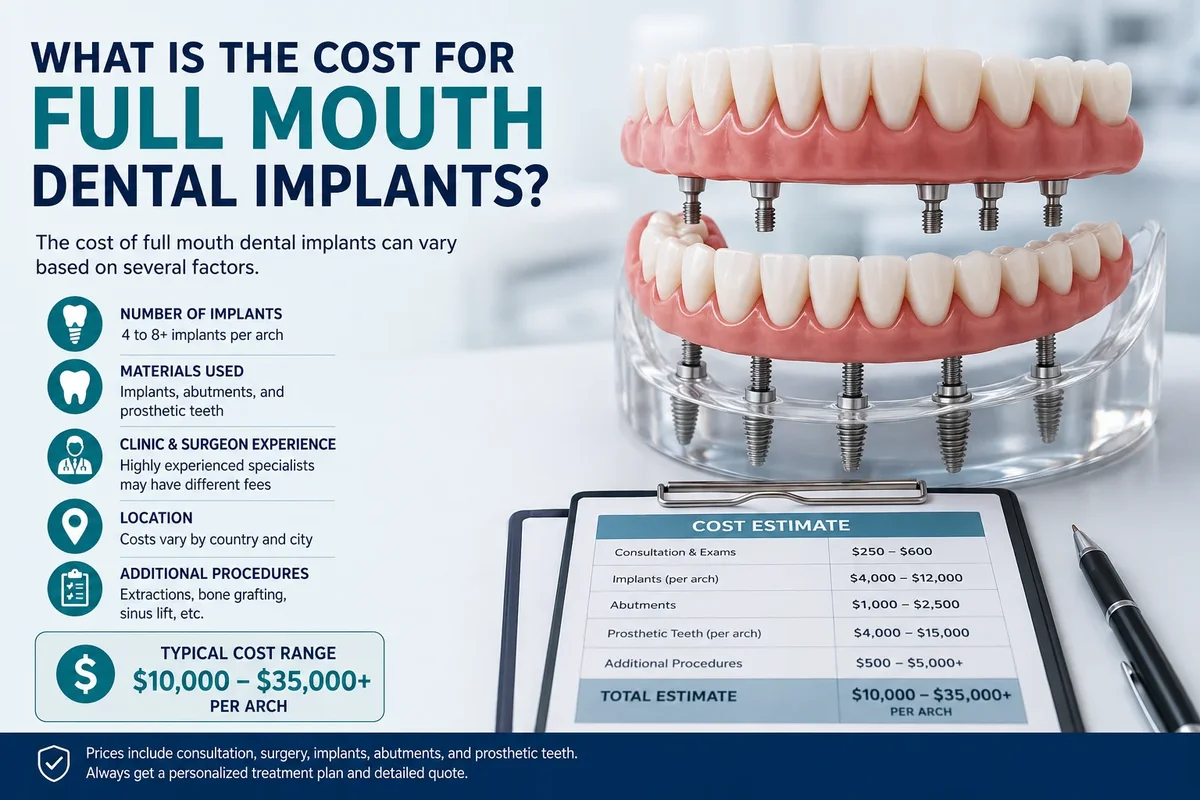
Choosing a Clinic After Asking What Is the Cost for Full Mouth Dental Implants
After researching what is the cost for full mouth dental implants, your final decision should not be based on the lowest advertised figure alone. You are choosing a clinical assessment, a surgical team, a restoration design, and an aftercare pathway. A useful quotation should explain what treatment is proposed, why it may be suitable, what alternatives exist, and which services are included. Any amount offered before a review of your dental condition, medical history, and imaging should be treated as preliminary rather than guaranteed.
Two clinics may give very different answers to what is the cost for full mouth dental implants because they may not be quoting the same care. One estimate may cover a single arch, implant placement, and temporary teeth. Another may include both arches, extractions, grafting, final restorations, follow-up visits, and adjustments. Compare the scope of treatment before comparing the total.
What Is the Cost for Full Mouth Dental Implants After a Proper Assessment?
A responsible plan normally starts with an examination of your remaining teeth, gums, jawbone, bite, smile line, and existing dental work. X-rays or three-dimensional imaging may be recommended to assess bone volume, infection, nerves, sinuses, and possible implant positions. The clinician should also review your medications, health conditions, smoking or nicotine use, and previous healing problems.
These findings shape what is the cost for full mouth dental implants. A patient with adequate bone and no active infection may need a different process from someone requiring gum treatment, extractions, bone grafting, or staged care. Photographs can support an initial conversation, but they may not reveal enough information for a final diagnosis, treatment design, or confirmed price.
A clinic should also assess the prognosis of every remaining tooth. Some teeth may still be treatable, while others may be too damaged, infected, or unstable to preserve predictably. When discussing what is the cost for full mouth dental implants, ask whether preserving suitable teeth could reduce the extent of treatment or provide a reasonable alternative. Removing natural teeth is irreversible, so the reasons for extraction should be clearly explained.
Signs of a Careful Evaluation
- Every remaining tooth is assessed before extraction is recommended.
- The clinic explains whether one arch or both arches require treatment.
- Gum health, bone levels, bite forces, and cleaning access are reviewed.
- Your medical history and medications are considered before surgery.
- You receive at least one clinically reasonable alternative.
- Possible changes in treatment or cost are explained before you pay a large deposit.
Compare What Is the Cost for Full Mouth Dental Implants Like for Like
To compare what is the cost for full mouth dental implants fairly, place each written estimate side by side. Confirm whether the price covers the upper arch, lower arch, or both. Check the proposed number of implants, the temporary restoration, the final material, and the expected number of visits.
The estimate should identify consultation, scans, digital planning, extractions, bone procedures, anesthesia or sedation, medication, implant components, temporary teeth, final teeth, laboratory work, fitting appointments, bite adjustments, and early reviews. Some clinics bundle these services while others charge separately. Neither structure is automatically better, but the complete amount should be understandable.
When discussing what is the cost for full mouth dental implants, ask which fees are confirmed and which could change. Additional treatment may depend on detailed imaging or findings during surgery. The clinic should explain when an extra cost might arise and obtain your agreement before providing non-urgent additional care.
Be especially careful with advertised “from” prices. These may be genuine starting figures, but they may apply only to straightforward cases or exclude important stages. The useful answer to what is the cost for full mouth dental implants is the likely total for your proposed treatment, not the lowest amount shown in an advertisement.
Ask Who Provides Each Part of Treatment
Full-mouth implant care may involve a surgeon, restorative dentist, dental technician, hygienist, and treatment coordinator. Ask who diagnoses your condition, places the implants, designs the teeth, fits the final bridge, and provides maintenance. This helps you understand whether what is the cost for full mouth dental implants includes coordinated care or only selected procedures.
Ask about the clinicians’ relevant experience and who takes responsibility if the treatment plan changes. Professional titles and permitted scopes of practice differ between countries, so request a clear explanation rather than assuming one person completes every stage. Consider a second professional opinion when removal of all remaining teeth is proposed and you are uncertain.
You should also know who will manage complications, temporary-restoration repairs, or bite adjustments. When comparing what is the cost for full mouth dental implants, check whether these services are included during the treatment period or charged separately. Clear responsibility is particularly important when the surgery and final restoration are provided by different clinicians.
Check the Implant System and Final Teeth
The implant fixtures and the visible restoration are separate parts of treatment. When reviewing what is the cost for full mouth dental implants, ask which implant system is proposed, whether replacement components are widely available, and how future servicing would be arranged. This is especially important if treatment is provided abroad and maintenance will occur near your home.
Final teeth may use acrylic-based materials, reinforced composite, zirconia, or a combination of materials. These options differ in appearance, weight, repairability, laboratory complexity, and cost. The most expensive material is not automatically the most suitable. Your bite, available space, implant positions, cleaning ability, and tooth-grinding habits should influence the recommendation.
The material can noticeably affect what is the cost for full mouth dental implants, so make sure each estimate identifies the final restoration rather than using a general description such as “fixed teeth.” Ask whether the treatment includes both temporary and final teeth and whether a trial stage is planned before the final restoration is completed.
Questions About the Restoration
- Are the immediate teeth temporary or final?
- Which material is planned for the final bridge?
- Will appearance, speech, and bite be tested before completion?
- How can the restoration be repaired if it chips or wears?
- Are adjustments and a protective night guard included when advised?
- How will you clean beneath the restoration at home?
Include Aftercare in What Is the Cost for Full Mouth Dental Implants
The complete answer to what is the cost for full mouth dental implants extends beyond surgery. Implant-supported teeth need daily cleaning, professional reviews, and periodic checks of the gums, bone, bite, screws, and restorative materials. Bridge servicing, replacement components, repairs, or professional cleaning may create future expenses.
Request a written maintenance schedule and confirm which early reviews are included. Ask what symptoms should prompt contact and how urgent concerns are handled. Read any guarantee or limited warranty carefully because conditions may apply to smoking, hygiene, attendance at reviews, or the use of a protective appliance. No policy can remove every biological or mechanical risk.
When planning what is the cost for full mouth dental implants, create a separate allowance for long-term care. Screws can loosen, restorative materials can wear or chip, and cleaning appointments may be needed throughout the life of the treatment. A quotation that explains maintenance openly is more useful than one that focuses only on the day of surgery.
General information from the American Dental Association may help you prepare questions, but your maintenance instructions should be personalized by the dental professionals responsible for your care.
Factor Travel Into What Is the Cost for Full Mouth Dental Implants
If treatment is provided in another country, what is the cost for full mouth dental implants should include flights, accommodation, transfers, meals, time away from work, and possible return visits. Ask how many trips are expected and what could require an additional journey. Healing may take longer than expected, temporary teeth may need adjustment, or the final restoration may require further fitting.
Confirm how you will receive your treatment plan, implant records, consent information, and aftercare instructions. Ask who will help if a temporary bridge loosens or your bite changes after you return home. These practical arrangements can change the real answer to what is the cost for full mouth dental implants, even when the clinical package appears affordable.
Redent Klinik can explain its initial review requirements and possible visit stages through the Redent Klinik Contact Page. However, a personalized recommendation and final estimate should follow an appropriate review of your oral condition, health history, imaging, and treatment goals.
Avoid Pressure When Comparing Treatment Costs
Be cautious if you are pressured to pay immediately, told that every patient qualifies for the same procedure, or promised permanent results without meaningful limitations. Same-day fixed temporary teeth may be possible for selected patients, but they are not suitable in every case. Likewise, no responsible clinician can guarantee that implants or restorations will last forever.
A low price does not prove poor care, and a high price does not prove excellence. When deciding what is the cost for full mouth dental implants, focus on whether the proposed treatment is justified, documented, maintainable, and supported by clear follow-up. Take time to read the plan and consent information before paying a large deposit or arranging finance.
Limited-time offers should not determine the timing of irreversible treatment. If you feel uncertain, request copies of your records and seek another professional opinion. A trustworthy clinic should allow you to ask questions about what is the cost for full mouth dental implants without making you feel that you must decide immediately.
Match the Treatment Plan to Your Priorities
Your decision should reflect your preference for fixed or removable teeth, tolerance for surgery, ability to clean the restoration, travel availability, and long-term budget. Ask about preserving suitable natural teeth, treating one arch, choosing an implant-retained removable denture, using conventional dentures, or completing care in stages.
When considering what is the cost for full mouth dental implants, ask the dentist to compare each realistic option in terms of stability, chewing, appearance, cleaning, treatment time, risks, repairs, and maintenance. The right plan is not automatically the most expensive or least expensive. It is the option that provides a reasonable balance of clinical suitability, personal priorities, and manageable long-term cost.
What to Check Before Choosing a Clinic
- Confirm that the estimate follows an appropriate examination and imaging review.
- Check whether the fee covers one arch or both arches.
- Ask which natural teeth can be preserved and why extraction is recommended.
- Verify the implant number, implant system, temporary teeth, and final material.
- Review possible additional fees, travel costs, maintenance, and finance charges.
- Confirm who provides surgery, restorative care, follow-up, and urgent support.
- Request a clinically suitable alternative and consider a second opinion when uncertain.
Request professional dental advice promptly if you have increasing facial swelling, persistent pain, pus, fever, uncontrolled bleeding, rapidly loosening teeth, or difficulty eating. Difficulty breathing or swallowing requires urgent medical attention. Arrange a comprehensive consultation when your quotation is based only on photographs, your health history has not been reviewed, the condition of your remaining teeth is unclear, or important services are missing from the estimate.
Ultimately, the best answer to what is the cost for full mouth dental implants is a transparent plan showing what you need, what you may not need, which alternatives are suitable, and how the complete financial commitment is calculated. Before choosing a clinic, check the diagnosis, clinician roles, treatment stages, materials, risks, aftercare, maintenance, and support arrangements. Request professional advice whenever the plan feels rushed, remains unclear, or does not reflect your individual health and priorities.
Disclosure: this page may contain affiliate links. We may earn a commission if you use them, at no extra cost to you.