
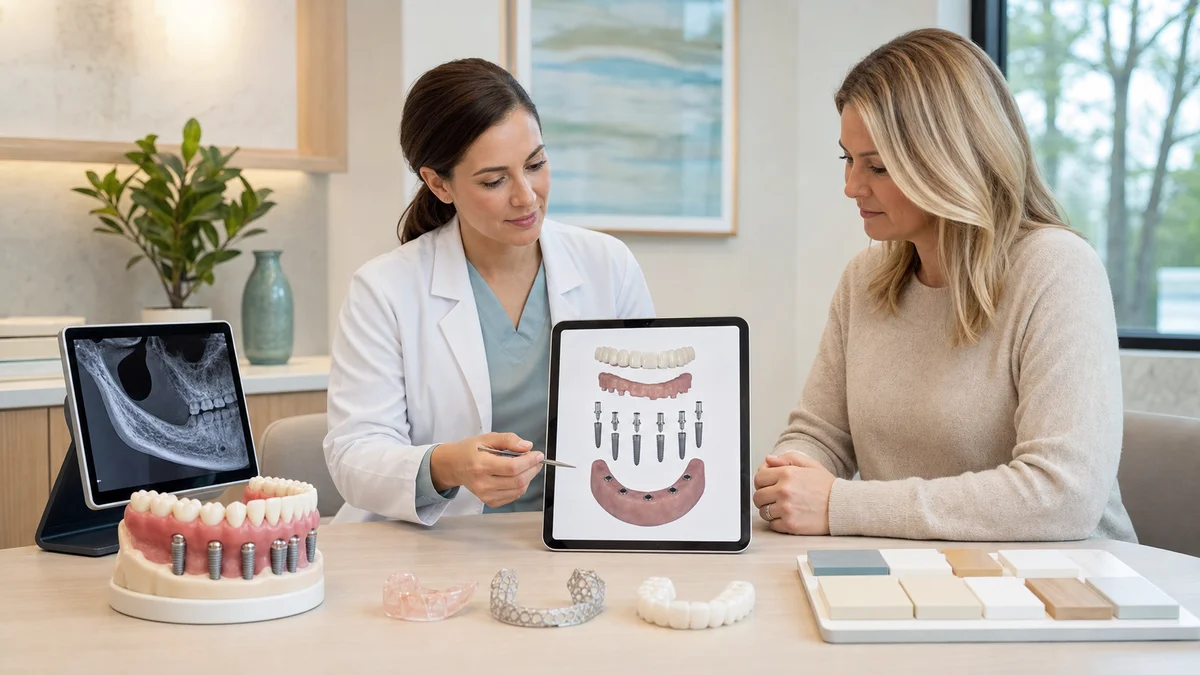
People searching what is the cost of complete dental implants often find advertisements with one prominent number and little explanation. That number may refer to one implant, one arch, surgery only, a temporary set of teeth, or a complete pathway. It may exclude the final prosthesis, implant components, bone grafting, anesthesia, return visits, or care after a complication. Two quotes that look similar can therefore purchase very different treatment.
“Complete dental implants” is not one standardized procedure. It may mean a fixed full-arch bridge on several implants, an implant-retained removable overdenture, treatment for one jaw, or rehabilitation of both jaws. The right design depends on the condition of any remaining teeth, bone and soft tissues, general health, bite, cleaning ability, preferences, and the planned final prosthesis. This guide does not diagnose or promise a result; it shows how to turn a headline price into a clinically meaningful comparison.
1. What Is the Cost of Complete Dental Implants Really Asking?
The first task is to define “complete.” A quote for a single upper arch is not comparable with treatment for both jaws. A fixed bridge is not the same product as a removable overdenture. A provisional acrylic bridge delivered near surgery is not necessarily the definitive prosthesis. Even the word “implant” can refer only to the fixture in bone or to the fixture plus abutment, screws, laboratory components, and artificial teeth.
When you ask what is the cost of complete dental implants, request a written treatment map. It should identify the jaw or jaws, teeth to preserve or remove, planned number and distribution of implants, provisional restoration, definitive restoration, expected visits, and the events that could change the plan. An estimate made from photographs should be labelled preliminary.
A single total is useful only after its assumptions are visible. Currency, taxes, expiration date, payment schedule, and refund terms also matter. A quote is not a diagnosis, and a low or high price does not by itself demonstrate quality.
2. Why What Is the Cost of Complete Dental Implants Has No Universal Answer
Full-arch implant therapy combines surgery, prosthodontics, dental laboratory work, medical risk management, and long-term maintenance. Costs vary with local professional fees, facility resources, clinical complexity, the implant system, component selection, prosthesis design, material, and how much follow-up is included. The patient’s anatomy and health can change the treatment sequence.
Factors such as active gum disease, smoking, diabetes control, bone volume, sinus or nerve position, grinding, previous implants, and the opposing teeth influence planning. Some patients can receive implants at the time of extraction; others need staged infection control or tissue healing. Bone augmentation may be unnecessary, limited, or extensive. No responsible estimate can assume the same pathway for everyone.
The practical answer to what is the cost of complete dental implants is therefore a range of possible pathways, not a guaranteed figure. A transparent clinician explains which costs are expected, which are conditional, and which would arise only after a complication or change in patient preference.
3. Diagnosis Comes Before the Final Quote
Implant planning starts with medical and dental history. The clinician should review medications, allergies, bleeding risk, healing factors, previous radiation or antiresorptive treatment, smoking, diabetes, and other relevant conditions. Oral examination includes remaining-tooth prognosis, decay, periodontal health, soft tissue, available restorative space, bite, jaw relationships, and hygiene access.
The European Federation of Periodontology describes a thorough oral examination and appropriate radiographs or CBCT when needed to assess bone shape and important structures such as nerves and sinuses. Imaging should answer a clinical question; not every patient needs the same scan. A prosthetic goal should guide where implants are considered, rather than placing implants first and designing teeth afterward.
A response to what is the cost of complete dental implants that arrives before this work is an assumption-based estimate. Ask which findings could require extraction, grafting, a different implant count, delayed loading, a removable provisional, or referral. Material changes should trigger updated consent and an updated quote before irreversible treatment continues.
4. Decision Table: What Is the Cost of Complete Dental Implants by Pathway?
The table below compares categories, not personal recommendations. It helps ensure that what is the cost of complete dental implants is answered for the same clinical objective.
| Possible pathway | Main prerequisite | Major cost drivers | Question to document |
|---|---|---|---|
| Preserve and restore remaining teeth | Teeth have a reasonable periodontal and restorative prognosis | Gum therapy, root canal care, fillings, crowns, or partial bridges | Why is each tooth restorable or non-restorable? |
| Conventional complete denture | A removable non-implant option is acceptable | Impressions, try-ins, denture, relines, adjustments, and replacement | What functional limits should I expect? |
| Implant-retained removable overdenture | Patient accepts a removable prosthesis with improved retention | Implants, attachments, denture, attachment wear, and maintenance | How often may attachments need service? |
| One-piece fixed full-arch bridge | Implants can be appropriately distributed for the prosthetic plan | Surgery, components, provisional, framework, final bridge, and hygiene care | Why is this implant number and distribution appropriate? |
| Segmented fixed implant bridges | Anatomy and implant distribution support separate prosthetic sections | Additional components, laboratory stages, and repair strategy | What is gained by segmenting the restoration? |
| Staged treatment | Infection, grafting, health, or financing requires phases | Extra visits, temporary dentures, grafting, and delayed final restoration | Which phase is essential now, and what remains later? |
5. The 18 Line Items a Complete Written Quote Should Show
A useful answer to what is the cost of complete dental implants marks each item as included, excluded, conditional, optional, or complication-related:
- Consultation and records: health history, clinical examination, photographs, and diagnostic casts or scans.
- Imaging: panoramic radiograph, site-specific images, and CBCT only when indicated.
- Prosthetic planning: tooth position, lip support, smile line, speech, bite, and hygiene space.
- Tooth extractions: simple or surgical removal and management of infection or retained roots.
- Bone shaping: alveoloplasty or other contouring required for restorative space.
- Bone or soft-tissue procedures: graft type, material, donor site, membrane, and healing stage.
- Implant fixtures: number, manufacturer, system, diameter, length, and whether the device cost is included.
- Prosthetic components: multi-unit abutments, angled parts, temporary cylinders, screws, and healing parts.
- Surgical guide: design, manufacture, verification, and whether its use remains appropriate during surgery.
- Anesthesia or sedation: local anesthesia, sedation professional, monitoring, facility, and recovery.
- Immediate provisional: fixed or removable design, material, reinforcement, adjustment, and repair.
- Healing-period visits: reviews, suture management, hygiene instruction, and provisional modifications.
- Definitive records: impressions or digital scans, verification, jaw relation, and bite records.
- Definitive prosthesis: framework, teeth, gingival material, zirconia or other exact construction.
- Laboratory stages: try-ins, passive-fit checks, characterization, remakes, and technician fees.
- Delivery: screws, torque protocol, bite adjustment, and baseline records.
- Maintenance: professional cleaning, screw checks, replacement parts, and recall schedule.
- Complication pathway: implant loss, fracture, loosening, re-surgery, new provisional, and travel costs.
Ask for the price of the complete pathway, then keep the detail. If the clinic provides only a package total, request an addendum that defines each component. The safest comparison is not the shortest quote; it is the quote that makes responsibility and uncertainty visible.
6. What Is the Cost of Complete Dental Implants for One Arch Versus Both?
“Full mouth” is often used loosely. It may mean one edentulous jaw, both jaws, or a combination of implant treatment in one arch and restorations on natural teeth in the other. A lower-arch fixed bridge and an upper complete denture are not the same scope as two fixed implant bridges.
For what is the cost of complete dental implants, every proposal should state “upper,” “lower,” or “both arches.” It should also describe the opposing dentition. Natural teeth, a removable denture, or another implant bridge create different bite forces and restorative demands. Treating a second arch can change tooth position, vertical dimension, laboratory records, provisional design, and maintenance.
Do not double a one-arch advertisement to estimate two arches. Some steps overlap, but clinical and laboratory complexity may not scale evenly. Obtain a patient-specific plan for each arch, plus a combined bite and sequencing plan.
7. Implant Number Is a Design Decision, Not a Price Tier
Complete fixed arches can be supported by different numbers of implants. The International Team for Implantology recommends that the final prosthetic plan guide surgery and notes that at least four appropriately distributed implants are recommended for a one-piece full-arch fixed prosthesis. It also emphasizes anatomy, bone, implant distribution, cantilever, material, hygiene access, and patient preference.
This does not mean four implants suit everyone or that six or more are automatically better. Additional implants may support different designs or provide options if one implant later has a problem, but they may require more bone distribution or more invasive treatment. A planned implant cannot simply be counted without considering its position and prosthetic role.
When a quote answers what is the cost of complete dental implants by multiplying a unit price by an implant count, it misses the central design question. Ask why this number is proposed, what prosthesis it supports, and how the design changes if an implant cannot be placed or integrated.
8. Extractions, Bone Grafting, and Sinus Procedures
Removing remaining teeth is irreversible. Each tooth should have a documented restorative, endodontic, and periodontal prognosis. The ITI recommendation specifically asks clinicians to consider tooth preservation as part of informed consent. A full-arch package should not determine the fate of teeth before the diagnosis does.
Bone may require augmentation to support the prosthetic plan, improve implant distribution, or manage an anatomic limitation. Upper-jaw treatment may involve the sinus; other sites may need ridge development or soft-tissue procedures. The need, material, donor site, healing period, alternatives, and added risks should be explained. Neither “graft-free” nor “grafting always required” is a safe universal promise.
In the calculation of what is the cost of complete dental implants, request conditional pricing. Which scan or surgical finding triggers a graft? Is biomaterial included? Does it add a visit or delay loading? What happens if the patient declines the added procedure? The consent and financial plan should be updated before proceeding.
9. Immediate Teeth Usually Means a Provisional, Not the Final Prosthesis
Some patients can receive a fixed provisional bridge near the time of implant placement. This is called immediate loading, but it does not mean biological integration is complete. Implant stability, bone, grafting, distribution, bite, systemic factors, and clinician judgment affect eligibility. The loading plan can change during surgery.
The ITI loading consensus states that implant number, size, and distribution must follow the implant-prosthodontic plan, arch form, and bone volume regardless of the loading protocol. A safe quote includes an alternative if immediate loading is not appropriate, such as a removable provisional or delayed fixed restoration.
When evaluating what is the cost of complete dental implants, separate the provisional and definitive prostheses. Record each material, delivery stage, repair rule, and replacement condition. “Teeth in a day” should not imply a permanent final bridge for every patient or guarantee that no later appointments are needed.
10. Provisional and Definitive Materials Change the Scope
A provisional full-arch bridge may be milled or fabricated from acrylic-based materials and can be reinforced. Its purpose is to provide temporary function, appearance, and a way to assess tooth position and bite during healing. It can crack or wear, particularly when loads are high, and repair arrangements matter.
Definitive designs may include acrylic or composite teeth on a metal framework, titanium-based structures, monolithic zirconia, or other combinations. Material influences laboratory steps, weight, space requirements, opposing-tooth wear, repairability, aesthetics, and replacement planning. No material is automatically best for every patient.
An adequate response to what is the cost of complete dental implants must name the construction, not use vague words such as “premium teeth.” Ask whether the bridge is one piece or segmented, how the framework is produced, how hygiene access is created, and what parts can be repaired locally.
11. Implant System, Abutments, and Small Components
The FDA explains that an implant system includes the implant body, the abutment, and often an abutment fixation screw. A full-arch restoration can add multi-unit abutments, angled components, temporary cylinders, prosthetic screws, scan bodies, and replacement parts. A quote for “implants” may include only the fixtures.
Brand alone cannot guarantee a result. Diagnosis, sterile technique, three-dimensional placement, prosthetic design, fit, hygiene, and follow-up all matter. However, an identifiable system and access to compatible original parts can make later maintenance easier. Patients should receive implant-position records and a component or implant passport.
For what is the cost of complete dental implants, ask which components are included on surgery day, which are reused or replaced for the final bridge, and what future screws or abutments cost. Confirm that the exact manufacturer and connection are documented, not merely described as a “lifetime implant.”
12. Laboratory Work, Verification, and Passive Fit
A complete-arch prosthesis may connect several implants in one framework. The positions must be transferred accurately, and the framework should seat according to the clinical protocol. Conventional impressions, digital scanning, photogrammetry, verification jigs, or combinations may be used. The appropriate technique depends on the case, equipment, and team experience.
Laboratory value includes more than making white teeth. It can include design, model or digital verification, framework production, try-ins, shade and gingival characterization, passive-fit assessment, bite records, and a remake when standards are not met. Fast production is convenient but is not proof of accuracy.
A quote answering what is the cost of complete dental implants should identify the laboratory, number of try-ins, remake policy, and responsibility for a misfit. Ask whether all clinical and laboratory fees for the definitive bridge are included or whether the advertised amount ends after the provisional.
13. Anesthesia, Sedation, and Medical Support
Many implant procedures can be performed with local anesthesia. Sedation or hospital-based support may be considered for anxiety, medical needs, or treatment complexity, but sedation is not necessary for every patient and is not risk-free. Pre-assessment, fasting instructions, monitoring, recovery, escort requirements, and the credentials of the responsible professional should be clear.
Facility fees, the anesthesia professional, medications, monitoring, and recovery can be separate cost categories. A marketing phrase such as “pain-free implants” does not define the service. Postoperative discomfort and swelling vary; the clinic should provide individualized instructions and an emergency route.
Include these items when asking what is the cost of complete dental implants. Also ask whether a medical consultation, laboratory tests, or coordination with a physician is needed. Uncontrolled bleeding, breathing or swallowing difficulty, rapidly increasing swelling, fever, or severe worsening pain requires prompt professional assessment regardless of financial arrangements.
14. Treatment Time and Number of Visits
Complete implant treatment is a sequence, not a single event. It can include diagnostics, extraction and surgery, early review, provisional adjustments, healing, definitive records, try-ins, bridge delivery, and maintenance. Some stages may be combined in appropriate cases; others need biological healing before the next step.
The EFP notes that osseointegration takes time. A clinician may use an immediate, early, or conventional loading protocol depending on the case. No calendar promise should override implant stability, tissue health, grafting, or a change found during surgery. The definitive bridge should not be delivered merely to meet a flight or work deadline.
To understand what is the cost of complete dental implants, ask for the expected visits and a realistic extra-visit scenario. Include travel, accommodation, escort, time away from work, flexible booking, and local emergency care if treatment is away from home. A package that includes the first trip may exclude the definitive stage.
15. Insurance: What Is the Cost of Complete Dental Implants After Benefits?
Coverage depends on country, plan, network, annual or lifetime limits, missing-tooth clauses, waiting periods, medical necessity rules, and whether surgical and prosthetic services are treated separately. A percentage in a brochure is not a personal authorization. Submit the diagnosis, tooth chart, itemized codes, radiographs, and complete plan before treatment when preauthorization is available.
In the United States, CMS states that Original Medicare generally excludes routine dental services for care or replacement of teeth, while limited dental services may be covered when inextricably linked to specified Medicare-covered medical care. Medicare Advantage plans may offer added dental benefits, but details vary. This does not create automatic coverage for a complete implant bridge.
Therefore what is the cost of complete dental implants after insurance can be answered only with a written plan decision. Ask about deductibles, coinsurance, annual caps, out-of-network rules, staged claims, and whether the final prosthesis falls in a different benefit period. The clinic can provide documents; the insurer decides benefits.
16. Cross-Border Treatment and the Total Trip Cost
Travel can change professional and laboratory prices, but it also adds logistics. Include flights, accommodation, transfers, food, companion costs, lost work, visas when applicable, travel insurance exclusions, currency conversion, and flexible rebooking. More importantly, identify who handles pain, a broken provisional, a loose screw, or an implant problem after the patient returns home.
For an English-language overview of treatment planning, patients may visit the Redent Clinic English homepage and use the English contact page to ask which records are needed for a preliminary file review. A remote review cannot replace an in-person examination or confirm a final treatment price.
A cross-border quote for what is the cost of complete dental implants should state which visits are included, whether the final bridge needs a second trip, and who pays travel for a remake. Clarify clinician licensing, facility authorization, interpreter role, record access, complaint pathway, and local aftercare before paying a non-refundable deposit.
17. Risks and a Complication Budget
Dental implant risks can include infection, bleeding, injury to nearby structures, altered sensation, sinus complications, failure to integrate, and later peri-implant disease. Prosthetic complications can include screw loosening, wear, chipping, fracture, loss of an artificial tooth, or a bite problem. Personal risk changes with anatomy, health, smoking, gum history, hygiene, loading, and design.
The FDA advises patients to discuss benefits and risks, share health and medication information, and understand the implant system. EFP emphasizes that implants require care because inflammation and bone loss around implants can threaten them. No clinic can guarantee a biological result or a complication-free lifetime.
A serious answer to what is the cost of complete dental implants includes the financial response to failure. If one implant does not integrate, who pays for removal, healing, grafting, a replacement implant, a modified bridge, or a new provisional? Write down professional, device, laboratory, travel, and medication responsibilities separately.
18. Long-Term Maintenance Is Part of the Cost
A fixed bridge is not maintenance-free. Patients need daily access beneath the prosthesis and around implant connections. Individual tools may include interdental brushes, floss threaders, water irrigation, or other aids recommended by the dental team. The bridge must provide enough space for effective cleaning without compromising other goals.
Professional review can include tissue assessment, plaque control, bite, screws, wear, radiographs when clinically indicated, and removal of the prosthesis only when justified. Frequency is individualized. A history of periodontal disease, smoking, diabetes, cleaning difficulty, or prosthetic complications may require closer follow-up.
Add this to what is the cost of complete dental implants: hygiene visits, replacement brushes, professional cleaning, worn attachment or screw replacement, repairs, and eventual renewal of parts or the prosthesis. A lower initial figure can become expensive if maintenance access, compatible parts, or local support is poor.
19. Warranty Is Not the Same as a Biological Guarantee
A clinic or manufacturer may offer written terms for a device, laboratory work, or selected repairs. The document may have time limits and conditions involving hygiene reviews, smoking, trauma, grinding, unauthorized treatment elsewhere, or return to the original clinic. It cannot guarantee that bone will integrate, tissues will remain disease-free, or health will not change.
For what is the cost of complete dental implants, translate “lifetime warranty” into line items. Does it cover only a replacement implant fixture, or also re-surgery, grafting, abutments, screws, anesthesia, provisional teeth, a new definitive bridge, travel, and accommodation? Who decides whether the warranty applies?
Transparent complication terms are useful, but they do not replace sound diagnosis, informed consent, traceable components, appropriate surgery, a maintainable prosthesis, and regular care. Treat any promise of a fixed lifespan or guaranteed outcome cautiously.
20. Financing, Deposits, and Staged Payments
Financing can make treatment accessible, but the borrowing cost is separate from the clinical price. Compare annual percentage rate, origination fees, deferred-interest conditions, late fees, refund destination, and what happens if the treatment plan changes. A monthly payment can conceal a higher total cost.
Match payments to clinical milestones when possible: planning, surgery, provisional, definitive records, and final delivery. Ask how unused funds are returned if fewer implants are placed, grafting is not needed, or treatment is stopped. Also ask how added procedures are approved and financed.
An estimate for what is the cost of complete dental implants should not pressure a patient into immediate irreversible treatment. A time-limited discount must not prevent review of records, insurance authorization, a second opinion, or understanding of cancellation terms. Keep copies of the treatment plan, finance agreement, receipts, and clinical consent.
21. Warning Signs in Complete Implant Advertising
- One price is presented without saying one arch or both arches.
- Remaining teeth are declared hopeless from photographs alone.
- The implant count is sold as a quality tier without a prosthetic explanation.
- Fixtures, abutments, screws, provisional, and final bridge are not separated.
- Bone grafting is promised to be impossible or unnecessary for everyone.
- Immediate permanent teeth are guaranteed before assessment.
- The implant system, treating clinicians, or laboratory are not identified.
- The final material is described only as “premium” or “best.”
- Insurance payment is promised without personal authorization.
- A lifetime biological result is guaranteed.
- Maintenance and hygiene design are omitted from the consultation.
- A deposit deadline prevents informed review or a second opinion.
One warning sign does not prove poor care, but it creates a question that deserves a documented answer. The team responding to what is the cost of complete dental implants should be able to explain diagnosis, alternatives, responsibility, uncertainty, and the complete financial scope without relying on testimonials.
22. A Fair Method for Comparing Three Quotes
Place each quote into the same spreadsheet or paper grid. Use one row for every item in the 18-point list. Standardize the arch count, currency, quote date, implant system, component set, provisional, definitive material, laboratory, anesthesia, grafting assumptions, visits, maintenance, and complication policy. Mark blank cells as “unknown,” not “included.”
Then classify each cost as expected, conditional, optional, or complication-related. Ask each clinic the same questions and request a revised written plan. Differences may reflect a different diagnosis or design rather than overcharging. If plans conflict, obtain a second opinion with the same records and ask each clinician to explain the clinical reason.
This method answers what is the cost of complete dental implants more safely than ranking headline totals. The goal is not to force different plans into one number; it is to understand what each plan is trying to achieve, what it removes or preserves, and how it will be maintained.
23. Questions to Bring to the Consultation
- Which remaining teeth can be predictably preserved, and why?
- Does this plan cover the upper arch, lower arch, or both?
- Why is the proposed implant number and distribution appropriate?
- What alternatives were considered, including an overdenture?
- Which implant fixtures, abutments, and screws are included?
- What triggers a graft, sinus procedure, or staged surgery?
- Is the immediate restoration provisional, and what is it made from?
- What is the exact definitive bridge construction?
- How are records, passive fit, speech, and bite verified?
- How many expected and possible extra visits are there?
- What insurance authorization must be obtained first?
- What happens clinically and financially if an implant fails?
- What maintenance can be performed by a local dentist?
- Which records and component passport will I receive?
- What conditions can change the final total?
These questions turn what is the cost of complete dental implants from a sales question into shared clinical decision-making. Ask for plain-language explanations. Informed consent requires understanding the benefits, risks, alternatives, uncertainty, total cost, and consequences of no treatment.
Frequently Asked Questions: What Is the Cost of Complete Dental Implants?
What Is the Cost of Complete Dental Implants for One Arch?
What is the cost of complete dental implants for one arch depends on diagnosis, implant number, components, extractions, grafting, anesthesia, provisional teeth, final bridge material, laboratory, visits, and maintenance. A clinical examination is needed before a dependable itemized quote.
What Is the Cost of Complete Dental Implants for Both Arches?
Do not simply double a one-arch advertisement. What is the cost of complete dental implants for both arches also depends on combined bite planning, sequencing, two provisional restorations, final materials, laboratory records, and whether both jaws can follow the same schedule.
What Is the Cost of Complete Dental Implants With Bone Grafting?
Grafting varies by site, purpose, material, volume, donor approach, membrane, and whether it adds a healing stage. A quote answering what is the cost of complete dental implants should give conditional graft pricing and the findings that would make it necessary.
What Is the Cost of Complete Dental Implants With Same-Day Teeth?
Same-day teeth commonly means a provisional restoration for suitable cases, not a guaranteed definitive bridge. For what is the cost of complete dental implants, separate surgery, immediate provisional, later records, definitive prosthesis, adjustments, and an alternative if immediate loading is unsafe.
What Is the Cost of Complete Dental Implants After Insurance?
Coverage varies by country and plan. What is the cost of complete dental implants after benefits requires written authorization for the exact codes, arches, network, deductibles, limits, exclusions, and treatment stages. Another patient’s coverage is not a personal benefit decision.
What Is the Cost of Complete Dental Implants Under Medicare?
Original Medicare generally excludes routine replacement-of-teeth services, with limited situations for dental care inextricably linked to specified covered medical care. What is the cost of complete dental implants under a Medicare Advantage plan depends on that plan’s added dental benefit and authorization.
What Is the Cost of Complete Dental Implants With Zirconia?
Zirconia describes material, not the complete design. What is the cost of complete dental implants with zirconia also depends on framework strategy, implant components, laboratory, verification, provisional treatment, opposing teeth, maintenance, and repair provisions. Ask for the exact construction.
What Is the Cost of Complete Dental Implants Abroad?
Add travel, accommodation, repeat visits, currency fees, local emergency care, and return travel for repairs. A cross-border answer to what is the cost of complete dental implants should name the clinician, licensed facility, final-prosthesis stage, records, and aftercare responsibility.
What Is the Cost of Complete Dental Implants Over a Lifetime?
No one can quote an exact lifetime total. What is the cost of complete dental implants over time includes hygiene visits, professional maintenance, replacement screws or parts, repairs, possible relines or remakes, and treatment of biological or mechanical complications.
What Is the Cost of Complete Dental Implants if One Implant Fails?
The cost may include diagnosis, removal, healing, grafting, replacement, a modified provisional, and changes to the definitive bridge. A proposal for what is the cost of complete dental implants should define warranty limits and who pays professional, device, laboratory, medication, and travel expenses.
24. Conclusion: Price the Entire Treatment Pathway
What is the cost of complete dental implants cannot be answered safely with a universal number. The meaningful total begins with diagnosis and includes the chosen arch or arches, tooth-preservation decisions, implants and components, tissue procedures, anesthesia, provisional restoration, definitive bridge, laboratory work, reviews, maintenance, and a plan for complications.
Compare like with like and keep every assumption in writing. Verify insurance before treatment, distinguish immediate provisional teeth from the final prosthesis, and ask how long-term hygiene and repairs will work. Choose transparent clinical reasoning and sustainable follow-up over fixed-price promises or guaranteed outcomes.
Official and Professional Sources for What Is the Cost of Complete Dental Implants
- U.S. Food and Drug Administration: Dental Implants—What You Should Know
- International Team for Implantology: Number of implants for complete-arch fixed prostheses
- International Team for Implantology: Loading protocols for fixed prostheses in edentulous jaws
- European Federation of Periodontology: Dental implants explained
- Centers for Medicare & Medicaid Services: Medicare dental coverage
- Cambridge University Hospitals NHS: Dental implants in restorative dentistry
- American Dental Association: Official professional and patient resources
- American Dental Association MouthHealthy: Dental implants
- World Health Organization: Oral health fact sheet