
Searching for the wisdom tooth removal best option can make it sound as though one technique is right for everyone. It is not. A fully erupted tooth that is easy to clean, an impacted tooth with no disease, a partly erupted tooth with repeated inflammation and a lower tooth whose roots appear close to a sensory nerve present very different decisions. “Best” therefore means clinically justified, proportionate and matched to your anatomy—not automatically the fastest or most extensive intervention.
This guide explains the main decision paths without diagnosing an individual reader. It does not replace an examination. A clinician may need current medical information, a dental examination and appropriate imaging before discussing whether observation or intervention offers the better balance of benefit and risk. At Redent Klinik, a personalised consultation is the starting point for that discussion.
1. Wisdom tooth removal best option starts with the reason for treatment
The first question is not “Which extraction technique should I choose?” It is “Is removal indicated now?” Wisdom teeth may be fully erupted, partially erupted, angled under the gum or completely enclosed in bone. Position alone does not prove disease. The clinician looks for a problem that the tooth is causing now, a condition that cannot be predictably managed while retaining it, or a meaningful threat to nearby structures.
Reasons that may support removal include decay that cannot be restored, an abscess, a cystic change, damage to the neighbouring molar, non-treatable disease around the tooth, or repeated clinically significant inflammation around a partly erupted crown. NICE guidance for the NHS advises against prophylactic removal of pathology-free impacted third molars and limits surgery to cases with evidence of pathology. That principle helps prevent exposing a healthy person to a surgical risk without a demonstrated benefit.
In other words, the wisdom tooth removal best option begins with a documented indication, not a routine assumption based only on the tooth’s name or angle.
- Symptoms: pain, swelling, bad taste, restricted opening or recurrent gum inflammation need clinical interpretation rather than online self-diagnosis.
- Disease: decay, periodontal damage, infection, resorption or a radiographic lesion may change the balance toward treatment.
- Function and hygiene: whether the tooth is useful, cleanable and stable matters.
- Neighbouring structures: the second molar, jawbone, sinus and nearby sensory nerves must be considered.
- Personal context: general health, medicines, smoking, pregnancy, anxiety and access to follow-up can affect timing and setting.
2. Is monitoring the wisdom tooth removal best option?
Monitoring may be the wisdom tooth removal best option when the tooth is disease-free, causes no significant problem and can be reviewed reliably. Monitoring does not mean ignoring the tooth. It means documenting its position and condition, maintaining hygiene, checking the surrounding gum and neighbouring tooth, and reassessing if symptoms or clinical findings change.
The NHS states that a wisdom tooth not causing problems will usually be left in place and monitored during routine dental check-ups. NICE similarly recommends routine care rather than additional procedures for pathology-free impacted third molars. These recommendations are useful guardrails, but they do not remove the need for individual clinical judgment. A patient who cannot return for review, has a changing lesion or has damage that is difficult to detect clinically may require a different plan.
Ask what “monitoring” will involve: the expected review interval, what will be examined, whether future imaging is justified, how to clean the area and which changes should trigger an earlier visit. Repeated X-rays should not be taken merely out of habit; imaging should answer a clinical question and follow local radiation-protection standards.
3. When simple extraction can be the wisdom tooth removal best option
A simple extraction may be appropriate when the wisdom tooth is fully erupted, accessible and can be removed without raising a surgical flap or removing bone. The dentist normally uses local anaesthetic, loosens the tooth and removes it through the socket. Even a tooth that looks straightforward online can have curved roots, fragile restorations nearby or medical factors that alter the plan, so the label “simple” should follow assessment rather than precede it.
For a suitable case, simple extraction can reduce surgical manipulation and may make recovery easier than a more involved operation. However, the wisdom tooth removal best option is not defined by the smallest procedure at any cost. If access is limited or force could endanger adjacent structures, a controlled surgical approach may be safer than persisting with a nominally simple extraction.
That is why the wisdom tooth removal best option should describe the planned safety route, not merely the billing label attached to an extraction.
4. When surgical extraction is the wisdom tooth removal best option
Surgical extraction may be recommended when a tooth is partly or fully covered by gum or bone, is positioned unfavourably, has roots that complicate delivery or cannot be removed safely through the socket alone. The operator may make a small incision, remove a limited amount of bone and divide the tooth into sections. Stitches may be placed and are often dissolvable.
The NHS explains that removal may be carried out by a dentist or referred to a specialist, depending on difficulty and the patient’s needs. Surgical extraction is not a sign that treatment has gone wrong; it can be the planned, controlled route that protects surrounding tissues. The relevant comparison is between the risks of a carefully planned operation, the risks of another treatment path and the risks of leaving the diagnosed disease untreated.
For an impacted tooth with a clear indication, the wisdom tooth removal best option may therefore be deliberate surgical access rather than an attempted simple extraction.
5. Coronectomy as a selected wisdom tooth removal best option
For some lower wisdom teeth, imaging suggests that the roots are very close to the inferior alveolar nerve, which supplies sensation to areas of the lower lip and chin. A coronectomy removes the crown while intentionally retaining suitable roots. The purpose is to address the crown-related problem while reducing manipulation close to the nerve. It is not appropriate for every tooth and is not simply a “partial extraction” requested for convenience.
University College London Hospitals explains that coronectomy may be offered when complete removal carries an increased nerve-injury risk. Suitability depends on factors such as the tooth’s condition, root status and presence of infection. Retained roots can move or, in some cases, later require management, so follow-up matters. A clinician should explain why coronectomy is being considered, what could require conversion to full removal and how the site will be reviewed.
6. Wisdom tooth removal best option after examination and imaging
A safe plan begins with history and examination. The clinician asks about the duration and pattern of symptoms, previous episodes, swelling, taste changes, difficulty opening, fever, medicines, allergies, medical conditions and prior anaesthetic experience. The mouth is examined for eruption, gum inflammation, decay, pocketing, drainage, hygiene and the condition of the adjacent second molar.
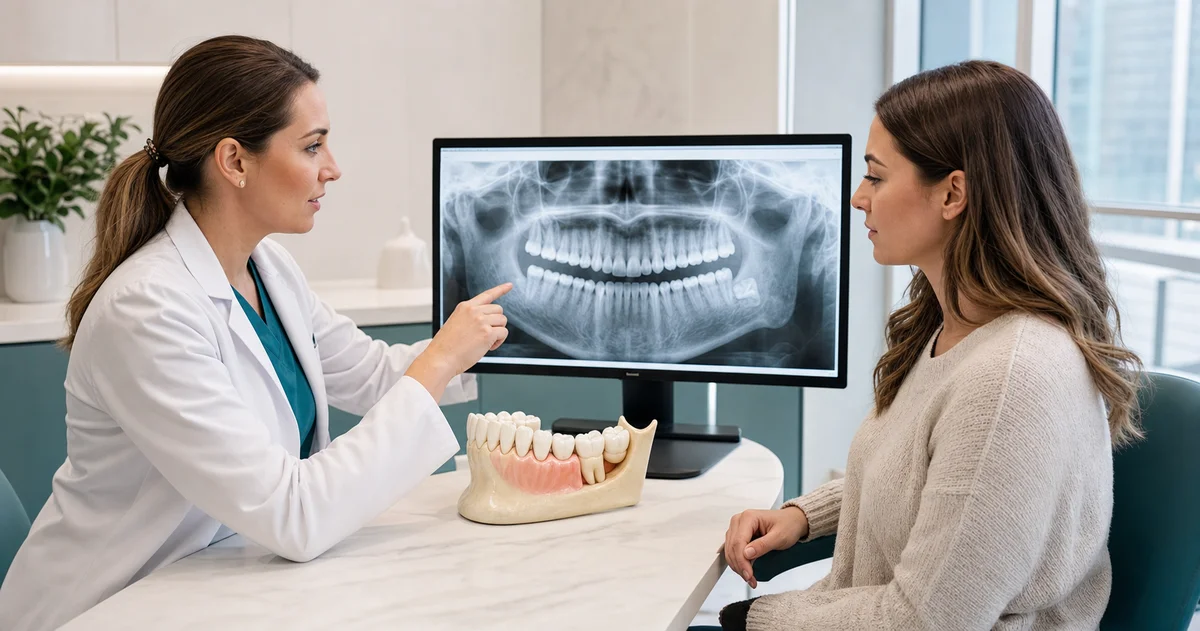
A panoramic dental radiograph is commonly considered when it will clarify tooth position, root form, adjacent structures and potential pathology. Some cases need additional three-dimensional imaging because a specific question cannot be answered adequately on a two-dimensional image. More imaging is not automatically better; the expected benefit should justify the exposure and cost. The wisdom tooth removal best option should follow the combined clinical picture, not one dramatic-looking image viewed in isolation.
A trustworthy wisdom tooth removal best option connects the history, examination and necessary imaging to one clear tooth-specific recommendation.
7. A decision table for the wisdom tooth removal best option
| Clinical situation | Option a clinician may discuss | Potential advantage | Important trade-off |
|---|---|---|---|
| Disease-free, symptom-free and reviewable tooth | Active monitoring and hygiene | Avoids immediate surgical exposure | Requires reliable review and attention to change |
| Fully erupted, accessible tooth with an indication for removal | Simple extraction under local anaesthetic | May involve less tissue manipulation | Suitability cannot be assumed without examination |
| Impacted or difficult tooth with diagnosed disease | Planned surgical extraction | Controlled access and sectioning can improve safety | Swelling, pain, dry socket, infection and nerve risks need consent |
| Selected lower tooth with high nerve proximity | Specialist review and possible coronectomy | May reduce direct manipulation near the nerve | Retained roots require selection and possible follow-up |
| Spreading infection or systemic illness | Urgent clinical assessment | Prioritises airway and infection safety | Definitive extraction timing depends on stabilisation and assessment |
This table is a conversation aid, not a remote treatment selector. The same symptom can arise from a neighbouring tooth, jaw joint, sinus or another condition. Only an examination can identify the source and determine whether one of these pathways is relevant.
8. Choosing the right clinician and setting
A general dentist can assess wisdom teeth and perform many extractions. Referral to an oral surgeon or oral and maxillofacial surgeon may be sensible when anatomy is complex, a tooth is deeply impacted, nerve or sinus proximity is concerning, there is significant medical complexity, or the proposed anaesthetic requires a facility with additional capabilities.
Experience is only one part of a safe setting. Ask how imaging is reviewed, how complications are handled, who is available after the procedure and where urgent care would be provided. If you are considering treatment while travelling, plan sufficient time for review before flying home and establish who will manage an unexpected problem after you leave. You can contact Redent Klinik to request an individual assessment rather than relying on a generic package.
9. Local anaesthetic, sedation or general anaesthetic?
Local anaesthetic numbs the operative area and is sufficient for many wisdom tooth procedures. Sedation may help an anxious patient remain relaxed while still receiving local anaesthetic. General anaesthetic is reserved for selected circumstances and requires a suitable clinical environment, pre-assessment, fasting instructions and post-procedure supervision. Greater anaesthetic intensity is not automatically a better experience or a safer operation.
The wisdom tooth removal best option includes the least intensive anaesthetic technique that can support safe, humane treatment. Complexity, anxiety, ability to cooperate, medical history and the number of teeth planned for treatment all matter. Ask which professional will provide sedation or anaesthesia, what monitoring is used, what recovery arrangements are required and when it is safe to drive, work or make decisions afterward.
10. One tooth or several: what is the wisdom tooth removal best option?
Removing every wisdom tooth in one visit may reduce the number of treatment episodes, but it also increases the amount of healing that occurs at once. Treating only the tooth with a clear indication can limit intervention, yet another tooth might later develop an independent problem. Neither strategy is universally superior.
Ask the clinician to explain the indication for each tooth separately. A healthy tooth should not be bundled into surgery merely because another tooth needs removal. Conversely, two teeth with documented disease may reasonably be treated together if the medical, anaesthetic and recovery plan supports it. A written tooth-by-tooth plan makes consent clearer.
11. Infection and the timing of the wisdom tooth removal best option
Local inflammation around a partly erupted wisdom tooth can cause pain, swelling, food trapping and a bad taste. Management may include cleaning the area, improving access for hygiene, addressing biting trauma and deciding whether recurrent or severe disease supports later removal. Antibiotics are not a substitute for dental treatment and are not needed for every local episode; their use depends on clinical findings such as spreading infection or systemic involvement.
NICE notes that plaque formation alone is not an indication for surgery and that a first episode of pericoronitis, unless particularly severe, should not automatically trigger removal; subsequent episodes may alter the indication. The decision remains clinical. A patient with rapidly increasing swelling, difficulty breathing or swallowing, uncontrolled bleeding, severe worsening pain, fever or marked illness needs urgent professional assessment rather than an online comparison.
12. Understanding surgical risks before choosing
Valid consent is more than signing a form. The clinician should describe the expected benefit, reasonable alternatives, material risks, uncertainties and what happens if the tooth is retained. Risks vary by tooth position and patient; a generic list cannot quantify your personal likelihood.
The consent conversation is part of the wisdom tooth removal best option because the patient must understand both intervention and monitoring before choosing.
- Pain, swelling and jaw stiffness: common short-term effects whose intensity depends on procedure and individual healing.
- Bleeding: usually controlled with local measures, but persistent bleeding needs advice.
- Dry socket: painful delayed healing associated with loss or breakdown of the protective clot.
- Infection: may cause worsening pain, swelling, bad taste, fever or feeling unwell.
- Nerve disturbance: lower wisdom-tooth surgery can affect lip, chin or tongue sensation; this may be temporary and can occasionally persist.
- Adjacent damage: nearby teeth, restorations, bone or, for upper teeth, the sinus can be relevant.
- Anaesthetic effects: local anaesthetic, sedation and general anaesthetic each have distinct considerations.
The NHS lists dry socket, infection and nerve damage among possible complications and advises that risks be discussed before treatment. Personalised consent should identify which items are most relevant to your anatomy, health and proposed technique.
13. Preparing for the wisdom tooth removal best option
Preparation reduces avoidable disruption and creates a safer recovery environment. Give the clinic an accurate medicine and medical history, including anticoagulants, antiplatelet medicines, immune-suppressing drugs, diabetes, allergies, pregnancy and previous anaesthetic problems. Do not stop prescribed medicine unless the responsible clinician tells you how and why.
- Confirm which tooth or teeth are planned and why each is being treated.
- Review the anaesthetic and any eating, drinking, escort or driving restrictions.
- Arrange time for recovery that matches the expected complexity and your work.
- Prepare suitable soft foods and obtain clinician-approved pain relief in advance.
- Ask how to reach the team after hours and where urgent complications are treated.
- Avoid scheduling treatment immediately before essential travel or an important event.
14. Recovery after the wisdom tooth removal best option
Recovery advice should come from the treating clinician because the operation, medicines and medical history differ. In general, protecting the blood clot, keeping the mouth appropriately clean, eating manageable food and avoiding smoking support healing. Vigorous rinsing, forceful spitting or disturbing the site soon after extraction can interfere with the clot. Follow the clinic’s timing for brushing and gentle rinsing.
The NHS notes that pain and swelling may occur and should begin to improve rather than progressively worsen. Difficulty chewing, bruising and jaw stiffness can occur after more involved removal. Seek advice if bleeding will not stop, pain or swelling is severe or worsening, pain is accompanied by a bad taste, or you develop fever or feel unwell. Emergency breathing or swallowing difficulty requires immediate emergency help.
15. Cost and value in the wisdom tooth removal best option
Cost depends on what is clinically required: consultation, imaging, tooth position, simple or surgical technique, number of teeth, clinician and facility, local anaesthetic or sedation, medicines, pathology testing and follow-up. A single advertised extraction fee may omit important components and cannot reveal whether the plan is appropriate.
Request a written, itemised treatment plan after assessment. It should identify the tooth, technique, anaesthetic, included follow-up and how an unexpected change would be handled. Insurance rules, waiting periods, exclusions, referral requirements and annual limits vary. Confirm benefits directly with the insurer and ask the clinic which items are billed separately. The cheapest quote is not the wisdom tooth removal best option if it leaves diagnostic, anaesthetic or aftercare gaps.
16. Questions that reveal whether a plan is truly personalised
- What diagnosed problem makes treatment appropriate now?
- What are the benefits and risks of monitoring this specific tooth?
- Is the procedure expected to be simple or surgical, and what could change that?
- How close are the roots to relevant nerves or the sinus?
- Would specialist review or coronectomy be reasonable in this anatomy?
- Why is the proposed anaesthetic appropriate for me?
- What symptoms are expected, and which require urgent contact?
- Who provides follow-up if I have treatment away from home?
- What is included in the written fee and what is not?
A clinician who can answer these questions clearly is helping you participate in shared decision-making. If the rationale remains unclear, it is reasonable to request clarification or an independent opinion before elective surgery.
17. Wisdom tooth removal best option for travel patients
Dental travel can be practical, but the calendar should not override clinical safety. Send recent records only through a secure method and expect an in-person assessment to confirm any preliminary opinion. Build in time for examination, treatment and review. Do not assume you can fly immediately after surgery or that a remote message can replace examination if a complication develops.
Ask for a treatment summary, the tooth number, the technique used, medicines provided, imaging and the clinic’s emergency contact route. Also identify a dentist near home who can examine you if necessary. Continuity is part of the wisdom tooth removal best option, especially when the proposed procedure is complex or follow-up is important.
18. Common myths about the wisdom tooth removal best option
“All wisdom teeth must come out.” Official UK guidance does not support prophylactic removal of pathology-free impacted teeth. Monitoring may be appropriate.
“No pain means no problem.” Some disease can be quiet, which is why examination matters; absence of pain is reassuring but not a complete diagnosis.
“An impacted angle always means surgery.” Position informs risk and cleanability, but an image alone does not establish an indication.
“General anaesthetic is the premium choice.” The safest suitable anaesthetic depends on treatment complexity and the patient, not status.
“Antibiotics fix a wisdom tooth.” Antibiotics may be indicated for selected infections, but they do not correct impaction, decay or a persistent local cause.
Frequently asked questions about wisdom tooth removal best option
Is removal always the wisdom tooth removal best option?
No. A healthy, symptom-free wisdom tooth may be monitored when it can be reviewed and no pathology is present. Removal becomes more relevant when examination and imaging identify disease, repeated significant problems or damage that cannot be managed predictably while retaining the tooth. The decision should be made tooth by tooth.
Is early surgery the wisdom tooth removal best option?
Age alone does not establish an indication. Younger people may heal differently from older people, while surgery still carries real risks at any age. The question is whether the expected benefit of treatment now outweighs the risks of surgery and the risks of monitoring in your particular case.
Is local anaesthetic enough for the wisdom tooth removal best option?
Local anaesthetic is sufficient for many simple and surgical extractions. Sedation or general anaesthetic may be considered for selected complexity, anxiety or medical circumstances. Your clinician should explain why the proposed level is appropriate, the monitoring involved and the recovery restrictions.
Can coronectomy be the wisdom tooth removal best option?
It can be considered for selected lower wisdom teeth when full root removal appears to carry increased nerve risk and the tooth meets clinical suitability criteria. It leaves roots intentionally, so the surgeon should explain follow-up, possible root movement and circumstances that could require further treatment.
Should all four teeth be removed in the wisdom tooth removal best option?
Not automatically. Each tooth needs its own indication and risk assessment. Treating several indicated teeth in one visit can reduce the number of procedures, while limiting treatment to one tooth can reduce the amount of healing at once. A written tooth-by-tooth rationale helps you compare those trade-offs.
Does an X-ray decide the wisdom tooth removal best option?
Imaging informs the decision but does not replace symptoms, examination and medical history. It may show impaction, root form, adjacent-tooth effects and proximity to a nerve or sinus. The best plan integrates those findings and uses additional imaging only when it is expected to answer a relevant clinical question.
What if I am afraid of the wisdom tooth removal best option?
Tell the team before treatment. They can explain the procedure, agree communication signals, allow appropriate pacing and discuss behavioural support or sedation when indicated. Anxiety deserves care, but the anaesthetic plan should still be proportionate to the procedure, your health and the capabilities of the setting.
How long is recovery after the wisdom tooth removal best option?
Recovery varies with the tooth, technique, number of sites, anaesthetic, health and type of work. Discomfort and swelling should generally move toward improvement rather than worsening. Use the treating team’s instructions and recovery estimate rather than planning around a universal online timetable.
When should I seek urgent help after wisdom tooth removal?
Contact the treating clinic or an urgent dental service for bleeding that does not stop, severe or worsening pain or swelling, bad taste with fever, or feeling markedly unwell. Difficulty breathing or swallowing, rapidly spreading swelling or other signs of an airway threat require immediate emergency care.
How do I compare quotes for the wisdom tooth removal best option?
Compare the diagnosis, tooth number, technique, clinician, facility, anaesthetic, imaging, medicines, follow-up and complication arrangements—not only the headline amount. Ask for an itemised written plan after assessment and verify insurance terms directly. A low figure without a complete safety pathway is not a meaningful comparison.
What is the final wisdom tooth removal best option?
The final option is the one chosen after informed, individual assessment: monitor a healthy tooth, use simple extraction when accessible, plan surgical extraction when controlled access is needed, consider specialist care or coronectomy for selected higher-risk anatomy, and establish recovery and follow-up before treatment. No article can select that option without examining you.
Evidence-based conclusion
The wisdom tooth removal best option is not synonymous with removal. It is a proportionate pathway that treats diagnosed disease while avoiding unnecessary intervention. Monitoring, simple extraction, surgical extraction, coronectomy, specialist referral and anaesthetic choices each have a place when supported by the clinical situation.
Prioritise a clear diagnosis, tooth-specific rationale, appropriate imaging, informed consent, a written plan and accessible aftercare. Seek urgent help for airway symptoms, spreading swelling, uncontrolled bleeding or systemic illness. For an elective decision, take the time to understand why the expected benefit is greater than the risks of both intervention and retention.
Sources and clinical guidance
- National Institute for Health and Care Excellence (NICE): Guidance on the extraction of wisdom teeth
- NHS: Wisdom tooth removal, indications, procedure, recovery and complications
- University College London Hospitals NHS Foundation Trust: Wisdom tooth surgery and coronectomy
- American Dental Association MouthHealthy: Extractions and recovery
- American Dental Association
- World Health Organization: Oral health fact sheet