
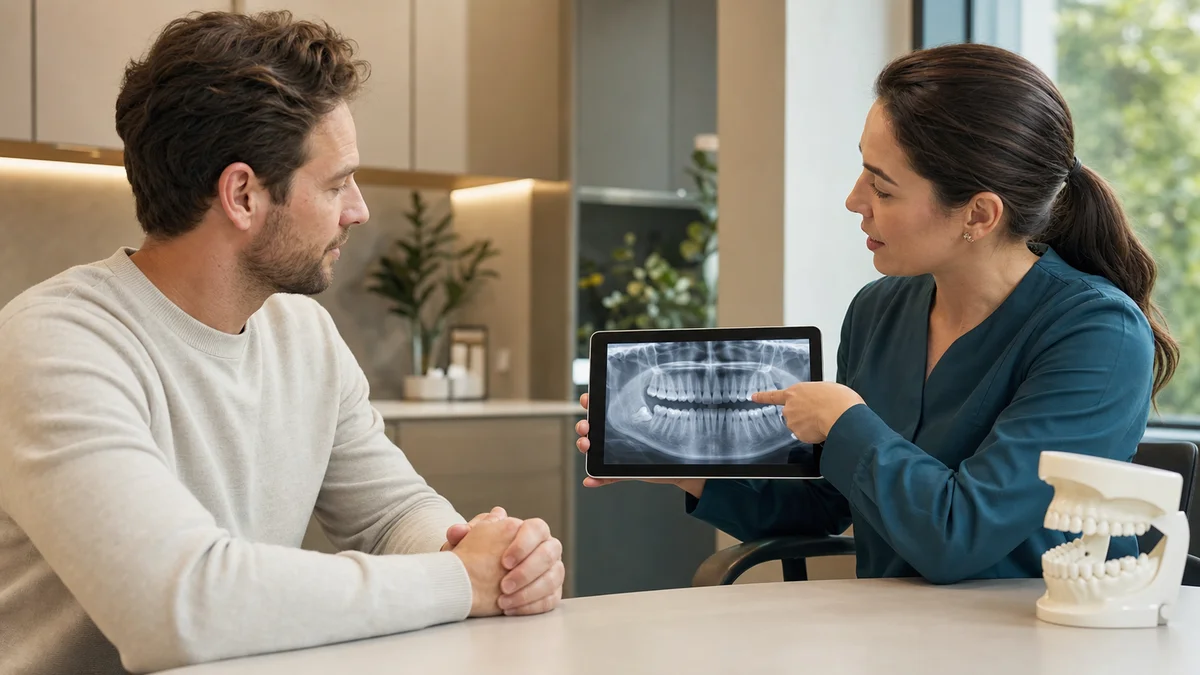
Quick answer: The main benefits are treating a tooth that is repeatedly infected, badly decayed, cystic or damaging its neighbour. The disadvantages include an irreversible operation, pain, swelling, dry socket, infection and possible nerve injury. A careful review of wisdom tooth removal pros and cons should compare removal with structured monitoring for your specific tooth.
Searching for wisdom tooth removal pros and cons usually means you have reached a real decision point: a dentist has found a third molar on an examination or X-ray, you have had symptoms, or you want to know whether a quiet tooth should be removed before it becomes troublesome. There is no responsible one-line answer for every patient. A healthy, cleanable and disease-free wisdom tooth is not the same clinical problem as a partly erupted tooth with repeated inflammation, an unrestorable cavity or damage to the second molar.
The safest decision starts with a diagnosis, not an assumption that all wisdom teeth are “bad.” It should identify what is happening now, what is likely to happen if the tooth is monitored, how difficult removal may be and which structures are nearby. The wisdom tooth removal pros and cons also change with age, general health, medication, pregnancy plans, smoking or nicotine use, access to follow-up care and the position of the roots relative to the lower-jaw nerve or upper sinus.
This guide is educational and cannot diagnose a tooth from symptoms or an image alone. It is written for review by Dentist Esma Çevrük Çakır and prioritises informed consent, proportionate imaging and patient-specific planning. If you have facial swelling that is spreading, difficulty breathing or swallowing, uncontrolled bleeding, fever with worsening illness, or a severe allergic reaction, seek urgent local medical or dental care rather than relying on an online guide.
1. What the wisdom tooth removal pros and cons decision is really about
A wisdom tooth, or third molar, is the last tooth at the back of a dental arch. It may erupt into a useful and cleanable position, emerge only partly, remain under gum or bone, or lean toward the tooth in front. “Impacted” describes a tooth that cannot erupt normally because of its position or lack of space; it does not, by itself, prove that surgery is necessary.
Official guidance supports this distinction. The NHS says a wisdom tooth that is not causing problems will usually be left in place and monitored at routine dental checks. The American Dental Association (ADA) notes that a healthy, correctly erupted wisdom tooth can contribute to chewing, while retained wisdom teeth need ongoing cleaning and evaluation. NICE advises against routine prophylactic surgery for pathology-free impacted wisdom teeth in NHS practice. Its current overview also says the guidance is being updated, so the individual clinician must use current evidence, judgment and patient preferences rather than treating an older document as a substitute for assessment.
Therefore, a useful discussion of wisdom tooth removal pros and cons asks four separate questions:
- Present disease: Is there decay, gum disease, recurrent pericoronitis, an abscess, a cystic change, resorption or harm to the neighbouring tooth?
- Future manageability: Can the tooth and the area behind the second molar be cleaned, examined and reviewed predictably?
- Surgical complexity: How close are the roots to a sensory nerve, the upper sinus or other important anatomy?
- Personal priorities: How do symptoms, uncertainty, recovery time, travel, cost and tolerance for surgical risk affect your choice?
A recommendation should name the problem being treated and explain why removal, monitoring or another option fits that problem. “You have wisdom teeth” is not a complete indication. Equally, the absence of pain does not prove the absence of disease; some decay or damage on the back of a second molar may be difficult to feel. Examination and justified imaging help bridge that gap when weighing wisdom tooth removal pros and cons.
2. When removal may offer a meaningful benefit
The strongest “pro” in the wisdom tooth removal pros and cons balance is the opportunity to remove a confirmed source of disease that cannot be predictably controlled another way. The ADA lists pain, infection, cysts, tumours, damage to neighbouring teeth, gum disease and tooth decay that is not practical to restore among reasons removal may be considered. The NHS similarly describes pericoronitis, food trapping, decay, gum disease, cysts and dental abscesses as problems associated with some wisdom teeth.
Removal may be reasonable when the expected benefit is concrete rather than speculative. Examples include:
- repeated episodes of inflammation or infection around a partly erupted tooth;
- an abscess or spreading infection requiring definitive source control after urgent care;
- decay that cannot be restored predictably because access and isolation are poor;
- periodontal damage or a cavity on the second molar attributable to the wisdom tooth’s position;
- a cyst, tumour, root resorption or other pathology confirmed through appropriate assessment;
- a tooth obstructing another necessary operation or a carefully planned course of dental treatment;
- a fractured or severely compromised tooth that cannot provide stable function.
In these situations, reviewing wisdom tooth removal pros and cons does not mean pretending the choices are equal. Leaving an active, non-restorable source of infection may carry avoidable harm. The relevant comparison is the risk and burden of a planned procedure versus the consequences of the documented disease, including possible emergency flare-ups. Antibiotics may be appropriate for selected infections, but they do not repair a cavity or permanently remove a local source when definitive treatment is indicated.
Another potential benefit is predictability. A planned procedure can be timed around work, caregiving and travel, with a clinician who has reviewed the anatomy and medical history. That does not guarantee an uncomplicated outcome, but it can be safer than repeatedly postponing care for a tooth already demonstrating disease. This practical predictability is one part of wisdom tooth removal pros and cons.
3. Why a quiet wisdom tooth may be monitored instead
The main counterweight in wisdom tooth removal pros and cons is that surgery is irreversible and pathology-free teeth may never cause a problem. NICE states that disease-free impacted wisdom teeth should not be removed routinely because reliable benefit from prophylactic removal has not been demonstrated and patients would still be exposed to operative risk. The NHS likewise says a tooth that is not causing problems is usually monitored.
Monitoring is not “doing nothing.” It is a planned strategy that depends on access to the tooth, the condition of the gum and neighbouring tooth, symptoms, and the ability to attend review. A monitoring plan might include routine clinical checks, attention to home cleaning, documentation of the baseline condition and new imaging only when findings or symptoms justify it. Repeating scans simply because time has passed may add cost and radiation without changing care.
The wisdom tooth removal pros and cons can favour monitoring when the tooth is:
- fully erupted, functional, painless and easy to clean;
- impacted but free of clinical and radiographic pathology;
- stable on prior records with a healthy second molar;
- located where surgical risk is disproportionate to the current benefit;
- present in a patient whose medical circumstances make elective surgery unusually risky at that time.
Monitoring has limitations. A tooth at the very back of the mouth can be difficult to inspect and clean. Disease can develop later, and future surgery may be technically different from surgery today. Those facts support review, not automatic extraction. The clinician should explain which symptoms or findings would trigger reassessment, how often routine care is appropriate and what uncertainty remains in the wisdom tooth removal pros and cons.
4. The surgical disadvantages and complications to understand
A balanced account of wisdom tooth removal pros and cons must make the “cons” specific. Common short-term effects can include soreness, swelling, bruising, jaw stiffness, altered eating and time away from normal activities. The NHS explains that a blood clot forms over the socket and supports healing. If that clot does not form properly or is dislodged, a painful condition called dry socket can occur.
Other recognised complications include infection, persistent bleeding, injury to a neighbouring tooth or restoration, delayed healing, retained fragments, and the need for additional treatment. Upper wisdom tooth removal may occasionally create a communication with the maxillary sinus. Lower wisdom tooth surgery may affect the inferior alveolar nerve, which supplies feeling to the lower lip and chin, or the lingual nerve, which supplies sensation and taste to part of the tongue. Altered sensation may be temporary; in some cases it can persist. Your personal risk cannot be estimated responsibly without reviewing the tooth and imaging.
Risk is not identical for every tooth. A fully erupted upper tooth with simple roots is a different operation from a deeply impacted lower tooth close to a nerve. Experience of the operator, surgical access, root shape, active infection, smoking or nicotine exposure, general health and adherence to aftercare can all influence planning. This is why internet lists of wisdom tooth removal pros and cons are a starting point for consent, not a personal risk calculator.
A clinician should explain material risks in a way you can understand, including any reasonable alternatives and what may happen without surgery. You should have a chance to ask questions before consenting. A guaranteed result, guaranteed absence of pain or promise that nerve injury is impossible would be misleading in any wisdom tooth removal pros and cons consultation.
5. A practical wisdom tooth removal pros and cons decision table
The table below organises the decision but does not replace an examination. The right-hand column highlights what would make each pathway safer and more defensible.
| Decision factor | Removal may be favoured when | Monitoring may be favoured when | What to confirm |
|---|---|---|---|
| Current disease | There is non-restorable decay, recurrent infection, abscess, cystic change, resorption or harm to the second molar. | The tooth and surrounding tissues are disease-free. | The diagnosis and the evidence supporting it. |
| Symptoms | Symptoms recur or correlate with a treatable wisdom-tooth problem. | There are no symptoms and no hidden pathology on justified assessment. | Whether pain could come from another tooth, the jaw joint or muscles. |
| Cleanability | Food trapping and inaccessible surfaces make disease control unreliable. | The tooth is cleanable and the patient can maintain it. | Gum probing, decay risk and the back surface of the second molar. |
| Anatomical risk | The disease-related benefit outweighs a manageable surgical risk. | The tooth is close to a nerve or sinus and present benefit is small. | Imaging findings and whether specialist input is appropriate. |
| Follow-up | Planned care is easier than managing repeated urgent episodes. | Reliable routine monitoring is accessible. | A review plan and clear triggers for earlier assessment. |
| Patient priorities | The patient accepts recovery and procedural risk to treat a defined problem. | The patient prefers surveillance after understanding uncertainty. | Work, travel, caregiving, cost and personal risk tolerance. |
Use the table to make the wisdom tooth removal pros and cons visible. If a recommendation changes when you ask what diagnosis is being treated, that is a reason to seek clarification. If the proposed plan is monitoring, ask what will be checked and what symptoms should bring you back sooner. Record the answer so the wisdom tooth removal pros and cons remain clear after the appointment.
6. Imaging, nerve proximity and the role of coronectomy
Clinical examination comes first. A dentist may use a panoramic radiograph to assess tooth angle, roots, neighbouring teeth and broad anatomical relationships. A three-dimensional cone-beam CT scan is not automatically necessary for every wisdom tooth. It may be considered when two-dimensional findings suggest a close relationship to the lower-jaw nerve and the added information is expected to change treatment. The benefit of extra detail, additional radiation and cost belongs in the wisdom tooth removal pros and cons.
If the roots of a lower wisdom tooth appear very close to the inferior alveolar nerve, a specialist may discuss coronectomy for selected teeth. In a coronectomy, the crown is removed while suitable roots are intentionally left in place. Current University College London Hospitals information explains that this can reduce, but not eliminate, the risk of nerve damage compared with full removal in appropriately selected cases. It also notes that decayed teeth or teeth with infection around the roots may not be suitable, and retained roots can migrate, become infected or require later treatment.
Coronectomy therefore adds another line to wisdom tooth removal pros and cons: it may lower a specific nerve risk, but it is not a universal compromise and it creates a need for informed follow-up. Ask why it is or is not appropriate, what happens if roots become mobile during surgery and whether a specialist referral would alter the plan.
7. Medical history, medicines and anaesthesia choices
Your health history can materially shift the wisdom tooth removal pros and cons. Tell the treating team about anticoagulants or antiplatelet medicines, antiresorptive drugs used for osteoporosis or cancer, immune-suppressing treatment, diabetes, bleeding disorders, kidney or liver disease, heart conditions, pregnancy or possible pregnancy, allergies, previous anaesthetic problems and all supplements. Never stop a prescribed medicine on your own to prepare for extraction.
Many wisdom teeth can be removed with local anaesthesia. Sedation or general anaesthesia may be considered for complexity, severe anxiety, medical factors or treatment setting. Deeper anaesthesia can add logistical requirements and its own risks, so it should serve a clear need. Ask who will administer it, what fasting rules apply, whether an escort is required, how long driving and important decisions must be avoided, and whom to contact after discharge. Anaesthesia choice is therefore part of the personal wisdom tooth removal pros and cons.
Pregnancy does not make all dental care impossible. Urgent infection requires timely professional attention, while elective timing, imaging and medicines should be coordinated with the dental and maternity teams as appropriate. Likewise, diabetes or immune suppression does not automatically prohibit surgery, but disease control, healing and infection risk may change the plan.
8. What recovery can involve without false promises
Recovery depends on the number and position of teeth, the operation, anaesthesia, personal health and the type of work you do. The NHS notes that pain, swelling, bruising, jaw stiffness and uncomfortable chewing can occur, often with improvement beginning after the first days, but individual courses vary. UCLH advises that swelling and bruising after coronectomy can peak around 48–72 hours and then resolve gradually. These are general expectations, not guarantees or deadlines.
Before choosing a date, include practical recovery in your wisdom tooth removal pros and cons:
- arrange transport and supervision if sedation or general anaesthesia requires it;
- allow flexibility for work, study, exercise and caregiving;
- have suitable soft foods and the clinician-approved pain plan available;
- avoid scheduling immediately before important travel or an event;
- know the clinic’s daytime and after-hours contact route.
Follow the personalised written instructions you receive. General NHS advice includes protecting the clot, cleaning carefully, using gentle rinses as directed, avoiding hard foods that may lodge in the socket, and not smoking. Advice on when rinsing begins can depend on timing and the procedure; follow the surgeon’s instructions rather than combining conflicting internet tips. Only use pain medicines that are safe for you, at the recommended dose, and do not use leftover antibiotics. The effort required for this aftercare is a real part of wisdom tooth removal pros and cons.
If bleeding does not stop with the instructed pressure, pain or swelling is severe or worsening, pain is accompanied by a bad taste and fever, or you feel systemically unwell, contact urgent dental services. Difficulty breathing or swallowing, rapidly spreading swelling, collapse or a severe allergic reaction requires emergency care. Red-flag planning should be documented when discussing wisdom tooth removal pros and cons.
9. Costs, insurance and the value of a written plan
There is no universal fixed fee for removal. Cost can vary by country, clinic, examination, imaging, tooth complexity, clinician or specialist, anaesthesia, facility, number of teeth, pathology testing, medicines and follow-up. Insurance rules, exclusions, waiting periods and referral requirements differ. An online price should not be treated as a personal quote.
Financial comparison belongs in wisdom tooth removal pros and cons, but it should not erase clinical need or informed consent. Ask for a written plan that separates the examination, imaging, surgical fee, anaesthesia or sedation, facility charges, prescribed medicines, follow-up and possible additional care. Confirm what the insurer requires directly with the insurer, including pre-authorisation and out-of-network rules.
If you are considering treatment away from home, include continuity of care, travel timing, access to the surgeon and management of complications. A low headline price can be misleading if it excludes diagnostics, anaesthesia or follow-up. These access questions belong in the wisdom tooth removal pros and cons. Redent Klinik can provide an individual assessment through its English contact page; a recommendation or quotation should follow review of the relevant clinical information. You can also explore the clinic’s wider services on the Redent Klinik English homepage.
10. Questions that improve informed consent
Good questions convert a generic list of wisdom tooth removal pros and cons into a personal decision. Consider taking these to your appointment:
- What exact diagnosis or risk are we treating?
- Can you show me the finding on the examination or X-ray?
- What are the reasonable alternatives, including monitoring?
- What is likely to happen if I wait, and how would we monitor safely?
- How close are the roots to the nerve or sinus?
- Would specialist assessment, further imaging or coronectomy change the risk?
- Which complications are particularly relevant to this tooth and my health?
- What anaesthesia is proposed, and why?
- What is included in the written cost estimate?
- Who should I contact if recovery differs from the plan?
A second opinion can be reasonable when the indication is uncertain, surgery is technically complex, the tooth is close to a nerve, different clinicians offer substantially different plans, or you do not feel you understand the alternatives. It is not disloyal to ask for records or clarification. A high-quality recommendation about wisdom tooth removal pros and cons should remain understandable when reviewed by another appropriately qualified clinician.
11. How to avoid common reasoning traps
One trap in wisdom tooth removal pros and cons is assuming that removing all four teeth at once is always efficient. It can reduce the number of treatment episodes in selected cases, but it may also increase the immediate recovery burden. Each tooth should have an indication and risk assessment. Another trap is assuming that “impacted” means “infected”; these terms describe different things.
A third trap is using pain alone to identify the source. Pain behind the jaw can arise from another tooth, inflamed gum, muscles or the temporomandibular joint. Removing the wrong target may not solve the symptom. A fourth is waiting for repeated antibiotics without reviewing source control when there is established dental disease. The correct wisdom tooth removal pros and cons comparison depends on an accurate diagnosis.
Finally, avoid guarantees in either direction. No clinician can promise that a retained wisdom tooth will never cause trouble, and no clinician can promise that removal will be complication-free. Honest care makes uncertainty explicit and uses it in shared decision-making about wisdom tooth removal pros and cons.
12. A patient-safety summary
The fairest summary of wisdom tooth removal pros and cons is not “remove early” or “never remove.” It is: treat documented disease when the expected benefit justifies the procedure; monitor healthy teeth when surveillance is reasonable; and tailor the plan to anatomy, health and patient preferences. Removal can relieve a defined source of infection or damage, but it exposes a patient to an operation. Monitoring preserves the tooth and avoids immediate surgical risk, but requires reliable care and acceptance of future uncertainty.
Before deciding, make sure you can name the diagnosis, the alternative, the material personal risks, the recovery plan and the follow-up route. That is the foundation of safe consent and a more useful interpretation of wisdom tooth removal pros and cons.
Frequently asked questions about wisdom tooth removal pros and cons
Do all impacted wisdom teeth need to be removed?
No. “Impacted” describes position, not necessarily disease. NICE advises against routine prophylactic removal of pathology-free impacted wisdom teeth, and the NHS says a tooth not causing problems will usually be monitored. The wisdom tooth removal pros and cons change if examination or imaging shows infection, decay, cystic change, gum disease or damage to another tooth.
Is pain enough reason to choose surgery?
Pain deserves assessment, but it is not a diagnosis. A dentist should determine whether the wisdom tooth is the source and whether the cause can be managed without removal. The wisdom tooth removal pros and cons are different for recurrent pericoronitis, a cavity, jaw-muscle pain and a symptom with no confirmed dental cause.
Can a symptom-free wisdom tooth still have a problem?
Yes. Some decay, gum damage or harm to the second molar may not cause early pain. That is why monitoring includes clinical review and justified imaging when findings would change care. Symptom-free does not mean “must remove,” but it also does not replace an examination of the personal wisdom tooth removal pros and cons.
Does removal prevent crowding of the front teeth?
Crowding has multiple causes, and the presence of wisdom teeth alone is not a sufficient reason to guarantee that removal will prevent future movement. If orthodontic care is involved, ask the orthodontist and surgeon to explain the specific objective and evidence. Include that objective explicitly in the wisdom tooth removal pros and cons discussion.
What is the difference between full removal and coronectomy?
Full removal takes out the crown and roots. Coronectomy removes the crown while intentionally retaining suitable roots, usually when a lower tooth is very close to the inferior alveolar nerve. It may reduce nerve risk in selected patients but has its own limitations and follow-up needs. It is not suitable for every tooth.
How long will recovery take?
There is no guaranteed timeline. Difficulty of surgery, number of teeth, anaesthesia, health and work demands matter. Pain, swelling, bruising and jaw stiffness are expected possibilities, and worsening symptoms need review. Ask for a personalised plan rather than relying on a single number from someone else’s experience of wisdom tooth removal pros and cons.
Should I stop blood thinners before wisdom tooth surgery?
Do not stop prescribed anticoagulant or antiplatelet medicine on your own. Tell the dentist or surgeon what you take and why. They may coordinate with the prescriber and use procedure-specific measures. Unsupervised interruption can create serious medical risk.
Can antibiotics replace removal?
Antibiotics may be used for selected infections, especially when there are systemic or spreading features, but they do not repair decay, remove a cyst or permanently resolve every local source. The definitive plan depends on the diagnosis and the personal wisdom tooth removal pros and cons. Repeated self-directed antibiotics are not a safe substitute for dental assessment.
When should I seek urgent help after removal?
Seek urgent dental advice for bleeding that does not stop, severe or worsening pain and swelling, bad taste with fever, or feeling increasingly unwell. Difficulty breathing or swallowing, rapidly spreading swelling, collapse or a severe allergic reaction requires emergency medical care. Follow the specific emergency instructions provided by your treating clinic.
Is a second opinion useful?
It can be, especially when the indication is unclear, nerve or sinus proximity makes surgery complex, or alternatives have not been explained. Bring the examination notes and images if possible. A second opinion should clarify the personal wisdom tooth removal pros and cons, not simply repeat a generic rule.
Sources and further reading
- National Institute for Health and Care Excellence (NICE): Guidance on the extraction of wisdom teeth (TA1)
- NICE: Wisdom teeth removal — patient notes
- NHS: Wisdom tooth removal, recovery and possible complications
- American Dental Association: Wisdom teeth
- American Dental Association
- University College London Hospitals: Advice for patients considering coronectomy
- NHS England: Oral surgery clinical standard
- World Health Organization: Oral health fact sheet