
Quick answer: There is no responsible universal percentage. Success begins with a valid reason for treatment, appropriate imaging and a procedure matched to anatomy. It can then be assessed through completion of the planned surgery, healing, symptom relief, preservation of nearby structures, absence or management of complications, and clear follow-up—not through a headline guarantee.
A search for wisdom tooth removal success rate can make a common operation sound like a single yes-or-no event. In reality, the outcome depends on why the tooth is being treated, whether it is upper or lower, erupted or impacted, its relationship to neighbouring teeth and nerves, the planned anaesthesia, the surgical approach, the patient’s health and the time point being measured. “The tooth was removed” is only one part of a patient-safe result.
It is equally important to ask whether removal is indicated. NICE guidance for the NHS recommends against routine prophylactic removal of pathology-free impacted wisdom teeth and limits surgical removal to teeth with evidence of disease or other defined clinical reasons. A Cochrane review found insufficient evidence to determine whether asymptomatic disease-free impacted wisdom teeth should routinely be removed or retained. Therefore, a credible wisdom tooth removal success rate begins with good selection, shared decision-making and monitoring when surgery is not chosen.
This guide does not diagnose your tooth, predict your personal outcome or promise uncomplicated healing. A dentist or oral and maxillofacial surgeon must take a medical and dental history, examine the mouth and interpret appropriate imaging. The safest question is not merely “What is the wisdom tooth removal success rate?” It is “What counts as success for this tooth, what could change the plan, and how will complications be prevented, recognised and managed?”
1. Why one wisdom tooth removal success rate cannot fit every patient
Studies and clinics may define wisdom tooth removal success rate differently. One may count complete removal during the planned appointment. Another may count absence of infection. Others may focus on pain, dry socket, nerve symptoms, return to usual activity, preservation of the second molar or patient satisfaction. These endpoints are related, but they are not interchangeable. A percentage without an endpoint does not explain the clinical outcome.
Follow-up duration changes the meaning as well. Early healing can be assessed over days and weeks, while altered sensation, root migration after a coronectomy or the health of the neighbouring second molar may need longer observation. A short-term wisdom tooth removal success rate should never be presented as proof that no later problem can occur.
Risk is not uniform across teeth, so a wisdom tooth removal success rate must describe anatomy. A fully erupted upper wisdom tooth may have a different procedure and risk profile from a deeply impacted lower tooth whose roots appear close to the inferior alveolar nerve. Age, smoking, medicines, bleeding conditions, diabetes, infection and surgical complexity may also affect planning or recovery. Research averages support consent, but they do not calculate an individual future with certainty.
2. The first success measure is choosing removal for the right reason
Indication is the first layer of a wisdom tooth removal success rate. The NHS explains that wisdom teeth may be removed when they are causing problems such as pain, swelling, gum infection around a partly erupted tooth, food trapping, decay, gum disease, a cyst or a dental abscess. NICE lists pathology such as unrestorable decay, non-treatable pulpal or periapical disease, cellulitis, abscess, osteomyelitis, resorption, fracture and cyst or tumour among reasons that may support removal of an impacted tooth. The diagnosis must apply to the individual tooth.
Symptoms alone do not always identify the source. Pain at the back of the jaw can arise from an adjacent tooth, jaw muscle, joint or another condition. AAOMS guidance begins with history, examination and imaging to determine symptoms, eruption status, function, caries, periodontal health, root anatomy and relationships to structures such as the second molar, nerve canal and maxillary sinus. Accurate source identification improves the meaning of a wisdom tooth removal success rate.
An operation-free decision will not appear in a surgical wisdom tooth removal success rate. If an impacted tooth is asymptomatic and disease-free, monitoring may be reasonable. Cochrane found the evidence insufficient to say that all such teeth should be removed or retained and advises regular clinical assessment when they remain. Monitoring is an active plan, not neglect. It should define routine reviews, relevant imaging when indicated and symptoms that require earlier contact.
Questions that establish the indication
- Which finding is caused by this wisdom tooth rather than another source?
- Is there current disease, a recurring problem or a planned procedure it obstructs?
- What are the reasonable options: monitoring, local management, full removal or coronectomy?
- What could happen if treatment is delayed, and how certain is that estimate?
- How will retaining the tooth affect the neighbouring second molar and cleaning access?
- Which new symptoms or findings would change a monitoring decision?
3. Define wisdom tooth removal success rate with nine outcomes
A useful wisdom tooth removal success rate separates the surgical objective from healing and long-term function. The following table is a discussion aid, not a personal prediction. Your clinician may prioritise different outcomes based on the tooth, diagnosis and chosen procedure.
| Outcome | What can be assessed | Relevant time | What it does not guarantee |
|---|---|---|---|
| Valid indication | Documented disease, symptoms or procedural reason | Before consent | That surgery has no risk |
| Planned procedure completed | Full extraction, coronectomy or modified plan as consented | At surgery | Instant healing |
| Nearby structures protected | Second molar, nerves, sinus and bone managed appropriately | During and after surgery | Zero chance of temporary symptoms |
| Bleeding controlled | Clot formation and expected wound behaviour | First hours and days | Absence of every later complication |
| Pain and swelling follow an expected trend | Symptoms begin to improve rather than worsen | Early recovery | The same timetable for all patients |
| No dry socket or infection | Clinical symptoms and examination when needed | Days after surgery | That preventive antibiotics were required |
| Sensation preserved or recovering | Lip, chin and tongue feeling compared with baseline | Immediately and over follow-up | Identical nerve risk for every lower tooth |
| Function returns | Eating, speaking, mouth opening and usual activity | During recovery | No temporary restriction |
| Follow-up completed | Wound or retained roots reviewed when indicated | Short and longer term | That future dental care is unnecessary |
If a clinic quotes a high wisdom tooth removal success rate, ask which table row it measures. Also ask whether the statistic is per tooth, per operation or per patient; whether simple and complex teeth were mixed; how long people were followed; and whether those lost to follow-up were counted. A number that only means “the intended tooth left the mouth” says little about recovery or complications.
4. Examination and imaging make the risk discussion personal
Clinical assessment should include symptoms, mouth opening, eruption status, gum tissue, decay, periodontal condition, the second molar and signs of infection or other disease. Tell the clinician about medicines, allergies, pregnancy, smoking or vaping, diabetes, bleeding disorders, immune conditions, previous anaesthetic problems and any altered sensation already present. These details can affect both the plan and interpretation of a wisdom tooth removal success rate.
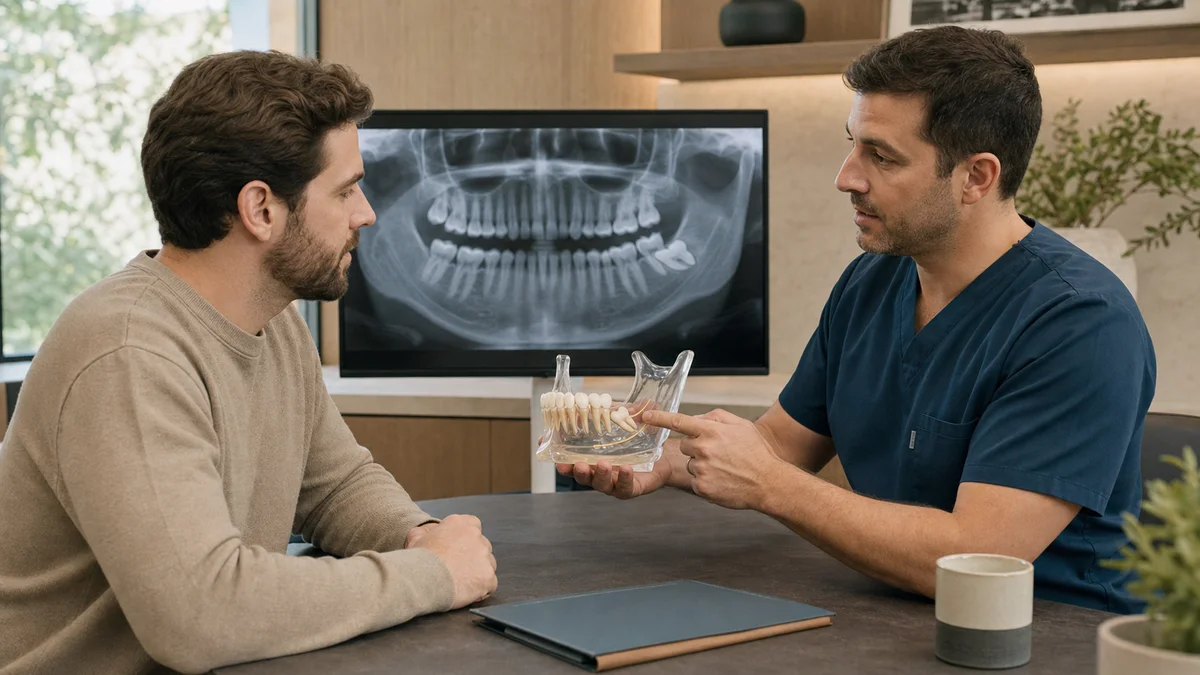
Imaging context makes a wisdom tooth removal success rate comparable. A conventional dental radiograph often shows the tooth’s angulation, roots and proximity to relevant anatomy. AAOMS states that imaging helps determine root anatomy and relationships to the inferior alveolar nerve, second molar and maxillary sinus. A three-dimensional cone-beam CT is not automatically required for every wisdom tooth; it may be considered when two-dimensional imaging leaves a clinically important question.
For a lower wisdom tooth, the inferior alveolar nerve supplies feeling to the lower lip and chin, while the lingual nerve supplies sensation and taste to part of the tongue. The surgeon should explain whether imaging suggests close contact and how that changes options. A diagram or model can help, but only the patient’s own images can support their individual risk discussion.
What if the roots appear close to the nerve?
When an indicated lower wisdom tooth is close to the inferior alveolar nerve, a specialist may discuss coronectomy. This removes the crown while intentionally leaving suitable roots in place to reduce nerve-injury risk. UCLH explains that not every tooth is suitable; root infection or decay may exclude the option, roots may loosen during surgery, and retained roots can later move or require treatment. A coronectomy wisdom tooth removal success rate therefore uses a different endpoint from full extraction.
5. Full extraction and coronectomy are different planned successes
For full extraction, the wisdom tooth removal success rate usually treats safe removal of the intended tooth or tooth sections as one goal. Depending on position, the clinician may make an incision, remove a small amount of bone or divide the tooth into sections. Dividing a tooth is a surgical technique, not evidence that something has gone wrong. The exact approach depends on anatomy and the operator’s judgement.
For coronectomy, roots are deliberately retained. Calling retained roots an incomplete extraction would misrepresent the agreed procedure. Success can mean removal of the problematic crown while reducing disturbance to a closely related nerve. Follow-up must account for possible root migration, exposure or infection. This distinction is essential in any published wisdom tooth removal success rate.
A plan can also change during surgery. For example, roots intended for coronectomy may become mobile and need removal, or unexpected anatomy may require a modified approach. Consent should cover reasonably foreseeable changes and who will decide. No surgeon can guarantee in advance that an operation will follow a single unaltered sequence.
6. Anaesthesia safety belongs inside the outcome
Anaesthesia is part of a complete wisdom tooth removal success rate. Many wisdom teeth can be treated with local anaesthesia. Sedation or general anaesthesia may be considered according to complexity, anxiety, health, setting and patient preference. “Being asleep” is not automatically safer or more successful. Each method has preparation, monitoring, recovery, transport and fasting implications that should be explained by the responsible team.
Tell the clinician about all prescribed and non-prescribed medicines, supplements, allergies, previous anaesthesia reactions, sleep apnoea, heart or lung conditions and recreational drug use. Follow fasting and escort instructions exactly when they apply. If instructions are unclear, contact the provider rather than guessing. Anaesthesia events should be part of the denominator in a complete wisdom tooth removal success rate.
Ask who administers and monitors sedation or general anaesthesia, what credentials and emergency systems are present, and when you may drive, work or make important decisions. NHS advice says not to drive for the specified period after general anaesthesia or sedation; use the personalised discharge instructions because medicines and local regulations vary.
7. Expected recovery is a trend, not a fixed deadline
The NHS notes that pain and swelling are common after wisdom tooth removal and should generally start to improve after the first days, although soreness, bruising, stiffness and chewing discomfort can continue during a recovery period that may extend to around two weeks. Difficulty of removal, number of teeth, anaesthesia, health and individual healing influence timing. One person’s return to work is not a valid benchmark for another.
Measure your early wisdom tooth removal success rate against the instructions you received: Is bleeding controlled with pressure? Are pain and swelling following the expected direction? Can you drink, take permitted medicines and maintain safe oral hygiene? Contact the surgical team if the trend is unexpectedly worse, rather than comparing images on social media.
Clot protection affects the early wisdom tooth removal success rate. A blood clot forms in the socket and supports healing. The NHS advises gentle cleaning, care around the wound, and avoiding hard or crunchy foods that may lodge in the area. It also advises avoiding smoking because it can increase infection risk. Follow the surgeon’s written instructions on rinsing, food, activity, alcohol and tobacco because advice may change with the procedure and timing.
What is normal after wisdom tooth removal?
Some pain, swelling, bruising, jaw stiffness and temporary chewing discomfort can be expected. The pattern should generally improve rather than become progressively severe. A reassuring early wisdom tooth removal success rate does not require zero discomfort. It requires symptoms compatible with the procedure, manageable care and access to assessment if recovery departs from the advised course.
8. Dry socket, infection and bleeding must be recognised early
Dry socket is a separate endpoint within a wisdom tooth removal success rate. Dry socket, or alveolar osteitis, is a painful condition in which the socket’s protective clot is absent or disrupted before healing is established. It is not simply ordinary soreness. Increasing or severe pain after initial improvement, sometimes with an unpleasant taste or smell, warrants professional assessment. Treatment is clinical and should not be improvised with substances placed into the socket.
Infection can present with worsening pain or swelling, fever, feeling unwell, pus or a bad taste. The NHS advises urgent dental help for severe or worsening pain and swelling not helped by pain relief, pain with a bad taste, high temperature or feeling unwell. Antibiotics are not a universal requirement for every extraction; the clinician weighs individual infection risk, benefits, adverse effects and antimicrobial resistance.
Oozing can occur early, but bleeding that does not stop with the advised pressure requires prompt contact. Seek emergency help for difficulty breathing or swallowing, rapidly spreading facial or neck swelling, collapse or another severe reaction. These events matter even if a clinic defines its wisdom tooth removal success rate only by completed extractions.
How can I lower the chance of dry socket?
Follow the surgical team’s instructions, avoid smoking or vaping, do not disturb the socket, use rinses only as directed and keep food away from the wound as advised. Risk cannot be reduced to zero. A preventive claim should specify the intervention and evidence; no product or technique can guarantee the wisdom tooth removal success rate for an individual.
9. Nerve symptoms require a baseline, consent and follow-up plan
Nerve outcomes need their own wisdom tooth removal success rate. Lower wisdom teeth can lie near the inferior alveolar and lingual nerves. Injury may cause numbness, tingling, altered feeling, burning or altered taste involving the lip, chin, gums or tongue. The NHS notes that nerve symptoms often improve but can persist for weeks or months and, in some cases, longer. The risk depends substantially on anatomy and procedure.
Before surgery, report any existing numbness or altered sensation. Ask the surgeon to show the relevant relationship on imaging and explain whether full removal, coronectomy or monitoring is appropriate. A nerve-specific wisdom tooth removal success rate should distinguish temporary from persistent change, name which nerve was assessed and report follow-up duration.
If altered sensation occurs, contact the treating team as instructed so it can be documented and monitored. Do not wait for a routine visit if the provider asked for immediate reporting. Early assessment does not guarantee a particular recovery, but it establishes a clinical baseline and appropriate pathway.
10. Pain control should be effective and medically appropriate
The ADA living guideline states that nonsteroidal anti-inflammatory medicines such as ibuprofen or naproxen, alone or combined with acetaminophen, can effectively manage acute pain for many adults and adolescents after extraction. These medicines are not safe for everyone. Medical conditions, pregnancy, ulcers, kidney or liver disease, blood thinners, allergies, interactions and age can change what is appropriate.
Use only the medicine and dose advised for you or permitted by the label and a qualified professional. Do not combine products without checking active ingredients, and do not use somebody else’s prescription. If the pain plan is inadequate or causes an adverse effect, contact the dental or medical team rather than increasing doses on your own.
Pain scores alone do not define the wisdom tooth removal success rate. A patient can have expected temporary pain with good healing, or surprisingly little pain while another issue develops. The direction of symptoms, wound findings, function and clinical review provide the fuller picture.
11. Smoking, health conditions and medicines can alter recovery
Smoking is associated with poorer oral healing and the NHS advises not smoking after wisdom tooth removal because it can increase infection risk. Ask for cessation support before surgery when possible. Avoid shaming: nicotine dependence is a health condition, and clear planning is more useful than assuming every patient can stop without help.
Diabetes, immune conditions, bleeding disorders and medicines that affect clotting, bone or immune response may change preparation or follow-up. Do not stop an anticoagulant, antiplatelet drug, diabetes medicine or any prescribed treatment unless the responsible prescriber and dental team direct it. Uncoordinated changes can create serious risk.
Your personal wisdom tooth removal success rate is better informed when the team has an accurate medication list, medical history and contact with other clinicians when needed. Concealing health information to keep an appointment can make treatment less safe. Ask how the plan accommodates your condition rather than seeking a generic percentage online.
12. A second-molar outcome may matter as much as the wisdom tooth
The adjacent tooth belongs in the wisdom tooth removal success rate. An impacted or partly erupted wisdom tooth can affect cleaning, decay or periodontal health around the adjacent second molar. Removal can also carry a risk of damage to nearby teeth or restorations. The preoperative record should note the second molar’s condition so later changes are not automatically attributed to surgery or overlooked.
If the wisdom tooth is monitored, ask how the second molar will be examined. If removal is planned, ask whether existing decay, gum disease or root damage needs separate treatment. A complete wisdom tooth removal success rate should report preservation of adjacent structures, not only removal of the third molar.
Upper wisdom teeth may also be near the maxillary sinus. The surgeon should explain relevant risks and what signs require contact. Do not assume that every upper extraction communicates with the sinus or that every sensation of nasal pressure indicates a complication; assessment is required.
13. Read success claims like a clinical study
When you encounter a published wisdom tooth removal success rate, first identify the group. Were teeth fully erupted, partially erupted or deeply impacted? Were upper and lower teeth combined? Were patients healthy? Were coronectomies included? A mixed group can make a simple case look riskier or a complex case look safer than it is.
Next identify the outcome and denominator. A per-tooth rate differs from a per-patient rate when several teeth are removed at once. “No major complication” may omit pain, dry socket or temporary altered sensation. “Successful coronectomy” may allow stable retained roots by design. Read definitions before comparing percentages.
Finally, inspect time and missing data behind the wisdom tooth removal success rate. A review at one week cannot determine long-term nerve recovery or retained-root behaviour. Patients who do not return may have recovered uneventfully or sought care elsewhere. A credible source reports follow-up and uncertainty rather than offering a lifetime guarantee.
Eight questions for any percentage claim
- What diagnosis or indication did the treated teeth have?
- What exactly counted as success, and who measured it?
- Was the result per tooth, per operation or per patient?
- Were upper, lower, simple, impacted and coronectomy cases separated?
- What anaesthesia, technique and aftercare were used?
- How long was follow-up and how many people were lost?
- Were dry socket, infection, bleeding and nerve changes all reported?
- Why does the clinician believe the evidence applies to your anatomy?
14. A practical decision pathway before consent
First, confirm the indication and alternatives. Ask whether the tooth has disease, is contributing to repeated symptoms or affects another planned procedure. If it is asymptomatic and disease-free, discuss active monitoring and the uncertainty described by NICE and Cochrane. Appropriate non-operation can be a successful decision, even though it never enters a surgical wisdom tooth removal success rate.
Second, review imaging and procedure-specific risks. Confirm whether the plan is full extraction, coronectomy or another approach; which nearby structures matter; and whether further imaging would change management. Review anaesthesia, medicines, transport, time away and the written recovery plan.
Third, define follow-up and urgent contact. Know who to call outside office hours, which symptoms need same-day advice and whether a planned review is required. Retain your imaging and procedure record, especially if roots remain after coronectomy. A safe pathway continues after you leave the chair.
Patients considering an assessment in Istanbul can review the English-language Redent Klinik website and use the Redent Klinik contact page to request individual information. Photographs or remote messages cannot show every anatomical relationship or replace examination and consent. Travel should allow safe recovery, access to urgent care and appropriate follow-up.
15. Frequently asked questions
What is the average wisdom tooth removal success rate?
There is no single responsible average wisdom tooth removal success rate. Results depend on the indication, tooth position, upper or lower jaw, nerve and sinus relationships, procedure, patient health, endpoint and follow-up. Ask for the outcome that matters in your case: planned completion, uncomplicated healing, symptom relief, nerve preservation or another defined goal.
Is wisdom tooth removal always successful?
No surgery is guaranteed. Removal is common and often straightforward, but dry socket, infection, bleeding, injury to nearby structures and temporary or persistent altered sensation can occur. Good assessment, appropriate technique, informed consent and accessible follow-up improve safety without making the personal wisdom tooth removal success rate certain.
Should a painless impacted wisdom tooth be removed?
Not automatically. NICE advises against routine prophylactic removal of pathology-free impacted wisdom teeth in the NHS, and Cochrane found insufficient evidence to determine whether all asymptomatic disease-free impacted teeth should be removed or retained. A dentist should assess disease, function, future risk, removal risk and monitoring feasibility with your preferences.
Does coronectomy have a different wisdom tooth removal success rate?
Yes, because coronectomy intentionally leaves suitable roots to reduce disturbance of a closely related lower-jaw nerve. Its wisdom tooth removal success rate should reflect crown removal, nerve outcome, root stability or migration, infection and later treatment. It should not be judged by whether the entire tooth was removed.
How long does wisdom tooth recovery take?
Recovery varies. The NHS says pain and swelling should usually start to improve after the first days, while soreness, bruising, jaw stiffness and chewing discomfort can continue for up to around two weeks. A difficult procedure or general anaesthetic may require more time away from work. Follow the individual discharge advice.
What symptoms could mean dry socket or infection?
Severe or increasing pain after initial improvement, unpleasant taste or smell, worsening swelling, fever, feeling unwell or discharge should prompt professional advice. Bleeding that will not stop also needs urgent contact. Difficulty breathing or swallowing and rapidly spreading swelling require emergency assessment. An online wisdom tooth removal success rate cannot diagnose these symptoms.
Will antibiotics improve wisdom tooth removal success rate?
Antibiotics are not automatically appropriate for every healthy patient or every extraction. Evidence suggests potential benefit in selected contexts, but adverse effects and antimicrobial resistance matter, and findings may not apply to everyone. The clinician should assess your infection risk and health. Never use leftover antibiotics or another person’s prescription to influence the wisdom tooth removal success rate.
Can nerve damage be avoided completely?
No technique can guarantee zero nerve risk. Imaging helps estimate the relationship, and coronectomy may be offered for suitable lower teeth close to the inferior alveolar nerve. Ask about both inferior alveolar and lingual nerve symptoms, alternatives and follow-up. Report any altered feeling according to the surgeon’s instructions.
Is no pain after surgery proof of success?
No. Low pain can be welcome, but a complete wisdom tooth removal success rate also considers bleeding, swelling, infection, socket healing, sensation, neighbouring structures and function. Conversely, expected temporary discomfort does not prove failure. The trend and clinical findings matter more than comparison with another patient.
When should I contact the surgeon after removal?
Follow the provider’s written contact instructions. Seek prompt advice for bleeding that does not stop, pain or swelling that is severe or worsening, pain with a bad taste, fever, feeling unwell, new or concerning numbness, or inability to drink. Seek emergency help for breathing or swallowing difficulty or rapidly spreading swelling.
16. The most honest success rate is an individual, monitored pathway
A useful wisdom tooth removal success rate begins before surgery: the tooth has a defensible indication, symptoms are correctly attributed, imaging answers the relevant anatomical questions and alternatives are discussed. The procedure is then judged by its agreed objective, protection of nearby structures, healing trend, complication management, function and follow-up.
A clinic should never turn a percentage into a guarantee or use it to rush consent. Appropriate monitoring of a healthy asymptomatic tooth can be as evidence-based as removal of a diseased one. A coronectomy can be complete treatment even though roots remain. Expected discomfort can coexist with good healing, while worsening symptoms require assessment even after technically completed surgery.
This article will be reviewed by Dentist Esma Çevrük Çakır and prioritises informed consent and patient safety over numerical reassurance. Bring your medical history, medication list, previous images if available and written questions about your personal wisdom tooth removal success rate. The answer should describe your tooth, your goal, your risks and your follow-up—not somebody else’s average.
Sources and further reading
- NICE: Guidance on the Extraction of Wisdom Teeth — Recommendations
- NICE: Wisdom Teeth Removal — Patient Notes
- NHS: Wisdom Tooth Removal
- NHS England: Oral Surgery Clinical Standard
- American Association of Oral and Maxillofacial Surgeons: Management of Third Molar Teeth
- American Association of Oral and Maxillofacial Surgeons: Management of Impacted Third Molar Teeth
- Cochrane: Surgical Removal Versus Retention of Asymptomatic Disease-Free Impacted Wisdom Teeth
- Cochrane: Surgical Techniques for Lower Wisdom Teeth
- American Dental Association: Acute Pain Management After Extraction
- University College London Hospitals: Advice for Patients Considering Coronectomy
- World Health Organization: Oral Health Fact Sheet