
Quick answer: affordable implants are not necessarily the lowest advertised fixture. They are a suitable, complete and maintainable tooth-replacement plan with transparent diagnosis, surgery, final teeth and aftercare. Costs may be controlled by treating disease early, comparing restoration designs, phasing care and reviewing finance terms—without skipping clinically necessary steps.
Affordable implants can mean different things to different people. For one patient, affordability means replacing a single missing tooth without preparing healthy neighbouring teeth. For another, it means stabilizing a removable denture with a limited number of implants rather than choosing a fixed full-arch restoration. The clinically appropriate route depends on the mouth, health, goals and ability to maintain the result; an online price cannot decide it.
This guide approaches affordability as a design problem rather than a discount. The aim is to identify where thoughtful planning can reduce unnecessary expense and where cost-cutting may create false economy. It does not provide a diagnosis, fixed fee, outcome prediction or guarantee. A dentist must assess gum health, remaining teeth, bone, bite, medical history, medicines and anatomical structures before recommending implant treatment.
The US Food and Drug Administration describes dental implants as medical devices placed in the jaw to support crowns, bridges or dentures. It also advises patients to discuss candidacy, benefits and risks, retain the implant brand and model, follow hygiene instructions and attend regular visits. Those responsibilities matter when evaluating affordable implants, because a restoration that cannot be serviced or cleaned is unlikely to remain economical.
What “affordable implants” should mean in a clinical plan
A complete implant restoration has more than one possible component. The fixture sits in bone; an abutment or connector helps support the visible replacement; and a crown, bridge or denture restores teeth. Diagnostic records, surgery, laboratory work, temporary teeth and maintenance may be separate. Some patients also need an extraction, disease treatment or bone augmentation. A single figure is useful only when its scope is defined.
Patient-safe affordable implants should meet four tests. First, the design is suitable for the diagnosis. Second, the plan states what is included and what remains conditional. Third, the materials and providers are traceable. Fourth, a practical aftercare route exists. Affordability is weakened if the quote excludes the final tooth, relies on repeated travel or leaves future clinicians unable to identify components.
- Clinically complete: the plan connects diagnosis, implant position and the intended final tooth.
- Financially legible: included, excluded and conditional items are written before commitment where possible.
- Maintainable: the patient can clean the restoration and reach suitable professional care.
- Serviceable: component records are retained and repair arrangements are explained.
- Consent-based: risks, limitations and non-implant alternatives are discussed without sales pressure.
These tests do not require the most expensive system. They require enough information to compare like with like. Affordable implants should reduce waste and surprises while preserving clinically necessary assessment, sterile surgery, restorative accuracy and follow-up.
In practical terms, affordable implants combine a suitable endpoint with costs the patient can understand and maintain.
Strategy 1: keep treatable teeth and control disease first
The least expensive implant is often the one that is not needed. A tooth should not be extracted merely to fit a package unless a clinician has explained why it cannot predictably be retained or why removal is part of a justified wider plan. Depending on the diagnosis, periodontal care, root canal treatment, a restoration or monitored observation may be alternatives. None is automatically better; the point is to compare realistic options.
Active decay or gum disease can also undermine a new restoration. The World Health Organization identifies tooth decay and periodontal disease among the major causes of tooth loss and emphasizes prevention, tobacco reduction and twice-daily brushing with fluoride toothpaste. Disease control is not an obstacle placed in front of affordable implants; it can protect remaining teeth, reduce future treatment needs and create a healthier environment for any implant that is placed.
Ask the dentist which teeth are healthy, which need treatment, which have an uncertain prognosis and which are genuinely non-restorable. Request the reasoning and timescale for each category. If many extractions are proposed, a second clinical opinion may help you understand whether the same findings lead to a different restorative design.
A prevention phase may feel like an added expense, but it can be central to affordable implants. Learning to clean effectively, treating active inflammation, addressing a high-sugar pattern or seeking tobacco-cessation support may improve the whole-mouth plan. These measures do not guarantee implant success, yet ignoring disease can increase biological and financial risk.
This is why affordable implants begin with whole-mouth stability rather than a fixture purchased in isolation.
Strategy 2: choose the least complex design that meets the goal
Patients sometimes begin with a product name when the more useful starting point is a functional goal. Do you need one fixed tooth, several fixed teeth, improved denture retention or replacement of an entire arch? A single implant crown, an implant-supported bridge, an overdenture and a fixed full-arch restoration have different surgery, laboratory, cleaning, repair and cost profiles.
Affordable implants are easier to plan when the desired benefit is explicit. If the main problem is a loose lower denture, an implant-retained overdenture may be discussed alongside conventional denture improvement and fixed solutions. If several adjacent teeth are absent, an implant bridge may replace more teeth than the number of supporting implants. The correct design is determined by anatomy, load, space, tissue support and hygiene—not by a universal formula.
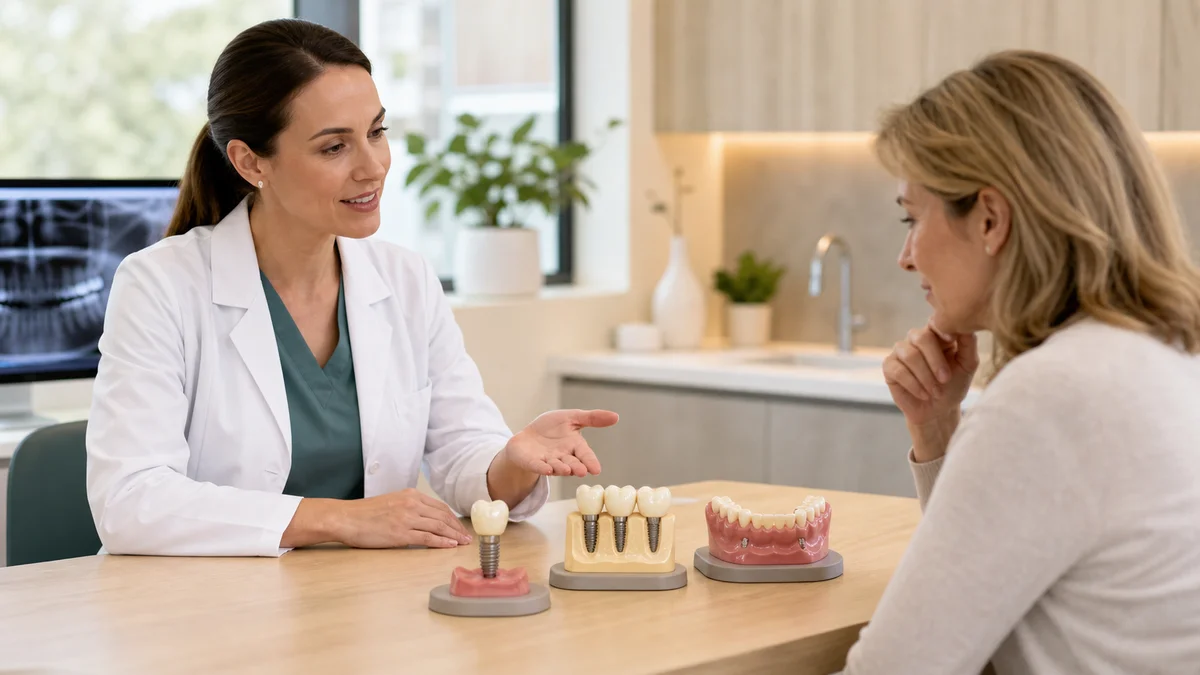
Ask to handle a demonstration model or view a drawing of the proposed restoration. Confirm which part is fixed, which part is removable, how it is cleaned and which components are likely to require periodic servicing. A less complex plan can sometimes be more affordable, but simplicity must be clinically appropriate rather than imposed by budget alone.
It is also reasonable to discuss a conventional bridge, removable partial denture, complete denture or no immediate replacement in selected circumstances. The ADA’s MouthHealthy guidance explains that implants can support individual crowns, bridges or dentures and that treatment may involve surgical placement, healing and final artificial teeth. Affordable implants should emerge from this wider comparison rather than being assumed to suit everyone.
Options-based planning keeps affordable implants connected to the patient’s actual functional priorities.
Strategy 3: separate required, optional and conditional costs
A written plan becomes more useful when each line is categorized. Required items are already expected for the proposed route. Optional items depend on patient preference rather than clinical necessity. Conditional items become relevant only if examination, imaging, healing or surgery reveals a defined need. This structure makes uncertainty visible without pretending that every biological event can be priced in advance.
For affordable implants, ask the provider to label assessment, imaging, extraction, sedation, grafting, implant fixture, abutment, provisional restoration, final crown or bridge, laboratory work, follow-up and maintenance. Clarify whether taxes, prescriptions and emergency reviews are included. If a surgical guide or three-dimensional scan is proposed, ask what clinical question it addresses rather than judging it solely by price.
- What is definitely included in the signed plan?
- Which procedures are possible but not yet confirmed?
- Who authorizes a change, and when will the revised fee be explained?
- What happens financially if an implant cannot be placed as planned?
- Is a temporary tooth included, and how many adjustments are allowed?
- Does the final fee include the abutment and definitive crown, bridge or denture?
A lower quote can be excellent value when it is complete. A higher quote can also be reasonable when it includes more complex care. The key is to compare the same endpoint. Affordable implants should not become expensive because the visible tooth, necessary connector or planned review was omitted from the headline.
Transparent categories make affordable implants easier to budget without disguising clinical uncertainty.
Strategy 4: understand why implant count and tooth count differ
The number of missing teeth does not always equal the number of implants. One fixture commonly supports one crown, while a bridge can use implants at selected positions to support several replacement teeth. An overdenture or fixed full-arch restoration also uses a planned number and distribution of implants rather than one fixture per tooth. This distinction can affect affordability substantially.
Fewer fixtures are not automatically safer or cheaper in the long run, and more fixtures are not automatically superior. The design must distribute forces, respect available bone and anatomical structures, support the planned teeth and allow cleaning. Affordable implants depend on prosthetic planning before surgery, because positions that are convenient surgically may not support an efficient final restoration.
Ask how the proposed implant number was selected, what evidence from your records supports the positions and what would change if one site were unsuitable. For a bridge or arch, ask what happens if a component needs repair and whether the restoration can be removed by a clinician. Request an explanation of the trade-offs between fixed and removable designs in language you understand.
Do not compare full-arch offers solely by labels such as “all-on” or by the highest implant number. Such labels may describe broad concepts while materials, laboratory design, temporary teeth, opposing bite and maintenance differ. A plan for affordable implants should specify the actual restoration and patient-specific reasoning.
Prosthetic planning is therefore the foundation of affordable implants, even when the surgical fee attracts the most attention.
Strategy 5: phase affordable implants when timing allows
Implant treatment is often naturally staged. Assessment and disease control may come first, followed by extraction or grafting where needed, implant placement, healing and the definitive restoration. Phasing can distribute payments and allow biological review between stages. It may also prevent premature commitment to a final design before important information is available.
Phased affordable implants do not mean delaying urgent treatment. Pain, swelling, trauma or suspected infection requires timely professional assessment. Nor should financing dictate unsafe timing. The clinical team should state which stages are time-sensitive, what temporary replacement is appropriate and what risks accompany a longer interval.
Ask for a phase-by-phase calendar with expected decision points rather than a promise that every stage will occur on a particular date. Healing varies. The FDA notes that implant-body healing may take several months or longer. Some selected patients may receive a provisional tooth quickly, but immediate placement or loading is not guaranteed simply because a travel or payment schedule is convenient.
Phasing may also help prioritize the area with the greatest functional need while another space is monitored. Whether that is appropriate depends on bite, disease, appearance, tooth movement and overall design. Affordable implants should be sequenced around health and function, not around an arbitrary sales deadline.
Strategy 6: use traceable, serviceable components
There is no single implant brand that is best for every case, and premium branding alone does not ensure a good outcome. Diagnosis, surgical positioning, restorative design, laboratory work, hygiene and follow-up all matter. However, identifying the manufacturer, model and component details can make future maintenance or repair more practical.
The FDA specifically recommends asking what brand and model are used and keeping that information. For affordable implants, request the implant labels or “passport,” lot or reference information where supplied, operative notes and restorative component details. Confirm that the product is legally supplied for the market in which treatment occurs and that the team can explain material choices.
Ask whether compatible replacement screws, attachments or restorative parts are likely to remain obtainable. A very low upfront component price may be a false economy if a minor repair later requires replacing a larger restoration because parts cannot be identified. Conversely, do not assume a costly material is necessary without understanding the functional reason.
Serviceability is especially important when treatment and maintenance occur in different countries. Affordable implants should leave you with records another qualified clinician can interpret. Keep digital and paper copies rather than relying solely on a clinic portal that may change.
Strategy 7: include maintenance in the cost of ownership
Implants cannot develop tooth decay, but the surrounding tissues can become inflamed, and prosthetic parts can wear, loosen or fracture. Natural teeth elsewhere still require preventive care. The initial treatment fee is therefore only one part of ownership. Daily hygiene, professional monitoring and repair planning belong in the budget.
Maintainable affordable implants should fit your dexterity and routine. Ask the dental team to demonstrate cleaning around the proposed design before treatment. A fixed bridge that looks elegant but is inaccessible to the patient may create repeated professional-care needs. A removable overdenture requires daily removal and cleaning but may offer easier access for some people.
Request a personalized maintenance schedule rather than assuming every patient needs the same interval. Risk may be influenced by previous gum disease, plaque control, tobacco exposure, diabetes, restoration design and other factors. Ask who monitors the implant, what signs require prompt contact and which future services are outside any commercial warranty.
A useful reserve fund may be more valuable than paying extra for a vaguely worded “lifetime” promise. Clinical outcomes cannot be guaranteed. Written warranty terms may cover a component yet exclude professional fees, travel, hygiene visits, grafting or complications related to health changes. Affordable implants remain affordable when these boundaries are clear.
Strategy 8: compare financing by total repayment, not monthly payment
A payment plan can make treatment accessible, but a smaller monthly figure does not necessarily mean a lower total cost. The US Consumer Financial Protection Bureau warns that medical credit cards and healthcare financing may use deferred-interest promotions. If the balance is not paid in full within the promotional period—or certain payment terms are breached—interest and fees may materially increase the total owed.
Before financing affordable implants, request the cash price and the total repayable amount under the proposed schedule. Review the annual percentage rate, whether it is fixed or variable, when interest begins, whether interest is deferred or waived, late fees, early-payment rules and consequences if treatment changes. Finance documents are separate from clinical consent; allow time to understand both.
| Path | Potential affordability advantage | Question that prevents false economy |
|---|---|---|
| Pay by clinical stage | Spreads spending across natural treatment phases | Are phase prices fixed, and what happens if the plan changes? |
| Provider installment plan | May reduce immediate outlay | What is the total repayment, interest, fee and missed-payment consequence? |
| Medical credit card | May offer a promotional period | Is interest deferred, and could it be charged from the purchase date? |
| Single implant crown | Replaces one tooth without using adjacent teeth | Are implant, abutment, crown, imaging and reviews all included? |
| Implant-supported bridge | May replace several teeth with selected supports | How is it cleaned, removed for service and repaired? |
| Implant overdenture | May improve denture retention with a removable design | Are the denture, attachments and future attachment replacements included? |
| Non-implant alternative | May avoid surgery or meet a different priority | What are the effects on support teeth, comfort, maintenance and future options? |
If insurance may contribute, obtain an itemized estimate and verify benefits directly with the insurer. Coverage, exclusions, annual limits, waiting periods and definitions of medical necessity vary. Pre-authorization may not guarantee payment. Affordable implants should still fit your finances if reimbursement is less than expected.
Sound financing protects the long-term value of affordable implants by making the full repayment visible before treatment begins.
Strategy 9: audit travel savings against follow-up risk
Different regions have different operating and laboratory costs, so travelling for care may reduce the clinical fee. The meaningful comparison includes flights or ground transport, accommodation, meals, time away from work, a companion if needed, multiple treatment visits and a possible unplanned return. A short holiday budget does not represent the whole pathway.
For affordable implants in Türkiye, verify that the healthcare provider appears on the Republic of Türkiye Ministry of Health’s current list of providers authorized for international health tourism. Authorization is an important regulatory check, but it does not predict an individual outcome. Also verify the treating dentist, facility, consent language, interpreter arrangements if needed and emergency contact.
- Request a written clinical plan before purchasing non-refundable travel.
- Ask which visits must occur in person and how long the dentist advises staying after surgery.
- Confirm whether temporary and definitive teeth require separate trips.
- Keep scans, treatment notes, prescriptions, invoices and component identifiers.
- Identify a local dentist willing to provide routine care before treatment abroad.
- Check whether travel insurance excludes planned dental care and related complications.
- Budget for delay, an extra night, an urgent assessment or a return visit.
At Redent Klinik, initial communication can organize records and questions, but the definitive recommendation must follow appropriate assessment. The English contact page can be used to ask which records may be helpful before a consultation. Remote discussion is not a substitute for examination.
Travel can support affordable implants when the treatment sequence, authorization, documentation and home aftercare are practical. If savings disappear after additional trips or local remedial care, the lowest destination price may not be the most affordable choice.
A consultation checklist for affordable implants
Bring the same questions to every provider. Consistent questions reduce the chance that different scopes will be compared as though they were identical. A responsible team should be comfortable explaining uncertainty, alternatives and why a proposed design fits your records.
- What diagnosis and patient goal does this restoration address?
- Which remaining teeth can be maintained, and which require treatment?
- Why is the proposed crown, bridge, overdenture or full-arch design appropriate?
- How many implants are planned, in which positions and for what load?
- Which assessment and imaging steps are included?
- Could extraction, grafting or sinus-related procedures be needed?
- What temporary tooth will be used during healing?
- Are the implant, abutment and definitive teeth included in the fee?
- Which manufacturer, model and restorative materials are planned?
- What maintenance, repair and urgent-care pathway will apply?
- What is the total cost under likely scenarios, not just the deposit?
- What non-implant alternatives remain reasonable?
Use the answers to compare complete pathways, not sales phrases. The best affordable implants plan may not have the smallest first payment. It should make the clinical endpoint, uncertainty, maintenance and total financial commitment understandable before consent.
Frequently asked questions
Are affordable implants lower quality?
Not necessarily. Regional costs, efficient workflows and an appropriate less-complex design can reduce fees. Safety cannot be inferred from price alone. Check diagnosis, clinician credentials, facility standards, traceable components, complete restorative scope and aftercare. A high fee is not a quality guarantee, and a low fee should not require skipping necessary care.
Can one implant replace several teeth?
A single implant commonly supports one crown. Several missing teeth may sometimes be replaced by a bridge supported by selected implants, but one implant does not simply carry any number of teeth. Bone, bite, span, position and restoration design determine what is appropriate. Affordable implants require individualized prosthetic planning.
Do all patients need bone grafting?
No. Grafting is considered when available bone does not support the planned implant position or contour. Some patients need none; others may need a localized or more extensive procedure. Only assessment and appropriate imaging can clarify this. Ask why it is proposed, what material may be used, the alternatives, healing time and cost.
Is an implant overdenture cheaper than fixed full-arch teeth?
It may involve a different number of implants and a removable prosthesis, so its cost profile can differ, but no design is automatically best or cheapest for every patient. Compare stability, speech, hygiene, tissue support, attachment maintenance, laboratory repairs and personal preference. A clinical examination must determine whether either option is suitable.
Can affordable implants be completed in one visit?
Implant placement and a provisional tooth may be possible in selected circumstances, while definitive restoration often follows healing. Infection, bone, implant stability, bite and the planned prosthesis affect timing. Advertising cannot guarantee immediate placement or loading. A safe schedule is based on clinical findings, not flight dates or a promotion.
Should I finance implant treatment?
That is a personal financial decision. Compare the cash price, total repayment, interest type, fees and missed-payment consequences. Be especially careful with deferred-interest offers. Do not allow credit approval to pressure clinical consent, and consider independent financial advice if the commitment is significant or terms are unclear.
What documents should I receive?
Request the written plan, relevant diagnostic records, consent information, operative notes, prescriptions, invoices, implant manufacturer and model, reference or lot labels where supplied, restorative component information and maintenance instructions. Documentation makes affordable implants easier to service if care is later provided elsewhere.
What is the first step toward affordable implants?
Begin with a diagnostic consultation rather than a deposit. Explain your priorities and budget, disclose health conditions and medicines, and ask for alternative designs with complete written scopes. If the recommendation is extensive or unclear, seek a second opinion. General information can prepare questions but cannot establish candidacy.
Conclusion: affordability is a whole-care outcome
Affordable implants are created through good decisions: preserve what can be preserved, control disease, choose the least complex suitable restoration, separate conditional costs, plan implant positions for the final teeth, phase care when safe, retain component records and fund maintenance. Financing and travel should be assessed by their complete consequences.
No article can determine whether implants are right for you or promise how long a restoration will last. Take an itemized plan to a qualified dentist, ask how alternatives compare and allow enough time for informed consent. This patient-safety article is prepared for review by Dentist Esma Çevrük Çakır and does not replace individualized dental or medical advice.
Official and professional sources
- American Dental Association — professional oral-health guidance and evidence resources.
- ADA MouthHealthy: Implants — implant stages, restorations and candidacy considerations.
- US Food and Drug Administration: Dental Implants—What You Should Know — implant components, patient recommendations, benefits and risks.
- World Health Organization: Oral Health — oral-disease burden, prevention, tobacco and access to care.
- US Consumer Financial Protection Bureau: Medical Credit Cards and Payment Plans — financing terms and deferred-interest risks.
- Guy’s and St Thomas’ NHS Foundation Trust: Dental Implants — treatment stages, grafting, risks, alternatives and long-term care.
- Republic of Türkiye Ministry of Health: Authorized Healthcare Providers — current international health-tourism provider lists.