
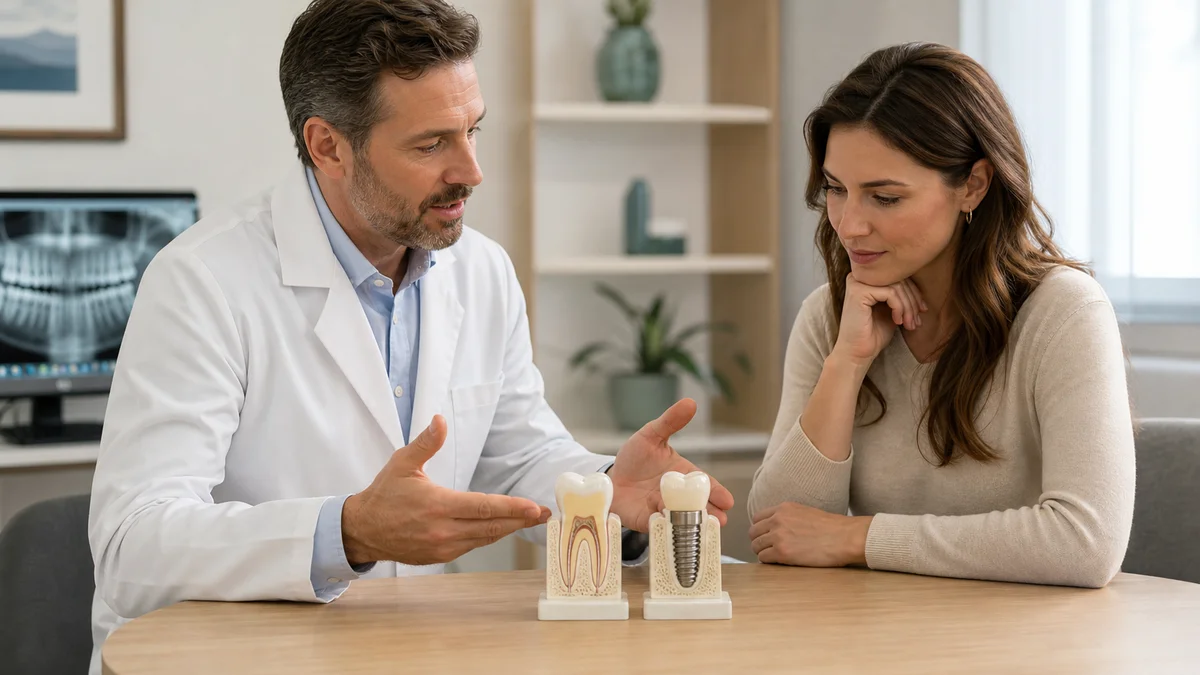
Quick answer: a root canal crown vs implant decision starts with whether the natural tooth can be predictably restored. Root canal treatment preserves a suitable tooth; an implant replaces a tooth that is missing or cannot reasonably be saved. Cracks, remaining tooth structure, gum and bone support, bite, health, timing and patient priorities all matter.
A root canal crown vs implant comparison is not a contest with one universal winner. The two pathways solve different problems. Root canal treatment disinfects the internal space of a natural tooth and allows that tooth to remain; a crown or another appropriate restoration then protects and restores it. An implant is placed in the jaw after a tooth has been removed or is already missing and supports an artificial crown. The starting diagnosis determines whether both choices are truly available.
Preserving a restorable natural tooth is generally an important goal, while retaining a tooth with a hopeless fracture or inadequate support may prolong infection, repeated procedures or discomfort. Conversely, extraction is irreversible and should not be chosen simply because an implant is marketed as more modern. A dentist may recommend specialist assessment before either path, particularly when the crack pattern, previous root filling, periodontal support or implant anatomy is uncertain.
This guide explains the questions that make a root canal crown vs implant decision clinically meaningful. It cannot examine your tooth, diagnose infection, predict healing or promise a result. Urgent pain, swelling, facial swelling, fever, trauma, difficulty swallowing or breathing requires prompt professional assessment rather than an online comparison.
1. Start the root canal crown vs implant decision with restorability
Restorability asks whether enough healthy tooth and supporting tissue remain to build a durable, cleanable restoration. The answer depends on the location and extent of decay, the depth and direction of cracks, remaining walls, the ability to create a sound seal, periodontal attachment, mobility, root shape, previous treatment and the relationship of the tooth to the bite. A tooth can be technically treatable internally yet still be a poor restorative candidate.
For a fair root canal crown vs implant assessment, request separate explanations of the endodontic and restorative prognosis. Ask whether the canals can be accessed, cleaned and sealed, then ask whether the remaining tooth can support the proposed crown without an unacceptable fracture or gum problem. If the tooth has an existing crown, the clinician may need to evaluate decay, leakage, perforation or fracture beneath it.
The American Association of Endodontists identifies tooth location, supporting bone, periodontal status, restorability and systemic factors as important in deciding whether to treat a tooth or replace it with an implant. Those factors cannot be graded from a photograph alone. Clinical examination, appropriate radiographs and sometimes magnification or three-dimensional imaging may be used when justified.
- Is the crack limited, or does it extend into a level that makes restoration unreliable?
- How much sound tooth remains above the gum and around the planned restoration?
- Can decay be removed while preserving a maintainable margin?
- Are the gums and bone supporting the tooth stable?
- Is the tooth important to a larger bridge or bite plan?
- Would specialist endodontic or restorative input clarify the prognosis?
A clinician should be able to show why the tooth is classified as restorable, questionable or non-restorable. That explanation is more valuable than a generic percentage. The first principle of root canal crown vs implant planning is to confirm that the alternatives being compared are both plausible for this particular tooth.
A defensible root canal crown vs implant recommendation begins with evidence that the tooth can—or cannot—support a maintainable final restoration.
2. What the root canal and crown pathway involves
Root canal treatment is used when the pulp inside a tooth is inflamed, infected or no longer healthy. The NHS describes removal of the infected pulp, cleaning and shaping of the internal space, and sealing the tooth. Treatment may take two or more appointments, with a temporary filling between visits. A crown may be needed when the tooth was badly damaged or infected.
In the root canal crown vs implant pathway, “root canal and crown” is itself a sequence rather than a single event. Diagnosis and emergency relief may occur first. The canals are then treated; the tooth receives a core or foundation restoration; and the definitive crown or other cuspal-coverage restoration is made when appropriate. Some teeth may require endodontic retreatment or root-end surgery rather than first-time treatment.
The crown does not strengthen the root or guarantee that the tooth will never fracture. Its purpose is to restore form, function and protection in a way that suits the remaining structure. The exact restoration varies with tooth position, amount of tissue left and bite. Not every root-filled tooth automatically needs the same crown design, and a dentist should explain the recommendation.
Ask whether the final restoration is included in the quoted root canal fee. In many settings it is a separate procedure. Also ask whether a post is proposed, why it is needed and what risks it adds. A post may retain a core when little tooth remains; it does not make the root biologically stronger. Clear staging prevents the natural-tooth side of the root canal crown vs implant comparison from being understated.
Documenting both endodontic and restorative stages keeps the root canal crown vs implant comparison clinically and financially complete.
3. What the extraction and implant pathway involves
An implant pathway begins with removal of the natural tooth if it is still present. Depending on the infection, bone, soft tissue, anatomical structures and restorative plan, implant placement may occur at extraction or after a healing period. Some sites need bone grafting or other augmentation; many do not. The implant then integrates with bone before or while a provisional restoration is managed, followed by an abutment and final crown.
The US Food and Drug Administration explains that an implant system includes an implant body and abutment and may include an abutment fixation screw. It advises patients to discuss candidacy, health, smoking, benefits and risks and to keep the brand and model for their records. In a root canal crown vs implant choice, this means the implant quote should include the whole final restoration, not only the fixture.
Immediate implant placement or an immediate temporary crown can be appropriate in selected circumstances, but neither can be promised before the site is assessed. Primary stability, infection, bone walls, gum shape, bite and patient factors matter. “Same day” often refers to a provisional tooth, not necessarily the definitive crown. The clinician should explain what will be placed and what remains conditional.
Extraction eliminates the possibility of future treatment on that natural tooth. If uncertainty remains about whether endodontic treatment can save it, an endodontic opinion before extraction may be useful. If the tooth is clearly non-restorable, delaying removal solely to avoid an implant discussion may also be inappropriate. Good root canal crown vs implant planning respects both reversibility and timely disease control.
Because extraction cannot be reversed, a root canal crown vs implant plan should make the reason for removal explicit before treatment.
4. Twelve clinical questions that shape the decision
The following questions organize the consultation. They do not create an automatic score. One severe finding—such as an unfavorable vertical root fracture—may carry more weight than several minor advantages. The dentist should integrate the findings and explain uncertainty.
- What is the exact diagnosis? Deep decay, pulp inflammation, infection, a crack, root fracture and periodontal disease require different reasoning.
- Is the tooth restorable? Enough accessible tooth structure must remain for a sealed, maintainable restoration.
- Where does any crack extend? Crack direction and depth can alter prognosis substantially.
- What is the periodontal support? Bone loss, attachment, mobility and furcation involvement may matter.
- Has root canal treatment been attempted? Retreatment complexity differs from first treatment.
- Can the final crown be designed predictably? Endodontic treatment and restoration must work as one plan.
- What is the bite load? Clenching, grinding and tooth position affect both natural and implant restorations.
- Is implant bone and space adequate? Nerves, sinus, adjacent roots, bone and gum dimensions influence placement.
- Are there medical or medicine-related considerations? Healing and surgical planning are individualized.
- What are the time and temporary-tooth needs? Each pathway may involve staged care.
- What maintenance can the patient perform? Both options require daily hygiene and professional review.
- What matters most to the patient? Preserving the tooth, avoiding surgery, treatment time, appearance, finances and tolerance of uncertainty may differ.
These questions turn root canal crown vs implant into a patient-specific decision. If the recommendation changes after new imaging, removal of an old restoration or direct inspection, the clinician should explain which new finding changed the plan.
Transparent decision points help a patient follow the root canal crown vs implant reasoning even when new clinical information appears.
5. Root canal crown vs implant decision table
This table highlights decision domains, not winners. A finding in the middle column may support attempting to retain the tooth; a finding in the right column may support extraction and replacement if confirmed. Many real cases sit between the columns and benefit from specialist assessment.
| Decision domain | May support root canal plus restoration | May support extraction and implant discussion |
|---|---|---|
| Remaining tooth structure | Sound, accessible structure can support a sealed restoration | Destruction extends too deeply or broadly for a maintainable restoration |
| Crack or fracture | Limited crack judged containable within a restorative plan | Confirmed unfavorable root fracture or non-restorable split |
| Periodontal support | Stable support compatible with retention | Severe, non-maintainable support loss despite appropriate care |
| Endodontic access | Canals can reasonably be treated or retreated | Obstruction, perforation or anatomy makes predictable management doubtful |
| Implant site | Not relevant if retaining the tooth | Bone, space and anatomy permit a suitable replacement plan, with augmentation if justified |
| Treatment burden | Patient accepts endodontic and restorative stages | Patient understands extraction, surgery, healing and restorative stages |
| Maintenance | Patient can clean the crown and surrounding natural tooth | Patient can clean the implant crown and attend long-term monitoring |
| Alternatives | Retreatment or endodontic surgery may remain possible | Bridge, removable option or no immediate replacement may also be discussed |
Use the table to ask how your findings fit, not to diagnose yourself. A documented root canal crown vs implant discussion should include reasonable alternatives, material risks and what the team would do if the preferred plan becomes unworkable.
The table is most useful when the dentist links every root canal crown vs implant factor to your examination and images.
6. Compare treatment time and number of stages accurately
A straightforward root canal may be completed over one or more visits, but the protective restoration adds another stage. Complex anatomy, retreatment, infection monitoring or referral can extend the sequence. An implant may involve extraction, healing, grafting when indicated, placement, integration, provisional restoration and a final crown. Selected cases can combine some stages, while others require months.
Therefore, a root canal crown vs implant time comparison should show the complete pathway on both sides. Ask when the tooth or implant can bear normal function, what temporary restoration is planned and which dates are estimates rather than promises. Treatment speed should not override adequate disinfection, healing or restorative accuracy.
Time away from work, travel, childcare and the ability to attend urgent reviews can matter as much as chair time. If treatment is abroad, calculate possible return visits. If a local specialist is required, ask how records and responsibility move between the endodontist, general dentist, surgeon and restorative dentist.
A fast procedure that leaves the final crown unplanned is not a fair comparison. Nor is it fair to count the implant surgery without extraction and final restoration. The complete root canal crown vs implant schedule should start with diagnosis and end with a maintainable tooth.
Time estimates for root canal crown vs implant should therefore include provisional care, healing reviews and delivery of the definitive restoration.
7. Understand risks without demanding a guarantee
Both pathways can work well in properly selected cases, and both can experience complications. A root-treated tooth may have persistent or recurrent infection, missed anatomy, leakage, fracture, periodontal problems or a restoration that fails. Further treatment can include retreatment, endodontic surgery, a new restoration or extraction. The exact likelihood depends on the tooth and care provided.
Implant treatment involves surgery and may be affected by failure to integrate, infection, injury to nearby structures, altered sensation, sinus involvement, poor positioning, screw loosening, crown damage or inflammation and bone loss around the implant. The FDA lists both early and later complications and advises prompt contact if an implant feels loose or painful.
The honest root canal crown vs implant conversation does not promise “lifetime” success. It identifies the important risks for your situation, steps used to reduce them and the contingency plan if healing or restoration differs from expectation. Commercial warranties may cover selected components but are not biological guarantees.
Balanced consent presents root canal crown vs implant risks in comparable terms without using fear to promote either route.
Smoking or tobacco exposure, plaque control, gum disease, diabetes and other health factors may influence planning and healing. Do not stop prescribed medicine based on general online information. Give the dental team a complete medical and medication history so they can coordinate with your physician where necessary.
8. Compare the total cost of each complete pathway
Fees vary by complexity, region, clinician, materials and what is included, so a fixed online price would be misleading. The natural-tooth pathway may include emergency care, root canal treatment or retreatment, core build-up, post when indicated, provisional restoration and definitive crown. The implant pathway may include extraction, grafting, implant placement, temporary tooth, abutment, implant crown and reviews.
For a realistic root canal crown vs implant comparison, request two itemized estimates with required and conditional lines. Ask what happens financially if the tooth proves non-restorable during treatment or if an implant site needs augmentation. Clarify whether diagnostic imaging, specialist fees, laboratory work and aftercare are included.
- Compare the final functional tooth, not the first procedure.
- List likely temporary-restoration costs on both pathways.
- Include travel and time away from work when relevant.
- Ask about maintenance, repair and replacement components.
- Verify insurance benefits directly; pre-authorization may not guarantee payment.
- Review finance interest, fees and total repayment rather than only the monthly figure.
The cheapest initial procedure may not be the lowest total-cost route, and the more expensive plan is not automatically better. Cost belongs within clinical suitability. A patient-safe root canal crown vs implant decision gives tooth preservation appropriate weight without asking the patient to fund repeated treatment for a tooth judged non-restorable.
Itemized estimates make root canal crown vs implant costs easier to compare because both endpoints include their definitive crown and follow-up.
9. Know when a second opinion adds value
A second opinion can be useful when extraction is recommended but restorability is uncertain, when a crack cannot be characterized, when previous root canal treatment has symptoms, when major grafting is proposed or when recommendations differ substantially. It is not a sign of distrust; it is a way to understand irreversible choices.
For a disputed root canal crown vs implant case, consider whether the second opinion should come from an endodontist, restorative dentist, periodontist, oral surgeon or another appropriately experienced clinician. Each sees a different part of the problem. The most useful consultation reviews the same radiographs and records and answers a specific question.
Ask the first clinician for copies of relevant images, periodontal measurements, treatment notes and the proposed restorative design. A specialist may still need new imaging or tests, but complete records reduce duplication. If urgent infection or swelling is present, obtain timely care while arranging further advice; a second opinion should not become unsafe delay.
At Redent Klinik, remote communication can help collect records and questions before a clinical visit, but it cannot establish restorability. The English contact page can be used to ask what records may support an individualized assessment. The final root canal crown vs implant plan must follow appropriate examination.
A focused second opinion can resolve a root canal crown vs implant uncertainty before the irreversible step of extraction.
10. Plan aftercare for a crowned tooth or an implant crown
A root-filled tooth still has a natural root, periodontal ligament and surrounding gum and bone. It needs brushing, interdental cleaning, caries prevention and monitoring of the crown margin, bite and surrounding tissues. A new cavity can form on exposed natural tooth structure, and a crown may wear, loosen or fracture over time.
An implant crown cannot develop dental caries, but plaque-associated inflammation can affect the surrounding tissues. The crown, screw or other components may need maintenance. Cleaning access, bite and professional monitoring remain important. The FDA advises regular cleaning and dental visits after implant treatment.
Maintenance does not prove one side of root canal crown vs implant is superior; it shows that neither is maintenance-free. Ask the team to demonstrate cleaning before the definitive restoration is delivered. If dexterity is limited, discuss tools or a removable design that the patient can manage.
Long-term hygiene belongs inside the original root canal crown vs implant decision rather than being postponed until treatment is complete.
Seek assessment for new swelling, drainage, persistent pain, mobility, a change in bite, a loose crown or implant, fracture or difficulty cleaning. Early review may allow a smaller intervention. Do not assume that absence of pain means every supporting tissue is healthy.
Frequently asked questions about root canal crown vs implant
Is a root canal crown vs implant choice always available?
No. If a tooth is missing or definitively non-restorable, root canal treatment cannot recreate it. If a tooth is restorable and endodontic treatment is appropriate, extraction may be avoidable. The first task is diagnosis and restorability assessment, not choosing from a menu before the findings are known.
Is it better to save the natural tooth?
Preserving a restorable natural tooth is generally valuable, and the American Association of Endodontists encourages evaluation of tooth-saving options. However, “save at all costs” is not patient-centered when a confirmed fracture, inadequate structure or severe support problem makes restoration unreasonable. The clinician should explain both prognosis and alternatives.
Does a root canal always need a crown?
Not every tooth receives the identical restoration. Posterior teeth or teeth with substantial structural loss often need cuspal protection, while the decision depends on position, remaining tissue, access and bite. The NHS notes that a crown may be needed when a tooth was badly infected. Ask what protects your specific tooth and why.
Can an implant be placed immediately after extraction?
Sometimes, but only when clinical conditions support it. Infection, socket anatomy, bone walls, gum tissue, primary stability, implant position and the intended crown affect the choice. Immediate placement does not always mean immediate final teeth. The plan may change during surgery if the site differs from imaging.
Which option takes longer?
It depends on complexity. Root canal treatment plus final restoration may require several visits; retreatment or infection monitoring can add time. Extraction and implant care may require healing, augmentation and restorative stages. Compare complete schedules and temporary teeth rather than a single appointment on each side.
Which option costs less?
There is no universal answer. Compare all required and likely conditional items. For the tooth, include endodontics, foundation and final restoration; for the implant, include extraction, possible grafting, fixture, abutment, crown and follow-up. Insurance, location and complexity vary. Suitability should lead the financial comparison.
Can either treatment be guaranteed for life?
No ethical plan can guarantee a biological or restorative outcome for life. Natural teeth, crowns, implants and implant crowns can all require future care. Ask about case-specific risks, maintenance, repair pathways and written warranty limits. A guarantee should never replace informed consent.
Who should review a difficult decision?
Your general dentist may coordinate care. An endodontist can assess tooth-saving treatment or retreatment; a restorative dentist can assess the final crown and overall plan; a periodontist or oral surgeon may assess supporting tissues and implant surgery. Complex root canal crown vs implant cases may benefit from shared planning.
Conclusion: make the diagnosis before choosing the replacement
The safest root canal crown vs implant decision begins by asking whether the natural tooth is restorable and worth retaining. Root canal treatment and a suitable restoration preserve a tooth; extraction and an implant replace one that cannot reasonably be kept or is already absent. Neither route should be sold as automatically faster, cheaper or permanent.
A patient-centered root canal crown vs implant choice remains open to specialist review and changes only when the clinical evidence changes.
Clear records strengthen a root canal crown vs implant consultation. Complete estimates keep a root canal crown vs implant comparison fair. Shared decision-making makes the final root canal crown vs implant plan easier to understand and maintain.
Ask for the diagnostic findings, final restorative design, full sequence, material risks, alternative options, itemized costs and maintenance plan. Seek specialist input before irreversible treatment when the prognosis is unclear. This evidence-based guide is prepared for review by Dentist Esma Çevrük Çakır and does not replace a clinical examination or personal dental and medical advice.
Official and professional sources
- American Dental Association — professional ethics, evidence and oral-health resources.
- American Association of Endodontists: Saving Your Natural Tooth — tooth preservation and endodontic treatment.
- American Association of Endodontists: Dental Implant Resources — factors in retention-versus-replacement planning.
- NHS: Root Canal Treatment — indications, procedure, appointments, crown considerations and aftercare.
- US Food and Drug Administration: Dental Implants—What You Should Know — implant components, patient recommendations, benefits and risks.
- ADA MouthHealthy: Implants — implant stages, restorations and candidacy considerations.
- Guy’s and St Thomas’ NHS Foundation Trust: Dental Implants — stages, risks, maintenance and alternatives.
- World Health Organization: Oral Health — prevention, periodontal disease, tooth loss and access to oral care.