
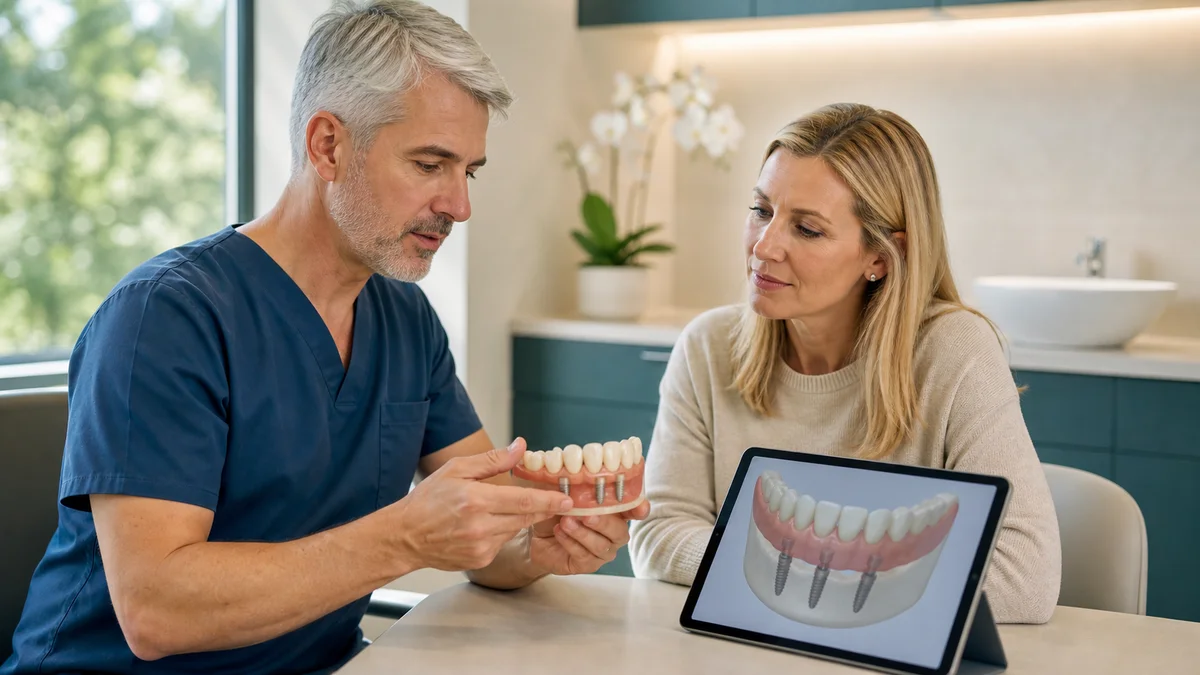
Searching for all on 3 dental implants cost information can be frustrating because a short online price rarely explains what is actually included. The phrase may describe a full-arch bridge supported by three implants, a removable overdenture using three attachments, or a clinic-specific treatment concept. Those are not interchangeable. Their diagnostic needs, materials, maintenance demands, biological risks, and final fees can differ substantially.
This guide explains how to assess a quote without assuming that three implants are suitable for every jaw. It is educational, not a diagnosis or a promise of candidacy. A dentist must examine the mouth, review medical history, assess remaining teeth and gums, and use appropriate imaging before recommending an implant number or prosthesis. The safest question is not simply “What is the lowest fee?” but “What complete, maintainable treatment plan fits my anatomy and goals?”
Quick answer: All on 3 dental implants cost varies with the type of prosthesis, diagnostic imaging, bone and gum condition, implant components, provisional teeth, laboratory materials, clinician expertise, anesthesia, location, and aftercare. Three implants are not automatically appropriate for every full arch. Compare written, itemized plans only after a clinical and radiographic assessment.
1. What “All-on-3” Usually Means
“All-on-3” is often used informally rather than as one universally standardized treatment. In a broad sense, it refers to replacing many or all teeth in one arch with a prosthesis supported or retained by three dental implants. The restoration might be fixed so that only a dental professional removes it, or removable so that the patient can take it out for cleaning. The term alone does not identify the implant system, attachment design, framework, tooth material, or clinical protocol. This is why all on 3 dental implants cost must be interpreted alongside a precise restoration description.
That ambiguity matters when you compare all on 3 dental implants cost estimates. One proposal may include only implant placement and a temporary denture. Another may cover imaging, surgical guides, extractions, provisional teeth, the definitive prosthesis, and scheduled reviews. A third may describe a removable solution, even though its marketing resembles a fixed bridge. Ask every clinic to write down exactly what will be placed and which stages are included.
Dental implants are medical devices inserted into the jawbone to support artificial teeth. The U.S. Food and Drug Administration explains that an implant system may include an implant body, an abutment, and an abutment fixation screw. A full-arch restoration adds several prosthetic components beyond those basic parts. The number of implants is only one line in the total plan, so all on 3 dental implants cost should never be reduced to the fixture count.
2. Is a Three-Implant Full Arch Appropriate for Everyone?
No. The correct number and distribution of implants depend on the arch being treated, bone volume and quality, bite forces, available restorative space, opposing teeth, the planned prosthesis, hygiene access, and the consequences if one implant develops a problem. A clinician should assess the complete system, not select a number because it appears in an advertisement. Any all on 3 dental implants cost estimate must therefore remain conditional until candidacy is established.
The American College of Prosthodontists states that implant use should be dictated by individual patient needs as determined by a dentist. Its guidance also emphasizes the surgical and prosthodontic complexity of implant care and the importance of appropriate training or referral. For that reason, an all on 3 dental implants cost conversation should begin with suitability and risk, not a sales package.
Some carefully selected patients may be offered a three-implant design. Others may need a different number or position of implants, a removable restoration, bone augmentation, treatment of active disease, or preservation of maintainable natural teeth. The upper and lower jaws also have different anatomical and loading considerations. No web article can determine which configuration is safe for a particular person, and all on 3 dental implants cost cannot substitute for that judgment.
- Active gum disease, untreated decay, or oral infection should be addressed as part of planning.
- Smoking can interfere with healing and may reduce long-term implant success, according to the FDA.
- Uncontrolled medical conditions may change surgical risk, healing, or treatment timing.
- Clenching, grinding, and a high-force bite can affect prosthetic design and maintenance.
- Bone and soft-tissue anatomy may limit implant position or require an alternative approach.
- Cleaning ability, dexterity, and willingness to attend recalls are part of candidacy.
3. What Should Happen Before a Reliable Cost Estimate?
A responsible estimate follows diagnosis. The clinical team usually reviews the patient’s concerns, medical conditions, medicines, allergies, smoking or nicotine use, previous dental experiences, and expectations. The mouth is examined for tooth prognosis, gum health, soft tissue, bite relationships, smile line, restorative space, and signs that could complicate treatment. These findings establish the clinical basis for discussing all on 3 dental implants cost.
Imaging is selected according to clinical need. It may include conventional radiographs and three-dimensional imaging where justified. Digital scans, impressions, photographs, and bite records can help connect implant positions to the proposed final tooth arrangement. If old records are available, they may help, but a treating dentist decides whether they are adequate and current. Record fees should be identified within the written all on 3 dental implants cost proposal.
This work explains why a credible all on 3 dental implants cost cannot be guaranteed from a photograph or chat message alone. Remote information may support an initial discussion, yet it does not replace examination or imaging. A preliminary estimate should be labeled as such and list the assumptions that could change it.
Planning should also compare the implant option with realistic alternatives. Those could include maintaining strategic teeth, a conventional complete denture, a tooth-supported solution, or an implant-retained removable denture. The best-value option is the one that balances safety, function, maintainability, and the patient’s priorities—not necessarily the plan with the fewest visits or lowest opening fee. This broader comparison gives all on 3 dental implants cost meaningful context.
4. The 12 Main All on 3 Dental Implants Cost Factors
The following elements commonly shape all on 3 dental implants cost. Their relevance varies by patient and clinic, so they should appear as clear line items or written inclusions rather than hidden assumptions.
- Diagnostic records: consultation, radiographs, three-dimensional imaging when indicated, scans, photographs, and planning records.
- Condition of existing teeth: removal of hopeless teeth, management of infection, and preservation of teeth that remain maintainable.
- Bone and soft-tissue needs: grafting or tissue procedures may be considered when anatomy does not support the planned design.
- Implant system and components: implants, abutments, screws, attachment parts, and restorative components are separate clinical items.
- Surgical complexity: anatomy, access, extraction difficulty, number of stages, and the need for specialist input affect time and resources.
- Anesthesia and comfort measures: local anesthesia is different from sedation or hospital-based support, where clinically appropriate.
- Guided or digital workflow: planning software, surgical guides, digital scans, and laboratory coordination may be included or charged separately.
- Immediate provisional teeth: a same-day temporary restoration, if clinically suitable, is not the same as the definitive prosthesis.
- Prosthesis design: fixed and removable restorations use different frameworks, attachments, contours, and hygiene strategies.
- Materials and laboratory work: acrylic, composite, metal frameworks, titanium, or ceramic options differ in fabrication and repair pathways.
- Clinical expertise and team structure: treatment may involve a restorative dentist, surgeon, prosthodontist, periodontist, anesthetic provider, and dental laboratory.
- Reviews and maintenance: healing checks, hygiene appointments, screw or attachment reviews, relines, repairs, and replacement components affect lifetime expenditure.
When a quotation omits several of these categories, its headline all on 3 dental implants cost may not be comparable with a more complete plan. An itemized quote does not need to predict every future event, but it should distinguish included treatment, optional treatment, foreseeable maintenance, and costs that would arise only if the plan changes.
5. Fixed, Removable, and Alternative Designs
Patients often use “fixed teeth” as shorthand for quality, but fixed and removable solutions solve different problems. A fixed full-arch bridge can feel stable and is removed by a clinician when necessary. It still requires careful cleaning under the prosthesis and professional maintenance. A removable implant-retained overdenture can offer strong retention while allowing the patient to remove it for cleaning; its attachment inserts may wear and need replacement.
These differences directly influence all on 3 dental implants cost. They also influence repairability, hygiene access, lip support, laboratory procedures, and what happens if an implant or prosthetic component fails. The written plan should state whether the restoration is fixed or removable, which arch it covers, what material is proposed, and whether a framework is included.
| Option to discuss | Potential reason to consider it | Key trade-off to clarify | Cost question to ask |
|---|---|---|---|
| Preserve maintainable teeth | Avoids removing teeth that may still have a reasonable prognosis | May require staged periodontal, root-canal, or restorative care | Which treatments and future repairs are included? |
| Conventional complete denture | No implant surgery and generally simpler initial treatment | Retention, chewing comfort, and adaptation vary | Are adjustments, relines, and replacement included? |
| Three-implant removable design | May improve retention for selected anatomy | Patient removes it; attachments and inserts need maintenance | What attachment servicing is expected? |
| Three-implant fixed design | May be proposed in carefully selected circumstances | Load distribution, hygiene, and loss of one implant require careful planning | What is the contingency plan if an implant cannot be used? |
| Full arch supported by more implants | May offer a different distribution or contingency strategy | More surgery and components do not automatically mean a better result | Why is this implant number appropriate for my anatomy? |
The table is a discussion aid, not a ranking. A dentist may recommend another design after examination. If two clinics propose different implant numbers, ask each to explain the biological and mechanical reasoning. A meaningful all on 3 dental implants cost comparison must compare clinically equivalent designs.
6. Treatment Stages and When Fees Arise
Full-arch implant treatment is a process rather than a single purchase. The first stage is diagnosis and planning. Disease control, extractions, or preparatory treatment may follow. Implant placement then begins a healing phase, and the FDA notes that healing may take several months or longer. Timing varies, and a temporary restoration does not prove that integration is complete. Each stage can contribute separately to all on 3 dental implants cost.
If immediate loading is considered, the clinician evaluates implant stability, bite, bone conditions, prosthetic design, and patient factors. “Teeth in a day” language should not be interpreted as a guarantee of final teeth or a promise that every patient qualifies. The definitive restoration is commonly made after clinical milestones are met. Reviews, adjustments, hygiene instruction, and a long-term recall plan follow delivery. A clear all on 3 dental implants cost schedule should connect payments to these defined stages.
Ask whether the quoted all on 3 dental implants cost covers each stage and what happens if the planned timeline changes. A delay for healing is not necessarily a failure; it may be a safety decision. Conversely, an unexpected need for grafting, a different provisional design, or replacement of an unusable implant may alter the treatment plan and financial consent.
- Initial consultation, records, diagnosis, and written alternatives
- Disease control and preparatory dental treatment
- Surgery, implants, components, and prescribed medicines
- Temporary restoration and its adjustment limits
- Healing reviews and additional imaging when clinically indicated
- Definitive prosthesis design, trial stages, material, and delivery
- Post-delivery adjustment, hygiene training, and recall schedule
7. Risks, Limitations, and Contingency Planning
Implant treatment can improve chewing, appearance, and support for artificial teeth, but it has risks. FDA patient guidance lists possible injury to nearby teeth or tissues, sinus or nerve complications, poor bite, screw loosening, infection, delayed healing, and implant failure. Problems may arise early or much later. Individual risk depends on health, anatomy, habits, disease control, and the planned procedure. Risk management is part of responsible all on 3 dental implants cost planning.
A low all on 3 dental implants cost does not reduce those biological realities. Ask how the team prevents and manages complications, who provides urgent care, and which remedial services are included. If one of three implants cannot be used, the restoration may need modification, additional treatment, or a different design. The exact consequence depends on implant positions and prosthetic engineering.
Informed consent should cover realistic alternatives and the option of no treatment or delayed treatment where appropriate. It should also distinguish expected postoperative effects from signs that require prompt contact. Persistent or worsening pain, mobility, swelling, drainage, altered sensation, or a change in the bite should be reported to the treating clinic. Online advice should not delay urgent dental assessment.
8. Materials, Laboratory Quality, and the Final Prosthesis
The visible teeth are only part of a full-arch restoration. Beneath them may be a milled or cast framework, prosthetic screws, cylinders, attachment housings, or other components. Contours must support speech, appearance, lip position, chewing, and cleanability. The dental laboratory works from the clinician’s prescription and records, so communication and verification stages matter. Those less-visible components help explain differences in all on 3 dental implants cost.
Material names alone do not establish quality. Acrylic-based teeth may be easier to adjust or repair in some circumstances, while ceramic or zirconia designs have different fabrication, weight, wear, space, and repair considerations. The opposing teeth or prosthesis also influence material selection. Ask why the proposed material suits your bite and how local repairs would be handled before comparing all on 3 dental implants cost.
When reviewing all on 3 dental implants cost, confirm whether the price describes a temporary or definitive prosthesis. Also ask whether a reinforcement framework, try-in, shade selection, replacement during healing, and laboratory remake policy are included. A glossy photo cannot answer those contractual and clinical questions.
9. Maintenance Is Part of the Real Cost
Implants do not make the mouth maintenance-free. Plaque can accumulate around implants and beneath prostheses. The FDA advises following oral-hygiene instructions, cleaning implants and surrounding teeth regularly, attending dental visits, and reporting pain or looseness. The cleaning method depends on the contours, spaces, dexterity, and whether the restoration is fixed or removable. Maintenance assumptions belong in every all on 3 dental implants cost discussion.
Long-term all on 3 dental implants cost should therefore include a realistic maintenance conversation. Professional cleaning, periodic examination, radiographs when indicated, replacement of worn attachment inserts, screw checks, fracture repair, relining, bite adjustment, or eventual prosthesis replacement may be necessary. No ethical provider can promise that a restoration will never require maintenance.
Ask for a written home-care demonstration and recall interval tailored to your risks. Water irrigation devices, interdental brushes, floss threaders, or other tools may be recommended, but the treating team should show where and how to use them safely. If the design is difficult for you to clean during the trial stage, raise that concern before the definitive restoration is completed.
10. Insurance, Medicare, Financing, and Lower-Cost Care
Coverage varies by country, plan, medical circumstance, and the exact code used. In the United States, Medicare states that it does not cover implants, dentures, or most routine dental services in most cases, although certain dental services directly linked to specified covered medical treatments may qualify. Patients should verify benefits directly and obtain any required preauthorization before relying on reimbursement. Coverage should be verified independently of an advertised all on 3 dental implants cost.
Private dental plans may have exclusions, waiting periods, annual limits, missing-tooth clauses, or different benefits for surgery and prosthetics. A pre-treatment estimate is useful but is not always a guarantee of payment. For a fair all on 3 dental implants cost comparison, separate the clinic fee, estimated insurance contribution, financing charges, and the amount the patient remains responsible for.
The National Institute of Dental and Craniofacial Research identifies dental-school clinics, supervised dental-hygiene schools, federally funded health centers, and state or local resources as possible avenues for lower-cost care. NIDCR also warns that it does not provide dental implants, implant trials, or financial assistance; messages claiming otherwise may be fraudulent. Availability and scope differ, and complex implant treatment may not be offered.
- Request an itemized plan before applying for credit.
- Ask whether interest, origination fees, or late charges apply.
- Do not let a limited-time offer replace a second opinion or medical review.
- Confirm refund and cancellation terms for laboratory work and staged treatment.
- Verify which provider is responsible if treatment occurs across multiple clinics or countries.
- Keep copies of imaging, consent forms, implant identifiers, invoices, and warranties.
11. How to Compare Two All on 3 Dental Implants Cost Quotes
Start by checking that both quotes cover the same arch, restoration type, number of implants, implant system, material, provisional phase, and definitive phase. Then compare diagnostic records, preparatory treatment, anesthesia, grafting assumptions, laboratory steps, follow-up, maintenance, and contingency terms. If one quote is dramatically lower, ask what is excluded rather than assuming the clinicians charge differently for an identical service.
Next, assess who is providing each stage. The ACP encourages patients to ask about a dentist’s training, experience, expected duration, alternatives, entire treatment cost, and maintenance cost. Complex cases may involve referral or coordinated care. Credentials do not eliminate risk, but clear responsibility and appropriate training are essential parts of value.
Finally, compare communication quality. A responsible team should discuss uncertainty and give you time to consider alternatives. Be cautious with guarantees, fixed remote diagnoses, pressure to remove teeth quickly, or claims that one implant number fits everyone. An all on 3 dental implants cost quote is useful only when it is connected to an individualized, documented plan.
12. Questions to Ask Before You Consent
Bring the same written questions to each consultation. The answers make an all on 3 dental implants cost estimate easier to interpret and can reveal whether two proposals are truly comparable.
- Why are three implants recommended for my specific arch and bite?
- Is the proposed restoration fixed or removable, temporary or definitive?
- What alternatives could preserve teeth or use a different prosthetic design?
- Which records and imaging support the plan?
- Who performs the surgery, restoration, laboratory work, and maintenance?
- What implant brand, model, and component information will I receive?
- Which materials and framework are included in the definitive prosthesis?
- What is excluded from the quote, and what events could change it?
- What happens if immediate loading is unsafe or one implant cannot be used?
- How will I clean the prosthesis, and how often will professional review be needed?
- Who handles complications or repairs after hours or after travel?
- What are the written cancellation, remake, maintenance, and warranty terms?
For clinic-specific information, you can review Redent Klinik’s overview of dental implant treatment. To request an individualized assessment rather than a remote diagnosis, use the Redent Klinik contact page. The Redent Klinik English homepage provides further clinic information.
Frequently Asked Questions About All on 3 Dental Implants Cost
Can a clinic confirm all on 3 dental implants cost from photos alone?
A photo can support an initial conversation but cannot show bone dimensions, three-dimensional anatomy, active infection, bite forces, or the full prognosis of remaining teeth. A remote estimate should be treated as preliminary. A final all on 3 dental implants cost plan normally requires clinical examination, relevant imaging, and a written definition of the proposed prosthesis.
Is an All-on-3 restoration always fixed?
No. The label may be used for fixed or removable concepts, depending on the provider. Ask the dentist to state whether you remove the prosthesis yourself, how it attaches, and who removes it for maintenance. This distinction can change fabrication, cleaning, repair, and all on 3 dental implants cost.
Does a lower implant count always mean a lower total fee?
Not necessarily. Implant count is only one component. Diagnostic work, surgical complexity, provisional teeth, framework design, materials, laboratory stages, anesthesia, and follow-up all affect the total. A design using fewer implants may also have different contingency requirements. Compare complete plans, not the price of individual fixtures.
Are temporary teeth included in all on 3 dental implants cost?
Sometimes, but inclusion and design vary. A quote may include a conversion of an existing denture, a newly made provisional bridge, or no immediate fixed provisional if stability and risk criteria are not met. Confirm the number of temporary restorations, adjustment policy, and what happens if healing takes longer than planned.
Will insurance pay for a three-implant full arch?
Coverage depends on the plan and procedure codes. Many policies limit implants or prostheses, and U.S. Medicare generally does not cover implants or dentures except for limited dental services tied directly to certain covered medical treatments. Obtain written benefit information, but remember that a pre-treatment estimate may not guarantee payment.
Why might the final quote change after examination?
Examination and imaging may identify infection, teeth that should be preserved or removed, bone limitations, soft-tissue needs, or a bite that requires another design. The clinician may also determine that three implants are not an appropriate foundation. The revised plan should explain the clinical reason and provide updated consent before treatment proceeds.
What records should I receive after implant placement?
Ask for implant brand and model details, component information, placement records, relevant imaging, the prosthesis material, cleaning instructions, and a maintenance schedule. The FDA recommends knowing and keeping the brand and model of the implant system. These records can help if you move, travel, or need future repair.
Can anyone guarantee the result or lifetime of the restoration?
No treatment is risk-free, and future health, hygiene, smoking, bite forces, accidents, and component wear can affect outcomes. Ask for realistic benefits, risks, and maintenance expectations. Written warranty terms may address selected materials or services, but they are not the same as a biological guarantee.
A Safer Way to Make the Decision
A useful all on 3 dental implants cost figure is the result of careful planning, not the starting point. Establish the diagnosis, understand why the proposed implant number and prosthesis suit your anatomy, compare reasonable alternatives, and request an itemized total with maintenance and contingency terms. Take time for a second opinion if recommendations differ or if healthy-looking teeth are proposed for removal.
Patient safety also depends on honest limits. A clinician may decide that a different number of implants, a removable solution, treatment of disease, or no implant surgery is more appropriate. That is not a failed sales consultation; it is individualized healthcare. The right plan is one you can understand, maintain, and consent to without pressure, even when it changes the expected all on 3 dental implants cost.
Sources and Further Reading
- U.S. Food and Drug Administration: Dental Implants—What You Should Know
- American College of Prosthodontists: Position Statement on Dental Implants
- American College of Prosthodontists: Maintenance of Full-Arch Implant Restorations
- Medicare: Dental Services Coverage
- National Institute of Dental and Craniofacial Research: Finding Dental Care
- American Dental Association
- World Health Organization: Oral Health