
If you are asking all on 4 dental implants or veneers which is better, the quickest answer is this: All on 4 dental implants are usually better for people who are missing most or all teeth, have severely damaged teeth, or need a full-arch fixed replacement, while veneers are usually better for people who still have healthy natural teeth but want to improve tooth color, shape, size, or minor alignment concerns. These two treatments can both improve a smile, but they solve very different dental problems. Choosing between them should not be based only on appearance; it should depend on your tooth health, gum condition, bone support, bite, budget, treatment expectations, and long-term maintenance ability.
Many patients compare these options because both can create a dramatic smile transformation. However, the question all on 4 dental implants or veneers which is better becomes clearer when you first identify the real problem. If your teeth are generally strong, stable, and free from severe gum disease, veneers may be a conservative cosmetic solution. Veneers are thin coverings placed on the front surface of teeth to improve aesthetics. They do not replace missing tooth roots, they do not solve advanced tooth mobility, and they are not designed to support a full arch of missing teeth. For someone with healthy teeth who dislikes staining, worn edges, small gaps, uneven shapes, or mild cosmetic imperfections, veneers may be the more suitable option.
On the other hand, if several teeth are missing, loose, broken beyond repair, or affected by advanced dental disease, All on 4 may be more appropriate. All on 4 dental implants use a limited number of implants to support a fixed full-arch prosthesis. This approach is intended for patients who need replacement of an entire upper arch, lower arch, or both. In this situation, asking all on 4 dental implants or veneers which is better is not simply a cosmetic question; it becomes a functional and restorative decision. The goal is not only to make the smile look better, but also to restore chewing ability, stability, comfort, facial support, and confidence in daily life.
Quick Decision Guide
To understand all on 4 dental implants or veneers which is better for your own situation, look at the condition of your natural teeth first. If your teeth are present, stable, and structurally healthy, veneers may be considered after a detailed dental examination. If your teeth are missing, failing, or cannot predictably support long-term restorations, All on 4 may be a stronger option. A patient with minor discoloration and small shape concerns does not usually need full-arch implant treatment. Similarly, a patient with multiple missing teeth and poor chewing function should not expect veneers to replace the function of implant-supported teeth.
Cost also plays an important role, but it should be evaluated carefully. Veneers may cost less than a full-arch implant treatment when only a few teeth are treated, but the total cost can increase if many teeth need veneers. All on 4 dental implants usually involve surgery, implant placement, prosthetic design, imaging, temporary teeth, and final restorations, so the investment can be higher. However, final costs vary from patient to patient and depend on examination findings, bone condition, materials, the number of arches treated, additional procedures, and the final treatment plan. No responsible clinic should give a guaranteed final price without evaluating your mouth in detail.
When Veneers May Be the Better Choice
Veneers may be better if your main concern is cosmetic and your natural teeth are still worth preserving. For example, if you have teeth that are stained, slightly chipped, uneven, short, mildly spaced, or aesthetically unbalanced, veneers can help create a more harmonious smile. In this type of case, the answer to all on 4 dental implants or veneers which is better may lean toward veneers because they improve the visible surface of existing teeth rather than replacing the full dental arch. Veneers can be a practical choice when the bite is stable, gum health is acceptable, and there is enough enamel or tooth structure for long-term bonding.
When All on 4 May Be the Better Choice
All on 4 may be better if the problem is not just how your teeth look, but whether they can function reliably. If you have widespread tooth loss, severe decay, advanced gum disease, loose teeth, repeated dental failures, or uncomfortable removable dentures, All on 4 may offer a more complete solution. In this case, all on 4 dental implants or veneers which is better should be answered through a full-mouth evaluation, not by comparing before-and-after photos alone. Implant-supported full-arch treatment can help restore chewing stability and may reduce the discomfort some patients feel with removable dentures, but it also requires surgery, healing, hygiene discipline, and regular dental follow-up.
Why a Dental Consultation Is Necessary
A professional consultation is needed because the better option cannot be chosen safely from symptoms or photos alone. A dentist must check tooth structure, gum health, bone volume, bite force, jaw relationship, smile line, medical history, and expectations. Digital imaging and clinical examination help determine whether natural teeth can be restored with veneers or whether a full-arch implant plan is more realistic. At Redent Klinik, this type of evaluation can help patients understand whether their case is mainly cosmetic, functional, or a combination of both. For patients comparing all on 4 dental implants or veneers which is better, a personalized plan is the safest way to avoid over-treatment, under-treatment, or choosing an option that may not last.
The practical next step is simple: list your main problem before your appointment. Are you trying to change color and shape, replace missing teeth, stop denture movement, improve chewing, or rebuild a failing smile? Then gather any previous dental X-rays, note your medical conditions, and ask the dentist to explain both short-term and long-term options. If you want guidance based on your own mouth rather than general information, you can request an evaluation through the Redent Klinik Contact Page. You can also review general oral health information from the American Dental Association to better understand why diagnosis and treatment planning should be individualized.
In summary, the answer to all on 4 dental implants or veneers which is better depends on whether you need to restore a full arch or enhance healthy natural teeth. Veneers are usually the better path for cosmetic improvements on stable teeth. All on 4 dental implants are usually the better path when teeth are missing, failing, or no longer functional. The right choice should protect your oral health, match your expectations, and support long-term comfort. Before making a decision, schedule a dental consultation, ask for a clear explanation of all suitable options, and compare not only the smile result but also maintenance, risks, healing time, and future care needs.
Cost Factors: Comparing All on 4 Dental Implants and Veneers
When patients ask all on 4 dental implants or veneers which is better, cost is often one of the first concerns. The honest answer is that neither treatment can be judged by price alone, because they are designed for different levels of dental need. Veneers are usually chosen to improve the visible front surface of natural teeth, while All on 4 dental implants are used to replace a full arch of missing or failing teeth with an implant-supported prosthesis. Because the treatment goals are different, the cost structure is also different. Veneers may seem more affordable when only a few teeth need cosmetic improvement, but the total can rise when many teeth are included. All on 4 may require a larger investment because it usually includes surgical planning, implant placement, temporary teeth, final prosthetic design, laboratory work, and follow-up care.
The best way to understand all on 4 dental implants or veneers which is better from a cost perspective is to ask what problem you are paying to solve. If your teeth are healthy but you dislike their color, shape, size, or symmetry, veneers may offer a targeted cosmetic solution. In that case, paying for full-arch implant treatment would usually be unnecessary unless there are deeper dental problems. If your teeth are loose, missing, painful, severely decayed, or no longer able to support normal chewing, veneers may not be a reliable investment. In that situation, All on 4 dental implants may be considered because the treatment is aimed at rebuilding function, not simply improving appearance.
Why Veneer Costs Vary
Veneer costs can vary depending on the number of teeth treated, the material selected, the complexity of smile design, gum health, bite condition, and whether any preparation or temporary restorations are needed. Some patients only need veneers on the upper front teeth, while others may want a broader smile makeover involving both upper and lower teeth. This difference matters because veneers are usually priced per tooth or per treatment plan, not as a single universal fee. Therefore, when comparing all on 4 dental implants or veneers which is better, a patient with two discolored front teeth and a patient needing ten or more veneers are not facing the same financial decision.
Veneers may also require replacement or repair over time. They are durable when properly planned and maintained, but they are not indestructible. Grinding, clenching, biting hard objects, poor oral hygiene, gum recession, and untreated bite problems can affect their lifespan. This means the initial price should not be the only factor. Patients should also ask about maintenance, night guards if needed, future replacement possibilities, and how much natural tooth structure must be altered. A lower initial cost is not always the better choice if the treatment does not match the patient’s bite, habits, or long-term oral health.
Why All on 4 Costs Are Different
All on 4 dental implants usually involve more clinical stages than veneers. The cost may include consultation, digital imaging, treatment planning, tooth extractions if required, implant surgery, temporary fixed teeth, final prosthesis fabrication, materials, and follow-up appointments. Some patients may also need additional procedures depending on their bone condition, gum health, sinus anatomy, or medical history. This is why no responsible clinic should promise a guaranteed final price before examination. When asking all on 4 dental implants or veneers which is better, patients should understand that All on 4 is often a full-mouth rehabilitation decision rather than a simple cosmetic upgrade.
Although All on 4 can cost more than veneers, the comparison should be fair. If a patient has failing teeth across an entire arch, choosing veneers may not solve pain, instability, infection risk, or chewing difficulty. Spending less on a treatment that cannot address the real dental problem may lead to repeated repairs, extractions, temporary fixes, and additional costs later. In this type of case, the more relevant question is not only “Which is cheaper?” but “Which treatment is clinically appropriate and likely to support my long-term comfort?” That is why all on 4 dental implants or veneers which is better must be answered after a proper diagnosis.
Short-Term Cost vs Long-Term Value
A useful way to compare both options is to separate short-term cost from long-term value. Veneers can be a strong value when they preserve healthy teeth and improve a smile without unnecessary extensive treatment. All on 4 can be a strong value when it replaces teeth that are already missing, failing, or causing functional problems. However, both require ongoing care. Veneers need brushing, flossing, professional cleaning, and protection from excessive bite forces. All on 4 dental implants need careful cleaning around the prosthesis, regular check-ups, professional maintenance, and monitoring of the implants and gums.
Patients sometimes assume that the more expensive treatment is automatically better, but that is not true. The better option is the one that matches the diagnosis. If you have healthy teeth, All on 4 may be too aggressive. If you have a failing full arch, veneers may be too limited. So when comparing all on 4 dental implants or veneers which is better, the most important financial decision is to avoid paying for the wrong treatment. A personalized examination can protect you from unnecessary costs and help you understand whether your case is cosmetic, restorative, surgical, or a combination of these.
How to Prepare for a Cost Consultation
Before requesting a price estimate, prepare a few practical details. Note how many teeth are missing, whether you currently wear dentures, whether you have pain or loose teeth, whether your main concern is appearance or chewing, and whether you have recent X-rays. During a consultation, ask what is included in the estimate, whether temporary restorations are part of the plan, what materials are being used, how many appointments may be needed, and what maintenance is expected after treatment. At Redent Klinik, patients can discuss these factors during a personalized evaluation so the treatment plan reflects their actual oral condition rather than a general online price range.
At the end of this cost comparison, the practical guidance is clear: choose veneers if your teeth are healthy and your goal is mainly cosmetic improvement; consider All on 4 if you need full-arch replacement because teeth are missing, unstable, or no longer functional. To decide all on 4 dental implants or veneers which is better for your own budget and oral health, check the condition of your natural teeth, ask for a full examination, review the treatment stages, and request a written plan. You should seek professional dental advice if you have missing teeth, loose teeth, gum disease symptoms, bite problems, repeated dental failures, pain, or uncertainty about whether your teeth can be preserved. Final costs should always depend on examination, imaging, and a treatment plan tailored to your mouth.
Suitability: Who Is a Better Candidate for All on 4 and Who Should Choose Veneers?
When deciding all on 4 dental implants or veneers which is better, suitability is the most important factor. The better treatment is not the one that looks more dramatic in photos; it is the one that matches the real condition of your teeth, gums, jawbone, bite, and long-term goals. All on 4 dental implants and veneers can both improve a smile, but they are made for very different types of patients. Veneers are usually suitable for people who still have healthy natural teeth and want cosmetic improvements. All on 4 dental implants are usually suitable for people who have lost most or all teeth in one arch, have failing teeth, or cannot chew comfortably with their current teeth or dentures.
A simple way to think about all on 4 dental implants or veneers which is better is to ask: “Do my natural teeth need improvement, or do they need replacement?” If your natural teeth are strong, stable, and free from advanced disease, veneers may be considered because they work with your existing teeth. If your teeth are loose, severely decayed, infected, broken, or missing, veneers may not solve the deeper problem. In that situation, All on 4 may be a more appropriate full-arch solution. This is why a clinical examination is essential before making a decision.
Who May Be Suitable for Veneers?
Veneers may be suitable if your main concern is cosmetic and your teeth are healthy enough to support them. Common reasons patients consider veneers include deep discoloration, worn edges, small chips, uneven tooth shapes, short teeth, minor spacing, or a smile that looks unbalanced. In these cases, asking all on 4 dental implants or veneers which is better often leads toward veneers because the goal is to improve the appearance of existing teeth rather than replace them.
Good candidates for veneers usually have healthy gums, enough enamel or tooth structure for bonding, stable bite function, and realistic expectations. They should also be willing to maintain excellent oral hygiene and attend regular dental check-ups. Veneers can create a significant smile improvement, but they do not cure gum disease, strengthen weak roots, replace missing teeth, or stop tooth mobility. If a tooth is already structurally compromised, placing a veneer may not be the right long-term choice. The dentist may need to consider crowns, orthodontics, gum treatment, implants, or another restorative plan instead.
When Veneers May Not Be Suitable
Veneers may not be suitable if you have untreated gum disease, severe tooth decay, large existing fillings, major bite problems, heavy grinding, very weak enamel, or teeth that are already loose. They may also be unsuitable if your main concern is missing teeth or poor chewing function. This is where the question all on 4 dental implants or veneers which is better becomes especially important. Veneers can make visible teeth look better, but they cannot replace a full arch of lost or failing teeth. If the foundation is not healthy, cosmetic treatment alone may lead to disappointment or repeated dental work.
Who May Be Suitable for All on 4 Dental Implants?
All on 4 dental implants may be suitable for patients who need a fixed full-arch replacement. This can include people who are missing all teeth in the upper jaw, lower jaw, or both. It can also include patients whose remaining teeth have a poor long-term outlook due to severe decay, advanced gum disease, repeated infections, trauma, or extensive dental breakdown. For these patients, the answer to all on 4 dental implants or veneers which is better may lean toward All on 4 because the treatment focuses on replacing failing teeth with a stable implant-supported prosthesis.
All on 4 may also be considered by patients who struggle with removable dentures. If dentures move while eating, cause sore spots, affect speech, or reduce confidence, an implant-supported full-arch option may offer improved stability. However, suitability depends on jawbone volume, gum condition, medical history, smoking habits, oral hygiene, bite forces, and expectations. Not every patient is automatically suitable for implant surgery. A dentist must evaluate bone quality, take imaging, review medications, and assess healing ability before recommending treatment.
Medical and Lifestyle Factors That Matter
Medical history can affect whether All on 4 dental implants are appropriate. Conditions such as uncontrolled diabetes, certain bone disorders, immune-related concerns, heavy smoking, or some medications may influence healing and implant success. These factors do not always prevent treatment, but they must be discussed before planning. When comparing all on 4 dental implants or veneers which is better, patients should be honest about health conditions, smoking, previous surgeries, gum disease history, and daily cleaning habits. A safe plan depends on accurate information.
Lifestyle also matters. Veneers require careful use of natural teeth and avoidance of habits like biting hard objects, chewing ice, or using teeth as tools. All on 4 requires commitment to cleaning under and around the prosthesis, attending maintenance visits, and protecting the implants from inflammation. Neither treatment should be viewed as a one-time solution that needs no care. The right candidate is someone who understands the responsibility of long-term maintenance.
How Age Affects the Decision
Age alone does not determine all on 4 dental implants or veneers which is better. A younger adult with healthy but discolored teeth may be more suitable for veneers, while an older adult with stable teeth and only mild cosmetic concerns may also be a veneer candidate. Similarly, All on 4 may be appropriate for adults of different ages if teeth are missing or failing and if the patient is medically suitable for implant treatment. The key issue is not age, but diagnosis. Tooth condition, bone support, gum health, and treatment goals matter more than the number of birthdays a patient has had.
For younger patients, dentists may be especially cautious about irreversible treatment. Veneers often involve some tooth preparation, and implant treatment involves surgery and long-term prosthetic planning. For older patients, comfort, chewing ability, medical history, and maintenance ability may be major decision points. In both cases, a personalized evaluation is necessary before choosing a treatment path.
Choosing Based on Your Main Problem
If your main problem is “My teeth are present but I do not like how they look,” veneers may be worth discussing. If your main problem is “I cannot chew well, my teeth are loose, I have many missing teeth, or my denture is uncomfortable,” All on 4 may be worth discussing. This distinction is the heart of all on 4 dental implants or veneers which is better. Cosmetic dissatisfaction and dental failure are not the same problem, so they should not be treated with the same solution.
At Redent Klinik, a consultation can help clarify whether your case is mainly cosmetic, functional, surgical, or restorative. The dentist may recommend veneers, All on 4, crowns, bridges, orthodontic treatment, gum therapy, whitening, removable dentures, or a staged treatment plan depending on your examination. The goal is not to force one option, but to match the treatment to the patient’s actual oral condition.
Before deciding, check whether your teeth are stable, whether you have gum bleeding or mobility, whether you are missing teeth, whether chewing is difficult, and whether your concern is mostly appearance or function. Request professional advice if you have pain, loose teeth, missing teeth, repeated infections, gum disease symptoms, old failing dental work, or uncertainty about whether your natural teeth can be preserved. The answer to all on 4 dental implants or veneers which is better should always come from a full dental evaluation, because the safest and most cost-effective choice is the one that fits your mouth, your health, and your long-term expectations.
Procedure Timeline: How Treatment Steps Differ Between All on 4 Dental Implants and Veneers
When patients compare all on 4 dental implants or veneers which is better, the treatment timeline is one of the clearest differences. Veneers usually follow a cosmetic dentistry process focused on planning, preparing, and bonding restorations to existing teeth. All on 4 dental implants follow a surgical and restorative process designed to replace a full arch of missing or failing teeth. This means the right choice depends not only on the final smile you want, but also on how much treatment your mouth actually needs, how quickly you expect results, whether surgery is appropriate, and how much healing time is involved.
The most important point is that veneers are usually faster when the natural teeth are healthy, while All on 4 dental implants usually require more planning and healing because implants must integrate with the jawbone. However, faster does not always mean better. If your teeth are strong and your goal is cosmetic improvement, veneers may be a practical route. If your teeth are loose, missing, painful, or failing, veneers may only cover the surface problem without restoring the foundation. In that situation, the answer to all on 4 dental implants or veneers which is better may depend on whether your treatment should improve appearance or rebuild function.
Step 1: Examination and Diagnosis
Both treatments should begin with a detailed dental examination. A dentist needs to evaluate your teeth, gums, bite, jaw relationship, smile line, and overall oral health before recommending either option. For veneers, the dentist checks whether the teeth are stable enough, whether the enamel can support bonding, whether gum tissue is healthy, and whether the bite could damage the restorations. For All on 4, the dentist also needs to evaluate bone volume, bone quality, existing infections, tooth mobility, medical history, and whether implant surgery is suitable.
This first stage is where many patients get a clearer answer to all on 4 dental implants or veneers which is better. A person with healthy teeth and mild cosmetic concerns may be guided toward veneers, whitening, orthodontics, or a less invasive option. A person with widespread missing teeth, severe decay, advanced periodontal problems, or an unstable denture may be guided toward implant-supported full-arch treatment. Without examination, it is easy to choose based on photos or price, but that can lead to the wrong treatment plan.
Veneer Procedure Timeline
The veneer process usually starts with smile design and planning. The dentist may discuss tooth color, shape, length, symmetry, facial balance, and expectations. In some cases, digital scans, photographs, or mock-ups may be used to preview the potential outcome. If the teeth and gums are healthy, the dentist may prepare the tooth surfaces lightly, take impressions or digital scans, and place temporary veneers while the final restorations are being made. Once the final veneers are ready, they are checked for fit, color, and bite before being bonded to the teeth.
For suitable candidates, veneers can often be completed in fewer appointments than All on 4 dental implants. This is one reason some patients prefer veneers when comparing all on 4 dental implants or veneers which is better. But the speed of treatment should not hide the fact that veneers are still a long-term dental decision. Some veneers require removal of a thin layer of enamel, which means the teeth may always need some form of restoration afterward. Patients should understand the preparation, maintenance, and future replacement possibilities before starting treatment.
When Veneer Treatment May Take Longer
Veneer treatment may take longer if the patient needs gum treatment, orthodontic alignment, whitening before shade selection, replacement of old restorations, bite correction, or treatment for tooth decay. For example, if the gums are inflamed or bleeding, placing veneers immediately may not be ideal. If the teeth are crowded or the bite is unstable, veneers may be at higher risk of chipping or debonding. In these cases, the answer to all on 4 dental implants or veneers which is better should include timing and preparation, not just the final appearance.
All on 4 Dental Implant Procedure Timeline
The All on 4 process is more comprehensive because it usually involves surgery and full-arch prosthetic planning. The dentist or implant team first reviews imaging, bone structure, bite, remaining teeth, gum health, and medical factors. If the patient is suitable, a surgical plan is prepared. In many cases, failing teeth may be removed, implants may be placed, and a temporary fixed prosthesis may be attached during the early phase. This temporary restoration is designed to support appearance and function while healing takes place, but the exact process can vary depending on the patient’s condition.
After implant placement, the implants need time to heal and integrate with the jawbone. During this period, the patient must follow instructions carefully, eat appropriate foods, maintain hygiene, attend follow-up visits, and avoid habits that could disturb healing. Once healing is satisfactory, the final prosthesis can be designed and fitted. This final stage may involve adjustments to bite, appearance, speech, comfort, and cleaning access. When comparing all on 4 dental implants or veneers which is better, patients should understand that All on 4 is not just a quick cosmetic change; it is a staged rehabilitation of the full arch.
Why Healing Time Matters
Healing time matters because implants depend on biological stability. Even when temporary teeth are provided early, the implants still need time to become secure within the bone. During healing, poor oral hygiene, smoking, uncontrolled health problems, excessive bite pressure, or missed appointments can increase the risk of complications. This does not mean All on 4 is unsuitable for everyone, but it does mean patients must be prepared for a more involved process than veneers. If your main priority is the fastest cosmetic improvement and your teeth are healthy, veneers may be more suitable. If your main priority is replacing failing teeth and improving chewing stability, All on 4 may be the better treatment path.
Comparing Comfort During the Process
Veneer treatment usually involves less surgical discomfort because it is performed on existing teeth and does not involve implant placement. Some patients may experience temporary sensitivity after tooth preparation, especially to cold or pressure, but this is different from surgical healing. All on 4 dental implants may involve swelling, tenderness, temporary diet changes, and healing instructions after surgery. The level of discomfort varies from patient to patient and depends on the complexity of the case, extractions, bone condition, and overall health.
Comfort should be considered when asking all on 4 dental implants or veneers which is better, but it should not be the only factor. A less invasive treatment may be preferable when it can solve the problem properly. However, if the teeth are failing, avoiding surgery may only delay the necessary treatment. A professional evaluation can help you understand whether a conservative cosmetic option is enough or whether a full-arch replacement plan is more realistic.
How Timing Affects Your Decision
If you have an upcoming event and want a cosmetic improvement, veneers may sometimes fit a shorter timeline, provided your teeth and gums are healthy. However, rushing veneer treatment without checking bite, gum health, or tooth structure can create problems later. If you need All on 4 dental implants, the timeline should be planned around diagnosis, surgery, healing, temporary teeth, and final prosthesis. Patients should avoid choosing based only on speed, because the treatment that looks quickest may not be the treatment that protects oral health.
At Redent Klinik, patients comparing all on 4 dental implants or veneers which is better can benefit from a personalized timeline after examination. The dental team can explain whether the case is suitable for veneers, whether implant treatment is needed, whether preparatory care is required, and how many visits may be involved. This helps patients make a realistic decision based on their own mouth rather than a general estimate.
Before choosing, check whether your goal is cosmetic enhancement, tooth preservation, denture replacement, full-arch reconstruction, or improved chewing function. Ask how many appointments may be needed, whether temporary restorations are included, what healing time is expected, and what maintenance will be required after treatment. Request professional advice if you have loose teeth, missing teeth, gum disease symptoms, pain, old failing dental work, severe wear, bite problems, or uncertainty about whether your teeth can be saved. The best answer to all on 4 dental implants or veneers which is better comes from matching the procedure timeline to your diagnosis, health, expectations, and long-term care needs.
Risks and Long-Term Maintenance: What Patients Should Know Before Deciding
When comparing all on 4 dental implants or veneers which is better, patients often focus on the final smile result, but long-term maintenance and possible risks are just as important. Both treatments can improve confidence, appearance, and comfort when they are planned correctly, but neither should be seen as risk-free or maintenance-free. Veneers protect and enhance the visible surface of natural teeth, while All on 4 dental implants replace a full arch with implant-supported teeth. Because they work in different ways, their risks, care routines, and long-term responsibilities are also different.
The most important decision point is this: veneers depend on the health of your natural teeth, while All on 4 depends on the health of implants, gums, bone, and the prosthesis. If your natural teeth are strong and your gums are healthy, veneers may be easier to maintain. If your teeth are failing or missing, veneers may not reduce the real risk because the underlying dental foundation may already be weak. In that case, the answer to all on 4 dental implants or veneers which is better may lean toward All on 4, but only after a careful examination confirms that implant treatment is suitable.
Possible Risks With Veneers
Veneers are usually considered a cosmetic-restorative treatment, but they still require proper diagnosis and planning. Some patients may experience tooth sensitivity after preparation, especially if enamel is reduced. Veneers can also chip, crack, debond, stain at the margins, or need replacement over time. These risks can increase if the patient grinds their teeth, clenches heavily, bites hard objects, has an unstable bite, or has untreated gum problems. This is why a dentist should check the bite and gum health before recommending veneers.
When asking all on 4 dental implants or veneers which is better, patients should understand that veneers do not make weak teeth strong enough for every situation. If a tooth has large fillings, deep cracks, active decay, infection, or poor root support, a veneer may not be the right solution. In some cases, crowns, orthodontics, gum treatment, whitening, bonding, or implants may be more appropriate. Choosing veneers only because they look attractive can lead to disappointment if the natural tooth structure cannot support them long term.
Veneer Maintenance Responsibilities
Veneers require daily brushing, flossing, professional cleanings, and regular dental check-ups. Patients should avoid using teeth to open packages, biting fingernails, chewing ice, or biting very hard foods directly with veneered teeth. If grinding or clenching is present, a night guard may be recommended. Good maintenance helps protect both the veneers and the natural teeth underneath. Veneers can look natural and function well, but they still need a healthy mouth around them.
For patients deciding all on 4 dental implants or veneers which is better, this maintenance routine may feel simpler than implant maintenance if only a few teeth are involved. However, if many veneers are placed, the patient still needs a serious long-term care plan. Gum recession, plaque buildup, bite changes, or poor hygiene can affect the appearance and lifespan of veneers. Regular monitoring allows small problems to be identified before they become larger and more expensive to correct.
Possible Risks With All on 4 Dental Implants
All on 4 dental implants involve surgery, so the risk profile is different from veneers. Possible concerns may include swelling, discomfort, bleeding, infection, delayed healing, implant instability, prosthesis fracture, gum inflammation around implants, or difficulty cleaning under the prosthesis. Some risks are related to medical history, smoking, uncontrolled diabetes, bone quality, bite forces, oral hygiene, and how closely the patient follows post-treatment instructions. A careful consultation is necessary before treatment because not every patient is automatically suitable for implant surgery.
When comparing all on 4 dental implants or veneers which is better, patients should also understand that implant-supported teeth are not natural teeth. They do not decay like natural teeth, but the tissues around implants can still become inflamed if plaque is not controlled. The prosthesis can also wear, chip, or need maintenance over time. This does not mean All on 4 is a poor option; it means patients need to view it as a long-term rehabilitation that requires commitment, follow-up, and professional cleaning.
All on 4 Maintenance Responsibilities
Daily cleaning around an All on 4 prosthesis is essential. Patients may need special brushes, floss threaders, water flossers, interdental brushes, or other tools recommended by the dental team. Cleaning should focus on the gum line, the area under the prosthesis, and spaces where food and plaque can collect. Regular professional check-ups are also important to assess implant stability, gum health, bite balance, prosthesis condition, and hygiene effectiveness.
If a patient is not willing or able to maintain this cleaning routine, the dentist should discuss that honestly before treatment. The question all on 4 dental implants or veneers which is better is not only about which option looks better; it is also about which option the patient can realistically care for. A treatment that requires more maintenance may still be the right choice if it solves severe tooth loss, but the patient should understand the responsibility before starting.
Bite Force, Grinding, and Protection
Bite force plays a major role in both veneers and All on 4 dental implants. Patients who grind or clench can damage veneers, overload implants, or cause prosthetic complications. A dentist may recommend a night guard, bite adjustment, material selection changes, or staged treatment to reduce risk. If grinding is severe, it should be discussed before any cosmetic or implant plan is finalized.
This is another reason why all on 4 dental implants or veneers which is better cannot be answered only by looking at the front teeth. The back teeth, jaw movement, muscle activity, and bite pattern all influence treatment success. A beautiful smile design that ignores bite force may not be stable over time. Patients should ask how their bite will be evaluated and how the treatment will be protected after completion.
How Gum Health Affects the Decision
Healthy gums are important for both treatments. Veneers need stable gum margins to look natural and remain easy to clean. If gums are inflamed, bleeding, or receding, the final appearance may be less predictable. All on 4 dental implants also require healthy tissues around the implants. Gum inflammation around implants can create long-term complications if not managed early. For this reason, gum treatment may be needed before veneers or implant surgery.
For many patients, the answer to all on 4 dental implants or veneers which is better becomes clearer after periodontal evaluation. If the teeth are stable and gum disease is controlled, veneers may remain an option. If the teeth are loose because of advanced gum disease, veneers may not be suitable. In such cases, All on 4 or another replacement option may be discussed after infection control and careful planning.
Long-Term Value Depends on Follow-Up Care
Long-term value is not created by the treatment alone; it is created by good planning, correct execution, and consistent maintenance. Veneers can provide lasting aesthetic improvement when the teeth are healthy and the patient protects them. All on 4 dental implants can provide full-arch stability when the patient is suitable and follows care instructions. But both can develop problems if hygiene is poor, check-ups are skipped, or bite issues are ignored.
At Redent Klinik, patients can discuss these long-term responsibilities during evaluation so they understand not only the treatment steps but also the care required afterward. This is especially helpful for people comparing all on 4 dental implants or veneers which is better because the right choice should match the patient’s oral condition, daily habits, medical factors, and maintenance ability.
Before deciding, check whether you have gum bleeding, tooth mobility, heavy grinding, missing teeth, old failing dental work, sensitivity, pain, or difficulty cleaning your current teeth. Ask your dentist how each option may behave over time, what complications are possible, what maintenance tools you will need, and how often follow-up visits should be scheduled. Request professional advice if you have loose teeth, untreated gum disease, repeated veneer or crown failures, denture discomfort, implant concerns, bite problems, or uncertainty about whether your natural teeth can be preserved. The safest answer to all on 4 dental implants or veneers which is better comes from choosing the option you can maintain successfully, not only the option that looks best on the first day.
Alternatives to Consider Before Choosing All on 4 Dental Implants or Veneers
When patients ask all on 4 dental implants or veneers which is better, they often think there are only two choices. In reality, there may be several alternatives between a simple cosmetic improvement and a full-arch implant treatment. The best option depends on whether the teeth are healthy, damaged, missing, loose, stained, crowded, worn, or already restored with older dental work. Before choosing All on 4 or veneers, it is important to understand whether a less invasive, more targeted, or staged treatment could solve the problem safely.
The question all on 4 dental implants or veneers which is better should not be answered before checking all reasonable options. Veneers may be too much if the main concern is only tooth color. All on 4 may be unnecessary if most teeth are healthy and only a few need repair. On the other hand, veneers may be too limited if there are many missing teeth, unstable dentures, severe gum disease, or a failing full arch. A professional consultation helps separate cosmetic concerns from functional problems, so the patient does not choose a treatment that is either too aggressive or not strong enough.
Teeth Whitening as a Conservative Alternative
If your main concern is discoloration, whitening may be the first option to discuss before veneers. Professional whitening can improve tooth shade without changing tooth shape or removing tooth structure. This may be suitable for patients whose teeth are healthy, well-aligned, and free from major restorations. In this case, asking all on 4 dental implants or veneers which is better may lead to a third answer: neither may be necessary if whitening can meet your expectations.
However, whitening has limits. It may not correct deep internal discoloration, old fillings, crowns, severe enamel defects, uneven tooth size, or shape problems. It also does not replace missing teeth or improve loose teeth. If discoloration is combined with chips, spacing, or worn edges, veneers may still be considered. If discoloration is part of a larger issue involving failing teeth, infection, or tooth loss, All on 4 or another restorative plan may be more relevant.
Dental Bonding for Minor Cosmetic Changes
Dental bonding may be an alternative for small chips, minor gaps, uneven edges, or limited cosmetic corrections. Bonding uses tooth-colored resin to reshape or repair visible areas. It is often more conservative than veneers because it may require little or no enamel reduction. For a patient with small cosmetic imperfections, bonding may be a practical first step before committing to porcelain veneers.
When comparing all on 4 dental implants or veneers which is better, bonding should be considered if the teeth are healthy and the desired change is small. Bonding is not as stain-resistant or durable as some veneer materials, and it may require more frequent polishing or repair. Still, it can be a useful option for patients who want a conservative improvement, especially when the dental issue is cosmetic rather than structural. A dentist can explain whether bonding is strong enough for your bite and aesthetic goals.
Orthodontic Treatment Before Veneers
Some patients want veneers because their teeth appear crowded, spaced, tilted, or uneven. In these cases, orthodontic treatment may be an alternative or a preparatory step. Clear aligners or braces can move natural teeth into better positions, sometimes reducing the need for extensive veneer preparation. If the teeth are healthy but misaligned, orthodontics may protect natural tooth structure better than using veneers to mask alignment problems.
This matters when deciding all on 4 dental implants or veneers which is better because veneers are not always the best answer for alignment concerns. Veneers can change the visible surface of teeth, but they do not move roots or correct bite relationships in the same way orthodontics can. If the bite is unstable, placing veneers without alignment may increase the risk of chipping or wear. A consultation can show whether orthodontics, veneers, or a combination would be more suitable.
Dental Crowns Instead of Veneers
Crowns may be considered when teeth need more protection than veneers can provide. A veneer covers mainly the front surface of a tooth, while a crown covers more of the tooth structure. If a tooth has a large filling, crack, heavy wear, root canal treatment, or significant structural weakness, a crown may be more appropriate than a veneer. This is especially important for patients who want cosmetic improvement but also need strength and coverage.
When asking all on 4 dental implants or veneers which is better, some patients discover that crowns are actually the better middle option. They may not need full-arch implant replacement if the teeth can be saved, but they may also not be ideal veneer candidates if the teeth are too damaged. Crowns still require careful planning, and they are not a solution for teeth with hopeless prognosis. If teeth are loose, infected, or severely compromised, extraction and implant options may need to be discussed.
Traditional Dental Implants for One or Several Missing Teeth
If you are missing one tooth or a few teeth, traditional individual implants may be an alternative to All on 4. All on 4 is usually considered for full-arch replacement, not for a single missing tooth. If the remaining teeth are healthy and stable, replacing only the missing teeth with individual implants may preserve more natural teeth and avoid unnecessary full-arch treatment.
This is an important distinction in the question all on 4 dental implants or veneers which is better. If you have one missing tooth and several healthy teeth with cosmetic concerns, the answer may involve a combination of one implant and veneers, whitening, bonding, or crowns. If most teeth in the arch are failing, individual implants may not be the most efficient plan, and All on 4 may become more relevant. The right choice depends on the number of missing teeth, bone condition, gum health, bite, and the long-term outlook of the remaining teeth.
Dental Bridges as a Non-Full-Arch Option
A dental bridge may replace one or more missing teeth by using neighboring teeth or implants for support. Bridges can be useful in selected cases, especially when nearby teeth already need crowns. However, a bridge may not be ideal if the neighboring teeth are completely healthy, because they may need preparation. Bridges also do not replace missing roots in the same way implants do, and they require careful cleaning underneath.
For someone comparing all on 4 dental implants or veneers which is better, a bridge may be worth discussing if only a small section of teeth is missing and the rest of the mouth is stable. If an entire arch is missing or failing, a bridge supported only by natural teeth may not be suitable. If the patient has widespread tooth loss, implant-supported full-arch treatment or removable prosthetic options may be considered instead.
Removable Dentures and Implant-Retained Dentures
Removable dentures may be an alternative for patients who need to replace many teeth but are not ready for fixed full-arch implant treatment. Dentures can restore appearance and basic chewing function, but some patients experience movement, sore spots, reduced bite strength, or lower confidence. Implant-retained dentures may improve stability by using implants to help secure a removable prosthesis.
When deciding all on 4 dental implants or veneers which is better, patients with many missing teeth should also ask whether removable or implant-retained dentures are appropriate. These options may have different costs, maintenance needs, and comfort levels. They may be suitable for some patients based on bone condition, medical history, budget, or treatment goals. However, if a patient wants a fixed solution and is clinically suitable, All on 4 may still be discussed as a full-arch option.
Staged Treatment Plans
Some patients do not need to choose everything at once. A staged treatment plan may begin with gum therapy, extractions of hopeless teeth, temporary restorations, whitening, orthodontics, or repair of key teeth before moving toward veneers, implants, or full-arch treatment. This approach can be helpful when the mouth has several problems and the patient needs time to understand priorities, costs, healing, and long-term maintenance.
At Redent Klinik, a staged evaluation can help patients understand whether their smile concern is cosmetic, functional, surgical, or a combination. For example, a patient may need gum treatment first, then veneers later. Another patient may need extractions and temporary teeth before an All on 4 plan. This is why all on 4 dental implants or veneers which is better should be answered after reviewing all realistic alternatives, not by choosing the most popular treatment online.
Before making a decision, check whether your main issue is color, shape, alignment, missing teeth, chewing difficulty, denture movement, gum disease, or failing dental work. Ask your dentist whether whitening, bonding, orthodontics, crowns, bridges, individual implants, removable dentures, implant-retained dentures, or staged care could be suitable before choosing All on 4 or veneers. Request professional advice if you have pain, loose teeth, bleeding gums, missing teeth, severe wear, old failing crowns, denture discomfort, or uncertainty about whether your natural teeth can be saved. The safest answer to all on 4 dental implants or veneers which is better comes from comparing every appropriate option and choosing the treatment that fits your diagnosis, budget, expectations, and long-term oral health.
Financing and Planning: How to Prepare for a Personalized Treatment Estimate
When patients compare all on 4 dental implants or veneers which is better, financing and planning can strongly influence the final decision. However, the most important point is that treatment should not be chosen only because one option appears easier to pay for at first. Veneers and All on 4 dental implants solve different problems, so a fair financial plan should begin with diagnosis. Veneers may be a more suitable investment when your natural teeth are healthy and the goal is cosmetic improvement. All on 4 may be a more suitable investment when you need full-arch tooth replacement because teeth are missing, failing, loose, or no longer functional. The right financial decision is the one that pays for the treatment your mouth actually needs.
A personalized treatment estimate is necessary because no two patients have the same starting point. One person may need only a few veneers to improve tooth shape and color. Another may need gum treatment, extractions, implant surgery, a temporary prosthesis, and a final fixed full-arch restoration. This is why the question all on 4 dental implants or veneers which is better should be discussed with clinical information, not only with online price ranges. Final costs can depend on examination findings, imaging, material selection, number of teeth or arches treated, laboratory work, temporary restorations, follow-up visits, and whether additional procedures are required.
Why a Personalized Estimate Matters
A personalized estimate helps you avoid two common mistakes: under-planning and over-treating. Under-planning happens when a patient chooses the lowest-cost cosmetic option even though the teeth have deeper structural or gum problems. For example, veneers may look appealing, but if several teeth are loose or infected, veneers may not solve the real issue. Over-treating happens when a patient assumes they need full-arch implant treatment even though most natural teeth are healthy and only cosmetic improvements are needed. In both situations, asking all on 4 dental implants or veneers which is better without a professional examination can lead to a decision that does not fit the patient’s actual oral health.
A good estimate should explain what is included and what is not included. For veneers, the plan may include consultation, smile design, tooth preparation if needed, temporary veneers, final veneers, bite adjustments, and follow-up visits. For All on 4, the plan may include diagnostic imaging, tooth extractions if necessary, implant placement, temporary teeth, healing checks, final prosthesis design, laboratory work, and maintenance instructions. The dentist should also explain whether any preparatory care is needed before the main treatment begins.
How to Compare Financing Without Choosing the Wrong Treatment
Financing can make treatment easier to organize, but it should not push you into the wrong option. If your teeth are healthy and your concern is mainly cosmetic, financing veneers may be reasonable after confirming that your bite, enamel, and gums are suitable. If your teeth are failing or you have difficulty chewing, financing veneers may not be the best use of your budget. In that case, the answer to all on 4 dental implants or veneers which is better may lean toward a full-arch restorative plan, even if the initial investment is higher.
On the other hand, if you only have mild staining, minor chips, or small gaps, financing All on 4 dental implants may be unnecessary and too aggressive. Full-arch implant treatment should be considered when there is a clear clinical need for replacing a full arch, not simply because the result looks impressive in before-and-after photos. A balanced financial decision should consider diagnosis, longevity, maintenance, comfort, appearance, and future care needs together.
Questions to Ask About Payment Planning
Before agreeing to any treatment, ask how the estimate is structured. Is the fee based on each veneer, each arch, or the full treatment plan? Are temporary restorations included? Are imaging and follow-up appointments included? What materials are being recommended, and why? What happens if additional treatment is needed after examination? Are maintenance visits separate? These questions help you compare options more clearly and reduce misunderstandings later.
When comparing all on 4 dental implants or veneers which is better, it is also useful to ask about future costs. Veneers may need repair or replacement over time, especially if there is grinding, chipping, gum recession, or bite stress. All on 4 prostheses may also need professional maintenance, adjustments, hygiene visits, or future prosthetic repairs. Neither option should be viewed as a one-time purchase with no future care. Responsible planning includes both the treatment cost and the long-term maintenance commitment.
Planning Around Time, Travel, and Recovery
Financial planning is not only about the treatment fee. Patients should also consider time away from work, travel needs, healing time, temporary diet changes, and appointment scheduling. Veneers may involve fewer visits when the mouth is healthy, but they still require planning, preparation, laboratory work, and final bonding. All on 4 dental implants usually involve a longer process because of surgery, healing, temporary teeth, and final prosthesis design. This timeline can affect work schedules, travel arrangements, and daily life.
If you are deciding all on 4 dental implants or veneers which is better, ask how long each option may take in your specific case. A patient with healthy teeth may complete veneer treatment more quickly, while a patient with severe dental breakdown may need a staged plan before All on 4 treatment can be completed. Timing should be realistic. Rushing a complex treatment can increase stress and may affect the quality of planning. A clear schedule allows you to prepare emotionally, financially, and practically.
Why Examination Comes Before the Final Price
It can be tempting to ask for a guaranteed price before a dental visit, but that is not reliable for either veneers or All on 4. A dentist must first check whether you have decay, gum disease, bone loss, bite problems, infections, worn teeth, missing teeth, or old failing restorations. Imaging may be needed to evaluate bone and root condition. Smile analysis may be needed to plan veneer shape, shade, and symmetry. For All on 4, implant positioning and prosthetic design must be planned carefully before a final treatment estimate can be meaningful.
This is why all on 4 dental implants or veneers which is better should be answered through a clinical plan rather than a simple price comparison. A low quote that does not include necessary procedures may become more expensive later. A higher estimate may include more complete planning, better materials, follow-up care, or required preparatory steps. Patients should compare what each plan includes, not just the headline number.
How Redent Klinik Can Help With Planning
At Redent Klinik, patients can discuss their goals, concerns, and expectations during a personalized evaluation. This helps identify whether the case is cosmetic, functional, surgical, or a combination. A patient who wants a brighter, more even smile may be guided toward veneers or another conservative cosmetic option if the teeth are healthy. A patient with missing or failing teeth may be guided toward All on 4, individual implants, bridges, dentures, or staged treatment depending on the examination. The aim is to match the treatment plan to the patient’s mouth, not to recommend the same solution for everyone.
For anyone comparing all on 4 dental implants or veneers which is better, the most practical approach is to request a written treatment plan after examination. This plan should explain the recommended option, why it is suitable, what alternatives exist, what stages are involved, what maintenance will be needed, and how the estimate is organized. A clear plan makes it easier to decide with confidence and avoid surprises.
Before choosing, check whether your budget is being matched to the right clinical need. Ask whether your teeth can be preserved, whether gum treatment is needed, whether missing teeth require replacement, whether temporary restorations are included, and what future maintenance may cost. Request professional advice if you have loose teeth, missing teeth, denture discomfort, gum bleeding, pain, old dental work that keeps failing, severe tooth wear, or uncertainty about whether veneers can safely solve your problem. The best answer to all on 4 dental implants or veneers which is better comes from a personalized diagnosis, a transparent treatment estimate, and a plan that balances cost, suitability, timing, risks, and long-term care.
FAQ: Common Questions About All on 4 Dental Implants or Veneers Which Is Better
Patients often search for all on 4 dental implants or veneers which is better because they want a clear answer before booking a dental consultation. The challenge is that both treatments can improve a smile, but they are not interchangeable. All on 4 dental implants are usually considered when a full arch of teeth is missing, failing, unstable, or no longer functional. Veneers are usually considered when natural teeth are healthy but need cosmetic improvement in color, shape, size, or symmetry. These frequently asked questions can help you understand which direction may fit your situation, but a dentist must still examine your mouth before giving a final recommendation.
Are All on 4 Dental Implants Better Than Veneers?
All on 4 dental implants are not automatically better than veneers. They are better for a different type of problem. If you are missing most or all teeth in one arch, have loose teeth, severe decay, advanced gum disease, or uncomfortable dentures, All on 4 may be more suitable because it replaces a full arch with implant-supported teeth. If your natural teeth are healthy and your main concern is cosmetic, veneers may be the better choice. So the answer to all on 4 dental implants or veneers which is better depends on whether your teeth need enhancement or replacement.
Are Veneers Better Than All on 4 Dental Implants?
Veneers may be better when the teeth are still strong, stable, and worth preserving. They can improve tooth color, shape, length, small chips, mild gaps, and smile balance. Veneers are usually less invasive than full-arch implant treatment because they work on existing teeth rather than replacing them. However, veneers are not better if the teeth are missing, infected, loose, or structurally weak. In those cases, veneers may not solve the real problem. When comparing all on 4 dental implants or veneers which is better, the condition of the natural teeth should guide the decision.
Can Veneers Replace Missing Teeth?
No, veneers do not replace missing teeth. A veneer is a thin restoration placed on the visible surface of a natural tooth. It needs a tooth underneath for support. If a tooth is missing, a dentist may discuss options such as an implant, bridge, removable partial denture, or another replacement plan. If many teeth are missing or failing across a full arch, All on 4 may be discussed. This is why all on 4 dental implants or veneers which is better is not just an aesthetic question; it is also a question about tooth presence, stability, and function.
Which Option Looks More Natural?
Both treatments can look natural when planned carefully. Veneers can create a highly natural smile because they are designed on existing teeth and can be matched to facial features, gum line, and tooth proportions. All on 4 dental implants can also look natural when the prosthesis is designed with proper tooth shape, shade, gum support, smile line, and bite balance. The more natural-looking option depends on the case, the materials used, the dental planning, and the patient’s anatomy. When asking all on 4 dental implants or veneers which is better, do not judge only by photos; ask how the result will be designed for your face, bite, and oral condition.
Which Treatment Is Faster?
Veneers are often faster when the gums and teeth are healthy, because the process may involve consultation, smile design, tooth preparation, temporary restorations, and final bonding. All on 4 dental implants usually require surgical planning, possible extractions, implant placement, temporary teeth, healing, and final prosthesis design. However, speed should not decide the treatment alone. A fast veneer plan may be wrong for failing teeth, and a full-arch implant plan may be unnecessary for healthy teeth. The safest answer to all on 4 dental implants or veneers which is better comes from matching the timeline to the diagnosis.
Which Option Costs Less?
Veneers may cost less when only a small number of teeth need cosmetic treatment. However, if many teeth need veneers, the total cost can increase. All on 4 dental implants usually involve a broader treatment plan, including imaging, surgery, implants, temporary teeth, laboratory work, and final prosthetic restoration. Because every patient is different, final costs depend on examination, treatment complexity, materials, number of teeth or arches involved, and any additional procedures. A clinic should not provide guaranteed pricing without evaluating your mouth. When comparing all on 4 dental implants or veneers which is better, ask what each estimate includes and whether the treatment solves the actual dental problem.
Which Option Lasts Longer?
Longevity depends on diagnosis, material quality, bite forces, hygiene, maintenance, medical factors, and regular dental follow-up. Veneers can last well when placed on healthy teeth and protected from grinding, hard biting, and poor hygiene. All on 4 dental implants can also provide long-term function when implants heal properly, the prosthesis is maintained, and the patient keeps the tissues clean. Neither treatment should be viewed as permanent without care. The better long-term option is the one that fits your dental foundation. For this reason, all on 4 dental implants or veneers which is better should be answered through a full clinical evaluation, not a general lifespan estimate.
Can I Get Veneers If I Have Gum Disease?
Untreated gum disease should usually be managed before veneers are considered. Healthy gums are important for appearance, bonding, comfort, and long-term stability. If gums are bleeding, inflamed, receding, or if teeth are mobile, veneers may not be appropriate until the underlying condition is treated. Advanced gum disease may also affect whether teeth can be saved. In some cases, full-arch replacement options may be discussed if the teeth have a poor prognosis. This is why patients asking all on 4 dental implants or veneers which is better should have their gum health checked before choosing any cosmetic or implant treatment.
Can I Get All on 4 If I Still Have Some Teeth?
Yes, some patients with remaining teeth may still be considered for All on 4 if those teeth are failing and cannot be predictably restored. However, removing natural teeth is a major decision and should not be taken lightly. If the remaining teeth are healthy, stable, and restorable, the dentist may recommend preserving them with veneers, crowns, gum treatment, orthodontics, bridges, or individual implants where needed. The question all on 4 dental implants or veneers which is better should include whether your natural teeth can be saved responsibly. Tooth preservation is often preferred when it is clinically realistic.
How Do I Know Which Option Is Right for Me?
The best way to decide is to identify your main problem. If your concern is color, shape, minor spacing, small chips, or smile balance, veneers may be worth discussing. If your concern is missing teeth, loose teeth, denture movement, poor chewing, pain, or repeated dental failures, All on 4 may be worth discussing. At Redent Klinik, a personalized examination can help determine whether your case is cosmetic, functional, surgical, or a combination. This helps answer all on 4 dental implants or veneers which is better based on your own mouth rather than a general online comparison.
Before making a decision, check whether your teeth are healthy, loose, missing, painful, worn, stained, crowded, or affected by gum problems. Ask your dentist whether veneers, All on 4, crowns, whitening, bonding, orthodontics, bridges, individual implants, dentures, or staged treatment would be most appropriate. Request professional advice if you have bleeding gums, tooth mobility, missing teeth, denture discomfort, old failing dental work, bite problems, severe wear, or uncertainty about whether your natural teeth can be preserved. The most reliable answer to all on 4 dental implants or veneers which is better comes from a complete diagnosis, clear treatment goals, and a plan that balances appearance, function, maintenance, timing, and long-term oral health.
Final Next Step: How to Choose the Right Treatment With Professional Guidance
If you are still asking all on 4 dental implants or veneers which is better, the final decision should come down to one practical question: are your natural teeth healthy enough to improve, or are they damaged enough to replace? Veneers are generally better when the teeth are present, stable, and suitable for cosmetic enhancement. All on 4 dental implants are generally better when a full arch is missing, failing, loose, painful, or no longer able to support reliable chewing. This distinction helps prevent two common mistakes: choosing veneers when the mouth actually needs full-arch rehabilitation, or choosing All on 4 when natural teeth could be preserved with a more conservative plan.
The safest next step is not to choose based only on online photos, price comparisons, or general treatment descriptions. The answer to all on 4 dental implants or veneers which is better depends on clinical details that only a dental examination can confirm. A dentist needs to check tooth structure, gum health, bone support, bite force, missing teeth, facial balance, smile line, medical history, and your expectations. Two people may want the same smile result, but one may be a veneer candidate while the other may need implant-supported full-arch treatment. The correct plan is personal, not universal.
Start by Defining Your Main Problem
Before booking a consultation, write down what bothers you most. If your main concern is tooth color, small chips, short teeth, uneven edges, mild spacing, or smile symmetry, veneers may be worth discussing. If your main concern is missing teeth, loose teeth, poor chewing, painful teeth, repeated infections, denture movement, or a full arch that feels unreliable, All on 4 may be worth discussing. This simple self-check can make the question all on 4 dental implants or veneers which is better easier to discuss with your dentist.
However, self-checking is not a diagnosis. A tooth may look acceptable but have hidden decay, cracks, root problems, or gum support loss. A smile may look damaged but still include teeth that can be saved. This is why professional evaluation matters. The goal should be to preserve healthy teeth when possible, replace teeth when necessary, and avoid treatment that is either too limited or too aggressive for the actual condition of your mouth.
Ask for a Full-Mouth Evaluation, Not Only a Smile Opinion
A smile consultation should not only focus on color and shape. When comparing all on 4 dental implants or veneers which is better, a full-mouth evaluation is more useful because it checks whether the proposed treatment can function safely over time. For veneers, the dentist should evaluate enamel, gum health, bite alignment, grinding habits, existing fillings, tooth sensitivity, and whether the teeth can support restorations. For All on 4 dental implants, the dentist should evaluate bone volume, implant positions, gum condition, medical factors, healing ability, prosthetic design, and hygiene access.
This type of evaluation helps you understand whether your case is mainly cosmetic, restorative, surgical, or a combination. For example, some patients may need gum therapy before veneers. Others may need extractions before All on 4. Some may need orthodontics, crowns, bridges, individual implants, whitening, bonding, or staged treatment instead of either option. A complete diagnosis protects you from making a decision based only on appearance.
Compare Treatment Plans by What They Include
Once you receive recommendations, compare the treatment plans carefully. Do not only ask which option costs less or which one looks faster. Ask what each plan includes, what problem it solves, how long it may take, what risks are involved, what maintenance is required, and what alternatives exist. When deciding all on 4 dental implants or veneers which is better, the best plan should explain why the treatment is suitable for your teeth, gums, bite, and long-term goals.
For veneers, ask how many teeth are involved, whether tooth preparation is needed, what material is recommended, whether temporary veneers are included, how your bite will be checked, and how future maintenance will work. For All on 4, ask whether imaging is included, whether extractions are needed, whether temporary fixed teeth are planned, how healing will be monitored, what final prosthesis material is recommended, and how cleaning should be performed after treatment. Final costs should always depend on examination and treatment planning, not on a guaranteed online estimate.
Choose the Option That Solves the Real Problem
The right treatment should solve the real dental problem, not just the visible concern. Veneers may be an excellent choice when the teeth are healthy and the patient wants a more balanced smile. But veneers cannot replace missing roots, stabilize loose teeth, or rebuild a failing full arch. All on 4 dental implants may be an excellent choice when full-arch replacement is needed, but they are not a simple cosmetic shortcut for healthy teeth. This is the core of all on 4 dental implants or veneers which is better: the better option is the one that fits the diagnosis.
If you choose veneers when teeth are failing, you may face repeated repairs, discomfort, or extractions later. If you choose All on 4 when teeth could have been preserved, you may receive more extensive treatment than necessary. A responsible dental plan should balance appearance, function, preservation, comfort, cost, healing time, and future maintenance.
Consider Your Long-Term Care Ability
Long-term maintenance should be part of the final decision. Veneers require careful brushing, flossing, professional cleanings, protection from hard biting habits, and monitoring for gum changes or chipping. All on 4 dental implants require daily cleaning under and around the prosthesis, regular professional maintenance, implant checks, bite monitoring, and hygiene tools recommended by the dental team. When asking all on 4 dental implants or veneers which is better, be honest about the care routine you can realistically follow.
A treatment can only perform well if it is maintained properly. If you grind your teeth, smoke, have gum disease, struggle with cleaning, or have medical conditions that affect healing, these factors should be discussed before treatment begins. They do not always prevent treatment, but they may change the plan, timing, material choice, or maintenance schedule.
Use Professional Guidance to Avoid Regret
At Redent Klinik, patients can request a personalized evaluation to understand whether their smile needs cosmetic enhancement, tooth preservation, full-arch replacement, or a staged plan. This is especially helpful for people comparing all on 4 dental implants or veneers which is better because the best decision depends on the condition of the entire mouth. A consultation can clarify what can be saved, what should be replaced, what alternatives exist, and what sequence of treatment may be most practical.
Professional guidance also helps set realistic expectations. Veneers can improve the appearance of healthy teeth, but they still need maintenance and may need replacement in the future. All on 4 can restore a full arch, but it involves surgery, healing, prosthetic care, and ongoing hygiene. Neither option should be presented as a guaranteed or effortless solution. A clear discussion with a dental professional helps you choose with confidence rather than pressure.
Your Practical Next Step
Before you decide, check four things: whether your teeth are stable, whether your gums are healthy, whether you are missing teeth, and whether your main goal is cosmetic improvement or functional reconstruction. If your teeth are healthy and you mainly want a better smile shape or shade, ask about veneers and conservative alternatives. If you have loose teeth, missing teeth, denture discomfort, or difficulty chewing, ask about All on 4 and other replacement options. This final check makes the question all on 4 dental implants or veneers which is better more practical and easier to answer.
Request professional advice if you have pain, bleeding gums, tooth mobility, missing teeth, repeated dental failures, old crowns or bridges that are failing, severe tooth wear, bite problems, denture movement, or uncertainty about whether your natural teeth can be preserved. The most reliable next step is a personalized dental examination with imaging and a written treatment plan. In the end, the answer to all on 4 dental implants or veneers which is better should not be based on which treatment is more popular; it should be based on which treatment protects your oral health, supports your bite, matches your expectations, and gives you a realistic path toward long-term comfort and confidence.
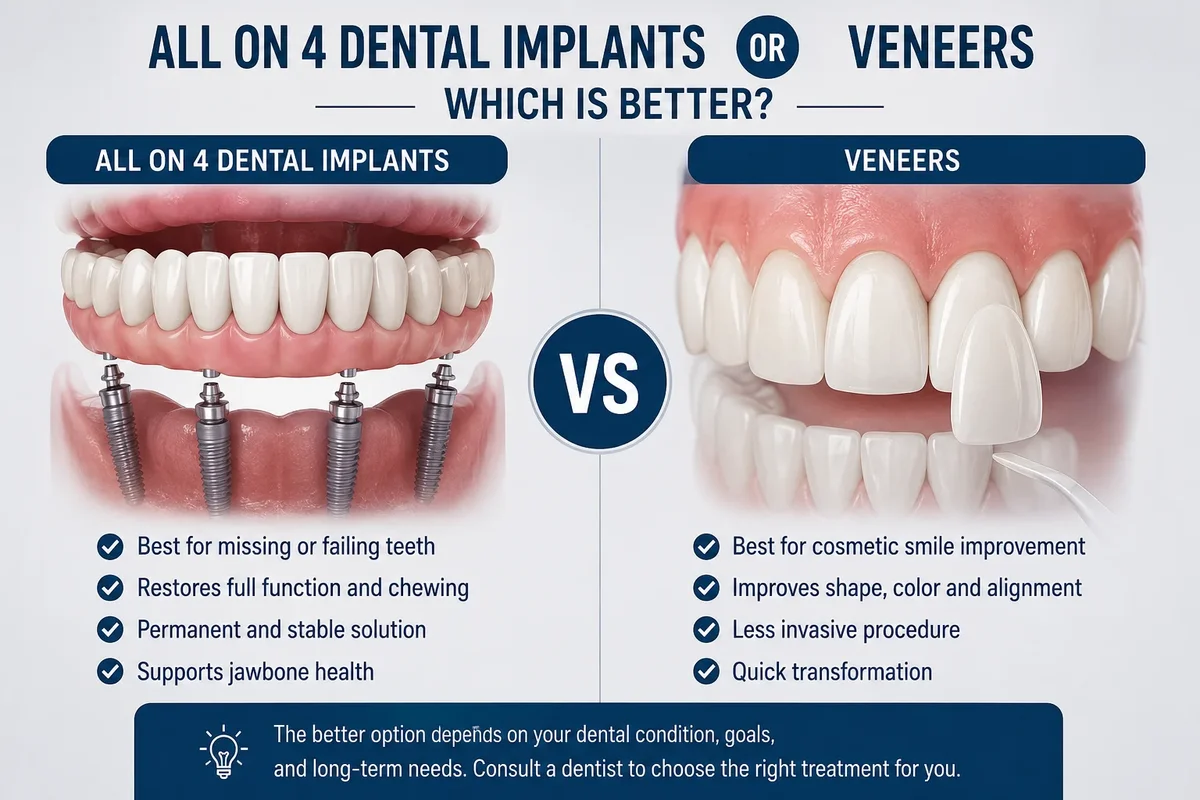
Decision Checklist: How to Know Whether All on 4 or Veneers Fits Your Case
When you reach the final comparison stage and still wonder all on 4 dental implants or veneers which is better, the most useful approach is to use a practical checklist. This checklist should not replace a dental examination, but it can help you understand what your symptoms and goals may mean before speaking with a dentist. In simple terms, veneers are usually considered when your natural teeth are healthy enough to keep and your main concern is cosmetic. All on 4 dental implants are usually considered when a full arch of teeth is missing, failing, unstable, or no longer comfortable for chewing. The better choice is the treatment that solves the real problem without doing too little or too much.
The question all on 4 dental implants or veneers which is better should begin with tooth condition. If your teeth are present, firm, and mostly healthy, veneers may be a suitable way to improve color, shape, length, mild spacing, or smile balance. If your teeth are loose, painful, severely decayed, infected, or already missing in several areas, veneers may not be enough. A veneer needs a stable natural tooth underneath. If the foundation is weak, the cosmetic result may not be predictable. In that situation, All on 4 or another replacement option may need to be discussed.
Checklist 1: Are Your Natural Teeth Healthy Enough to Keep?
Your first question should be whether your natural teeth can be preserved. Veneers work best when the teeth have enough structure, healthy gums, and stable bite support. If you have only mild discoloration, small chips, uneven edges, or cosmetic concerns, veneers may be a conservative direction. If you have large untreated cavities, severe cracks, repeated infections, advanced gum disease, or tooth mobility, a cosmetic surface treatment may not solve the deeper issue. This is why all on 4 dental implants or veneers which is better cannot be answered properly without checking the long-term outlook of each tooth.
In some cases, the dentist may recommend saving some teeth and replacing others. Not every patient fits neatly into one category. You may need crowns on damaged teeth, veneers on healthy front teeth, an implant for one missing tooth, or gum treatment before any cosmetic work. If most teeth in an arch have a poor prognosis, All on 4 may become a more realistic option. If most teeth are healthy, removing them for full-arch implant treatment may be unnecessary.
Checklist 2: Is Your Main Goal Cosmetic or Functional?
Your main goal strongly affects the answer to all on 4 dental implants or veneers which is better. If your goal is to improve smile appearance, veneers may be appropriate after examination. They can improve tooth color, shape, symmetry, and visible proportions. If your goal is to chew better, replace missing teeth, stop denture movement, or restore a failing full arch, All on 4 may be more relevant. Cosmetic dissatisfaction and functional failure are different problems, so they usually need different treatment plans.
A patient who says, “I do not like the shade and shape of my teeth,” may need whitening, bonding, veneers, orthodontics, or crowns. A patient who says, “I cannot chew, my denture moves, or my teeth are loose,” may need implants, dentures, bridges, extractions, gum treatment, or full-arch rehabilitation. Before choosing, write down your top three concerns. This helps the dentist guide you toward a solution that matches your real priority.
Checklist 3: How Much Treatment Are You Ready For?
Veneers and All on 4 differ in treatment intensity. Veneers usually involve planning, possible tooth preparation, temporary veneers, and final bonding. All on 4 usually involves imaging, surgical planning, possible extractions, implant placement, temporary teeth, healing, and final prosthetic work. When asking all on 4 dental implants or veneers which is better, think about whether your mouth requires a cosmetic process or a surgical-restorative process.
If your teeth are healthy and you want a faster cosmetic change, veneers may seem easier. However, veneers should still be planned carefully because some enamel may be altered and future maintenance is needed. If your teeth are failing, All on 4 may involve more appointments and healing time, but it may address the full problem more appropriately. A shorter treatment is not automatically better if it does not treat the cause of your dental issues.
Checklist 4: What Are the Cost and Maintenance Responsibilities?
Cost matters, but it should be compared with suitability. Veneers may cost less when only a few teeth are treated, but the total can increase if a full smile makeover is planned. All on 4 dental implants may require a larger investment because it includes surgical and prosthetic stages. Final costs depend on examination, imaging, materials, number of teeth or arches involved, temporary restorations, follow-up care, and any additional procedures. No final price should be guaranteed without a dental assessment.
Maintenance is also part of the decision. Veneers require daily brushing, flossing, professional cleanings, and protection from grinding or hard biting habits. All on 4 requires careful cleaning around and under the prosthesis, implant monitoring, bite checks, and regular professional maintenance. When deciding all on 4 dental implants or veneers which is better, choose the option you can realistically care for over time. Even a well-planned treatment can develop problems if hygiene and follow-up are ignored.
Checklist 5: What Should You Ask During Consultation?
During your consultation, ask direct questions. Are my natural teeth healthy enough for veneers? Do any teeth have a poor prognosis? Is gum treatment needed first? Do I have enough bone for implants? What alternatives should I consider? What is included in the treatment estimate? How long will the process take? What maintenance will I need after treatment? These questions help turn all on 4 dental implants or veneers which is better from a general search query into a personalized treatment discussion.
At Redent Klinik, a personalized evaluation can help clarify whether your case is mainly cosmetic, functional, surgical, or a combination. The goal should be to match the treatment to your mouth, not to force one popular option. Some patients may be better suited to veneers, some to All on 4, and others to alternatives such as whitening, bonding, crowns, bridges, individual implants, dentures, orthodontics, or staged care.
Final Practical Guidance
Before making a decision, check whether your teeth are stable, whether your gums bleed, whether you have missing teeth, whether chewing is difficult, whether you wear uncomfortable dentures, and whether your concern is mainly appearance or function. If your natural teeth are healthy and your concern is cosmetic, ask about veneers and conservative alternatives. If your teeth are missing, loose, painful, or failing across a full arch, ask about All on 4 and other replacement options. This is the most practical way to answer all on 4 dental implants or veneers which is better for your own situation.
You should request professional dental advice if you have tooth mobility, missing teeth, gum bleeding, pain, repeated infections, severe wear, old dental work that keeps failing, denture movement, or uncertainty about whether your teeth can be saved. The right next step is a clinical examination, imaging when needed, and a written treatment plan that explains suitable options, risks, timing, maintenance, and estimated costs based on your case. In the end, all on 4 dental implants or veneers which is better should be answered by choosing the treatment that protects oral health, restores the right function, supports a natural-looking smile, and fits your long-term care needs.
Disclosure: this page may contain affiliate links. We may earn a commission if you use them, at no extra cost to you.