
When comparing dental implants vs clear aligners, the most important point to understand is that these two treatments are designed to solve very different dental problems. Many people search for dental implants vs clear aligners because they want the best long-term solution for their smile, but the correct choice depends on whether you are replacing missing teeth, correcting tooth alignment, or dealing with both issues at the same time. Instead of asking which treatment is universally better, it is more helpful to determine which option matches your current oral health, future goals, and treatment priorities.
In the discussion of dental implants vs clear aligners, dental implants are intended to replace one or more missing teeth by placing an artificial tooth root into the jawbone and attaching a crown afterward. Clear aligners, on the other hand, are removable orthodontic trays that gradually move natural teeth into improved positions. Because one treatment replaces missing teeth while the other straightens existing teeth, they are not direct competitors. In fact, many comprehensive treatment plans successfully combine both approaches to achieve better function and aesthetics.
If you are trying to decide between dental implants vs clear aligners, begin by asking yourself a few simple questions. Are you missing one or more teeth? Do you mainly dislike crowded or crooked teeth? Are you struggling with chewing because of tooth loss? Or is your biggest concern the appearance of your smile? Your answers help determine which treatment deserves priority. Someone with healthy but crowded teeth may benefit from clear aligners alone, while someone who has lost a tooth generally needs an implant or another tooth replacement option before considering cosmetic improvements.
The comparison of dental implants vs clear aligners also depends on your oral health. Dental implants require sufficient jawbone volume and healthy gums to support successful healing. Clear aligners require teeth that can safely be moved through orthodontic treatment. Active gum disease, untreated decay, or significant infections should usually be addressed before either treatment begins. A professional examination helps identify these issues early and allows your dentist to recommend a treatment sequence that supports long-term oral health.
Another important consideration when evaluating dental implants vs clear aligners is treatment timing. Dental implants often involve healing periods after implant placement before the final restoration is attached. Clear aligners usually require wearing the trays for most of the day over several months, with treatment duration depending on the complexity of tooth movement. Some patients complete orthodontic treatment before receiving implants so the implant can be positioned after the surrounding teeth reach their ideal locations. Others may require implant treatment first if missing teeth are causing functional problems.
Function is another major difference in dental implants vs clear aligners. Dental implants are designed to restore chewing ability, help maintain jawbone stimulation, and replace missing teeth without relying on adjacent teeth. Clear aligners improve bite alignment, tooth positioning, and smile appearance by gradually moving natural teeth. Since each treatment addresses different clinical goals, choosing one over the other without understanding your specific needs may not provide the outcome you expect.
Many patients are also interested in appearance when researching dental implants vs clear aligners. Clear aligners are popular because they are transparent and removable, making orthodontic treatment less noticeable than traditional braces. Dental implants are designed to resemble natural teeth once restored with custom-made crowns. Both treatments can improve smile aesthetics, but they achieve those improvements in fundamentally different ways. One replaces missing teeth, while the other repositions existing teeth.
Financial planning is another topic that frequently arises when comparing dental implants vs clear aligners. Treatment costs vary according to the number of implants, complexity of surgery, bone grafting requirements, length of orthodontic treatment, and individual treatment planning. Because every patient’s needs are different, a personalized examination is necessary before any reliable estimate can be provided. It is more useful to compare the expected treatment objectives and long-term value than to focus only on initial costs.
Your lifestyle should also influence your decision regarding dental implants vs clear aligners. Clear aligners require excellent compliance because they must be worn for the recommended number of hours each day to achieve predictable tooth movement. Dental implants require careful healing after placement and continued oral hygiene to maintain healthy surrounding tissues. In both cases, regular dental follow-up appointments play an important role in monitoring progress and maintaining treatment results.
If your situation involves both missing teeth and crooked teeth, the decision between dental implants vs clear aligners may not actually be an either-or choice. Comprehensive treatment planning often combines orthodontic alignment with implant restoration to improve bite function, oral health, and smile aesthetics together. Determining the proper sequence requires clinical examination, digital imaging, and evaluation of bone levels, gum health, and bite relationships.
Reliable information is essential before making any treatment decision. Educational resources provided by the American Dental Association can help you better understand general dental treatment principles. However, online information cannot replace an individualized clinical assessment because every patient presents different anatomical and functional considerations.
If you would like a personalized evaluation of dental implants vs clear aligners, an experienced dental team can explain which treatment—or combination of treatments—is most appropriate for your goals. At Redent Klinik, treatment recommendations are based on detailed examinations, digital diagnostics, and discussions about your expectations rather than one-size-fits-all solutions. If you decide to seek professional advice, you can arrange a consultation through the Redent Klinik Contact Page to discuss the most suitable treatment pathway for your individual situation.
Next step: Before deciding between dental implants vs clear aligners, make a list of your primary concerns—missing teeth, tooth alignment, chewing ability, appearance, treatment time, and budget. Bring these priorities to your dental consultation so your dentist can recommend a treatment plan that matches your oral health needs and long-term expectations instead of relying solely on general online comparisons.
Dental Implants vs Clear Aligners: Which Option Is Right for You?
Choosing between dental implants vs clear aligners can feel confusing because both treatments are associated with healthier, more attractive smiles, yet they solve completely different dental problems. Many people assume they must choose one or the other, but in reality the decision depends on your current oral condition rather than personal preference alone. Understanding how each treatment works will help you make an informed decision and know when a professional evaluation is the next logical step.
The comparison of dental implants vs clear aligners begins with identifying your primary concern. If your biggest issue is a missing tooth, an implant may be the appropriate solution because aligners cannot replace teeth. If your natural teeth are present but crowded, spaced, or misaligned, clear aligners may address those orthodontic concerns without replacing any teeth. In some situations, patients require both treatments, completed in a carefully planned sequence to produce the best functional and cosmetic outcome.
Understand the Main Purpose of Each Treatment
The most important factor in deciding between dental implants vs clear aligners is understanding what each treatment is designed to accomplish.
Dental Implants
Dental implants replace missing teeth by inserting a titanium or ceramic implant into the jawbone. After healing, a custom restoration is attached to restore appearance and chewing function. Implants are intended for patients who have already lost one or more teeth because of injury, decay, periodontal disease, or other causes.
Clear Aligners
Clear aligners gradually move existing natural teeth into improved positions using a series of removable transparent trays. They improve alignment, bite relationships, spacing, crowding, and overall smile aesthetics. They cannot replace missing teeth or restore areas where teeth no longer exist.
Therefore, when evaluating dental implants vs clear aligners, the first question should always be whether the problem involves tooth loss or tooth position.
Which Patients Usually Benefit Most?
Every patient is different, but general guidelines can simplify the comparison of dental implants vs clear aligners.
- Patients missing one or several teeth often benefit from implant evaluation.
- Patients with crooked or crowded teeth generally benefit from orthodontic assessment.
- Patients with healthy teeth but cosmetic alignment concerns may be excellent candidates for clear aligners.
- Patients with missing teeth and shifting neighboring teeth may require both treatments.
- Patients with untreated gum disease or severe decay usually need those conditions managed before either treatment begins.
Rather than trying to decide alone, an examination helps identify which treatment addresses the root cause of your concern.
How Daily Life Influences the Decision
When comparing dental implants vs clear aligners, lifestyle should not be overlooked. Clear aligners require discipline because they must be worn for the recommended number of hours each day. Frequently removing them or forgetting to wear them may affect treatment progress.
Dental implants involve a healing period after surgery, followed by ongoing oral hygiene and routine dental maintenance. Although implants do not require daily insertion and removal like aligners, they still require consistent brushing, flossing, and professional monitoring.
Your daily habits, work schedule, travel frequency, and willingness to follow instructions all influence which treatment fits your lifestyle more comfortably.
How Long Does Treatment Usually Take?
One of the most common questions regarding dental implants vs clear aligners concerns treatment duration.
Clear aligner treatment often lasts several months, although more complex orthodontic movement may require longer. Treatment depends on tooth movement, patient compliance, and clinical objectives.
Dental implant treatment varies according to healing requirements, bone quality, extraction timing, and whether additional procedures such as bone grafting are necessary. Some patients receive immediate temporary restorations, while others require longer healing before the permanent restoration is placed.
Because every treatment plan differs, exact timelines should always be discussed after a clinical examination rather than estimated from general online information.
Cost Should Not Be the Only Decision Factor
When researching dental implants vs clear aligners, many people naturally compare costs first. While budgeting is important, focusing exclusively on price may lead to choosing a treatment that does not solve the underlying problem.
Final treatment costs depend on numerous individual factors, including:
- Clinical examination findings
- Number of missing teeth
- Severity of alignment problems
- Need for bone grafting or other preparatory procedures
- Treatment duration
- Type of restoration or aligner system selected
- Overall treatment planning
Instead of asking which option is cheaper, it is often more useful to ask which treatment best addresses your long-term oral health needs.
When Both Treatments May Be Recommended
An important point often overlooked in discussions about dental implants vs clear aligners is that these treatments frequently complement each other.
For example, a patient may lose a tooth years earlier, allowing neighboring teeth to drift into the empty space. Before placing an implant, orthodontic treatment with clear aligners may create sufficient space for ideal implant positioning. Likewise, correcting bite alignment before implant placement may improve long-term function and aesthetics.
This coordinated approach demonstrates why professional treatment sequencing is often more important than selecting a single treatment in isolation.
Questions to Ask During Your Consultation
If you are still uncertain about dental implants vs clear aligners, preparing questions before your appointment can help you make a more confident decision.
- Is my primary problem missing teeth or tooth alignment?
- Would one treatment improve my oral function more effectively?
- Do I need orthodontic treatment before implant placement?
- Is my bone and gum health suitable for implants?
- How long is my expected treatment process?
- Are there alternative treatment options appropriate for my situation?
These discussions provide far more useful guidance than relying solely on general comparisons found online.
Making a Decision Based on Your Individual Needs
The comparison of dental implants vs clear aligners ultimately comes down to understanding your diagnosis instead of searching for a universally better treatment. Missing teeth, bite problems, cosmetic concerns, bone health, and long-term maintenance all contribute to selecting the most suitable option.
Clinics experienced in comprehensive treatment planning, including Redent Klinik, often evaluate not only individual teeth but also bite function, jawbone condition, gum health, facial aesthetics, and future maintenance before recommending any procedure. This individualized planning helps ensure that treatment recommendations match each patient’s clinical situation rather than following a one-size-fits-all approach.
What to check next: Before deciding between dental implants vs clear aligners, confirm whether your main concern is tooth replacement, tooth alignment, or both. If you have missing teeth, shifting teeth, persistent bite problems, or uncertainty about the correct treatment sequence, schedule a professional dental examination. Digital imaging, a clinical evaluation, and a personalized treatment discussion can help determine the most appropriate next step for your specific oral health needs.
Cost Factors in Dental Implants vs Clear Aligners
For many people, the financial aspect is one of the biggest considerations when comparing dental implants vs clear aligners. While cost is an important part of treatment planning, it should never be the only factor guiding your decision. The lowest initial price may not provide the most suitable long-term solution if the treatment does not address your actual dental needs. Understanding what influences costs can help you ask better questions during your consultation and plan your budget more effectively.
The discussion about dental implants vs clear aligners often starts with the misconception that one treatment is always more expensive than the other. In reality, both treatments have highly individualized pricing because every patient’s clinical condition is unique. The final treatment plan depends on oral health, the complexity of the case, additional procedures, materials used, treatment duration, and long-term goals. A personalized examination is necessary before any clinic can provide an accurate estimate.
Why Treatment Costs Differ Between Patients
When researching dental implants vs clear aligners, it is helpful to understand that two patients receiving the same type of treatment may still receive different treatment plans and cost estimates.
Several factors influence overall treatment expenses, including:
- The number of missing or misaligned teeth.
- Existing gum health.
- Jawbone quality and available bone volume.
- Need for tooth extractions.
- Need for bone grafting or sinus augmentation.
- Complexity of bite correction.
- Treatment duration.
- Type of restoration or aligner system selected.
- Follow-up appointments and maintenance requirements.
Because of these variables, comparing prices alone rarely provides enough information to choose between dental implants vs clear aligners.
Cost Considerations for Dental Implants
Implant Surgery
Dental implant treatment usually includes several stages rather than a single procedure. Costs may involve diagnostic imaging, implant placement, healing appointments, abutments, and the final crown or prosthetic restoration. Some patients also require preparatory procedures before implants can be placed safely.
Bone Grafting
One important financial consideration in dental implants vs clear aligners is whether sufficient jawbone is available. If bone loss has occurred after tooth extraction, additional procedures such as bone grafting may be recommended before implant placement. These procedures increase treatment complexity and may affect both treatment duration and overall cost.
Number of Implants
The total investment depends partly on how many teeth require replacement. Replacing a single tooth differs significantly from restoring several teeth or a full dental arch. A comprehensive examination allows your dentist to determine the most appropriate restorative approach for your situation.
Cost Considerations for Clear Aligners
Complexity of Tooth Movement
When evaluating dental implants vs clear aligners, orthodontic complexity is one of the primary cost factors. Minor cosmetic adjustments generally require fewer aligners than comprehensive bite correction involving multiple stages of tooth movement.
Treatment Length
Longer orthodontic treatment often requires additional aligners, more review appointments, and periodic refinements. The duration depends on how much movement is needed and how consistently the aligners are worn according to professional instructions.
Replacement Aligners
Because aligners are removable, they can occasionally become damaged or misplaced. Depending on the treatment provider and circumstances, replacement trays may influence the overall treatment process.
Long-Term Value Instead of Initial Price
One of the most practical ways to evaluate dental implants vs clear aligners is to focus on value rather than simply comparing initial costs. A treatment that effectively addresses the underlying dental problem may provide greater long-term satisfaction than choosing an option based solely on price.
For example, clear aligners improve tooth alignment but cannot replace a missing tooth. Similarly, placing a dental implant will restore a missing tooth but will not correct crowding or spacing elsewhere in the mouth. Choosing the treatment that addresses your primary concern helps reduce the likelihood of requiring additional corrective procedures later.
Maintenance Costs After Treatment
Financial planning should also include ongoing maintenance when comparing dental implants vs clear aligners.
Dental implants require routine dental examinations, professional cleanings, and good oral hygiene to maintain healthy surrounding tissues. Although implants are designed as long-term restorations, regular maintenance remains important throughout their lifespan.
After clear aligner treatment, most patients are advised to wear retainers to help maintain tooth position. Regular dental reviews continue to play an important role in monitoring oral health and preserving treatment results.
Considering these future responsibilities provides a more complete understanding of overall treatment value.
Can Insurance or Financing Help?
Questions about insurance frequently arise during discussions of dental implants vs clear aligners. Dental insurance policies differ considerably depending on the provider, region, policy limits, waiting periods, and specific treatment categories.
Some plans may contribute toward certain restorative procedures, while orthodontic benefits vary widely. It is advisable to contact your insurance provider directly to understand your available benefits before beginning treatment. If financing options are available through a dental clinic, reviewing repayment terms carefully can help you choose a plan that fits your budget without making assumptions about total treatment costs.
Why a Personalized Treatment Plan Matters
Even when patients search extensively for average prices, no online guide can determine the exact cost of dental implants vs clear aligners for an individual case. Clinical examination, digital imaging, bite evaluation, gum assessment, and treatment objectives all influence the final recommendation.
Clinics that provide comprehensive treatment planning, including Redent Klinik, typically explain each stage of care, discuss alternative treatment options when appropriate, and prepare an individualized treatment plan before discussing estimated costs. This approach allows patients to understand not only the financial aspect but also the expected benefits, limitations, and treatment sequence.
Making a Smart Financial Decision
Choosing between dental implants vs clear aligners should involve balancing oral health needs, functional goals, cosmetic expectations, treatment time, and long-term maintenance—not simply comparing two numbers. Asking detailed questions about every stage of treatment will help you understand exactly what is included and why certain procedures may be recommended.
What to check next: Before making a decision, request a complete examination that includes digital imaging, an assessment of your teeth, gums, bite, and jawbone, along with a written treatment plan outlining recommended procedures. If cost is a significant concern, ask about all expected treatment stages, possible alternatives, maintenance requirements, insurance coverage, and available financing options. A personalized consultation is the most reliable way to determine which approach best suits your oral health and budget.
Who Is a Good Candidate for Dental Implants vs Clear Aligners?
One of the most important questions people ask when researching dental implants vs clear aligners is whether they are actually a suitable candidate for either treatment. The answer depends on much more than age or appearance. Your oral health, the condition of your teeth and gums, your jawbone, bite alignment, lifestyle, and treatment goals all influence which option is most appropriate. In many cases, the decision is not about choosing the “better” treatment but about identifying the one that solves your specific dental problem safely and effectively.
The comparison of dental implants vs clear aligners begins with a professional diagnosis rather than personal preference. Dental implants replace missing teeth, while clear aligners reposition existing natural teeth. Because these treatments address different clinical needs, understanding your current condition is the first step toward making an informed decision.
When Dental Implants May Be the Better Choice
If your primary concern is replacing one or more missing teeth, the discussion of dental implants vs clear aligners generally points toward implant treatment rather than orthodontics. Clear aligners cannot fill gaps created by missing teeth, whereas implants are specifically designed to restore both appearance and chewing function.
You Have One or More Missing Teeth
The clearest indication for implant treatment is tooth loss. Whether a tooth was lost because of trauma, advanced decay, gum disease, or another reason, an implant may be considered if enough healthy bone is available to support it.
Your Jawbone Can Support an Implant
Successful implant treatment requires sufficient jawbone volume and healthy surrounding tissues. If bone loss has occurred, your dentist may recommend additional procedures before implant placement. A clinical examination and imaging are necessary to evaluate bone quality.
You Want a Fixed Tooth Replacement
Many patients comparing dental implants vs clear aligners prefer implants because they provide a fixed solution for missing teeth instead of a removable appliance. However, suitability depends on individual anatomy and overall oral health rather than personal preference alone.
When Clear Aligners May Be the Better Choice
For patients with healthy natural teeth that are crowded, spaced, or slightly rotated, dental implants vs clear aligners often leads toward orthodontic treatment rather than tooth replacement.
You Want Straighter Teeth
Clear aligners are designed to move existing teeth into improved positions. If your concern involves crooked teeth, overlapping teeth, spacing, or mild bite issues, orthodontic treatment may be appropriate after a professional assessment.
Your Teeth and Gums Are Healthy
Healthy gums and stable teeth are important before orthodontic movement begins. Active gum disease or untreated cavities should usually be treated first to reduce potential complications during tooth movement.
You Can Wear Aligners Consistently
One practical consideration in dental implants vs clear aligners is patient commitment. Clear aligners are removable, but they only work effectively when worn for the recommended number of hours each day. Patients who frequently remove them or struggle with compliance may experience slower progress.
Can You Need Both Treatments?
An important point that is often overlooked in discussions of dental implants vs clear aligners is that many patients benefit from both treatments as part of a comprehensive plan.
For example, someone who lost a tooth several years ago may also have neighboring teeth that gradually shifted into the empty space. In this situation, clear aligners may first create the proper space before a dental implant is placed. Likewise, correcting bite alignment before implant restoration may improve long-term function and aesthetics.
This coordinated approach highlights why treatment planning should always focus on your complete oral condition instead of evaluating each procedure separately.
Health Factors That Influence Eligibility
Several medical and dental factors can influence the decision between dental implants vs clear aligners. Your dentist will usually assess these areas during a comprehensive consultation.
- Overall gum health.
- Presence of untreated tooth decay.
- Jawbone volume and density.
- Bite alignment.
- Number of missing teeth.
- Oral hygiene habits.
- Smoking or tobacco use.
- General medical history.
- Previous dental restorations.
These factors do not automatically exclude treatment, but they help determine the safest and most predictable treatment plan for each patient.
Lifestyle Considerations
Your daily routine also affects the comparison of dental implants vs clear aligners. People with demanding work schedules, frequent travel, or difficulty maintaining routines should discuss these factors during treatment planning.
Clear aligners require patients to remember to wear and clean the trays consistently. Dental implants require careful healing after placement and excellent long-term oral hygiene. Choosing a treatment that matches your lifestyle can improve both comfort and long-term maintenance.
Age Is Usually Less Important Than Oral Health
Many people assume age alone determines whether they should choose dental implants vs clear aligners. In reality, oral health generally matters far more than chronological age.
Adults of many ages may be candidates for implants if jaw growth has completed and bone conditions are suitable. Likewise, adults of different age groups can benefit from clear aligners if their teeth and gums are healthy enough for orthodontic movement. Instead of focusing on age, dentists evaluate biological factors such as bone health, gum condition, and treatment objectives.
Questions to Discuss During Your Consultation
Preparing questions before your appointment can make your comparison of dental implants vs clear aligners much more productive.
- What is the main cause of my dental concern?
- Am I missing teeth or primarily dealing with alignment issues?
- Do I have enough bone for implant treatment?
- Would orthodontic treatment improve my bite before implant placement?
- Are there alternative treatment options for my situation?
- What maintenance will each treatment require?
These questions encourage personalized discussions instead of relying on general online information.
Making the Right Choice for Your Situation
The decision between dental implants vs clear aligners should always be based on a complete clinical assessment rather than assumptions or advertisements. Every smile is different, and successful treatment planning considers function, aesthetics, oral health, future maintenance, and patient expectations together.
At clinics such as Redent Klinik, dentists typically evaluate digital scans, bite relationships, gum health, and jawbone condition before recommending treatment. This individualized planning helps patients understand not only which option is appropriate but also whether combining treatments could produce a better overall result.
What to check next: Before deciding between dental implants vs clear aligners, schedule a comprehensive dental examination if you have missing teeth, shifting teeth, bite problems, persistent spacing, crowding, or uncertainty about the best treatment path. A professional evaluation with clinical examination and imaging can determine your suitability, identify any conditions that should be treated first, and help you understand whether implants, clear aligners, or a combination of both is the most appropriate solution for your individual needs.
Understanding the Treatment Process for Dental Implants vs Clear Aligners
When comparing dental implants vs clear aligners, understanding how each treatment is performed is just as important as comparing costs or appearance. Although both procedures aim to improve oral health and confidence, they follow very different treatment pathways. Dental implants involve replacing missing teeth with artificial tooth roots and restorations, while clear aligners gradually reposition existing natural teeth. Knowing what happens before, during, and after each treatment helps you make realistic expectations and decide which approach better fits your dental needs and lifestyle.
One common misunderstanding in the discussion of dental implants vs clear aligners is that the treatments are interchangeable. In reality, the clinical process is completely different because each treatment addresses a separate problem. Understanding every stage allows you to prepare for appointments, recovery, follow-up care, and long-term maintenance.
The First Step: Comprehensive Dental Examination
Regardless of whether you are considering dental implants vs clear aligners, treatment begins with a thorough dental evaluation. Your dentist will collect information that helps determine which option is appropriate for your situation.
Clinical Examination
The dentist evaluates your teeth, gums, bite, oral hygiene, existing restorations, and any signs of decay or periodontal disease. This examination identifies problems that should be addressed before treatment begins.
Digital Imaging
X-rays, digital scans, or three-dimensional imaging may be recommended depending on your clinical needs. Imaging allows the dentist to evaluate bone levels, tooth roots, jaw structure, and surrounding anatomical features before recommending treatment.
This diagnostic stage is essential when comparing dental implants vs clear aligners because it helps determine whether implant placement, orthodontic movement, or a combination of both is appropriate.
The Dental Implant Treatment Process
If the examination shows that replacing missing teeth is the priority, the treatment pathway for dental implants vs clear aligners moves toward implant therapy.
Treatment Planning
The dentist determines implant position, evaluates available bone, and develops an individualized surgical and restorative plan. If additional procedures are necessary, they are discussed before treatment begins.
Preparation Before Surgery
Some patients require tooth extraction, bone grafting, or periodontal treatment before implant placement. These preparatory procedures create healthier conditions for successful implant therapy when clinically indicated.
Implant Placement
The implant is surgically inserted into the jawbone under appropriate local anesthesia or another suitable form of pain management recommended by the treating clinician. Healing begins as the implant gradually integrates with surrounding bone.
Healing Phase
The healing period varies depending on individual circumstances, overall health, and treatment complexity. During this stage, following oral hygiene instructions and attending review appointments is important for monitoring recovery.
Final Restoration
Once healing is complete, the final crown, bridge, or prosthetic restoration is attached to the implant. The completed restoration is designed to restore chewing ability and blend naturally with surrounding teeth.
The Clear Aligner Treatment Process
Patients whose primary concern is tooth alignment usually follow a different treatment pathway when comparing dental implants vs clear aligners.
Digital Smile Assessment
Digital impressions or intraoral scans are taken to create a virtual treatment plan showing how teeth are expected to move throughout treatment.
Custom Aligner Fabrication
A series of transparent aligners is manufactured according to the treatment plan. Each set is designed to move teeth gradually toward their planned positions.
Wearing the Aligners
Patients typically change aligners according to the schedule provided by their dentist or orthodontist. Consistent wear is important because removing aligners too frequently may slow tooth movement.
Progress Reviews
Regular follow-up appointments allow the dentist to evaluate tooth movement, monitor oral health, and determine whether treatment is progressing as expected. Additional aligners or refinements may occasionally be recommended.
Retention After Treatment
After orthodontic treatment is completed, retainers are commonly recommended to help maintain the new tooth positions. Retention plays an important role in preserving treatment results over time.
When Both Treatments Are Part of the Same Plan
One of the most interesting aspects of dental implants vs clear aligners is that both treatments may be combined rather than chosen separately.
For example, if a missing tooth has allowed neighboring teeth to drift, clear aligners may first create the proper space before implant placement. Alternatively, orthodontic treatment may improve bite relationships before restorative work begins. Coordinated treatment planning often provides better functional and aesthetic outcomes than performing each procedure independently.
What Happens During Recovery?
The recovery experience differs considerably when evaluating dental implants vs clear aligners.
After implant surgery, temporary tenderness or swelling may occur as tissues heal. Patients receive individualized postoperative instructions regarding oral hygiene, diet, and follow-up care.
With clear aligners, patients commonly experience mild pressure for a short period after switching to a new aligner set. This sensation generally reflects tooth movement rather than tissue healing.
Following professional instructions throughout either treatment helps support successful progress.
Patient Responsibilities During Treatment
Successful outcomes in dental implants vs clear aligners depend not only on clinical procedures but also on patient participation.
- Maintain excellent daily oral hygiene.
- Attend scheduled review appointments.
- Follow dietary recommendations when appropriate.
- Wear aligners consistently if prescribed.
- Report unusual symptoms promptly.
- Follow postoperative instructions after implant surgery.
Patients who actively participate in their care generally have a clearer understanding of treatment expectations and maintenance requirements.
How Treatment Planning Supports Better Decisions
The comparison of dental implants vs clear aligners is ultimately less about selecting one procedure and more about creating the right treatment sequence. Every patient’s mouth presents unique anatomical, functional, and cosmetic considerations. Digital planning, clinical examination, and careful discussion of treatment objectives help ensure that recommendations are tailored to individual needs rather than generalized comparisons.
Clinics such as Redent Klinik often use comprehensive diagnostics to determine whether implant placement, orthodontic treatment, or a combined approach is most appropriate. Individualized planning also helps patients understand expected treatment stages, maintenance responsibilities, and realistic timelines before treatment begins.
What to check next: Before choosing between dental implants vs clear aligners, ask your dentist to explain every stage of the recommended treatment plan, including preparation, expected healing or tooth movement, follow-up visits, maintenance requirements, and possible alternatives. If you are uncertain about the treatment sequence or have both missing and misaligned teeth, request a comprehensive evaluation with digital imaging and a personalized consultation to determine the most appropriate path for your oral health.
Risks, Limitations, and Long-Term Considerations
When comparing dental implants vs clear aligners, it is easy to focus on the expected benefits while overlooking the potential risks and long-term responsibilities. Every dental treatment has limitations, and understanding them before making a decision helps you set realistic expectations. Neither treatment is universally better than the other because they solve different clinical problems and require different levels of patient commitment. A careful discussion with your dentist can help you understand how each option fits your oral health, lifestyle, and future goals.
The comparison of dental implants vs clear aligners should include more than appearance or treatment time. Long-term maintenance, possible complications, oral hygiene requirements, and the stability of treatment results are equally important. By considering these factors early, you can make a more informed decision and reduce the likelihood of unexpected challenges later.
Potential Risks of Dental Implants
Dental implants have become a well-established treatment option for replacing missing teeth, but like any surgical procedure, they involve potential risks that should be discussed before treatment begins.
Healing After Surgery
Following implant placement, the surrounding bone and soft tissues need time to heal. Healing time varies between individuals and depends on factors such as overall health, oral hygiene, bone quality, and whether additional procedures were required. Attending follow-up appointments allows the dentist to monitor the healing process and address any concerns promptly.
Bone and Gum Health
One important aspect of dental implants vs clear aligners is that implants require healthy supporting structures. Insufficient jawbone or untreated periodontal disease may require treatment before implants can be considered. Ignoring these conditions may reduce the predictability of implant therapy.
Long-Term Maintenance
Although implants do not develop cavities like natural teeth, the surrounding gum tissue still requires regular care. Daily brushing, flossing, and routine professional cleanings remain essential to help maintain healthy tissues around the implant.
Potential Risks of Clear Aligners
When evaluating dental implants vs clear aligners, it is equally important to understand that orthodontic treatment also has limitations and responsibilities.
Patient Compliance
Clear aligners depend heavily on consistent wear. Removing them too often or failing to wear them for the recommended number of hours each day may slow tooth movement or reduce treatment effectiveness. Success relies not only on the treatment itself but also on the patient’s commitment.
Temporary Discomfort
Some patients experience mild pressure or tenderness when changing to a new set of aligners. This sensation is generally associated with tooth movement and often decreases as the teeth adapt to each aligner.
Oral Hygiene During Treatment
Maintaining good oral hygiene is especially important while wearing aligners. Teeth should be cleaned before replacing the trays to reduce plaque accumulation and help maintain healthy gums throughout treatment.
Limitations of Dental Implants
Understanding the limitations of dental implants vs clear aligners helps prevent unrealistic expectations.
- Dental implants replace missing teeth but do not straighten crooked natural teeth.
- Additional procedures such as bone grafting may sometimes be recommended before implant placement.
- Healing requires time and regular follow-up appointments.
- Good oral hygiene remains essential throughout the life of the implant.
These limitations do not mean implant treatment is unsuitable; they simply highlight the importance of individualized treatment planning.
Limitations of Clear Aligners
Clear aligners also have specific limitations that should be considered when comparing dental implants vs clear aligners.
- They cannot replace missing teeth.
- Complex orthodontic cases may require additional treatment approaches.
- Results depend significantly on patient cooperation.
- Retainers are usually recommended after treatment to help maintain tooth position.
Understanding these limitations allows patients to make more realistic decisions based on their actual dental needs.
How Lifestyle Influences Long-Term Success
Your daily habits play a major role in the long-term success of dental implants vs clear aligners. Good oral hygiene, routine dental examinations, and following professional recommendations contribute to maintaining treatment results over time.
Patients who smoke, neglect oral hygiene, or frequently miss follow-up appointments may face additional challenges regardless of which treatment they choose. Likewise, patients using clear aligners should develop consistent routines for wearing, cleaning, and storing their aligners properly.
Choosing a treatment that matches your ability to maintain these routines often contributes to greater long-term satisfaction.
Can Both Treatments Be Part of a Long-Term Plan?
An important point in discussions about dental implants vs clear aligners is that the two treatments are not mutually exclusive. Many comprehensive treatment plans successfully combine orthodontic alignment with implant restoration.
For example, moving teeth into their ideal positions before implant placement may improve the final functional and cosmetic result. Likewise, replacing missing teeth after orthodontic treatment can help stabilize the bite and restore chewing efficiency.
This coordinated approach demonstrates why treatment planning should focus on your complete oral condition rather than isolated procedures.
Questions to Ask About Long-Term Maintenance
Before deciding between dental implants vs clear aligners, consider discussing long-term maintenance with your dentist.
- How often should follow-up appointments be scheduled?
- What oral hygiene routine is recommended?
- Will retainers be necessary after orthodontic treatment?
- Are there any lifestyle habits that could affect treatment outcomes?
- What signs should prompt an earlier review appointment?
These questions help patients understand that successful treatment extends beyond the final appointment.
Balancing Benefits and Responsibilities
The comparison of dental implants vs clear aligners is not simply about identifying advantages. Every treatment involves responsibilities, maintenance, and realistic expectations. Dental implants restore missing teeth but require healthy supporting tissues and careful long-term care. Clear aligners improve tooth alignment but depend on patient compliance and ongoing retention after treatment.
Clinics such as Redent Klinik generally emphasize individualized treatment planning because every patient has different priorities, oral conditions, and long-term goals. A comprehensive evaluation helps determine not only which treatment is appropriate but also how potential risks can be minimized through careful planning and regular follow-up care.
What to check next: Before making a final decision about dental implants vs clear aligners, ask your dentist to explain the possible risks, expected maintenance, healing or treatment timeline, and long-term responsibilities associated with each option. If you have gum disease, bone loss, multiple missing teeth, bite problems, or questions about treatment stability, request a comprehensive examination so your treatment plan can be based on your individual oral health rather than general comparisons.
Alternatives to Dental Implants vs Clear Aligners
Although many people search for dental implants vs clear aligners, these are not the only treatment options available. Dentistry offers several alternatives depending on the condition of your teeth, gums, jawbone, budget, treatment goals, and overall oral health. Understanding these alternatives allows you to have a more informed discussion with your dentist and choose a treatment plan that fits your individual situation rather than assuming only two options exist.
The comparison of dental implants vs clear aligners becomes much more meaningful when alternative treatments are also considered. In some cases, an implant or aligner is clearly the most appropriate solution. In others, a different restorative or orthodontic approach may better address the patient’s needs. A professional examination is essential because the most suitable treatment depends on diagnosis rather than personal preference.
Alternatives to Dental Implants
If your primary concern involves replacing missing teeth, several alternatives may be discussed before deciding on dental implants vs clear aligners.
Dental Bridges
A traditional dental bridge replaces one or more missing teeth by using adjacent teeth as support for the restoration. Bridges may be considered when neighboring teeth already require crowns or when implant placement is not currently appropriate. However, preparing healthy adjacent teeth may be necessary, making this option different from implant treatment.
Removable Partial Dentures
Partial dentures replace missing teeth using a removable appliance. They may be suitable for certain patients depending on the number of missing teeth, oral health, personal preferences, and financial considerations. Some patients appreciate the lower initial cost, while others prefer fixed solutions after discussing long-term expectations with their dentist.
Complete Dentures
Patients missing all teeth in one or both arches may consider conventional complete dentures. Depending on individual circumstances, implant-supported dentures may also be discussed as another treatment option. The most appropriate recommendation depends on bone condition, oral anatomy, and functional goals.
Alternatives to Clear Aligners
Patients researching dental implants vs clear aligners because of crooked teeth should also understand that aligners are not the only orthodontic treatment available.
Traditional Metal Braces
Metal braces remain a widely used orthodontic treatment for correcting tooth alignment and bite problems. Because brackets remain attached throughout treatment, patient compliance differs from removable aligners. Some complex orthodontic movements may be more suitable for fixed appliances depending on the clinical situation.
Ceramic Braces
Ceramic braces function similarly to metal braces while using tooth-colored or clear brackets that are generally less noticeable. They may be appropriate for patients seeking a more discreet fixed orthodontic option.
Limited Orthodontic Treatment
Some patients require only minor alignment corrections. In these situations, shorter orthodontic treatments may be discussed if clinically appropriate. The suitability of limited treatment depends entirely on examination findings and treatment objectives.
When Both Implant and Orthodontic Alternatives Are Needed
One important aspect of dental implants vs clear aligners is recognizing that some patients require a combination of restorative and orthodontic treatment rather than choosing one procedure alone.
For example, losing a tooth can allow neighboring teeth to drift into the empty space over time. Before replacing the missing tooth, orthodontic treatment may first reposition surrounding teeth to create adequate space for restoration. Likewise, correcting bite relationships before implant placement may improve long-term function and appearance.
This coordinated planning often produces better results than treating each issue separately.
Factors That Influence Alternative Treatment Choices
Several clinical factors determine whether alternatives should be considered during discussions about dental implants vs clear aligners.
- Number of missing teeth.
- Condition of adjacent teeth.
- Amount of available jawbone.
- Severity of tooth crowding or spacing.
- Overall bite relationship.
- Gum health.
- Medical history.
- Patient expectations.
- Long-term maintenance preferences.
Each of these factors contributes to selecting an individualized treatment plan rather than relying on generalized comparisons.
How Budget Can Influence Treatment Alternatives
Budget is often an important consideration when comparing dental implants vs clear aligners and their alternatives. However, treatment decisions should balance financial planning with clinical needs. Choosing a lower-cost option that does not adequately address the underlying problem may result in additional treatment later.
Discussing available alternatives with your dentist allows you to understand the expected benefits, limitations, maintenance requirements, and overall treatment objectives of each option before making a decision.
Questions to Ask About Alternative Treatments
Before deciding between dental implants vs clear aligners, consider asking your dentist several practical questions regarding possible alternatives.
- Are there multiple treatment options for my condition?
- What are the advantages and limitations of each alternative?
- Which option best supports my long-term oral health?
- Will delaying treatment affect future choices?
- Can treatment be completed in stages?
- What maintenance is required after each option?
These discussions help ensure that your treatment plan reflects both your clinical needs and your personal priorities.
Why Personalized Planning Matters
The comparison of dental implants vs clear aligners becomes much clearer after a complete dental examination because your dentist can evaluate the full range of available treatment options. Online articles can explain general differences, but they cannot determine which treatment—or combination of treatments—is appropriate for your unique oral condition.
Clinics such as Redent Klinik commonly evaluate bite alignment, gum health, bone quality, missing teeth, existing restorations, and aesthetic goals before discussing restorative or orthodontic alternatives. This comprehensive planning helps patients understand not only the primary recommendation but also reasonable alternatives that may better suit their circumstances.
Making an Informed Decision
Choosing between dental implants vs clear aligners should not feel like selecting from only two possibilities. Modern dentistry offers multiple restorative and orthodontic solutions, each with different indications, benefits, and limitations. The most suitable treatment depends on accurate diagnosis, realistic expectations, long-term oral health, and careful treatment planning rather than popularity or marketing claims.
What to check next: Before making a final decision, ask your dentist to explain every appropriate alternative for your specific condition, including the expected treatment sequence, maintenance requirements, possible limitations, and long-term goals. If you have both missing teeth and alignment concerns, or if you are unsure whether restorative or orthodontic treatment should come first, request a comprehensive evaluation with digital imaging and a personalized consultation to determine the most suitable approach for your oral health.
Financing, Insurance, and Budget Planning
For many patients, comparing dental implants vs clear aligners is not only about clinical outcomes but also about financial planning. Even if one treatment appears to be the ideal solution, it still needs to fit comfortably within your budget and long-term financial goals. Understanding how financing, insurance, and treatment planning work together can help you avoid surprises and make a decision based on both your oral health and your financial situation.
One of the biggest misconceptions about dental implants vs clear aligners is that there is a simple answer to the question, “Which costs less?” In reality, treatment expenses vary significantly because every patient has different oral health needs. The complexity of your case, the number of teeth involved, additional procedures, treatment duration, materials used, and follow-up care all influence the final treatment plan. For this reason, online price comparisons should be viewed only as general references rather than accurate estimates for your own situation.
Why Personalized Treatment Plans Affect Costs
When discussing dental implants vs clear aligners, it is important to understand that dentists do not calculate treatment fees using only one factor. Instead, they evaluate your complete oral condition before preparing a treatment recommendation.
Some patients require only straightforward treatment, while others may benefit from a more comprehensive plan involving several stages. During your consultation, the dentist may assess:
- The number of missing teeth.
- The condition of surrounding teeth.
- Jawbone quantity and quality.
- Gum health.
- Bite alignment.
- Whether orthodontic movement is required.
- The need for preparatory procedures.
- Expected treatment timeline.
Because every clinical situation is unique, two patients considering dental implants vs clear aligners may receive completely different treatment recommendations and therefore different cost estimates.
Insurance Considerations
Dental Implant Coverage
Insurance coverage for dental implants varies depending on your provider, policy, country, annual limits, waiting periods, and individual plan conditions. Some policies may contribute toward parts of restorative treatment, while others may provide limited or no coverage for implant-related procedures. It is always advisable to verify your benefits directly with your insurance company before beginning treatment.
Clear Aligner Coverage
Insurance benefits for orthodontic treatment also differ widely. Some plans include orthodontic benefits for eligible patients, while others provide partial reimbursement or no orthodontic coverage at all. Age restrictions, lifetime benefit limits, and treatment eligibility may also apply depending on the policy.
Because insurance policies differ considerably, comparing dental implants vs clear aligners should include a careful review of your own coverage instead of relying on general assumptions.
Questions to Ask Your Insurance Provider
Before starting treatment, it is helpful to prepare a list of questions for your insurance company regarding dental implants vs clear aligners.
- Which procedures are covered?
- Are there annual reimbursement limits?
- Are waiting periods applicable?
- Is pre-authorization required?
- Are diagnostic imaging and consultations included?
- Are retainers or implant restorations covered?
Obtaining clear answers before treatment begins can help you plan your finances more confidently.
Financing Options
Many dental clinics understand that comprehensive treatment may represent a significant investment. For this reason, financing options are sometimes available to help patients spread treatment costs over time. The availability of payment plans varies between clinics and countries, so discussing these options during your consultation can be valuable.
When evaluating financing for dental implants vs clear aligners, consider more than the monthly payment. It is equally important to understand repayment periods, interest or administrative fees if applicable, payment schedules, and any conditions associated with financing agreements.
Carefully reviewing these details allows you to select a payment option that fits comfortably within your overall financial planning.
Thinking Beyond the Initial Investment
Another important aspect of dental implants vs clear aligners is evaluating long-term value instead of focusing exclusively on the initial treatment fee.
For example, dental implants are intended to replace missing teeth and restore chewing function, while clear aligners improve tooth alignment and bite relationships. Since these treatments solve different problems, their value should be measured according to how effectively they address your own clinical needs rather than by comparing prices alone.
Choosing the treatment that appropriately treats the underlying condition may reduce the need for additional corrective procedures in the future.
Budgeting for Ongoing Maintenance
Financial planning should also include maintenance after treatment when comparing dental implants vs clear aligners.
After Dental Implant Treatment
Routine dental examinations, professional cleanings, and excellent daily oral hygiene help maintain healthy tissues surrounding dental implants. These regular appointments should be considered part of your long-term oral healthcare plan.
After Clear Aligner Treatment
Following orthodontic treatment, retainers are commonly recommended to help maintain tooth position. Periodic dental reviews continue to play an important role in preserving both oral health and treatment results.
Considering these future maintenance needs provides a more realistic understanding of total treatment commitment.
Comparing Treatment Value Instead of Price Alone
The discussion of dental implants vs clear aligners should always return to one essential question: which treatment addresses your primary dental problem?
If you are missing teeth, replacing them may improve function and oral health more effectively than orthodontic treatment alone. If your teeth are healthy but misaligned, correcting their position may provide greater benefits than replacing teeth that are already present. In some situations, combining both treatments offers the most comprehensive result.
Evaluating treatment value in relation to your diagnosis is often more helpful than comparing average prices found online.
Preparing Financially for Your Consultation
Before attending your consultation regarding dental implants vs clear aligners, consider gathering information that will help your dentist prepare a realistic treatment discussion.
- Your current dental insurance information.
- A list of previous dental treatments.
- Your approximate treatment budget.
- Your preferred treatment timeline.
- Questions regarding payment options.
- Your long-term smile goals.
Providing this information helps your dentist explain appropriate treatment options while taking your financial priorities into account.
Making a Balanced Financial Decision
Choosing between dental implants vs clear aligners requires balancing oral health, treatment objectives, long-term maintenance, insurance benefits, and financial planning. An informed decision is rarely based on price alone. Instead, it should consider whether the recommended treatment solves your actual dental concern while fitting your overall budget and expectations.
At Redent Klinik, individualized treatment planning allows patients to understand recommended procedures, possible alternatives, expected treatment stages, and estimated costs following a comprehensive examination. This personalized approach supports informed decision-making without relying on generalized assumptions or guaranteed pricing.
What to check next: Before making your final decision about dental implants vs clear aligners, request a written treatment plan outlining recommended procedures, expected treatment stages, maintenance requirements, and estimated costs based on your examination. Review your insurance benefits, ask about available financing options if needed, and seek professional advice whenever you are uncertain about which treatment provides the most appropriate balance between clinical needs and your financial goals.
Frequently Asked Questions About Dental Implants vs Clear Aligners
Patients often search for dental implants vs clear aligners because they want a straightforward answer before scheduling a dental consultation. While online research is a useful starting point, every smile is different, and many of the most common questions can only be answered accurately after a clinical examination. This FAQ section addresses the concerns patients frequently raise while also explaining how those answers may apply to different situations. The goal is not simply to provide information but to help you understand when professional guidance becomes necessary.
The comparison of dental implants vs clear aligners should always begin with one key principle: these treatments are designed for different purposes. Dental implants replace missing teeth, while clear aligners reposition existing teeth. Because of this difference, many questions have answers that depend entirely on your oral condition rather than a universal rule.
Can Dental Implants and Clear Aligners Be Used Together?
Yes, in Many Cases
One of the most common questions about dental implants vs clear aligners is whether patients must choose only one treatment. The answer is often no. Many comprehensive treatment plans combine orthodontic treatment with implant restoration.
For example, if neighboring teeth have shifted after tooth loss, clear aligners may first reposition the teeth before a dental implant is placed. In other situations, implant treatment may be completed after orthodontic correction to achieve improved function and appearance.
Which Treatment Usually Takes Longer?
The timeline for dental implants vs clear aligners depends entirely on individual circumstances.
Dental implant treatment may include healing periods between surgical placement and the final restoration. Clear aligner treatment depends on how much tooth movement is required and how consistently the aligners are worn. Since treatment plans differ significantly between patients, your dentist can provide a more realistic estimate after evaluating your oral condition.
Which Option Looks More Natural?
Another frequent question regarding dental implants vs clear aligners concerns aesthetics.
Dental implants are restored with crowns designed to resemble natural teeth in shape and color. Clear aligners are transparent orthodontic trays intended to be less noticeable than conventional braces while gradually moving natural teeth into improved positions. Both treatments can contribute to an attractive smile, but they achieve this goal in completely different ways.
Can Clear Aligners Replace Missing Teeth?
No
Clear aligners cannot replace teeth that are already missing. Their purpose is to move existing teeth. If tooth replacement is necessary, your dentist may discuss dental implants, bridges, removable prostheses, or other restorative options depending on your clinical condition.
This distinction is one of the most important differences when comparing dental implants vs clear aligners.
Can Dental Implants Straighten Crooked Teeth?
No
Dental implants replace missing teeth but do not move surrounding natural teeth into better alignment. If crowding, spacing, or bite problems are present, orthodontic treatment may be recommended before or after implant placement depending on the treatment plan.
This is why dental implants vs clear aligners is often the wrong question. Many patients benefit from understanding how the treatments complement one another rather than compete.
How Do I Know Which Treatment I Need?
This is perhaps the most important question about dental implants vs clear aligners.
The answer depends on several clinical factors, including:
- Whether you have missing teeth.
- Whether your natural teeth are crowded or spaced.
- Your bite relationship.
- Jawbone condition.
- Gum health.
- Your overall treatment goals.
A comprehensive examination is necessary because online articles cannot accurately diagnose your specific condition.
Does Age Determine Which Treatment Is Better?
Age alone rarely determines the most appropriate choice in dental implants vs clear aligners. Dentists usually focus more on oral health than chronological age.
Healthy adults with sufficient bone may be candidates for implants. Likewise, adults of various ages may successfully complete orthodontic treatment if their gums and teeth are healthy enough for safe tooth movement.
Will I Need Additional Procedures?
Some patients comparing dental implants vs clear aligners require additional procedures before treatment begins.
Examples include:
- Professional periodontal treatment.
- Treatment of tooth decay.
- Bone grafting before implants.
- Tooth extraction.
- Minor restorative procedures.
Whether additional treatment is required depends entirely on examination findings and individualized treatment planning.
How Important Is Oral Hygiene?
Excellent oral hygiene is essential regardless of whether you choose dental implants vs clear aligners.
Implants require healthy surrounding gum tissue for long-term maintenance, while clear aligners should be worn over clean teeth to reduce plaque accumulation and maintain gum health throughout orthodontic treatment.
Daily brushing, flossing, and regular dental examinations remain important after treatment is completed.
Should Cost Decide My Treatment?
Many patients researching dental implants vs clear aligners naturally compare prices first. While financial planning is important, treatment decisions should primarily be based on diagnosis, long-term oral health, and expected treatment outcomes.
Choosing a treatment solely because it appears less expensive may not resolve the underlying dental problem if it is not clinically appropriate.
Can Online Information Replace a Consultation?
No. Educational articles help patients understand general concepts, but they cannot replace a professional examination. Factors such as bone quality, bite alignment, periodontal health, existing restorations, and medical history all influence treatment recommendations.
Clinics such as Redent Klinik typically use digital imaging, clinical examination, and individualized treatment planning to determine whether implants, clear aligners, or a combination of both is most appropriate. This personalized approach allows recommendations to reflect your actual oral condition rather than generalized online advice.
Final Thoughts on Frequently Asked Questions
The discussion of dental implants vs clear aligners often becomes much simpler once you understand that these treatments solve different problems. Dental implants replace missing teeth, while clear aligners improve tooth alignment. Many patients ultimately benefit from both treatments as part of a carefully coordinated plan designed around their specific oral health needs.
What to check next: If you still have unanswered questions about dental implants vs clear aligners, prepare a written list before your consultation. Ask your dentist about diagnosis, treatment sequencing, expected maintenance, alternative options, estimated treatment stages, and long-term oral health goals. If you have missing teeth, crowding, bite problems, or uncertainty about which treatment is appropriate, request a comprehensive dental examination and digital imaging so your decision can be based on your individual clinical situation rather than general online comparisons.
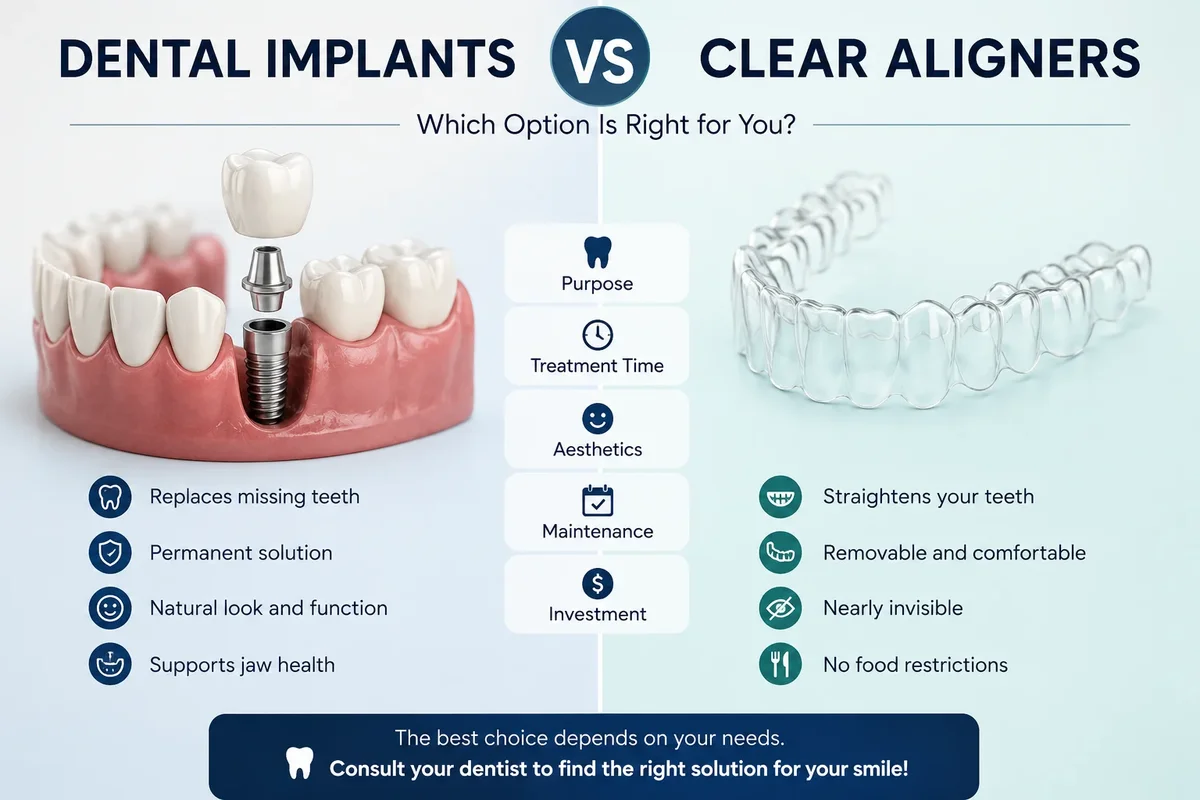
Your Next Step: Choosing Between Dental Implants vs Clear Aligners
After exploring the differences between dental implants vs clear aligners, the final decision should not be based on online opinions, social media trends, or the experiences of friends and family. Instead, it should be based on your own oral health, treatment goals, lifestyle, and a professional clinical evaluation. Every patient has unique dental conditions, which means the most appropriate treatment plan is also unique. The purpose of this final section is to help you organize everything you have learned and understand the practical next steps before beginning treatment.
The comparison of dental implants vs clear aligners often becomes much easier once you stop asking, “Which treatment is better?” and begin asking, “Which treatment solves my dental problem?” This small change in perspective allows you to focus on long-term oral health rather than simply comparing procedures.
Step 1: Identify Your Primary Dental Concern
The first step in choosing between dental implants vs clear aligners is identifying the problem you actually want to solve.
If You Have Missing Teeth
If your main concern is replacing one or more missing teeth, implant treatment may be discussed because clear aligners cannot replace missing teeth. During your consultation, your dentist will evaluate bone quality, gum health, and surrounding teeth before determining whether implant treatment is appropriate.
If Your Teeth Are Crooked or Crowded
If your teeth are present but crowded, spaced, rotated, or mildly misaligned, clear aligners may be a suitable option after a complete orthodontic assessment. Since clear aligners move natural teeth rather than replacing them, they are generally considered when alignment is the primary concern.
If You Have Both Problems
Many patients comparing dental implants vs clear aligners actually need a combination of treatments. Missing teeth can allow neighboring teeth to shift over time, while bite problems may affect implant positioning. In these situations, your dentist may recommend orthodontic treatment first, implant treatment first, or a staged approach based on your clinical findings.
Step 2: Consider Your Long-Term Goals
Successful treatment planning extends beyond immediate cosmetic improvements. When evaluating dental implants vs clear aligners, ask yourself what you hope to achieve five or ten years from now.
- Do you want improved chewing ability?
- Is smile appearance your main priority?
- Are you hoping to improve bite function?
- Do you want to replace missing teeth permanently?
- Are you preparing for future restorative treatment?
Your answers help guide conversations with your dentist and ensure the recommended treatment aligns with your expectations.
Step 3: Evaluate Your Lifestyle
Your daily routine plays an important role when choosing between dental implants vs clear aligners.
Daily Commitment
Clear aligners require consistent daily wear and regular cleaning. Patients who frequently remove aligners or forget to wear them may experience slower treatment progress.
Healing and Maintenance
Dental implants require a healing period after placement and long-term attention to oral hygiene. Regular professional examinations remain important to help maintain healthy surrounding tissues.
Choosing a treatment that fits naturally into your lifestyle often contributes to better long-term success.
Step 4: Understand That Treatment May Be Completed in Stages
Another important lesson from comparing dental implants vs clear aligners is that comprehensive dental care is often completed over multiple stages rather than during a single procedure.
For example, gum treatment may be recommended before orthodontic care. Orthodontic treatment may create the ideal space before implant placement. Restorative work may follow after healing is complete. Understanding this sequence helps patients develop realistic expectations regarding both treatment duration and clinical planning.
Step 5: Ask the Right Questions During Your Consultation
A consultation is your opportunity to receive personalized information rather than general advice. Before your appointment regarding dental implants vs clear aligners, consider preparing questions such as:
- What is the primary cause of my dental problem?
- Would one treatment solve all of my concerns?
- Would a combined treatment plan provide better results?
- What additional procedures may be necessary?
- How should treatment be sequenced?
- What maintenance will be required after treatment?
- How will my bite and oral health be monitored long term?
These discussions often provide far more valuable guidance than simply asking which treatment is more popular.
Step 6: Make Decisions Based on Diagnosis, Not Assumptions
The most important principle when comparing dental implants vs clear aligners is that treatment recommendations should always follow diagnosis. Online information provides useful education, but it cannot evaluate bone quality, gum health, tooth movement, bite relationships, or restorative needs.
Digital imaging, intraoral examination, photographs, and clinical assessment allow your dentist to identify conditions that cannot be seen through photographs or internet research alone. This diagnostic process forms the foundation of safe and individualized treatment planning.
Why Professional Planning Matters
Comprehensive treatment planning often reveals options that patients have not previously considered. Clinics such as Redent Klinik evaluate not only missing teeth or alignment problems but also jawbone condition, periodontal health, chewing function, facial aesthetics, existing restorations, and future maintenance requirements. This broader evaluation helps ensure that recommendations are tailored to each patient rather than following a standard protocol.
Whether treatment ultimately involves implants, clear aligners, or a combination of both, the goal is to create a plan that supports long-term oral health while respecting your personal priorities and expectations.
Final Guidance
When reviewing everything discussed about dental implants vs clear aligners, remember that there is rarely a universal answer that applies to everyone. Dental implants replace missing teeth, while clear aligners improve the position of natural teeth. Many patients benefit from one treatment, while others achieve the best results through a carefully coordinated combination of both.
Making an informed decision requires balancing oral health, treatment objectives, lifestyle, expected maintenance, financial planning, and professional recommendations. By focusing on your individual diagnosis rather than comparing treatments in isolation, you are more likely to choose a solution that supports both immediate needs and long-term dental health.
What to check next: Before making your final decision about dental implants vs clear aligners, schedule a comprehensive dental consultation that includes a clinical examination, digital imaging when appropriate, and a detailed discussion of your goals. Ask your dentist to explain the diagnosis, treatment sequence, possible alternatives, expected maintenance, and realistic timeline for your specific situation. If you have missing teeth, bite problems, crowding, or uncertainty about which treatment should come first, a personalized evaluation is the most reliable way to determine the next step for your oral health.
Disclosure: this page may contain affiliate links. We may earn a commission if you use them, at no extra cost to you.