
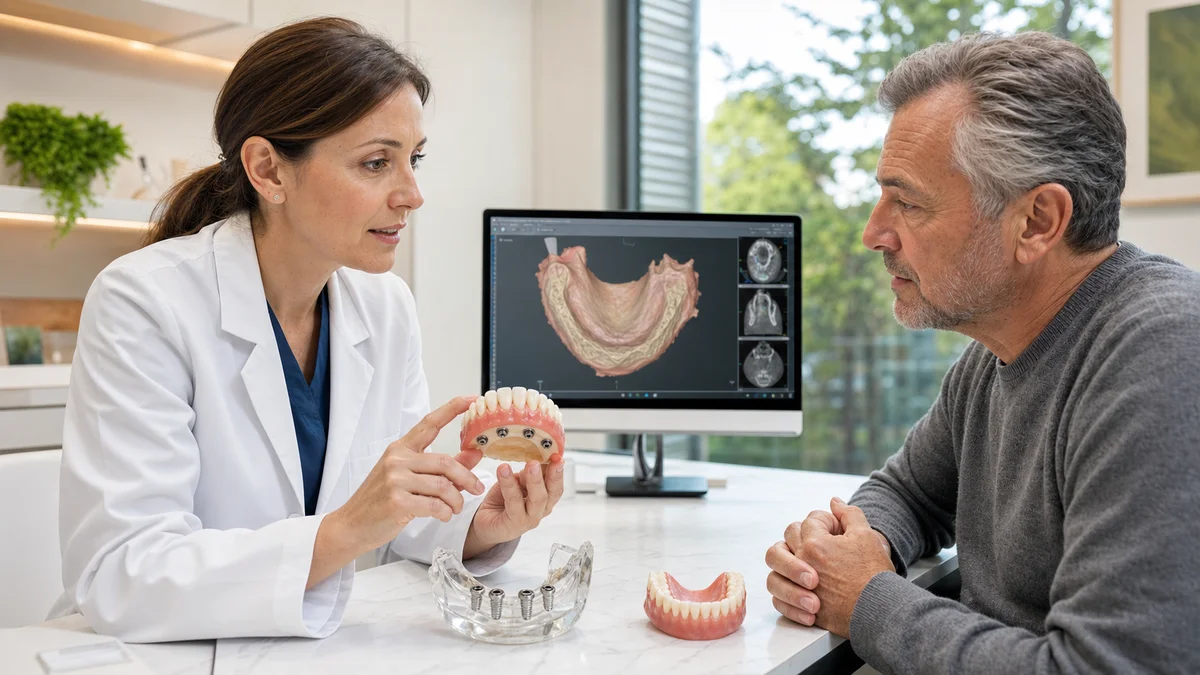
The search all on 4 dental implants worth it usually begins with a practical concern: is the comfort of fixed teeth worth surgery, cost and long-term responsibility? For some patients with a terminal dentition or an unstable complete denture, a fixed full-arch restoration can be a major functional improvement. For a patient with several maintainable teeth, removing everything to fit a standardized package may sacrifice healthy structure without sufficient benefit.
“All-on-4” is commonly used for a full-arch fixed prosthesis supported by four implants, often with posterior implants angled to use available bone. It does not describe one universal operation, one implant brand, one material or one risk profile. The upper and lower jaws differ, and the same number of implants may not be appropriate for every anatomy, bite, bone condition or prosthetic design.
This guide provides a decision framework rather than a verdict. It does not diagnose a scan, promise same-day fixed teeth, quote a fixed price or guarantee longevity. The final recommendation requires clinical examination, periodontal assessment, appropriate imaging, evaluation of every remaining tooth and a prosthetically driven plan.
All on 4 Dental Implants Worth It Starts With Tooth Prognosis
The first question is not how many implants fit; it is whether the existing teeth are maintainable. Each tooth should be assessed for decay, cracks, root condition, periodontal support, mobility, strategic value and restorative feasibility. A full-arch fixed implant bridge replaces all teeth in that arch, so extraction decisions are irreversible. Convenience or package pricing is not a sufficient reason to remove teeth with a reasonable prognosis.
A terminal dentition is one in which the remaining teeth collectively have a poor outlook or cannot predictably support a functional plan. Severe periodontal destruction, extensive nonrestorable decay, repeated failures or unfavorable distribution may contribute. Even then, the patient should understand which teeth are being removed and why. A second opinion is sensible when several teeth are scheduled for extraction or when two clinicians give very different prognoses.
For all on 4 dental implants worth it, the value proposition becomes stronger when the alternative is an unstable complete denture, repeated failure of compromised teeth, or a more complex reconstruction with little predictable benefit. It becomes weaker when a conservative treatment can preserve healthy teeth with acceptable function, hygiene and cost.
- Potentially favorable: fully edentulous arch, terminal dentition, adequate implant sites and commitment to maintenance.
- Needs extra caution: active periodontal disease, uncontrolled diabetes, heavy smoking, severe grinding or limited hygiene ability.
- Requires alternatives: several maintainable strategic teeth, uncertain diagnosis, unrealistic appearance expectations or no follow-up plan.
- May change design: limited bone, high bite forces, opposing implant bridge, unusual jaw relationship or insufficient restorative space.
What Four Implants Actually Support
A full-arch implant restoration has multiple components. Implant bodies are surgically placed in the jaw. Abutments or multi-unit components connect them to a prosthesis. The visible bridge includes artificial teeth and often replacement gum material. Screws, framework and veneering material each have distinct maintenance and repair implications.
The FDA explains that dental implant systems include an implant body, abutment and often an abutment screw, and that implants can support crowns, bridges or dentures. This distinction matters because a headline price may include implant placement but exclude abutments, temporary teeth, final bridge, sedation, grafting or maintenance. “Four implants” is not the completed treatment.
Four implants can be a valid full-arch support strategy when they are distributed and stabilized appropriately and when the prosthesis is engineered for the anticipated forces. The number alone does not prove suitability. Implant diameter and length, anterior-posterior spread, bone quality, cantilever length, opposing dentition, parafunction and framework all influence load.
When asking all on 4 dental implants worth it, request a drawing or digital plan showing implant positions and the final bridge. Ask why four implants are selected instead of another number, what contingency exists if one site lacks stability, and whether the design permits future repair. A patient-specific explanation is more meaningful than a branded protocol name.
Benefits That Can Make a Fixed Full Arch Worthwhile
The American Academy of Periodontology describes full-mouth implants as potentially more stable and comfortable than conventional dentures, with support for chewing and speech. A fixed bridge does not move like a removable denture and eliminates the need to remove the prosthesis every night. Some patients report greater confidence in social situations and a broader food choice after adaptation.
Implants transfer forces to bone and can help preserve bone around functioning implant sites, although they do not stop every age- or disease-related change in the jaws. A well-designed bridge can restore tooth display, lip support and vertical dimension. These benefits depend on accurate records, realistic tooth selection, speech testing and bite adjustment, not simply on making the teeth white or long.
All on 4 dental implants worth it may therefore be answered “possibly yes” when the expected functional and quality-of-life gains outweigh surgery and maintenance for that individual. The patient must still be able to clean under the bridge, attend professional reviews and accept that components can wear, loosen, chip or require replacement.
Decision Table: Fixed Bridge, Overdenture or Conventional Denture
The comparison below frames all on 4 dental implants worth it against realistic alternatives. It is not a prescription; anatomy and diagnosis can exclude or modify any option.
| Decision factor | Fixed full-arch bridge | Implant overdenture | Conventional denture |
|---|---|---|---|
| Daily removal | Usually removed only by a clinician | Patient removes for cleaning | Patient removes for cleaning |
| Stability | High when implants and bridge are stable | Improved retention but removable | Depends on anatomy, fit and adaptation |
| Hygiene access | Requires tools under a fixed bridge | Easier access after removal | Prosthesis and tissues cleaned separately |
| Surgery | Multiple implants and possible grafting | Implants, sometimes fewer or differently distributed | No implant surgery |
| Repair pathway | Clinical/laboratory repair may be complex | Attachments and denture can wear | Reline, repair or remake may be needed |
| Initial cost | Generally highest scope | Intermediate and design-dependent | Usually lower initial scope |
| Best fit | Selected patients wanting fixed function | Patients prioritizing retention and cleanability | Patients avoiding surgery or with limited candidacy |
Immediate Loading and “Teeth in a Day” Are Conditional
Same-day fixed teeth usually means a provisional bridge is connected shortly after implant placement. It is not necessarily the final bridge, and it does not prove osseointegration. Immediate loading requires sufficient primary implant stability, an appropriate distribution, controlled occlusal loading and a patient able to follow diet and hygiene instructions.
If one or more implants lack the required stability or if grafting, infection or bite concerns change the risk, the team may delay loading or use a removable temporary solution. This is a clinical safety decision, not a failure of the plan. A responsible consent process explains the fallback before surgery.
For all on 4 dental implants worth it, ask whether the advertised same-day teeth are fixed, removable, loaded in the bite and included in the fee. Also ask how long the provisional is expected to serve, what happens if it fractures, and when the final prosthesis is made. A temporary bridge may intentionally have a different contour, material and tooth arrangement.
Risks, Complications and the Cost of a Contingency
Implant surgery carries risks. FDA patient guidance lists injury to nearby teeth or tissues, sinus perforation, jaw injury, altered bite, screw loosening, infection, delayed healing, implant looseness and persistent numbness among possible concerns. Complications can occur soon after surgery or years later. Some require repair, medication or additional surgery.
In a full-arch design, a complication at one implant can affect the prosthetic plan for the entire arch. The bridge may need modification, temporary removal or redesign. The consequence depends on implant location, timing, number of stable supports and framework design. This is why the preoperative plan should include a contingency rather than assuming every implant will behave identically.
Prosthetic complications are different from biological complications. A screw may loosen, acrylic or composite teeth may chip, ceramic may fracture, or the framework may require repair. Biological problems include mucosal inflammation and peri-implantitis with supporting bone loss. A fixed bridge can remain visually attractive while disease develops underneath, so comfort and appearance are not enough for monitoring.
- Ask for the clinic’s plan if an implant does not integrate.
- Separate temporary-bridge repair from final-bridge warranty.
- Clarify who pays laboratory, anesthesia, imaging and travel costs for revisions.
- Know whether the bridge can be removed locally using accessible components.
- Keep implant brand, model, sites and component records.
- Do not interpret a commercial warranty as a guarantee of biological success.
Hygiene Is a Daily Eligibility Test
A fixed full-arch bridge does not come out for routine cleaning by the patient. The space beneath it must be shaped so the patient can reach plaque-retentive areas with suitable brushes, flossing aids or water irrigation according to professional instruction. Limited hand function, vision or support can make this difficult and may favor a removable solution.
The American Academy of Periodontology emphasizes that implants require home care and regular dental visits. Peri-implant mucositis affects the soft tissues, while peri-implantitis includes deterioration of supporting bone. Redness, tenderness or bleeding around implants should not be dismissed simply because the bridge feels stable.
The practical answer to all on 4 dental implants worth it changes if the planned bridge contour cannot be cleaned. Before approval, ask the team to show the intended hygiene space and tools. After delivery, demonstrate that you can clean all sites. Professional maintenance may require removal of the prosthesis in selected circumstances, which has its own fee and technical considerations.
Smoking, Diabetes, Medications and Bite Risk
The FDA notes that smoking may impair healing and reduce long-term success, while uncontrolled diabetes can be associated with higher concern for infection or implant failure. These factors do not create a universal yes-or-no rule, but they require honest assessment and risk management. Smoking cessation support and medical coordination may improve the treatment environment.
Report anticoagulants, antiplatelet drugs, antiresorptive medicines, immunosuppressants, cancer therapy and all other prescriptions or supplements. Never stop a prescribed drug without the prescribing clinician’s guidance. Medical consultation may be appropriate depending on the procedure and health history.
Clenching and grinding can increase forces on provisional and final prostheses. A strong opposing dentition, another implant bridge or an unfavorable jaw relationship can alter the design. The team may adjust tooth material, framework, implant number, cantilever or protective appliance. A four-implant concept should not be imposed when biomechanics support another design.
Twelve Tests Before You Decide It Is Worth It
Use these questions to turn all on 4 dental implants worth it into an individualized decision:
- Tooth prognosis: which remaining teeth are maintainable, questionable or hopeless, and why?
- Alternatives: what would preservation, overdenture or conventional denture involve?
- Disease control: are decay, infection and active periodontal disease addressed?
- Anatomy: do bone, nerves, sinus and restorative space support the plan?
- Implant number: why are four supports appropriate for this arch and bite?
- Immediate loading: what stability threshold and fallback plan will be used?
- Temporary bridge: what material, restrictions and repair terms apply?
- Final bridge: what framework, tooth material, shade and cleaning access are planned?
- Health risks: how are smoking, diabetes, medications and grinding managed?
- Total cost: are surgery, components, prosthesis, maintenance and possible revisions included?
- Continuity: who handles urgent care and routine follow-up after travel?
- Personal value: do fixed function and confidence justify surgery, cost and maintenance for you?
What the Total Cost Should Include
There is no single responsible price for every full-arch case. The scope can include examination, imaging, extractions, infection control, sedation, implants, abutments, grafts, provisional bridge, final prosthesis, laboratory work, hygiene visits and repairs. Travel, accommodation and time away from work matter for overseas treatment.
When calculating all on 4 dental implants worth it, a low quote may cover four implant bodies and surgery but not the final bridge. Another may include a temporary acrylic bridge but charge separately for the definitive framework. Ask for a line-item plan and a statement of what could change after examination. Materials should be named clearly rather than described only as “premium.”
For all on 4 dental implants worth it, calculate lifetime value rather than the opening payment. A fixed bridge may reduce denture movement and adhesive use, yet professional maintenance and component repairs continue. An overdenture may have lower initial complexity but needs attachment replacement and daily removal. The less expensive choice is not automatically worse; the incomplete comparison is.
Materials and Repairability of the Final Bridge
Final full-arch prostheses can use different frameworks and tooth materials. Each option has tradeoffs in weight, wear, sound, fracture behavior, opposing-tooth impact, appearance, laboratory repair and cost. No material is universally best. The design must provide adequate thickness without creating a bulky, uncleanable contour.
Ask whether the final bridge is screw-retained and how it can be accessed for repair. Confirm which parts are stocked in your home country and whether another clinician can obtain them. A proprietary component may be clinically appropriate, but the patient should know how future service will work.
The answer to all on 4 dental implants worth it can turn negative when a beautiful bridge cannot be maintained or repaired without repeated international travel. Obtain an implant passport, component list, surgical summary, final design information and relevant radiographs. These records support continuity but do not obligate another clinic to provide free warranty care.
Turkey Versus Local Full-Arch Treatment
Turkey may offer a different cost structure and concentrated treatment schedule, but geography does not determine quality by itself. Compare diagnosis, clinician qualifications, facility authorization, implant traceability, laboratory, prosthetic materials, consent, hygiene design and aftercare. Ensure that the number of arches, implant count and final bridge are identical across quotes.
Redent Klinik’s English-language treatment page provides general information for international patients. Existing radiographs and questions can be submitted through the English contact page. Remote review remains preliminary; a final plan may change after direct examination and appropriate imaging.
When deciding all on 4 dental implants worth it abroad, ask how many visits are expected, whether the first bridge is provisional, when the final bridge is delivered and who treats complications at home. Do not let a return flight dictate loading, healing or prosthetic delivery. A flexible travel plan is part of clinical safety.
Verify the facility’s authorization for international health services and identify the treating dentists. Separate the clinic from a travel broker. The broker may coordinate transport or lodging, but diagnosis, consent and treatment decisions belong to licensed clinicians. Know which entity receives payment and handles complaints.
Red Flags That Reduce the Value
All on 4 dental implants worth it is harder to answer positively when marketing replaces diagnosis. A package can still be legitimate, but it should adapt to findings rather than require every patient to fit the same number, material and schedule.
- All remaining teeth are labeled hopeless without tooth-by-tooth reasoning.
- Four implants are promised before reviewing bone, bite and health.
- Same-day temporary teeth are presented as the definitive bridge.
- No fallback exists if primary stability is insufficient.
- Hygiene access and professional maintenance are not demonstrated.
- The implant system, components or final material are unnamed.
- A lifetime result is guaranteed despite biological uncertainty.
- Urgent payment pressure prevents a second opinion.
- Complications require travel, but travel costs are never discussed.
Frequently Asked Questions
Are all on 4 dental implants worth it for everyone with dentures?
No. They may offer greater stability and fixed function, but surgery, bone, health, hygiene ability, bite, budget and maintenance must fit. An implant overdenture may provide strong retention with easier cleaning and lower complexity for some patients. Conventional dentures remain reasonable when surgery is unsuitable or unwanted.
Do four implants always support a full arch safely?
No fixed number is automatically safe. Implant distribution, stability, bone quality, arch shape, cantilever, opposing teeth, force and prosthetic design matter. Some patients may need a different number or a different restoration. Ask the clinician to explain the biomechanical rationale.
Will I leave with permanent teeth on the same day?
Same-day teeth are usually a provisional restoration and depend on adequate implant stability and controlled loading. If conditions are unfavorable, loading may be delayed. The final bridge is commonly made after healing and additional records, trials and bite verification.
Can healthy teeth stay under an All-on-4 bridge?
A full-arch implant bridge replaces the teeth in that arch and does not simply fit over retained natural teeth. Removing maintainable teeth requires clear justification. If strategic teeth can be preserved, a different restorative or removable design may be more conservative.
Is All-on-4 easier to clean than dentures?
It is different, not automatically easier. A fixed bridge stays in the mouth and must be cleaned underneath with appropriate tools. A removable denture or overdenture can be removed for direct cleaning. Manual ability and bridge contour are important selection factors.
How long do All-on-4 implants last?
No individual lifespan can be guaranteed. Implant integration, gum health, smoking, diabetes, bite forces, prosthetic material, hygiene and maintenance affect performance. Even stable implant bodies may require screw, tooth, veneer or bridge repairs over time.
What happens if one implant fails?
The response depends on timing and implant position. The bridge may be modified, supported differently, temporarily removed or remade; an implant may be replaced after assessment. Ask for the contingency, fees and temporary-tooth plan before treatment begins.
Is bone grafting always avoided with All-on-4?
No. Angled posterior implants may reduce grafting in selected anatomy, but they cannot eliminate every deficiency. Bone volume, implant position, soft tissue and prosthetic goals determine whether grafting or another design is appropriate. The indication should follow examination and imaging.
Does insurance cover All-on-4 treatment?
Coverage varies by country and policy. Medical necessity, plan exclusions, annual maximums, missing-tooth clauses and overseas-care rules may apply. Submit the itemized plan before treatment and obtain a written estimate. Insurance approval does not determine clinical suitability.
Conclusion: Worth It Is a Patient-Specific Calculation
The clearest answer to all on 4 dental implants worth it is conditional. It can be worthwhile for an appropriately selected patient who needs full-arch replacement, values fixed stability, accepts surgery and can maintain the bridge. It may not be worthwhile when teeth can reasonably be preserved, hygiene is impractical, risk is uncontrolled or the plan lacks repair and follow-up pathways.
Ask for tooth-by-tooth prognosis, alternatives, implant rationale, provisional and final prosthetic details, total cost, contingency and lifetime maintenance. Keep the device records and seek a second opinion before irreversible extractions when uncertainty remains. A sound decision is not the most dramatic package; it is the plan whose benefits, risks and responsibilities make sense for the individual patient.
Official Sources and Clinical References
- U.S. Food and Drug Administration: Dental Implants — What You Should Know.
- American Academy of Periodontology: Full Mouth Dental Implants.
- American Academy of Periodontology: Peri-Implant Diseases.
- American Dental Association MouthHealthy: Dental Implants.
- American Dental Association MouthHealthy: Dentures.
- American Dental Association.
- World Health Organization oral health fact sheet.
Sources reviewed July 13, 2026. Individual health, anatomy, product labeling and clinical protocols vary; follow the treating team’s current advice.
Disclosure: this page may contain affiliate links. We may earn a commission if you use them, at no extra cost to you.