
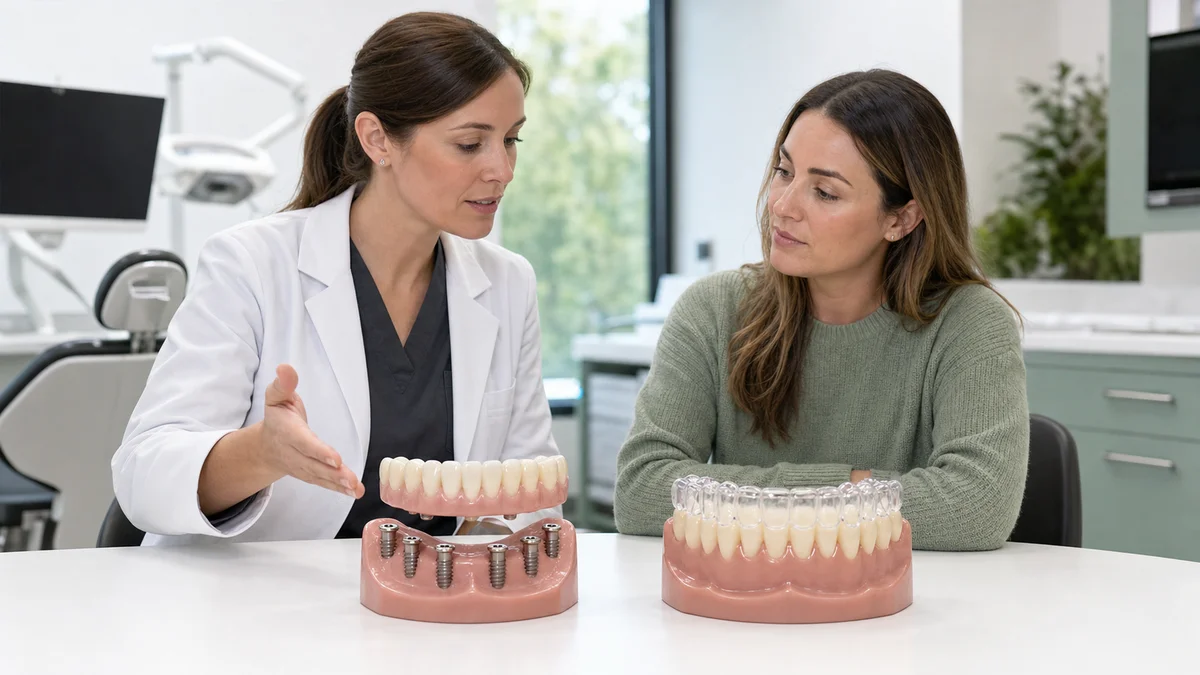
Quick answer: all on 6 dental implants or clear aligners which is better has no single answer because the treatments solve different problems. A full-arch implant restoration replaces a complete or failing dental arch; clear aligners move existing teeth. The right pathway depends on which teeth can be preserved, gum and bone health, bite, general health and a clinical examination.
Searching for all on 6 dental implants or clear aligners which is better can make these options appear to be competing versions of smile treatment. They are not. A treatment commonly called All-on-6 uses dental implants to support a full-arch prosthesis when all teeth in an arch are already missing or when a carefully documented diagnosis indicates that the remaining teeth cannot predictably be maintained. Clear aligners, by contrast, apply controlled forces to move natural teeth through bone. They require teeth and supporting tissues that are suitable for orthodontic movement.
The visual goal may overlap: both pathways can change the way a smile looks. The biological task is completely different. One replaces an arch with a prosthetic reconstruction after surgery; the other repositions existing teeth while preserving them. The most important first question is therefore not which option looks faster or costs less. It is whether the clinical problem is tooth loss, terminal tooth damage, malocclusion, or a combination that needs a staged plan.
This guide explains the decision in patient-safe terms. It does not diagnose whether teeth should be removed, promise immediate fixed teeth or predict that aligners will create a particular result. At Redent Klinik, recommendations are based on an examination, appropriate imaging, periodontal and restorative findings, functional needs and informed consent. Preserving maintainable natural teeth should be considered before irreversible extraction.
What Do All-on-6 and Clear Aligners Actually Treat?
All-on-6 is a commonly used description for a fixed full-arch dental prosthesis supported by six implants. It is not a universal recipe or a guarantee that exactly six implants are suitable for every jaw. Implant number, position, angulation, dimensions and prosthetic design depend on anatomy, bone availability, opposing teeth, loading strategy and the planned restoration. Some people may need a different implant configuration, grafting, a removable implant-supported option or a conventional denture.
The implant bodies are placed surgically in the jaw. Abutments and prosthetic components connect them to a temporary or definitive arch of replacement teeth. The U.S. Food and Drug Administration describes dental implants as medical devices surgically implanted into the jaw to support artificial teeth such as crowns, bridges or dentures. This means implant treatment involves both a surgical foundation and a prosthetic restoration; neither part can be planned responsibly in isolation.
Clear aligners are removable orthodontic appliances. A series of custom trays is used to move existing teeth in planned stages. Attachments, elastics, enamel reduction between teeth or other auxiliaries may be considered when clinically appropriate. Aligners can address selected crowding, spacing and bite relationships, but they cannot replace missing teeth, rebuild severely damaged teeth or make an unstable tooth healthy.
- Full-arch implant treatment: replaces missing or non-maintainable teeth with an implant-supported prosthesis.
- Clear aligner treatment: moves maintainable natural teeth to improve position and bite.
- Restorative treatment: repairs individual teeth when fillings, bonding, onlays or crowns are indicated.
- Periodontal treatment: controls gum and supporting-bone disease before elective reconstruction or orthodontics.
All on 6 Dental Implants or Clear Aligners Which Is Better for Your Starting Point?
The safest decision begins with an inventory of what is present and maintainable. A person with a healthy set of teeth that are crowded has a fundamentally different starting point from someone with complete tooth loss. Between those ends are complex situations: multiple missing teeth, advanced decay, severe periodontal breakdown, failing bridges, mobility, worn teeth or a mixture of natural teeth and restorations.
If natural teeth have a reasonable prognosis, removing them solely to obtain a uniform implant smile can sacrifice living tissue and create a lifelong prosthetic maintenance burden. Implants can be valuable replacements for missing teeth, but they are not upgraded natural teeth and they are not immune to biological or mechanical complications. A clinician should explain the prognosis of each tooth, what treatment might preserve it and why extraction is or is not recommended.
If an arch is already toothless, clear aligners have nothing to move. If only a few teeth remain and those teeth cannot support a stable long-term plan, the discussion may centre on full-arch replacement options. If many maintainable teeth remain but their positions interfere with function, cleaning or planned restorations, orthodontics may be part of the solution. In selected multidisciplinary cases, aligners can move teeth before implants are placed because implants cannot be orthodontically moved after integration.
A Decision Table: Different Problems, Different Pathways
| Decision factor | Full-arch implant pathway | Clear aligner pathway | Question to ask |
|---|---|---|---|
| Primary purpose | Replace a complete arch of missing or non-maintainable teeth | Reposition maintainable natural teeth | What is the diagnosis: tooth loss, tooth disease or malocclusion? |
| Natural teeth required | The final arch is prosthetic; remaining teeth in that arch may require extraction only when justified | Requires teeth with roots and supporting tissues suitable for movement | What is the documented prognosis of each existing tooth? |
| Biological foundation | Jaw anatomy, bone, soft tissue, healing capacity and infection control | Healthy gums, adequate bone support, suitable roots and controlled forces | Which examinations and images support candidacy? |
| Irreversibility | Surgery and any extractions are irreversible | Tooth movement is biological and requires retention; some adjuncts may alter enamel | What conservative alternatives should be considered first? |
| Patient participation | Hygiene around the prosthesis, healing instructions and long-term reviews | Consistent tray wear, hygiene, change schedule, refinements and retention | What daily responsibilities continue after treatment starts? |
| Maintenance | Professional prosthetic, screw, bite, implant and tissue monitoring | Retention, periodontal review and monitoring of tooth position and bite | What can fail, wear, relapse or need replacement? |
| Outcome limits | Cannot recreate natural sensation or remove all surgical and prosthetic risk | Cannot replace teeth or solve every skeletal and restorative problem | Which goals are achievable and which remain limited? |
This comparison is deliberately based on indication rather than marketing claims. If a clinic recommends both pathways as interchangeable packages without first explaining the diagnosis, ask for a clearer clinical rationale or seek another opinion.
When Might Full-Arch Implant Treatment Be Considered?
A full-arch implant-supported restoration may be discussed when an arch has no teeth or when remaining teeth have a poor or hopeless prognosis after comprehensive assessment. Possible reasons include extensive structural destruction, advanced periodontal support loss or a combination of problems that cannot be managed predictably with tooth-preserving care. The decision must be individual; age, photographs and dissatisfaction with tooth colour are not sufficient reasons for full-arch extraction.
Planning usually considers medical history, medications, smoking, previous dental treatment, oral hygiene, gum condition, bone volume, nerve and sinus anatomy, jaw relationships and available restorative space. Three-dimensional imaging may be indicated to assess anatomy and implant positions. The final prosthesis must also be planned before surgery because implant placement should support the intended tooth positions, cleansability and bite.
Overall health can affect candidacy and healing. The FDA advises patients to discuss benefits, risks and candidacy with a dental provider and notes that health influences healing and how long an implant may remain in place. It also identifies smoking, uncontrolled diabetes, local infection, untreated periodontal disease and poor cleaning access as relevant concerns. These factors do not create the same answer for every person, but they require assessment and risk communication.
A temporary fixed arch may sometimes be connected around the time of surgery, but “same day” language should not be interpreted as final healing or guaranteed immediate loading. Stability, bone, surgical findings and bite forces influence whether and how a provisional restoration can be used. Integration and tissue healing continue afterward. A definitive prosthesis may be provided later, and the sequence can change if the biological response is not suitable.
When Might Clear Aligners Be Considered?
Clear aligners may be considered when natural teeth can be maintained and movement is needed to address selected crowding, spacing, rotations or bite relationships. Suitability depends on the type and size of movement, root positions, jaw relationships, gum and bone support, restorations, missing teeth and patient cooperation. Some movements are predictable with aligners; others may need additional mechanics, braces, restorative coordination or jaw surgery assessment.
An orthodontic diagnosis is more than a scan of the visible crowns. The American Association of Orthodontists explains that radiographs can reveal root health and impacted teeth that cannot be seen in a visual examination. It also warns that moving teeth in poor periodontal health can contribute to recession, root problems or tooth loss. An in-person assessment of the gums and supporting tissues is therefore central to safe planning.
Aligners are removable, which helps with eating and oral hygiene, but that benefit creates a compliance requirement. Trays generally need to be worn according to the clinician’s prescribed schedule. Inconsistent wear can affect tracking and timing. Attachments may be bonded to teeth, and refinement trays may be needed when movement differs from the digital plan. The animated setup is a planning tool, not a guarantee that biology will follow every frame exactly.
Retention is part of orthodontic treatment. Teeth can move after active treatment, so a retainer plan and long-term review matter. If implants or other restorations are planned after alignment, the team should coordinate spaces and bite before those restorations are made. An implant is fixed in bone and does not move like a natural tooth; sequence matters.
Why Extracting Maintainable Teeth Is a Major Decision
Extraction is irreversible. Once a natural tooth and its periodontal ligament are removed, no implant can fully reproduce its biology, sensation or ability to adapt. Implant treatment can restore function and appearance for people who need replacement, but it also introduces surgical, prosthetic and maintenance risks. The choice should therefore be based on prognosis and informed consent, not on the convenience of treating every tooth with one full-arch design.
A tooth may look unattractive while remaining structurally and periodontally maintainable. Colour, mild crowding, worn edges or old fillings can have conservative options. Conversely, a tooth can look acceptable in a photograph while having a crack, deep decay or severe support loss. A tooth-by-tooth assessment may include periodontal measurements, vitality tests, restorability, mobility, radiographs and the strategic role of the tooth in the overall plan.
Ask the clinician to classify teeth in understandable terms and explain uncertainty. What treatment could improve a questionable tooth’s prognosis? What would maintenance involve? What evidence supports extraction? Would another dentist with relevant restorative, periodontal or orthodontic expertise review the plan? A second opinion is especially reasonable before removing multiple teeth that are not causing an emergency.
- Do not treat edited photographs as evidence that teeth cannot be saved.
- Request a written explanation for each proposed extraction.
- Ask about periodontal, endodontic, restorative and orthodontic alternatives.
- Understand that an implant prosthesis will also need professional maintenance and eventual component care.
- Take time to consider the plan unless urgent infection or another clinical emergency requires prompt action.
Risks, Limitations and Warning Signs
Dental implant surgery can involve pain, swelling, infection, bleeding, injury to nearby structures, nerve disturbance, sinus complications, inadequate integration and implant loss. Later problems can include inflammation around implants, bone loss, loosening or fracture of screws and components, wear or fracture of prosthetic teeth, difficulty cleaning and an uncomfortable bite. Additional surgery or prosthetic repair may be needed. These possibilities should be discussed without implying that every complication is likely.
Clear aligner treatment can cause temporary discomfort and may contribute to gum irritation if trays or hygiene are poor. Root shortening, gum recession, loss of support, cavities, decalcification and unwanted tooth movement are among concerns considered in orthodontic care. Teeth may not track as planned, and treatment can require refinements or a change in appliance. Relapse can occur without appropriate retention.
For both pathways, active decay and gum disease should be controlled. A clean-looking restoration or straight digital simulation cannot compensate for unstable biology. Be cautious about providers who offer a definitive surgical or orthodontic plan from photographs alone, promise a guaranteed timeline, minimise the need for reviews or discourage questions about clinician credentials and emergency arrangements.
Urgent assessment is appropriate for spreading swelling, fever with dental symptoms, uncontrolled bleeding, difficulty breathing or swallowing, persistent numbness after a procedure, severe worsening pain, a loose implant-supported restoration or signs of infection. This educational article cannot evaluate urgent symptoms; contact an appropriate dental or medical service.
How Treatment Timelines Differ
Full-arch implant treatment has surgical, healing and prosthetic phases. Records and planning come first. If teeth must be removed, extraction and implant placement may occur together in selected cases or at separate appointments. Grafting may be needed before or during implant treatment. A provisional prosthesis can sometimes be used, but integration and tissue maturation continue for months. The definitive restoration and maintenance schedule depend on healing and the chosen design.
Clear aligner treatment proceeds through staged tooth movement. The number of trays does not by itself predict the finish date because biological response, wear consistency, complexity, missed visits and refinements can alter the schedule. Moving quickly is not automatically safer. Orthodontic forces and review intervals should be prescribed for the person, and a digital plan should be adjusted if clinical tracking differs.
Neither pathway should be reduced to the shortest advertised time. A responsible plan includes diagnosis, consent, disease control and follow-up. For patients travelling, enough time should be reserved for in-person assessment, procedures and review. Ask what happens if healing is delayed, a tray does not fit, a provisional prosthesis fractures or the bite requires adjustment after returning home.
How Costs Should Be Compared Without Fixed Promises
These treatments have different cost structures, so comparing one headline price with the other is not useful. Full-arch implant estimates may include imaging, extractions, sedation or anaesthesia where appropriate, grafting, implant components, a provisional restoration, laboratory work, a definitive prosthesis and reviews. Some quotations include only one stage. Ask whether maintenance, repairs or a protective appliance are separate.
Clear aligner estimates may include records, digital planning, trays, attachments, interproximal enamel reduction where indicated, review appointments, refinements and retainers. The scope can differ by provider and complexity. A low initial figure may not include replacement trays, extended treatment or retention. Ask for a written plan rather than relying on a price displayed for an average case.
Medical and dental insurance coverage varies by policy, location and indication. Full-arch reconstruction and adult orthodontics may have exclusions, annual limits or documentation requirements. Only the insurer can confirm a particular benefit. Treatment should not be represented as covered before that confirmation, and a clinical recommendation should not be changed merely to fit a marketing claim.
The World Health Organization notes that oral diseases create a major burden and that oral care costs can be a barrier to access. Financial planning matters, but value should include disease control, appropriate diagnostics, clinician expertise, materials, continuity and maintenance. A lower fee is not lower risk when essential parts of care are omitted.
Can Implant and Orthodontic Treatment Be Combined?
Yes, but usually as coordinated stages rather than simultaneous alternatives. A person may have several maintainable teeth that need alignment and a separate missing tooth space planned for an implant. Orthodontics can create or redistribute space, improve root position and establish a bite before the implant is placed. Because an integrated implant does not move with orthodontic force, placing it too early can restrict the final tooth arrangement.
A person being considered for full-arch replacement may also need management of the opposing natural arch. If the other arch has crowding, unstable contacts or restorative needs, planning both arches together can improve function. That does not mean clear aligners can correct a prosthetic implant arch. They act only on teeth, and the prosthesis must be designed through restorative and surgical planning.
Complex cases may involve a general dentist, prosthodontic, surgical, periodontal and orthodontic perspectives. Patients should understand who is responsible for diagnosis, surgery, the provisional prosthesis, the definitive restoration, orthodontic monitoring and urgent care. Shared records and a written sequence reduce the risk of one stage undermining another.
Maintenance After Treatment
An implant-supported arch needs daily cleaning around and beneath the prosthesis using methods recommended for its design. Professional visits assess tissues, plaque, bleeding, bone levels when imaging is indicated, screw and component stability, prosthetic wear and bite. Depending on the restoration, professional removal may be considered for maintenance or repair. Implant restorations are not immune to disease, wear or breakage.
After aligner treatment, retainers help manage the lifelong tendency of teeth to move. Retainers also need cleaning and replacement when worn or damaged. Natural teeth remain vulnerable to decay and periodontal disease, so brushing with fluoride toothpaste, interdental cleaning and professional care continue. A straight smile is not the same as a disease-free mouth.
Smoking, poorly controlled health conditions, clenching, grinding and missed maintenance can affect risk in different ways. A protective appliance may be recommended for some restorative patients, but it cannot guarantee against fracture. Maintenance should be discussed before treatment begins so the long-term responsibilities and likely costs are not a surprise.
Frequently Asked Questions
Are All-on-6 implants better because they are fixed?
Being fixed can improve stability and confidence for a suitable person who needs a complete arch replacement, but it does not make implant treatment better for someone with maintainable natural teeth. A fixed prosthesis still requires cleaning, reviews and possible repair. Candidacy depends on anatomy, health, prognosis of existing teeth and the ability to maintain the restoration.
Can clear aligners prevent the need for implants?
Aligners can move existing teeth and may help organise spaces before restorative care, but they cannot rescue every damaged tooth or replace a missing one. In selected cases, orthodontics may close a space or improve conditions for another restoration. Whether an implant is needed depends on diagnosis, available teeth, bite and treatment goals.
Can clear aligners move dental implants?
No. Once integrated, an implant is fused to the surrounding bone and does not move like a tooth with a periodontal ligament. Aligners may move neighbouring natural teeth, which is why orthodontic and implant sequencing must be coordinated. Trying to use an implant as though it were a movable tooth can compromise the plan.
Does All-on-6 always require bone grafting?
No. Grafting depends on the available bone, implant positions, anatomy and prosthetic plan. Some patients may not need it, while others may require grafting or a different approach. Only clinical and radiographic assessment can answer this. Advertising that promises either mandatory grafting or guaranteed graft-free treatment is too broad.
Are clear aligners suitable with gum disease?
Active periodontal disease should be assessed and controlled before elective tooth movement. Orthodontic forces applied to teeth with inadequate support can increase risk. Some patients with a history of periodontal disease can have orthodontic treatment after stabilisation and with close monitoring, but that requires an individual plan involving the appropriate clinicians.
Can a dentist decide from a scan whether teeth should be extracted?
A scan can provide valuable information, but extraction decisions normally combine symptoms, examination, periodontal measurements, restorability, tooth vitality, radiographs, bite and the overall treatment plan. A three-dimensional image alone does not replace these findings. Ask for a tooth-by-tooth explanation and consider a second opinion before multiple elective extractions.
Which option gives a faster cosmetic change?
A provisional implant arch can change appearance quickly in selected surgical cases, and aligners can begin moving teeth early, but neither speed claim describes completion, healing or long-term stability. Fast does not mean appropriate. The safe timeline depends on disease control, biology, complexity, cooperation and review findings.
All on 6 dental implants or clear aligners which is better if I have missing teeth and crowding?
The answer may be neither treatment alone. The team must assess how many teeth are missing, which remaining teeth can be maintained, root positions, bone, gums and bite. Orthodontics might organise selected teeth before a bridge or implant, while a full-arch prosthesis may be relevant only if the entire arch requires replacement. A coordinated plan is essential.
A 9-Question Consultation Checklist
- What is the diagnosis for each tooth, and which teeth are maintainable?
- Is the main problem tooth loss, disease, position, bite or a combination?
- Which records and imaging support the proposed treatment?
- What tooth-preserving alternatives were considered before extraction?
- What are the personal surgical, periodontal, orthodontic and prosthetic risks?
- What parts of the treatment are temporary, and when is healing considered adequate?
- What daily cooperation and long-term maintenance will be required?
- What exactly is included in the written estimate and follow-up plan?
- Who will provide urgent and routine care if treatment takes place away from home?
A trustworthy consultation should leave you able to explain why the recommended pathway fits your starting condition. It should also make clear what the treatment cannot do. Be wary of a plan that treats healthy or maintainable teeth as obstacles to a package, promises guaranteed integration or alignment, or dismisses the need for ongoing care.
For questions about records, multidisciplinary planning and travel timing, you can contact Redent Klinik. Any remote discussion remains preliminary until a clinician examines the mouth and reviews appropriate diagnostic information.
The core answer to all on 6 dental implants or clear aligners which is better is clinical rather than commercial. Full-arch implants replace an arch that needs replacement. Clear aligners move teeth worth maintaining. When the starting problem is correctly identified, the conversation becomes safer, clearer and more respectful of natural tooth structure.
This article is general education and does not provide a diagnosis, treatment recommendation, fixed price or outcome guarantee. A licensed dental professional must assess individual oral and general health, explain reasonable alternatives and obtain informed consent.