
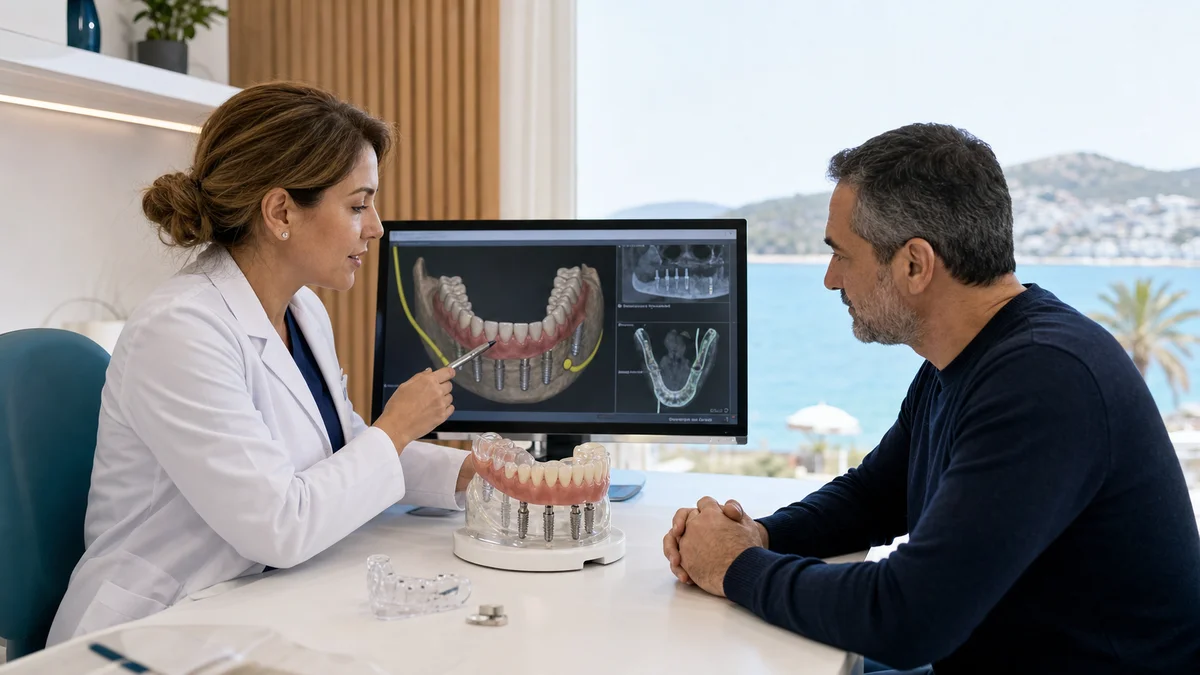
Quick answer: all on 6 dental implants risks include surgical injury, infection, delayed healing, implant failure, bite or prosthetic problems and inflammation around implants. Individual risk depends on health, smoking, bone, gum condition, hygiene, planning and follow-up. A clinical examination and three-dimensional assessment are needed before treatment can be recommended.
People researching all on 6 dental implants risks are often trying to balance two realities. A fixed full-arch restoration may improve chewing and confidence for a suitable patient, yet it involves surgery, multiple implanted devices and a prosthesis that needs lifelong professional maintenance. A responsible explanation should therefore cover both potential benefits and limits, without presenting treatment as risk-free or inevitable.
“All-on-6” is a general description for supporting a full-arch dental prosthesis on six implants. It is not one identical procedure for every mouth. Implant positions, bone availability, whether teeth must be removed, the need for grafting, immediate or delayed loading, the provisional restoration and the final prosthetic material can all differ. These choices affect the risk profile and should be documented in a personalised plan.
This guide is for informed discussion, not self-diagnosis. It explains questions to take to a licensed implant dentist. At Redent Klinik, suitability should be considered only after medical and dental history, clinical examination and appropriate imaging have been reviewed. No online article can determine whether six implants, another number of implants, a removable option or no treatment is best for one person.
What are the main all on 6 dental implants risks?
The risks can be grouped by when they may occur. During or shortly after surgery, concerns include bleeding, swelling, pain, infection and injury to nearby structures. During healing, an implant may fail to join predictably with bone, a wound may open, or a provisional prosthesis may create excessive pressure. Later concerns include screw loosening, fracture or wear of prosthetic parts, difficulty cleaning, inflammation around implants, bone loss and loss of an implant.
The US Food and Drug Administration explains that dental implant complications can arise soon after placement or much later. Its patient information lists injury to nearby teeth or tissues, sinus perforation, jawbone injury, altered bite, screw loosening, local or systemic infection, delayed healing, implant-body failure and nerve-related numbness among possible concerns. This does not mean every patient will experience them. It means consent should address the risks that are relevant to the planned sites and individual health.
- Surgical: bleeding, infection, swelling, nerve or sinus injury and damage to neighbouring structures.
- Healing: delayed healing, failure to integrate with bone or inability to load the implants as initially planned.
- Mechanical: loose screws, wear, chipping, fracture or an uncomfortable bite.
- Biological: plaque-related inflammation, peri-implant disease and progressive supporting-bone loss.
A useful consultation separates common temporary effects, manageable complications and uncommon but serious events. Ask what is expected after your exact procedure, what would be outside the expected range, and who to contact at any hour if an urgent concern develops.
How do planning and anatomy affect all on 6 dental implants risks?
Implants must be placed within available bone while respecting nerves, blood vessels, adjacent roots and sinus spaces. Full-arch planning also has to consider where chewing forces will act on the temporary and final bridge. Clinical examination and three-dimensional imaging may help the team assess bone volume, anatomy and prosthetically useful positions. A scan is a planning tool, not a guarantee that every planned implant can be placed exactly as first imagined.
In the lower jaw, proximity to the nerve that supplies feeling to the lower lip and chin can influence implant length and position. In the upper jaw, the sinus and the quality and quantity of bone can change the approach. Previous infection, severe bone loss or unusual anatomy may lead to a grafting discussion, a staged procedure, a modified implant plan or a different restorative option.
Ask whether the plan is driven by the future teeth as well as the bone. An implant can be surrounded by bone yet still be poorly positioned for cleaning, speech, appearance or force distribution. Digital planning, surgical guides and experienced clinical judgement can support precision, but every technique has limitations. Your consent discussion should include what the team will do if the anatomy seen during surgery differs from the pre-operative plan.
Who may have a higher risk of healing or implant failure?
Personal health factors can change all on 6 dental implants risks, so a general online checklist cannot replace individual medical and dental review.
Overall health can affect healing and long-term implant care. The FDA advises patients to discuss health status because it may influence candidacy, healing time and how long an implant remains functional. Uncontrolled diabetes, immune or healing concerns, some medicines, previous radiotherapy, untreated oral infection and heavy smoking may change the risk discussion. This is not a complete list, and a diagnosis alone does not automatically include or exclude someone.
Smoking deserves a direct conversation. FDA and NHS patient guidance both identify smoking as a factor that can impair healing or increase complications. A clinician may recommend stopping before treatment and remaining smoke-free. The safest timing and support should be discussed with appropriate healthcare professionals; a dental clinic should not promise that a short pause removes all added risk.
Tell the team about prescribed and non-prescribed medicines, supplements, allergies, previous operations, bleeding concerns and conditions affecting bone or immunity. Do not stop medication without advice from the clinician who manages it. If coordination with a doctor is needed, understand what information will be requested and how it changes the plan.
- Active decay, gum disease or infection that needs stabilisation first
- Poor plaque control or inability to clean beneath a full-arch prosthesis
- Smoking, uncontrolled systemic disease or factors that delay healing
- Severe clenching, grinding or a bite pattern that may overload components
- Insufficient bone or anatomy that limits safe, restorable implant positions
What can go wrong with immediate temporary teeth?
Immediate provisional teeth introduce a distinct part of the all on 6 dental implants risks discussion because function must be carefully controlled while bone healing continues.
Some full-arch plans include a fixed provisional bridge soon after implant placement. Patients may hear this described as “teeth in a day.” It does not mean healing is complete in one day or that the temporary bridge can immediately be used like natural teeth without restrictions. The implants still need a protected healing period, and the provisional restoration is designed for that stage.
Immediate loading depends on primary stability, implant distribution, bite control and the patient’s ability to follow instructions. If stability is not adequate, the safest plan may change during surgery. A removable temporary restoration, a delayed fixed bridge or an altered design may be recommended. Consent should cover this possibility before treatment, so a change is understood as a safety decision rather than a surprise.
A provisional bridge can chip, loosen or fracture. Excessive force, hard foods or an uneven bite may place stress on components during healing. Patients should receive written dietary, hygiene and emergency instructions. Ask how often the bite will be checked and whether repairs or replacement of the provisional are included in the plan.
All on 6 dental implants risks during and after surgery
| Stage | Possible concern | Risk-reduction discussion | When to contact the clinic |
|---|---|---|---|
| Planning | Unsuitable anatomy or uncontrolled disease | History, examination, imaging and stabilisation before surgery | Report health or medication changes before the appointment |
| Surgery | Bleeding, tissue injury, nerve or sinus involvement | Site-specific consent, anatomical planning and qualified surgical care | Follow the emergency instructions for uncontrolled bleeding or breathing difficulty |
| Early healing | Infection, wound opening, persistent pain or swelling | Hygiene, prescribed care, reviews and avoidance of smoking | Contact promptly for worsening symptoms, fever, discharge or a bad taste |
| Integration | Implant mobility or failure to join with bone | Protect loading, attend checks and follow diet instructions | Report movement, new pain or a change in the bridge |
| Long term | Inflammation, bone loss, screw loosening, wear or fracture | Daily cleaning, professional maintenance and bite/prosthesis review | Arrange assessment for bleeding, swelling, looseness, fracture or bite change |
This table supports a conversation; it is not an emergency protocol. Symptoms and urgency vary. After surgery, use the clinic’s own written instructions and emergency number. Seek urgent medical care for severe breathing or swallowing difficulty, rapidly increasing swelling, collapse, chest pain or other symptoms that may indicate a medical emergency.
How infection and peri-implant disease can threaten a full arch
Long-term all on 6 dental implants risks include biological complications that may develop after an initially comfortable healing period.
Implants do not decay like natural teeth, but the tissues around them can become inflamed. Plaque accumulation can lead to bleeding and swelling. Progressive peri-implant disease can involve supporting-bone loss and may threaten one or more implants. A full-arch bridge can make access more demanding, so the shape of the prosthesis and the patient’s ability to use recommended cleaning aids matter from the beginning.
Cambridge University Hospitals advises that poor implant cleaning can lead to swollen or bleeding gums, infection, bone loss and implant failure, and emphasises long-term dental or hygiene maintenance. The required schedule is individual. A person with previous gum disease, smoking exposure, difficult cleaning access or other risk factors may need closer professional monitoring.
Ask the clinician to demonstrate cleaning before you consent, not only after the bridge is fitted. You should be able to understand where plaque collects, which brushes or flossing aids fit beneath the bridge, whether a water irrigator is appropriate, and how professional cleaning will be performed without damaging components. If the proposed design cannot be cleaned by the patient or caregiver, that is a planning concern.
Mechanical and bite-related complications
Mechanical all on 6 dental implants risks concern the bridge, screws, connections, bite and the forces transmitted to supporting implants.
Full-arch treatment is both biological and mechanical. The implants support screws, connectors and a bridge that experiences repeated chewing forces. Parts may loosen, wear or fracture over time. The FDA specifically lists altered biting function and abutment-screw loosening among implant-system risks. A prompt assessment can sometimes prevent a small mechanical problem from becoming a larger one.
Clenching and grinding may increase forces. Cantilevers, uneven contacts, a poorly fitting framework or delayed review after a bite change can also matter. The treatment plan should explain the material proposed for the provisional and final bridge, expected maintenance, what can be repaired, and what may require laboratory replacement. No prosthesis should be described as maintenance-free or guaranteed for life.
Report clicking, rocking, a loose sensation, a new gap, chipping or a bite that suddenly feels different. Do not continue chewing hard food on a bridge that appears mobile. Avoid trying to tighten a component yourself. Keep details of the implant system and prosthesis in your records, as recommended by the FDA, because this can help future clinicians identify compatible parts.
How to reduce all on 6 dental implants risks before treatment
Risk reduction starts before the operation. Active disease should be identified and managed, expectations should be realistic, and alternatives should be explained. A written plan should state which teeth are proposed for removal, how many implants are planned, whether grafting may be needed, the temporary restoration pathway, the final prosthesis, follow-up arrangements and foreseeable extra treatment.
Ask who is responsible for surgery, prosthetic planning and maintenance. In team care, more than one clinician may contribute; responsibilities should still be clear. If travelling, discuss the number and timing of visits, how complications will be assessed after you return home, what records you will receive and how your local dentist can communicate with the treating clinic.
- Request an individual diagnosis and site-specific risk explanation.
- Confirm that health, medicines, smoking and oral disease have been reviewed.
- Ask what imaging supports the plan and what its limitations are.
- Understand alternatives, including removable treatment or no immediate treatment.
- Obtain written provisional, final-prosthesis and maintenance expectations.
- Know the urgent contact route before surgery begins.
Patients considering care in Turkey can use the Redent Klinik Contact Page to request an assessment discussion. A remote conversation may organise records and travel questions, but a final diagnosis and treatment recommendation require appropriate clinical evaluation.
What alternatives should be discussed?
Comparing alternatives places all on 6 dental implants risks beside the different limitations and responsibilities of removable, tooth-supported and other implant-based options.
Six implants are not the only way to restore a toothless or failing arch. Depending on anatomy, health, remaining teeth and priorities, alternatives may include preserving selected teeth, conventional bridges, removable complete dentures, implant-retained removable dentures, a fixed bridge on a different number or distribution of implants, staged treatment or no immediate intervention. Each has different surgical, maintenance, functional and financial considerations.
Guy’s and St Thomas’ NHS Foundation Trust notes that alternatives can include no treatment, tooth-supported bridges or a different denture design, depending on the person. A balanced consent discussion should not present a fixed full arch as the only respectable choice. Some patients prioritise easier cleaning, lower surgical burden or simpler repair; others prioritise fixed function. Preferences matter after clinical boundaries are understood.
Ask which healthy structures would be altered or removed by each option. If teeth are described as hopeless, request a clear explanation of the diagnosis and prognosis. Seeking a second opinion is reasonable before irreversible extraction or extensive surgery, especially when recommendations differ.
When should you wait or seek another opinion?
A second opinion can help when all on 6 dental implants risks have not been explained in relation to your records, anatomy and ability to maintain the result.
Delay can be appropriate when infection or gum disease is uncontrolled, medical information is incomplete, smoking cessation has not been addressed, expectations are unrealistic, hygiene cannot be maintained or the patient has not understood alternatives. Additional assessment may also be sensible when the plan relies on unexplained guarantees, same-day promises that ignore healing, or a price that does not define the provisional and final stages.
Be cautious if a provider avoids discussing all on 6 dental implants risks, will not identify the implant system, pressures you to pay before reviewing records, or promises that implants cannot fail. Good consent is a process, not a signature collected after a sales conversation. You should have time to ask questions and receive answers you understand.
Frequently asked questions about all on 6 dental implants risks
Can all six implants fail at the same time?
Failure can affect one or more implants, but the pattern and consequences vary. Infection, healing problems, overload and systemic or local factors may contribute. A clinician must assess mobility, symptoms, imaging and prosthesis stability before recommending repair, observation or removal.
Is numbness normal after All-on-6 surgery?
Local anaesthetic can temporarily change sensation. Persistent or unexpected numbness, tingling or altered feeling should be reported promptly because nerve irritation or injury is a recognised implant-surgery risk. Follow the treating team’s instructions rather than waiting for an online timeframe.
Does a fixed bridge eliminate infection risk?
No. A fixed bridge does not prevent plaque-related inflammation around implants. Daily cleaning beneath the prosthesis and professional maintenance remain essential. Bleeding, swelling, discharge, bad taste or increasing discomfort warrants dental assessment.
Are all on 6 dental implants risks higher for smokers?
Smoking can impair healing and is identified by FDA and NHS guidance as a factor associated with implant complications or failure. Individual risk depends on more than smoking alone, but it should be discussed honestly before treatment.
Can a broken full-arch bridge be repaired?
Some chips, worn teeth or loose components may be repairable; other damage may require laboratory work or replacement. The material, framework, implant positions and cause of the problem affect the solution. Avoid using a mobile or fractured bridge until assessed.
What warning signs need prompt contact?
Contact the dental team for worsening pain or swelling, fever, discharge, persistent bleeding, new numbness, movement, a changed bite or a fractured component. Severe breathing or swallowing difficulty, collapse or rapidly increasing swelling requires urgent medical attention.
A safer decision starts with a personalised risk discussion
A useful consent process translates all on 6 dental implants risks into patient-specific precautions, alternatives, warning signs and follow-up responsibilities.
The central lesson about all on 6 dental implants risks is that they cannot be reduced to a generic percentage or eliminated by a brand name. Anatomy, health, oral disease, smoking, hygiene, surgical and prosthetic planning, loading and follow-up all interact. The most useful plan explains what applies to you, how risk will be reduced, what alternatives exist and how problems will be managed.
Use authoritative patient information as a starting point. The US Food and Drug Administration dental implant guidance describes benefits, risks and records to keep. The Guy’s and St Thomas’ NHS dental implant guide explains treatment stages, smoking, integration and long-term responsibility. These sources support, rather than replace, individual consent.
This educational article does not diagnose implant suitability, estimate personal complication probability or replace urgent care. It is prepared for medical review by Dentist Esma Çevrük Çakır and prioritises informed, patient-safe decision-making.
Sources
Disclosure: this page may contain affiliate links. We may earn a commission if you use them, at no extra cost to you.