
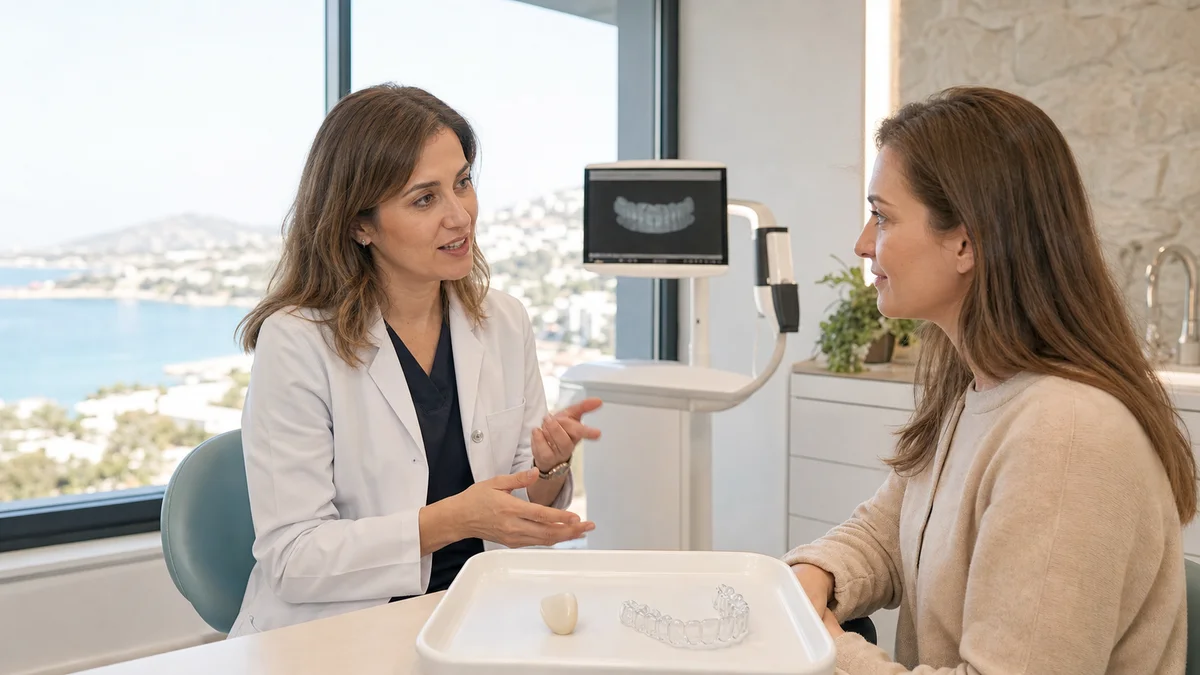
Quick answer: porcelain veneers vs clear aligners is a comparison between changing a tooth’s visible surface and moving teeth into new positions. Veneers can change colour, contour and proportion but may require irreversible enamel removal. Aligners preserve tooth surfaces while moving suitable teeth, yet require consistent wear, monitoring and retainers.
Choosing between porcelain veneers vs clear aligners begins with a diagnosis, not a photograph. The two options solve different problems. Porcelain veneers are custom restorations bonded to the front of selected teeth. Clear aligners are removable appliances prescribed in a sequence to move teeth gradually. One changes the appearance of tooth surfaces; the other changes tooth position and may influence the bite.
A person unhappy with crowding may assume veneers are faster, while someone concerned about colour may assume aligners will create the desired smile. Neither assumption is reliable without an examination. Tooth health, gum condition, enamel, existing fillings, root health, bite, jaw relationships, expectations and willingness to maintain the result all matter.
This guide explains porcelain veneers vs clear aligners as a patient-safety decision. It does not diagnose suitability or promise an outcome. At Redent Klinik, a responsible discussion should identify the problem first, then compare conservative and clinically suitable ways to address it.
Porcelain veneers vs clear aligners: what does each treatment do?
Porcelain veneers cover the visible front surface of a tooth with a thin ceramic restoration. They may be considered for selected concerns involving colour, shape, surface texture, proportions, small chips or some spaces. They do not move the tooth root into a new position. Creating space and an appropriate contour may require removal of enamel, which makes treatment irreversible where preparation occurs.
Clear aligners apply planned forces to move teeth in small steps. A series of custom trays is worn according to a dentist or orthodontist’s instructions. Aligners may address some crowding, spacing and bite relationships, but they are not suitable for every tooth movement or jaw problem. Attachments, enamel reduction between teeth, elastics or additional orthodontic techniques may sometimes be recommended.
The FDA explains that clear aligners are removable alternatives used to straighten teeth, and that suitability must be determined after dental examination. It also notes the need to follow prescribed daily wear and use retainers after active treatment. The American Dental Association’s patient information describes veneers as irreversible when enamel is removed and advises treating decay or gum disease first.
Start with the problem: colour, shape, position or bite?
The strongest porcelain veneers vs clear aligners decision starts by naming the concern precisely. “I want straighter teeth” can mean actual crowding, one rotated tooth, uneven incisal edges, different tooth widths or simply a photograph in which the teeth appear asymmetrical. Each may point toward a different treatment or a combination.
- Colour and surface: whitening, bonding or veneers may be discussed depending on cause and existing restorations.
- Shape and proportion: conservative contouring, composite bonding or veneers may be options in selected teeth.
- Position and spacing: aligners or other orthodontic methods may move teeth rather than masking their location.
- Bite and jaw relationship: orthodontic assessment may be necessary; veneers do not correct a skeletal discrepancy.
Sometimes the visible issue has more than one cause. A tooth may be both rotated and discoloured. Moving it first could allow a smaller restoration later, while severe colour change may remain after alignment. Sequencing matters because orthodontic movement changes contacts, spaces and the amount of restorative work needed.
Which option preserves more natural tooth structure?
Tooth preservation is central to comparing porcelain veneers vs clear aligners. Clear aligners generally move natural teeth without covering their surfaces. However, treatment may involve attachments bonded to teeth and, in selected plans, small amounts of enamel reduction between teeth. These details should be explained before treatment.
Porcelain veneers may require enamel preparation to create space, correct contour and support a durable bond. Preparation can vary, but “no-prep” is not automatically suitable or genuinely preparation-free for every person. Adding ceramic without adequate planning can create bulky contours, cleaning difficulty or an unnatural appearance. Ask the clinician to explain expected enamel changes for each proposed tooth.
When healthy teeth are being considered for elective treatment, the most conservative predictable option deserves serious attention. This does not mean aligners are always best. If the problem is primarily tooth colour or damaged surfaces, moving teeth may not solve it. It means the expected benefit should justify any irreversible change.
Porcelain veneers vs clear aligners decision table
| Decision factor | Porcelain veneers | Clear aligners | Ask at consultation |
|---|---|---|---|
| Main purpose | Change visible colour, shape and proportion | Move suitable teeth and improve selected alignment or bite concerns | What is the diagnosis behind my concern? |
| Natural tooth change | May require irreversible enamel removal | Usually preserves facial surfaces; attachments or interproximal reduction may be planned | What exactly will be added, removed or moved? |
| Patient participation | Hygiene, protection and reviews | Consistent prescribed wear, tray care, reviews and retainers | What happens if I cannot follow the schedule? |
| Timing | Usually a restorative sequence after health and planning checks | Gradual movement over a case-specific period | What milestones determine completion? |
| Long-term care | Possible repair or replacement; gum and bite monitoring | Retention is needed to limit relapse; dental monitoring continues | What maintenance costs and appointments should I expect? |
This table is intentionally general. Materials, orthodontic complexity, oral health and treatment goals vary. A consultation should convert these broad differences into a written recommendation based on records.
How long does each option take?
Timeline is often the most visible difference in porcelain veneers vs clear aligners, but faster is not automatically safer or better. Veneer treatment can sometimes be completed in a shorter restorative sequence once the mouth is healthy and the plan is final. Records, mock-ups, tooth preparation, temporary veneers, laboratory fabrication, try-in, bonding and review may be separate stages.
Aligner treatment is gradual. The FDA’s general consumer information describes a series of custom aligners, each worn for a prescribed period, followed by retention. Case duration depends on the starting position, complexity of movement, response, wear consistency and whether refinements are needed. An online average cannot predict one person’s completion date.
Ask what “finished” means. For aligners, it may include acceptable tooth positions, bite contacts and a retention plan. For veneers, it should include fit, gum response, contacts, bite and a review after bonding. A deadline built around an event or flight should not override biological and technical checks.
Risks and limitations of porcelain veneers
A balanced porcelain veneers vs clear aligners comparison should state veneer risks plainly. Enamel removal is generally irreversible. Teeth may become temporarily or persistently sensitive. A veneer may chip, crack, loosen, wear or need replacement. Decay can still occur around margins, and gum recession can change how an edge looks. Bite forces and grinding may increase mechanical concerns.
The ADA’s MouthHealthy guidance advises that existing decay or gum disease should be treated before veneers and notes that veneers can chip, crack, wear or loosen. It also states that people who clench or grind, or who have certain bite relationships, may not be good candidates. These are general considerations; the treating dentist must assess the individual tooth and bite.
- Irreversible enamel modification where preparation is performed
- Sensitivity, gum irritation or contour-related cleaning difficulty
- Chipping, fracture, debonding, wear or future replacement
- Colour mismatch as natural teeth change or are whitened later
- Failure to address an underlying alignment or bite problem
Ask whether a mock-up or trial design can help evaluate proportions before irreversible work. A preview is a communication tool, not a guarantee that every lighting condition, photograph or facial movement will look identical.
Risks and limitations of clear aligners
Clear aligners require sustained cooperation. Inadequate wear can delay movement, reduce tracking and change the plan. Teeth or gums may feel sore, and speech or saliva can change temporarily. Attachments can loosen. Poor cleaning or drinking sugary beverages while trays are in place can raise the risk of decay, decalcification or gum inflammation.
Aligners do not work equally well for every movement. Some cases may need fixed braces, elastics, additional appliances, restorative coordination or jaw surgery assessment. The FDA advises that aligners may not work for everyone’s teeth and that a dentist or orthodontist should determine suitability after examination.
Orthodontic movement also requires attention to root and gum health. The American Association of Orthodontists explains that imaging can reveal information not visible in the mouth, such as root condition and impacted teeth. A remote scan or selfie alone cannot provide the same assessment. Direct-to-consumer treatment without appropriate examination and monitoring can miss disease or unsuitable movement.
Retention is not optional background detail. Teeth can move after active treatment, so a prescribed retainer plan and replacement expectations should be discussed before starting. Retainers themselves need cleaning and may wear, distort or be lost.
Can aligners reduce the amount of veneer work?
In some patients, a staged porcelain veneers vs clear aligners plan is not an either-or decision. Orthodontic movement may place teeth in more favourable positions before whitening, bonding or a smaller number of veneers. This can sometimes reduce aggressive contour correction and help create more balanced spaces. Whether that is possible depends on the starting condition and goals.
For example, moving a rotated tooth may reduce the need to remove enamel from its prominent surface. Closing or redistributing spaces can help restorative proportions. Conversely, moving teeth cannot replace missing enamel, repair a large fracture or change the intrinsic colour of an existing ceramic crown. The orthodontic and restorative plans should be coordinated from the beginning.
Ask for the sequence in writing: health stabilisation, orthodontic movement, retention, whitening if appropriate, final restorative design and reviews. Whitening is often planned before matching ceramic shade because porcelain does not whiten like natural enamel.
How do cost and value differ?
Price alone is a poor way to choose porcelain veneers vs clear aligners. Veneer cost may depend on the number of teeth, ceramic, laboratory workflow, temporary restorations, complexity and any treatment needed first. Aligner cost may depend on records, complexity, the planned series, attachments, refinements, monitoring and retention.
A complete porcelain veneers vs clear aligners comparison should also consider what happens if priorities change. Orthodontic treatment can sometimes be paused or modified under professional supervision, although unwanted movement or delay may occur. Prepared teeth, by contrast, continue to need appropriate restorations. This difference in reversibility and future commitment deserves as much attention as the first invoice.
Compare complete written plans. A veneer quote should identify the teeth, material, preparation, temporaries, laboratory work, reviews and known exclusions. An aligner quote should identify diagnostic records, supervision, expected refinements, replacement-tray policy, retainers and follow-up. Neither should promise a fixed outcome regardless of clinical response.
Long-term value includes maintenance. Veneers may require polishing, repair or replacement. Aligners require retention after movement, and retainers can need replacement. Both require routine dental care. The cheapest initial option can be poor value if it does not solve the diagnosed problem or creates avoidable irreversible treatment.
Who may be suitable, and who should wait?
Suitability for porcelain veneers vs clear aligners cannot be determined from age or photographs alone. Healthy teeth and gums, realistic goals and the ability to maintain care are common foundations. Veneers may be considered where a surface or shape change is needed and the tooth can support a conservative bonded restoration. Aligners may be considered where planned movement is clinically achievable and the patient can follow wear and review instructions.
Treatment may need to wait if there is active decay, gum disease, unexplained pain, poor hygiene, incomplete records or a health issue requiring coordination. Veneer treatment should pause when the patient has not understood irreversible preparation or alternatives. Aligner treatment should pause when roots, gums or the bite have not been adequately assessed, or when consistent wear is unrealistic.
A second opinion is reasonable when healthy teeth are proposed for extensive preparation, when aligners are offered without appropriate examination, when a provider guarantees speed or perfection, or when no alternative is discussed.
Questions to ask before choosing porcelain veneers vs clear aligners
- Is my main problem tooth position, bite, colour, surface, shape or a combination?
- What untreated dental or gum conditions must be addressed first?
- How much enamel would each proposed veneer require removing?
- Which movements can aligners predictably attempt in my case, and which may need another method?
- What records and imaging support the diagnosis?
- Could alignment reduce the number or preparation of restorations?
- What are the temporary, refinement, retainer, repair and replacement policies?
- What symptoms or changes should prompt an earlier review?
- What written records will I receive if I travel or change clinicians?
Patients planning care in Turkey can use the Redent Klinik Contact Page to discuss records and arrange an assessment. Remote information can support planning, but final suitability should follow an appropriate clinical examination.
Frequently asked questions about porcelain veneers vs clear aligners
Are clear aligners always more conservative than veneers?
Aligners generally move natural teeth without covering their front surfaces, while veneers may require irreversible enamel removal. However, aligners can involve attachments or interproximal reduction and may not address a colour or structural problem. “Conservative” must be judged against the diagnosed need.
Can veneers make crooked teeth look straight?
Veneers can alter visible contours in selected situations, but they do not move roots or correct a jaw relationship. Masking significant crowding may require excessive preparation or create bulky contours. Orthodontic assessment can clarify whether movement is safer.
Can clear aligners change tooth colour or shape?
No. Aligners move teeth; they do not whiten enamel, repair chips or change intrinsic tooth shape. Whitening, contouring, bonding or veneers may be discussed separately after health and alignment are assessed.
Which option is faster?
Veneers may have a shorter active restorative sequence, while aligners move teeth gradually. Speed should not replace diagnosis, disease control, safe preparation, biological response or retention. Individual timelines require examination and planning.
Will I need retainers after clear aligners?
Retention is generally needed after orthodontic movement to limit relapse. The type, wear schedule, monitoring and replacement plan should be prescribed for the individual and explained before treatment begins.
Can I have aligners first and veneers later?
Yes, a coordinated sequence may be suitable for some patients. Alignment can sometimes improve tooth positions before whitening or conservative restorations. The final restorative goal should guide orthodontic space and bite planning from the start.
Make the decision around diagnosis and tooth preservation
The practical conclusion to porcelain veneers vs clear aligners is that they are not equivalent cosmetic products. Veneers change the visible tooth surface and may involve irreversible preparation. Aligners move suitable teeth over time and depend on cooperation, monitoring and retention. The right option addresses the diagnosed problem with an acceptable balance of benefit, risk and natural-tooth preservation.
Before deciding, describe the smallest change that would satisfy you and ask whether it can be achieved with a less invasive step. A staged porcelain veneers vs clear aligners discussion may reveal that whitening, bonding, limited orthodontics or observation is sufficient. It may also confirm that a carefully planned veneer or aligner pathway is reasonable. The value lies in understanding why.
Use official information to prepare questions. The FDA guide to braces and clear aligners describes removable aligners, professional assessment, hygiene and retention. The American Dental Association MouthHealthy veneer guide explains preparation, types, limitations and care.
This article is educational and cannot diagnose suitability, predict duration or guarantee a cosmetic result. It is prepared for medical review by Dentist Esma Çevrük Çakır with patient safety, informed consent and evidence-based decision-making as priorities.
Sources
Disclosure: this page may contain affiliate links. We may earn a commission if you use them, at no extra cost to you.