
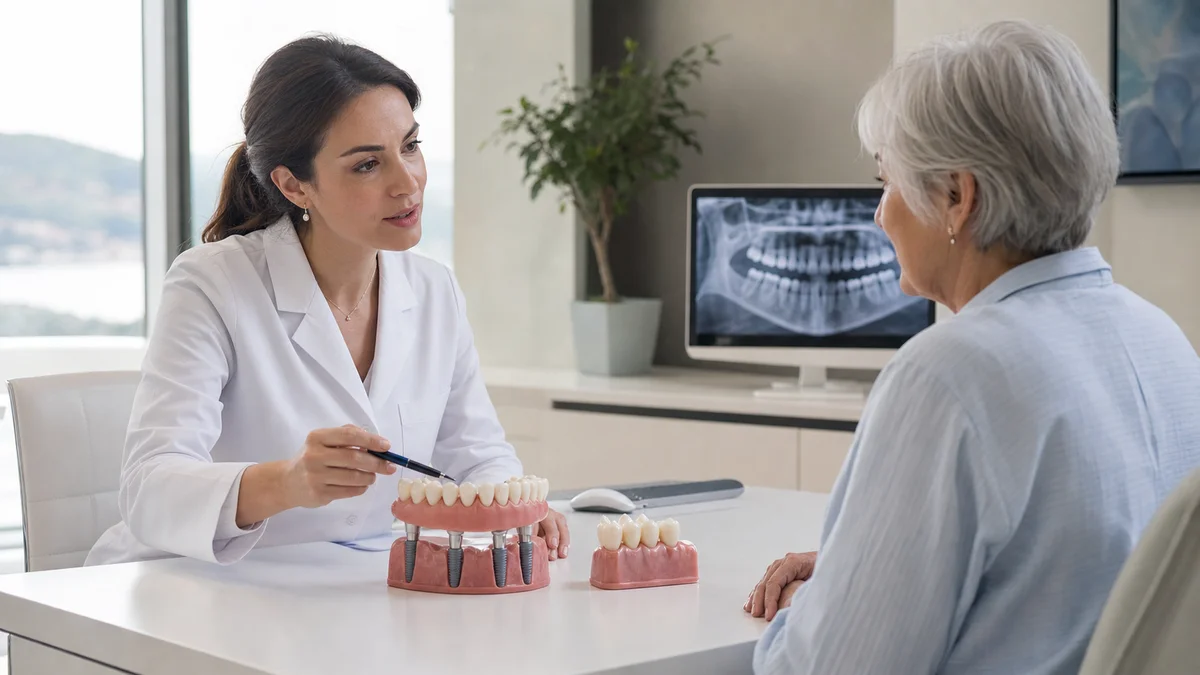
Quick answer: all on 6 dental implants or dental bridge which is better depends first on what “bridge” means and how many teeth are missing. All-on-6 supports a full-arch bridge on six implants. A conventional bridge usually replaces a shorter gap using natural teeth. They are not direct substitutes in every case.
Searching all on 6 dental implants or dental bridge which is better can lead to confusing answers because the terms are often mixed together. “All-on-6” is itself an implant-supported full-arch bridge. A conventional dental bridge generally spans one or a few missing teeth and is supported by natural teeth. An implant-supported bridge may replace several teeth without relying on natural teeth. Before comparing outcomes or prices, the type and extent of each proposal must be clear.
The decision also depends on whether teeth are missing, failing, or still maintainable. A person with one short gap is facing a different decision from someone with a toothless arch or many teeth with a poor prognosis. Removing treatable teeth to fit a full-arch prosthesis is irreversible. Conversely, asking a few compromised natural teeth to support a long conventional bridge can be an unsuitable load.
This guide frames all on 6 dental implants or dental bridge which is better around diagnosis, preservation, surgery, cleaning, repair and long-term care. It cannot determine personal suitability. At Redent Klinik, the starting point should be a medical and dental history, examination, appropriate imaging and a tooth-by-tooth prognosis.
First clarify: what kind of dental bridge is being compared?
The phrase “dental bridge” describes a replacement tooth or teeth joined to supports. According to the American Dental Association’s MouthHealthy information, a fixed bridge can attach to surrounding natural teeth, while an implant bridge attaches replacement teeth to implants in the jaw. Those designs differ in surgery, preparation, cleaning and repair.
All-on-6 usually refers to a complete fixed arch supported by six implants. It may be considered for a fully toothless arch or an arch in which remaining teeth have been assessed as not maintainable. A conventional bridge more commonly replaces a localised gap and requires suitable natural abutment teeth. An implant-supported partial bridge occupies another category.
- Conventional tooth-supported bridge: neighbouring teeth support one or more replacement teeth.
- Implant-supported partial bridge: implants support multiple replacement teeth in a limited span.
- All-on-6 full-arch bridge: six implants support a fixed prosthesis replacing an entire arch.
- Removable option: a denture may rest on tissues or receive support/retention from implants.
If a quotation says only “bridge,” request a diagram and written description. Ask which teeth or implants support it, what it replaces, whether it is fixed or removable, and how it can be cleaned and repaired.
All on 6 dental implants or dental bridge which is better for one missing tooth?
For one missing tooth, all on 6 dental implants or dental bridge which is better is usually the wrong comparison. Full-arch treatment would not ordinarily be used simply to replace one missing tooth. The relevant options may include a single implant crown, a conventional bridge, a resin-bonded bridge, a removable solution, orthodontic space management or no replacement, depending on the site and diagnosis.
A conventional bridge can be useful when neighbouring teeth are already heavily restored and suitable as supports. However, it may require preparation of those teeth. The ADA notes that implants can replace missing teeth without removing good tooth structure to make a bridge, but implant treatment involves surgery and requires suitable health, bone and maintenance.
The condition of adjacent teeth changes the balance. Preparing intact teeth has a different cost from incorporating teeth that already need crowns. A single implant avoids linking natural teeth but introduces surgical risks, healing time and implant maintenance. Ask for both local and whole-mouth consequences rather than selecting from a generic ranking.
All on 6 dental implants or dental bridge which is better for a failing full arch?
For extensive tooth loss, the all on 6 dental implants or dental bridge which is better question becomes more relevant, but a conventional short bridge may still not be a realistic full-arch alternative. The clinical team must assess whether any teeth can be predictably maintained, whether they can support restorations, and whether a fixed, removable or combined plan is appropriate.
All-on-6 may provide a fixed full-arch restoration without relying on natural abutment teeth. It still requires surgery, sufficient bone in usable locations, controlled disease, a maintainable prosthetic design and long-term reviews. “Six” is not automatically the correct number. Anatomy, force distribution and prosthetic design may lead to another implant count or distribution.
A tooth-supported long-span bridge depends on the health, position and load-bearing capacity of abutment teeth. If one critical abutment fails, a larger restoration may be affected. On the other hand, preserving strategically valuable teeth can be biologically and emotionally important when prognosis is acceptable. A careful prognosis should separate hopeless, questionable and maintainable teeth and explain why.
Tooth preservation is the first decision test
A strong answer to all on 6 dental implants or dental bridge which is better starts with what must be removed or altered. All-on-6 for a dentate arch generally means extracting remaining teeth in that arch. Those teeth cannot be returned if the patient later dislikes the prosthesis. A conventional bridge often means shaping natural abutment teeth, which is also irreversible.
Ask for a tooth-by-tooth diagnosis, not only a panoramic image with a treatment label. Decay, cracks, periodontal support, root health, mobility, previous treatment, strategic value and the bite should be considered. If teeth are described as unsalvageable, request an explanation of the evidence and alternatives. A second opinion is reasonable before extensive extraction.
Preservation does not mean keeping every tooth regardless of prognosis. Repeated infection, inadequate support, non-restorable damage or a design that cannot be cleaned may make retention unwise. The aim is to avoid both premature extraction and unrealistic rescue treatment.
All on 6 dental implants or dental bridge which is better: comparison table
| Decision factor | All-on-6 full-arch bridge | Conventional tooth-supported bridge | Question to ask |
|---|---|---|---|
| Typical scope | Replaces an entire arch | Usually replaces a localised gap | Are these plans treating the same number of teeth? |
| Support | Six surgically placed implants | Prepared natural abutment teeth | What is the prognosis of each support? |
| Irreversible step | Surgery and often extraction of remaining teeth | Preparation of supporting teeth | Which healthy structures are changed? |
| Healing | Implant integration and staged prosthetic care | Dental and gum stabilisation plus restorative stages | What temporary solution is planned? |
| Maintenance | Cleaning beneath a full arch and implant monitoring | Cleaning under the bridge and protecting abutment teeth | Can I demonstrate the required daily cleaning? |
| Failure pathway | Implant, screw, framework or prosthetic complications | Decay, gum disease, fracture or abutment failure | What can be repaired and what requires replacement? |
The table does not declare a winner because the treatments usually serve different scopes. A fair comparison must include other realistic options for the same arch, not only two marketing labels.
How do surgery and healing change the decision?
The surgical burden is a major difference in all on 6 dental implants or dental bridge which is better. All-on-6 requires implant surgery and may involve extractions, bone management, sedation or staged procedures. The FDA lists potential implant risks including injury to nearby teeth or tissues, sinus perforation, jawbone injury, altered bite, screw loosening, infection, delayed healing, implant failure and nerve-related numbness.
Overall health, smoking, medicines, bone, oral infection and hygiene can influence candidacy and healing. The FDA advises discussing benefits, risks, health and implant system details with the provider. A temporary fixed bridge may sometimes be attached soon after placement, but this does not mean bone healing is complete. Immediate loading depends on stability, force control and adherence to instructions.
A conventional bridge does not require implant placement, but it is not risk-free. Abutment teeth may need significant preparation, and some may later develop sensitivity, decay, gum problems, fracture or pulpal complications. Treatment timing also depends on whether extractions, gum care or root canal treatment are needed.
Cleaning and maintenance: which design can you manage?
Long-term success in all on 6 dental implants or dental bridge which is better depends heavily on cleaning. A fixed full-arch bridge does not come out for daily home cleaning. The patient must clean around implants and beneath the prosthesis using recommended tools. The bridge contour should provide access without compromising speech, comfort or strength.
A conventional bridge also requires special cleaning under the replacement tooth and around abutments. Decay can develop at margins of natural teeth, and gum inflammation can threaten supporting tissues. An implant cannot decay, but plaque-related inflammation and bone loss can occur around it. Neither option is maintenance-free.
- Ask the clinician or hygienist to demonstrate cleaning on a model before consent.
- Confirm which brushes, flossing aids or irrigators are appropriate.
- Understand the professional review and cleaning schedule.
- Discuss who provides maintenance if treatment is completed abroad.
- Report bleeding, swelling, discharge, looseness, fracture or bite changes promptly.
If dexterity, vision or caregiving support limits daily cleaning, a removable design may sometimes be easier to maintain. That trade-off deserves an honest discussion.
All on 6 dental implants or dental bridge which is better for repair?
Repairability is often overlooked in the all on 6 dental implants or dental bridge which is better conversation. A full-arch implant prosthesis contains implants, abutments, screws, a framework and replacement teeth or ceramic. Screws can loosen, surfaces can wear, teeth can chip and frameworks or prosthetic components can fracture. The exact repair depends on material and design.
A conventional bridge can loosen, fracture or develop problems in an abutment. If one supporting tooth develops extensive decay or a fracture, the entire bridge may be affected. Some repairs are local; others require removing and replacing the restoration. Ask whether the proposed bridge is retrievable and how emergency access to a support would be managed.
Request a written maintenance plan covering minor adjustments, laboratory repairs, replacement components and circumstances requiring a new prosthesis. Keep implant brand and model information, as FDA patient guidance recommends, because future clinicians may need compatible components.
How do appearance, speech and chewing differ?
Both options can support appearance and function when properly planned. A conventional bridge emerges from the region of natural teeth and replaces a limited gap. A full-arch prosthesis replaces all teeth in an arch and may also replace lost gum volume with prosthetic material. Lip support, tooth display, speech space and the transition between prosthesis and natural tissue need careful design.
Patients with substantial bone and gum loss may need pink prosthetic material to restore proportions. Patients with a high smile line may expose the transition, which can affect aesthetic planning. A trial tooth arrangement or provisional bridge can help test speech, tooth position and appearance, but it cannot guarantee every final outcome.
Chewing comfort depends on fit, bite, muscle adaptation and opposing teeth. A fixed restoration should not be promised to feel exactly like natural teeth. Ask what foods or forces should be avoided during healing and how the bite will be reviewed after the provisional and final stages.
Cost and timeline should compare the same scope
Price answers to all on 6 dental implants or dental bridge which is better are meaningless if one quote replaces a whole arch and another replaces three teeth. Written plans should define the treated area, extractions, implants, grafting, temporary restoration, final material, sedation, laboratory work, reviews and maintenance.
All-on-6 often includes surgical and prosthetic stages over a healing period. A conventional bridge may have fewer stages but can include abutment treatment, temporary crowns, laboratory fabrication and reviews. Additional care discovered after examination can change either plan.
Ask whether the advertised figure is provisional or final, what assumptions it makes, and which foreseeable events cost extra. Long-term value includes cleaning, repairs and eventual component or prosthesis replacement. Avoid guarantees of lifetime function or a fixed result.
Alternatives that belong in the consultation
A good all on 6 dental implants or dental bridge which is better consultation should include more than two choices. Depending on diagnosis, alternatives may include preserving selected teeth, shorter conventional bridges, single implants, an implant-supported partial bridge, a removable complete denture, an implant-retained overdenture, a fixed full arch on a different implant number, staged treatment or no immediate treatment.
Cambridge University Hospitals notes that implants can support crowns, bridges or dentures and may avoid drilling adjacent teeth, while suitability depends on health, hygiene, stable oral conditions and available bone. The best option may prioritise a lower surgical burden, easier cleaning, fixed function, natural-tooth preservation or simpler repair according to patient needs.
- Define the functional and personal goal.
- Stabilise active disease.
- Record the prognosis of every remaining tooth.
- Compare fixed and removable options for the same scope.
- Review surgical, maintenance and repair responsibilities.
- Allow time for consent and a second opinion.
Who may be suitable, and who should wait?
All-on-6 may be considered when an entire arch is missing or remaining teeth have a poor prognosis, usable bone and anatomy are present, health allows surgery, disease is controlled and the patient can maintain the bridge. A conventional bridge may be considered for a suitable gap when abutment teeth have an acceptable prognosis and preparation is justified.
Treatment should wait when active infection or gum disease is uncontrolled, health or medicine information is incomplete, smoking or healing risks have not been addressed, hygiene is inadequate, records are insufficient or the patient has not understood irreversible steps. Urgency created by a discount or travel date is not a clinical indication.
Seek another opinion if maintainable teeth are proposed for extraction without a clear prognosis, a very long bridge is planned on weak supports, implant surgery is offered without appropriate imaging, or the provider refuses to discuss alternatives and complications.
Questions to ask before choosing all on 6 dental implants or dental bridge which is better
- Exactly which teeth are missing, maintainable, questionable or non-restorable?
- Does “bridge” mean tooth-supported, implant-supported, full-arch or removable?
- Are the compared plans replacing the same teeth and functions?
- What natural teeth would be prepared or extracted?
- What imaging and records support the plan?
- What temporary restoration will I use during healing?
- How will I clean the design every day?
- What are the likely repair and replacement pathways?
- Who provides urgent and long-term care after I return home?
Patients considering treatment in Turkey can contact the Redent Klinik Contact Page to discuss records and assessment logistics. Remote review can organise information, but a final recommendation requires appropriate clinical evaluation.
Frequently asked questions
Is All-on-6 a type of dental bridge?
Yes. All-on-6 generally describes a fixed full-arch bridge supported by six implants. This is different from a conventional bridge supported by natural teeth and from a short implant-supported bridge.
Does All-on-6 save the remaining teeth?
No. If teeth remain in the treated arch, full-arch implant treatment usually involves removing them. Their prognosis and alternatives should be documented before irreversible extraction.
Is a conventional bridge less risky because there is no implant surgery?
It avoids implant-placement surgery but has different risks, including irreversible abutment preparation, decay, gum problems, fracture or failure of supporting teeth. Individual health and tooth prognosis determine the balance.
Which option is easier to clean?
Ease of cleaning depends on design, access, dexterity and support. Both fixed full-arch and conventional bridges require cleaning beneath replacement teeth. A removable option may be easier for some patients.
Can one failed implant make the whole All-on-6 bridge fail?
The effect depends on timing, implant position, remaining support, bridge design and the cause. A clinician must assess stability and biology before deciding whether the bridge can remain, be modified or requires further treatment.
Which option lasts longer?
No fixed lifespan applies to every patient. Health, hygiene, smoking, force, materials, design, support condition and maintenance influence both options. Ask for realistic maintenance and failure pathways, not a lifetime guarantee.
All on 6 dental implants or dental bridge which is better: the conclusion
The answer to all on 6 dental implants or dental bridge which is better is not a universal winner. If one tooth is missing, All-on-6 is usually not the relevant comparison. If a complete arch is failing, a short conventional bridge may not address the same problem. The decision must compare clinically realistic plans for the same teeth and goals.
Use official patient information to prepare. The US Food and Drug Administration dental implant guide explains benefits, risks, candidacy and records. The American Dental Association MouthHealthy bridge guide explains tooth- and implant-supported bridges.
This article is educational and cannot diagnose tooth prognosis, implant suitability or individual risk. It is prepared for medical review by Dentist Esma Çevrük Çakır with informed consent, natural-tooth preservation and long-term maintainability as priorities.
Sources
- US Food and Drug Administration: Dental Implants, What You Should Know
- American Dental Association MouthHealthy: Bridges
- American Dental Association MouthHealthy: Implants
- Cambridge University Hospitals: Dental Implants in Restorative Dentistry
- American Dental Association
- World Health Organization Oral Health Fact Sheet
Disclosure: this page may contain affiliate links. We may earn a commission if you use them, at no extra cost to you.