
Quick answer: wisdom tooth removal price depends on whether removal is necessary, the tooth’s position, simple versus surgical technique, imaging, anaesthesia or sedation, clinician and facility needs, number of teeth and aftercare. Compare written plans with the same scope; a headline extraction fee is not always the complete treatment cost.
People searching wisdom tooth removal price often expect one number. Clinically, wisdom teeth range from fully erupted teeth that may be removed similarly to other teeth to deeply impacted teeth close to nerves or the sinus. The required examination, imaging, surgical steps, anaesthesia and follow-up can therefore differ substantially.
Price should not be the first decision. A wisdom tooth that is healthy, symptom-free and not causing disease may be monitored rather than removed. The NHS explains that wisdom teeth causing no problems are usually left in place and checked during routine dental visits. Removal may be discussed when there is repeated gum infection, pain, food trapping, decay, gum disease, cyst formation, abscess or damage risk.
This guide explains what a responsible wisdom tooth removal price quote should contain. It does not diagnose whether extraction is needed or estimate an individual fee. At Redent Klinik, a final recommendation should follow medical and dental history, examination and appropriate imaging.
What determines wisdom tooth removal price?
The main cost driver is procedural complexity. A fully erupted tooth with accessible roots may be removed with local anaesthetic in a straightforward appointment. An impacted tooth may require an incision, removal of bone, division of the tooth into sections, stitches and more surgical time. Root shape and proximity to important anatomy can influence planning.
The number of teeth matters, but multiplying a single-tooth advertisement can be misleading. Removing two teeth in one visit does not necessarily duplicate every diagnostic or facility cost. Conversely, four teeth may involve different levels of difficulty and anaesthesia planning. Each tooth should be described separately in the written plan.
- Clinical consultation and review of health, medicines and symptoms
- Panoramic x-ray and, when justified, three-dimensional imaging
- Simple extraction, surgical extraction or coronectomy
- Local anaesthesia, sedation or general anaesthesia pathway
- Number and position of teeth, clinician time and facility needs
- Stitches, prescribed medicines, review and management of complications
A quote should state which items are included and which could be added only if clinically necessary. It should also explain cancellation or rescheduling rules when fasting, escort or health requirements are not met.
Simple extraction versus surgical extraction
A clear wisdom tooth removal price comparison distinguishes a simple extraction from surgical removal. A simple extraction generally involves an erupted tooth that can be accessed and removed without raising a gum flap or removing bone. Difficulty can still vary with roots, mouth opening, decay and tooth position.
Surgical extraction may be needed when a tooth is partly or fully impacted, covered by gum or bone, angled against the neighbouring tooth, fractured or otherwise inaccessible. The surgeon may make an incision, remove a small amount of bone or divide the tooth. These steps affect time, instruments, expertise and aftercare.
Do not infer technique from the word “impacted” alone. Imaging and examination guide the plan, and the approach can change if the anatomy encountered differs. Ask whether the quote is based on the current images and what circumstances would change it.
Wisdom tooth removal price and imaging
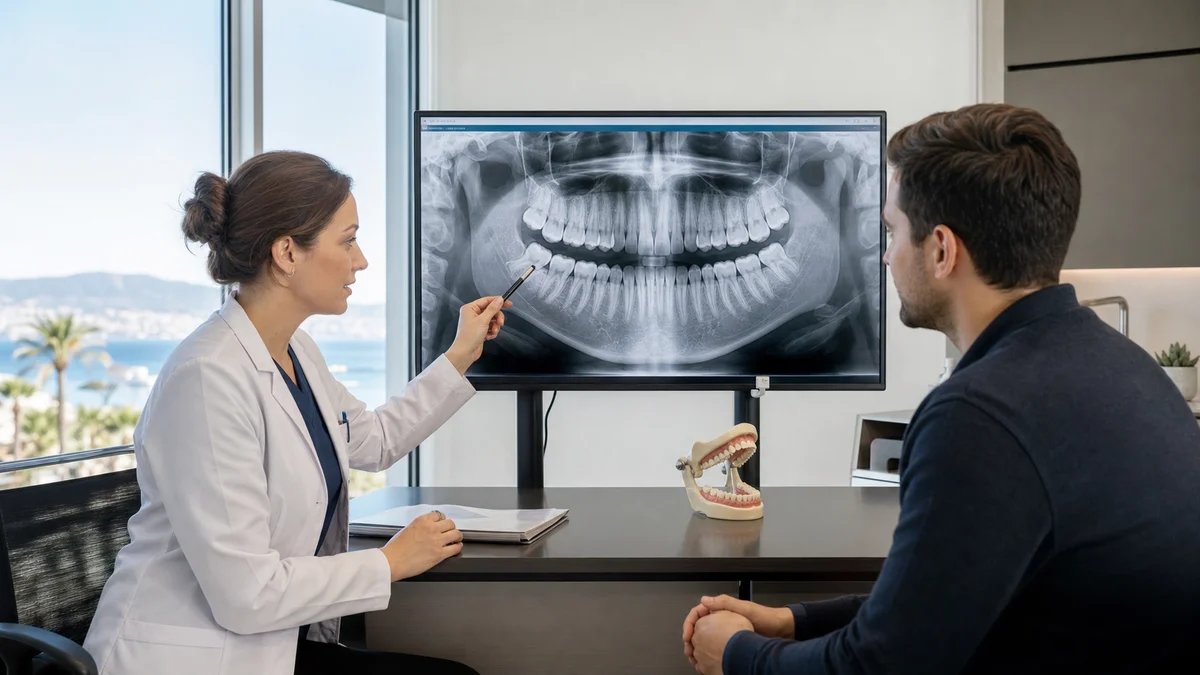
Imaging is not an administrative extra; it supports diagnosis and risk assessment. A panoramic radiograph can show tooth angle, roots, neighbouring teeth and broad relationships to the jaw canal or sinus. A cone beam CT scan may sometimes be considered when a three-dimensional view would materially change management, especially when lower wisdom-tooth roots appear close to a sensory nerve.
Cambridge University Hospitals explains that a normal x-ray can show the nerve, while a cross-sectional cone beam CT may be used to clarify the relationship between roots and the nerve. Not every patient needs this scan. Radiation exposure should be justified by the expected clinical benefit.
Ask whether imaging is included in the wisdom tooth removal price, whether recent suitable images from another provider can be reviewed, and whether the clinic will give you copies for your records. A low quote that excludes necessary imaging is not directly comparable with an inclusive plan.
Anaesthesia, sedation and facility costs
Local anaesthesia numbs the treatment area while the patient remains awake. Some patients or procedures may be considered for conscious sedation, and selected cases may require general anaesthesia in an appropriate setting. These pathways are not interchangeable upgrades. Health, anxiety, complexity, safety, local rules and clinician assessment guide the decision.
Sedation can add pre-operative assessment, monitoring, medicines, trained staff, recovery space and escort requirements. General anaesthesia involves a different facility and anaesthetic team. A quote should state the planned method, who provides it, where it occurs and what happens if the plan changes.
Follow fasting, escort and driving instructions exactly. The NHS advises not driving for a specified period after sedation or general anaesthesia; use the instructions from your own provider because medicines and local rules vary. Never choose deeper anaesthesia only because a package makes it sound more convenient.
Wisdom tooth removal price comparison table
| Quote item | Why it matters | What to confirm | Possible exclusion |
|---|---|---|---|
| Consultation | Confirms indication and health factors | Examination and written treatment plan | Separate specialist opinion |
| Imaging | Shows position and anatomical relationships | Panoramic x-ray and reason for any CBCT | External radiology fee |
| Procedure | Simple and surgical removal use different steps | Technique and tooth-specific complexity | Unexpected additional surgery |
| Anaesthesia | Changes staffing, monitoring and recovery | Local, sedation or general anaesthesia | Anaesthetist or facility charge |
| Aftercare | Supports healing and identifies complications | Instructions, contact route and planned review | Unscheduled treatment for complications |
| Medicines | Prescribing depends on individual need | What is prescribed and where it is obtained | Pharmacy cost |
Use this table to compare the same clinical scope. A quote can be more expensive because it includes imaging, sedation or reviews, not because the procedure itself is priced differently.
Is wisdom tooth removal always necessary?
No. The NHS states that wisdom teeth not causing problems are generally left and monitored. Removal should have a reason that outweighs the risks of surgery. Repeated pericoronitis, unrestorable decay, damage to the adjacent tooth, cystic change, abscess or another diagnosed problem may support treatment.
Preventive removal without current disease requires a patient-specific discussion. Age, eruption path, cleaning access, future disease risk, surgical difficulty and preferences can matter. A clinician should explain the findings, alternatives and consequences of monitoring.
If you are unsure, ask for copies of the image and a clear description of what is wrong now. Seeking another opinion is reasonable before surgery, particularly when the tooth is symptom-free, close to a nerve or the recommendation differs between clinicians.
When coronectomy may change the plan and price
A coronectomy removes the crown of a lower wisdom tooth while intentionally leaving healthy roots when complete removal is judged to carry a higher nerve-injury risk. It is not appropriate for every tooth. Infection, root condition, mobility and other factors can make root retention unsuitable.
Cambridge University Hospitals explains that coronectomy may be offered when roots are intimately related to the jaw nerve, with the aim of reducing nerve risk. Retained roots can migrate, become infected or require later surgery. These possibilities belong in consent and financial planning.
If coronectomy is discussed, ask whether the quoted wisdom tooth removal price includes required imaging, the procedure, planned follow-up and assessment if roots later move or symptoms develop. Do not treat it as a cheaper partial extraction; it is a specific risk-management decision.
Risks that should be explained before payment
Wisdom tooth removal is common, but complications can happen. Expected effects can include pain, swelling, bruising and jaw stiffness. Risks include bleeding, infection, dry socket, injury to neighbouring teeth, communication with the sinus in upper-tooth surgery, jaw injury and altered sensation from nerve bruising or damage in lower-tooth surgery.
The NHS identifies dry socket, infection and nerve-related numbness or tingling among possible complications. Risk is individual and can be higher with difficult tooth positions. The treating clinician should explain the site-specific risk based on imaging rather than quoting an unrelated average.
- How close are roots to the lower jaw nerve or upper sinus?
- Could the adjacent second molar be damaged or already affected?
- Is coronectomy or monitoring a reasonable alternative?
- What symptoms are expected, and what indicates a complication?
- Who provides urgent advice outside normal hours?
A consent form does not replace a conversation. You should have time to ask questions before the procedure and understand how complications would be managed.
Recovery, time off and indirect cost
The total wisdom tooth removal price may include indirect costs such as time away from work, transport, an escort after sedation, soft food and follow-up. Recovery varies with complexity, number of teeth, anaesthesia, health and individual response.
The NHS notes that pain and swelling can persist for days and may take up to two weeks to settle fully, with more difficult removals or general anaesthesia potentially requiring additional time off. That is general information, not a personal recovery prediction. Follow the written advice from your own surgeon.
Plan transport before the appointment. If sedation or general anaesthesia is used, an adult escort and supervision may be required. Do not schedule flights, strenuous activity or critical events without discussing timing. A low procedure fee can become poor value if travel plans ignore review or complication care.
Aftercare included in wisdom tooth removal price
Aftercare should be defined before treatment. You should receive written instructions about bleeding control, cleaning, food, smoking, medicines, activity and contact routes. A planned review may be routine in some cases and symptom-led in others. Stitches may dissolve or require management depending on the material.
The NHS advises protecting the blood clot, keeping the area clean as instructed, avoiding smoking and seeking help for persistent bleeding, severe or worsening pain and swelling, fever, bad taste or feeling unwell. Do not rinse aggressively or improvise remedies that conflict with your clinician’s advice.
Ask whether an unscheduled review is included and how treatment of dry socket or infection is charged. Transparent policies prevent financial uncertainty when a patient is already uncomfortable.
How to compare wisdom tooth removal price abroad
Patients considering treatment while travelling should compare care pathways, not just currencies. Confirm the clinician’s role, facility, imaging, anaesthesia, timing, language support, emergency access and records. A complex impacted tooth may need sufficient time for assessment before surgery and review afterward.
Ask what happens if imaging shows that removal is unnecessary, higher-risk than expected or better managed by coronectomy or a hospital service. A clinic should be willing to change or stop the plan when safety requires it. A non-refundable package should not pressure a patient toward surgery.
Use the Redent Klinik Contact Page to discuss existing images and appointment logistics. Remote review may help organise a visit, but final diagnosis and wisdom tooth removal price require appropriate clinical evaluation.
Insurance and payment questions
Coverage depends on country, policy, clinical indication, provider status and documentation. Some plans distinguish routine extraction, surgical extraction, imaging, sedation and hospital care. The clinic cannot guarantee what an insurer will reimburse unless the insurer confirms it.
Request procedure descriptions, clinical notes and an itemised estimate before treatment. Ask whether pre-authorisation is needed and who submits documents. If paying in another currency, understand exchange, card and refund policies.
Do not delay urgent assessment solely while waiting for reimbursement information. Pain, swelling, infection or difficulty opening the mouth needs timely dental advice, and breathing or swallowing difficulty requires urgent medical attention.
Health history and medicines can change the appointment scope
A safe wisdom tooth removal price plan also depends on information that may not appear on an x-ray. Tell the clinician about allergies, pregnancy, bleeding conditions, previous anaesthetic problems, heart or immune conditions and every prescribed, non-prescribed or herbal product you use. Anticoagulants, antiplatelet medicines and other treatments may require coordination, but you should never stop them without instructions from the clinician responsible for your care.
Additional medical correspondence, blood tests, hospital facilities or anaesthetic assessment can change timing and cost in selected cases. These steps are not automatically necessary for everyone. A written estimate should explain whether the current quote assumes routine outpatient treatment and what finding would require another setting.
Bring an updated medicine list and disclose changes before the appointment. If a health issue means surgery should be delayed or moved to a different service, that is a safety decision. A provider should not proceed merely to preserve a package price or travel schedule.
Questions to ask about wisdom tooth removal price
- Why is removal recommended now, and what happens if the tooth is monitored?
- Is the tooth erupted, partly impacted, bone-covered or close to a nerve or sinus?
- Does the quote include consultation and necessary imaging?
- Is the procedure simple extraction, surgical extraction or coronectomy?
- Which anaesthesia method is planned and why?
- Who performs the procedure, and in what facility?
- Are medicines, stitches and planned reviews included?
- How are dry socket, infection or an unscheduled review charged?
- What records and emergency contact details will I receive?
Put answers in writing. A responsible quote can include conditional items, but it should explain what clinical event triggers each additional charge.
Frequently asked questions about wisdom tooth removal price
Why can two wisdom teeth have different prices?
They may have different eruption, root shape, bone coverage, nerve or sinus relationships and surgical difficulty. A tooth-specific assessment is more meaningful than multiplying a generic fee.
Does wisdom tooth removal price include x-rays?
It depends on the provider. Ask whether consultation, panoramic imaging and any justified CBCT are included. The need for three-dimensional imaging should be based on clinical benefit, not routine packaging.
Is sedation necessary for wisdom tooth removal?
Not always. Many removals use local anaesthesia. Sedation or general anaesthesia may be considered according to complexity, health, anxiety, safety and local practice. The clinician should explain the recommendation and added requirements.
Is removing all four wisdom teeth cheaper than separate visits?
Combined treatment may share some consultation or facility costs, but it also changes procedure time, recovery and anaesthesia considerations. Suitability and complete scope matter more than a package discount.
Can a wisdom tooth be left if it does not hurt?
Yes, some symptom-free teeth can be monitored when no disease is present. Pain is not the only finding, so examination and imaging may still identify decay, gum damage, cystic change or effects on the adjacent tooth.
When should I seek urgent help after removal?
Seek prompt dental advice for bleeding that does not stop, severe or worsening pain and swelling, fever, bad taste, discharge or feeling unwell. Severe breathing or swallowing difficulty or rapidly spreading swelling requires urgent medical care.
A complete quote follows a clinical decision
The most useful way to understand wisdom tooth removal price is to ask what problem is being treated and what the plan includes. A simple erupted extraction, difficult impacted surgery and nerve-risk coronectomy are not the same service. Imaging, anaesthesia, number of teeth, facility and aftercare explain much of the variation.
Use official information to prepare. The NHS wisdom tooth removal guide explains indications, recovery and complications. The Cambridge University Hospitals consent guide describes impacted-tooth surgery, nerve considerations and coronectomy.
This article is educational and cannot determine whether a wisdom tooth should be removed, what anaesthesia is appropriate or what an individual procedure will cost. It is prepared for medical review by Dentist Esma Çevrük Çakır with informed consent and patient safety as priorities.
Sources
Disclosure: this page may contain affiliate links. We may earn a commission if you use them, at no extra cost to you.