
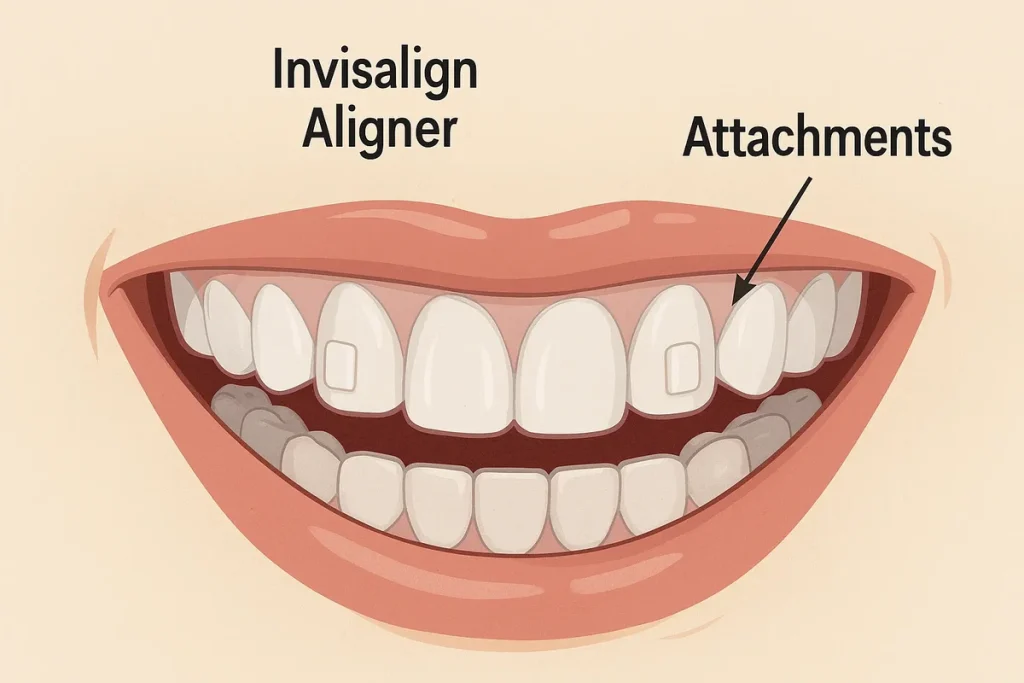
When people choose Invisalign to achieve a straighter smile, they often imagine a clear, nearly invisible treatment that aligns teeth without the discomfort of traditional braces. However, many patients are surprised to hear their orthodontist mention something called attachments Invisalign. These tiny, tooth-colored shapes are an essential part of the Invisalign system, helping aligners apply precise pressure for accurate tooth movement. Understanding what these attachments are, how they work, and why they are so important can make your Invisalign journey smoother and more predictable. Let’s dive deep into everything you need to know about attachments Invisalign and how they help create that perfect smile 😁.
What Are Invisalign Attachments?
Attachments Invisalign are small, tooth-colored composite bumps bonded to certain teeth to give the aligners something to “grip” onto. Unlike the clear plastic trays, these attachments are not removable—they stay on your teeth throughout the treatment and are strategically placed by your orthodontist. Their size and shape depend on the type of tooth movement required. For instance, rectangular attachments can help rotate teeth, while rounder ones are used for vertical adjustments.
Think of them as “handles” that guide your teeth into the right position. Without attachments, Invisalign aligners might slip or fail to deliver enough force for more complex movements. Although the word “attachments” might sound intimidating, they are painless to apply and almost invisible to others once your aligners are in place.
How Attachments Help Invisalign Work Better
The main goal of attachments Invisalign is to enhance control and efficiency. Each attachment is placed according to a digital plan designed by your orthodontist using advanced 3D imaging software. These attachments allow the aligners to apply focused pressure on specific areas of your teeth, resulting in faster and more predictable movement. In simpler cases, Invisalign may work fine without attachments, but in moderate to complex cases—especially those involving rotations, vertical movements, or bite corrections—attachments are crucial.
Attachments act as anchors that help aligners push, pull, or rotate teeth in the desired direction. They are also useful for preventing unwanted movements. Essentially, they make Invisalign capable of handling cases that were once only treatable with metal braces. According to the American Dental Association, precision attachments are one of the technological advancements that have made clear aligner therapy much more effective than it was a decade ago.
Comfort and Aesthetics of Invisalign Attachments
One of the biggest questions patients have is whether attachments affect the appearance or comfort of Invisalign. The truth is, while attachments are visible up close, they blend very well with the natural color of your teeth. Once the aligners are in, they’re hardly noticeable. You might feel slight roughness or mild irritation during the first few days, but this quickly fades as you get used to them.
Since attachments are bonded with dental resin, they don’t cause pain or sensitivity. However, you might notice that your aligners fit a little tighter or are trickier to remove—this is completely normal and a sign that they are working effectively.
Cleaning and Maintenance Tips 🪥
Proper hygiene is essential when you have attachments Invisalign. Food and plaque can accumulate around the bumps, so brushing after meals and flossing regularly is important. It’s also recommended to use an interdental brush to clean around the attachments and rinse your aligners daily with lukewarm water or Invisalign cleaning crystals. Avoid hot water as it can warp your aligners. If you’re unsure about cleaning methods, your dentist at Redent Klinik Contact Page can provide personalized instructions.
Common Myths About Invisalign Attachments
Many people worry that attachments might stain or damage their teeth. In reality, attachments are made from the same resin used in cosmetic dental fillings and are completely safe. Staining is rare if you maintain proper oral hygiene. Another myth is that attachments make Invisalign uncomfortable or visible—they do not. They are designed to be discreet, and most people won’t even notice them.
Duration and Removal Process
Attachments usually remain in place for the entire Invisalign treatment, which can last anywhere from 6 to 18 months. Once your treatment is complete, your dentist will gently polish the attachments off your teeth without any discomfort or damage to your enamel. The removal process is quick and painless, leaving your teeth smooth and ready to shine in your new smile ✨.
Advantages of Using Attachments with Invisalign
With attachments Invisalign, you can achieve more complex tooth movements that standard aligners can’t accomplish alone. The advantages include:
- Improved precision in tooth movement
- Shorter treatment duration in some cases
- Better control over tooth rotations and vertical corrections
- Ability to treat moderate-to-severe alignment issues
Ultimately, attachments enhance the overall effectiveness of Invisalign, making it suitable for a wider range of orthodontic cases while maintaining comfort and aesthetics.
Final Thoughts
Attachments Invisalign play an integral role in achieving a flawless smile with aligners. They are discreet, efficient, and a key reason why Invisalign has become a leading orthodontic solution worldwide. By understanding their function and maintaining good oral hygiene, you can ensure a smooth treatment journey and get the smile you’ve always wanted. For expert guidance or to start your Invisalign journey today, reach out to Redent Klinik and take the first step toward your dream smile! 😃
What Are Attachments in Invisalign and How Do They Work?
Many people think Invisalign is just a set of transparent aligner trays that gradually move teeth into the correct position. However, the real power of this system comes from the combination of aligners and small, carefully positioned additions known as attachments Invisalign. These tiny elements might look insignificant, but they are key to achieving the precision and effectiveness that Invisalign is famous for. Understanding how attachments function helps you appreciate why your orthodontist includes them in your treatment plan and how they play a vital role in creating that dream smile 😁.
Defining Invisalign Attachments
Attachments Invisalign are small, tooth-colored shapes made from dental composite material, the same kind used for fillings or bonding. They are bonded to specific teeth based on a detailed digital 3D model created by your orthodontist. Their primary function is to help the aligners grip your teeth more effectively, applying just the right amount of pressure in the right direction. Think of them as “tiny handles” that allow your aligners to move your teeth in ways that would otherwise be impossible with smooth surfaces.
The shape of each attachment depends on the movement needed. For example, rectangular attachments help rotate teeth, triangular ones are used for extrusion (pulling teeth downward), and circular attachments assist in more complex multi-directional movements. Without these attachments, certain teeth might not respond as effectively to aligner pressure, slowing down your treatment or causing unwanted movement.
How Attachments Work with Aligner Trays
Each attachments Invisalign piece is strategically placed during your treatment setup using digital software. The orthodontist decides exactly where to bond the attachments, based on your customized tooth movement plan. Once in place, your aligners snap over them perfectly. When you wear your aligners, the attachments act like “grip points” where gentle, consistent pressure is applied to move teeth into the desired alignment.
This pressure is distributed evenly, ensuring that each tooth moves according to the plan. Attachments are particularly helpful for rotations (turning teeth), vertical movements (pulling or pushing teeth), and complex bite corrections. This means that Invisalign is no longer limited to mild orthodontic cases—thanks to attachments, it can treat moderate and even some severe misalignments that used to require braces.
Why Orthodontists Use Attachments
Orthodontists use attachments Invisalign to improve precision, efficiency, and predictability. The Invisalign system uses advanced digital mapping (ClinCheck software) to plan every stage of your treatment. The software shows how teeth should move week by week, and where attachments are required to achieve those movements. This ensures that your aligners fit perfectly and that each adjustment occurs smoothly. The attachments help the aligners deliver directional forces—without them, your teeth might not move as intended.
Essentially, attachments bridge the gap between traditional braces and clear aligner therapy. They enable Invisalign to match, and sometimes even outperform, braces in terms of control and accuracy while maintaining the comfort and aesthetics patients love.
What Materials Are Used for Invisalign Attachments?
Attachments are made from composite resin—a tooth-colored material used widely in restorative dentistry. It’s biocompatible, durable, and resistant to staining when maintained properly. During placement, the dentist lightly etches the enamel, applies bonding adhesive, and uses a template aligner to press the resin into place. After curing with a blue light, the template is removed, leaving behind small, smooth bumps that blend seamlessly with your natural tooth color.
Are They Noticeable?
Although you can feel them with your tongue, attachments Invisalign are barely visible to others. They’re designed to match the natural shade of your enamel, making them practically invisible—especially when you wear your aligners. In some cases, attachments may appear slightly shiny under bright light, but most people won’t even realize you have them. This is one of the main advantages of Invisalign over metal braces—it combines functionality with aesthetics 🌟.
The Science Behind Tooth Movement
Tooth movement in orthodontics relies on a biological process called bone remodeling. When gentle, continuous pressure is applied to a tooth, the bone on one side of the root dissolves while new bone forms on the opposite side, allowing the tooth to shift gradually. Attachments Invisalign help direct this pressure precisely where it’s needed. Each aligner applies targeted force, and the attachments ensure that the force remains consistent and predictable throughout the treatment. This is why aligner fit and attachment placement are so crucial—small errors can delay progress or cause misalignment.
Benefits of Using Attachments
Using attachments provides several benefits that enhance Invisalign treatment effectiveness:
- Precision: They allow orthodontists to control individual tooth movement more accurately.
- Efficiency: Complex movements can be achieved without switching to braces.
- Comfort: Smooth and rounded edges prevent irritation to lips or cheeks.
- Discreet Appearance: Their tooth-colored finish maintains the “invisible” look of Invisalign.
- Predictable Results: Attachments improve consistency between the digital plan and real-life outcomes.
How Long Do Invisalign Attachments Stay On?
Typically, attachments Invisalign remain bonded for the entire duration of your treatment, which can range from 6 months for simple cases to 18 months or more for complex ones. They are designed to withstand daily wear, eating, and cleaning routines. Occasionally, an attachment may come off, especially if you bite into hard foods, but your dentist can easily replace it. You should always inform your orthodontist if an attachment detaches, as it can affect aligner fit and tooth movement.
Do Attachments Hurt?
The placement of attachments is completely painless. During the first few days, you might feel mild discomfort or tightness when inserting your aligners, as your teeth start to move. However, this sensation is temporary and indicates that your treatment is progressing correctly. You can continue your normal daily activities without any interruption. In fact, most patients forget about their attachments after a week or two.
Conclusion: The Key to Invisalign’s Success
Understanding attachments Invisalign reveals just how advanced modern orthodontics has become. These small yet powerful tools give your dentist the ability to control tooth movement with incredible precision—something that was once only possible with metal brackets and wires. Their combination of comfort, invisibility, and efficiency makes them essential for most Invisalign cases. If you’re considering Invisalign treatment, consult a professional dentist or orthodontist, such as those at Redent Klinik, to learn how attachments can help perfect your smile. For additional scientific insights into orthodontic treatment, visit the American Dental Association website and explore their research on aligner technologies.
Why Are Attachments Invisalign Needed for Effective Teeth Movement?
One of the most common questions patients ask when they start their Invisalign journey is, “Why do I need attachments?” At first glance, the idea of bonding small bumps to your teeth may seem unnecessary or even confusing. However, attachments Invisalign are an essential component that make clear aligner therapy highly effective for complex tooth movements. Without them, Invisalign would be limited to treating only very mild cases of misalignment. Let’s explore in detail why these attachments are necessary, how they influence your treatment, and what makes them the secret weapon behind Invisalign’s success 🦷.
The Purpose of Attachments in Invisalign Treatment
The main reason attachments Invisalign are needed is to improve the aligners’ grip and control over tooth movement. Unlike traditional braces that use brackets and wires, Invisalign relies on the fit of the plastic trays to move teeth. However, smooth teeth surfaces can sometimes make it difficult for aligners to apply force efficiently. That’s where attachments come in—they act as anchor points, ensuring that pressure from the aligners is applied in the correct direction.
Each tooth requires different forces depending on its shape and position. For instance, rotating a round tooth like a canine is much harder than moving a flat tooth like an incisor. Attachments make it possible for the aligners to perform these specialized movements with precision. They create the necessary leverage and ensure that teeth move exactly as planned by your orthodontist.
Biomechanics Behind Tooth Movement
Orthodontics is a delicate balance of physics and biology. Every tooth movement requires a controlled force that stimulates bone remodeling. Attachments Invisalign allow these forces to be directed precisely where needed. When an aligner snaps onto the attachments, it exerts pressure that triggers bone resorption on one side of the root and bone formation on the opposite side. This is how teeth shift gradually into their ideal positions.
Force Distribution and Accuracy
In cases where attachments are not used, aligners might apply uneven pressure, leading to slower or unpredictable results. By using attachments, your orthodontist ensures consistent force distribution across all necessary points. This leads to faster progress and reduces the chance of treatment delays. It’s a fine-tuned system—each attachment is designed in size and shape to achieve a specific type of tooth movement.
When Are Attachments Invisalign Most Commonly Used?
Not every Invisalign case requires attachments. They are usually reserved for moderate to complex orthodontic problems, such as:
- Rotations: Turning a tooth around its axis (especially canines and premolars).
- Extrusions: Pulling teeth downward to align with others.
- Intrusions: Pushing teeth slightly upward to correct bite issues.
- Torque Adjustments: Tilting teeth inward or outward for proper alignment.
- Root Movements: Guiding the root portion of the tooth for complete alignment, not just the crown.
In these cases, attachments Invisalign are critical for achieving three-dimensional control over tooth positioning. Without them, Invisalign might struggle to handle the complex biomechanics needed to complete treatment effectively.
Attachments vs. Traditional Braces: The Control Factor
In traditional braces, brackets and wires provide mechanical control over teeth. Invisalign uses attachments to mimic that same control but with a more aesthetic and comfortable approach. Each attachment acts like a mini-bracket but without the metal appearance. Combined with the snug fit of the aligners, they offer a hybrid effect—precision of braces and invisibility of aligners.
Why This Combination Works So Well
The digital precision of Invisalign’s 3D planning system means attachments are placed at exactly the right angles. The aligner trays are then molded to interact perfectly with these attachments, allowing micro-adjustments at every stage of the process. Every two weeks (or as scheduled), a new set of aligners continues applying pressure in slightly different directions, ensuring continuous, gentle tooth movement. This cycle repeats until the final alignment is achieved.
Predictability and Efficiency of Results
The inclusion of attachments Invisalign significantly improves treatment predictability. Studies have shown that aligners with attachments achieve more accurate tooth movement compared to those without. For instance, complex rotations and vertical movements are nearly impossible with plain aligners. By integrating attachments, Invisalign can now handle these movements as effectively as braces—sometimes even faster, thanks to better patient compliance and comfort.
Another advantage is efficiency. Because attachments provide more precise control, your orthodontist can design shorter treatment plans with fewer refinements. In other words, fewer unexpected corrections and faster results for patients.
Comfort and Adaptation for Patients
Patients are often concerned about whether attachments will make Invisalign uncomfortable. The truth is, attachments are extremely small and smooth. You may notice a slight difference when you first start wearing your aligners, but within a few days, your mouth adapts. Their rounded design prevents irritation, and since they match your tooth color, they remain discreet. Many patients forget they have them after the first week of use.
Real-Life Example of Attachment Effectiveness
Consider a patient who needs to rotate a canine by 25 degrees. Without attachments, the aligner would likely slide over the tooth’s curved surface, applying minimal rotational force. With attachments Invisalign, the aligner grips the tooth firmly, creating the leverage necessary to rotate it gradually and precisely. This same principle applies to other movements like lifting or tilting teeth. It’s the perfect example of how biomechanics and technology work hand in hand in modern orthodontics.
How Dentists Determine Where to Place Attachments
Your orthodontist uses digital simulation tools such as Invisalign’s ClinCheck software to map out your entire treatment plan. The program predicts how your teeth will move, step by step, and automatically suggests the most efficient placement of attachments. The dentist then verifies and fine-tunes this plan before applying it. Every attachment’s shape, size, and location are tailored to your specific dental anatomy and alignment goals. This customization ensures maximum effectiveness and comfort throughout your treatment journey.
Final Thoughts on Why Attachments Matter
Ultimately, attachments Invisalign are what elevate Invisalign from a cosmetic aligner system to a comprehensive orthodontic solution. They transform simple plastic trays into powerful tools capable of handling complex movements while maintaining aesthetics and comfort. If you’re considering Invisalign, always remember that attachments are not a flaw—they are the key to achieving precise, predictable, and long-lasting results. For professional consultation and customized Invisalign plans, reach out to Redent Klinik for expert guidance. You can also explore research-backed orthodontic studies at the American Dental Association to learn more about how attachments enhance aligner performance and success rates.
Different Types of Invisalign Attachments Explained 🦷
When undergoing Invisalign treatment, you may be surprised to learn that not all attachments are the same. Each attachment serves a unique purpose and is customized to your individual treatment plan. These tiny, tooth-colored bumps may look simple, but they are designed with remarkable precision to perform specific orthodontic functions. Understanding the different attachments Invisalign types helps patients appreciate how advanced and personalized clear aligner therapy truly is. Below, we’ll explore the most common attachment types, their functions, and how they contribute to achieving your ideal smile.
Overview: What Are Invisalign Attachments?
Attachments Invisalign are made of composite resin—the same material used in tooth-colored dental fillings. They are bonded onto teeth using a custom template that ensures perfect placement. Each attachment’s shape and position are planned digitally through Invisalign’s ClinCheck software, allowing orthodontists to guide tooth movement with incredible accuracy. These attachments come in different shapes, such as rectangular, circular, ellipsoidal, or beveled, depending on the desired motion.
The differences between attachment types are not just aesthetic—they determine how force is applied and in what direction. Whether your treatment involves rotating teeth, correcting vertical misalignments, or adjusting the bite, the right combination of attachment designs ensures predictable and efficient results.
1. Rectangular Attachments
Rectangular attachments are among the most common types used in attachments Invisalign systems. They are primarily employed for rotational movements, particularly for teeth like premolars or canines, which have rounded surfaces that are difficult for aligners to grip. These attachments create a flat surface for the aligner to push against, improving grip and ensuring consistent rotational pressure.
Orthodontists may use single or paired rectangular attachments depending on the complexity of movement required. They are usually positioned vertically or horizontally to control the tooth’s rotational axis. The precision of this design allows Invisalign to achieve results similar to those obtained with metal brackets, without compromising aesthetics or comfort.
Advantages of Rectangular Attachments
- Offer excellent rotational control for rounded teeth.
- Distribute pressure evenly for efficient tooth movement.
- Are minimally visible due to their flat profile and tooth-colored resin.
2. Ellipsoidal Attachments
Ellipsoidal (oval) attachments are designed for multi-directional movements, particularly for adjusting both vertical and horizontal positions. They are smoother and more rounded than rectangular attachments, making them ideal for anterior teeth where aesthetics are more important. These attachments help aligners “seat” better on the tooth, improving tracking and ensuring the aligners stay in place throughout the treatment.
When Are They Used?
Ellipsoidal attachments are typically used when both torque and extrusion are needed—for example, pulling a front tooth slightly downward while also adjusting its tilt. Their curved surface allows aligners to apply a gentle yet effective force from multiple angles, reducing discomfort and improving treatment efficiency.
3. Beveled Attachments
Beveled attachments are uniquely shaped with angled edges that help control torque movements—the forward or backward tipping of a tooth’s root. This is essential for achieving a natural-looking alignment and proper bite closure. Attachments Invisalign of this type are common in complex orthodontic cases where vertical and rotational control must be applied simultaneously.
These attachments are carefully oriented depending on the force direction. For instance, an upward-facing bevel may push a tooth root inward, while a downward bevel might pull it outward. This customization helps orthodontists fine-tune even the most challenging tooth movements with remarkable precision.
4. Horizontal Attachments
Horizontal attachments, as the name suggests, are placed parallel to the biting surface of the tooth. They help with extrusion (pulling a tooth down) and intrusion (pushing it up). For example, when a tooth is shorter than its neighbors, a horizontal attachment allows the aligner to “grip” it and apply an upward or downward force to correct its position.
These attachments are often used for incisors and premolars, helping achieve uniform alignment and improving bite functionality. Without them, Invisalign would struggle to perform vertical corrections that require strong mechanical leverage.
5. Button Attachments (Elastics Integration)
Although not technically part of the main attachments Invisalign group, button attachments are worth mentioning. They are small hooks bonded onto specific teeth to attach rubber bands (elastics). Buttons are commonly used in cases involving bite corrections, such as overbites, underbites, or crossbites. The elastics connect upper and lower arches, providing additional force to guide jaw alignment.
How They Work
When elastics are attached to these buttons, they apply inter-arch pressure that adjusts jaw relationships over time. This allows Invisalign to treat complex bite issues that once required braces. Despite being slightly more visible, button attachments are temporary and removed after the necessary correction is achieved.
6. Optimized Attachments (SmartForce Technology)
Perhaps the most advanced design within attachments Invisalign are the SmartForce optimized attachments. These are digitally designed by Invisalign’s proprietary software to match each patient’s tooth geometry and treatment requirements. Unlike generic shapes, optimized attachments have unique contours that allow aligners to apply precise forces across multiple axes. This innovation has revolutionized Invisalign’s ability to handle previously untreatable cases.
Optimized attachments are often smaller and more efficient, meaning fewer attachments are needed overall. They can perform multiple functions simultaneously, such as rotating, extruding, and torquing a tooth—all from a single attachment. This reduces treatment time while maintaining excellent aesthetic appeal.
Choosing the Right Attachment for Each Case
Your orthodontist determines the type and position of attachments Invisalign after analyzing your digital treatment plan. Each case is different—some may need several attachments, while others might need only one or two. The dentist evaluates factors such as tooth shape, movement direction, and crowding severity before deciding. The right combination ensures your aligners fit perfectly and deliver consistent, controlled force throughout your treatment journey.
Do Attachment Types Affect Treatment Duration?
Yes, but in a positive way. Having the correct attachment type often shortens treatment duration because it improves control and efficiency. The aligners can move teeth more predictably, reducing the need for mid-treatment refinements. Patients who follow their wear schedule (20–22 hours per day) typically complete treatment faster when proper attachments are in place.
Final Thoughts
Each attachment type plays a vital role in making Invisalign one of the most sophisticated orthodontic systems available today. From rectangular to optimized designs, these small but powerful elements ensure that every tooth moves exactly as planned. The next time you notice these tiny shapes on your teeth, remember—they are the key to your smile transformation. To learn more about which attachments Invisalign type might suit your case, schedule a consultation through the Redent Klinik Contact Page. For additional scientific insights into aligner biomechanics, explore the American Dental Association resources for professionals and patients alike.
How Are Invisalign Attachments Applied and Removed by Dentists?
One of the biggest advantages of Invisalign is that the treatment process is simple, comfortable, and minimally invasive. However, to achieve precise tooth movements, small composite bumps—known as attachments Invisalign—are bonded onto certain teeth. These attachments act as anchors, giving the aligners the grip and control needed to guide teeth effectively. But how are these attachments applied, and what happens when your treatment is complete? In this section, we’ll explore every step of the application and removal process in detail, from the initial consultation to the final polishing stage. 🦷
The Step-by-Step Process of Applying Invisalign Attachments
Applying attachments Invisalign is a painless and efficient procedure that typically takes less than 30 minutes. The process is precise and digitally planned in advance using 3D imaging software. Every attachment is placed according to the exact specifications of your treatment plan. Below is a detailed breakdown of each step involved in applying these important components.
1. Digital Treatment Planning
Before anything is placed on your teeth, your orthodontist or dentist uses Invisalign’s proprietary software, ClinCheck, to design a digital 3D model of your teeth. This simulation shows how your teeth will move throughout the treatment and identifies where attachments Invisalign are needed to achieve optimal results. The software automatically determines the size, shape, and location of each attachment. This ensures that the aligners will fit perfectly over them once applied.
2. Tooth Preparation
Once the treatment plan is finalized, your dentist begins by cleaning and drying the teeth where attachments will be bonded. This step is crucial because any moisture or plaque can weaken the bond. The surface of each selected tooth is gently etched with a mild acidic gel to create microscopic pores, increasing the bonding strength. This process is completely painless and takes just a few seconds per tooth.
3. Using the Template Aligner (Attachment Tray)
Invisalign provides a custom-made plastic template, also known as an “attachment tray,” that looks like a clear aligner but with small pockets inside corresponding to the locations of your attachments. The dentist fills these pockets with tooth-colored composite resin. When the tray is placed over your teeth, the resin fills the designated areas, forming perfectly shaped attachments.
4. Light Curing the Resin
Once the tray is in position, a dental curing light (blue light) is used to harden the resin. This process typically takes only a few seconds per tooth. The tray is then carefully removed, leaving behind the hardened composite attachments securely bonded to your teeth. The dentist will inspect each attachment for accuracy and polish any rough edges to ensure comfort.
5. Fitting and Testing the Aligners
After the attachments are bonded, your dentist will fit your first set of aligners over them. This ensures that everything fits correctly and that each aligner engages the attachments as designed. You might feel slight pressure or tightness initially—this means the aligners are doing their job. From this moment, your attachments Invisalign will guide your teeth gradually through each stage of movement, changing aligners every one to two weeks as directed.
Patient Experience: What to Expect After Application
For most patients, the addition of attachments is barely noticeable. The material used is smooth, and the color matches your enamel, making them virtually invisible. However, you may feel a small bump when running your tongue over your teeth. Within a few days, your mouth adapts completely. Eating and speaking are unaffected, though it may take slightly more effort to remove your aligners due to the increased grip.
It’s essential to maintain good oral hygiene during this phase. Food particles can sometimes accumulate around attachments, so brushing and flossing after meals are critical. You can also use an interdental brush to clean around each attachment effectively. Regular cleaning prevents discoloration and plaque buildup, ensuring that your attachments remain discreet and functional throughout treatment.
How Dentists Remove Invisalign Attachments
Once your Invisalign treatment is complete, the attachments must be removed. The removal process is quick, safe, and entirely painless. Here’s how your dentist removes attachments Invisalign at the end of treatment:
1. Inspection and Evaluation
Your dentist begins by assessing your final results to ensure that all planned tooth movements have been achieved. Photos, X-rays, or digital scans may be taken to confirm alignment and bite accuracy before attachment removal.
2. Polishing the Attachments Off
Using a special dental polishing tool with a fine bur or carbide tip, the dentist gently grinds off each composite attachment. This step removes the resin without damaging the enamel underneath. The vibration or sound of the tool might feel similar to that of a routine dental cleaning, but there is no pain involved. Since the resin material is softer than enamel, the dentist can remove it precisely without causing sensitivity.
3. Final Finishing and Polishing
After the attachments are removed, your dentist will polish your teeth to restore their natural smoothness and shine. A fluoride paste may be applied to strengthen the enamel. Most patients are surprised at how natural their teeth look afterward—the process leaves no trace of the attachments. Once polishing is complete, the dentist will take impressions or digital scans for your retainers, which help maintain your new alignment.
Does Removal Damage Tooth Enamel?
One common concern among patients is whether removing attachments Invisalign causes any damage to the enamel. The good news is no—when done correctly by a professional, the procedure is completely safe. The resin is carefully polished off without affecting the natural tooth surface. In fact, the enamel underneath often looks smoother and brighter after the final polish. Patients may even experience a “freshly cleaned” feeling, similar to after a dental hygiene session.
Aftercare Tips Following Attachment Removal
After the attachments are removed, it’s important to maintain your results with good dental care and retainer use. Follow these tips:
- Wear your retainers as prescribed by your orthodontist to prevent relapse.
- Continue brushing twice daily and flossing once a day.
- Schedule regular dental cleanings and checkups every 6 months.
- Use a fluoride mouth rinse to strengthen enamel post-polish.
Final Thoughts
The process of applying and removing attachments Invisalign is a perfect example of how modern orthodontics blends precision, comfort, and aesthetics. From digital planning to seamless removal, every step is designed to ensure your treatment is efficient and your smile stays beautiful. These small yet powerful attachments are the reason Invisalign can handle complex movements that were once only possible with braces. For professional guidance on Invisalign attachment procedures, visit the Redent Klinik Contact Page to schedule a consultation. You can also learn more about aligner innovations by exploring resources from the American Dental Association, which provides in-depth information on orthodontic best practices and patient safety.
Common Problems and Solutions with Attachments Invisalign
While Invisalign treatment is one of the most advanced and patient-friendly orthodontic solutions available today, even the most precise system can present minor challenges along the way. One key component—attachments Invisalign—plays an essential role in guiding teeth into their correct positions, but because they interact directly with your aligners and oral environment, some patients may experience issues like detachment, staining, or discomfort. The good news? Most of these problems are temporary, preventable, and easily managed by your dentist. Let’s explore the most common issues associated with attachments and how to fix or avoid them effectively 🦷.
Understanding the Role of Attachments
Before discussing potential problems, it’s important to understand that attachments Invisalign are vital for treatment precision. They ensure your aligners can apply targeted pressure to specific teeth, enabling rotations, extrusions, and bite corrections that wouldn’t be possible otherwise. Since each attachment is uniquely shaped and positioned, even small issues like loosening or misfit can temporarily affect your treatment progress. This is why recognizing and addressing problems early on is key to maintaining your smile journey on track.
1. Attachments Falling Off or Detaching
One of the most frequent concerns patients report is when an attachment falls off. This typically occurs if the composite bonding material weakens due to chewing hard foods, teeth grinding, or improper aligner insertion. It can also happen if saliva contaminates the bonding surface during application.
How to Recognize the Problem
If your aligner suddenly feels looser on one side or you notice a small bump missing from your tooth, it’s likely an attachment has come off. You may also see a visible gap between your aligner and the tooth surface.
Solution
Do not panic—detachment is common and easily fixed. Contact your orthodontist as soon as possible to have the attachment re-bonded. Until then, continue wearing your aligners as instructed to avoid treatment delays. Avoid attempting to reattach it yourself or using glue. If you’re traveling, store the loose piece in a small case and bring it to your next appointment.
2. Difficulty Removing or Inserting Aligners
Attachments create small protrusions on your teeth, helping aligners fit tightly for effective movement. However, this also means that aligners can sometimes feel tight or challenging to remove—especially during the first few days of a new set.
How to Manage This
- Use both hands and remove the aligner gently from the back teeth first, then work forward.
- Never forcefully pull the aligners—doing so might damage them or dislodge attachments.
- If needed, use an aligner removal tool (orthodontic hook) for easier handling.
After a few days of consistent wear, your aligners will loosen slightly as your teeth begin to shift, making removal easier. This tightness is actually a good sign—it means your attachments Invisalign and aligners are doing their job effectively!
3. Attachment Staining or Discoloration
Although attachments are made from tooth-colored resin, they can sometimes become slightly discolored over time due to certain foods, beverages, or smoking. Coffee, tea, red wine, and curry are the most common culprits. Fortunately, this staining is purely aesthetic and does not affect performance.
Preventing Discoloration
- Brush your teeth after consuming colored foods or drinks.
- Use a soft-bristled toothbrush and fluoride toothpaste to gently clean around attachments.
- Avoid smoking or use whitening mouthwash to minimize staining.
- Regular dental cleanings will help maintain a bright, clean smile throughout treatment.
If staining persists, consult your dentist—they can polish the attachments during your routine check-up without affecting their function.
4. Gum Irritation or Soreness
Occasionally, patients may experience mild gum irritation, particularly after new attachments Invisalign are applied or when starting a new aligner set. This discomfort usually stems from your gums adjusting to the new contours of your aligners or attachments.
How to Soothe Irritation
- Rinse your mouth with warm salt water to reduce inflammation.
- Apply orthodontic wax to the edge of an attachment if it feels rough against your inner lip.
- Use over-the-counter pain relief gel for temporary relief.
- Ensure aligners are seated correctly—improper fitting can cause rubbing or pressure.
If the irritation lasts more than a few days or worsens, visit your orthodontist for an adjustment. Often, a small polish or refinement of the attachment solves the issue immediately.
5. Misfitting Aligners
Sometimes, aligners don’t fit perfectly over attachments due to wear pattern changes, improper seating, or skipping aligners. This can lead to ineffective tooth movement or delayed progress.
Fixing a Misfit
If your aligner doesn’t fully seat over your attachments Invisalign, try the “chewy” method—bite down on orthodontic chewies (small rubber cylinders) several times a day to help the aligner seat properly. Always wear your aligners for the recommended 20–22 hours daily. If misfit persists after a few days, contact your dentist. They may adjust your treatment plan or order refinement trays to restore accuracy.
6. Attachments Interfering with Eating
Since attachments are small, most people forget they’re there after a few days. However, some patients notice mild friction when eating hard foods or experience food getting caught around them. While you always remove aligners before eating, sticky foods can still cling to attachment edges.
Simple Prevention Tips
- Brush after every meal to remove trapped food particles.
- Avoid sticky or chewy foods like caramel or gum.
- Use a water flosser for deep cleaning between teeth and attachments.
With consistent care, your attachments Invisalign will remain clean, comfortable, and effective throughout your treatment.
7. Psychological Discomfort (Aesthetic Concerns)
Some patients worry that attachments make their aligners more visible. The truth is, they are made of enamel-colored composite resin, which blends seamlessly with your teeth. Once the aligners are in place, they are nearly invisible. If you feel self-conscious at first, remember that most people won’t even notice them. Confidence grows as you start to see results, and the end outcome—a straight, radiant smile—is worth it!
8. Post-Treatment Attachment Marks
After removing attachments Invisalign, you might notice slight differences in tooth color where the resin was bonded. This is temporary and usually due to minor enamel dehydration. Within a few days, your enamel rehydrates naturally and blends evenly again. Professional polishing can also remove any minor marks instantly.
When to Contact Your Dentist
While minor issues can be managed at home, you should contact your orthodontist if you experience:
- An attachment has fallen off or feels loose.
- Your aligner no longer fits correctly over attachments.
- Persistent gum irritation or sharp edges.
- Severe discomfort or visible damage to an aligner.
Final Thoughts
Like any orthodontic tool, attachments Invisalign require a small adjustment period, but the benefits far outweigh the temporary inconveniences. They allow for highly precise tooth movements, ensuring efficient and predictable outcomes. By maintaining proper hygiene, following your wear schedule, and communicating with your dentist, you can minimize any issues and enjoy a smooth Invisalign experience. For personalized advice or treatment support, reach out to Redent Klinik, where experts specialize in managing all aspects of Invisalign care. To learn more about dental innovations and care guidelines, visit the American Dental Association website for trusted information on orthodontic health.
Do Attachments Affect Invisalign Appearance and Comfort?
One of the biggest appeals of Invisalign is its nearly invisible design—offering orthodontic correction without the aesthetic drawbacks of metal braces. However, when patients hear about attachments Invisalign, they often wonder whether these tiny bumps will compromise the discreet look or cause discomfort. The truth is that attachments are designed to be both subtle and comfortable, enhancing aligner performance while maintaining Invisalign’s trademark invisibility. In this section, we’ll break down how attachments affect the appearance, comfort, and overall experience of wearing Invisalign, so you can feel confident throughout your smile transformation 😁.
How Visible Are Invisalign Attachments?
Let’s start with the most common question: can people see attachments Invisalign? The answer depends on several factors—mainly tooth color, attachment placement, and lighting conditions. Attachments are made from composite resin that matches your natural enamel shade. In most lighting, they blend seamlessly with your teeth, appearing as faint, subtle bumps. When the aligners are worn over them, the attachments are even less noticeable since the aligners themselves diffuse light and reduce surface reflection.
Most people won’t notice attachments unless they are standing very close or specifically looking for them. Even under bright lighting, they appear as soft contours rather than visible dots. For front teeth, orthodontists usually use smaller or lower-profile attachments to maintain a completely natural appearance. So, while attachments Invisalign slightly alter the texture of your teeth, they rarely affect your smile’s aesthetics.
Comfort Level: What to Expect
In terms of comfort, attachments are extremely smooth and unobtrusive. They are made from the same dental material used in fillings, which is biocompatible and safe for long-term wear. You may feel a small difference when your tongue brushes against them, especially during the first few days. However, this sensation fades quickly as you get used to the new texture inside your mouth.
Initial Adjustment Period
It’s completely normal to feel tightness or pressure when first wearing aligners over attachments. This happens because the aligners are designed to fit snugly against them to generate the correct tooth movement. Within 3–5 days, most patients adapt fully, and the sensation of tightness turns into a feeling of progress. Using orthodontic “chewies” (soft cylinders you bite on) can also help seat your aligners more comfortably and ensure proper fit around each attachment.
Do Attachments Make Invisalign Harder to Remove?
Because attachments improve grip, aligners may feel slightly harder to remove—especially for new users. This is a positive sign that the system is working effectively. However, you can minimize removal difficulty with the right technique:
- Always start removing aligners from the back molars and gently work toward the front.
- Use both hands evenly to avoid bending or stressing the aligner edges.
- Use an aligner removal tool if you struggle with finger grip.
Over time, removing aligners becomes second nature. The tightness tends to reduce slightly as your teeth begin to move, making it easier with each new tray. The key is patience—forcing the aligners off too quickly can potentially damage them or dislodge attachments.
Attachments and Speech
Another common concern is whether attachments Invisalign affect speech. Fortunately, the impact is minimal. Some patients may experience a mild lisp during the first few days as their tongue adjusts to the presence of aligners and attachments. Practicing reading aloud or speaking slowly helps the tongue adapt faster. Within a week, speech returns to normal for nearly all users. Since attachments don’t cover large tooth areas or block airflow, they don’t significantly interfere with articulation.
Eating and Drinking with Attachments
Invisalign aligners are always removed before eating, so attachments don’t interfere with chewing. However, since they remain bonded to your teeth, you might notice that sticky or hard foods can cling to them. To maintain comfort and cleanliness:
- Brush or rinse your mouth after meals before reinserting aligners.
- Avoid chewing on very hard foods that could chip the composite material.
- Use interdental brushes or a water flosser to clean around attachments effectively.
These habits not only protect your attachments but also help prevent plaque buildup that could dull their natural appearance.
Do Attachments Cause Irritation or Ulcers?
For most people, attachments Invisalign do not cause irritation. They are designed to be smooth and rounded, eliminating sharp edges. However, if you feel irritation on your inner lips or tongue, it may be due to a slightly rough surface or tight aligner fit. In this case, you can:
- Use orthodontic wax on the attachment temporarily for relief.
- Rinse with warm salt water to soothe sore areas.
- Ask your dentist to gently polish the attachment surface at your next visit.
Discomfort usually disappears after your mouth adjusts, typically within a few days. Remember, Invisalign is designed to be far gentler on your mouth than traditional braces, which often cause more noticeable irritation from metal brackets and wires.
Aesthetic Maintenance: Keeping Attachments Invisible
To ensure your attachments Invisalign stay discreet, follow simple care routines. Staining can occasionally occur from coffee, tea, or tobacco use, but it’s easily preventable. Brush gently around attachments with a soft toothbrush and non-abrasive toothpaste. If you drink staining beverages, use a straw to minimize contact with teeth. Regular dental checkups allow your dentist to polish attachments if they begin to lose their original shade. Because attachments are replaced or adjusted periodically, you’ll rarely deal with long-term discoloration.
Pro Tip for a Cleaner Look
Using aligner cleaning tablets or Invisalign’s own cleaning system can help maintain overall brightness and clarity of both attachments and trays. This ensures that your Invisalign system remains practically invisible even during close interactions.
Psychological Comfort: The Confidence Factor
Invisalign is designed to blend seamlessly into your lifestyle. Many patients find that once they start seeing results, any initial concerns about visibility disappear. Knowing that attachments Invisalign are temporary and essential to achieving a perfect smile makes the experience more reassuring. The confidence of knowing your orthodontic treatment is working—without wires or brackets—helps you smile naturally during the entire process.
When to Talk to Your Dentist
If you ever feel persistent discomfort, gum soreness, or a noticeable fit issue, contact your orthodontist promptly. Sometimes, minor refinements to the attachments or trimming the aligner edge can dramatically improve comfort. Your dentist can also adjust attachment shapes or reposition them to ensure optimal aesthetics and ease of use.
Final Thoughts
Overall, attachments Invisalign have minimal impact on both comfort and appearance. They are tiny, smooth, and carefully color-matched to your enamel, ensuring that your treatment remains virtually invisible to others. Any initial tightness, speech adjustment, or removal difficulty fades quickly as you adapt. Attachments are a small but powerful part of your orthodontic transformation, providing precision control that guarantees better, faster results. For guidance on how Invisalign can enhance your smile comfortably, schedule a consultation through the Redent Klinik Contact Page. To learn more about aligner design and comfort innovations, visit the American Dental Association for expert resources on orthodontic care.
How to Clean Invisalign with Attachments Properly
Keeping your Invisalign aligners and attachments clean is one of the most important parts of successful orthodontic treatment. While Invisalign is known for its convenience and comfort, the system still requires a consistent hygiene routine to prevent plaque buildup, staining, and bad breath. Patients with attachments Invisalign need to take a few extra steps because food particles and bacteria can accumulate around the composite bumps. Fortunately, maintaining excellent oral hygiene during treatment is simple when you know the right techniques. In this section, we’ll explore a complete, step-by-step guide to cleaning Invisalign with attachments safely and effectively 🪥.
Why Cleaning Is Essential During Invisalign Treatment
Unlike traditional braces, Invisalign aligners are removable, giving you full access to your teeth for proper cleaning. However, attachments create small ridges on the tooth surface where plaque can stick more easily. If neglected, this can lead to enamel discoloration, gum irritation, or even cavities around the attachments. Properly cleaning both your teeth and aligners helps you maintain a bright smile, prevents odor, and ensures your attachments Invisalign remain discreet and functional throughout your treatment.
Step-by-Step Routine for Cleaning Invisalign with Attachments
Cleaning your Invisalign and attachments doesn’t take much time, but consistency is key. Follow these steps daily to keep your aligners crystal clear and your attachments healthy.
1. Remove Aligners Before Eating or Drinking
Always take out your aligners before consuming anything other than water. Eating with them on can cause staining, warping, or even cracking. Once you remove your aligners, rinse them gently under lukewarm water to wash away saliva and bacteria. This helps keep both your aligners and attachments Invisalign free from debris.
2. Rinse Aligners Every Time You Remove Them
Each time you take your aligners out, rinse them thoroughly. Bacteria can grow quickly on the moist surface of your trays, especially when exposed to air. Avoid hot water—it can warp the thermoplastic material of the aligners. Instead, use room-temperature or slightly warm water.
3. Brush and Floss After Every Meal
Before reinserting your aligners, always brush and floss your teeth. Food residue trapped between teeth or around attachments Invisalign can lead to plaque buildup and cavities. If you’re on the go and can’t brush right away, at least rinse your mouth thoroughly with water or mouthwash to minimize bacteria until you can brush properly.
Best Cleaning Techniques for Aligners
1. Use a Soft Toothbrush and Clear Liquid Soap
Instead of toothpaste—which can be abrasive and scratch your aligners—use a soft-bristled toothbrush and a few drops of gentle liquid soap. Brush the inside and outside surfaces for about 60 seconds, then rinse thoroughly. This helps remove plaque and saliva film without damaging the aligners’ clarity. Remember, scratched aligners can make attachments Invisalign appear more visible, so gentle cleaning is key.
2. Soak Aligners in Cleaning Solution
To give your aligners a deeper clean, soak them once daily in Invisalign Cleaning Crystals or a denture-cleaning solution for 15–20 minutes. This helps dissolve stubborn buildup and keeps them odor-free. Make sure to rinse them completely before placing them back in your mouth. Avoid using mouthwash containing alcohol, as it can discolor the aligners and damage the material.
3. Avoid Harmful Cleaning Methods
Some patients make the mistake of using toothpaste, hot water, or harsh chemicals to clean their aligners. These can cause cloudiness, distortion, or unpleasant taste. Bleach and vinegar solutions should also be avoided. Always stick to products approved for dental appliance cleaning. The gentler the method, the longer your aligners will remain clear and odor-free.
Cleaning Around Attachments
1. Use an Interdental Brush
Because attachments Invisalign slightly change the contours of your teeth, a regular toothbrush might miss spots where food can lodge. An interdental brush (a tiny brush with a cone-shaped tip) is perfect for cleaning around attachments. Gently glide it between your teeth and around the bumps to dislodge food particles and plaque. This tool ensures deep cleaning without damaging the composite material.
2. Water Flosser for Advanced Cleaning
A water flosser, like Waterpik, is an excellent addition to your daily routine. It uses pulsating water pressure to remove plaque and debris from hard-to-reach areas, including around attachments. It’s gentle on gums and helps prevent inflammation. For best results, use the flosser after brushing and before bedtime.
3. Brushing Technique for Attachments
Brush your teeth at a 45-degree angle to target the gumline and around the attachments. Use circular motions to clean all surfaces thoroughly. A soft electric toothbrush with a small head can make the process even more effective, especially for cleaning behind the attachment areas where plaque tends to accumulate.
Nighttime Deep Cleaning Routine
Before bed, follow a more thorough cleaning routine. Brush, floss, and rinse your mouth carefully. Then clean your aligners using a dedicated soaking solution overnight or for at least 30 minutes before wearing them again. Going to bed with clean teeth and aligners prevents overnight bacterial growth and keeps your attachments Invisalign fresh and clear.
Maintaining Fresh Breath and a Bright Smile
Consistent cleaning not only protects your oral health but also ensures your Invisalign treatment remains fresh and odor-free. Attachments can sometimes trap odor-causing bacteria, leading to bad breath if ignored. Using alcohol-free mouthwash and keeping a portable hygiene kit (toothbrush, toothpaste, and aligner case) with you during the day can make maintenance much easier. For whitening support, use mild fluoride toothpaste or whitening mouthwash recommended by your dentist—these products are safe for use around attachments.
Common Mistakes to Avoid
- Skipping brushing after snacks or drinks other than water.
- Using hot water to clean aligners—it can warp them permanently.
- Leaving aligners in the open air without rinsing or storing properly.
- Using toothpaste or abrasive materials that scratch aligners.
When to Contact Your Dentist
If your aligners start to smell even after proper cleaning, or if you notice buildup that doesn’t go away with regular care, visit your dentist. They can professionally clean your attachments and ensure your treatment stays on track. Sometimes, residue from cleaning solutions can harden around attachments Invisalign, which your dentist can easily polish off.
Final Thoughts
Proper hygiene during Invisalign treatment is crucial for achieving a beautiful, healthy smile. By following these cleaning routines, you’ll keep both your aligners and attachments spotless, comfortable, and invisible. Remember, your efforts directly affect the efficiency and aesthetics of your treatment. For personalized cleaning recommendations or professional checkups, contact the dental experts at Redent Klinik. You can also read more about dental hygiene and aligner maintenance at the American Dental Association website, which provides trusted information for maintaining oral health throughout your orthodontic journey.
How Long Do Invisalign Attachments Stay On and When Are They Removed?
When starting Invisalign treatment, one of the most common questions patients ask is, “How long will the attachments Invisalign stay on my teeth?” These tiny, tooth-colored bumps play a vital role in moving your teeth efficiently and precisely. However, because they’re bonded to your enamel for the entire course of treatment, it’s natural to wonder when they’re applied, how long they stay on, and how the removal process works. This section will walk you through every stage — from how long attachments remain attached to how dentists safely remove them — with expert-level detail and patient-friendly guidance. 🦷
The Lifespan of Invisalign Attachments
The duration that attachments Invisalign stay on depends on the complexity of your orthodontic case. On average, attachments remain in place throughout the full Invisalign treatment, which can last anywhere from 6 to 24 months. However, not every patient requires attachments for the same amount of time. In some cases, they may be removed or replaced midway through treatment if your orthodontist modifies your aligner plan or if certain teeth no longer require them.
Average Duration Based on Case Type
- Mild Alignment Cases: 6–9 months — fewer and smaller attachments are used, often removed early.
- Moderate Cases: 12–18 months — attachments remain for the majority of treatment.
- Complex Cases: 18–24 months — multiple attachments may be needed throughout, replaced or repositioned as necessary.
Remember that these durations are only guidelines. Each Invisalign plan is customized to your unique tooth movement goals. Your orthodontist will periodically check your attachments during follow-up appointments and make adjustments when required.
Factors That Influence How Long Attachments Stay On
1. Tooth Movement Complexity
Teeth that require rotation, extrusion, or significant repositioning typically need attachments Invisalign for a longer period. This is because attachments help the aligners apply precise directional forces to those teeth.
2. Attachment Bond Strength
Attachments are bonded using strong dental composite, similar to what’s used in fillings. This ensures they stay firmly attached for months without falling off under normal conditions. However, their durability depends on your oral habits—biting hard foods, grinding, or improper aligner removal techniques can occasionally cause them to detach prematurely.
3. Treatment Refinement Stages
Invisalign treatment often includes “refinement” phases, where new aligners are created to perfect final tooth positioning. During these stages, your orthodontist may remove, reshape, or reposition attachments to match the updated aligner design. This is completely normal and part of ensuring optimal results.
Attachment Replacement During Treatment
Occasionally, attachments may fall off due to everyday wear or chewing habits. If this happens, contact your orthodontist promptly. Missing attachments can reduce aligner effectiveness and delay progress. Your provider will quickly re-bond the attachment during a short appointment. There’s no pain involved—it’s the same quick and easy process as the initial application.
When Attachments Need to Be Replaced
- The attachment has chipped or flattened, reducing grip strength.
- Your aligner feels loose or doesn’t fit perfectly on one tooth.
- The attachment detached while eating or cleaning.
Replacing attachments ensures that your attachments Invisalign system continues functioning at peak performance, maintaining treatment precision and speed.
When Are Attachments Removed?
Attachments are usually removed once your treatment reaches its final stage—after your last set of aligners. Your orthodontist confirms that all teeth have moved into their ideal positions before scheduling the removal. The removal process is completely painless and quick, taking about 10–20 minutes depending on how many attachments you have.
Step-by-Step Removal Process
- Inspection: The dentist examines your teeth to confirm movement completion and attachment integrity.
- Polishing Tool: Using a fine diamond bur or polishing disc, the dentist gently buffs off each attachment without damaging enamel.
- Final Polishing: A special paste is applied to smooth and shine your tooth surfaces, ensuring a natural, glossy finish.
After removal, your orthodontist may take impressions or digital scans for your retainers, which help maintain your newly aligned smile. Since attachments Invisalign are made from composite resin (softer than enamel), removal doesn’t cause pain or sensitivity.
Does Attachment Removal Damage Teeth?
Absolutely not. Dentists use tools that polish away the resin safely without affecting your enamel. You might notice slight roughness or white marks immediately after removal, but this is temporary. Within a few hours, your teeth’s natural hydration and texture return. A fluoride treatment is often applied afterward to strengthen enamel further.
Post-Removal Care Tips
- Brush with a soft-bristled toothbrush to keep your enamel clean.
- Use fluoride mouthwash daily to strengthen teeth after polishing.
- Avoid acidic foods (like citrus or soda) for 24 hours to minimize sensitivity.
With proper care, your teeth will feel smooth, clean, and free from any trace of attachments.
What Happens After Attachments Are Removed?
Once your attachments Invisalign are removed, you’ll transition into the retainer phase of treatment. Retainers prevent your teeth from shifting back to their old positions. Depending on your case, you may receive fixed (bonded) retainers behind your teeth or removable clear retainers that resemble Invisalign aligners. Wearing them as directed by your orthodontist is critical to maintaining your smile’s alignment long-term.
How to Tell If It’s Time for Removal
In some cases, patients can feel when it’s time for attachments to come off—aligners start fitting loosely, or tooth movements seem complete. However, removal should only be done by a professional. Attempting to remove attachments Invisalign at home can damage enamel and compromise results. Always wait until your dentist confirms treatment completion before scheduling removal.
Common Questions About Duration and Removal
Will I Need Attachments for Refinement Aligners?
Sometimes, yes. If refinement trays require additional tooth movement, your orthodontist may reapply attachments temporarily to assist those adjustments. These refinements usually last only a few weeks or months.
Do Attachments Affect Retainer Fit?
No. Retainers are molded after attachments are removed, ensuring a perfect fit and smooth surface contact with your teeth. If any roughness remains, your dentist will polish the enamel again during retainer fitting.
Final Thoughts
In summary, attachments Invisalign typically stay on for the full treatment duration—anywhere between 6 and 24 months, depending on your specific needs. They are carefully designed to enhance aligner precision, ensuring your teeth move exactly as planned. Removal is simple, safe, and leaves your enamel intact and polished. Once they’re off, you’ll officially see your final smile results—straight, balanced, and radiant. To learn more about Invisalign aftercare and retention, reach out to Redent Klinik for personalized guidance. For more scientific insights on orthodontic materials and attachment safety, explore the official resources provided by the American Dental Association.

Comparing Attachments Invisalign vs. Traditional Braces: Which Is Better?
When choosing between Invisalign and traditional braces, patients often wonder which treatment provides the best balance between aesthetics, comfort, and effectiveness. Both systems aim to straighten teeth and improve oral health, but they do so through different mechanisms. The introduction of attachments Invisalign has significantly narrowed the performance gap, allowing clear aligners to achieve complex tooth movements once possible only with metal braces. In this section, we’ll explore an in-depth comparison between Invisalign with attachments and conventional braces to help you make an informed decision for your smile transformation 😁.
Overview of Both Systems
What Are Traditional Braces?
Traditional braces use metal brackets, wires, and elastic bands to gradually move teeth into alignment. The brackets are glued directly to each tooth, and the archwire is periodically tightened by the orthodontist to apply consistent pressure. Braces are highly effective for severe misalignments, bite issues, and complex rotations. However, their metal design can make them less comfortable and less aesthetically pleasing.
What Is Invisalign with Attachments?
In contrast, attachments Invisalign represent a modern, discreet approach to orthodontics. Invisalign aligners are clear, removable trays made from thermoplastic material. Attachments—tiny, tooth-colored bumps—are bonded to certain teeth to give aligners a better grip and improve control over specific movements like rotations or extrusions. Together, they create an efficient, virtually invisible orthodontic system that fits seamlessly into your lifestyle.
1. Aesthetic Comparison
For appearance-conscious adults and teens, Invisalign is the clear winner. The transparent aligners and enamel-colored attachments make the system almost invisible in day-to-day life. Traditional braces, on the other hand, are more noticeable because of their metal brackets and wires. Even ceramic braces, though less visible, still reflect light differently and can discolor over time.
Why Invisalign Wins for Appearance
- Aligners are completely clear and custom-molded for a snug, low-profile fit.
- Attachments Invisalign are tiny and match your tooth shade.
- No visible wires or elastics.
- Easier to smile confidently in professional or social settings.
Many patients report feeling more confident in photos and interactions during Invisalign treatment compared to when wearing braces. For this reason, Invisalign has become the preferred choice for image-conscious adults and professionals.
2. Comfort and Irritation
When it comes to comfort, attachments Invisalign outperform traditional braces. The smooth plastic trays eliminate the metal edges that often cause mouth sores, cheek irritation, and lip cuts. Although attachments create slight bumps on the teeth, they are rounded and polished, ensuring a comfortable fit. Most patients adapt within a few days.
Key Comfort Benefits
- No sharp edges or metal brackets rubbing against soft tissue.
- Attachments are small and biocompatible, reducing gum irritation.
- Removable trays allow easy cleaning and no food restrictions.
By contrast, braces often require orthodontic wax for comfort and can make oral hygiene more challenging. Tightening appointments may also cause soreness for several days, while Invisalign adjustments are smoother and less painful.
3. Treatment Duration and Efficiency
Traditional braces typically require between 18 and 36 months, depending on case severity. Invisalign, enhanced with attachments, can match or even shorten this timeline for mild to moderate cases. The precision of attachments Invisalign allows aligners to apply targeted forces, improving efficiency. In some cases, treatment can be completed in as little as 6–12 months.
Why Attachments Improve Efficiency
- They allow better grip and torque control for complex tooth movements.
- They distribute pressure more evenly across the tooth surface.
- Digital planning ensures every movement is pre-programmed.
However, patient compliance plays a key role. Since Invisalign aligners must be worn 20–22 hours per day, skipping usage or removing them frequently can extend treatment time. Braces, being fixed, eliminate this variable but can require longer adjustment periods.
4. Oral Hygiene and Maintenance
Invisalign makes daily oral hygiene much simpler. You remove your aligners to brush, floss, and eat, allowing full access to every tooth surface. With braces, cleaning around wires and brackets is more difficult and time-consuming. Food particles can get trapped easily, increasing the risk of cavities or gum inflammation.
Advantages of Cleaning with Invisalign
- Aligners are removable for thorough brushing and flossing.
- No metal parts to trap plaque or food debris.
- Cleaning attachments Invisalign requires only gentle brushing—no special tools needed.
Invisalign also reduces the need for emergency dental visits due to broken brackets or snapped wires. Patients experience fewer interruptions and maintain healthier gums throughout treatment.
5. Dietary Freedom
One of the greatest advantages of Invisalign is that you can continue enjoying your favorite foods. Since aligners are removable, there are no restrictions on eating popcorn, nuts, sticky candy, or hard foods. Braces, in contrast, limit such foods to avoid damaging brackets or wires. This dietary flexibility makes Invisalign much easier to integrate into daily life.
6. Adjustments and Appointments
Traditional braces require regular in-office visits every 4–6 weeks for wire tightening. Invisalign offers more convenience; you typically visit your orthodontist every 8–12 weeks for progress checks. Many modern practices even provide virtual monitoring tools, allowing you to send photos and receive remote guidance. The predictability of attachments Invisalign means fewer unexpected issues and smoother treatment tracking.
7. Cost Comparison
The cost of Invisalign has become comparable to traditional braces in recent years. Depending on your location and case complexity, Invisalign treatment ranges between $3,000–$7,000. Braces cost roughly the same, but Invisalign’s comfort and convenience often justify the price difference. Additionally, Invisalign’s digital planning ensures fewer refinements and visits, potentially saving time and money in the long run.
Insurance and Financing Options
Many dental insurance plans now cover Invisalign the same way they cover braces. Clinics such as Redent Klinik offer flexible payment options to make treatment accessible for every budget. Always check your coverage and payment options before starting treatment.
8. Effectiveness for Complex Cases
Invisalign technology has evolved dramatically, and with the addition of attachments, it can now handle many complex movements that previously required braces. Attachments Invisalign allow for controlled rotations, root torque, and vertical movements. However, very severe skeletal misalignments or jaw corrections might still require braces or a hybrid approach. In some cases, orthodontists combine braces and aligners for optimal results.
9. Psychological and Lifestyle Factors
Patients using Invisalign often report higher treatment satisfaction. The ability to remove aligners for important events, combined with the nearly invisible design, reduces social anxiety. Teenagers and adults find it easier to stay motivated when they can see gradual improvements in their smile without compromising appearance. Braces, on the other hand, may cause self-consciousness or frustration due to visible metal and food limitations.
10. Overall Verdict
Both Invisalign and braces are effective, but the choice depends on your needs and lifestyle. For patients who value aesthetics, comfort, and convenience, attachments Invisalign deliver exceptional results with minimal disruption. For very complex orthodontic cases, traditional braces may still be preferred for maximum mechanical control. Consulting a certified orthodontist is the best way to determine which system fits your goals. You can learn more about orthodontic comparisons and innovations at the American Dental Association or book a personalized consultation with the experts at Redent Klinik.
In conclusion, Invisalign with attachments represents the evolution of modern orthodontics—offering precision, aesthetics, and comfort in one advanced system. Whether you’re an adult seeking discreet correction or a teen wanting a confident smile, Invisalign has proven itself as a powerful alternative to braces. The combination of digital technology and attachments Invisalign ensures predictable, efficient, and life-changing results for every smile.
Disclosure: this page may contain affiliate links. We may earn a commission if you use them, at no extra cost to you.