
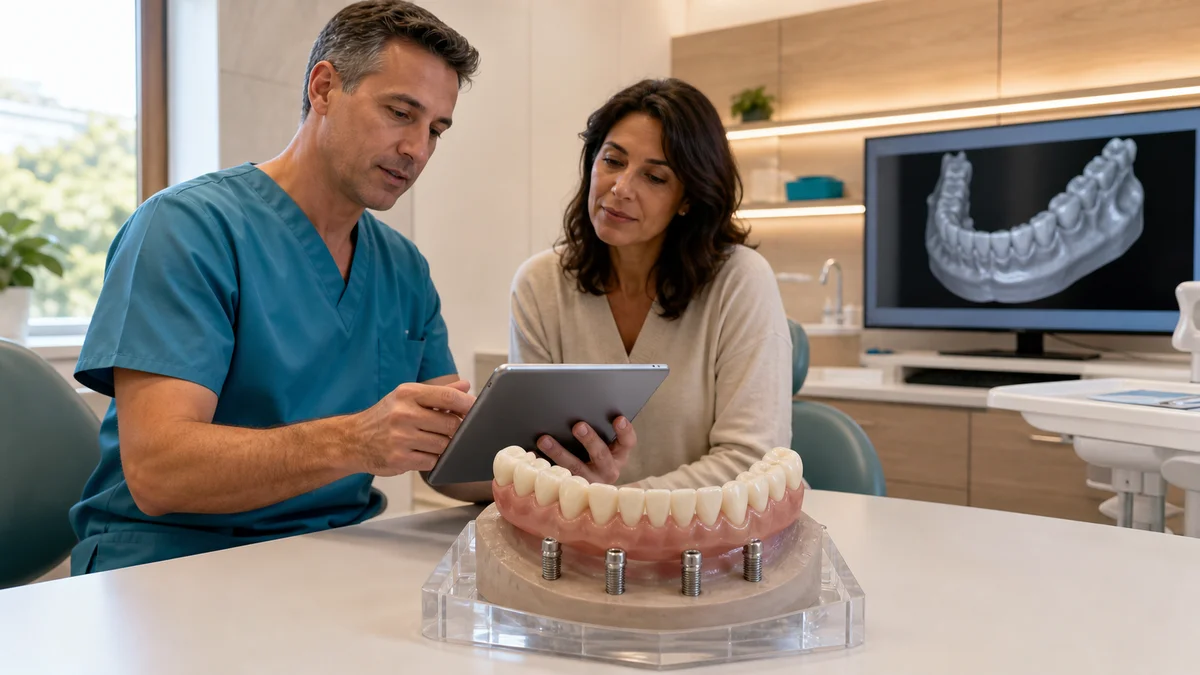
Quick answer: The search for average cost of 4 on 1 dental implants usually refers to one full-arch fixed prosthesis supported by four implants, not four implants replacing one tooth. No universal average is clinically reliable. Compare itemised, per-arch estimates that separate diagnostics, surgery, temporary and final teeth, laboratory work, possible grafting, reviews, and long-term maintenance.
People searching for the average cost of 4 on 1 dental implants are often comparing offers that do not describe the same treatment. “4-on-1” is not a standard diagnostic term. A clinic may use it informally for a full set of replacement teeth in one jaw supported by four implants, while an advertisement may omit whether it means the upper arch, lower arch, or both. Before comparing any figures, ask the provider to define the treatment in clinical language and confirm the scope in writing.
The average cost of 4 on 1 dental implants cannot be determined safely from the number of fixtures alone. The final prosthesis, remaining teeth, bone and gum condition, need for extractions, temporary restoration, materials, anaesthesia, laboratory process, and follow-up all affect the plan. This guide explains how to read a full-arch implant estimate without offering a diagnosis, fixed price, or outcome guarantee. Individual recommendations require an examination and appropriate imaging.
What “4 on 1” should mean before you compare cost
In full-arch implant treatment, several implants can support one connected fixed prosthesis that replaces the teeth in a single jaw. This is the clinical concept usually intended by average cost of 4 on 1 dental implants searches. Four appropriately positioned implants are one possible foundation, but four is not automatically the correct number for every person or every arch. The International Team for Implantology states that the final prosthetic plan should guide surgery and recommends a minimum of four appropriately distributed implants for a one-piece fixed full-arch prosthesis, while also warning that future implant loss or complications must be considered when selecting the number.
That nuance matters when interpreting the phrase average cost of 4 on 1 dental implants. It should not be understood as a retail bundle that fits every jaw. Implant distribution, available bone, prosthetic space, opposing teeth, hygiene access, material choice, patient preferences, systemic health, and clinician judgement all influence whether a four-implant design is suitable. Additional implants, a segmented prosthesis, a removable implant-supported overdenture, or preservation of existing teeth may be discussed instead.
Four implants do not normally replace one missing tooth. A single missing tooth is generally restored with one implant-supported crown when that approach is appropriate. If an advertisement uses “4-on-1,” request a diagram and written description. The quote should say whether it covers:
- one complete upper or lower arch, or both arches;
- a fixed temporary prosthesis, a final fixed prosthesis, or both;
- four implant bodies, the abutments, prosthetic screws, and replacement teeth;
- extraction of remaining teeth and management of the healing sites;
- any bone or soft-tissue procedure that is confirmed or only a contingency;
- the planned loading approach and the conditions required for a fixed temporary;
- professional reviews, repairs, hygiene visits, and future maintenance.
A written definition prevents an average cost of 4 on 1 dental implants search from turning into a comparison between an incomplete surgical package and a completed full-arch restoration. If the provider cannot define the endpoint, the headline figure is not ready for comparison.
Why an average cost of 4 on 1 dental implants can mislead
A mathematical average is useful only when the underlying services are comparable. Full-arch quotations may differ in the number of arches, extraction count, imaging, sedation, grafting, temporary teeth, final framework, prosthetic material, laboratory method, warranty terms, and follow-up. A headline described as the average cost of 4 on 1 dental implants may cover implant placement alone, while another estimate covers a completed and maintained restoration.
Geography, currency, taxes, clinic operating costs, professional experience, laboratory fees, and regulatory requirements also change the amount. These average cost of 4 on 1 dental implants variables do not prove that a high quote is better or a low quote is unsafe. They show why one global average cannot replace an itemised plan. The meaningful question is not “What is the cheapest number?” but “What care, materials, risk management, and continuity does this number represent?”
Online prices may also be based on an uncomplicated reference case. Your estimate can change if the clinical examination identifies untreated periodontal disease, decayed or fractured teeth, insufficient bone, an unfavourable bite, reduced restorative space, a need for staged healing, or medical factors that alter surgical planning. A transparent average cost of 4 on 1 dental implants discussion distinguishes confirmed treatment from possible additions and explains when new consent would be required.
11 components of a complete full-arch quote
Use the following categories to compare estimates line by line. Not every patient needs every service, but omissions should be explicit. For a useful average cost of 4 on 1 dental implants comparison, ask each provider to place the same confirmed, optional, and excluded items into the same categories.
- Consultation and diagnosis. This includes dental and medical history, examination, periodontal assessment, discussion of goals, and evaluation of whether existing teeth can or should be preserved.
- Imaging and records. Appropriate radiographs, three-dimensional imaging when justified, photographs, scans or impressions, and bite records may be needed for coordinated surgical and prosthetic planning. Their inclusion changes an average cost of 4 on 1 dental implants comparison.
- Pre-treatment disease control. Active infection, gum disease, decay, or hygiene barriers may need management before definitive implant care.
- Extractions. If teeth are removed, the quote should state how many, whether removal is expected to be straightforward or complex, and how the sites will be managed.
- Bone and soft-tissue procedures. Grafting, ridge modification, or sinus-related procedures are not automatic. When proposed, their purpose, material, stage, risks, and fee should be separate from the average cost of 4 on 1 dental implants base package.
- Implant surgery. The estimate should identify the number of implants, system, components, placement approach, sterile materials, clinician fees, and surgical follow-up. These are core parts of an average cost of 4 on 1 dental implants estimate.
- Anaesthesia or sedation. Local anaesthetic, oral medication, intravenous sedation, or hospital-based care have different requirements and costs. Suitability is a medical decision.
- Interim teeth. A removable healing denture and a fixed immediate temporary are different. The quote should state which is planned and what happens if immediate fixation is not clinically possible.
- Final prosthesis. Framework, tooth and gum materials, abutments, prosthetic screws, laboratory stages, try-ins, delivery, and initial adjustments should be specified.
- Reviews and complication care. Define how many visits are included, for how long, and which repairs, adjustments, or emergency appointments are excluded.
- Long-term maintenance. Professional cleaning, prosthesis removal when indicated, screw or component replacement, imaging, hygiene tools, and periodic review continue after the original treatment.
If a quote bundles these services into one figure, request the underlying assumptions. A complete average cost of 4 on 1 dental implants estimate should also explain what is refundable if treatment cannot proceed to a later stage, what is payable at each milestone, and how a changed clinical plan affects the financial agreement.
Decision table: are two full-arch offers truly comparable?
The table below turns broad marketing terms into questions. It helps standardise an average cost of 4 on 1 dental implants review, but it is a quote-comparison tool—not a recommendation for a particular prosthesis or number of implants.
| Quote label | What it may include | What may still be missing | Question to ask |
|---|---|---|---|
| Implant surgery only | Four implant bodies and placement in one arch | Extractions, abutments, temporary and final teeth, laboratory work | What is the total to reach a completed, usable final arch? |
| Surgery plus immediate temporary | Implants and a provisional fixed arch if stability criteria are met | Final framework, final teeth, later scans and try-ins, repairs | What happens clinically and financially if immediate loading is not suitable? |
| Completed single arch | Diagnostics, surgery, temporary care, and one final upper or lower prosthesis | Grafting, sedation, maintenance, treatment of the opposite arch | Which exclusions and contingency fees are written into the plan? |
| Both arches | Upper and lower full-arch pathways | Complex extractions, added implants, grafts, extended accommodation or travel | Is every component priced per arch and is the sequence clinically realistic? |
| Long-term care package | Defined reviews, hygiene visits, adjustments, or limited repairs | Wear-related replacement, major fracture, implant loss, care after the package ends | What exact events, dates, and conditions are covered? |
This comparison shows why the average cost of 4 on 1 dental implants must be tied to an endpoint. “Implants placed” and “final full-arch prosthesis delivered” are different endpoints. A lower early-stage price may lead to a similar or higher completed total once omitted components are added.
Diagnosis comes before a four-implant plan
A fixed full-arch restoration can be appropriate for some people who have lost all teeth or whose remaining teeth have a poor prognosis, but extraction is irreversible. The ITI consensus guidance specifically says that when teeth remain, options should include preservation as part of informed consent. A quote for the average cost of 4 on 1 dental implants should never become the reason to remove maintainable teeth.
The examination considers periodontal health, decay, infection, tooth prognosis, jaw relationships, smile and lip support, available prosthetic space, bone volume, anatomy, hygiene access, speech, expectations, and the opposing dentition. Each finding can change an average cost of 4 on 1 dental implants plan. The dentist also reviews general health and medicines. The US Food and Drug Administration advises patients that overall health affects candidacy, healing, and longevity, and that smoking may delay healing and reduce long-term success.
Imaging should answer clinical questions about bone and anatomy. A cone-beam CT may be justified for three-dimensional implant planning, while other records help the team design the proposed teeth and implant positions together. Ask who is responsible for the surgical plan, who designs the prosthesis, and how they coordinate. A reliable average cost of 4 on 1 dental implants estimate follows this diagnosis; it does not precede it.
Temporary teeth and immediate loading are not guaranteed
Some full-arch protocols allow a fixed temporary prosthesis to be attached soon after implant placement. This is called immediate loading, and it can influence the average cost of 4 on 1 dental implants, but it depends on case selection and implant stability. ITI guidance emphasises that systemic conditions, stability at each implant site, grafting needs, implant characteristics, and clinician skill must be considered. A marketing phrase such as “teeth in a day” does not guarantee that immediate fixation is safe for every patient.
Before accepting an average cost of 4 on 1 dental implants offer, ask what temporary solution is included and what the backup plan is. If implants do not meet the stability criteria for immediate loading, a removable healing prosthesis or a period without a fixed arch may be advised. The financial document should state whether changing from a fixed temporary to a removable option creates a credit, extra fee, or laboratory change.
A fixed temporary is not usually the final prosthesis. It may be used during healing to guide function, appearance, speech, cleanability, and the final design. Repairs or adjustments can be necessary. Ask how many provisional replacements or repairs are included and what dietary or hygiene instructions apply during healing. These services affect the real average cost of 4 on 1 dental implants.
Final prosthesis materials and laboratory work
Full-arch restorations can use different frameworks and tooth materials, which is a major average cost of 4 on 1 dental implants variable. The American College of Prosthodontists notes that full-arch screw-retained restorations may use acrylic teeth over a cast or milled framework, milled titanium, or zirconia-based designs, among other compositions. Material names alone do not determine quality or suitability. The space available, bite, opposing teeth, repairability, weight, appearance, cleanability, and clinician-laboratory workflow all matter.
A final arch commonly requires impressions or digital records, bite registration, tooth arrangement or design approval, try-ins, fabrication, connection, and adjustment. Complex digital workflows can still require verification and clinical judgement. Ask whether the final prosthesis is screw-retained or cement-retained, whether it is one piece or segmented, and how the design permits hygiene. These details belong in an average cost of 4 on 1 dental implants comparison.
Request documentation of the implant manufacturer and model, abutments, prosthetic screws, and final prosthesis. The FDA recommends asking which implant brand and model is used and keeping the information. Traceable parts matter if the prosthesis requires future service or if care is transferred to another provider.
Possible added procedures and why they change the estimate
Four strategically placed implants may sometimes reduce the need for extensive grafting, but an average cost of 4 on 1 dental implants package cannot promise that grafting will never be required. Bone volume, anatomy, implant distribution, prosthetic position, and surgical access vary. ITI guidance notes that bone augmentation may be recommended when the prosthetic plan requires increased implant distribution or number. Such procedures can be more invasive and require additional skill.
Extractions also vary. Removing several mobile teeth is different from managing retained roots, fractured teeth, impacted teeth, or sites with infection. Soft-tissue procedures may be discussed to improve tissue quality or hygiene access. Sedation needs depend on health, anxiety, procedure length, local rules, and the setting. Each confirmed addition should be separated from the base average cost of 4 on 1 dental implants estimate.
Ask the team to label each additional service as one of three things: required now, possible depending on findings, or unlikely but discussed for consent. Avoid paying an undefined “complexity fee.” A clear plan names the problem, proposed response, alternative, expected timing, risks, and price before the service is performed whenever circumstances allow.
Alternatives to a fixed full-arch restoration
A four-implant fixed arch is not the only way to replace a complete set of teeth. An average cost of 4 on 1 dental implants discussion should therefore include alternatives. Depending on the clinical findings and preferences, these may include preserving strategic teeth, a conventional complete denture, an implant-retained removable overdenture, a fixed arch supported by a different number or distribution of implants, or staged treatment. The appropriate comparison includes function, maintenance, repair, surgery, timing, and long-term cost.
- Preserve treatable teeth: may avoid irreversible extraction but can require periodontal, restorative, or endodontic care and ongoing reassessment.
- Conventional complete denture: avoids implant surgery but is removable and may have different stability, adaptation, and maintenance needs.
- Implant-retained overdenture: remains removable for cleaning and can improve retention, with its own attachments and replacement needs.
- Fixed implant-supported arch: remains in place for daily use but requires adequate hygiene access, professional maintenance, and management of mechanical or biological complications.
- Staged or mixed plan: may address urgent disease first and defer part of the definitive rehabilitation until healing, health, or finances permit.
When reviewing the average cost of 4 on 1 dental implants, request an estimate for at least one reasonable alternative. A lower initial fee does not always mean a lower lifetime cost, and a higher initial fee does not guarantee greater longevity. Every option involves maintenance and may need repair or replacement over time.
Insurance, finance, travel, and per-arch pricing
Insurance can change what you personally pay, but it does not redefine the clinical average cost of 4 on 1 dental implants. Coverage varies by country, policy, medical or dental indication, annual limits, waiting periods, exclusions, and network rules. Some plans may contribute to extractions, a conventional denture, or part of implant treatment; others exclude full-arch implants. Pre-authorisation is not always a guarantee of payment. Ask the insurer to confirm codes, documentation, exclusions, alternative benefits, and your responsibility in writing.
Payment plans and third-party credit can spread expenditure but do not reduce the clinical average cost of 4 on 1 dental implants. Review interest, fees, missed-payment terms, cancellation rules, and what happens if treatment changes or pauses. Payments should be linked to defined treatment stages rather than an unexplained advance balance.
If considering treatment abroad, compare the complete pathway rather than the surgical visit. Include travel, accommodation, food restrictions, companion costs, currency conversion, time away from work, extra healing visits, and the cost of returning for repairs. Confirm who provides urgent and long-term care at home. A low advertised average cost of 4 on 1 dental implants can become less favourable if continuity is difficult.
For a personalised discussion of options, consult the Redent Clinic English website and arrange an assessment through the Redent Clinic contact page. Remote records can help an initial conversation, but they do not replace a clinical examination or confirm a final quote.
Risks, repairs, and long-term maintenance
A responsible average cost of 4 on 1 dental implants estimate includes risk management, not only parts. Dental implants can support chewing and prosthetic teeth, but complications can occur. The FDA lists risks such as injury to teeth or tissues, sinus or nerve involvement, jaw injury, bite problems, screw loosening, local or systemic infection, delayed healing, hygiene difficulty, numbness, and implant failure. Full-arch restorations can also experience prosthetic wear, tooth or material fracture, screw complications, or a need for adjustment.
Maintenance is part of the average cost of 4 on 1 dental implants, even when it is billed later. The American College of Prosthodontists recommends professional maintenance intervals based on the patient’s risk profile and stresses assessment of the prosthesis, implants, tissues, hygiene, and occlusion. Some patients need more frequent care because of periodontal history, smoking, systemic conditions, or difficulty performing home hygiene.
Ask how to clean under the prosthesis and which brushes, floss, irrigators, or other tools fit its design. Professional review may include tissue assessment, plaque control, bite, screw or material integrity, and imaging when indicated. Whether the prosthesis should be removed during maintenance depends on its design and clinical findings; routine removal should not be assumed without a reason.
Seek prompt dental advice for increasing pain, swelling, bleeding, discharge, a bad taste, prosthesis movement, a fractured tooth or framework, a loose screw sensation, altered bite, or numbness. Facial swelling with difficulty swallowing or breathing, uncontrolled bleeding, or severe systemic symptoms needs urgent medical or dental assessment. A financial estimate cannot substitute for a complication plan.
Red flags in an average cost of 4 on 1 dental implants offer
Transparent care makes uncertainty visible. Be cautious when an offer presents the average cost of 4 on 1 dental implants as a guaranteed total before examination, recommends extracting teeth without explaining their prognosis, or promises permanent results without maintenance. Also pause if the provider will not identify the implant system, final material, responsible clinicians, or plan for complications.
- The price is not clearly stated per arch or for both arches.
- The temporary and final prostheses are described as if they are the same item.
- Immediate fixed teeth are guaranteed regardless of implant stability.
- Necessary imaging, extractions, anaesthesia, or laboratory work appears only after a deposit.
- There is pressure to remove teeth or sign finance documents immediately.
- No reasonable alternative, including tooth preservation or removable treatment, is discussed.
- The provider cannot explain who manages reviews, hygiene, repairs, or emergencies.
- A “lifetime” promise hides exclusions for wear, smoking, hygiene, disease, or missed recalls.
A second opinion is reasonable for irreversible, complex, or high-cost treatment. Bring the average cost of 4 on 1 dental implants quote, images, and plans so the second clinician can assess the same information. The goal is not to collect the lowest number; it is to understand which plan is appropriate, complete, maintainable, and supported.
Frequently asked questions
Is “4 on 1 dental implants” the same as a full-arch treatment?
It often refers informally to one connected full-arch prosthesis supported by four implants, but the wording is not standard enough to assume. Ask whether the average cost of 4 on 1 dental implants applies to one upper or lower arch, both arches, a temporary prosthesis, or the final restoration. Request the clinical name and a component list.
Can a clinic give an exact average cost of 4 on 1 dental implants online?
A clinic can describe typical components or provide a provisional estimate, but a final average cost of 4 on 1 dental implants quote requires examination, health review, diagnosis, and suitable records. Bone, remaining teeth, bite, prosthetic space, grafting needs, and loading suitability cannot be confirmed from a price form alone.
Does the quote usually cover one arch or both arches?
There is no universal convention. Many offers are priced per arch, while promotional wording can be ambiguous. The document should say “upper,” “lower,” or “both,” list the implant number in each jaw, and identify the temporary and final prostheses. Never double an assumed single-arch price without obtaining a combined clinical plan.
Are four implants always enough for a fixed full arch?
No number is automatically correct for everyone. ITI consensus guidance supports a minimum of four appropriately distributed implants for a one-piece fixed full-arch prosthesis, while stressing prosthetic design, anatomy, implant distribution, hygiene, preferences, and future complications. The clinician may recommend a different number, distribution, or type of restoration.
Are extractions and bone grafts included in the average?
They may be included, excluded, or listed as contingencies. The average cost of 4 on 1 dental implants should show extraction count and grafting separately. Grafting is not automatic, and its need cannot be determined from a generic package. Ask why it is proposed, what material is used, and how it changes timing and risk.
Is the temporary bridge the same as the final bridge?
Usually not. A provisional full arch may be used during healing and to evaluate function, speech, appearance, and cleanability. The final prosthesis may use a different framework, material, and laboratory process. Confirm that both stages, try-ins, adjustments, and any temporary repairs are represented in the estimate.
How long can full-arch implant treatment take?
Timing varies with disease control, extractions, grafting, implant stability, healing, temporary care, and laboratory stages. The FDA notes that implant healing may take several months or longer. A staged timeline is more credible than a universal completion date. Ask which clinical milestones determine when the final prosthesis can be made.
What ongoing expenses should I plan for?
Budget for professional maintenance, hygiene tools, periodic imaging when indicated, adjustments, replacement of worn components, temporary or final prosthesis repair, and possible future treatment of biological or mechanical complications. Ask which services are included for a defined period and which are separate from the original average cost of 4 on 1 dental implants.
What records should I receive after treatment?
Keep the diagnosis, consent documents, images, invoices, implant manufacturer and model, component details, operative record, prosthesis material information, maintenance schedule, and emergency contacts. These records improve continuity if you move, change dentists, or need future repair. The record should identify each treated arch clearly.
Clinical sources and further reading
- US Food and Drug Administration: Dental Implants—What You Should Know
- American Academy of Periodontology: Full Mouth Dental Implants
- International Team for Implantology: Number of Implants for Complete-Arch Fixed Prostheses
- American College of Prosthodontists: Maintenance of Full-Arch Implant Restorations
- NHS: Dental Treatments and Dental Implants
- American Dental Association
- World Health Organization: Oral Health
Sources were checked on 1 August 2026. This article is educational and does not replace an examination, diagnosis, or personalised treatment plan.