
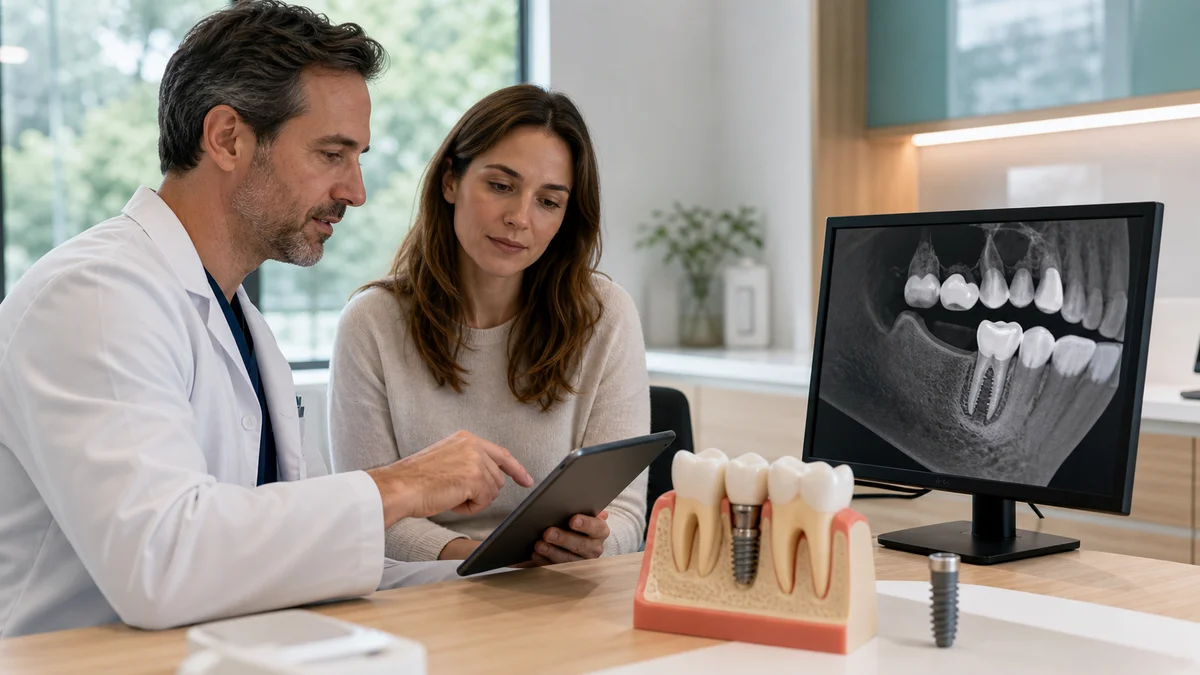
Quick answer: A first molar implant cost cannot be estimated responsibly from the implant fixture alone. A complete written plan should separate diagnosis, extraction or grafting if needed, the implant body, abutment, crown, laboratory work, temporary options, follow-up, and maintenance. Anatomy, oral health, materials, and treatment complexity all change the final estimate.
When people compare a first molar implant cost, they often encounter numbers that describe different things. One clinic may quote only the titanium implant body, while another includes the abutment, custom crown, imaging, surgical care, and reviews. Those offers are not directly comparable. The safest starting point is a clinical examination followed by a written, itemised treatment plan that explains what is included, what might become necessary, and what remains optional.
The first molar is a heavily used chewing tooth, but its replacement is never a one-size-fits-all purchase. Upper and lower molars have different nearby anatomical structures; bone volume and gum health vary; the opposing bite matters; and the condition of adjacent teeth can change the choice between an implant, bridge, removable option, or monitored space. This guide explains the first molar implant cost without promising a diagnosis, a fixed fee, or a guaranteed outcome. It is educational information to help you ask better questions during a personal consultation.
What a first molar implant cost should actually include
A dental implant restoration is a system rather than a single object. The US Food and Drug Administration describes an implant system as including the implant body placed in the jaw, an abutment connected to it, and the prosthetic tooth or teeth. For a single molar, the visible replacement is usually a crown. Each component can have its own clinical, laboratory, and material charge, which is why an advertisement for an “implant” may not equal the final first molar implant cost.
A complete first molar implant cost estimate commonly considers several stages. Not every patient needs every stage, and some appointments may be combined. The treatment team should make clear which services are confirmed after the examination and which are contingency items that would require your consent.
- Consultation, dental and medical history, examination, and a personalised risk review.
- Appropriate two-dimensional imaging and, when clinically justified, three-dimensional imaging.
- Removal of a damaged tooth if it is still present, with any related site management.
- Bone or soft-tissue grafting only when the site assessment indicates a need.
- The implant body, surgical placement, sterile materials, and surgical follow-up.
- The abutment, impression or digital scan, laboratory work, and definitive molar crown.
- A temporary tooth option when appropriate, plus adjustments and planned reviews.
- Long-term professional maintenance, which may be priced separately from treatment.
Ask whether taxes, medication prescriptions, emergency reviews, sedation, replacement of a temporary restoration, and treatment of unexpected complications are included. A clear estimate does not mean every biological event can be predicted. It means the known components and reasonable contingencies are communicated before you decide.
Why first-molar anatomy changes planning and price
The phrase first molar implant cost does not describe one identical operation. A responsible first molar implant cost assessment recognises that the upper first molar can be close to the maxillary sinus, while the lower first molar can be near important nerves and blood vessels. The available bone height, width, density, tooth-root shape, and healing condition after extraction influence whether straightforward placement is possible or whether added planning and procedures may be discussed.
Space is another variable in a first molar implant cost plan. The dentist evaluates the gap between neighbouring teeth, the distance to anatomical structures, the gum contours, and the room available for a crown that can be cleaned. The way the opposing teeth meet the restoration also matters. A person who clenches or grinds may need a more cautious restorative design and may be advised to use a protective appliance. These observations are individual clinical findings, not facts that can be inferred from an online photograph or a price list.
Timing after tooth loss can affect the site. In some situations, removal and implant placement may be considered at one appointment; in others, healing is allowed before placement. Bone grafting can sometimes be performed at extraction, during implant placement, or as a separate stage. The American Academy of Periodontology notes that implant care is staged and that every case differs. The plan behind the first molar implant cost should therefore state both the proposed sequence and why that sequence is appropriate.
9 factors that shape first molar implant cost
The following nine categories explain most differences between responsible estimates. They are not a formula for self-pricing. Instead, use them to check whether two quotes cover comparable care.
- Diagnostic complexity. A focused examination and suitable imaging are essential. Three-dimensional imaging may be recommended when it adds clinically useful anatomical information, but it should not be treated as an automatic retail add-on.
- Current condition of the molar. A tooth that is already missing creates a different starting point from a fractured or infected tooth that still requires assessment and removal. Treatment of active oral disease is separate from the implant itself.
- Bone and soft-tissue needs. Some sites have adequate support; others may need grafting or staged healing. The type, extent, material, and timing of any graft influence the first molar implant cost.
- Surgical approach. Straightforward placement, guided planning, additional surgical exposure, or a more complex anatomical site use different resources and clinical time.
- Implant and component system. The implant body, compatible components, traceability, manufacturer support, and availability of future replacement parts should be documented.
- Abutment design. A stock abutment and a custom-designed abutment are different solutions. The appropriate choice depends on the implant position, tissue contours, restorative space, and crown design.
- Crown material and laboratory process. Molar crowns can be made through different material and manufacturing workflows. Suitability is based on the bite, available thickness, appearance, cleanability, and clinical judgement—not simply the most expensive label.
- Temporary care and appointment count. Some people need no temporary tooth in a posterior gap; others may benefit from an interim option. Extra scans, fittings, adjustments, or staged visits affect the overall estimate.
- Aftercare and risk management. Reviews, hygiene support, bite adjustments, and management of complications may be included for a defined period or billed separately. Long-term maintenance continues beyond the original first molar implant cost.
Geography, clinic operating costs, clinician experience, laboratory fees, and currency also influence a quotation. These commercial first molar implant cost factors should never replace clinical transparency. A higher estimate is not automatically better, and a lower estimate is not automatically unsafe; the meaningful comparison is the proposed care, documentation, safeguards, materials, and continuity behind it.
A decision table for comparing replacement options
An implant is one option for a missing first molar, not an automatic requirement. A first molar implant cost comparison should therefore include reasonable alternatives. The American Academy of Periodontology explains that a single-tooth implant can replace a missing tooth without preparing adjacent teeth for a tooth-supported bridge. However, candidacy, timing, maintenance, preferences, and the condition of neighbouring teeth must be assessed. This table is a discussion aid, not an individual recommendation.
| Option to discuss | What it generally involves | Possible advantages | Questions that affect the decision |
|---|---|---|---|
| Single implant and crown | An implant body, abutment, and molar crown after suitable healing | Independent replacement; adjacent teeth usually need not support it | Is there adequate bone and space? What are the health and maintenance risks? |
| Tooth-supported bridge | A fixed replacement supported by neighbouring teeth | No implant surgery; may suit some adjacent-tooth situations | Are the supporting teeth healthy or already restored? How will it be cleaned? |
| Removable replacement | A removable appliance replacing one or more teeth | Non-surgical and adaptable; may have a different initial fee | How stable and comfortable will it be? What daily care and adjustment are needed? |
| No immediate replacement | The space is monitored rather than restored now | Avoids immediate intervention | What are the bite, tooth-movement, chewing, and future-treatment implications in this specific mouth? |
When comparing the first molar implant cost with a bridge or removable option, compare expected maintenance and biological trade-offs as well as the initial fee. Ask what happens if a crown chips, a supporting tooth changes, an implant component becomes unavailable, or the gum condition deteriorates. No restoration is maintenance-free or guaranteed to last for life.
Diagnosis and imaging before a reliable estimate
A credible first molar implant cost begins with diagnosis. The clinician needs to understand why the tooth was lost or why removal is being considered. Untreated gum disease, decay elsewhere, bite problems, or an active infection may require attention before or alongside implant planning. The examination also considers oral hygiene, gum condition, available space, neighbouring teeth, opposing teeth, and the proposed crown.
Your general health matters when a first molar implant cost and care pathway are prepared. The FDA advises patients to discuss health conditions and medicines with dental providers and notes that smoking may delay healing and reduce long-term success. Diabetes control, medicines that affect bone or bleeding, immune conditions, previous radiotherapy, allergies, and other medical factors may alter planning. This does not mean that a diagnosis can be made from a checklist; it means the treatment team needs a complete and current history.
Imaging should answer a clinical question. A routine dental radiograph may provide useful information about adjacent teeth and the site. A cone-beam CT scan can show three-dimensional relationships when indicated. Ask what the image is expected to clarify and whether it changes the plan. The imaging charge should be clearly located in the first molar implant cost estimate rather than appearing unexpectedly after you commit.
Extraction, grafting, and temporary care
If the first molar remains in place, the clinician first assesses whether it is maintainable. A first molar implant cost quote is not a reason to remove a tooth that could be treated predictably and appropriately. If removal is advised, ask for the diagnosis, alternatives, expected healing, and the plan for the socket. A second opinion can be reasonable when the decision is complex or irreversible.
Bone grafting is not automatically required. When it is proposed, request a plain-language explanation of the deficiency, the aim of the graft, the material source, whether it is performed at extraction or later, and how it changes timing. A separate graft stage can increase visits, clinical time, materials, and the overall first molar implant cost. It also introduces its own healing period and risks, which should be included in consent.
A posterior missing tooth is often less visible than a front tooth, so some patients do not require a temporary tooth. Others may need an interim option for comfort, function, or spacing. Immediate placement or immediate use of a temporary crown is not suitable for every site. The terms “immediate implant,” “immediate temporary,” and “final crown” describe different decisions; they should not be bundled into a promise of instant completion.
Implant, abutment, crown, and laboratory choices
The implant body is placed in bone, but the patient ultimately uses the crown. Planning must connect the surgical position to a crown that fits the bite and can be cleaned. An implant placed without sufficient restorative planning can make the final tooth harder to design or maintain. Ask whether the surgeon, restoring dentist, and dental laboratory coordinate the plan, particularly when different providers perform the stages.
The implant system should have traceable documentation. Patients can ask for the manufacturer, model, component details, and an implant record after treatment. This information may become important if care is transferred or a component needs attention years later. The FDA also advises patients to ask about the implant brand and model and to retain the information for their records.
Abutments and crowns are selected according to the case, so a first molar implant cost should identify the restorative assumptions. Material descriptions alone do not establish quality. Fit, contours, contact with neighbouring teeth, bite, surface finish, retrievability, cement control where relevant, and cleanability all matter. Laboratory remakes, additional fittings, or changes in design can influence the final first molar implant cost; the estimate should explain how those events are handled.
How to compare written quotes without being misled
Ask each clinic to provide a written plan using the same categories. If one offer is dramatically lower, determine whether the crown, abutment, imaging, extraction, graft, sedation, follow-up, or taxes are excluded. If one is dramatically higher, ask which additional clinical services, materials, safeguards, or maintenance are included. The goal is not to negotiate away necessary care; it is to understand the scope of the first molar implant cost.
- Is the quote for the implant body only, or for a completed tooth?
- Which diagnosis and imaging services are included?
- Are extraction, grafting, or soft-tissue procedures confirmed, optional, or excluded?
- What implant system, abutment type, crown material, and laboratory process are proposed?
- Who performs each stage, and who is responsible for coordination?
- How many planned reviews and adjustments are included, and for what period?
- What could reasonably change the estimate, and when would new consent be requested?
- What records will you receive, including implant component information and invoices?
- What are the cancellation, refund, complication, and revision policies?
Be cautious with countdown discounts, a guaranteed lifetime result, or pressure to pay before diagnosis. Also be cautious when a quote is based only on a message or panoramic image without a clinical examination. Good consent allows time for questions and acknowledges uncertainty. If you are planning care abroad, include travel, accommodation, healing time, and the practical cost of returning for adjustments or complications—not only the advertised first molar implant cost.
For a personalised written assessment, you can review the treatment philosophy on the Redent Clinic English home page and use the Redent Clinic contact page to arrange a consultation. An online conversation can collect background information, but a final plan depends on an in-person examination and suitable records.
Insurance, payment, and financial consent
Insurance can change the amount you personally pay, but it does not change the clinical definition of a first molar implant cost. Coverage differs by country, insurer, policy, reason for tooth loss, waiting period, annual limit, and whether a provider or laboratory is in network. Some plans separate surgery from the crown; some reimburse a portion; others exclude implants or cover only an alternative benefit. Do not assume that a pre-authorisation is a guarantee of payment. Ask the insurer to confirm the applicable codes, documentation, limits, exclusions, and patient responsibility in writing.
A clinic estimate should identify what is payable at each stage. If a payment plan or third-party credit product is offered, review interest, fees, missed-payment terms, refund rules, and what happens if treatment is delayed or changed. Financing can spread payments, but it does not reduce the clinical first molar implant cost. Avoid committing to credit before you understand the diagnosis and full treatment scope.
Currency conversion can also make an overseas offer appear more predictable than it is. Exchange rates, international card fees, extra visits, and unplanned stays can change the total. A careful comparison uses the same currency and includes both clinical and travel-related expenses while keeping them clearly separated.
Treatment stages and realistic timing
A first molar implant cost plan should match the treatment timeline. The full process may include assessment, disease control, tooth removal, grafting, implant placement, healing, restorative scanning, crown fitting, and review. Guy’s and St Thomas’ NHS Foundation Trust explains that implant treatment has several stages and can take multiple visits over months. That does not establish a universal timeline; healing and sequencing vary with the person and the site.
After implant placement, bone healing takes time. The FDA notes that healing can take several months or longer. A clinician decides when the implant is ready for restorative loading using the clinical findings, not a calendar alone. Rushing the definitive crown to meet a travel schedule may not be appropriate. Ask for a range of anticipated dates, the milestones that determine progress, and the plan if healing takes longer.
Timing also affects payment. A transparent first molar implant cost schedule connects each payment to a defined stage and states whether unused stages are refundable if the plan changes. Keep copies of consent forms, imaging, invoices, prescriptions, component records, and the final crown details.
Risks, maintenance, and the long-term cost of ownership
A safe first molar implant cost discussion includes risk management as well as components. Dental implants can provide useful function, but complications are possible. The FDA lists risks including injury to surrounding tissues, sinus or nerve involvement, bite problems, screw loosening, infection, delayed healing, difficulty with cleaning, and implant failure. The purpose of discussing these events is not to alarm you; it is to support meaningful consent and early recognition of problems.
The tissues around implants need continuing care. The American Academy of Periodontology describes peri-implant mucositis as inflammation around the soft tissue and peri-implantitis as inflammation with loss of supporting bone. Previous periodontitis, poor plaque control, smoking, and diabetes are among the factors associated with increased risk. Individual risk assessment and regular maintenance matter even when the implant feels comfortable.
Daily cleaning should follow the advice for your specific crown and tissue shape. Professional reviews may include assessment of plaque control, gum health, probing findings where appropriate, bite, crown or screw stability, and radiographs when indicated. A protective night appliance may be advised for some patients who grind or clench. These future services are not always included in the original first molar implant cost, so ask how maintenance is scheduled and billed.
Seek prompt dental advice for increasing pain, swelling, bleeding, discharge, a bad taste, mobility, numbness, a change in the bite, or a loose or fractured restoration. Urgent facial swelling, difficulty swallowing or breathing, uncontrolled bleeding, or severe systemic symptoms require urgent medical or dental assessment. Online information cannot determine the cause or urgency for an individual.
Questions to ask before accepting a first molar implant cost
A short consultation can feel information-heavy. Bring the written estimate and use the questions below. A responsible team should welcome clarification and document changes.
- What is the diagnosis, and what alternatives—including no immediate treatment—are reasonable?
- Why is this timing recommended, and what clinical milestone must occur before the crown?
- Which anatomical or health factors make my case straightforward or more complex?
- What exactly is included in the quoted first molar implant cost?
- What additional procedure is possible but not yet confirmed?
- Who will place the implant, restore it, and provide long-term maintenance?
- Which symptoms should prompt a routine call, urgent dental visit, or emergency assessment?
- What records and component information will I receive after treatment?
The answers should be specific to your mouth and written in language you understand. A trustworthy first molar implant cost explanation should never rely on a guarantee, dismiss medical history, or prevent you from considering alternatives. The best-value plan is the one that is clinically appropriate, transparent, maintainable, and supported over time.
Frequently asked questions about first molar implant cost
Can I get an exact first molar implant cost online?
No responsible provider can confirm an exact first molar implant cost without an examination and suitable diagnostic records. A remote first molar implant cost estimate may offer categories or a provisional range, but it cannot establish bone condition, gum health, anatomical relationships, bite, or whether extraction or grafting is indicated. Ask for a final itemised plan after assessment.
Does the advertised implant price include the crown?
Not always. Some advertisements refer only to the implant body or surgical placement. The abutment, crown, laboratory work, scans, medication, temporary care, and follow-ups may be separate. Ask the clinic to mark every included and excluded item. A low headline first molar implant cost may not represent a completed, functional tooth.
Will I definitely need a bone graft for a first molar implant?
No. Grafting depends on the site, available support, anatomy, extraction history, and proposed implant position. When grafting is recommended, ask what deficiency it addresses, whether there are alternatives, how it affects timing, and how it changes the first molar implant cost. The decision requires clinical assessment.
Is an implant always better than a bridge for a missing molar?
No single option is always best. An implant can avoid preparing adjacent teeth, while a bridge may be reasonable in other circumstances, particularly when neighbouring teeth already need restorative care. Health, anatomy, tooth condition, preferences, maintenance ability, timing, and finances all belong in the decision.
Why can the upper and lower first molar estimates differ?
Nearby anatomy and available bone differ between sites. An upper molar may be near the sinus, while a lower molar may be near important nerves. This can change imaging, planning, grafting discussions, and surgical complexity. It does not mean one jaw is always more expensive; the individual findings determine the plan.
How long does first molar implant treatment take?
The pathway may take months and varies with extraction timing, grafting, implant stability, healing, and restorative scheduling. Some stages can be combined, while others need separate healing. A promised universal completion date is not a substitute for monitoring. Ask what milestones control each step and what could extend the schedule.
Can smoking or diabetes affect the plan?
They can affect risk assessment and healing. The FDA notes that smoking may delay healing and reduce long-term success, while periodontal guidance identifies smoking and diabetes among peri-implant disease risk considerations. Tell the team about current health, medicines, and tobacco or nicotine use so advice can be personalised.
What should I receive after implant treatment?
Keep the treatment plan, consent documents, invoices, relevant images, prescriptions, implant manufacturer and model information, component record, and crown details. Also request a written maintenance schedule and emergency contact pathway. These records support continuity if you change dentists, move, or need future component care.
Are check-ups included in first molar implant cost?
Some clinics include a defined number of surgical and restorative reviews; routine long-term maintenance is often separate. Ask which appointments, imaging, hygiene services, bite adjustments, and complication reviews are included and for how long. Continued professional care is part of implant ownership even after the original first molar implant cost has been paid.
Clinical sources and further reading
- US Food and Drug Administration: Dental Implants—What You Should Know
- American Academy of Periodontology: Single Tooth Dental Implants
- American Academy of Periodontology: Peri-Implant Diseases
- Guy’s and St Thomas’ NHS Foundation Trust: Dental Implants
- American Dental Association
- World Health Organization: Oral Health
Sources were checked on 1 August 2026. This educational article supports informed discussion and does not replace an examination, diagnosis, or personalised treatment plan.