
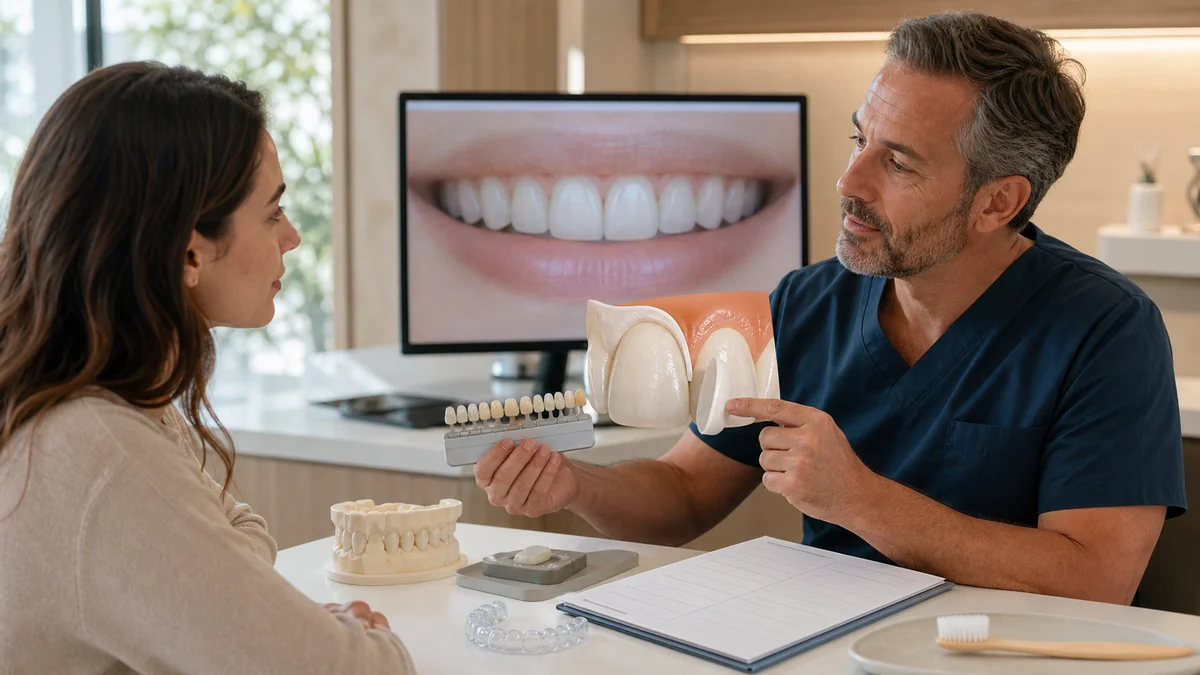
Quick answer: Making veneers affordable safely means choosing the least invasive treatment that solves a diagnosed problem, not buying the lowest per-tooth headline. Compare porcelain, composite and non-veneer alternatives; request a written scope for examination, mock-up, preparation, temporaries, laboratory work, bonding and follow-up; and budget for maintenance, repair and eventual replacement.
The search phrase veneers affordable usually means, “How can I improve my smile without accepting an unsafe treatment or an unmanageable bill?” That is a sensible question. The answer cannot be one fixed price because veneer treatment varies by tooth count, material, existing dental health, bite, laboratory work, location and aftercare. Some people need no veneers at all; whitening, bonding, orthodontics, repair of disease or simply accepting healthy variation may be better.
Veneers are custom coverings placed on the front of teeth. The American Dental Association explains that porcelain and composite are the main types and that treatment can be irreversible when enamel is removed. This guide treats veneers affordable as a planning goal, not a promise of cheap dentistry. It offers questions for comparing equal scopes after a licensed dentist has examined your teeth. It does not diagnose suitability or guarantee a result.
1. What veneers affordable should mean
A responsible veneers affordable plan balances four things: a clear diagnosis, the smallest reasonable biological intervention, a complete financial scope and a maintenance pathway. Price matters, but a low initial bill can become costly if healthy enamel is removed unnecessarily, decay or gum disease is covered, the bite is ignored, or repairs are unavailable. The goal is value over time, not the lowest number on a social-media graphic.
Define the concern before choosing the procedure. Are you trying to change colour, repair a chip, close a small space, alter shape, address wear or straighten visibly rotated teeth? One material cannot solve every cause. When patients ask how to keep veneers affordable, the most useful first step is to separate these goals and rank them. A small bonding repair or whitening may address one priority without treating every visible tooth.
- Necessary care first: diagnose and manage decay, gum inflammation, erosion, cracks, pain and infection.
- Preserve sound tissue: compare no treatment, whitening, orthodontics, enamel reshaping and bonding before irreversible coverage.
- Match the scope: compare the same number of teeth, material, temporary stage, laboratory steps and reviews.
- Plan the future: include repairs, hygiene, protective care and eventual replacement in the budget.
2. Examination before an aesthetic quote
An online photograph can help communicate preferences but cannot reveal decay between teeth, cracks, enamel thickness, gum disease, bite contacts or the causes of wear and discoloration. A dentist normally reviews medical and dental history, symptoms, medicines, oral hygiene, gums, teeth and bite. Radiographs are selected when clinically needed. Any definitive veneers affordable quote issued without appropriate assessment is missing information.
Existing disease should be treated before cosmetic coverage. The ADA warns that placing veneers over unhealthy teeth can worsen dental problems. Recession, active erosion, clenching, grinding or a deep overbite may affect suitability or design. A tooth with a large restoration, crack or significant structural loss may need a different treatment. The safest veneers affordable strategy is sometimes to stabilize health and reconsider appearance later.
Check 1: Is each tooth being diagnosed?
Ask the dentist to explain why every proposed tooth needs treatment. A broad smile may show different tooth numbers in different people, and symmetry does not require covering an arbitrary set. Some teeth may need bonding, orthodontic movement or no treatment. A tooth-by-tooth plan can make veneers affordable while avoiding unnecessary enamel removal.
Check 2: Is the cause of colour or shape understood?
Surface stain, internal discoloration, old fillings, erosion, wear and developmental changes respond differently. Whitening affects natural tooth structure but not existing restorations. A veneer can mask colour, yet the required thickness and opacity influence preparation and appearance. For veneers affordable planning, diagnose the cause before paying for a material that may not address it predictably.
Check 3: Is the bite part of the estimate?
Front teeth guide movement and may receive high forces during clenching or grinding. The dentist should assess overbite, edge contacts, wear patterns and habits. Veneers can chip, crack, loosen or wear, and a bite problem cannot be edited out of a photograph. A veneers affordable proposal that ignores function may transfer cost into repeated repair.
3. Porcelain and composite are not the same purchase
Porcelain veneers are indirect restorations: teeth are prepared when needed, records are taken, a dental laboratory or in-office manufacturing pathway creates the shells, and the dentist verifies fit before bonding. Composite veneers are sculpted from tooth-coloured resin, often directly in the mouth. The ADA notes that composite may require less enamel removal and fewer visits, and can be easier to repair, while it is generally less resistant to stain and wear. These differences shape veneers affordable decisions.
Do not assume “porcelain” or “composite” is a complete specification. Ceramic type, case design, preparation, bonding surface, laboratory communication and occlusion matter. For composite, layering, finishing and polish influence appearance and maintenance. An inexpensive material placed without diagnosis is not good value; a premium material used unnecessarily is not automatically better. Veneers affordable means selecting the appropriate route for the tooth and goal.
Porcelain veneer cost components
A porcelain proposal may include diagnostic records, mock-up, tooth preparation, scans or impressions, temporary veneers, laboratory fabrication, try-in, bonding and reviews. It may also involve replacement of old restorations or management of gum position. Ask which steps are included. A per-tooth advertisement can make veneers affordable appear simple while omitting temporaries or laboratory remakes.
Composite veneer cost components
Composite treatment may include shade selection, isolation, adhesive steps, incremental sculpting, contouring, finishing and polishing. It can be completed in fewer visits in selected cases, but chair time and artistic skill still matter. Future repolishing, stain management or repair should be discussed. A veneers affordable composite plan is a clinical restoration, not a quick coating by an unlicensed person.
Why “no-prep” is not a universal bargain
Some teeth and designs may allow minimal or no reduction, but adding material without enough space can create bulky contours, gum irritation, speech changes or an unnatural profile. Other cases need controlled enamel preparation for fit and emergence. “No-prep” is a possible technique, not a guarantee. When marketing makes veneers affordable by promising zero preparation for everyone, ask for the anatomical reasoning and a reversible preview.
4. Decision table: alternatives before veneers
The most economical safe treatment may not be a veneer. This table is a discussion aid, not a personal recommendation. Use it to connect a diagnosed concern with the least irreversible option that can reasonably address it.
| Option | May address | Potential budget advantage | Limitations and questions |
|---|---|---|---|
| No treatment or monitoring | Healthy variation without disease or functional harm | No procedural cost or enamel removal | Appearance remains; agree on what changes would trigger review |
| Professional whitening | Selected colour concerns in natural teeth | Can treat colour across many teeth without covering them | Does not change shape or lighten restorations; sensitivity and candidacy matter |
| Small composite repair or bonding | Selected chips, edges, contours or small spaces | Can target fewer areas and may be repairable | Can stain or wear; maintenance and polish matter |
| Orthodontic treatment | Position, rotation, spacing and some bite issues | Moves natural teeth rather than masking alignment | Takes time, requires retention and may not change colour or shape |
| Enamel reshaping | Very small contour differences in appropriate enamel | Limited intervention in carefully selected cases | Irreversible and limited by enamel thickness and bite |
| Composite veneer | Broader colour and shape changes in selected cases | Often fewer visits and easier localized repair | Lower stain and wear resistance than many ceramic options |
| Porcelain veneer | Selected colour, shape and surface changes | Durable aesthetic material when well indicated | Laboratory and temporary stages; enamel removal may be irreversible |
| Crown or other restorative care | Teeth with extensive structural damage when clinically indicated | Addresses structural needs a veneer may not solve | More tooth coverage; should not replace veneer merely for convenience |
To keep veneers affordable, compare endpoints rather than labels. Whitening plus two small bonding repairs is not equivalent to eight porcelain veneers, but it may meet the person’s actual goals. Orthodontics may take longer, yet it can preserve uncut teeth. A written options discussion makes the trade-offs visible.
5. Build a complete veneer cost map
The complete price begins before preparation and continues after bonding. The most reliable way to make veneers affordable is to list every likely stage, mark conditional items and identify who is responsible. Not every case needs every step, but the quote should make exclusions clear.
- Examination, relevant radiographs, photographs, scans or impressions
- Disease control and replacement of defective restorations if indicated
- Diagnostic wax-up, digital preview or trial mock-up
- Number of teeth and material for each tooth
- Preparation, anaesthesia where needed and tissue management
- Temporary veneers and included adjustments
- Laboratory fabrication, shade customization and try-in
- Bonding, bite adjustment and early review
- Maintenance, repolishing, repair and replacement policy
Ask whether taxes, laboratory fees, imaging and temporary restorations are inside the total. Confirm what happens if a tooth needs unexpected treatment after preparation. A transparent veneers affordable estimate separates likely work from contingencies instead of promising that nothing can change.
6. Tooth count: treat the problem, not a package
Package advertising often groups veneers into fixed counts. Your visible smile, tooth proportions, gum line and goals may not match that number. Treating too few teeth can create a shade or shape mismatch; treating too many can remove healthy tissue unnecessarily. A mock-up helps assess transitions. The right way to make veneers affordable is to justify each tooth rather than default to six, eight, ten or more.
Colour planning matters when veneers sit beside natural teeth. Whitening may be performed first in suitable patients so the final shade can be selected after colour stabilizes. Existing crowns or fillings will not whiten, which may affect the scope. A staged approach can help, but temporary mismatches or multiple visits should be explained. Budget should follow the agreed endpoint.
If only one or two teeth are damaged, ask whether a localized repair, veneer or another restoration could blend. If the entire smile concern is alignment, orthodontics deserves discussion. “More units for less” is not a biological discount. Veneers affordable planning values preserved teeth over bulk purchasing.
7. Mock-ups and temporaries can prevent expensive misunderstandings
A digital image can help communicate tooth length and proportion, but monitor colour and simulations are imperfect. A physical or intraoral mock-up may let the patient preview general shape and speech before irreversible preparation, depending on the case. Ask whether the mock-up fee is credited toward treatment. For veneers affordable planning, this stage can identify design concerns before final laboratory work.
Temporary veneers protect prepared teeth and preview aspects of contour, but they are not identical to the final ceramic. Ask how many adjustments are included and what symptoms require contact. Temporaries can loosen, chip or feel rougher. A proposal that omits them may not be comparable. Their purpose and replacement policy should appear in the written scope.
Consent should occur before preparation, with time to ask about alternatives, risks and maintenance. Do not let a same-day discount substitute for reflection. The ability to stop or revise a design before irreversible steps is a meaningful part of keeping veneers affordable and patient-centred.
8. Insurance and public coverage: expect limits, verify details
The ADA states that veneers are considered cosmetic and may not be covered unless deemed medically necessary. This does not mean every plan follows one rule. Coverage can depend on the diagnosis, contract language, exclusions, waiting periods, annual maximum, network status and pre-treatment review. No clinic can guarantee that insurance will make veneers affordable.
HealthCare.gov explains that adult dental coverage is not an essential Marketplace health benefit and that stand-alone dental plans may have waiting periods. In the UK, the NHS says veneers are generally available privately unless there is a clinical need. Rules vary by country and can change. Confirm current terms directly with the payer or public service before treatment.
Request procedure codes, the dentist’s diagnosis and a written pre-treatment estimate when available. Ask whether a repair of trauma or a structural defect is evaluated differently from an elective colour change. Pre-authorization may not guarantee final payment. Insurance should be treated as potential reimbursement, not the foundation of a veneers affordable promise.
9. Financing without losing control of the decision
Monthly payment plans can improve cash flow but may increase total cost. Review interest, origination fees, deferred-interest terms, missed-payment consequences and refund rules. Confirm whether financing covers the entire clinical scope or only the initial units. A true veneers affordable plan remains manageable even if a veneer needs repair or a later appointment is added.
Do not borrow before the examination and consent process are complete. Ask when deposits become non-refundable, who holds them, and which milestones trigger payment. If the plan changes after disease is found, the contract should explain how funds are reallocated or returned. Consider an independent financial comparison rather than relying only on a clinic’s monthly number.
A second clinical opinion may save more than negotiating a unit price, particularly when many healthy teeth are proposed for preparation. Give both dentists the same records and goals. Compare diagnoses and alternatives first, materials and totals second. This protects veneers affordable decisions from pressure or incomplete assumptions.
10. Risks and irreversible trade-offs
When enamel is removed, treatment is not reversible. Possible problems include sensitivity, gum irritation, colour mismatch, contour concerns, bite discomfort, chipping, cracking, wear, debonding and decay at restoration margins. A tooth can still develop disease beneath or around a veneer. In some circumstances, additional restorative or root canal treatment may later be needed. No dentist can promise that veneers will last forever.
Risk is influenced by preparation depth, remaining enamel, bonding conditions, material, tooth position, bite, grinding, diet, hygiene and trauma. A mouthguard may be recommended for sport or some grinding patterns, but it does not eliminate all risk. A veneers affordable quote should include how complications are assessed and which repairs are charged separately.
Seek professional advice for persistent or increasing pain, swelling, a bite that remains wrong, a loose veneer, sharp fracture, gum bleeding that does not settle, or signs of infection. Do not glue a veneer back yourself. Urgent symptoms cannot be diagnosed through a price article.
11. Maintenance and the lifetime budget
The ADA recommends brushing with fluoride toothpaste twice daily and cleaning between teeth. Veneered teeth can still develop cavities around margins. Avoid using teeth to open packages and avoid chewing hard objects such as ice or pens. A sports mouthguard protects during activities with injury risk. Regular reviews allow the dentist to assess gums, margins, bite and material condition.
Composite may need periodic polishing or localized repair; ceramic may chip, crack or debond and can require laboratory replacement. Natural teeth can change colour while ceramic remains stable, and gums may recede over time. Future work should be expected even when the original treatment is excellent. Veneers affordable budgeting includes maintenance and replacement rather than treating them as unexpected failure.
Ask for written care instructions and records of tooth numbers, material, shade, laboratory and bonding products when appropriate. Keep photographs and scans if the clinic provides them. These records can help another dentist understand the design if you move. Continuity has financial value.
12. Treatment abroad: compare total care, not chair price
Some patients travel to make veneers affordable, but travel adds flights, accommodation, time away, language, follow-up and repair logistics. The CDC Yellow Book advises medical travellers to research clinicians and facilities, understand included services, arrange local follow-up before travel and obtain complete records. Complications or remakes can add return trips and expense.
For care in Türkiye, verify whether the provider appears on the current Ministry of Health list for international health tourism. Authorization is an administrative check, not proof that a specific treatment plan is right. Confirm the licensed dentist, laboratory, sterilization, consent, materials, emergency route and who pays if a temporary or final veneer requires adjustment.
Do not combine treatment with a rushed vacation schedule. Allow time for assessment, mock-up, preparation, laboratory work, try-in and review. Obtain before-and-after clinical records, tooth preparation information, materials, shade, prescriptions and maintenance instructions in a language you understand. The full travel pathway determines whether veneers affordable remains affordable after you return home.
13. Red flags in low-price veneer marketing
The ADA warns against unlicensed “veneer technicians” and advises patients to use a licensed dentist. Unsupervised treatment can miss disease and create risks including infection or nerve damage. Dental services should not be provided in salons, homes or pop-up settings without lawful clinical oversight. A low offer does not make unsafe care acceptable.
Other red flags include a final quote from selfies, no examination, no discussion of whitening or bonding, a promise to prepare every tooth the same way, “permanent” or “guaranteed” claims, and extreme whiteness presented as the only successful result. A legitimate veneers affordable plan discusses natural variation, consent and limitations.
- No proof that the provider is a licensed dentist
- No diagnosis or treatment of decay and gum disease
- No distinction between composite, porcelain and temporary material
- No preview, tooth-by-tooth rationale or preparation explanation
- No written total including laboratory, temporaries and reviews
- No repair pathway or maintenance instructions
- Pressure to pay immediately for an expiring package
14. A consultation checklist for veneers affordable planning
Bring a list of concerns rather than a demanded tooth count. Explain which colour, shape, chip or spacing issue bothers you and what you would prefer to keep natural. Share clenching, grinding, sensitivity and previous restorative experiences. Ask the dentist to show healthy findings and problems separately. A patient-safe veneers affordable plan is built from your priorities and diagnosis.
Request written options, the predicted amount of enamel removal, a mock-up when useful, material and laboratory details, provisional stages, appointment schedule, payment terms and future maintenance. At Redent Clinic, an individual assessment can clarify which options fit the teeth; the contact page can help arrange an appointment and secure record transfer. Online price discussions do not replace examination.
Frequently asked questions about veneers affordable choices
How can I make veneers affordable without choosing unsafe care?
Start with examination, rank your goals and compare non-veneer alternatives. Treat only justified teeth, request an itemized scope and budget for repairs. Making veneers affordable safely is about reducing unnecessary treatment, not removing licensed clinical oversight.
Are composite veneers always cheaper than porcelain?
Composite often has fewer laboratory steps and may cost less initially, but fees vary and maintenance can differ. It may stain, wear or need polishing and repair. Compare total expected care. A veneers affordable decision should match material to diagnosis and priorities.
Can I veneer only two front teeth?
Possibly, if those teeth are the actual concern and colour, shape and bite can be integrated. In other cases, whitening, bonding or a different tooth count may blend better. A mock-up can help. Tooth count for veneers affordable treatment should be justified individually.
Do veneers require shaving teeth down?
Preparation varies. Some cases need minimal enamel reduction, others need more, and selected additive designs may need little or none. Extremely aggressive “shark teeth” preparations may describe crowns rather than veneers. Ask to see the planned preparation before accepting a veneers affordable package.
Are no-prep veneers reversible?
Not automatically. Even if no drilling is planned, bonding, removal and replacement can affect the tooth, and added material may create contour issues. The design must be assessed clinically. “No-prep” should not be used as a universal veneers affordable guarantee.
Does insurance cover veneers?
Often not when treatment is cosmetic, but contracts differ and some clinically necessary restorations may be evaluated differently. Confirm exclusions, waiting periods, network rules and pre-treatment review with the payer. No clinic can guarantee that benefits will make veneers affordable.
How long do veneers last?
No exact lifespan applies to everyone. Material, enamel bonding, bite, habits, hygiene, trauma and maintenance all matter. Veneers can chip, loosen, wear or require replacement. Budgeting for future care is central to keeping veneers affordable over time.
Can whitening replace veneers?
Whitening may improve selected colour concerns in natural teeth but does not change shape or lighten fillings and crowns. It may be a more conservative option when colour is the main issue. Ask whether it could make veneers affordable by reducing the number of restorations needed.
Can bonding replace porcelain veneers?
Bonding may repair selected chips, edges, contours or small spaces with less intervention. It has different stain, wear and maintenance characteristics. It cannot solve every case. Compare a diagnostic bonding option before choosing a full veneers affordable ceramic package.
Why do veneer quotes differ so much?
Tooth count, material, laboratory skill, diagnostics, mock-up, preparation, temporaries, complexity, location and aftercare differ. Some quotes omit stages. To compare veneers affordable proposals, align the endpoint and included services rather than comparing one headline number.
What if my teeth are crooked?
Mild appearance changes may sometimes be masked, but significant position or bite problems may require orthodontic assessment. Covering rotated teeth can demand more preparation. Orthodontics may preserve enamel. A safe veneers affordable plan compares movement with masking.
What happens if a veneer breaks abroad?
Contact the treating clinic and a licensed local dentist. Keep records of the material, shade and laboratory. Do not use household glue. Ask before travel who pays for assessment, repair and return visits; those terms determine whether veneers affordable remains realistic.
When should I seek a second opinion?
Consider one when many healthy teeth are proposed for preparation, disease is not addressed, alternatives are dismissed, the result is guaranteed or you feel pressured. Compare findings with the same records. A second opinion can protect both enamel and a veneers affordable budget.
Key takeaways
Making veneers affordable safely starts with diagnosis and restraint. Compare no treatment, whitening, bonding and orthodontics before irreversible coverage. If veneers are reasonable, align material, tooth count, mock-up, preparation, temporaries, laboratory work, bonding, reviews and repairs in writing.
Use a licensed dentist, treat disease first, avoid package pressure and keep future maintenance in the budget. Insurance and travel savings are uncertain until verified. The best veneers affordable plan is the one that meets a defined goal while preserving as much healthy tooth structure as reasonably possible.
Sources and further reading
- American Dental Association — Professional oral-health resources
- American Dental Association, MouthHealthy — Veneers
- American Dental Association — Materials for indirect restorations
- American Dental Association — Public warning about unlicensed veneer technicians
- NHS — Dental treatments, including veneers
- NHS — Clinically necessary and private dental care
- HealthCare.gov — Marketplace dental coverage
- U.S. Centers for Disease Control and Prevention — Medical Tourism, Yellow Book 2026
- World Health Organization — Oral health fact sheet
- Republic of Türkiye Ministry of Health — Authorized healthcare providers
Educational information reviewed for patient safety. It does not replace an individual examination, diagnosis or treatment plan.