
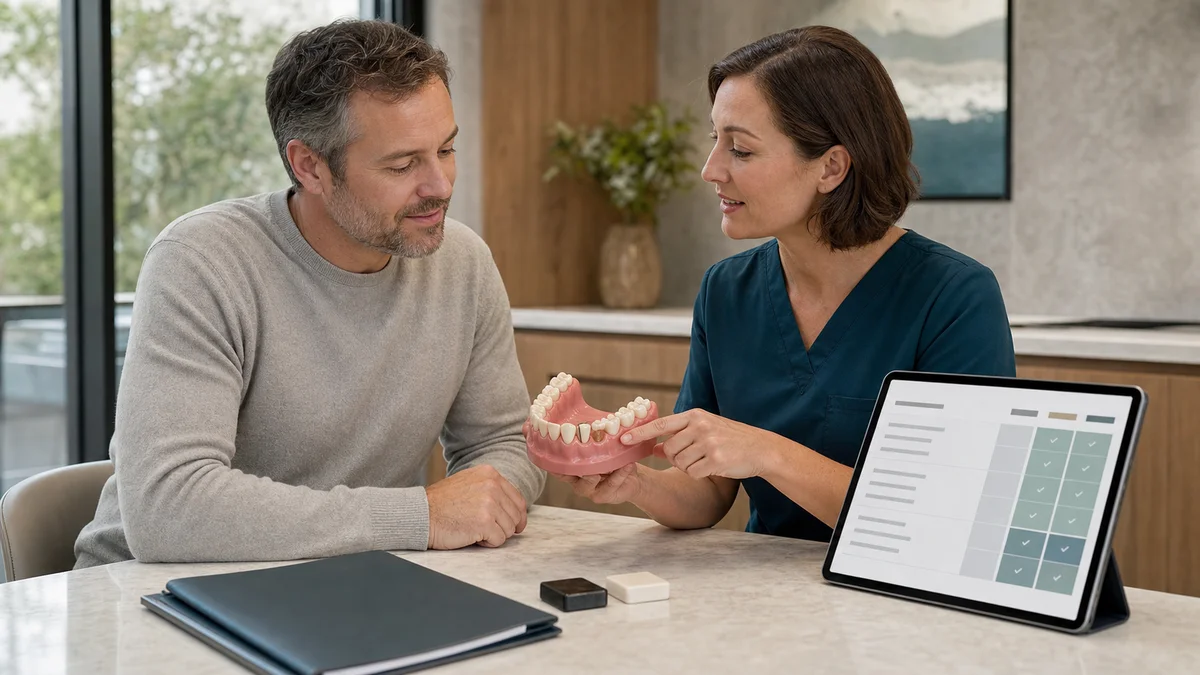
Quick answer: There is no single reliable average cost of bridge for teeth that applies to every patient or country. A meaningful estimate follows an examination and identifies the bridge design, number of units, supporting teeth or implants, material, laboratory work, temporary restoration, imaging, related treatment and aftercare. Compare written, itemized plans rather than headline prices, and confirm insurance directly with the payer.
Searching for the average cost of bridge for teeth is a sensible first step when one or more teeth are missing. The difficulty is that a “bridge” is not one standardized product. It can describe different designs, span different numbers of teeth and rely on natural teeth, resin-bonded retainers or implants. The condition of the mouth may also require treatment before a bridge can be made. A single online number usually hides these differences.
This guide explains how to turn the phrase average cost of bridge for teeth into a safer comparison. It does not quote a fixed fee, promise insurance coverage or recommend a particular restoration without an examination. Instead, it shows which clinical and financial details belong in a written plan, which items are commonly omitted from advertisements and how to compare treatment in different countries without assuming that the cheapest headline represents the same care.
1. Why there is no universal average cost of bridge for teeth
Dental fees reflect professional time, local operating costs, laboratory work, materials, regulatory requirements and the complexity of the individual case. The American Dental Association states that it cannot quote fees or set or recommend fees for procedures. That limitation is important: even a professional association cannot create a universal price that fairly represents every provider and location.
The average cost of bridge for teeth also changes with the definition used. One source may report only the laboratory-made bridge, another may include examination and temporary restorations, and another may mix tooth-supported and implant-supported designs. Currency conversion, tax rules, benefit contracts and the date of the estimate can create further differences. Before comparing amounts, make sure the scope and date are comparable.
Use average cost of bridge for teeth as search shorthand, not as a fee promise. The useful next step is to define the restoration that the shorthand is supposed to represent.
2. What a dental bridge actually replaces
The ADA’s MouthHealthy resource describes a bridge, sometimes called a fixed partial denture, as artificial teeth replacing a gap and attached to surrounding teeth for support. A traditional three-unit bridge, for example, may involve a replacement tooth joined to retainers on teeth on each side. Other designs use a different number or arrangement of supports.
That definition explains why the average cost of bridge for teeth cannot be calculated from the number of missing teeth alone. A plan may include several connected units, and each supporting tooth must be assessed for decay, cracks, periodontal support, previous restorations, alignment and pulp health. The design should distribute forces while permitting acceptable cleaning and function.
For average cost of bridge for teeth comparisons, record both missing teeth and total units. Those are related but different quantities.
3. The clinical examination comes before the estimate
A responsible bridge plan starts with a dental and medical history plus a clinical examination. The dentist may assess the missing-tooth space, supporting teeth, gum health, bone contour, bite, tooth mobility, smile line and oral hygiene. Clinically justified radiographs or other records can help evaluate roots, bone and existing treatment. The amount of information needed depends on the situation.
Any quoted average cost of bridge for teeth given before this assessment should be treated as orientation only. The examination may show that an apparent support tooth needs a filling, buildup, periodontal care, root canal assessment or extraction. It may also show that a shorter, less invasive option is possible. An irreversible preparation should not begin until diagnosis, alternatives, benefits, risks and likely costs have been discussed.
4. Bridge design is the first major cost variable
Different bridge designs use different clinical and laboratory steps. A conventional tooth-supported bridge usually requires preparation of supporting teeth. A cantilever design has support on one side and is only suitable in selected load situations. A resin-bonded bridge can involve a metal or ceramic wing bonded to a supporting tooth and may preserve more tooth structure in appropriate cases. An implant-supported bridge relies on implants and therefore adds surgical and healing stages.
When researching the average cost of bridge for teeth, identify the exact design instead of comparing every fixed replacement together. The least invasive design is not automatically the most durable for every site, and the most expensive design is not automatically the best. Space, bite, support, appearance, restorability, age and patient preference all influence the choice.
A meaningful average cost of bridge for teeth comparison therefore begins with design equivalence. If the designs differ, label them as alternatives rather than competing prices for the same item.
- Conventional bridge: supported by prepared natural teeth, often with crowns as retainers.
- Cantilever bridge: supported on one side in carefully selected situations.
- Resin-bonded bridge: bonded with one or more retainers, commonly considered in selected gaps.
- Implant-supported bridge: supported by implants rather than solely by adjacent natural teeth.
5. Unit count is more useful than “one bridge”
A bridge is usually described by its units: retainers and pontics are connected in one restoration. Two quotes for “one bridge” may therefore describe different unit counts. The number of missing teeth, number of supporting teeth and the planned span can alter preparation, material volume, laboratory time and risk.
Ask whether the quoted average cost of bridge for teeth is per unit, per pontic, per retainer or for the whole restoration. Then request the tooth numbers and a simple design diagram. Without these details, an inexpensive “bridge price” may represent a different restoration from the one proposed elsewhere.
6. Supporting teeth can add necessary treatment
Natural abutment teeth must be able to support the planned bridge. Existing decay, large fillings, cracks, short clinical crowns, periodontal disease or unfavorable alignment can change the plan. Some teeth may need a core buildup or other restorative work. Root canal treatment is not automatically required for every crowned support tooth, but pulp symptoms or disease may need separate assessment.
The average cost of bridge for teeth becomes misleading when related care is excluded. Ask whether stabilization of gum disease, removal of decay, replacement of failing restorations, buildup, root canal care or crown-lengthening assessment is included. These items should only be recommended when clinically indicated, not added simply to make a package appear comprehensive.
7. Material affects appearance, design and laboratory work
Bridges may use metal alloys, porcelain fused to metal, different ceramics or combinations chosen for strength, thickness, bonding, appearance and compatibility with the case. Material names alone do not determine quality. Connector dimensions, span, support, bite, preparation, laboratory communication and cementation or bonding protocols also matter.
A quoted average cost of bridge for teeth should identify the intended material without claiming it is universally superior. Ask why it suits the site, what esthetic limits exist, how opposing teeth will be considered and what happens if the material must be repaired. If the material changes after preparation or laboratory review, the financial change should be discussed before fabrication continues.
8. Laboratory quality is part of the restoration
The American College of Prosthodontists explains that dental laboratories fabricate prostheses from a dentist’s prescription using an impression or digital scan, and that accurate dentist-laboratory communication is necessary. The laboratory is not simply selling an off-the-shelf item. It interprets a case-specific prescription within the information supplied.
When comparing the average cost of bridge for teeth, ask whether laboratory fees, shade characterization, models, digital design, try-ins and remakes are included. A higher laboratory charge does not guarantee a better result, while an unspecified laboratory charge prevents transparent comparison. The dentist remains responsible for clinical diagnosis, preparation, records, fit assessment and delivery.
Do not publish an average cost of bridge for teeth from laboratory fees alone. Clinical stages and responsibility remain part of the treatment pathway.
9. Diagnostics, impressions and temporary restorations
A treatment plan may involve an examination, radiographs when clinically needed, photographs, bite records, impressions or intraoral scans and diagnostic models. Conventional bridges often need a temporary restoration while the laboratory makes the definitive bridge. Temporary care protects prepared teeth and helps maintain position and function, but it has different material and longevity from the final prosthesis.
Online descriptions of the average cost of bridge for teeth may omit these stages. Confirm whether scans or impressions, local anesthesia, removal of an existing bridge, temporary fabrication, temporary recementation, shade appointments and final bite adjustments are inside the quote. Also ask what is charged if a temporary is lost while travelling.
10. Gum and bone conditions may change timing
Active gum disease, inflammation, extraction healing or an irregular soft-tissue contour can affect when impressions are taken and how the pontic is shaped. Selected cases may need periodontal treatment or tissue management before a definitive bridge. Implant-supported bridges add bone and soft-tissue assessment, implant placement and a healing phase.
The average cost of bridge for teeth should not conceal these differences inside a vague “smile package.” Ask which procedures are essential for health and which are optional esthetic refinements. A staged plan should state the decision points and explain how the estimate changes if healing or tissue response requires a different approach.
11. Implant-supported bridges are a separate pathway
An implant-supported bridge can avoid preparing some adjacent natural teeth, but it is not merely a more expensive version of the same procedure. It involves implant diagnosis, possible surgical planning, implant components, healing, provisionalization and maintenance around implants. Health history, smoking, periodontal status, bone, medication and hygiene can affect candidacy and timing.
Do not combine implant-supported and tooth-supported figures into one average cost of bridge for teeth. Request separate line items for imaging, surgery, implants, abutments, provisional prosthesis, definitive bridge and follow-up. No implant plan should offer a fixed biological outcome or universal healing schedule.
12. Alternatives belong in the value discussion
A bridge is one option for replacing a missing tooth. Depending on the findings, alternatives may include no immediate replacement, a removable partial denture, a resin-bonded restoration, an implant restoration, orthodontic space management or another tooth-supported design. Each option has different effects on adjacent teeth, cleaning, repair, surgery, treatment time and long-term maintenance.
The average cost of bridge for teeth only becomes meaningful after the clinical goals are clear. A less costly option may not meet the same functional or esthetic objective, while a higher initial fee may include components absent from another proposal. Compare benefits, risks, maintenance and likely future interventions as well as the initial payment.
13. A decision table for comparing written quotes
Use this table to convert an advertised average cost of bridge for teeth into questions that can be verified:
| Quote item | What to confirm | Why totals may differ | Document to request |
|---|---|---|---|
| Bridge design | Conventional, cantilever, resin-bonded or implant-supported | Different preparation, surgery and laboratory stages | Written plan with tooth numbers and design |
| Unit count | Retainers, pontics and total connected units | “One bridge” can contain different numbers of units | Itemized estimate or diagram |
| Supporting teeth | Decay, buildup, gum treatment and restorability | Related treatment may be included or excluded | Examination findings and radiographs |
| Material and laboratory | Material, laboratory work, shade and remake policy | Materials and custom laboratory steps differ | Material description and lab inclusions |
| Temporary phase | Temporary bridge, adjustments and recementation | Some headline prices begin only at final fabrication | Staged treatment schedule |
| Aftercare | Reviews, hygiene instruction and adjustment period | Follow-up may have limits or separate charges | Written aftercare and fee terms |
| Insurance | Network, waiting period, deductible, limit and authorization | Benefits are contract-specific and not a treatment guarantee | Payer’s written benefit response |
14. How US dental coverage changes out-of-pocket cost
Adult dental coverage in the United States varies by plan. HealthCare.gov states that adult dental coverage is not an essential health benefit for Marketplace medical plans, and stand-alone dental plans can have waiting periods for adult services. Medicare states that it does not cover most routine dental services, with limited exceptions when dental care is directly linked to certain covered medical treatment.
Therefore, an online average cost of bridge for teeth cannot predict a patient’s insurance payment. Verify whether the dentist is in network, whether a bridge is covered, how the plan classifies the service, whether a missing-tooth clause or waiting period applies, what deductible and annual maximum remain, and whether alternative benefits are used. A pre-treatment estimate or authorization is not always a guarantee of final payment.
For insurance purposes, average cost of bridge for teeth and expected out-of-pocket cost are different questions. Only the payer can interpret the patient’s current contract.
- Ask the payer for the applicable procedure description and benefit category.
- Confirm network status for both clinical and laboratory-related billing where relevant.
- Check waiting periods, deductibles, annual maximums and replacement-frequency rules.
- Ask whether documentation, radiographs or preauthorization are required.
- Request the response in writing and note that final benefits depend on the actual claim.
15. NHS and private care are not the same price system
In England, the NHS places clinically necessary bridges within its dental charge-band framework. The current official NHS page should be checked because charges can change. NHS guidance also explains that patients should receive a treatment plan for relevant bands or mixed NHS/private treatment, with private items listed separately and changes discussed.
This system should not be mixed with a global private average cost of bridge for teeth. Eligibility, clinical necessity and availability affect NHS care, while private designs and materials may follow different fees. A charge in England cannot be assumed to apply in Scotland, Wales, Northern Ireland, the United States or Türkiye. Use the official local system and a current written plan.
The search average cost of bridge for teeth should always be paired with a named country and payment system. Otherwise, public charges and private fees are easily confused.
16. Comparing treatment abroad requires a total-trip view
Cross-border treatment can add flights, accommodation, local transport, time away from work, translation, repeat visits and aftercare at home. A bridge may require preparation, a temporary phase, a laboratory interval, try-in and delivery. Extraction or implant healing may extend the timeline further. Travel dates should not force the mouth into a clinically unsuitable schedule.
A foreign average cost of bridge for teeth is incomplete without these items. Ask what happens if supporting-tooth treatment is discovered after arrival, the laboratory requests a repeat scan, the bridge needs adjustment after returning home or a temporary loosens. Confirm how records and material details will be transferred to a local dentist and who pays for unplanned care.
When travel is involved, average cost of bridge for teeth should mean the total planned pathway rather than the clinic invoice alone.
17. Exchange rates, payment methods and financing
International estimates may be issued in a currency different from the patient’s bank account. The final card or transfer amount can change with exchange rates, conversion spreads and provider or bank fees. A deposit may be refundable only under defined conditions. Financing can add interest, origination charges or late-payment consequences.
Do not let a monthly payment turn the average cost of bridge for teeth into an apparently smaller number. Compare total repayment, annual percentage rate where applicable, deposit terms and what happens if the clinical plan changes. Medical need and free consent should remain separate from pressure to sign a credit agreement immediately.
18. Maintenance and future repair belong in the budget
A fixed bridge still requires daily plaque control and professional review. Cleaning under the pontic and around retainers may require floss threaders, interdental brushes or other aids selected for the design. Supporting teeth remain vulnerable to decay, gum disease, fracture and loss of retention. Ceramic can chip, cement can fail and bite changes can require adjustment.
The first average cost of bridge for teeth does not capture every possible future expense. Ask how the bridge can be cleaned, repaired or removed, which complications require remaking it and how supporting teeth will be monitored. No responsible maintenance plan guarantees that a bridge will last for life.
Long-term average cost of bridge for teeth estimates remain uncertain because maintenance needs are individual. Discuss plausible responsibilities without inventing a replacement date.
19. Warranty language is not a biological guarantee
Some clinics or laboratories offer limited terms for repair or replacement. Read the conditions carefully: the term may cover a manufacturing defect but exclude new decay, gum disease, trauma, bruxism, missed reviews or treatment performed elsewhere. It may require periodic checks or have geographic limits.
A warranty does not transform the average cost of bridge for teeth into a guaranteed health outcome. Ask who decides whether a claim qualifies, which costs are covered and whether travel, removal, temporary care and related tooth treatment are excluded. Keep the written terms and material information.
20. Why low headline prices can be incomplete
Advertising may show the least complex design, a per-unit fee, a laboratory-only amount or a starting price. It may assume healthy supporting teeth and omit examination, imaging, temporary restoration, anesthesia, removal of an old bridge, buildups or follow-up. The ad may also expire before treatment begins.
If the average cost of bridge for teeth looks unusually low, do not assume deception; ask for scope. A transparent provider should explain the assumptions and possible changes without inventing urgency. A quote that cannot be connected to tooth numbers, unit count and a clinical plan is not ready for comparison.
A headline average cost of bridge for teeth is only comparable after every included and excluded stage is visible.
21. Red flags in a bridge quote
Several warning signs should pause a decision regardless of the advertised average cost of bridge for teeth:
- A definitive bridge is sold without an examination or plan to verify supporting teeth.
- The quote does not state the design, unit count, material or tooth numbers.
- Alternatives and the effect on adjacent teeth are not discussed.
- A lifetime result, zero complications or universal insurance payment is promised.
- Necessary temporary, laboratory, implant or restorative stages are hidden.
- The price is available only if the patient pays immediately or waives questions.
- Written records, material details or aftercare terms are refused without explanation.
- The proposed travel schedule overrides healing or diagnostic needs.
22. How to assess Redent Klinik in Istanbul
The English Redent Klinik website provides information about its Istanbul location and dental services. It is an introduction, not a case-specific diagnosis or price. Patients can use the English contact page to ask for the clinical records needed, proposed bridge design, unit count, material, included appointments and follow-up pathway.
Redent Klinik is in Istanbul. It is not a local emergency service in the patient’s home country and cannot decide whether an insurer will pay. Any Redent estimate should replace, not merely repeat, a generic average cost of bridge for teeth. The written plan should identify assumptions, exclusions, currency and the process for clinically necessary changes. This guide makes no price, coverage or outcome guarantee.
23. A 12-question checklist before accepting a plan
Use these questions to turn the average cost of bridge for teeth into a complete comparison:
Write the phrase average cost of bridge for teeth at the top of the worksheet, then replace it with the actual design, units, material, location and payer as answers become available.
- What diagnosis and treatment goal support replacing this gap now?
- Which bridge design is proposed, and why does it suit the site?
- How many retainers, pontics and total units are included?
- Which teeth or implants provide support, and what is their prognosis?
- What material is planned, and what are its relevant strengths and limits?
- Which examination, imaging, scans and laboratory steps are included?
- Is a temporary restoration included, and what care does it require?
- Are buildups, gum treatment, root canal care or implant surgery separate?
- Who places, adjusts and reviews the bridge?
- What aftercare, hygiene instruction and emergency contact are provided?
- What can change the estimate, and how will consent be updated?
- What has the insurer confirmed in writing, and what remains uncertain?
Frequently asked questions about average cost of bridge for teeth
Can a website give me an accurate average cost of bridge for teeth?
It can provide broad orientation, but not an accurate personal estimate. Websites may use different countries, dates, bridge designs and inclusions. A useful figure comes after examination and identifies unit count, support, material, laboratory work, temporary care, related treatment and follow-up. Ask for assumptions and exclusions in writing.
Is a dental bridge priced per missing tooth?
Not necessarily. A bridge contains connected units, which may include one or more replacement teeth and retainers. Providers and payers can describe fees differently. Ask whether the estimate is per unit or for the complete restoration and request tooth numbers and a design diagram.
Does the lowest average cost of bridge for teeth mean the best value?
No. A lower amount may describe a different design or exclude diagnostics, temporary restoration, laboratory characterization, supporting-tooth care or follow-up. Value involves clinical suitability, informed consent, repairability, hygiene, total scope and future maintenance. Higher price alone is not evidence of quality either.
Does insurance always cover a bridge?
No. Coverage depends on the payer and contract. Network rules, waiting periods, deductibles, annual maximums, frequency limits, missing-tooth provisions and alternative benefits may apply. Medicare does not cover most routine dental services, and adult Marketplace dental coverage is not automatically included. Obtain plan-specific written information.
Is an implant-supported bridge included in the same average?
It should be analyzed separately. Implant-supported care may include imaging, surgery, implants, abutments, provisional work, healing and a definitive prosthesis. Combining it with tooth-supported bridges obscures the clinical pathway and cost. Ask for staged line items and contingency points.
Why might supporting teeth make the quote higher?
Supporting teeth may need treatment for decay, failing fillings, gum disease or structural weakness before they can carry a bridge. Some findings may make a different design preferable. Related treatment should be clinically justified, documented and itemized rather than bundled without explanation.
Do bridge materials determine the whole price?
No. Material is one variable. Unit count, design, preparation, records, laboratory communication, temporary work, clinician time, location and related care also contribute. Ask why a material is recommended and whether the estimate includes all custom laboratory stages.
Can I compare the average cost of bridge for teeth in different countries?
Yes, but compare total pathways rather than converting headline prices. Include travel, accommodation, visits, temporary care, exchange fees, records, local aftercare and possible unplanned return. Confirm professional licensing and who handles complications after you go home.
What should a written bridge estimate contain?
It should identify the proposed design, tooth numbers, unit count, material, diagnostics, temporary and definitive stages, laboratory work, related procedures, follow-up, currency, payment schedule, exclusions and circumstances that can change the plan. Insurance estimates should be labeled as estimates rather than guarantees.
When should I get a second opinion?
Consider one when supporting teeth have uncertain prognosis, a large span is proposed, implant surgery is involved, plans differ substantially, the quote is unclear or alternatives were not explained. Take copies of relevant images, findings and estimates so the second clinician can compare the same information.
Conclusion: compare plans, not a floating average
The search for average cost of bridge for teeth is useful only when it leads to a complete, case-specific plan. Bridge design, units, supporting teeth, material, laboratory, temporary care, related procedures, maintenance, location and benefits can all alter the total. A headline price without those details is not a like-for-like comparison.
Prioritize diagnosis, informed choice and written scope before payment. Confirm insurance with the payer, allow for future maintenance and add travel costs when care crosses borders. The most reliable answer to average cost of bridge for teeth is not a universal number; it is an itemized estimate that explains what is being done, why it is suitable and what remains uncertain.
Sources and further patient information
These official and professional sources support the clinical, pricing and coverage framework in this guide. They do not replace an examination or a plan-specific benefit decision.
- American Dental Association MouthHealthy: Bridges
- American Dental Association Health Policy Institute: Dental care market and fee information
- American Dental Association: Patient autonomy and alternatives
- American Dental Association: Official portal
- American College of Prosthodontists: Dental laboratory and dentist relationship
- HealthCare.gov: Dental coverage in the Marketplace
- HealthCare.gov: Essential health benefits and adult dental coverage
- Medicare.gov: Dental services coverage
- NHS: Current dental treatment charge framework
- NHS: Dental services and written treatment plans
- NHS Business Services Authority: 2026 personal dental treatment plan
- US CDC: Oral health information
- World Health Organization: Oral health fact sheet