
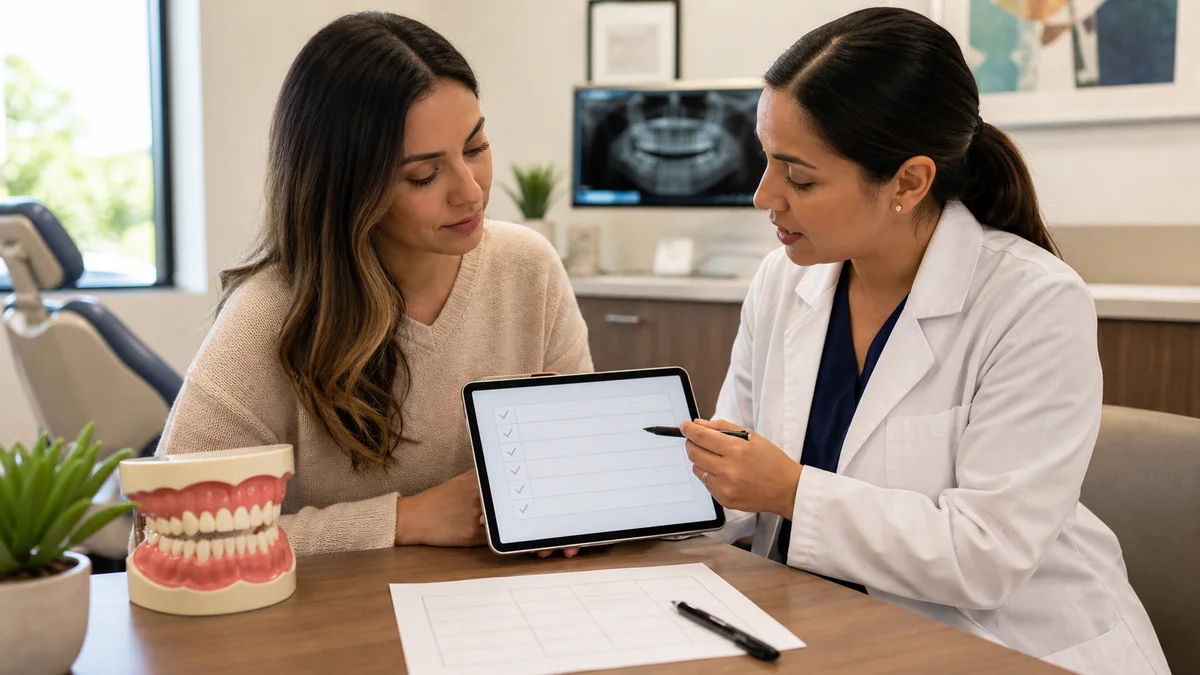
When you need a cheap dentist, the word “cheap” usually means something more important than the lowest advertised fee. You may need pain relief today, a clinic that accepts your coverage, an income-based discount, or a treatment plan you can complete without taking on unaffordable debt. The safest goal is affordable, necessary care with clear credentials and costs—not an unexplained bargain.
Dental prices vary by location, diagnosis, treatment complexity, materials, provider type, insurance network, and whether care is urgent. A phone quote cannot tell you whether a tooth needs a filling, root canal, crown, extraction, or no treatment. A proper examination and appropriate imaging come before a final plan. This guide explains how to search, what to ask, and how to compare options without accepting unnecessary or unsafe treatment.
The U.S. National Institute of Dental and Craniofacial Research, or NIDCR, directs people seeking lower-cost care toward dental and dental-hygiene schools, federally funded health centers, Medicaid or CHIP, state and local health departments, 2-1-1, and selected clinical trials. Availability, eligibility, wait times, and services vary, so every option must be confirmed directly.
1. If you need a cheap dentist, first decide how urgent the problem is
Price comparison is useful only when it does not delay an urgent condition. Tooth decay can progress to pain, infection, facial swelling, and fever. A dental abscess needs dental treatment and does not resolve simply because pain temporarily improves. Antibiotics are not a substitute for definitive care in most routine dental pain and localized swelling situations.
If you need a cheap dentist because of intense pain, swelling, a broken tooth, a knocked-out permanent tooth, or bleeding that will not stop, tell the clinic exactly what is happening. Ask for an emergency evaluation or triage slot rather than a routine cleaning appointment. Many offices reserve some time for urgent patients, but policies differ.
- Seek immediate emergency help: trouble breathing, speaking, or swallowing; rapidly spreading mouth, face, eye, or neck swelling; uncontrolled bleeding; severe trauma; confusion or signs of serious systemic illness.
- Seek urgent dental assessment: suspected abscess, fever with dental pain, worsening swelling, severe pain not controlled with normal self-care, a broken tooth with pain, or a lost permanent tooth.
- Schedule promptly: a new cavity, recurring sensitivity, bleeding gums, a loose filling, or a denture problem without emergency signs.
- Plan preventive care: examination, cleaning, fluoride, sealants, and risk-based follow-up when no urgent symptoms are present.
In the United States, call 911 or use an emergency department for a possible airway threat, severe spreading infection, uncontrolled bleeding, or major facial trauma. An emergency department may stabilize a medical emergency but often cannot provide definitive restorative dental treatment. After stabilization, you may still need a dentist.
The phrase need a cheap dentist should never postpone airway protection or treatment of a spreading infection. Stabilize danger first, then use the lower-cost routes below for definitive and continuing care.
2. Start with an HRSA-funded health center
If you need a cheap dentist in the United States, the federal Health Resources and Services Administration’s “Find a Health Center” tool is one of the most reliable starting points. Health centers are community-based clinics that may provide medical, dental, behavioral, and other services. Not every site offers every dental procedure, so call the listed location before traveling.
HRSA requires health centers to operate sliding fee discount programs for services within their approved scope. Discounts are adjusted based on ability to pay, generally using income and family size documentation. A center may maintain separate schedules for preventive dental care and other dental services. “Sliding fee” does not necessarily mean every service is free.
When you call because you need a cheap dentist, ask:
- Does this site provide dental examinations and urgent visits?
- Are new dental patients currently accepted?
- Which documents prove household income and family size?
- Does the sliding fee apply to imaging, fillings, root canals, crowns, dentures, or extractions?
- Is there a nominal charge, deposit, or separate laboratory fee?
- What happens if a needed service is referred outside the health center?
- Do you accept my Medicaid plan or dental insurance?
- How are emergency appointments prioritized?
A health center should not deny an in-scope service solely because a person cannot pay, but the exact service scope, discount schedule, referral arrangement, and appointment supply matter. Confirm the program before assuming a complex procedure will be available at the same site.
If you need a cheap dentist, write down every health center you call, the documents requested, the next available date, and whether the service is performed onsite or referred elsewhere.
3. Contact a dental school or dental-hygiene school
When you need a cheap dentist, teaching clinics can be worth comparing because supervised care may be offered at a lower fee, although appointments can take longer and acceptance is not guaranteed.
NIDCR recommends dental schools as a source of reduced-cost care. Students provide treatment under close supervision by experienced licensed dentists. Dental-hygiene schools may offer supervised preventive services such as cleanings. Appointments can take longer because teaching, documentation, and faculty checks are part of care.
If you need a cheap dentist for comprehensive treatment, ask a dental school whether it accepts new patients for your type of problem. Some schools begin with screening to determine whether a case fits educational needs. Complex emergency care may be referred, and waiting lists may apply.
Do not assume the school is free. Request the screening fee, imaging fees, payment schedule, laboratory charges, and cancellation rules. Ask whether student, resident, faculty practice, and specialty clinics have different fees. A resident clinic may manage more complex care but use a different price structure.
A dental-hygiene program is useful for preventive services, but a cleaning does not replace diagnosis or treatment of an abscess, deep decay, fractured tooth, or advanced gum disease. When you need a cheap dentist for pain, confirm that a dentist—not only a hygiene clinic—can diagnose and manage the cause.
A patient who says “I need a cheap dentist” should ask the school whether the screening itself creates a treatment relationship and who provides urgent help between teaching appointments.
4. Check Medicaid and CHIP before paying cash
Children enrolled in Medicaid receive dental benefits through the Early and Periodic Screening, Diagnostic and Treatment framework. Federal Medicaid guidance says children’s dental services must at minimum address pain and infection, restore teeth, and maintain dental health when medically necessary under state rules. Separate CHIP programs also must provide dental coverage that meets federal requirements.
Adults have a different situation: states choose the scope of adult Medicaid dental benefits, and there is no federal minimum adult dental benefit. If you need a cheap dentist, check your current state’s benefit handbook, provider directory, prior-authorization rules, and annual or service limits. Information from another state may be wrong for you.
Provider directories can be outdated. Call both the dental office and the plan to verify that the specific dentist is accepting new members under your exact plan. Ask whether a referral, assigned dental home, or prior approval is required. Save the date, representative name, and confirmation number.
For children, InsureKidsNow.gov and state program resources can help locate participating dentists. A child’s medical screening does not substitute for a dental examination. If you need a cheap dentist for a child with pain or swelling, request an urgent dental provider through the plan rather than waiting for the next routine visit.
When a family says “we need a cheap dentist,” checking Medicaid or CHIP eligibility before paying cash can prevent an avoidable bill, but coverage and provider acceptance must both be confirmed.
5. Understand what Medicare does and does not cover
Original Medicare does not cover most routine dental care, such as cleanings, fillings, routine extractions, dentures, or implants. Medicare may cover specific dental services when they are inextricably linked to the success of certain Medicare-covered medical treatments, and it may cover hospital services in limited circumstances. The clinical link and care coordination must be documented.
If you need a cheap dentist and have Medicare, do not assume every dental service is excluded or covered. Ask whether you have a Medicare Advantage plan with supplemental dental benefits, Medicaid as secondary coverage, a retiree plan, or another dental policy. Benefits, networks, maximums, waiting periods, and copayments can change each plan year.
Before treatment, ask the plan for a written benefit estimate based on the procedure codes. A benefit estimate is not always a payment guarantee, but it is more useful than a general statement that “dental is included.” Confirm whether the dentist is in network and whether laboratory or specialist fees are handled separately.
If you need a cheap dentist while enrolled in a Medicare Advantage plan, compare the plan’s actual network and remaining allowance with community-clinic and dental-school options rather than relying on the marketing summary.
6. Call state and local health departments and 2-1-1
If you need a cheap dentist and the nearest community clinic has a long wait, local referral services may reveal county programs, mobile clinics, or limited charitable resources that are not easy to find through a general search.
NIDCR suggests contacting state or local health departments for programs offering free or reduced-cost care. Local programs may include mobile clinics, school-based services, county dental clinics, senior programs, pregnancy-related care, veteran resources, or periodic community events. Availability can be limited to residents, age groups, income levels, or specific procedures.
When you need a cheap dentist, 2-1-1 can help identify nearby social and health services. The referral is a starting point, not proof that a clinic is currently open, licensed, affordable for your procedure, or accepting patients. Verify every listing directly.
Community charity events can be valuable for urgent extractions or basic restorations, but they may not provide continuity or complex multi-visit treatment. Ask what follow-up is available if a temporary treatment fails or symptoms return. Do not let a one-day event replace a long-term plan for uncontrolled diabetes, gum disease, recurrent decay, or dentures.
People who need a cheap dentist can use a charity event as one step, but should leave with records, aftercare instructions, warning signs, and a realistic plan for the remaining disease.
7. Use this decision table to choose a lower-cost route
The right choice when you need a cheap dentist depends on urgency, eligibility, treatment complexity, travel, and wait time. This table is a screening tool, not a promise that a service will be available.
| Your situation | Best first call | What to verify | Common limitation |
|---|---|---|---|
| Severe pain or suspected abscess | Emergency dental clinic, health center, or existing dentist | Same-day triage, examination fee, definitive treatment availability | Emergency visit may address only the urgent problem |
| Low income and uninsured | HRSA-funded health center | Dental scope, sliding-fee documents, current appointments | Complex procedures may be referred |
| Time is flexible | Dental school | Screening, student/resident clinic, appointment length, total fees | Long visits and possible waiting list |
| Preventive cleaning needed | Dental-hygiene school or health center | Supervision, radiographs, dentist examination, referral process | Cannot provide all restorative or emergency treatment |
| Child without private coverage | Medicaid/CHIP and Insure Kids Now | Eligibility, participating provider, urgent-access process | Directory and appointment availability vary |
| Adult enrolled in Medicaid | State Medicaid dental program | Covered services, limits, authorization, network status | Adult benefits differ by state |
| Medicare beneficiary | Medicare plan, Medicaid if dual eligible, or local clinic | Advantage benefit, medical linkage exception, network rules | Original Medicare excludes most routine dental care |
| Considering financing | Provider billing office, credit union, and plan documents | Cash price, APR, deferred interest, total repayment, default terms | A low monthly payment may cost more overall |
Compare at least access time, examination quality, clinically appropriate options, written price, and follow-up. If one route cannot provide the needed service, ask for the referral name, records, and a copy of current imaging so you do not unnecessarily repeat tests.
When you need a cheap dentist, the best route may change by procedure: a health center for urgent disease control, a school for complex planned care, and a hygiene program for prevention.
8. Ask for a prioritized, itemized treatment plan
If you need a cheap dentist, tell the clinician your budget before irreversible treatment begins. Ask the dentist to separate urgent disease control, definitive treatment, prevention, and elective cosmetic work. Staging can make costs manageable, but delaying a recommended step may change prognosis; ask what can safely wait and for how long.
A useful written estimate identifies the tooth, diagnosis, procedure, code, fee, insurance estimate, patient estimate, number of visits, and whether laboratory work is included. For a crown, ask whether the buildup, temporary crown, final material, lab fee, and follow-up are included. For dentures, ask about extractions, immediate versus final denture, adjustments, relines, and replacement.
Request clinically reasonable alternatives:
- Can a restorable tooth receive a filling instead of a crown?
- Is root canal treatment plus restoration reasonable, or is extraction the only predictable option?
- If extraction is chosen, what happens if replacement is delayed?
- Is a removable partial denture a safe lower-cost alternative to a bridge or implant?
- Can gum infection be stabilized before elective restorative work?
- Which preventive steps reduce the chance of another expensive emergency?
- Which option preserves the most healthy tooth structure?
The least expensive treatment today can cost more later if it fails to address the disease or creates a difficult replacement problem. When you need a cheap dentist, compare complete pathways—not isolated fees.
The written plan helps a person who says “I need a cheap dentist” identify which costs are necessary now, which can be staged safely, and which are elective.
9. Verify credentials and infection-control basics
Even when you need a cheap dentist urgently, take a moment to confirm the clinician’s license through the relevant dental board and ask who will perform each part of the treatment.
Affordable care should still be delivered by properly licensed professionals in an appropriate setting. Check the dentist’s license through the state dental board, including any publicly available disciplinary information. Confirm who will perform each procedure and who supervises students or trainees.
If you need a cheap dentist, do not accept treatment in a home, hotel room, salon, or other unlicensed setting simply because the price is low. Warning signs include no examination, no medical history, no consent, cash-only pressure, unlabeled materials, refusal to provide records, or a guarantee that every problem can be fixed in one visit.
Ask how instruments are sterilized, how single-use items are handled, and what happens in an emergency. You do not need to audit the clinic, but the team should answer basic safety questions professionally. For sedation, confirm the clinician’s permit, monitoring, escort rules, and emergency arrangements under state requirements.
A legitimate low-cost clinic may look modest or have longer waits. Appearance is not a reliable quality measure. Transparent diagnosis, licensing, consent, infection control, documentation, and follow-up matter more.
If you need a cheap dentist, a verified license and a clear infection-control process are minimum requirements, not premium upgrades that should disappear at a lower price.
10. Beware of dental discount-plan and “free treatment” claims
The Federal Trade Commission warns that medical discount plans are not health insurance. Some plans provide legitimate negotiated discounts; others exaggerate savings or list providers who do not participate. If you need a cheap dentist, call the dental office independently before paying an enrollment fee.
Ask for the exact discounted fee schedule for the procedure you may need, not an “up to” percentage. Add membership, enrollment, renewal, and administrative fees. Confirm waiting periods, exclusions, geographic limits, cancellation rules, and whether specialists participate. Check the plan with your state insurance regulator if registration or licensing applies.
Be cautious with advertisements for free implants, research grants, or government dental funds. NIDCR specifically states that it does not provide dental implants or financial assistance and warns that claims using its name may be fraudulent. A real clinical trial has eligibility criteria, informed consent, a registered protocol, and treatment limited to the study—not a universal free-care promise.
If an unsolicited caller asks for Social Security, bank, or card information to secure a discount, stop. Use the official agency or clinic website and published phone number. Pressure to enroll immediately is a reason to pause.
A search for need a cheap dentist can attract misleading advertisements, so confirm every grant, plan, and clinic through the named agency’s own website before sharing personal data.
11. Compare payment plans without turning dental bills into expensive debt
When you need a cheap dentist, a monthly payment can make treatment possible, but it can also hide the total cost. Ask for the cash price before applying for financing. Then compare down payment, annual percentage rate, fixed or variable interest, number of payments, total repayment, fees, late-payment terms, and prepayment rules.
The Consumer Financial Protection Bureau cautions that some medical credit cards use deferred interest. If the promotional balance is not paid in full by the deadline, or if contract conditions are missed, interest may be charged under terms that make the treatment much more expensive. Minimum payments may not be enough to clear the balance during the promotional period.
- Ask about an internal interest-free plan before opening a medical credit card.
- Check whether a local credit union or bank offers a lower total cost.
- Do not finance elective upgrades before asking about lower-cost appropriate care.
- Confirm whether a refund goes to you or directly to the lender if treatment changes.
- Understand what happens to the loan if the provider closes or you transfer care.
- Leave room in the budget for follow-up, medications, laboratory work, and emergencies.
Financing does not make treatment covered by insurance and does not guarantee a result. If you already have trouble paying essential bills, contact a nonprofit credit counselor or legal-aid resource before adding high-cost debt.
If you need a cheap dentist, ask about financial assistance and lower-cost treatment before applying for credit; financing a higher fee is not the same as reducing the fee.
12. Use insurance correctly before accepting a cash discount
If you need a cheap dentist but already have dental coverage, the lowest advertised cash fee may not produce the lowest final bill once network discounts and plan payments are counted.
If you have dental insurance, ask for a pretreatment estimate for nonurgent, higher-cost care. Confirm deductible, annual maximum, waiting period, frequency limit, missing-tooth clause, network status, downgrade rules, and remaining benefit. An estimate is not an absolute guarantee because eligibility and clinical facts can change.
When you need a cheap dentist, a cash price may look lower than an out-of-network fee, but compare the final patient responsibility. Ask whether the office will submit claims, whether the price is contingent on not using insurance, and how coordination of benefits works if you have two plans.
Do not delay treatment for swelling or systemic symptoms while waiting for a routine authorization. The clinic and insurer can explain whether emergency services have separate rules. Keep copies of explanations of benefits, claims, estimates, and receipts.
People who need a cheap dentist should also ask whether an in-network specialist, prior authorization, or alternate benefit changes the final patient cost.
13. Lower the cost of future dental care
Prevention cannot reverse every problem, but it can reduce avoidable disease and emergency spending. Brush twice daily with fluoride toothpaste, clean between teeth, limit frequent sugar exposure, avoid tobacco, and attend risk-based examinations. A dentist may recommend fluoride varnish, prescription toothpaste, sealants, dry-mouth management, or shorter recall intervals according to risk.
If you need a cheap dentist today because of one painful tooth, ask for a full prevention plan after the urgent issue is controlled. Repeated emergency extractions may be less expensive per visit but can lead to chewing problems and later replacement costs. Early decay may be treated less invasively than advanced decay.
Keep your records and radiographs. A new dentist decides whether existing images are current and diagnostically adequate, but access to records can prevent unnecessary repetition. Ask the office how to request copies and whether a reasonable records fee applies under local rules.
Manage related health conditions. Diabetes control, smoking cessation, medication review, and dry-mouth treatment can affect oral health. Tell the dentist about all diagnoses and medicines; never stop prescribed medication solely to reduce dental costs.
The long-term answer to need a cheap dentist includes prevention and disease control, because avoiding another emergency is often more valuable than finding a one-time discount.
14. Considering treatment abroad: compare the full care pathway
Some people who need a cheap dentist compare domestic care with treatment in another country. A lower quote may be real, but travel, accommodation, time off work, additional imaging, staged visits, complications, maintenance, and future repairs belong in the total. Urgent infection should be assessed locally before travel.
Ask who holds the clinical license, which regulator oversees the facility, what records you receive, and how informed consent is provided. Confirm implant or prosthetic component details, laboratory materials, warranties, emergency contacts, and whether a dentist near home can maintain the work. A commercial warranty is not a biological outcome guarantee.
Redent Klinik provides general information on its English-language website. You can use the English contact page to ask which records are needed for a preliminary review. Remote review cannot replace an examination, establish a final fee, or guarantee suitability. Compare only medically appropriate plans.
If you need a cheap dentist for routine fillings or preventive care, repeated international travel may erase savings. Cross-border care is more commonly considered for planned, extensive treatment after local diagnosis. Continuity and repair access deserve the same weight as the initial quote.
Before traveling because you need a cheap dentist, compare the complete domestic and international pathways after a local examination, not two advertisements with different scopes.
Questions people ask when they need a cheap dentist
Where should I call first if I need a cheap dentist today?
For urgent pain or swelling, call a local emergency dental clinic, HRSA-funded health center, dental school, or your insurer’s urgent provider line. Describe symptoms rather than asking only for a price. Trouble breathing or swallowing, major spreading swelling, severe trauma, or uncontrolled bleeding needs emergency medical help.
Are federally funded health centers free?
Not necessarily. They use sliding fee discounts based on income and family size for covered in-scope services, and some patients may have a nominal charge. Dental scope varies by site. Ask which documents, procedures, laboratory fees, and referrals qualify before the appointment.
Is a dental school safe?
Dental students provide care under licensed faculty supervision, and residents are licensed dentists receiving advanced training. Teaching visits often take longer and cases must fit program needs. Verify the clinic’s screening, supervision, fees, emergency process, and follow-up.
Does Medicaid cover adult dental treatment?
Adult benefits vary by state because there is no federal minimum adult dental benefit. Some states offer extensive coverage, while others limit services. Children’s Medicaid and CHIP dental requirements are broader. Check the current state program and exact participating provider.
Can an emergency room pull a painful tooth?
Emergency departments can evaluate and stabilize serious medical problems such as spreading infection, airway risk, uncontrolled bleeding, or major trauma. Many do not provide definitive dental procedures. You may still need urgent follow-up with a dentist after medical stabilization.
How do I know whether the cheapest treatment is appropriate?
Ask for the diagnosis, prognosis, alternatives, risks of waiting, and complete pathway cost. A filling, crown, root canal, extraction, bridge, denture, and implant solve different problems. A second opinion is reasonable before an irreversible or expensive decision when time and safety allow.
Is a dental discount plan the same as insurance?
No. A discount plan typically charges a membership fee for negotiated prices at participating providers; it does not pay claims like insurance. Verify the provider, exact fee, total membership cost, exclusions, and state registration before enrolling.
Should I use a medical credit card for dental work?
Only after comparing the cash price, provider payment plan, credit union or bank options, APR, total repayment, deferred-interest deadline, fees, and default consequences. A missed deadline may sharply increase cost. Do not use financing to bypass a more affordable clinically suitable treatment.
Can I negotiate a dental bill?
You can ask about self-pay pricing, prompt-pay discounts, staged treatment, sliding fees, laboratory alternatives, or an interest-free internal plan. The clinic is not required to agree, and negotiation should never change infection control or necessary diagnostic standards. Get every arrangement in writing.
Final checklist before booking
Before choosing a clinic because you need a cheap dentist, compare the same treatment scope, written fees, credentials, timing, and follow-up responsibilities across the options.
If you need a cheap dentist, use this short sequence:
- Triage emergency symptoms before comparing routine prices.
- Search official HRSA, Medicaid/CHIP, NIDCR, health department, and dental-school resources.
- Verify license, new-patient status, exact service, and supervision.
- Ask for a written diagnosis and itemized estimate.
- Separate urgent, definitive, preventive, and elective treatment.
- Request lower-cost clinically appropriate alternatives.
- Confirm insurance, sliding fee, and prior-authorization rules.
- Compare cash price with total financing repayment.
- Check follow-up, repair, records, and emergency access.
- Do not accept guarantees, pressure, or treatment in an unlicensed setting.
The best answer when you need a cheap dentist is not a universal clinic or fee. It is a verified route to timely care, a plan that treats the disease, and a cost structure you understand. Affordable care can be high quality; the key is to compare complete, appropriate treatment rather than an advertisement.
Keep this need a cheap dentist checklist with your call notes and estimates so each provider is compared on urgency, scope, safety, total cost, and follow-up.
Official sources and trusted directories
- National Institute of Dental and Craniofacial Research — Finding Dental Care, reviewed December 2024.
- Health Resources and Services Administration — Find a Health Center.
- HRSA Bureau of Primary Health Care — What is a Health Center?, reviewed November 2025.
- HRSA — Sliding Fee Discount Program requirements.
- Medicaid.gov — Dental Care benefits for children and adults.
- Medicaid.gov — CHIP dental benefits.
- Medicare.gov — Dental service coverage, current 2026 information.
- Consumer Financial Protection Bureau — Medical credit cards and payment plans.
- Federal Trade Commission — Medical discount plans and scams.
- NIDCR — Tooth decay, infection, swelling, and fever.
- CDC and ADA — Dental pain, swelling, and antibiotic stewardship.
- American Dental Association — Professional and patient dental resources.
- World Health Organization — Oral health fact sheet.
Sources were checked in July 2026. Programs, benefits, provider participation, and appointment availability change; confirm details directly with the official program and treating clinic.