
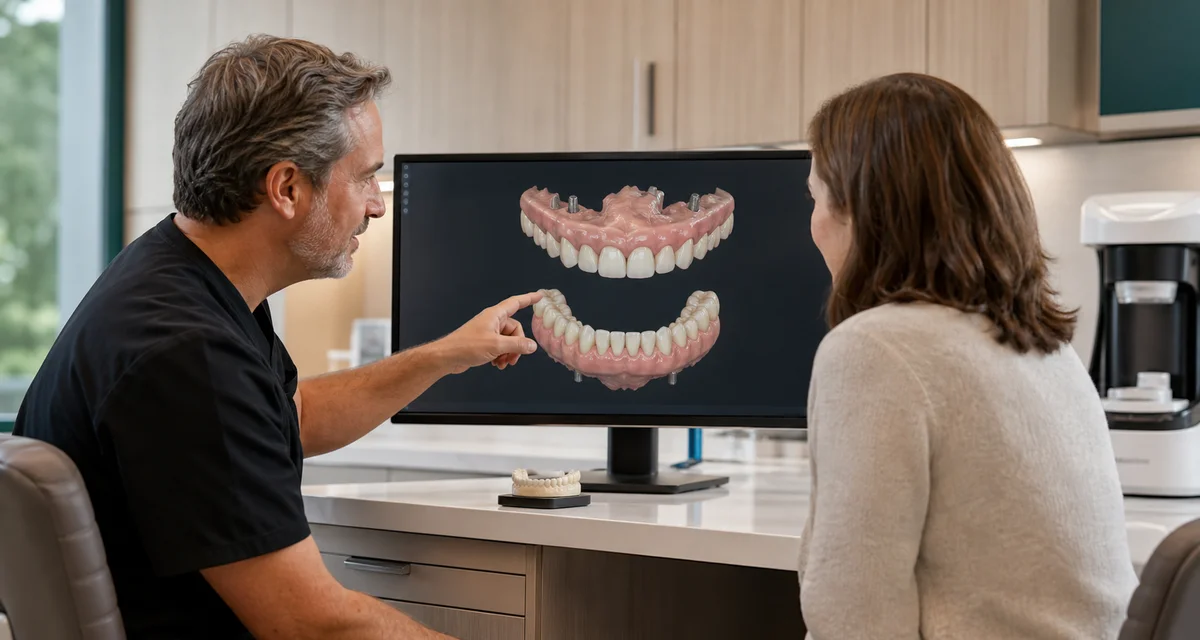
Quick answer: The average cost of full upper and lower dental implants is not one reliable patient-specific figure. The total depends on diagnosis, extractions, bone or gum procedures, implant and prosthetic design, temporary teeth, final materials, anesthesia, follow-up, maintenance, and location. Compare written, like-for-like plans after a clinical assessment instead of choosing from a headline price.
People searching for the average cost of full upper and lower dental implants are usually trying to answer a practical question: what would it take to replace both arches, and can the plan fit their budget? The difficulty is that identical-sounding advertisements may describe very different care. One quote may cover only implant placement. Another may include temporary teeth but exclude the final bridges. A third may assume no extractions, grafting, sedation, repairs, or follow-up. Those are not directly comparable totals.
This guide is designed as a quote-comparison framework, not a diagnosis or price promise. Full-arch implant treatment is elective, complex care that should follow a medical and dental history, clinical examination, appropriate imaging, and a discussion of alternatives. The U.S. Food and Drug Administration describes dental implants as surgically implanted medical devices and advises patients to discuss benefits, risks, candidacy, implant records, and long-term care with their clinician. The right question is therefore not only “What is the fee?” but also “What exactly is planned, why is it appropriate, and what happens if the clinical findings change?”
1. Why the average cost of full upper and lower dental implants is not a universal price
A statistical average can combine patients with different anatomy, diagnoses, prostheses, treatment stages, and local cost structures. It may also mix one-arch and two-arch care, fixed and removable restorations, provisional and final teeth, or routine and complex surgery. That makes the average cost of full upper and lower dental implants a weak substitute for an itemized treatment plan. A low figure may be a limited starting price; a higher figure may include more of the care pathway. Neither is automatically better until the scope is clear.
Location also affects professional fees, laboratory costs, staffing, facility standards, taxes, exchange rates, and travel. Yet geography does not eliminate biological variability. Two patients treated in the same clinic can need different preparatory care and different prosthetic designs. Even detailed remote photographs cannot confirm bone dimensions, gum condition, bite forces, infection, medical risk, or whether teeth can be preserved. A responsible provider can explain a planning range or provisional estimate, but the definitive recommendation should follow sufficient assessment.
Used responsibly, the average cost of full upper and lower dental implants is only a research benchmark; it is not evidence that two plans deliver equivalent care.
2. Define what “full upper and lower” means before comparing
The phrase can refer to replacement of all teeth in the maxilla and mandible, but it does not specify the restoration. A plan may use fixed full-arch bridges supported by implants, removable implant-retained overdentures, or a staged combination. The number, position, size, and brand of implants can differ. The provisional restoration may be removable or fixed, and the final restoration may use a different framework or tooth material. Those choices change clinical steps, laboratory work, maintenance needs, and the average cost of full upper and lower dental implants.
Ask the provider to name the exact restoration planned for each arch. “Fixed teeth,” “permanent teeth,” and branded treatment labels can be interpreted differently. In dentistry, a restoration described as fixed may still need professional removal for cleaning, repair, or component replacement. “Permanent” does not mean indestructible or maintenance-free. A complete quote should distinguish what is placed during healing from what is delivered after integration and tissue maturation.
For a fair comparison, the average cost of full upper and lower dental implants must be tied to a defined upper restoration and a defined lower restoration.
- Is the upper restoration fixed, removable, or undecided pending examination?
- Is the lower restoration the same design as the upper?
- How many implants are planned per arch, and what could change that number?
- Does the fee include both provisional and definitive prostheses?
- Are abutments, screws, cylinders, frameworks, and laboratory stages included?
- Which repair, remake, or conversion events are excluded?
3. Start with diagnosis, candidacy, and reasonable alternatives
Full-arch implant care should not begin with a package. It should begin with the diagnosis. The clinician needs to determine which teeth are present, whether any are maintainable, how gum disease is controlled, whether active infection exists, and how the jaws, joints, muscles, speech, smile, and bite interact. Medical history, medicines, allergies, tobacco or nicotine use, previous radiation, healing history, diabetes control, and other factors may affect risk or timing. The FDA notes that overall health and habits such as smoking can influence healing and implant success.
Because candidacy differs, the average cost of full upper and lower dental implants cannot establish whether implant treatment is the safest or most proportionate option.
For this reason, the average cost of full upper and lower dental implants should never replace a conversation about alternatives. Depending on findings and patient priorities, alternatives can include preserving selected teeth, conventional complete dentures, tooth-supported treatment, removable implant-retained overdentures, phased care, or no immediate treatment with monitoring where clinically appropriate. Each path has different trade-offs in surgery, comfort, function, hygiene, repairability, and long-term cost. A second opinion can be valuable when the proposed plan involves removing restorable teeth or when the diagnosis is unclear.
4. Diagnostics and records included in a complete quote
High-quality planning can involve a comprehensive examination, periodontal charting, photographs, scans or impressions, bite records, radiographs, three-dimensional imaging when justified, diagnostic setups, and a medical-risk review. Some clinics bundle these items; others bill them separately. The average cost of full upper and lower dental implants can look lower when essential diagnostic and laboratory planning is outside the headline fee.
Ask which records will be taken, who interprets them, and whether additional imaging may be needed. Imaging should be clinically justified rather than performed automatically. A digital workflow may improve communication and prosthetic planning, but “digital” alone does not guarantee accuracy or suitability. The diagnostic appointment is also the time to document the patient’s expectations about tooth display, lip support, speech, cleaning access, dietary transition, and acceptable compromises.
When diagnostics are billed separately, the average cost of full upper and lower dental implants should be adjusted before it is compared with an inclusive proposal.
Patients should retain copies of relevant imaging, treatment plans, consent documents, implant brand and model information, component references, laboratory details, prescriptions, and post-operative instructions. These records can matter if maintenance or emergency care is later provided elsewhere. The FDA specifically advises patients to ask for implant brand and model information and keep it with their health records.
5. Extractions and disease control can change the scope
If teeth remain, the quote should state whether extraction is recommended, which teeth are involved, and why. Simple and surgical extractions are not always equivalent. Root fragments, infection, previous treatment, bone shape, proximity to anatomical structures, and the desire to preserve tissue can change complexity. The average cost of full upper and lower dental implants may exclude extractions even when they are a necessary first stage.
Active gum disease, decay, infection, or inflammation elsewhere in the mouth may also need management. Removing teeth does not remove the need for hygiene or professional monitoring. Disease-control steps may include cleaning, periodontal therapy, temporary stabilization, medication when clinically indicated, or time for healing and reassessment. A quote that assumes immediate surgery should explain what happens if the examination identifies a reason to postpone or stage care.
An advertised average cost of full upper and lower dental implants can understate the pathway when disease control and healing reviews are outside the package.
6. Bone and soft-tissue procedures are patient-specific
Implants need an appropriate three-dimensional site and maintainable surrounding tissues. Depending on anatomy and the chosen design, a clinician may discuss socket preservation, ridge contouring, bone augmentation, sinus-related procedures, soft-tissue grafting, or a different implant position. These procedures are not automatically required, and they should not be promised or ruled out from advertising alone. The average cost of full upper and lower dental implants changes substantially when preparatory or simultaneous grafting is included.
Ask whether the proposed fee assumes no grafting, includes a defined graft, or leaves grafting as a contingency. The plan should explain the material, objective, expected healing period, alternatives, and relevant risks. If a provider says “no grafting ever,” ask how they adapt when anatomy does not support the advertised approach. If extensive grafting is recommended, ask whether a different prosthetic design could meet the patient’s priorities with less intervention.
The average cost of full upper and lower dental implants is most useful here when the no-graft assumption and every grafting contingency are explicit.
7. Implant surgery, components, and professional responsibilities
The surgical portion can include planning, guides, implant placement, cover screws or healing components, abutments, sutures, medications, and review visits. It may also involve separate professionals for surgery and prosthodontic restoration. The average cost of full upper and lower dental implants is easier to interpret when the quote names each responsible clinician, the treatment site, and who coordinates complications or after-hours concerns.
Implant systems are not interchangeable in every circumstance. Brand, model, diameter, length, connection, and component availability matter for future maintenance. Ask whether all implants and prosthetic components are from traceable systems and whether the clinic will provide identifiers after placement. A surgical guide can be useful in selected workflows, but it does not replace clinical judgment. The clinician may need to change the plan if the actual anatomy, stability, or tissue conditions differ from the simulation.
A transparent average cost of full upper and lower dental implants comparison therefore records the implant system, included components, and responsibility for future component access.
The FDA lists possible complications such as injury to surrounding tissues, sinus or jaw damage, bite problems, implant-body failure, loosening, infection, delayed healing, cleaning difficulty, untreated periodontal disease, and nerve injury. This does not mean those events will occur; it means informed consent and a contingency plan belong in the discussion. No ethical quote can guarantee integration, function, or a specific lifespan.
8. Temporary teeth and the meaning of “same-day”
Some patients may receive a provisional restoration on or soon after surgery, while others need a delayed or removable option. Immediate loading depends on primary implant stability, bone condition, bite control, prosthetic design, and other clinical factors. It cannot be confirmed safely for every patient before assessment. The average cost of full upper and lower dental implants should say whether temporary teeth are included and what alternative is provided if immediate fixed loading is not advisable.
Clarify whether the provisional is fixed or removable, how many adjustments are included, what dietary restrictions apply, and what happens if it fractures. Temporary restorations are part of a healing pathway; they are not necessarily the same design or material as the final prosthesis. A phrase such as “teeth in a day” usually describes timing, not the completion of all healing and definitive laboratory work.
The average cost of full upper and lower dental implants is incomplete if it hides whether the temporary stage is fixed, removable, repairable, or separately charged.
9. The final prosthesis can be a major cost driver
The definitive upper and lower restorations involve design, records, try-ins, framework choices, tooth and base materials, surface characterization, laboratory expertise, and occlusal adjustment. Options may include reinforced polymers, composite-based systems, metal frameworks, zirconia-based designs, or hybrid constructions. No material is universally best. Space, bite, parafunction, repair strategy, appearance, weight, hygiene access, and clinician experience all matter.
A meaningful average cost of full upper and lower dental implants comparison therefore identifies the final material and framework rather than using only terms such as “premium” or “porcelain.” Ask whether the fee includes a prototype, verification jig, try-in, final delivery, night guard when indicated, and post-delivery adjustments. Also ask what counts as an aesthetic preference change versus a clinically necessary remake.
Prostheses can wear, chip, fracture, stain, loosen, or need relining, screw replacement, or remake over time. Implant survival and prosthesis survival are not the same outcome. A durable treatment plan includes a realistic discussion of maintainability and repair, not only the day of delivery.
Final material and repair strategy can make one average cost of full upper and lower dental implants estimate fundamentally different from another.
10. Anesthesia, sedation, facility, and medical support
Local anesthesia may be sufficient for some procedures. Other patients may discuss minimal, moderate, or deeper sedation depending on anxiety, procedure length, medical history, local regulation, and clinical setting. These services differ in staffing, monitoring, medicines, recovery requirements, and fee structure. The average cost of full upper and lower dental implants can omit sedation or list it as an optional add-on.
Ask what level is proposed, who administers it, which credentials and emergency protocols apply, and whether pre-operative tests or medical clearance are required. Patients should disclose medicines, supplements, allergies, sleep apnea, previous anesthesia reactions, pregnancy status, and relevant medical conditions. Transport and supervision after sedation may be required. A lower advertised surgical fee is not comparable if necessary anesthesia, monitoring, or facility charges are excluded.
The average cost of full upper and lower dental implants should identify anesthesia and facility assumptions instead of presenting them as an unexpected day-of-surgery charge.
11. Decision table: compare scope, not advertising labels
Use the following table to organize written proposals. It does not rank a treatment type or identify a best option. It shows why the average cost of full upper and lower dental implants cannot be interpreted until the included care is visible.
| Quote description | Questions to resolve | Potential exclusions | Decision signal |
|---|---|---|---|
| Implant placement only | Does it cover one arch or both, and which components? | Extractions, grafting, temporaries, final teeth, anesthesia | Not a complete two-arch comparison |
| Surgery plus provisional teeth | Are provisionals fixed, and what if immediate loading is unsuitable? | Definitive bridges, laboratory upgrades, repairs | Confirm the final restorative stage in writing |
| Two-arch package | Which diagnostics, implants, materials, reviews, and contingencies? | Complex grafts, sedation, travel, long-term maintenance | Useful only when exclusions are specific |
| Staged individualized plan | What triggers each stage and when can the estimate change? | Unexpected pathology or elective changes | May improve transparency for complex care |
| Overseas bundled plan | Who provides local follow-up, and what travel is included? | Flights, hotel, complications, return trips, exchange-rate changes | Compare total pathway and continuity of care |
12. A 17-point itemized quote checklist
Before accepting an estimate framed around the average cost of full upper and lower dental implants, request a dated written plan. It should explain what is included, what is provisional, and which findings can change the recommendation. Use this checklist during consultations:
- 1. Diagnosis and objectives for each arch.
- 2. Alternatives, including tooth preservation and removable options.
- 3. Examinations, imaging, scans, and planning records.
- 4. Teeth to be retained or extracted, with reasons.
- 5. Disease-control and healing stages.
- 6. Bone or soft-tissue procedures and contingencies.
- 7. Number, system, and planned positions of implants.
- 8. Surgical guide, components, and professional fees.
- 9. Anesthesia, sedation, monitoring, and facility fees.
- 10. Immediate, delayed, fixed, or removable provisional teeth.
- 11. Definitive prosthesis design and materials for each arch.
- 12. Laboratory, try-in, delivery, and adjustment visits.
- 13. Medicines, hygiene tools, and protective appliance if indicated.
- 14. Follow-up schedule and named complication contact.
- 15. Maintenance, repair, and remake exclusions.
- 16. Payment milestones, cancellation terms, and financing conditions.
- 17. Travel, accommodation, return visits, and local aftercare when relevant.
If the provider cannot separate these categories, ask for clarification before paying a non-refundable amount. The objective is not to force every clinic into the same billing format. It is to prevent a partial price from being mistaken for the total care pathway.
Documenting all 17 items turns the average cost of full upper and lower dental implants from a vague marketing number into a traceable comparison.
13. Timeline, stages, and contingencies affect the total
A full-arch pathway may include assessment, preparatory care, surgery, provisionalization, healing reviews, definitive records, try-ins, delivery, and maintenance. Some stages can be combined; others should be separated for biological or prosthetic reasons. The average cost of full upper and lower dental implants does not reveal how many visits, healing periods, or return trips are assumed.
Ask the clinic to provide a stage-by-stage timeline with decision points. For example, the definitive restoration may wait until tissue changes stabilize. A provisional may need adjustment as swelling resolves. Additional visits may be needed if the bite, speech, hygiene access, or appearance requires refinement. The timeline should also explain what happens if an implant does not achieve sufficient stability, fails to integrate, or cannot be restored as planned.
Contingencies should be specific. “Additional procedures may cost extra” is too vague on its own. Ask which findings are foreseeable, how they are diagnosed, who decides, whether consent is renewed, and whether the patient can pause or choose an alternative. This makes financial consent part of clinical consent.
A staged average cost of full upper and lower dental implants estimate should show when each payment becomes due and which finding can change it.
14. Maintenance and repair belong in lifetime planning
Implant-supported teeth still need daily plaque control and professional review. Cleaning access should be designed into the restoration, and the patient should be shown which brushes, flossing aids, or irrigators are appropriate. The FDA advises careful cleaning and regular dental visits after implant placement. Smoking cessation and management of health conditions can also support healing and long-term care.
The average cost of full upper and lower dental implants usually describes initial treatment, not future maintenance. Ask about examination intervals, professional cleaning, radiographs when indicated, screw checks, replacement of worn components, repair labor, removal and reinsertion of fixed prostheses, and eventual remake. A night guard may be discussed for patients who clench or grind, but its indication is individual.
Warranty language deserves close reading. A clinic may distinguish implant components, laboratory materials, professional time, accidental damage, hygiene-related complications, and care performed elsewhere. Conditions may require scheduled maintenance. No warranty can erase biological risk or guarantee a lifelong result, and it should not discourage a patient from seeking urgent care locally.
For lifetime budgeting, add expected review and repair categories to the average cost of full upper and lower dental implants rather than treating delivery as the final expense.
15. Insurance, benefits, taxes, and reimbursement
Dental and medical benefit rules differ by insurer, employer plan, country, diagnosis, procedure code, annual maximum, waiting period, network, and documentation. Some plans may contribute to selected parts of care; others exclude implants or limit prosthetic benefits. The average cost of full upper and lower dental implants should not be presented as the patient’s net responsibility without a plan-specific benefit review.
Request a written pre-treatment estimate or predetermination when available, but understand that it is not always a guarantee of payment. Ask how diagnostic, surgical, prosthetic, anesthesia, and follow-up items are coded, who submits claims, and what happens if the insurer pays less than expected. International treatment may have different reimbursement documentation requirements. Tax deductions or health-account eligibility also depend on jurisdiction and personal circumstances; consult the appropriate plan administrator or qualified tax professional rather than relying on a clinic’s general statement.
Only after plan-specific benefits are checked can the average cost of full upper and lower dental implants be translated into a plausible out-of-pocket estimate.
16. Financing can change the amount ultimately paid
Monthly-payment advertising can make the average cost of full upper and lower dental implants appear more manageable, but the monthly amount is not the total cost. Compare cash price, financed principal, annual percentage rate, term, fees, late-payment consequences, prepayment rules, and total of payments. Confirm whether financing is provided by the clinic or a separate company and whether funds are disbursed before all treatment is completed.
The U.S. Consumer Financial Protection Bureau has warned that medical credit cards and financing plans may be confusing. With some deferred-interest products, interest can accrue from the original purchase date and become payable if the balance is not cleared by the deadline. Terms vary, so read the agreement and ask questions before signing. Do not let a limited-time financing offer rush an irreversible clinical decision.
Also ask how refunds are handled if the treatment plan changes, if a medical issue postpones surgery, or if a provider cannot complete a stage. Payment milestones aligned with completed treatment can be easier to audit than a single unexplained advance payment. Patients considering currency conversion should account for exchange-rate and card fees without assuming the rate will remain stable.
Financing terms can make the amount paid exceed the average cost of full upper and lower dental implants, even when the clinical fee itself does not change.
17. Travel dentistry: calculate the whole pathway
International care may offer a different fee structure, but the comparison should include flights, accommodation, local transport, time away from work, companions, medicines, travel insurance limitations, and possible return visits. The average cost of full upper and lower dental implants advertised abroad may not include treatment by a local dentist if an adjustment or complication occurs after returning home.
The U.S. Centers for Disease Control and Prevention identifies dental care as a common form of medical tourism and advises travelers to consider credentials, infection prevention, communication, records, continuity, and travel-related risks. A pre-travel health consultation may be appropriate, especially for people with medical conditions. Recent surgery and long travel can create individual concerns; the treating clinician and travel-medicine professional should advise on timing.
For an international comparison, the average cost of full upper and lower dental implants should include the realistic cost of travel, return care, and continuity planning.
- Verify the treating clinicians’ names, qualifications, and regulatory standing.
- Ask which facility performs surgery and how sterilization and emergencies are managed.
- Obtain a written stage plan, implant identifiers, imaging, prescriptions, and discharge record.
- Identify a local provider willing to evaluate urgent problems and clarify who pays.
- Allow time for reviews rather than planning a rushed departure immediately after treatment.
- Check passport, medication, mobility, and travel-insurance considerations in advance.
18. Red flags and the value of a second opinion
A trustworthy consultation should leave room for questions, uncertainty, and alternatives. Be cautious when the average cost of full upper and lower dental implants is paired with guaranteed success, a guaranteed lifetime, a diagnosis made only from a message, pressure to remove teeth immediately, or a payment deadline that prevents review of consent documents.
Other warning signs include an unnamed implant system, unclear final material, refusal to provide records, no written complication plan, no explanation of hygiene, and a package that hides whether the final teeth are included. A very polished sales presentation is not evidence that a plan suits the patient. Credentials, diagnosis, consent, traceability, and continuity matter more than celebrity photos or before-and-after images whose circumstances cannot be verified.
If a seller will not define the average cost of full upper and lower dental implants in writing, the patient cannot know which clinical promise the number represents.
Seek another assessment if the proposed treatment is irreversible, the recommendations differ substantially, or the provider dismisses material concerns. A second opinion does not mean the first plan is wrong. It can reveal whether clinicians agree on diagnosis, restorability, risks, prosthetic design, and staging. Bring the same records and ask each clinician to explain the reasoning in plain language.
19. How Redent Klinik approaches a personalized estimate
Redent Klinik is located in Istanbul and provides dental consultations for local and international patients. Information about the clinic and its services is available on the Redent Klinik English homepage. An online enquiry can help organize existing records and priorities, but it does not replace the clinical assessment needed to confirm a two-arch implant plan.
For Redent Klinik, the average cost of full upper and lower dental implants is a starting search question, not a treatment prescription. A personalized proposal should explain the diagnosis, alternatives, planned stages, prosthetic design, inclusions, exclusions, and follow-up. The recommendation may change after examination or imaging if the anatomy and oral health differ from preliminary information.
Patients can use the Redent Klinik contact page to request a consultation and ask which records would be helpful. Do not delay urgent dental or medical care while seeking an estimate. Severe swelling, uncontrolled bleeding, breathing or swallowing difficulty, fever with worsening dental symptoms, or significant trauma warrants prompt local assessment.
At consultation, the average cost of full upper and lower dental implants becomes meaningful only after the proposed design and its assumptions are recorded for the individual.
Frequently asked questions about the average cost of full upper and lower dental implants
What is normally included in the average cost of full upper and lower dental implants?
There is no universal bundle. A complete plan may include assessment, imaging, extractions, implants, components, temporary teeth, final prostheses, anesthesia, reviews, and selected adjustments, but any of these may be excluded. Ask for a written two-arch scope with separate surgical, provisional, definitive, and maintenance stages. Confirm whether the quoted total is conditional on no grafting or other additional procedures.
Is “All-on-4” the same as full upper and lower implants?
Not necessarily. The term is commonly used for a particular full-arch concept, but advertisements may use it loosely. Full upper and lower treatment could involve a different number or distribution of implants, fixed or removable prostheses, and different timing. The appropriate design depends on anatomy, restorative space, bite, hygiene, health, and clinician judgment. Compare the actual written plan rather than assuming a branded label defines every detail.
The average cost of full upper and lower dental implants should not be inferred from a branded concept unless the actual two-arch design matches it.
Does the average cost of full upper and lower dental implants include extraction and grafting?
Sometimes, but not automatically. Extraction complexity, bone contouring, grafting, sinus-related procedures, and soft-tissue treatment are patient-specific. A headline price may assume none of them are needed. Ask the clinician to identify which procedures are included, which are possible contingencies, how the need is diagnosed, and how any change would affect timing, consent, and fees.
Are temporary teeth and final teeth both included?
Do not assume so. Some plans include an immediate or early provisional but charge separately for definitive bridges. Others include both but limit provisional repairs or material options. Ask whether each arch will have a fixed or removable temporary, what happens if immediate loading is unsafe, when final records are taken, which final material is planned, and how many adjustment visits are included.
A complete average cost of full upper and lower dental implants comparison names both the temporary restoration and the definitive restoration.
Can a clinic confirm the final fee from photographs alone?
Photographs and existing scans can support preliminary discussion, but they usually cannot establish every anatomical, periodontal, bite, medical, and restorative factor. A remote estimate should state its assumptions and exclusions. The final diagnosis and plan may require examination and current imaging. Be cautious if a provider guarantees both suitability and a fixed total without enough clinical information.
A remote average cost of full upper and lower dental implants estimate is provisional until clinical findings confirm its assumptions.
Will insurance cover the average cost of full upper and lower dental implants?
Coverage varies by plan and jurisdiction. Benefits may apply to selected diagnostic, surgical, or prosthetic items while excluding others, and annual limits can be much lower than the treatment fee. Request plan-specific information and a written pre-treatment estimate when possible. Even then, confirm that approval is not a guarantee and ask who is responsible for any unpaid balance.
Is treatment abroad cheaper after travel and follow-up?
It may have a lower quoted clinical fee, but the meaningful comparison includes travel, accommodation, time away, exchange costs, local aftercare, possible return trips, and complication management. Evaluate provider credentials, records, infection controls, communication, and continuity. The total pathway may still suit some patients, but it should be chosen after an individualized risk and logistics review rather than price alone.
An overseas average cost of full upper and lower dental implants figure is comparable only after travel and follow-up responsibilities are added.
Which records should I keep after full-arch implant treatment?
Keep the treatment plan, consent forms, imaging, implant brand and model identifiers, sizes and positions if supplied, component details, prosthetic material and laboratory information, medication records, maintenance instructions, and clinician contact details. Request copies before leaving an overseas clinic. These records help future dentists identify compatible components and understand the completed care.
Records also document what the average cost of full upper and lower dental implants estimate ultimately included and which components may need future service.
Final decision framework
The safest way to use the average cost of full upper and lower dental implants is as a prompt for better questions. First confirm the diagnosis and alternatives. Then compare equivalent plans arch by arch and stage by stage. Verify that the provisional and final prostheses, materials, surgery, anesthesia, contingencies, maintenance, and travel responsibilities are explicit. Finally, weigh clinical reasoning, communication, traceability, and continuity alongside the total fee.
No article can determine individual candidacy or predict a result. An experienced dental team should explain benefits, material risks, limitations, alternatives, and uncertainty in language the patient understands. Take time to review the written plan, ask for clarification, and seek a second opinion when the decision is irreversible or unclear.
Sources and further reading
- U.S. Food and Drug Administration: Dental Implants — What You Should Know
- U.S. Centers for Disease Control and Prevention: Medical Tourism
- Consumer Financial Protection Bureau: Medical Credit Cards and Financing Plans
- American Dental Association
- World Health Organization: Oral Health Fact Sheet
Sources accessed August 20, 2026. This educational article does not replace an examination, diagnosis, or individualized treatment plan.