
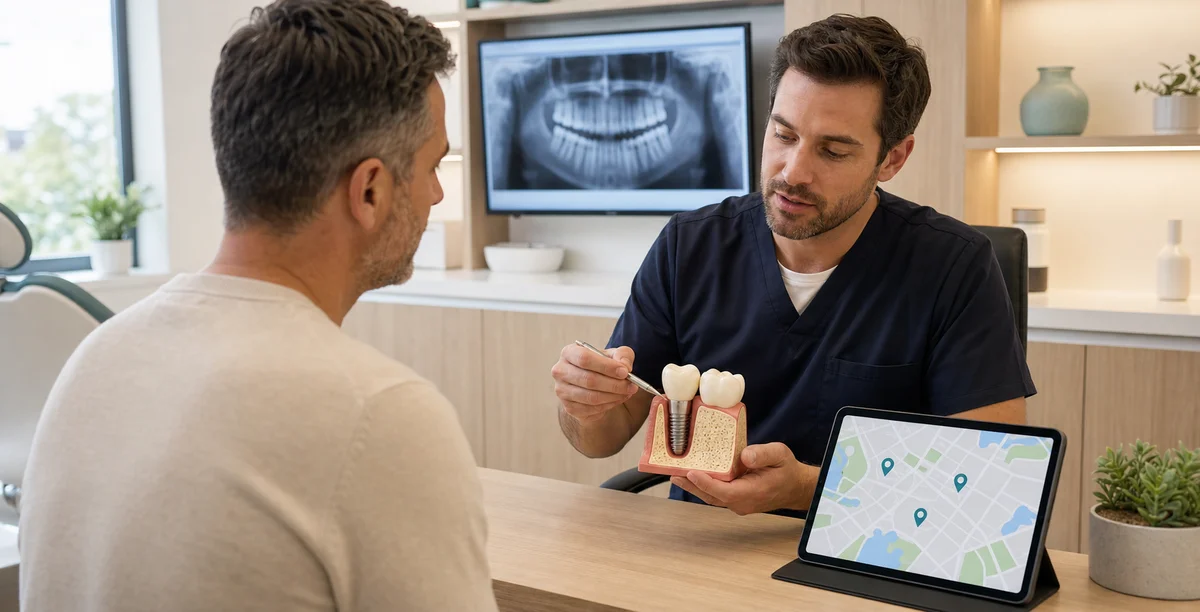
Quick answer: To compare dentists that do dental implants near me, verify current licensure through the relevant authority, ask who plans each surgical and restorative stage, review diagnostics, risks, alternatives, implant records, written costs, maintenance, and emergency arrangements. Distance matters, but a convenient clinic is not automatically the safest clinical fit.
A search for dentists that do dental implants near me often begins after tooth loss, a failing tooth, an uncomfortable denture, or a recommendation from another clinician. Search results can produce a long list within seconds, yet proximity alone does not show whether a provider has assessed your diagnosis, can coordinate surgery and restoration, uses traceable components, or will be available for maintenance. The goal is not to identify a universally “best” dentist. It is to build a safe shortlist and compare how each team approaches your individual needs.
Dental implants are not just cosmetic products. The U.S. Food and Drug Administration describes them as medical devices surgically implanted into the jaw to support artificial teeth such as crowns, bridges, or dentures. Treatment can involve diagnosis, surgery, healing, prosthetic design, hygiene, and long-term review. This guide explains how to evaluate providers without promising candidacy, a fixed fee, a specific timeline, or a guaranteed result. Only an appropriate clinical assessment can establish which options are reasonable for you.
1. Start the dentists that do dental implants near me search with your need
Before comparing clinic websites, define what problem you are trying to solve. Replacing one missing tooth is different from stabilizing a removable denture or rebuilding a complete arch. A cracked tooth may still need a restorability assessment before extraction is considered. Gum disease, decay, infection, bite problems, or a poorly fitting prosthesis can affect both the recommendation and sequence. When you search for dentists that do dental implants near me, include the type of evaluation you need rather than assuming an implant is already the correct answer.
Write down your main concerns: chewing, appearance, speech, comfort, repeated repairs, treatment anxiety, time constraints, medical conditions, and budget boundaries. Bring a current medicine list and any relevant dental records. This gives prospective clinics enough context to explain whether they routinely manage cases like yours and what information they need before giving advice.
The search should also preserve alternatives. Depending on the findings, reasonable choices may include monitoring, preserving a tooth, a conventional bridge, a removable partial or complete denture, an implant-retained removable restoration, an implant-supported fixed restoration, or phased treatment. A provider should be able to explain why one route fits your situation and what trade-offs come with each option.
Use dentists that do dental implants near me as a discovery phrase, then let diagnosis determine whether implant care belongs on your option list.
2. Understand which clinicians may be involved
The phrase dentists that do dental implants near me does not specify professional role. In many settings, a general dentist may provide some or all implant services. Periodontists, oral and maxillofacial surgeons, prosthodontists, and other appropriately trained clinicians may participate, depending on jurisdiction, complexity, and practice model. Titles, specialty recognition, and scopes of practice vary by country or state, so verify them with the relevant regulator rather than relying only on advertising language.
Implant care has both surgical and restorative components. One clinician may place the implant while another designs and delivers the crown, bridge, or denture. In an integrated clinic, the team may coordinate these stages internally. Neither model is automatically superior. What matters is that responsibilities are clear, records are shared, the restorative outcome guides implant positioning, and one named person coordinates questions and complications.
- Who makes the diagnosis and discusses alternatives?
- Who plans and performs implant placement?
- Who designs and delivers the final restoration?
- Who manages gum health, hygiene, and long-term reviews?
- Who responds if pain, swelling, loosening, or breakage occurs?
- Will any part of care be referred to another location or professional?
Ask these questions before comparing fees. A quote from one provider may cover surgery only, while another includes both surgery and restoration. The team structure can therefore change what an apparently similar offer actually represents.
For dentists that do dental implants near me, role clarity matters as much as proximity because surgery and restoration must support the same outcome.
3. Build a shortlist beyond the first map results
Search engines are useful for location and opening hours, but ranking is not a clinical credential. Sponsored placement, review volume, and polished photographs can influence visibility. The American Dental Association’s MouthHealthy guidance suggests practical starting points such as its Find-a-Dentist tool, local dental societies, trusted referrals, health departments, and dental schools. It also reminds readers that online reviews reflect individual experiences and needs.
Use at least two routes to create a shortlist of dentists that do dental implants near me. For example, combine a map search with an insurer directory, professional association tool, recommendation from your current dentist, or regulator lookup. Then visit each clinic’s own site to identify the named clinicians, treatment locations, contact information, accessibility, languages, and emergency arrangements.
Do not treat association membership as a substitute for licensure, or licensure as proof of implant-specific experience. Each source answers a different question. A regulator can confirm whether a license is current and may publish disciplinary information. A professional directory can help identify members or recognized specialties. A clinic consultation is where you assess communication, case selection, planning, and continuity.
A credible dentists that do dental implants near me shortlist combines location tools, official verification, and direct consultation rather than trusting one ranking signal.
4. Verify licensure, training, and relevant experience
For every name on your dentists that do dental implants near me shortlist, confirm the clinician’s identity and current professional status through the official dental licensing authority for the place where treatment will occur. The clinic name alone is not enough. Ask who will actually perform surgery and who will deliver the restoration. If a specialty or board certification is advertised, confirm it through the body that issues or recognizes it in that jurisdiction.
Training and experience should be discussed in relation to your proposed procedure. A single posterior implant, an aesthetic front-tooth implant, a grafted site, an implant overdenture, and a full-arch fixed bridge present different planning demands. Instead of asking only “How many implants have you placed?”, ask how the provider evaluates cases like yours, which cases they refer, how they maintain competence, and what complications they encounter and manage.
Numbers without context can mislead. A high procedure count does not reveal case selection, outcome definitions, follow-up duration, or whether the same clinician completed the prosthetic stage. A thoughtful provider should be willing to describe their workflow, limitations, referral network, and approach to unexpected findings without promising a perfect result.
When comparing dentists that do dental implants near me, ask for experience relevant to your proposed procedure instead of accepting an unexplained total.
5. Use the consultation to test communication and consent
The ADA’s guidance on choosing a dentist emphasizes meeting the team, bringing records, asking about prevention, emergencies, financial options, and permanent records, and selecting a clinician who can act as a health-care partner. Apply that approach when meeting dentists that do dental implants near me. Notice whether the clinician listens before recommending treatment, explains uncertainty, and invites questions.
A high-quality consultation should separate what is known from what still needs examination or imaging. It should explain the diagnosis in plain language, describe alternatives including no immediate implant treatment where appropriate, and outline material benefits and risks. Consent is a continuing discussion, not just a signature on the day of surgery.
- Can the team explain the diagnosis without sales pressure?
- Do they ask about health conditions, medicines, allergies, nicotine use, and previous healing?
- Are benefits, limitations, risks, and alternatives discussed in understandable language?
- Can you receive the proposed plan and consent materials before deciding?
- Are interpreter or accessibility needs supported?
- Is there enough time for a second opinion before irreversible care?
Your comfort matters, but comfort should not be confused with agreement. A trustworthy clinician may explain that an advertised approach is unsuitable, that more records are needed, or that preserving a tooth deserves consideration. That caution can be evidence of responsible case selection.
The best dentists that do dental implants near me consultation for you should support informed choice, including the choice to pause or seek another opinion.
6. Expect a patient-specific diagnostic process
Reputable dentists that do dental implants near me do not establish candidacy from a map listing, a price advertisement, or a photograph alone. Assessment may include a medical and dental history, examination of teeth and gums, bite evaluation, appropriate radiographs, scans or impressions, and three-dimensional imaging when clinically justified. The records needed depend on the problem and proposed treatment.
The FDA advises patients to discuss benefits, risks, and candidacy with their dental provider. It notes that overall health can affect candidacy and healing, and that smoking may impair healing and long-term success. Other individual factors can also matter, including active gum disease, uncontrolled infection, restorative space, bone anatomy, oral hygiene, medicines, previous radiation, and the ability to attend follow-up. These factors require clinical interpretation; a checklist cannot diagnose you.
Ask the provider to show how the diagnosis supports the plan. If extraction is proposed, ask whether the tooth is restorable and what evidence supports removal. If grafting is proposed, ask about its objective, timing, alternatives, and how it changes the treatment pathway. If immediate loading is discussed, ask which clinical findings must be present before that option can be confirmed.
Responsible dentists that do dental implants near me should distinguish a preliminary discussion from a recommendation confirmed by adequate clinical records.
7. Compare the complete implant and restoration plan
When people contact dentists that do dental implants near me, they may assume the implant is the visible tooth. In fact, the implant body is placed in bone, an abutment or other component connects to it, and a crown, bridge, or denture restores function and appearance. The FDA explains that implant systems include the implant body and abutment and may include an abutment fixation screw. A treatment quote should specify both the surgical device and the restoration it will support.
Ask for a stage-by-stage plan: diagnosis and disease control, extraction if necessary, tissue management, implant placement, healing, provisional restoration, final restoration, and maintenance. Some stages may happen together, while others may need separation. The ADA’s patient information describes placement, osseointegration, and delivery of the artificial tooth or teeth as distinct phases, with timing that varies.
For a single tooth, compare implant position, provisional plan, final crown material, aesthetic goals, and management of adjacent teeth and gums. For multiple teeth, clarify whether the proposal is a bridge, removable overdenture, or fixed full-arch restoration. Ask how the design can be cleaned and what repair or remake may involve.
Quotes from dentists that do dental implants near me become comparable only when the same surgical, provisional, restorative, and follow-up stages are included.
8. Ask about the implant system and records
Traceability is an important question for dentists that do dental implants near me. The FDA recommends asking for the brand and model of the implant system and keeping that information with your health records. Implant components are not universally interchangeable, and knowing the system can help another provider identify compatible parts if maintenance or urgent repair is later needed.
Ask whether you will receive an implant record after placement. Useful information may include the manufacturer, system, model, dimensions, site, placement date, relevant component details, and treating clinician. Keep copies of imaging, consent documents, prescriptions, laboratory information, restoration details, and follow-up instructions as well.
A well-known brand does not guarantee clinical success, and a device choice cannot compensate for unsuitable planning or poor maintenance. The purpose of the question is traceability, evidence, component access, and informed consent. Be cautious if a clinic refuses to identify the system or suggests that records are unnecessary.
Traceable dentists that do dental implants near me care includes an implant record you can retain, not just a brand mentioned during a sales conversation.
9. Review infection prevention, facility, and anesthesia arrangements
Implant placement is a surgical procedure, so your comparison of dentists that do dental implants near me should include the treatment environment. Ask where surgery takes place, how instruments are processed, how sterile materials are handled, and how the team responds to medical emergencies. Patients are not expected to audit a clinic, but the staff should answer reasonable questions clearly and comply with applicable local rules.
Local anesthesia is common. Sedation options, when appropriate, vary in depth, staffing, monitoring, credential requirements, recovery, and cost. Ask who administers sedation, what training and authorization they hold, what pre-operative instructions apply, and whether an escort is required. Disclose all medicines, supplements, allergies, previous anesthesia reactions, sleep apnea, pregnancy status, and relevant health conditions.
Also confirm how prescriptions, after-hours concerns, and unexpected medical issues are handled. A clinic that refers anesthesia or surgery elsewhere should identify the facility and responsible clinician in advance. The quote should distinguish professional, facility, sedation, imaging, and laboratory charges rather than presenting them as surprises.
Include facility and anesthesia questions when screening dentists that do dental implants near me, because these services can involve different professionals and safety responsibilities.
10. Understand benefits, risks, and follow-up
The FDA states that dental implants can support chewing and appearance and can help preserve surrounding structures, but complications can occur early or later. Listed risks include damage to nearby teeth or tissues, sinus or jaw injury, bite problems, screw loosening, implant-body failure, infection, delayed healing, cleaning difficulty, untreated periodontal disease, and nerve injury. Your discussion with dentists that do dental implants near me should reflect the risks relevant to the proposed site and procedure.
Ask how the clinician reduces and monitors risk, what symptoms require a call, and who manages complications. A practice should not promise that every implant will integrate or last for life. It should explain foreseeable alternatives if placement is not possible, initial stability is insufficient, healing is delayed, or the restoration needs repair.
The FDA also recommends following hygiene instructions, cleaning implants and surrounding teeth, scheduling regular visits, and contacting the provider if an implant feels loose or painful. Long-term care therefore belongs in the original selection decision. A nearby clinic that cannot provide maintenance may be less convenient over time than a coordinated team with a clear recall plan.
Long-term dentists that do dental implants near me comparisons should include maintenance access, not merely the availability of a surgical appointment.
11. Decision table for dentists that do dental implants near me
Use this table to compare written information from dentists that do dental implants near me. It is not a scoring tool and does not replace professional judgment. A clinic may have a different workflow and still provide appropriate care; the important point is that responsibilities, evidence, and contingencies are understandable.
| Decision area | Strong information to request | Reason to pause |
|---|---|---|
| Credentials | Named clinicians, current licensure, verifiable specialty claims, defined roles | Unnamed surgeon or unverified title |
| Diagnosis | History, examination, justified imaging, alternatives, patient-specific reasoning | Guaranteed candidacy from a photo or message |
| Treatment scope | Surgery, components, provisional, final restoration, reviews, exclusions | Implant-only price presented as complete care |
| Safety | Consent, infection prevention, anesthesia roles, emergency and complication plan | Risks dismissed or consent rushed |
| Traceability | Implant brand and model record, imaging, laboratory and restoration records | System kept secret or records refused |
| Continuity | Named follow-up provider, maintenance schedule, after-hours contact | No plan after final delivery |
| Financial consent | Itemized written estimate, assumptions, payment stages, finance terms | Pressure to pay before assessment |
The strongest dentists that do dental implants near me candidate is the one whose documented plan fits your clinical needs—not simply the clinic with the most checklist marks.
12. Compare written costs without choosing on price alone
Fees from dentists that do dental implants near me may differ because their quotes include different services. One may cover implant placement only; another may include extraction, grafting, a provisional restoration, the final crown, and follow-up. The number alone is not meaningful until the same clinical scope is compared. Avoid assuming that the lowest estimate is unsafe or that the highest is best.
Request an itemized estimate after sufficient assessment. It should identify examinations, imaging, extractions, grafting or tissue procedures, implant and components, surgical guide if used, anesthesia or sedation, temporary restoration, final restoration, laboratory work, review visits, maintenance, and possible contingencies. It should also explain which parts are not yet knowable.
If financing is offered, compare the cash price with the financed principal, annual percentage rate, fees, term, total of payments, late-payment consequences, refund rules, and whether a third party provides the credit. A monthly figure is not the total cost. Do not let a limited-time offer rush a decision involving surgery or extraction.
Financial comparisons among dentists that do dental implants near me should use the same treatment scope and the total payable amount, not a promotional monthly figure.
13. Check insurance and network details directly
Some people narrow dentists that do dental implants near me by insurance network. That can be practical, but network participation does not establish clinical suitability, and coverage does not necessarily mean every stage is paid. Benefits vary by plan, diagnosis, procedure code, waiting period, annual maximum, missing-tooth provision, network status, and documentation.
Confirm network status with both the clinic and insurer. Ask for a pre-treatment estimate or predetermination when available, while recognizing that it may not guarantee payment. Clarify how diagnostic, surgical, restorative, anesthesia, and maintenance services are coded and who is responsible for an unpaid balance.
If the clinic is outside your network, ask for the same itemized information before comparing expected out-of-pocket costs. Do not rely on a website’s general insurance statement. Plan rules and provider contracts can change, and only the insurer can explain your current benefits.
Insurance filters can narrow dentists that do dental implants near me, but they cannot replace a clinical review of suitability and treatment design.
14. Let distance reflect the number of follow-up visits
Convenience is a legitimate factor when evaluating dentists that do dental implants near me. Implant care can require assessment, surgery, checks, restoration visits, hygiene, and later maintenance. A clinic’s distance, hours, parking, public transport, accessibility, language support, and ability to handle urgent concerns can affect whether you complete the plan comfortably.
Ask for a realistic visit schedule rather than a best-case minimum. Healing and prosthetic adjustments vary. A provisional tooth may require review, the final restoration may involve multiple records or try-ins, and complications may create additional appointments. If surgery and restoration occur in different offices, include travel to both.
For a distant or international provider, continuity needs extra planning. Identify who will evaluate you locally if pain, swelling, loosening, or fracture occurs. Obtain complete records and ask whether return travel is required for routine maintenance or component replacement. A lower clinical fee can be outweighed by travel and fragmented aftercare, although the final decision remains individual.
Distance changes the practical value of dentists that do dental implants near me, especially when the pathway requires several reviews or unplanned care.
15. Know urgent symptoms and emergency arrangements
When calling dentists that do dental implants near me, ask how they handle urgent problems during healing and after restoration. The FDA advises contacting the dental provider promptly if an implant feels loose or painful. Clinics should provide post-operative instructions and a route for questions outside normal hours.
Some discomfort and swelling can occur after surgery, but only the treating team can tell you what is expected in your case. Seek prompt professional advice for worsening symptoms, fever, spreading swelling, persistent bleeding, altered sensation, a loose implant or restoration, or difficulty eating and drinking. Breathing or swallowing difficulty, severe uncontrolled bleeding, or rapidly worsening facial swelling requires urgent emergency assessment.
Do not wait for an implant consultation if you have an acute infection, significant trauma, or another urgent dental problem. Contact a local dental or emergency service appropriate to the severity. Online information cannot safely triage every symptom.
Emergency access is part of the dentists that do dental implants near me decision because problems do not always occur during routine office hours.
16. Watch for marketing and consent red flags
Advertisements for dentists that do dental implants near me may use dramatic before-and-after images, countdown offers, financing headlines, or labels such as “permanent teeth.” Marketing should not replace diagnosis. No provider can responsibly guarantee candidacy, painless care, implant integration, a specific lifespan, or an identical cosmetic result for every patient.
- Pressure to book surgery or pay a large non-refundable amount before assessment.
- A recommendation to remove teeth without discussing restorability or alternatives.
- A package price that does not identify the final restoration.
- Unclear clinician names, roles, licenses, or treatment location.
- No discussion of risks, maintenance, or possible additional procedures.
- Claims that follow-up is unnecessary or that complications cannot occur.
- Refusal to provide implant identifiers or copies of your records.
A professional website can still belong to a responsible practice, and a simple website can belong to an excellent clinician. Judge the clinical process, documentation, communication, and continuity—not production value alone.
Marketing can help you discover dentists that do dental implants near me, but clinical evidence and verifiable professional information should guide the shortlist.
17. Use second opinions for irreversible or complex plans
A second opinion is especially useful when dentists that do dental implants near me recommend removing restorable teeth, extensive grafting, immediate full-arch treatment, or markedly different plans. It does not imply that the first clinician is wrong. It helps you compare diagnosis, alternatives, treatment burden, restorative design, risks, and maintenance.
Bring the same records and questions to both consultations. Ask each clinician to explain which findings are certain, which assumptions may change, and why their design fits your priorities. Differences can arise from philosophy, training, prosthetic preferences, or interpretation of anatomy. What matters is whether the reasoning is evidence-based and understandable.
Do not shop for a second opinion only to obtain the answer you hoped to hear. Give more weight to transparent reasoning, respect for alternatives, and willingness to coordinate care than to certainty or sales pressure.
Different recommendations from dentists that do dental implants near me deserve an explanation of diagnostic assumptions, not an automatic choice of the faster plan.
18. Redent Klinik and international treatment enquiries
Redent Klinik is located in Istanbul, so it may not be geographically “near” every reader searching for dentists that do dental implants near me. The Redent Klinik English homepage provides general information for local and international patients. An online enquiry can help organize your concerns and existing records, but it cannot confirm implant candidacy or replace an in-person clinical assessment and justified imaging.
International treatment requires the same checks as local care plus travel and continuity planning. Ask how many visits are expected, who performs each stage, which records you receive, what happens if the plan changes after examination, and who manages follow-up after you return home. Include flights, accommodation, time away, return visits, exchange costs, and local aftercare when comparing options.
You can use the Redent Klinik contact page to request a consultation and ask which records may help preliminary review. A personalized plan should follow an appropriate assessment and explain diagnosis, alternatives, stages, materials, inclusions, exclusions, risks, and maintenance. Do not delay urgent local care while waiting for an international estimate.
For readers searching dentists that do dental implants near me, Redent Klinik should be evaluated as a travel-care option whenever Istanbul is not locally accessible.
Frequently asked questions about dentists that do dental implants near me
How do I verify dentists that do dental implants near me?
Start with the official licensing authority where treatment will occur and search the individual clinician’s name, not only the clinic. Confirm current status and verify any advertised specialty or board credential through its issuing body. Then ask who performs surgery, who restores the implant, and how the team handles referrals. Professional association directories can help create a shortlist but do not replace regulator verification.
Verification makes a dentists that do dental implants near me search safer by separating map visibility from current professional status.
Which type of dentist can place dental implants?
Rules and training pathways vary by jurisdiction. General dentists and recognized specialists may provide implant services when appropriately trained and authorized. The more useful question is whether the named clinician has relevant education, experience, case-selection judgment, facilities, and a coordinated restorative plan for your proposed procedure. Verify scope and credentials with the applicable regulator instead of relying on a title in an advertisement.
The phrase dentists that do dental implants near me can include several professional backgrounds, so assess the individual clinician and proposed scope.
Should dentists that do dental implants near me provide both surgery and the crown?
They may, but they do not have to. One clinician can place the implant and another can provide the crown, bridge, or denture. This team model can work well when planning and records are coordinated. Ask who owns each decision, how the restorative goal guides implant position, where appointments occur, how fees are divided, and who manages complications that cross surgical and restorative stages.
Can I get an accurate implant quote by phone?
A clinic can explain its fee structure and offer a preliminary estimate, but a patient-specific quote usually depends on diagnosis, examination, imaging, restoration type, tissue needs, anesthesia, and follow-up. Ask what the estimate assumes and excludes. Be cautious if a provider guarantees a final fee or candidacy from a brief call or photograph without enough clinical information.
What should I ask dentists that do dental implants near me about the implant brand?
Ask which manufacturer, system, and model are proposed; why the system fits the plan; whether components are traceable and locally available; and which records you will receive. The FDA recommends keeping implant brand and model information. Brand alone does not predict success, but traceability can make future maintenance, compatible-part identification, and adverse-event reporting more practical.
How close should an implant dentist be?
There is no universal distance. Consider the expected number of assessment, surgical, restorative, and maintenance visits; your mobility; travel time; work and caregiving commitments; and access to urgent care. A slightly farther coordinated team may be more practical than a nearby office offering only one stage. For distant treatment, establish a local follow-up plan before surgery.
Do online reviews identify the best implant provider?
Reviews may reveal patterns in communication, scheduling, or patient experience, but they cannot verify diagnosis, clinical appropriateness, device traceability, or long-term outcomes. Individual needs differ, and reviews can be incomplete or selectively presented. Use them as one signal after checking licensure, named clinicians, treatment scope, informed consent, records, and continuity of care.
What records should dentists that do dental implants near me give me?
Request copies of the treatment plan, consent documents, relevant imaging, prescriptions, implant brand and model details, site and placement date, component information when available, laboratory or restoration details, maintenance instructions, and contact information. Records are particularly important if surgery and restoration occur in different clinics or if you may relocate or travel after treatment.
Final 15-check shortlist
Before selecting among dentists that do dental implants near me, confirm these points in a form you can compare:
- The treating clinicians are named.
- Licensure and advertised credentials are verifiable.
- The provider has relevant experience and clear referral boundaries.
- The diagnosis is based on an appropriate examination and records.
- Alternatives, including tooth preservation where relevant, are discussed.
- Surgical and restorative responsibilities are coordinated.
- The plan defines provisional and final restorations.
- Benefits, risks, limitations, and contingencies are understandable.
- The implant system is traceable and records will be supplied.
- Infection prevention, anesthesia, and emergency arrangements are clear.
- The written estimate is itemized and assumptions are identified.
- Insurance and financing details are checked independently.
- The visit schedule is realistic for the distance.
- Maintenance and urgent follow-up have named providers.
- You have time to review the plan or seek a second opinion.
The search phrase dentists that do dental implants near me should lead to a careful clinical conversation, not an instant purchase. A sound decision balances diagnosis, appropriate training, restorative planning, risk communication, traceability, maintenance, access, and cost. No web guide can determine whether implants are suitable for you, and no ethical provider can guarantee a particular outcome or lifespan.
Ultimately, dentists that do dental implants near me is the beginning of a shortlist; informed consent and individualized planning determine whether a provider fits your care.
Sources and further reading
- U.S. Food and Drug Administration: Dental Implants — What You Should Know
- American Dental Association MouthHealthy: Implants
- American Dental Association MouthHealthy: How to Choose a Dentist
- American Dental Association
- World Health Organization: Oral Health Fact Sheet
Sources accessed August 20, 2026. This article is educational and does not replace an examination, diagnosis, or individualized treatment plan.