
Quick answer: When searching for zygomatic dental implants near me, compare more than distance or advertising. Look for a team with documented zygomatic surgery and full-arch restorative expertise, midface CT/CBCT planning, sinus assessment, clearly explained alternatives, hospital-level emergency readiness, written fees, and long-term maintenance. This is complex treatment for selected cases, not a routine implant shortcut.
A search for zygomatic dental implants near me often begins after someone has been told that the upper jaw has too little bone for conventional implants, that previous grafts or implants failed, or that a removable prosthesis is difficult to tolerate. The search results can make the procedure look like a standardized product. It is not. Zygomatic implants are longer implants that obtain anchorage in the cheekbone region and are used in selected reconstructions of a severely deficient upper jaw. Planning involves the maxilla, zygoma, sinus, orbit-adjacent anatomy, prosthetic design, hygiene access, and the patient’s general health.
The International Team for Implantology’s 2023 consensus describes this as complex care whose success depends heavily on clinician skill and experience, with both surgical and restorative expertise needed. The same consensus recommends CT or CBCT that includes the midface, three-dimensional assessment of maxillary and zygomatic bone, and evaluation for existing sinus disease. Those recommendations change the question from “Which office is closest?” to “Which team can plan, perform, restore, and maintain this treatment safely?”
This guide does not diagnose candidacy, recommend a particular number of implants, or promise an outcome. It translates current consensus and review evidence into practical questions for patients. A personal decision requires examination, medical and dental history, suitable imaging, and discussion of realistic alternatives. If you have rapidly increasing swelling, difficulty breathing or swallowing, uncontrolled bleeding, visual changes, or a serious facial injury, seek urgent medical assessment rather than relying on an online guide.
1. Understand what zygomatic implants are—and what they are not
Conventional dental implants usually rely on bone within the upper or lower jaw. A zygomatic implant follows a much longer path and gains support from the zygomatic bone. It may be combined with conventional implants, or more than one zygomatic implant may be considered on each side in highly selected circumstances. The final choice depends on anatomy, remaining bone, prosthetic goals, previous treatment, and the team’s assessment. A page targeting zygomatic dental implants near me cannot determine which configuration is appropriate for you.
This approach is generally discussed for severe maxillary atrophy or deficiency, previous graft or implant failure, or certain defects after resection, trauma, or congenital conditions. It should not be assumed to be better simply because it may avoid a staged graft in some cases. Avoiding one procedure can introduce a different set of surgical, sinus, prosthetic, and maintenance considerations. For anyone searching zygomatic dental implants near me, the appropriate comparison is between complete treatment pathways, not between isolated components.
Zygomatic implants also do not automatically mean “teeth in one day.” Immediate provisional restoration may be possible when primary stability, implant distribution, occlusion, and other factors are suitable, but delayed loading remains clinically acceptable. The provisional prosthesis is not always the final prosthesis, and function must be controlled during healing. When reviewing zygomatic dental implants near me, ask the team to separate surgery, provisional restoration, final restoration, and maintenance into distinct stages.
2. Who may be considered a candidate?
Candidacy begins with the problem to be solved. Severe loss of upper-jaw bone, inability to place conventional implants in strategic sites, previous failure, or a maxillofacial defect may prompt evaluation. The ITI consensus supports zygomatic implants as an evidence-based alternative for selected partially or completely edentulous maxillae, often splinted with other implants. A zygomatic dental implants near me page must not turn that statement into a universal recommendation for every person with bone loss.
Your clinicians should review medical conditions, medicines, allergies, smoking or nicotine exposure, previous radiotherapy, antiresorptive medication, sinus symptoms, oral hygiene capacity, mouth opening, expectations, and ability to attend follow-up. None of these can be screened reliably by a short form alone. A responsible zygomatic dental implants near me consultation will ask what caused the bone loss and why previous treatments succeeded or failed.
The remaining teeth and implants matter too. Extraction of salvageable teeth should not be treated as an automatic step toward a package. Each tooth requires a prognosis, and its role in alternative plans should be discussed. When a zygomatic dental implants near me provider proposes extractions and placement together, infection, hard and soft tissue conditions, clinician experience, and patient preference deserve explicit attention because combined procedures may alter risk.
- Reason for severe maxillary deficiency and whether the condition is stable.
- Sinus history, nasal symptoms, prior sinus surgery, and current disease.
- General health, medications, healing risks, and anesthesia suitability.
- Remaining teeth, previous implants, grafts, prostheses, and records.
- Hygiene ability, smoking status, clenching or grinding, and maintenance access.
- Expectations for appearance, speech, lip support, chewing, and treatment time.
3. Why midface CT/CBCT and sinus assessment are essential
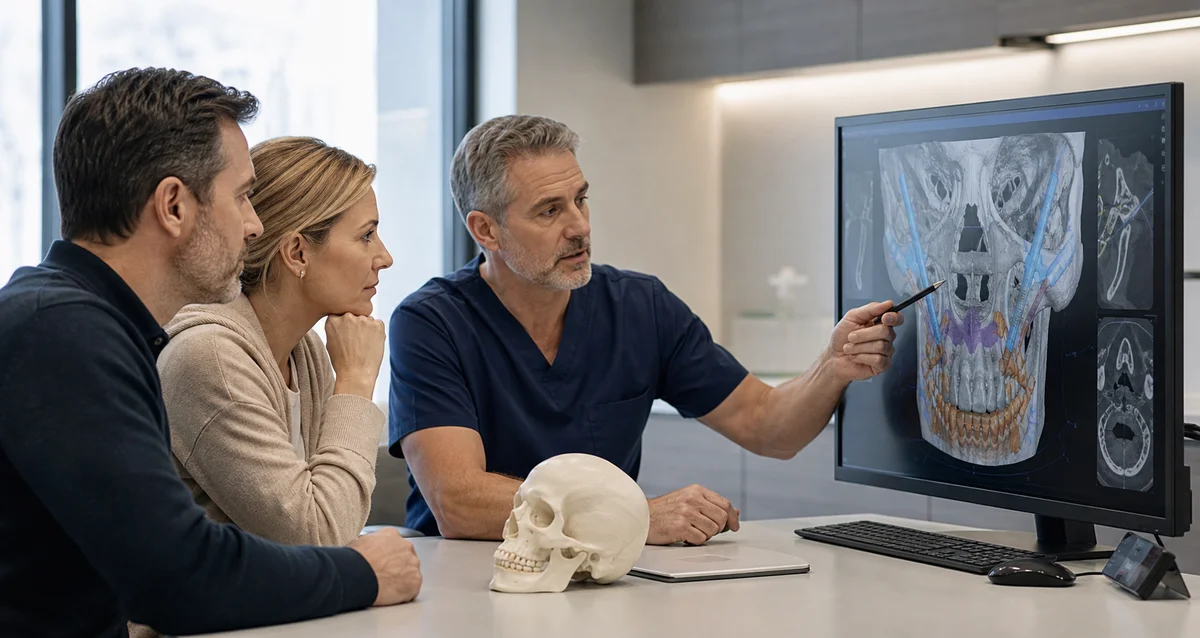
A panoramic image alone does not show the three-dimensional surgical corridor with the detail required for this treatment. ITI recommends CT or CBCT that includes the midface, enabling assessment of maxillary and zygomatic bone volume and sinus health. The scan should be interpreted in the context of examination and prosthetic planning. When comparing zygomatic dental implants near me, ask who reviews the scan and whether radiology or ear, nose, and throat input is available when findings are uncertain.
The team must study implant trajectory in relation to the orbit, infraorbital nerve region, sinus, nasal cavity, infratemporal space, soft tissues, and intended prosthetic emergence. A digital line on a screen is only one part of planning. Direct knowledge of anatomy, adequate visualization during surgery, and a plan for unexpected findings remain critical. In zygomatic dental implants near me results, guided or navigated technology may support planning or execution, but it does not replace expertise or eliminate complications.
Existing sinus disease should be identified and addressed before elective reconstruction when appropriate. A history of recurrent sinusitis, congestion, facial pressure, prior surgery, or abnormal imaging may change the sequence of care. A high-quality zygomatic dental implants near me evaluation will not dismiss persistent sinus symptoms as unrelated, nor will it promise that one surgical approach prevents all sinus problems.
4. Evaluate the team, not just one clinician’s marketing profile
Zygomatic implant rehabilitation combines advanced surgery and complex prosthodontics. The surgical path must be safe, while implant positions must support a prosthesis that is stable, cleansable, functional, and acceptable in appearance and speech. A technically integrated zygomatic dental implants near me team may include an oral and maxillofacial surgeon or an appropriately trained implant surgeon, a restorative dentist or prosthodontist, anesthesia professionals, radiology support, dental technicians, hygienists, and access to ENT or ophthalmology services if needed.
Ask how many comparable cases the named clinicians have planned, performed, restored, and followed—not how many the brand claims collectively. Experience should be relevant to your anatomy and proposed configuration. The best answer is not necessarily a large number; it is a transparent description of roles, training, case selection, complications encountered, and how those complications were managed. Results pages for zygomatic dental implants near me may blur the difference between a visiting surgeon and a continuously responsible team.
Confirm who will make decisions if the planned implant path is not feasible, who delivers the temporary and final prosthesis, and who is available after hours. Ask whether the zygomatic dental implants near me center operates in an environment with suitable monitoring, sterile processing, medications, rescue equipment, and transfer procedures. Complexity should be matched by infrastructure rather than hidden behind spa-like presentation.
5. Compare zygomatic implants with complete alternatives
Alternatives may include a removable complete denture, an implant-retained removable prosthesis, conventional implants where bone permits, short or tilted implants in selected sites, staged bone augmentation, different grafting strategies, or no surgical treatment. Not every option is feasible for every anatomy, and each has its own treatment time, morbidity, maintenance, cost, and uncertainty. A credible zygomatic dental implants near me consultation should explain why reasonable alternatives are unsuitable or less aligned with your priorities.
Comparison must start with the same treatment goal. A removable prosthesis, a fixed full-arch bridge, and a reconstruction after tumor surgery solve different functional and anatomical problems. Lip support, smile line, speech, opposing teeth, restorative space, cantilever, cleaning access, and patient dexterity affect prosthetic design. In any zygomatic dental implants near me decision, the implant is a foundation; the day-to-day outcome is experienced through the prosthesis.
| Decision point | Question to ask | Reassuring answer | Warning sign |
|---|---|---|---|
| Indication | Why is a zygomatic pathway being considered? | Objective anatomy and treatment history are shown | It is offered as the default premium option |
| Imaging | Does the scan include the midface and sinus? | 3D anatomy and sinus findings are reviewed | A remote quote is made from photographs alone |
| Team | Who performs, restores, and maintains treatment? | Named clinicians and responsibilities are documented | The operator is unclear until surgery day |
| Alternatives | What are the grafted, graftless, and removable options? | Benefits, limits, timing, and risks are balanced | Only one package is discussed |
| Complications | How are sinus or orbital concerns managed? | Prevention, referral, and emergency pathways are clear | Risk is minimized as “the same as routine implants” |
| Maintenance | How will the prosthesis and tissues be monitored? | A written long-term schedule and cleaning plan exist | Care ends when the bridge is fitted |
6. Make the prosthetic plan before finalizing surgery
Implants should be positioned to support a planned restoration, not placed first with the hope that a workable bridge can be designed later. The team should evaluate tooth display, lip support, facial profile, speech, vertical restorative space, opposing dentition, bite forces, cantilever, material, screw-access paths, and cleaning access. When assessing zygomatic dental implants near me, ask to see how the proposed tooth position relates to the scan and implant paths.
A trial setup, digital design, or provisional prosthesis can help test appearance, phonetics, and function. These tools improve communication but are not guarantees. Swelling, healing, tissue changes, muscle adaptation, and technical limitations can alter the result. A zygomatic dental implants near me consent discussion should distinguish a simulation from an assured outcome.
Ask whether the restoration is fixed or removable, what “fixed” means in practical maintenance, and whether only the clinical team can remove it. Learn how you will clean beneath it and what happens if a tooth, screw, framework, or veneering material is damaged. A zygomatic dental implants near me provider should plan repairability and access before treatment begins.
7. Understand anesthesia, surgical setting, and contingency planning
Anesthesia may range from local anesthesia with sedation to general anesthesia, depending on the procedure, patient, clinician, and facility. Each pathway has eligibility requirements and risks. The person delivering sedation or anesthesia should be appropriately qualified, monitoring standards should match the depth of anesthesia, and recovery criteria should be defined. A zygomatic dental implants near me advertisement should never let the phrase “sleep dentistry” replace a formal anesthesia discussion.
Ask what happens if planned placement cannot be completed, primary stability is inadequate, the sinus findings differ from expectations, or the temporary prosthesis cannot be fitted. Consent should cover foreseeable alternatives without asking you to accept an unlimited change of plan. A prepared zygomatic dental implants near me team can explain its stop rules and backup pathways before surgery.
The facility should have infection-control systems, sterile instrument processing, emergency medicines and equipment, trained recovery staff, and a route to hospital care if escalation is needed. Proximity to a hospital is not the same as a transfer protocol. If a zygomatic dental implants near me operation is performed outside a hospital, ask how rare but serious complications would be recognized and managed.
8. Discuss complications without sensationalism or minimization
Systematic reviews report high implant survival in selected patients, but survival is not the same as freedom from complications, prosthetic success, comfort, or easy maintenance. Much of the evidence includes observational studies and case series, so percentages vary with technique, follow-up, definitions, and reporting quality. A safe zygomatic dental implants near me conversation should explain uncertainty rather than selecting the most flattering statistic.
Reported concerns include sinusitis, infection, oroantral communication, soft-tissue recession or overgrowth near abutments, altered sensation, nosebleed, bruising, prosthetic complications, implant malposition, and failure. Rare serious events involving the orbit or eye have also been described. A zygomatic dental implants near me provider should explain that mentioning these possibilities does not predict they will happen to you; it establishes why anatomical planning, surgical experience, follow-up, and referral access matter.
Ask which symptoms are expected after surgery and which require urgent contact. New visual disturbance, eye movement problems, severe or worsening eye-area pain, difficulty breathing, uncontrolled bleeding, rapidly increasing swelling, fever with deterioration, or neurological change should not be managed only by text message. The clinic should give you written emergency instructions and contact details.
9. Read survival claims in context
An implant can remain in place while the patient experiences sinus disease, hygiene difficulty, soft-tissue problems, speech concerns, or repeated prosthetic repairs. “Implant survival” therefore answers a narrower question than “Was the whole rehabilitation successful?” When comparing zygomatic dental implants near me, ask for outcome definitions, follow-up duration, patient-level complications, prosthesis survival, and maintenance burden.
Results from highly experienced centers may not transfer automatically to every zygomatic dental implants near me provider. Published groups also differ in anatomy, prior treatment, smoking, medical history, surgical technique, restoration, and follow-up. A quoted average cannot estimate your personal probability without a clinical assessment. Guarantees such as “100 percent success,” “risk-free,” or “lifetime solution” are incompatible with biological uncertainty.
Testimonials and before-and-after photographs show selected experiences. Lighting, facial expression, image editing, and follow-up timing influence appearance. They do not reveal sinus findings, cleaning access, bite forces, complications, or later repairs. Use them to understand a clinic’s communication style, not as proof that the same result will occur for you.
10. Use the “near me” search to test continuity of care
Location matters because this is not a one-visit transaction. You may need diagnostic appointments, surgery, provisional adjustments, final restorative stages, hygiene visits, imaging, and urgent review. A center found through zygomatic dental implants near me should be reachable not only on treatment day but throughout maintenance. Ask who covers care when the main surgeon or restorative clinician is unavailable.
zygomatic dental implants near me results can combine offices that perform the surgery regularly, clinics that host a visiting clinician occasionally, and lead-generation pages that refer patients elsewhere. Confirm the exact surgical address, legal healthcare provider, named operator, restorative dentist, and aftercare contact. Verify professional registration and facility authorization through appropriate local regulators rather than relying solely on website badges.
Distance should be weighed against expertise. The closest office may not be the best-equipped center for a rare complex procedure; the most distant “destination clinic” may create difficult follow-up. A sensible zygomatic dental implants near me decision balances team competence, infrastructure, travel demands, and a realistic plan for urgent and routine care.
11. If you are traveling, add a cross-border safety checklist
Travel can make treatment more affordable or accessible, but it also compresses decision-making and separates surgery from long-term care. A destination zygomatic dental implants near me plan should follow appropriate examination and imaging, not a photograph-only sales call. Confirm the clinic’s authorization, clinician registration, interpreter arrangements, data privacy, and who is responsible if the advertised plan changes.
Your itinerary should allow clinical flexibility. Healing cannot be guaranteed to match a flight date, and a temporary prosthesis may require adjustment. Ask when it is medically reasonable to fly, how pain and swelling will be monitored, and what symptoms would delay travel. A destination appearing in zygomatic dental implants near me results should provide written records and imaging that can be shared with clinicians at home.
Clarify who pays for extra accommodation, repeat surgery, emergency hospital care, replacement components, or travel if complications occur. A zygomatic dental implants near me “warranty” may cover only specific technical parts and require attendance at one clinic. It cannot remove biological risk. Independent travel insurance may exclude planned treatment or complications, so coverage must be checked directly with the insurer.
12. Compare cost by scope, not by headline price
The cost can depend on diagnostic imaging, anesthesia, surgical configuration, extractions, management of existing disease, provisional restoration, final prosthetic material, laboratory work, hospital resources, medications, follow-up, and maintenance. A fixed online price given before imaging relies on assumptions. When evaluating zygomatic dental implants near me, request an itemized written estimate linked to a written clinical plan.
Ask what is excluded and what events could change the total. Does the zygomatic dental implants near me estimate include CT/CBCT interpretation, anesthesia professional, facility fee, temporary and final prostheses, adjustments, hygiene equipment, night guard if indicated, scheduled reviews, and complication management? Are replacement components proprietary, and can another qualified clinic obtain them?
The lowest zygomatic dental implants near me price is not automatically unsafe, and the highest price is not proof of quality. Compare like with like: indication, named team, setting, imaging, prosthetic design, materials, follow-up, and contingency coverage. Avoid non-refundable pressure before you have had a meaningful consent discussion or an opportunity to seek a second opinion.
13. Plan recovery and long-term maintenance before treatment
Written postoperative guidance should explain medication, diet, hygiene, activity, swelling, bruising, bleeding, sinus-related precautions when relevant, and contact thresholds. Instructions must be individualized; do not stop anticoagulants, antiresorptive medication, diabetes treatment, or other prescribed medicines without coordination with the appropriate clinician. A zygomatic dental implants near me plan should include who reviews healing and when.
The prosthesis must remain cleansable. You may need special brushes, flossing devices, water irrigation, or professional maintenance based on the design and tissues. The zygomatic dental implants near me team should assess plaque control, soft tissues, screws, occlusion, prosthetic wear, patient comfort, sinus symptoms, and imaging when clinically indicated. Maintenance intervals are personal rather than universally fixed.
Long-term care should survive changes in staff or location. Keep copies of the implant record, component details, imaging, operative report, prosthetic design, medication history, and review schedule. If you move, ask how information will transfer. The value of a local zygomatic dental implants near me provider lies partly in dependable continuity, not only surgical convenience.
14. Red flags that justify pausing the process
- A definitive plan or surgical date is offered from photographs without suitable examination and midface imaging.
- Zygomatic implants are marketed as routine, risk-free, or suitable for everyone with upper-jaw bone loss.
- The surgeon, restorative clinician, anesthesia provider, or legal treatment location remains unnamed.
- Sinus health, orbital-adjacent anatomy, prosthetic emergence, and hygiene access are not discussed.
- Alternatives such as removable care, grafting, conventional implants, or no treatment are dismissed without reasons.
- Consent focuses on a signature while significant risks, uncertainties, and backup plans remain vague.
- A large immediate deposit is demanded before records, itemized scope, and second-opinion time are available.
- The clinic cannot explain urgent transfer, complication referral, or long-term maintenance arrangements.
One communication problem does not prove poor care, but several red flags together justify stopping and seeking another assessment. A confident zygomatic dental implants near me team should welcome informed questions. If your zygomatic dental implants near me search produces conflicting plans, ask each clinician to identify the anatomical assumptions and treatment priorities behind the difference rather than choosing by sales style.
15. Questions to take to your consultation
- What objective findings make me a possible candidate for this pathway?
- Does my scan include the midface, and what does it show about both sinuses and zygomatic bone?
- What reasonable conventional, grafted, graftless, removable, or no-treatment alternatives exist?
- Who will perform surgery, anesthesia, provisional restoration, final restoration, and maintenance?
- How does the prosthetic design address lip support, speech, bite, cantilever, and cleaning access?
- What complications are most relevant to my anatomy and health, and how would you manage them?
- What would cause you to change or stop the plan during treatment?
- Which parts of the estimate are fixed, conditional, included, or excluded?
- What records will I receive, and how is after-hours or travel-related care organized?
- What maintenance will I need for the prosthesis, tissues, implants, and sinus health?
To understand Redent Klinik’s broader approach, visit the Redent Klinik English homepage. For an individualized discussion and appointment request, use the English contact page. These links do not establish candidacy; the same safeguards described in this zygomatic dental implants near me guide still require personal assessment.
16. zygomatic dental implants near me: frequently asked questions
Are zygomatic implants simply longer conventional implants?
No. Although both are implant-supported approaches, zygomatic placement follows a different anatomical path and is used in selected severe maxillary deficiencies. It demands midface imaging, advanced surgical planning, prosthetic coordination, and management of sinus and orbit-adjacent risks. It should not be treated as a routine length variation.
Can I know whether I qualify from an online consultation?
An online discussion can collect history, explain the pathway, and identify records to obtain. It cannot replace examination and appropriate three-dimensional imaging. A final proposal for zygomatic dental implants near me should follow assessment of the maxilla, zygoma, sinus health, remaining teeth or implants, soft tissues, bite, prosthetic needs, and medical suitability.
Do zygomatic implants always avoid bone grafting?
A zygomatic dental implants near me team may provide a graftless alternative in selected cases, but “graftless” does not mean simple or lower risk. Some patients may still need other procedures, and a grafted pathway may remain reasonable. Compare total morbidity, timing, predictability, prosthetic outcome, maintenance, and personal preference with a qualified team.
Does immediate loading mean I receive final teeth the same day?
Usually the immediate restoration, when appropriate, is provisional and must protect healing while providing function and appearance. The final prosthesis may follow after clinical review and adjustments. Immediate loading depends on stability and the complete plan; it is not guaranteed by the implant type.
What is the most common complication discussed in reviews?
Sinusitis is repeatedly identified among the most common biological complications, though estimates vary substantially across studies, techniques, follow-up periods, and definitions. Infection, oroantral communication, soft-tissue issues, altered sensation, prosthetic complications, and rare serious orbital events are also reported. Your personal risk requires clinical evaluation.
Should an ENT specialist review every case?
Not necessarily every patient needs a separate ENT consultation. However, existing sinus symptoms, previous sinus surgery, abnormal imaging, or uncertainty may justify ENT input. The implant team should have a clear pathway for sinus evaluation and for referral if symptoms develop before or after treatment.
How do I verify experience claimed by a clinic?
Ask for the named clinician’s relevant training, registration, role, comparable case experience, complication management, and continuity of follow-up. Verify registration through the appropriate authority. Marketing portfolios do not substitute for credentials, and a clinic-wide case total may not reflect the operator who will treat you.
Is the closest center always preferable?
No. Proximity improves follow-up, but expertise and infrastructure are crucial for complex care. Balance distance with named surgical and restorative experience, appropriate imaging, anesthesia and emergency systems, complication referral, records, and maintenance. The best result from zygomatic dental implants near me is the safest complete pathway, not merely the shortest drive.
Conclusion: choose a complete care pathway, not a search result
Zygomatic implants can be a valuable reconstructive option for carefully selected patients with severe upper-jaw deficiency, including some who have experienced failed grafts or implants. They are also complex and anatomically demanding. Your decision should integrate diagnosis, midface CT/CBCT, sinus assessment, alternatives, surgical and restorative expertise, anesthesia setting, prosthetic design, emergency planning, written scope, and long-term maintenance.
Use zygomatic dental implants near me to identify possible centers, then evaluate each center with the same questions. Avoid guarantees, remote package decisions, and pressure to bypass a second opinion. This article is general education and will be reviewed by Dentist Esma Çevrük Çakır; it does not replace a clinical examination or advice from the professionals responsible for your care.
Sources
- International Team for Implantology — Indications and clinical recommendations for zygomatic implants
- ITI Consensus Report — planning, techniques, outcomes, and continuing care
- PubMed — 2026 umbrella review of clinical risk and complications
- PubMed — systematic review of ocular complications
- PubMed — systematic review of survival and complication rates
- American Dental Association
- World Health Organization — Oral health fact sheet