
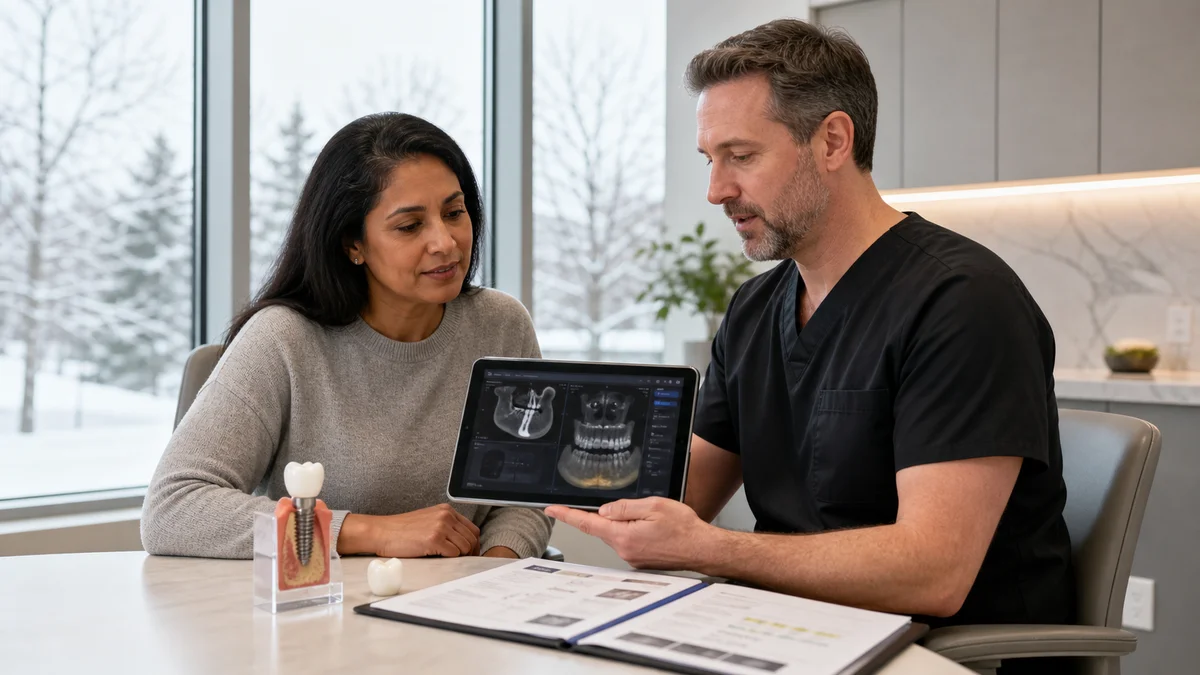
Searching for the best dental implants in minnesota can produce polished galleries, package prices, and claims about technology. None of those alone establishes that a treatment is right for you. A safer choice begins with a licensed clinician, a diagnosis that explains why a tooth cannot be preserved, a prosthetically driven implant plan, transparent alternatives, and an aftercare system you can realistically use.
Quick answer: There is no single implant brand, dentist, or clinic that is “best” for every Minnesota patient. Verify the professional’s current license, ask who performs each phase, review diagnostic records and alternatives, obtain an itemized plan, and confirm maintenance and emergency access. The best match is the team that can justify, deliver, and support your individual treatment safely.
This guide does not rank Minnesota practices and cannot diagnose implant candidacy. It provides a structured way to compare local providers and, if you are considering treatment outside Minnesota or abroad, to compare continuity of care on equal terms. Final decisions require an in-person dental examination and appropriate imaging. Outcomes, healing time, and longevity cannot be guaranteed.
What “best dental implants in minnesota” should mean
Dental implants are components, not a complete treatment by themselves. The implant body is placed in bone, an abutment or connection supports the restoration, and a crown, bridge, or denture restores the visible and functional portion. The result depends on diagnosis, surgical execution, restorative design, laboratory work, hygiene, bite forces, health factors, and long-term review.
“Best” should therefore describe a care process rather than a marketing superlative. A strong process protects teeth that can reasonably be saved, identifies infection and periodontal disease, positions implants for the planned restoration, explains uncertainty, and designs a prosthesis that can be cleaned and repaired. It also defines who will help if discomfort, loosening, fracture, or inflammation develops later.
The U.S. Food and Drug Administration’s dental implant information advises patients to discuss benefits, risks, and candidacy with their provider. It notes that overall health can affect candidacy, healing, and how long an implant may remain in place. This is why a brand comparison is never enough.
1. Verify the Minnesota dental license and practice status
Start with the Minnesota Board of Dentistry. Its official site provides license lookup and public information for dental professionals practicing in the state. Confirm the dentist’s name, current status, and available disciplinary or corrective information. A clinic’s business listing is not a substitute for checking the individual professional who will be responsible for care.
Ask who performs the examination, implant surgery, grafting if needed, restorative phase, and maintenance. Different clinicians may share the case. That can be appropriate, but responsibilities and communication should be clear. If a visiting clinician performs surgery, confirm how postoperative reviews and urgent concerns will be handled after that clinician leaves.
- Search the clinician’s full legal name in the state license lookup.
- Confirm who is the dentist of record for your treatment.
- Ask whether surgery and restoration are completed by one clinician or a coordinated team.
- Request the name of the provider who will manage complications and maintenance.
- Do not rely on titles in advertisements without checking what they mean.
2. Look for diagnosis before an implant recommendation
An implant recommendation should follow a medical and dental history, examination, periodontal assessment, and review of the tooth or missing-tooth site. The clinician should ask about medications, allergies, tobacco or nicotine exposure, diabetes, bone-related medicines, bleeding conditions, prior radiation, grinding, and previous implant problems. Relevant conditions do not always rule out treatment, but they can change timing, consent, and risk management.
If a tooth is still present, ask why it cannot be predictably preserved. Large decay, fracture, severe periodontal support loss, resorption, or failed treatment may affect prognosis, yet the explanation should be tooth-specific. Extraction is irreversible. A second opinion is reasonable when an extensive number of teeth are recommended for removal, especially if the recommendation is primarily cosmetic.
Imaging should be selected for a clinical reason. Two-dimensional radiographs may answer some questions; three-dimensional cone-beam imaging may be indicated for anatomy and implant planning in other cases. More imaging is not automatically better. The team should explain what the scan is expected to show and how it changes the plan.
3. Compare implant candidacy, not just before-and-after photos
Before-and-after images can illustrate a type of restoration, but they cannot show whether your bone, gums, bite, health history, or expectations match the photographed case. Images may also omit the provisional phase, repairs, grafting, or maintenance. Use them to discuss design preferences, not to predict a guaranteed result.
Candidacy includes adequate bone or a plan to manage deficiency, controlled oral disease, a restoration that fits the available space, and the ability to maintain hygiene. Active periodontal inflammation should be addressed. Patients who clench or grind may need changes in design and a protection strategy. Smoking or nicotine use should be discussed honestly because it may influence healing and long-term disease risk.
Implant treatment can be considered for one missing tooth, several teeth, or an entire arch, but these are different projects. A single implant crown cannot be compared directly with a fixed full-arch bridge. The number and position of implants, prosthesis material, cleaning access, and repair pathway must match the clinical problem.
4. Use a decision table to compare Minnesota providers
The table below is a consultation tool, not a scoring system. A provider should be able to explain each item in language you understand.
| Decision factor | Reassuring evidence | Reason to ask more | Your next step |
|---|---|---|---|
| License and roles | Current license and named clinicians for each phase | Unclear responsibility or rotating providers | Verify through the Minnesota Board |
| Diagnosis | Written findings, alternatives, and tooth prognosis | Treatment offered from photos alone | Request an examination and records |
| Imaging | Imaging selected and explained for your anatomy | Scan promoted as a sales feature without indication | Ask how it changes treatment |
| Implant system | Traceable components and a documented system | No record of parts or replacement access | Request system and component documentation |
| Cost | Itemized surgery, restoration, grafting, and follow-up | One package price with undefined exclusions | Compare equivalent scopes |
| Consent | Risks, alternatives, and uncertainty discussed | Pressure to decide immediately | Take the plan home or seek another opinion |
| Maintenance | Written hygiene, recall, and repair plan | Implants described as maintenance-free | Ask who performs long-term reviews |
| Emergencies | Defined contact and local coverage | No plan after evenings, travel, or provider absence | Confirm response and fees in writing |
5. Ask how the restoration drives implant position
An implant should not simply be placed where bone appears easiest. Its position needs to support the planned crown, bridge, or denture. This is often described as prosthetically driven planning: the team considers the final tooth position, bite, emergence through the gum, cleaning access, and available restorative space before surgery.
Ask to see the proposed restoration, not only the implant locations. Digital planning, guides, scans, and laboratory designs can assist the process, but technology does not replace clinical judgment. A surgical guide may improve transfer of a plan in appropriate cases; it does not remove biological variation or guarantee exact healing.
For front teeth, soft-tissue shape, lip line, neighboring teeth, and bone thickness may be especially important. For back teeth, load, access, and the relationship to the sinus or nerve can influence options. For full-arch treatment, the design must allow cleaning beneath the bridge. A restoration that looks smooth in a rendering may still be difficult to maintain in daily life.
6. Understand implant systems, materials, and records
Patients often ask which implant brand is best. Established system documentation, component availability, clinician familiarity, and traceability matter, but no system eliminates surgical or biological risk. Ask why a system is selected for your case and whether replacement screws, abutments, and restorative parts are accessible if you move or change providers.
Request a record of the implant manufacturer, product line, dimensions, lot or reference information, placement site, and date. Keep copies with your radiographs and restorative records. This information can help another clinician identify parts later. A generic statement such as “premium implant” is less useful than traceable documentation.
Restorative materials also require context. Zirconia, titanium components, ceramics, acrylic-based materials, and other options have different design and repair considerations. The most expensive material is not automatically best for every bite or prosthesis. Ask about wear against opposing teeth, potential chipping, repair method, hygiene, and what must be replaced if one part fails.
7. Review risks, healing, and realistic timelines
Dental implant placement is a surgical procedure. Potential issues can include pain, swelling, bleeding, infection, injury to nearby structures, failure to integrate, and later inflammation with bone loss. The relevance and probability of specific risks depend on the site and the individual. The consent discussion should be personalized rather than limited to a generic signature form.
Healing schedules vary. Immediate placement after extraction, immediate provisional teeth, early loading, and delayed loading are not interchangeable promises. Primary stability, bone condition, infection control, bite, and restoration design affect timing. “Teeth in a day” may describe a provisional stage for selected patients, not the final restoration or a guarantee that every implant will integrate.
Ask what happens if the plan changes during surgery or healing. A responsible estimate distinguishes confirmed procedures from possible additions. If grafting becomes necessary, you should know whether it changes cost, treatment time, provisional options, or insurance authorization. You should also understand which symptoms require urgent contact.
- Who is less suitable for immediate loading?
- What medications should be reviewed before surgery?
- How will pain and swelling be managed?
- What is the plan if an implant does not integrate?
- Which follow-up visits are included?
- When can the implant be cleaned normally and loaded?
- What emergency service is available outside office hours?
8. Compare complete costs and insurance assumptions
There is no responsible fixed price for the best dental implants in minnesota without an examination. Cost may include diagnostics, extraction, grafting, implant placement, sedation, provisional restoration, abutment, final crown or bridge, laboratory work, hygiene visits, and follow-up. A low implant placement fee may exclude the visible tooth or necessary preparation.
Ask for an itemized estimate with procedure descriptions and identify which items are expected, optional, or contingent on findings. If comparing offices, make sure the plans include the same clinical scope. One estimate may include grafting and the final restoration while another includes only surgery.
Dental insurance benefits vary by plan, waiting period, annual maximum, missing-tooth clause, network, and medical necessity rules. Preauthorization can clarify expected benefits but may not be a payment guarantee. Ask the insurer and clinic what documentation is needed and what amount remains your responsibility. Financing terms should be reviewed separately from clinical consent.
9. Evaluate maintenance before committing
Implants do not decay, but the tissues around them can become inflamed, and restorations can wear, loosen, or fracture. Daily plaque control and professional monitoring remain necessary. The World Health Organization oral health fact sheet emphasizes prevention and modifiable risks across oral diseases. An implant is not a reason to stop routine oral care.
Your maintenance plan should reflect the restoration. A single implant crown needs cleaning at the gumline and between teeth. An implant bridge may need specialized floss or interdental brushes. A full-arch bridge requires access beneath the prosthesis. If dexterity, vision, or caregiving needs make cleaning difficult, the design and support plan should account for that before treatment.
Ask how often recalls are recommended for your risk level, which measurements or images may be used over time, and what signs are monitored. Also ask whether routine maintenance is included in a package or billed separately. A clinic that cannot explain maintenance is not presenting the whole treatment.
10. Compare local Minnesota care with dental travel carefully
Some Minnesota residents consider traveling within the United States or internationally for implant treatment. Travel can change price and scheduling, but it also divides care across locations. Compare the same elements: clinician credentials, diagnosis, component records, provisional and final phases, time between visits, lodging, emergency access, and the cost of return travel.
When treatment is performed abroad, confirm who will manage postoperative checks in Minnesota and whether that clinician has agreed to do so. Do not assume a local dentist can immediately repair every system or accept responsibility for another team’s plan. Ask the traveling clinic for complete records in a usable language and format.
Redent Klinik is located in Turkey, not Minnesota. Patients considering an international comparison can review the English Redent Klinik website and use the Redent Klinik contact page to ask what records, visits, provisional stages, and follow-up arrangements would be required. Remote review can prepare questions but cannot replace an in-person diagnosis or promise candidacy.
A travel plan should include extra time for review, not only the procedure date. Identify where you would seek help for persistent bleeding, swelling, fever, altered sensation, a loose provisional restoration, or a broken component after returning home. Savings are meaningful only when continuity and possible return care are included.
11. Recognize red flags and reasons to seek a second opinion
High-pressure sales are incompatible with informed consent. Be cautious when treatment is recommended solely from photographs, when the same plan is offered to everyone, or when a discount expires before you can review records. Claims of painless surgery, lifetime success, guaranteed integration, or maintenance-free teeth oversimplify real clinical uncertainty.
Other warning signs include refusal to identify the implant system, unclear division of provider roles, no written alternatives, and no explanation of what happens if an implant fails. A second opinion is especially valuable before removing restorable teeth, undertaking a full-arch reconstruction, or accepting extensive grafting.
- A quote is provided without examination or diagnostic records.
- Healthy or treatable teeth are proposed for extraction mainly for speed or appearance.
- The provider cannot explain implant and prosthetic component records.
- Risks are dismissed because a procedure is called “digital” or “guided.”
- No local emergency or maintenance pathway is defined.
- You are discouraged from taking records or seeking another opinion.
Frequently asked questions
How do I find the best dental implants in minnesota for my case?
Begin with diagnosis and provider verification, not a brand list. Confirm the clinician’s Minnesota license, ask who performs surgery and restoration, review alternatives, and compare itemized plans. The right team should explain why an implant is appropriate, how it will be maintained, and what happens if the expected course changes.
Is an oral surgeon or periodontist always required?
Implant care may involve general dentists and dental specialists depending on training, case complexity, and team structure. A title alone does not determine your best match. Verify each professional’s license and ask about their role, relevant experience, communication with the restorative dentist, and management of complications.
Does the newest implant technology produce the best result?
Technology can support imaging, planning, surgery, or fabrication, but it cannot replace diagnosis or eliminate biological risk. Ask how a tool changes your plan and what evidence supports its use. A digital workflow is valuable when it serves a sound clinical objective, not merely because it is new.
Can I receive a firm implant price before an examination?
A clinic may provide a range or explain common fee components, but a reliable final plan usually requires examination and imaging. Bone grafting, extraction, provisional treatment, implant parts, and the final restoration can alter scope. Obtain an itemized written estimate and identify contingent fees before consenting.
Are same-day dental implants safe for everyone?
No. Immediate placement or loading may be appropriate for selected cases, but suitability depends on infection control, bone, implant stability, bite, health, and the planned restoration. “Same day” may refer to a provisional tooth rather than the final prosthesis. Ask what criteria would change the timing.
What records should I receive after implant placement?
Keep the implant manufacturer and product line, site, dimensions, relevant lot or reference details, placement date, radiographs, surgical summary, and restorative information. Ask for copies of the final treatment plan and maintenance instructions. Records improve continuity if you later change dentists or move.
How long do dental implants last?
No clinician can guarantee an individual lifespan. Longevity depends on health, site, planning, healing, hygiene, smoking, bite forces, restoration design, and professional maintenance. Implants and prosthetic components can require treatment or replacement. Ask for a risk-based maintenance and repair plan instead of a guaranteed number of years.
Should I travel outside Minnesota for lower implant fees?
Travel is a personal decision that should include all visits, accommodations, time away, records, component availability, emergency access, and return treatment. Confirm who provides follow-up after you return. Compare full clinical scopes rather than headline prices, and do not begin irreversible care without an in-person assessment.
Final checklist for a confident choice
The best dental implants in minnesota are not defined by one advertisement, price, or brand. A defensible choice combines a verified professional, complete diagnosis, preservation of treatable teeth, restoration-led planning, understandable consent, traceable components, realistic cost, and accessible long-term support.
Take written plans home, compare equivalent treatment scopes, and ask for records. Seek another opinion if the recommendation is extensive or unclear. The goal is not simply to have an implant placed; it is to receive a cleanable, functional, repairable restoration supported by a team that remains accountable throughout healing and maintenance.