
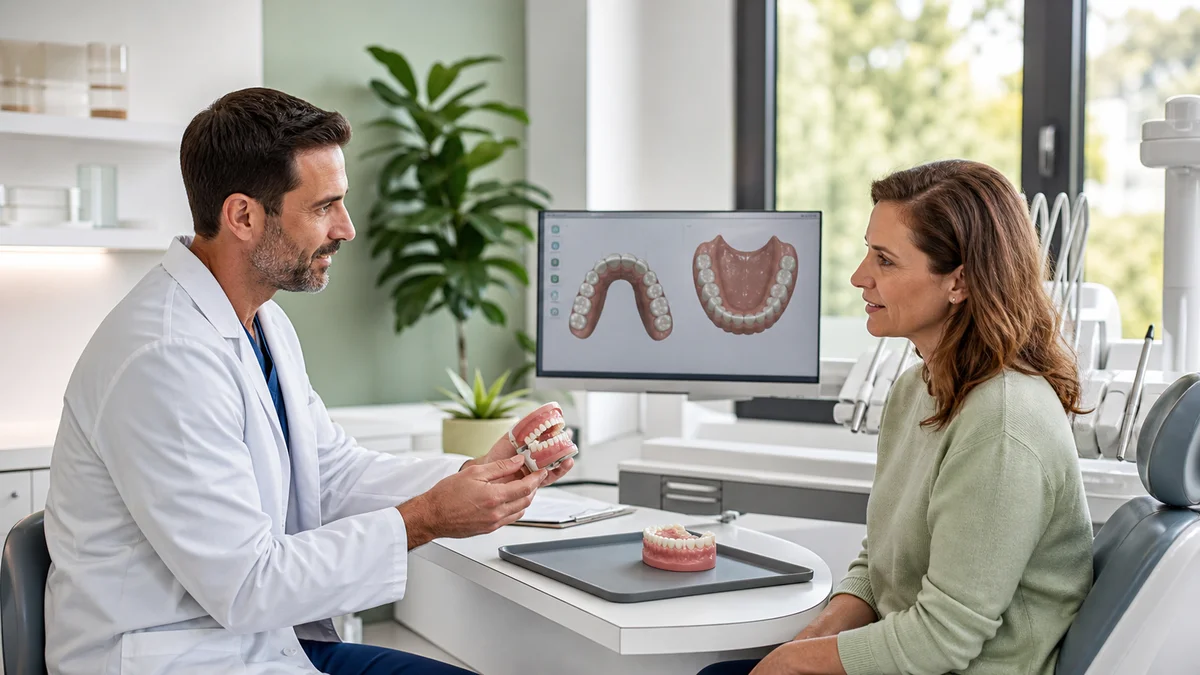
If you are asking how much is a full mouth of dentures, you are probably trying to balance affordability, comfort, appearance and long-term oral health. The honest answer is that there is no single fee that applies to every patient. The type of denture, required preliminary care, materials, laboratory work, implant needs and local pricing all affect the total.
Quick answer: There is no reliable universal fee for a full upper and lower denture set. The total depends on whether dentures are conventional, immediate or implant-retained; the materials and laboratory stages; and whether extractions, imaging, temporary teeth, relines or follow-up are included. Only an examination and itemized plan can establish your cost.
This guide explains what may be included in a quote, how different options compare and which questions can help you make a safer decision. It is written for visible medical review by Dentist Esma Çevrük Çakır and uses a patient-safety-first approach. It cannot replace a personal dental examination.
How much is a full mouth of dentures by type?
“A full mouth” generally means replacing all teeth in both the upper and lower arches. However, advertised prices do not always cover the same service. One clinic may quote only the dentures, while another may bundle examinations, extractions, temporary dentures, adjustments and follow-up visits. Comparing headline numbers without comparing inclusions can therefore be misleading.
The table below compares treatment scope rather than quoting a universal currency amount. Fees vary substantially by country, city, clinician, laboratory, materials and case complexity, while exchange-rate changes make international comparisons unreliable. A written plan following an examination is the appropriate basis for a personal estimate.
| Option | Typical scope pattern | How it works | Important cost considerations |
|---|---|---|---|
| Economy conventional dentures | Usually the least complex removable pathway; confirm whether the quote covers one arch or both. | Removable dentures rest on the gums and are taken out for cleaning. | May use more basic materials, fewer customization stages or limited adjustment coverage. |
| Premium conventional dentures | Usually adds individualized laboratory stages, materials, try-ins and appearance customization. | Removable dentures with more individualized tooth selection, bite setup and appearance. | Higher laboratory fees, materials, try-ins and follow-up services may increase the price. |
| Implant-retained overdentures | Adds implant planning, surgery, attachments and restorative work to the removable denture pathway. | A removable denture attaches to dental implants for improved retention. | Implant number, attachments, imaging, surgery and possible grafting strongly affect cost. |
| Fixed full-arch implant teeth | Usually the broadest surgical and restorative scope, with temporary and definitive prostheses potentially priced separately. | A full-arch prosthesis is secured to implants and removed professionally when required. | Surgical complexity, implant components, temporary teeth and final restorative materials matter. |
These categories are not interchangeable. A low-cost removable denture is not simply a cheaper version of a fixed implant restoration; it uses a different support system and involves different maintenance, risks and future expenses. Ask whether a quoted amount covers one arch or both, because “full denture” sometimes refers to only an upper or lower appliance.
What determines the final price?
The denture itself is only one part of treatment. A careful estimate begins with your medical and dental history, an oral examination and, when indicated, imaging. The clinician must assess remaining teeth, gum health, jaw anatomy, bite, healing capacity and expectations before recommending an option.
Pre-denture treatment
Decayed, infected or non-restorable teeth may require treatment or removal. Some patients need gum care, smoothing of sharp bone, management of oral lesions or time for tissues to heal. These services can add to the initial total, but skipping necessary care merely to reduce the headline fee may compromise comfort or safety.
Extraction costs depend on the number and difficulty of teeth involved. Surgical extractions generally differ from straightforward removals. Sedation, when clinically appropriate, is another separate expense in many clinics. Patients using blood-thinning medication or managing conditions such as diabetes may need additional coordination with their medical clinician; medicines should never be stopped without professional advice.
Immediate versus conventional dentures
An immediate denture is prepared before extractions and inserted soon after teeth are removed. It means the patient does not have to spend the initial healing period without teeth, but the mouth changes shape as it heals. Relines, adjustments or a replacement denture may later be necessary.
A conventional denture is usually made after tissues have healed sufficiently for dependable impressions and measurements. This can reduce some early fit changes, although all removable dentures still require adaptation and maintenance. Ask whether temporary teeth, soft liners, laboratory relines and the definitive appliance are separate charges.
Materials and laboratory design
Denture bases and teeth are available in different materials, shades and quality levels. Fees may reflect individualized tooth arrangement, characterization of the gum-colored base, additional try-ins or stronger components. The most expensive material is not automatically the best choice for every mouth. Fit, jaw relationship, hygiene access and technically sound design are at least as important as cosmetic upgrades.
Implants, imaging and bone conditions
Implant-supported treatment adds three-dimensional imaging, surgical planning, implant fixtures, restorative components and healing reviews. The number and position of implants must be selected for the individual anatomy and proposed prosthesis. Bone grafting or other preparatory surgery may be considered when bone quantity or quality is inadequate, but it is not required in every case.
An implant fee may exclude the overdenture or fixed bridge placed on top. Conversely, a package may include temporary teeth but not the final restoration. Ask for separate surgical and restorative cost lines so you can understand the complete pathway.
Professional time and aftercare
Good denture care involves more than taking an impression. Records of facial support and bite, trial arrangements, laboratory communication, delivery and pressure-point adjustments all require time. Clarify how many post-delivery visits are included, how long that coverage lasts and what future repairs or relines may cost.
Are full dentures suitable for you?
Complete dentures may be appropriate when all teeth in an arch are already missing or when remaining teeth cannot predictably be preserved. Tooth removal is irreversible, however. Extracting treatable teeth solely to make treatment faster or apparently simpler deserves especially careful consideration.
You may be a suitable candidate if
- You are missing all teeth in one or both arches, or remaining teeth have a poor prognosis after proper assessment.
- Your oral tissues are healthy enough for impressions, healing and regular denture use.
- You understand that removable dentures can move and feel different from natural teeth.
- You can clean the appliance and mouth daily and attend follow-up appointments.
- Your expectations for chewing, speech, appearance and adaptation are realistic.
- For implant options, your general health and jaw conditions permit surgery after individualized evaluation.
Who should wait or seek further assessment?
Active infection, uncontrolled gum disease, suspicious oral lesions or unaddressed medical concerns should be assessed before definitive treatment. Recent extractions may also require healing before a final appliance is produced. Patients who smoke, clench, grind or have difficulty maintaining hygiene are not automatically excluded, but these factors can influence risks and treatment choice.
If you are uncertain whether remaining teeth can be saved, ask about restorative and periodontal options or obtain a second opinion before consenting to extraction. Anyone considering implants should discuss healing, medicines, smoking, previous radiotherapy, bone conditions and relevant medical history openly with the dental team.
What happens during treatment?
The exact sequence depends on whether teeth remain, whether the denture is immediate or conventional and whether implants are involved. A typical removable-denture pathway includes the following stages.
- Consultation and diagnosis: The dentist reviews your goals, health history, mouth and existing dental work. Imaging may be recommended when it could change the plan.
- Written treatment plan: Suitable options, limitations, expected appointments, fees and alternatives should be explained before treatment begins.
- Preliminary care: Necessary extractions, gum treatment or other procedures are completed. Healing time varies with the procedure and individual circumstances.
- Impressions or digital records: Accurate records capture the shape of the supporting tissues. More than one impression stage may be needed.
- Bite and appearance records: The clinician measures how the jaws meet and discusses tooth size, shade, facial support and smile characteristics.
- Try-in: A trial arrangement may allow evaluation of appearance, speech and bite before the final denture is processed.
- Delivery and adjustments: The dentist checks fit, bite and pressure areas, then explains insertion, removal, cleaning and adaptation.
- Review and maintenance: Follow-up visits address sore areas and function. Later relining, repair or replacement may be needed as tissues and materials change.
Implant treatment adds surgical placement and a healing phase before the final attachment or bridge is completed. Some patients may receive temporary teeth sooner, but immediate loading is not suitable for every clinical situation. The dentist and restorative team should explain what you will wear at each stage.
Benefits, limitations and possible risks
Full dentures can restore a visible smile, provide lip and cheek support, and improve the ability to manage foods compared with having no teeth. They may also help speech once the patient adapts. These are reasonable treatment goals, but no clinician should guarantee that dentures will feel or function exactly like natural teeth.
Common early issues can include increased saliva, altered speech, a sense of bulk, gagging, movement and sore spots. Adjustments can often help pressure areas, but patients should not repeatedly reshape a denture at home. Persistent pain, ulcers, swelling, bleeding, numbness or a sudden change in fit warrants professional assessment.
Lower complete dentures are often less stable than upper dentures because the tongue occupies space and the supporting area is smaller. Adhesive may sometimes improve confidence, but it should not be used to disguise a damaged or persistently ill-fitting appliance. Excess adhesive and poor cleaning can create additional problems.
Implants may improve retention and function, yet surgery introduces risks such as infection, delayed healing, implant failure, nerve or sinus complications and problems with restorative components. Long-term success also depends on hygiene, professional maintenance and control of relevant risk factors. A personalized consent discussion should cover the risks relevant to your anatomy and health.
Daily care essentials
- Clean dentures every day with a method and product recommended for their material.
- Handle them over a folded towel or basin of water to reduce the chance of breakage.
- Clean the tongue, palate, gums and any remaining teeth or implant components.
- Remove dentures for an appropriate rest period, commonly overnight, unless your clinician advises otherwise.
- Store removable dentures as directed so they do not dry out or distort.
- Continue regular oral examinations even when no natural teeth remain.
Routine examinations matter because the dentist assesses tissue health, fit, bite and hygiene, not only teeth. Guidance from the American Dental Association and the World Health Organization oral health fact sheet also reinforces the importance of prevention and continuing oral care.
Alternatives worth comparing
The best alternative depends on which teeth remain and whether they can be maintained. Preserving useful natural teeth may provide support and sensation that a conventional complete denture cannot reproduce. Treatment could involve fillings, gum therapy, root canal treatment, crowns, bridges or a partial denture, depending on diagnosis.
Partial dentures
A removable partial denture replaces selected teeth while using remaining teeth for support or retention. It can be less invasive than removing every tooth, but supporting teeth and gums must be healthy enough for the proposed design. Future repair may be required if the dental condition changes.
Implant-retained overdentures
An overdenture remains removable for cleaning but connects to implants. It can provide greater retention than a conventional denture, particularly in the lower jaw. Attachments wear over time and require maintenance, so ongoing component costs should be discussed at the outset.
Fixed full-arch implant restorations
A fixed full-arch restoration stays secured to implants and is usually removed only by a dental professional. It may feel more stable, but it requires surgery, careful home cleaning, sufficient restorative space and a larger budget. The prosthesis and its components can still chip, wear or require repair.
Keeping a serviceable existing denture
If an existing denture is structurally sound, a repair, reline or rebase may sometimes improve serviceability. This is not appropriate when tooth wear, bite errors, poor design or major changes make replacement safer. A clinical examination is needed to distinguish a repairable problem from one requiring a new appliance.
Financing and comparing quotes responsibly
Once you understand how much is a full mouth of dentures for your particular plan, compare the total course of care rather than the deposit alone. A less expensive quote can become costly if it excludes essential diagnostics, temporary teeth, attachments, relines or follow-up.
Ask each provider for an itemized written estimate. Useful categories include examination, imaging, extractions, sedation, temporary dentures, final dentures, implants, grafting, laboratory work, adjustments and maintenance. Confirm whether prices are per arch, per implant or for the entire mouth.
Payment arrangements vary. Depending on the clinic and country, possible routes may include staged payments, third-party healthcare financing, private dental insurance, health savings accounts or treatment completed in phases. Interest, eligibility rules and exclusions should be reviewed carefully. Insurance may classify dentures, implants and preparatory procedures differently, and preauthorization is not a guarantee that every charge will be paid.
For treatment abroad, include travel, accommodation, return visits and contingency costs. Determine who will manage complications or maintenance after you return home. Selecting care purely by price may overlook infection control, clinician credentials, implant systems, laboratory quality and access to follow-up.
Redent Klinik can provide a personalized plan only after appropriate assessment. Patients wishing to ask about consultation steps, records or an itemized estimate can use the Redent Klinik Contact Page without committing to treatment.
Questions to ask at your consultation
- Can any of my remaining teeth be predictably treated and preserved?
- Why is the recommended denture type appropriate for my mouth and priorities?
- Does the estimate cover one arch or both arches?
- Which examinations, imaging, extractions and temporary appliances are included?
- How many try-ins and post-delivery adjustments are included?
- What will I wear while my mouth or implants heal?
- What limitations should I expect with eating, speech and denture movement?
- What are the material, warranty terms and likely maintenance costs?
- Who should I contact if I develop pain, swelling or a broken appliance?
- What alternatives are reasonable, and what could happen if I postpone treatment?
Bring an updated medicine list and explain relevant diagnoses, allergies, tobacco use and previous dental experiences. If the explanation feels rushed or important costs remain unclear, it is reasonable to pause, request written information or seek another opinion.
Frequently asked questions
How much is a full mouth of dentures without implants?
No responsible universal amount applies to every conventional upper and lower denture case. Services differ in materials, customization, laboratory stages and aftercare, while extractions, temporary dentures, imaging, sedation and relines may be separate. Ask for an itemized estimate that states whether one arch or both arches are included and is based on current clinical findings.
Does “full mouth dentures” mean both upper and lower teeth?
Patients commonly use the phrase to mean a complete upper and lower set, but dental quotes may describe a “full denture” for just one arch. Ask the provider to state clearly whether the fee is for the upper arch, lower arch or both. Also confirm whether temporary and final dentures are priced separately.
Are immediate dentures more expensive?
They can increase the overall cost because they are made before extractions and may need several adjustments as swelling settles and the jaw tissues remodel. A reline or later replacement may also be advised. However, pricing structures vary, so ask whether the immediate denture, healing-stage adjustments and definitive denture are included.
How long do full dentures last?
There is no universal replacement date. Denture teeth and bases wear, while the supporting mouth changes over time. Fit, bite, hygiene, grinding, material and accidental damage all influence service life. Regular reviews help determine whether adjustment, repair, relining or replacement is appropriate before discomfort or tissue injury becomes significant.
Can I eat normally with full dentures?
Most patients need an adaptation period. Starting with softer foods, taking smaller bites and chewing on both sides can help develop control. Some foods may remain difficult, particularly with a lower conventional denture. Persistent instability or pain should be assessed rather than accepted or covered with increasing amounts of adhesive.
Are implant dentures worth the additional cost?
Implants may provide meaningful improvements in retention and chewing confidence, especially for a loose lower denture. Whether they justify the cost depends on your priorities, anatomy, health, hygiene capacity and willingness to undergo surgery and maintenance. They are not maintenance-free and cannot be promised to last indefinitely.
Will dental insurance pay for a full set?
Coverage depends on the policy. Some plans contribute to conventional dentures but limit replacement frequency, annual benefits or preliminary procedures. Implant treatment may be excluded or partly covered. Request a written treatment estimate and ask the insurer about deductibles, waiting periods, maximum benefits and required preauthorization before relying on reimbursement.
Can all my teeth be removed and dentures placed on the same day?
Immediate dentures can sometimes be inserted soon after planned extractions, but same-day treatment is not appropriate for every person or procedure. Diagnosis and fabrication occur beforehand, and healing changes the fit afterward. Infection, surgical complexity, medical conditions and the proposed restoration influence timing. A dentist must assess these factors individually.
Why do two denture quotes differ so much?
The quotes may include different materials, clinician and laboratory stages, imaging, extractions, temporary appliances or adjustment periods. Implant quotes may also differ in implant number, components, grafting and final prosthetic material. Request itemized plans and compare like with like, including likely maintenance and who provides follow-up care.
Your final next step
An online range can help with budgeting, but it cannot determine whether teeth should be removed, which denture will function best or whether implants are suitable. The safest next step is a comprehensive consultation followed by a written, itemized plan. Review the diagnosis, alternatives, limitations, timeline, maintenance and total expected fees before consenting.
Contact a qualified dental team promptly if you currently have facial swelling, uncontrolled bleeding, fever, trauma, difficulty swallowing or severe worsening pain. These concerns require assessment rather than waiting for routine denture planning.
Sources
- American Dental Association: Dentures
- World Health Organization: Oral Health
- NHS: Dentures — current guidance on denture types, fitting, private cost variability and daily care.
- NHS Business Services Authority: dental charges from April 2026 — an official country-specific fee schedule that illustrates why jurisdiction and eligibility must be checked directly.
- Medicare: What Original Medicare does not cover — current U.S. coverage guidance noting that dentures are generally outside Original Medicare coverage, with limited medical-service exceptions.