
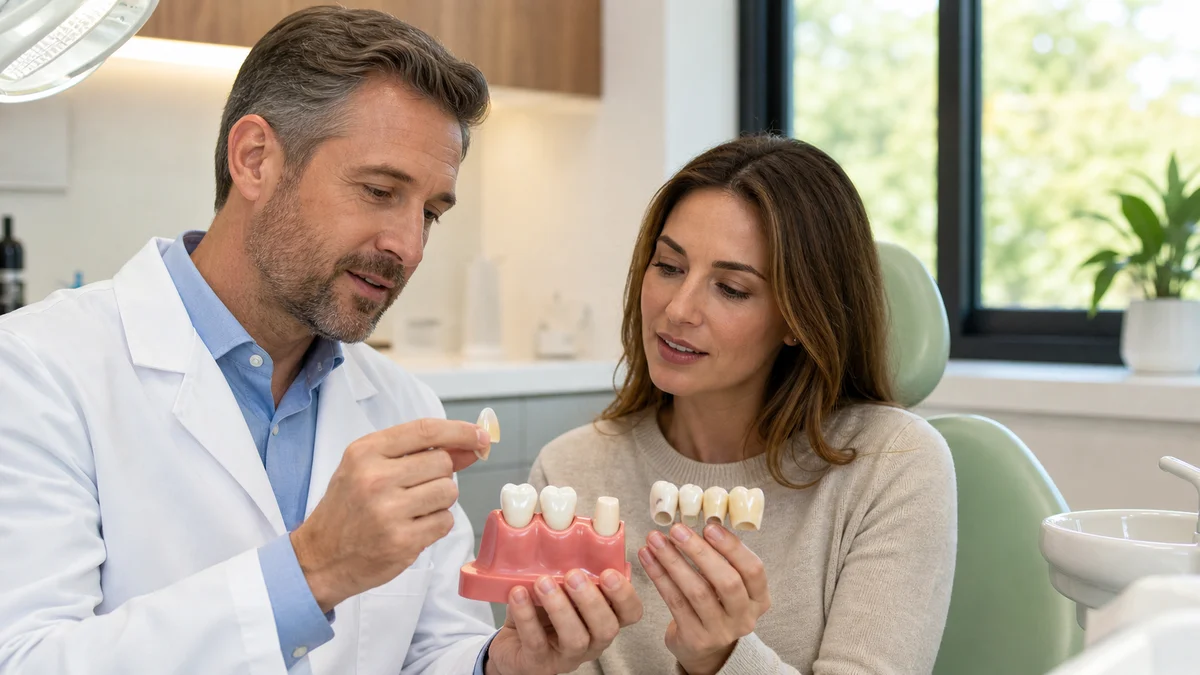
Choosing between porcelain veneers vs dental bridge treatment starts with one essential question: are you trying to improve an existing tooth, or replace a tooth that is missing? Although both treatments can improve a smile, they solve fundamentally different problems. Veneers cover the visible surfaces of teeth, while a bridge fills a gap by supporting an artificial tooth between natural teeth or implants.
Quick answer: Porcelain veneers may improve the color, shape, spacing, or proportion of existing front teeth. A dental bridge replaces one or more missing teeth. The appropriate option depends on which teeth remain, their health, the condition of the gums and bone, bite forces, appearance goals, and findings from an in-person dental examination.
This guide follows the practical decisions that usually matter most: purpose, suitability, cost factors, treatment steps, risks, alternatives, financing, and consultation questions. It is written for patient education and visible medical review by Dentist Esma Çevrük Çakır. It cannot replace an examination, dental imaging, or an individualized diagnosis.
Porcelain Veneers vs Dental Bridge: The Main Difference
A porcelain veneer is a thin, custom-made ceramic restoration bonded mainly to the front surface of an existing tooth. It may be considered when a tooth is present but has cosmetic concerns such as persistent discoloration, an uneven outline, a small gap, limited wear, or an unfavorable proportion. Some preparation of enamel may be required, and the underlying tooth must be suitable for bonding.
A conventional dental bridge replaces a missing tooth with a false tooth, called a pontic, connected to crowns placed on neighboring support teeth. Other designs include cantilever, resin-bonded, and implant-supported bridges. Each design has different indications and limitations. A bridge is therefore not a cosmetic shell for a present tooth; it is a tooth-replacement system.
| Decision point | Porcelain veneer | Dental bridge |
|---|---|---|
| Primary purpose | Changes the visible appearance of an existing tooth | Replaces one or more missing teeth |
| Teeth involved | Usually the tooth being improved | The gap plus supporting teeth or implants |
| Typical location | Most often visible front teeth | Front or back of the mouth, when support and bite conditions allow |
| Tooth reduction | Often limited to enamel, although the amount varies | A conventional bridge usually requires crown preparation of support teeth |
| Effect on a missing-tooth gap | Does not replace a missing tooth | Designed to restore a missing-tooth space |
| Cleaning needs | Brushing, interdental cleaning, and careful gum-line care | Brushing plus cleaning beneath the pontic and around retainers |
| Key planning issue | Enamel, tooth position, color, bite, and cosmetic expectations | Support-tooth health, gap size, gum and bone condition, bite, and bridge design |
If a tooth is still present but badly weakened, neither a veneer nor a bridge may be the first choice. A crown, root canal assessment, periodontal treatment, orthodontics, repair, or extraction may need consideration. Likewise, placing veneers on nearby teeth does not substitute for replacing a missing tooth. Accurate diagnosis comes before choosing a restoration.
1. Compare the Treatment Goal Before Appearance
It is natural to begin with the desired smile, but safe planning begins with function and disease control. A dentist first determines whether each tooth is present, restorable, free of active decay, and supported by healthy gums. The bite, jaw movement, tooth wear, clenching habits, and available enamel also affect the decision.
Veneers may create a more uniform appearance when conservative cosmetic correction is clinically reasonable. They cannot reliably reinforce every heavily restored, fractured, or severely decayed tooth. Bonding is generally more predictable when sufficient healthy enamel remains, although the final preparation depends on tooth position and the planned ceramic thickness.
A bridge may restore appearance, chewing contact, and continuity after tooth loss. Its design must distribute forces safely. Using compromised neighboring teeth simply because they border a gap can create avoidable risk. Conversely, sound neighboring teeth may require substantial preparation for a conventional bridge, so implant-based or less invasive alternatives should also be discussed when appropriate.
2. Understand the Cost Factors
There is no responsible universal price comparison between these treatments. Veneers are commonly planned per tooth, whereas a bridge price reflects the number of units, supporting teeth, materials, laboratory work, provisional restorations, and design. A three-unit conventional bridge, for example, contains two retainers and one replacement tooth, but actual designs can be simpler or more complex.
What can change the total treatment cost?
- The number and location of teeth being treated
- The selected ceramic, metal-ceramic, composite, or other restorative material
- The condition of the teeth, gums, bone, existing fillings, and previous dental work
- Whether X-rays, scans, photographs, diagnostic models, or a wax-up are needed
- Whether decay treatment, root canal care, gum therapy, buildup, extraction, or bone management is required first
- The need for temporary restorations, bite adjustments, a night guard, or maintenance visits
- Laboratory complexity, clinician planning, and local practice costs
A low initial quotation may not describe the same treatment scope, material, preparation, or follow-up. Ask for a written plan that separates essential health treatment from elective cosmetic work. Final cost depends on examination, treatment planning, current clinical conditions, and any findings identified during care. No quoted range should be treated as a guaranteed final price before assessment.
At Redent Klinik, a patient can ask for an itemized explanation after the clinical findings and realistic options have been reviewed. A sound decision compares long-term maintenance and biological impact, not only the fee on the first day.
3. Check Whether You Are a Suitable Candidate
Who may be suitable for porcelain veneers?
Veneers may be considered for an adult with healthy gums, stable oral health, adequate tooth structure, and a cosmetic concern that cannot be managed more conservatively or is not suited to a simpler option. Expectations should be realistic: porcelain can imitate natural enamel, but perfect symmetry, a permanent shade, and an unlimited lifespan cannot be promised.
A veneer assessment commonly considers:
- How much healthy enamel is available for reliable bonding
- Whether the tooth is intact, cracked, decayed, heavily filled, or root-treated
- Whether tooth position can be improved more conservatively with orthodontics
- Whether whitening or composite bonding could meet the goal with less preparation
- Whether clenching, grinding, nail biting, or other forces threaten the restoration
- Whether the desired color and shape will harmonize with untreated teeth
Who may be suitable for a dental bridge?
A bridge may be considered when one or more teeth are missing and the space, bite, gum health, and support are appropriate. For a conventional tooth-supported bridge, the neighboring teeth must be strong enough to carry additional forces and suitable for crown preparation. Teeth that already need crowns may make this design more logical, but that conclusion still requires examination.
An implant-supported bridge may avoid relying on natural teeth, but implant treatment depends on medical history, bone availability, gum condition, healing capacity, and the anatomical location of nerves or sinuses. A resin-bonded bridge may conserve more tooth structure in selected situations, especially in some front-tooth spaces, but it is not suitable for every bite.
Who should wait before either treatment?
Elective restorative treatment should usually wait when active oral disease or uncontrolled risk factors are present. A clinician may recommend stabilization first if there is untreated decay, gum inflammation, periodontal disease, infection, poor plaque control, unexplained pain, an unstable bite, or active tooth movement.
Patients who grind their teeth, smoke, have a very dry mouth, or have health conditions affecting healing may still have options, but risks need individual discussion. Pregnancy, ongoing medical investigations, recent tooth trauma, or planned orthodontic treatment may also affect timing. Never stop prescribed medicine for dental treatment unless the prescribing clinician and dentist advise it.
4. Know What the Procedures Involve
Typical porcelain veneer journey
Planning may include an oral examination, photographs, X-rays when indicated, shade records, bite assessment, and digital or physical models. A preview or diagnostic wax-up can help evaluate proportions before irreversible preparation. If whitening is planned, it is often completed before the final veneer shade is selected because porcelain does not whiten later.
At the preparation appointment, the dentist removes only the amount of tooth structure required by the design, where clinically possible. An impression or digital scan is sent for fabrication. Temporary veneers may be used, although this depends on preparation and workflow. The final ceramics are tried in to assess fit, shade, margins, contacts, and patient acceptance before adhesive bonding. The bite is then checked and care instructions are provided.
Typical dental bridge journey
For a conventional bridge, the supporting teeth are prepared for crowns, recorded with an impression or scan, and protected by a temporary bridge while the definitive restoration is made. The laboratory designs connected retainers and a pontic suited to the space. At fitting, the dentist evaluates seating, contacts, contours, appearance, cleansability, and bite before cementation.
An implant-supported bridge requires a separate surgical and healing pathway. Implant placement is planned with appropriate imaging and medical assessment. Healing time varies, and a temporary replacement may be discussed. A resin-bonded bridge usually requires less preparation, but careful enamel bonding and bite design are essential.
Appointment numbers and timelines vary for both options. Laboratory remakes, tissue healing, additional treatment, or the need to reassess symptoms can extend the process. Rushing definitive care before the mouth is stable may compromise comfort, cleaning, or longevity.
5. Weigh Risks, Limitations, and Maintenance
Neither treatment is maintenance-free or guaranteed to last for life. Natural teeth and gums remain vulnerable to decay, inflammation, wear, trauma, and changes in the bite. Regular professional reviews allow problems to be detected before they become more extensive.
Possible veneer risks
- Temporary or persistent tooth sensitivity
- Chipping, cracking, debonding, staining at margins, or wear of opposing teeth
- Color mismatch as surrounding natural teeth change over time
- Gum irritation if margins or home care are unfavorable
- A future need for repair, replacement, root canal care, or a crown
- Irreversible loss of tooth structure when preparation is performed
Avoid using veneered teeth to open packages, bite hard objects, or chew ice. Patients who clench or grind may be advised to use a protective appliance, though a guard cannot eliminate every risk.
Possible bridge risks
- Decay or gum disease around supporting teeth
- Loss of vitality or later root canal treatment in a support tooth
- Chipping, fracture, loosening, cement failure, or food retention
- Difficulty cleaning under the replacement tooth
- Overloading or failure of a support tooth or implant
- Changes in gum contour or appearance beneath the pontic
Bridge cleaning usually requires floss threaders, interdental brushes, or another device recommended for the design. A pontic does not decay, but the supporting structures can develop disease. Daily plaque removal, fluoride toothpaste, appropriate diet habits, and review intervals based on individual risk remain essential.
6. Consider Conservative and Long-Term Alternatives
The most appropriate comparison may not be limited to porcelain veneers vs dental bridge care. A complete consultation should include reasonable alternatives, including the choice to monitor or delay elective treatment when safe.
Alternatives to porcelain veneers
- Professional whitening for eligible natural teeth with color concerns
- Direct composite bonding for selected shape, edge, or spacing changes
- Orthodontic treatment to move teeth rather than mask their position
- Enamel recontouring for very small shape adjustments
- A crown when a tooth needs broader structural coverage
- No treatment when the concern is cosmetic and the tooth is healthy
Alternatives to a dental bridge
- A single implant and crown or an implant-supported prosthesis
- A removable partial denture
- A resin-bonded bridge in a suitable space and bite
- Orthodontic space closure in selected cases
- Monitoring the space when clinically acceptable
An implant does not require preparation of neighboring teeth, but it involves surgery, adequate healing, ongoing maintenance, and sufficient bone and soft tissue. A removable denture may be less invasive and replace several teeth, but it feels and functions differently from a fixed restoration. Orthodontic space closure takes time and is not anatomically appropriate in every case.
7. Plan Financing Without Compromising Diagnosis
When treatment is elective or complex, ask which stages are urgent, which are optional, and whether treatment can safely be phased. Disease control should not be postponed merely to prioritize cosmetic work. A phased plan might address decay and gum health first, then reassess restorative choices once the mouth is stable.
Before accepting finance or a payment arrangement, request the total proposed fee, deposit terms, expected number of appointments, inclusions, exclusions, cancellation rules, and likely maintenance costs. Ask what happens financially if a tooth proves unsuitable after further testing or if the plan must change. Credit terms, eligibility, and consumer protections vary by provider and location.
Travel should also be budgeted realistically if care is away from home. Include assessment, possible additional visits, temporary-restoration problems, follow-up, and access to urgent care. A short trip should never dictate a clinically unsafe schedule.
Questions to Ask at Your Consultation
A useful consultation should explain the diagnosis in language you understand and allow time for questions. Consider taking this checklist:
- Is the tooth present and restorable, or does the space require tooth replacement?
- What clinical findings make the recommended option suitable for me?
- How much natural tooth structure would be removed?
- Are my gums, bone, bite, and neighboring teeth healthy enough?
- Could whitening, bonding, orthodontics, an implant, or no treatment be reasonable?
- What are the material options and why is one recommended?
- What problems could occur during treatment or later?
- How will I clean the restoration, and might I need a night guard?
- Which costs are included, and which additional treatments might become necessary?
- Who should I contact if a temporary or final restoration feels loose, painful, or high in the bite?
Bring a current medicine list, relevant medical information, previous dental records if available, and a clear description of symptoms. Photographs of smiles you like may help communicate preferences, but anatomy and biological safety determine what is achievable.
Frequently Asked Questions
Can a veneer replace a missing tooth?
No. A veneer must bond to an existing tooth and cannot independently span a missing-tooth space. A bridge, implant restoration, removable denture, orthodontic approach, or carefully monitored space may be considered instead. The options depend on the gap, bone, gums, neighboring teeth, bite, health history, and personal priorities.
Which lasts longer, porcelain veneers or a dental bridge?
There is no dependable universal winner because the restorations perform different jobs. Longevity is influenced by diagnosis, material, preparation, bonding or cementation, tooth support, bite forces, oral hygiene, smoking, grinding, diet, and maintenance. Either restoration may eventually need repair or replacement. A personalized risk assessment is more useful than a single lifespan claim.
Is a dental bridge more invasive than veneers?
A conventional bridge generally requires crown preparation around its supporting teeth, while a veneer usually involves the facial surface and sometimes edges of one tooth. However, invasiveness depends on the exact design and starting condition. An implant adds a surgical procedure but may preserve adjacent teeth; a resin-bonded bridge may require minimal preparation. These tradeoffs should be compared individually.
Which option looks more natural?
Both can look natural when appropriately indicated, planned, fabricated, and maintained. Veneers can modify visible tooth color and form. A bridge must also create a believable replacement tooth emerging from or contacting the gum area. Resulting appearance depends on ceramic selection, underlying tooth color, gum contours, available space, smile line, and laboratory-clinician communication.
Can I get veneers if I grind my teeth?
Grinding does not automatically exclude veneers, but it can increase the risk of ceramic chipping, debonding, wear, and tooth damage. The dentist should assess wear patterns, bite contacts, symptoms, and the likely cause. Stabilization, behavior changes, management of contributing conditions, orthodontics, restorative alternatives, or a protective appliance may be discussed before treatment.
Can a bridge be placed immediately after extraction?
Sometimes a temporary replacement can be provided promptly, but definitive timing varies. Infection, extraction-site shape, gum healing, bone changes, appearance demands, and the planned bridge type all matter. Immediate treatment is not automatically better. The clinician may recommend healing or tissue management before final impressions so that fit, contours, and cleaning access can be planned more predictably.
How do I clean underneath a bridge?
Ordinary floss cannot pass through connected bridge units from the biting surface. Floss threaders, super floss, interdental brushes, or a water-based device may help clean beneath the pontic and beside retainers. The best tool depends on the space and contour. A dental professional should demonstrate the technique and check that cleaning does not injure the gums.
How should I decide between porcelain veneers vs dental bridge treatment?
First identify whether the problem is an existing tooth that needs appearance modification or a missing tooth that needs replacement. Then compare disease status, remaining tooth structure, support, bite, cleaning ability, treatment burden, alternatives, risks, costs, and maintenance. The final choice should follow examination and shared decision-making rather than an online photograph or price alone.
Your Final Next Step
If you are considering porcelain veneers vs dental bridge care, arrange a comprehensive assessment rather than selecting a procedure from appearance alone. A dentist can examine the teeth and gums, request imaging when justified, assess the bite, and explain conservative alternatives alongside likely maintenance.
For an individualized discussion, visit the Redent Klinik Contact Page. Bring your questions and ask for a written treatment plan before committing. Seek prompt dental care sooner if you have swelling, fever, spreading facial symptoms, trauma, uncontrolled bleeding, or significant pain, because urgent problems should be assessed before elective cosmetic or replacement treatment.
Sources
- American Dental Association
- World Health Organization oral health fact sheet
- NHS dental treatments guidance — definitions of fixed bridges and veneers, including their different purposes and preparation requirements.
- MouthHealthy by the American Dental Association: Veneers — veneer preparation, bonding, maintenance and patient-safety guidance.
- National Institute of Dental and Craniofacial Research: Dental Materials — current overview of indirect restorations, including veneers and bridges, and the importance of preserving tooth structure.