
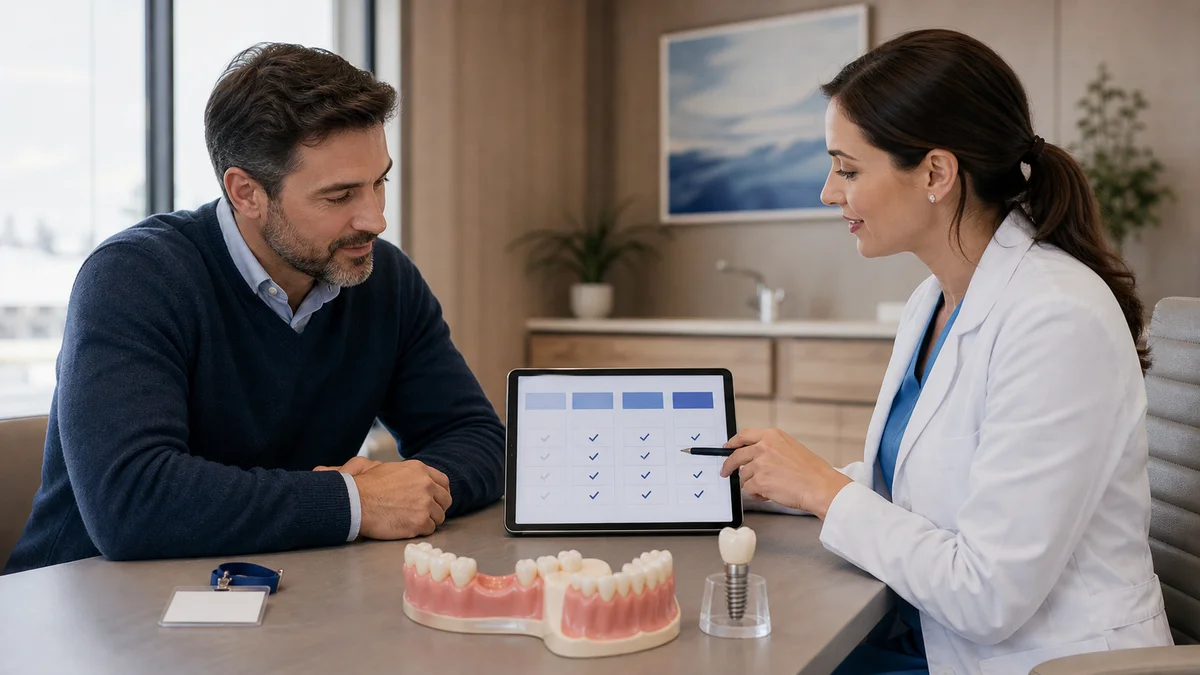
Quick answer: The best federal dental insurance for implants is not one universal carrier. For 2026, compare the official FEDVIP brochure, implant-specific maximum, major-service cost share, allowed amount, network, frequency rules, alternate benefits, premium, and the timing of every implant stage. Request a written pre-treatment estimate before committing to elective care.
Searching for the best federal dental insurance for implants can look like a request for a single winner. In practice, a plan that fits one federal employee may be poor for another. Your ZIP code affects available networks and premiums; your proposed treatment can include extraction, grafting, implant placement, an abutment, a crown, imaging, anesthesia, and maintenance; and a brochure may apply separate maximums or limitations to different parts of that sequence. The right comparison therefore begins with your own eligibility, location, dentist, and itemized clinical plan.
This guide reviews current 2026 public information from the U.S. Office of Personnel Management (OPM) and official carrier pages. It does not diagnose whether an implant is appropriate, promise that a claim will be paid, or replace the controlling plan brochure. OPM itself says its comparison tool is not an official statement of benefits and that the individual brochure controls. Benefits, provider participation, premiums, and treatment codes can change, so verify them with the plan before enrollment and again before treatment.
A dental benefit and a clinical recommendation answer different questions. Insurance rules determine what a plan may reimburse; a dentist determines whether an implant is suitable after examining oral health, bone, gums, bite, medical history, medicines, habits, and alternatives. A generous benefit does not make unnecessary care appropriate, while a limited benefit does not make clinically necessary disease control optional. Patient safety comes first throughout this comparison.
1. What “best federal dental insurance for implants” should mean in 2026
The phrase best federal dental insurance for implants should mean the plan with the strongest expected fit for a specific person, not the plan with the largest headline percentage. A carrier can advertise an unlimited general annual benefit while maintaining different rules for implants. Another may publish a separate implant maximum but have a network that does not include your surgeon or restorative dentist. A lower premium can be sensible for someone without planned major care, yet cost more overall for a person beginning a multi-stage restoration.
Start with expected annual value, not advertising language. Add the annual premiums you would pay, the deductible, your expected share of the plan’s allowed amount, and any amount above the allowance when using an out-of-network provider. Then account for annual and implant-specific maximums. Finally, consider excluded procedures, frequency rules, alternate-benefit provisions, waiting periods if any, and whether each clinician participates in the network on the date of service.
- Eligibility and enrollment: confirm that you may enroll in FEDVIP and whether Open Season or a qualifying life event applies.
- Premium: use your exact ZIP code and enrollment type rather than a national example.
- Network: verify the oral surgeon, periodontist, general dentist, laboratory pathway, and imaging site separately.
- Allowed amount: ask what the plan recognizes for each procedure code and how out-of-network billing works.
- Maximums: distinguish the general annual maximum from any separate implant, orthodontic, or other sublimit.
- Limitations: review missing-tooth, replacement, frequency, alternate-benefit, and medically necessary documentation rules.
- Treatment timing: map each stage to the plan year in which the service is completed and billed.
Do not assume a higher plan payment percentage automatically produces a lower bill. Percentages generally apply to the plan allowance, not an unlimited provider charge, and maximums can stop additional payment. The official brochure, not a marketing summary or an online ranking, is the document to read before making a decision.
2. How best federal dental insurance for implants coverage and treatment interact
FEDVIP is separate from the Federal Employees Health Benefits and Postal Service Health Benefits programs. OPM lists participating dental carriers and links to their official brochures. Enrollment status, coordination with other coverage, overseas rules, and the plan’s definition of covered services all matter. If you have another dental plan, do not simply add two advertised percentages; coordination-of-benefits rules determine the sequence and total payment.
An implant restoration is also not one billing line. A clinically appropriate pathway may involve assessment, radiographs or three-dimensional imaging when justified, removal of a tooth, treatment of active infection or gum disease, bone grafting, placement of the implant fixture, a healing interval, an abutment, a provisional restoration, a definitive crown, and maintenance. Some people need fewer stages and others need different alternatives. Ask the treating clinicians to identify anticipated procedure codes and who will bill each one.
When comparing the best federal dental insurance for implants, check whether the brochure treats the fixture, abutment, crown, graft, imaging, and anesthesia in the same benefit class. A plan can cover the crown under major services but apply a separate implant maximum to certain surgical components. A pre-treatment estimate can clarify the plan’s current interpretation, although it remains an estimate rather than a guarantee when eligibility, benefits, clinical facts, or submitted codes change.
Coverage does not determine candidacy. Untreated periodontal disease, insufficient bone, uncontrolled medical risks, tobacco or nicotine exposure, oral hygiene limitations, bruxism, medications, and the condition of neighboring teeth may change the risk-benefit discussion. A dentist may recommend disease control, another restoration, or no elective surgery at that time. Urgent swelling, fever, difficulty breathing or swallowing, uncontrolled bleeding, or spreading facial symptoms require prompt professional assessment rather than an insurance comparison.
3. 2026 best federal dental insurance for implants carrier examples
The following examples show why the best federal dental insurance for implants depends on details. They are not a ranking, endorsement, or complete statement of benefits. The information was checked against official 2026 sources on August 8, 2026. Always open the brochure for the option and enrollment area you are actually considering.
For a best federal dental insurance for implants comparison, MetLife Federal Dental High presents an unlimited general annual benefit, while its Standard option lists a $2,000 calendar-year maximum per person. The 2026 MetLife brochure includes implant services, advises members to request a pre-treatment estimate, and explains that alternate-benefit provisions may apply. The absence of a general annual maximum can be attractive for a large treatment plan, but it does not erase deductibles, member cost shares, plan allowances, frequency limitations, network differences, or implant-specific clinical and coding rules.
Within a best federal dental insurance for implants shortlist, United Concordia High publishes a separate $2,500 annual maximum for implant services in its 2026 brochure. The brochure shows major services, including certain single implant crowns, at 50% member cost share in network and 60% out of network. It also lists five-year limitations for a number of implant-related codes and states that implant services not listed are excluded. That explicit sublimit and code-level detail can make planning clearer, but the outcome still depends on which services are proposed and the allowed charge.
A best federal dental insurance for implants review should note that GEHA Standard and High publish implant limits on their official 2026 plan pages. GEHA Standard lists a $2,500 in-network and $2,000 out-of-network implant limit, while the High option lists $2,500 per person per year in or out of network. Standard also lists a general annual maximum and higher member cost shares for major services than many high options. The key lesson is that an implant limit must be read alongside the premium, general maximum, provider status, deductible, and applicable service class.
For the best federal dental insurance for implants analysis, Delta Dental FEDVIP identifies implants as Class C major services on its official plan comparison. Its published 2026 percentages differ by High versus Standard and in-network versus out-of-network care. Those percentages are useful screening data, but they do not reveal your final liability without the allowance, deductible, maximums, code limitations, and provider charge. Confirm the exact brochure and dentist participation before relying on the summary.
Other OPM-listed carriers may be a better fit in a particular area. A carrier that is not highlighted here should not be treated as inferior; these examples simply illustrate different benefit designs. Use the OPM comparison tool to create the initial shortlist, then use the carrier brochure and a written estimate to test it.
4. Decision table for the best federal dental insurance for implants
| Decision factor | Question to verify | Why it changes expected cost | Evidence to keep |
|---|---|---|---|
| General annual maximum | Is it limited or unlimited, and which services are excluded from that statement? | A headline maximum may not include a separate implant sublimit. | Brochure page and carrier response |
| Implant-specific maximum | Does one maximum combine fixture, abutment, implant crown, and related codes? | The sublimit may be reached before the full restoration is completed. | Written pre-treatment estimate by code |
| Member cost share | Is the percentage the plan’s share or the member’s share, and what allowance is used? | The same percentage can produce different bills under different allowances. | Explanation of benefits and fee estimate |
| Network status | Are all treating providers currently participating at the specific location? | Out-of-network balance billing and allowances can increase liability. | Plan directory confirmation and office verification |
| Frequency and replacement rules | Is there a five-year or other replacement interval, and when does it begin? | A prior implant, crown, bridge, or denture can affect eligibility. | Brochure section and prior claim history |
| Alternate benefit | May the plan base payment on a less expensive covered alternative? | The plan payment may be lower than an implant-based treatment estimate. | Carrier’s written calculation |
| Treatment year | Which date controls each claim: preparation, placement, completion, or seat date? | Stages can cross calendar years, premiums, and benefit changes. | Clinical timeline and plan billing rule |
| Premium and enrollment type | What is the exact annual premium for your ZIP and self, self plus one, or family tier? | A richer benefit may not offset its higher premium for every household. | Dated OPM comparison result |
Fill this table for every finalist using the same treatment codes. A plan becomes a strong candidate only after it performs well across the factors that matter to you. This is more reliable than declaring the best federal dental insurance for implants from one percentage or maximum.
5. Calculate best federal dental insurance for implants expected value
Build the best federal dental insurance for implants calculation with one worksheet for each plan. Begin with the full-year premium difference, because premiums are paid whether or not treatment proceeds. Add the deductible and the expected member share of each allowed amount. Add any provider charge above the plan allowance that could apply outside the network. Then subtract only benefits supported by a current written estimate, subject to maximums and exclusions. Use a range rather than one exact forecast when the clinical sequence is uncertain.
For example, do not multiply a provider’s total estimate by “50%” and assume that is the plan payment. The percentage might describe the member share rather than the plan share; it may apply only after the deductible; the plan may use a lower allowed amount; an implant maximum may cap reimbursement; or an alternate benefit may be used. Grafting, anesthesia, imaging, the abutment, and the crown may also be classified differently.
The best federal dental insurance for implants is the option with the most favorable realistic total for your scenario, together with acceptable network access and contract terms. If a high option costs substantially more in annual premiums, compare that extra premium with the plausible additional benefit. If treatment might not start during the plan year, include that uncertainty. Do not change or delay clinically needed disease control merely to optimize a benefit year.
- Use the same itemized dental estimate for every carrier.
- Ask each plan to show the allowed amount, deductible, plan payment, member share, and maximum impact by code.
- Include twelve months of premium, not only the per-pay-period figure.
- Model both in-network and out-of-network scenarios if provider status is uncertain.
- Keep a conservative allowance for services that may not be covered.
- Recheck benefits if treatment crosses January 1 or the treatment plan changes.
6. Best federal dental insurance for implants network checks
A best federal dental insurance for implants network check begins with the online directory but does not end there. Call the plan and the dental office shortly before care. Confirm the exact provider name, tax identification or practice location where appropriate, specialty, and network. An office may participate with one product but not another, or one dentist at a group practice may have a different status from colleagues. Ask who will perform the surgical and restorative stages.
If the treatment team uses different clinicians, request separate estimates. The surgeon’s network status does not prove that the restorative dentist, imaging center, anesthesiology provider, or laboratory-related charge will receive the same treatment. Ask whether the contracted fee includes the relevant components and what happens if a referral goes outside the network.
For someone receiving care outside the United States, review the plan’s overseas benefit and claim-submission rules before travel. Do not assume a domestic provider directory or cost share applies abroad. If you are considering dental treatment at Redent Klinik, the Redent Klinik English overview explains the clinic’s services, and the Redent Klinik contact page is the appropriate place to request an individualized assessment. Coverage must still be verified directly with your FEDVIP carrier; the clinic cannot guarantee reimbursement.
7. Best federal dental insurance for implants exclusions and limits
A brochure can cover implants while limiting when or how it pays. Search the official PDF for “implant,” “abutment,” “crown,” “missing tooth,” “alternate benefit,” “frequency,” “replacement,” “maximum,” and “predetermination.” Read the definitions, exclusions, and claims sections around each result. One isolated table row rarely tells the whole story.
A replacement rule may restrict payment when an implant, crown, bridge, or denture was placed or replaced within a defined period. A missing-tooth limitation may affect teeth lost before coverage began, depending on the plan language. An alternate-benefit provision may calculate payment using a lower-cost covered treatment even when the patient and dentist choose an implant. These rules do not necessarily prohibit treatment; they change the insurer’s payment.
When testing the best federal dental insurance for implants, give the plan accurate information about the tooth, prior restorations, extraction date, proposed codes, providers, and clinical timeline. Ask the carrier to cite the brochure section supporting its estimate. Keep the response and the version of the brochure used. A telephone representative’s statement can be helpful, but written plan documents and the final processed claim control the actual benefit.
8. Best federal dental insurance for implants pre-treatment estimates
Ask for a best federal dental insurance for implants pre-treatment estimate before non-urgent major care. The submission may include procedure codes, tooth numbers, radiographs, notes, and the provider’s charges. The response can show current eligibility, estimated allowance, deductible, benefit percentage, limitations, and remaining maximum. It is not a guarantee because enrollment, benefits, codes, provider status, clinical facts, or accumulated claims can change before the service date.
Staging treatment across plan years sometimes appears to preserve maximums, but the correct billing date is governed by the brochure and the actual service. Do not ask a clinician to use an inaccurate date or code. A multi-stage implant also needs biological healing, not an artificial insurance timetable. The treating dentist should determine safe timing based on examination and response to care.
The best federal dental insurance for implants should still be acceptable if a stage moves, a graft becomes necessary, or the restoration design changes. Build a contingency range and ask how the plan handles revised codes. If the estimate expires, eligibility changes, or a new plan year begins, request an updated response before proceeding when clinically reasonable.
9. Clinical questions before a best federal dental insurance for implants decision
An implant is one method of replacing a missing tooth; alternatives may include a tooth-supported bridge, a removable prosthesis, maintaining the space in selected circumstances, or another individualized plan. Each option has different effects on neighboring teeth, hygiene, surgery, maintenance, timing, repair, and cost. The choice should follow a diagnosis and shared decision-making, not an insurance maximum alone.
Ask the dentist what problem is being treated, what alternatives are reasonable, and what would happen with no immediate restoration. Discuss the condition of gums and remaining teeth, bone volume, bite forces, esthetic expectations, maintenance ability, smoking or nicotine use, relevant medical conditions and medicines, and the possibility of complications or additional procedures. No implant is guaranteed to integrate or last indefinitely.
- Who is responsible for surgery, restoration, and long-term maintenance?
- Is active decay, gum disease, or infection controlled before elective implant care?
- What imaging is clinically justified, and who interprets it?
- Is bone or soft-tissue grafting anticipated, and what could change that decision?
- What are the material, component, and restoration choices?
- How will cleaning, professional reviews, and repair needs be managed?
- What signs should prompt an earlier review?
Insurance is one input after these questions are answered. The safest best federal dental insurance for implants decision is one that supports a clinically justified plan without pressuring the patient toward unnecessary surgery or an unrealistic schedule.
10. A practical 2026 best federal dental insurance for implants workflow
Start the best federal dental insurance for implants workflow by obtaining an examination and a written, itemized treatment proposal from a licensed dentist. If a diagnosis or major elective plan is unclear, consider a second professional opinion. Second, check FEDVIP eligibility and use OPM’s 2026 comparison tool with your actual ZIP, enrollment tier, and family circumstances. Save the date and results because premiums and plan details can change.
Third, download the official brochure for each finalist from OPM or the carrier. Mark the pages covering Class C or major services, implants, maximums, deductibles, frequency rules, alternate benefits, networks, claims, overseas care if relevant, and coordination of benefits. Fourth, verify every treating provider and request a pre-treatment estimate using the same codes from each plan.
Fifth, calculate a conservative total: annual premiums plus deductible plus expected member cost shares plus uncovered or above-allowance amounts. Compare that total with the same calculation under each option. Sixth, review the clinical timing with the dentist and the benefit timing with the carrier. Finally, keep records of enrollment, brochures, network confirmations, estimates, claim documents, receipts, and appeals instructions.
This workflow turns the best federal dental insurance for implants question into a documented decision. It also makes uncertainty visible. If two options are close, network access, claims service, overseas needs, family dental use, and tolerance for a higher premium may reasonably decide the result.
11. Frequently asked questions about the best federal dental insurance for implants
Is MetLife High automatically the best federal dental insurance for implants because its general annual benefit is unlimited?
No. An unlimited general annual benefit can be valuable, but it does not mean every implant-related charge is paid without limit. The deductible, member cost share, allowed amount, network status, alternate-benefit provision, code limitations, premiums, and treatment sequence still apply. Compare a written MetLife estimate with other plans using the same proposed codes.
Does a 50% best federal dental insurance for implants benefit pay half the fee?
Not necessarily. Confirm whether the brochure states the plan share or member share. The percentage normally applies to an allowed amount and may be reduced by the deductible or a maximum. An out-of-network provider may bill above that allowance. A code-by-code pre-treatment estimate is the most useful current projection.
Can I enroll in the best federal dental insurance for implants immediately?
Usually, the need for treatment alone does not create an enrollment opportunity. FEDVIP enrollment generally occurs during Federal Benefits Open Season or after an eligible qualifying life event, subject to OPM rules. Verify your situation with BENEFEDS or your appropriate benefits office rather than delaying urgent disease management while waiting for coverage.
Should best federal dental insurance for implants stages span two years?
Only when the clinical timeline is safe and the claims follow the plan’s billing rules. A dentist must not misstate service dates, and biological healing should not be rushed or delayed merely for insurance. Ask which completion date controls each code, whether benefits may change January 1, and whether a new pre-treatment estimate will be needed.
Will the best federal dental insurance for implants pay outside the United States?
Possibly, depending on the selected plan’s overseas coverage, allowance, documentation, translation, currency conversion, claim deadline, and exclusions. Obtain written guidance from the carrier before travel. A provider cannot guarantee a U.S. plan’s payment, and reimbursement may differ from domestic in-network benefits.
What if the best federal dental insurance for implants denies a claim?
Read the explanation of benefits and compare the denial reason with the brochure and submitted records. Ask the provider whether the code or documentation is accurate. Follow the plan’s reconsideration or appeal procedure and deadline, supplying relevant clinical records and the pre-treatment response. A prior estimate can support the inquiry but may not guarantee reversal.
Do medical plans cover care when best federal dental insurance for implants does not?
Routine dental restoration is commonly handled through dental benefits, while a medical plan may apply only in specific medically necessary circumstances defined by that contract. Do not assume FEHB or PSHB will pay. Ask both plans about coordination, required documentation, prior authorization, and which provider should submit the claim.
12. Best federal dental insurance for implants bottom line
There is no universal best federal dental insurance for implants. MetLife High’s unlimited general annual benefit, United Concordia High’s stated implant maximum, GEHA’s published implant limits, and Delta Dental’s Class C implant percentages illustrate distinct designs rather than a simple ranking. Premiums, networks, allowances, exact codes, frequency rules, alternate benefits, and the annual timing of care determine the practical result.
Use OPM to create a 2026 shortlist, then let the official brochure and a written code-by-code estimate do the real comparison. Keep the dental diagnosis separate from the insurance calculation. The plan should support an individualized, evidence-based treatment decision, but it should never dictate surgery or promise a clinical result.
Sources and 2026 verification
Benefit information was checked on August 8, 2026. The official brochure controls, and readers should confirm current eligibility, premiums, networks, allowances, and pre-treatment estimates directly with the plan.
- U.S. Office of Personnel Management — 2026 FEDVIP plan comparison
- U.S. Office of Personnel Management — FEDVIP dental plans and brochures
- MetLife FEDVIP — 2026 dental plan details
- MetLife — 2026 FEDVIP Dental Plan brochure
- United Concordia — 2026 FEDVIP Dental Plan brochure
- GEHA — 2026 Standard dental plan details
- Delta Dental — 2026 FEDVIP plan comparison
- American Dental Association — professional and patient dental information
- World Health Organization — oral health fact sheet