
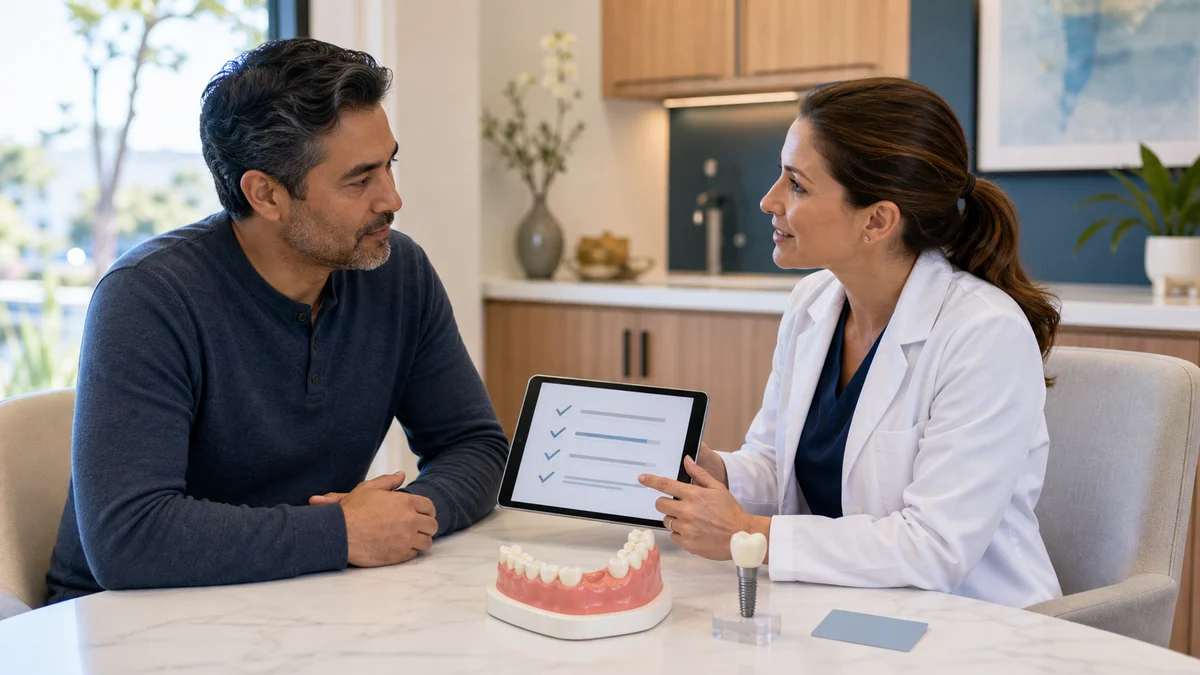
Quick answer: does medi cal cover dental implants? Medi-Cal lists implants among adult dental benefits, but the July 2026 provider criteria say implant services are benefits only when exceptional medical conditions are documented, medical necessity is established, and prior authorization is approved. Routine replacement of a missing tooth is not automatically covered. Eligibility and program pathway also matter.
The search does medi cal cover dental implants needs a careful answer. California’s official benefits page includes dental implants in its adult dental list. However, the current Medi-Cal Dental Manual of Criteria says implant services are a benefit only when exceptional medical conditions are documented and reviewed for medical necessity. Surgical placement of an endosteal implant requires prior authorization, radiographs as applicable, and written documentation explaining the condition, medical necessity, history, and proposed treatment.
That means “listed benefit” is not the same as automatic approval. A member’s current eligibility, age, scope of benefits, county delivery system, clinical circumstances, provider enrollment, requested procedure codes, records, and authorization decision all influence the outcome. The plan can also distinguish a covered implant fixture from related components, grafts, imaging, anesthesia, abutments, crowns, or maintenance. Your Medi-Cal dental provider should check each anticipated service rather than treating the word “implant” as one package.
This guide reflects official California sources checked on August 8, 2026. Policies can change, and a web article cannot determine eligibility or medical necessity for one person. The current handbook, the authorization response, and any applicable Dental Managed Care plan documents control. Clinical suitability must be decided by a licensed dentist after an examination; insurance coverage must never substitute for diagnosis or informed consent.
1. Does medi cal cover dental implants for every missing tooth?
No. The safest interpretation of does medi cal cover dental implants is “sometimes, under specific criteria,” not “yes for any missing tooth.” The July 2026 Medi-Cal Dental Provider Handbook states that implant services are benefits only when exceptional medical conditions are documented and the request is reviewed for medical necessity. It also directs providers to implant general policies and code-specific requirements.
A common desire to avoid a removable denture or bridge does not by itself prove that the program’s medical-necessity standard is met. The provider must explain the condition being addressed, why the proposed implant service is medically necessary, pertinent history, and the proposed treatment. Radiographs and photographs may be required when applicable. Medi-Cal then reviews the submitted request; the dentist cannot guarantee approval before that decision.
Coverage and clinical appropriateness are separate. Even if authorization may be possible, a dentist must assess gums, bone, oral hygiene, bite, neighboring teeth, medical history, medicines, nicotine exposure, healing capacity, and alternatives. Active dental disease may need treatment first. Conversely, a denied benefit does not mean a clinician has said the treatment is impossible; it means the program did not authorize payment under the information and criteria applied.
2. What the official 2026 rules say about does medi cal cover dental implants
The current evidence for does medi cal cover dental implants comes from two levels of official information. The public DHCS benefits page lists dental implants among adult dental benefits. The detailed provider Manual of Criteria governs how particular implant codes are reviewed. For procedure D6010, surgical placement of an endosteal implant, the manual states:
- implant services are a benefit only when exceptional medical conditions are documented and reviewed for medical necessity;
- prior authorization is required;
- arch, pre-operative periapical, or panoramic radiographs are submitted as applicable;
- photographs are submitted as applicable;
- written documentation must describe the condition, medical-necessity rationale, pertinent history, and proposed treatment; and
- a tooth or arch code is required as applicable.
The manual also shows why a member should not assume every related code is payable. Some procedures refer back to the D6010 criteria, some are included in another fee and not separately payable, and some are identified as not a benefit. A complete plan can involve several codes across surgery and restoration. The provider should identify which services are being requested, which need authorization, and which may be excluded or bundled.
There is no responsible way to answer does medi cal cover dental implants from a treatment total alone. Medi-Cal does not authorize an abstract retail package. It evaluates covered codes, eligibility, provider status, documentation, and policy criteria. Ask for a copy or explanation of the proposed treatment authorization request and the resulting Notice of Authorization.
3. Does medi cal cover dental implants for adults in 2026?
For an adult with the appropriate scope of Medi-Cal eligibility, implants remain listed on the state’s benefits page, subject to the exceptional-condition, medical-necessity, and prior-authorization rules. Current eligibility must be verified on the date of service. Some members have a share of cost or other program conditions, so no article should promise that all approved care will always be free.
A 2026 policy issue deserves special attention. Earlier notices described an adult dental change based on immigration status. DHCS subsequently posted that the change was delayed until July 1, 2027. As of the August 8, 2026 verification date for this article, the official Medi-Cal help and provider pages identify July 1, 2027 as the future effective date. Members should still renew on time and check their own scope of benefits because eligibility is individualized and future policy can change.
Pregnant members, people in the postpartum period, children, and former foster youth can have distinct eligibility protections. Emergency benefits also differ from comprehensive implant treatment. Severe pain, infection, swelling, trauma, or another urgent problem should be assessed promptly; do not wait for an elective implant authorization before seeking appropriate emergency evaluation.
4. Does medi cal cover dental implants through EPSDT?
For members under age 21, the federal Early and Periodic Screening, Diagnostic, and Treatment benefit can be broader than a standard state-plan list. DHCS explains that full-scope members under 21 may receive medically necessary services needed to correct or ameliorate a condition, even when the service is not otherwise listed as a routine benefit. A provider submits a Treatment Authorization Request when required.
DHCS gives an implant-specific example: when edentulous areas cannot be adequately restored using conventional prosthetics, an implant-retained fixed prosthesis may be authorized as an EPSDT service. This is not automatic entitlement to a preferred restoration. The provider must document why the service is medically necessary to correct or ameliorate the identified condition and why conventional options are inadequate.
Therefore, the answer to does medi cal cover dental implants for a person under 21 may involve EPSDT analysis. The family should work with an enrolled provider who understands the program’s documentation and authorization process. If a request is denied, the notice should explain review or hearing rights.
5. Does medi cal cover dental implants in FFS and managed care?
Medi-Cal Dental services are delivered through fee-for-service across California and through Dental Managed Care plans in Los Angeles and Sacramento counties for certain members. DHCS says Dental Managed Care covers the same dental services as fee-for-service, but provider networks, referrals, plan contacts, and authorization workflows can differ. Your Benefits Identification Card and enrollment information help the office identify the correct route.
When asking does medi cal cover dental implants, first determine which dental delivery system handles your care. A fee-for-service member should use a provider enrolled in Medi-Cal Dental. A managed care member should start with the dental plan’s member services and network. Do not assume that a dentist who accepts one Medi-Cal pathway participates in another.
- Verify active Medi-Cal eligibility and dental scope before the consultation.
- Confirm whether you are in fee-for-service or a Dental Managed Care plan.
- Use the official provider directory or plan directory, then confirm participation with the office.
- Ask whether the proposed clinician can submit the required authorization.
- Confirm whether surgical and restorative providers are both enrolled and appropriately referred.
- Request language assistance or accessible communication when needed.
An office saying that it “takes Medi-Cal” is not enough. Ask about the specific dentist, location, delivery system, and requested service. Enrollment status can change, and a provider may participate while not offering every specialty procedure.
6. Prior authorization for does medi cal cover dental implants
Prior authorization is a review before specified care is provided or paid. DHCS explains that providers must receive authorization for some medical, pharmacy, and dental services. The provider knows when and how to submit the request. For implant procedure D6010, the current dental criteria explicitly require prior authorization.
A strong does medi cal cover dental implants request is clinically specific. It should identify the medical or oral condition, missing tooth or arch, proposed procedure codes, relevant history, alternatives considered, and the medical-necessity rationale. The current manual calls for appropriate radiographs and written documentation; photographs may also be submitted when applicable. The reviewer may ask for additional information.
The provider should not represent a pending request as approved. Ask whether the office has received a formal Notice of Authorization, which codes and teeth or arches it covers, the validity dates, and whether any conditions remain. If the treatment plan changes, a revised authorization may be needed. Eligibility must still be active when the service is delivered.
7. Decision table: what happens after you ask does medi cal cover dental implants?
| Situation | What it means | Safe next step | Document to keep |
|---|---|---|---|
| Provider says an implant may be clinically appropriate | A treatment option has been identified, but coverage is not established | Ask for alternatives, risks, stages, and proposed codes | Written treatment plan |
| Provider prepares prior authorization | The plan is being submitted for program review | Confirm supporting records and do not assume approval | Submission or reference details |
| Authorization approved | Specified codes are approved under stated conditions and dates | Recheck eligibility, provider, scope, and clinical plan before care | Notice of Authorization |
| Authorization modified | Only part of the requested plan may be authorized | Ask the dentist to explain the safe clinical alternatives | Authorization and treatment revision |
| Authorization denied | The request did not meet the applied coverage criteria based on the record reviewed | Read the reason, correct factual gaps, and review hearing or grievance rights | Denial notice and records |
| Provider is not enrolled or out of plan network | Medi-Cal may not pay that clinician through your delivery system | Use the official directory and request an appropriate referral | Directory and plan confirmation |
| Treatment changes after approval | Existing authorization may not match the revised codes or scope | Ask whether a new or modified authorization is required | Updated plan and authorization |
This table prevents a frequent misunderstanding: prior authorization is not the dental diagnosis, and the diagnosis is not prior authorization. Both must align before elective care proceeds.
8. Does medi cal cover dental implants across every treatment stage?
An implant restoration is a sequence, not one object. Depending on the diagnosis, it may include examination, radiographs or three-dimensional imaging when justified, extraction, infection or periodontal treatment, hard- or soft-tissue grafting, implant placement, uncovering, an abutment, a provisional restoration, a definitive crown or prosthesis, and maintenance. Not every patient needs every step.
The answer to does medi cal cover dental implants may differ for each stage. A service can be covered, bundled into another procedure, require its own authorization, or be excluded. The implant fixture being authorized does not automatically prove that a graft, sedation, custom abutment, crown material, or future maintenance is authorized. Ask the provider to map each proposed code to the current criteria.
Also ask who will perform and bill each stage. Surgical placement and the final restoration may be provided by different clinicians. Both should verify program participation and authorization responsibilities. If the case is referred, keep the names, locations, and notices for the complete team.
9. Clinical safety before asking does medi cal cover dental implants
Insurance cannot decide whether an implant is safe. A dentist may evaluate the missing-tooth area, bone dimensions, gums, bite, hygiene, remaining teeth, previous prostheses, and imaging. Health history may include diabetes control, immune or healing concerns, bleeding risk, medicines, allergies, nicotine use, prior radiation, and other factors relevant to treatment. The dentist should explain reasonable alternatives and the consequences of no immediate restoration.
Potential alternatives can include a tooth-supported bridge, removable partial or complete denture, repair or adaptation of an existing prosthesis, space maintenance in selected circumstances, or another individualized plan. Each option has its own surgical burden, effect on neighboring teeth, maintenance, repair pathway, and limitations. Coverage should not push a member toward an inappropriate option.
A medically necessary authorization does not guarantee integration, comfort, appearance, function, or longevity. Complications and additional procedures can occur. Long-term plaque control, professional review, and restoration maintenance remain important. Seek prompt care for increasing swelling, fever, drainage, uncontrolled bleeding, difficulty breathing or swallowing, rapidly spreading facial symptoms, or severe worsening pain.
10. When does medi cal cover dental implants receives a denial
If the answer to does medi cal cover dental implants is “not approved” for your request, read the notice rather than relying on a verbal summary. Identify whether the issue is eligibility, provider status, missing documentation, a nonbenefit code, lack of demonstrated medical necessity, an alternative service, or another criterion. Ask the provider whether the record accurately reflects the diagnosis and proposed treatment.
DHCS states that a member who disagrees with a prior-authorization decision may be able to request a fair hearing. The denial or modification notice should provide the applicable procedure and deadline. Dental Managed Care members may also have plan grievance or appeal steps. Follow the instructions for your delivery system; do not assume that sending the same material to a different office starts a valid appeal.
- Keep the denial or modification notice and envelope or electronic delivery date.
- Request the submitted treatment plan, radiographs, notes, and code list.
- Ask the dentist whether clinically relevant documentation is missing or incorrect.
- Review the stated hearing, grievance, or appeal deadline promptly.
- Use an authorized representative only with appropriate consent and documentation.
- Continue urgent disease control and discuss covered alternatives while the dispute proceeds.
A denial should not lead to untreated infection or uncontrolled pain. Ask what covered care is available now and whether referral is needed. An elective implant question must not delay emergency assessment.
11. Does medi cal cover dental implants outside enrolled care?
A does medi cal cover dental implants search should not lead a member to pay a private deposit for elective care on the assumption that Medi-Cal will reimburse it later. Confirm eligibility, enrolled-provider status, authorization, and any member financial responsibility first. A member with a share of cost may have different obligations from a member without one. Ask for written explanations rather than a fixed promise.
Medi-Cal Dental is designed around enrolled providers and program rules. If you seek care from a provider who is not enrolled or outside the plan network, payment may not be available. Treatment outside California or outside the United States requires direct confirmation; never assume that an authorization or foreign invoice will be reimbursed.
For readers exploring treatment at Redent Klinik, the Redent Klinik English service overview describes the clinic, and the Redent Klinik contact page can be used to request an individualized clinical consultation. Redent Klinik is not presented here as a Medi-Cal provider, and it cannot guarantee Medi-Cal payment. Confirm program coverage with DHCS or your dental plan before making travel or financial commitments.
12. Frequently asked questions: does medi cal cover dental implants?
Does medi cal cover dental implants when dentures are uncomfortable?
Discomfort alone does not establish implant coverage. A dentist should first diagnose the cause and assess whether a denture can be adjusted, repaired, relined, remade, or replaced. Implant services require documentation of exceptional medical conditions and medical necessity under current criteria. For an EPSDT member under 21, inability to restore an edentulous area adequately with conventional prosthetics may support review, but authorization is still required.
Does medi cal cover dental implants for one missing tooth?
Not automatically. The number of missing teeth does not replace the exceptional-condition and medical-necessity analysis. The enrolled provider must document the specific condition, alternatives, history, and proposed codes, then obtain prior authorization when required. A routine preference for an implant over a bridge is not a coverage guarantee.
Does medi cal cover dental implants and the crown?
The fixture and restoration can use different procedure codes. Some implant-supported restorations refer to the D6010 criteria, while other services may be bundled or not benefits. Ask the provider to list the fixture, abutment, crown or prosthesis, graft, imaging, and anesthesia separately and identify what the authorization covers.
Does medi cal cover dental implants without prior authorization?
Current 2026 criteria for D6010 require prior authorization. A provider should not promise retroactive approval for elective placement. Confirm the formal decision, approved codes, service location, provider, and authorization dates before proceeding. Emergency care follows different clinical and program rules.
Does medi cal cover dental implants for members under 21?
EPSDT can authorize medically necessary services needed to correct or ameliorate a condition. DHCS specifically notes that an implant-retained fixed prosthesis may be authorized when edentulous areas cannot be adequately restored with conventional prosthetics. The provider must document the need and submit the required authorization request.
Does medi cal cover dental implants from any dentist?
No. The provider must be appropriately enrolled for the applicable Medi-Cal Dental delivery system, and managed care members generally need plan-network care or an authorized referral. Confirm the exact dentist and location in the official directory and with the office. Participation does not mean the dentist offers every implant service.
Does medi cal cover dental implants after an authorization expires?
An expired authorization should not be treated as valid. Ask the provider whether an extension, new request, or updated documentation is required. Eligibility, clinical circumstances, policy, provider status, and codes may have changed. Do not schedule elective surgery until the office confirms the current requirements.
Can I appeal when does medi cal cover dental implants is answered “no”?
You may have fair-hearing, grievance, or appeal rights depending on the program and decision. Follow the instructions and deadline on the notice. Ask the provider to correct missing or inaccurate clinical documentation where appropriate. An appeal reviews benefit entitlement; it does not replace informed clinical decision-making.
13. Does medi cal cover dental implants: a safe checklist
Begin the does medi cal cover dental implants checklist by checking active Medi-Cal eligibility and dental scope. Identify whether fee-for-service or Dental Managed Care administers the benefit. Use the official directory to locate an enrolled provider, then confirm participation and whether the office evaluates complex implant requests. Bring your Benefits Identification Card, medical history, medication list, prior dental records, and any existing authorization or denial notices.
After examination, request a written diagnosis, reasonable alternatives, and an itemized plan. Ask the dentist to explain why an implant is medically necessary under the current criteria and what exceptional condition is being documented. Confirm which records and codes will be submitted. Wait for the formal authorization decision before non-urgent implant treatment.
When the notice arrives, compare it with the plan. Check tooth or arch, codes, provider, service location, dates, and conditions. If approved, recheck eligibility and clinical readiness before each stage. If denied or modified, read the reason, discuss safe alternatives, and act promptly on hearing or grievance rights. Keep copies of every document.
14. Bottom line on does medi cal cover dental implants
The accurate 2026 answer to does medi cal cover dental implants is conditional. California lists dental implants as an adult Medi-Cal benefit, but the current detailed criteria restrict implant services to documented exceptional medical conditions, medical-necessity review, and prior authorization. Members under 21 may have an EPSDT pathway when the service is medically necessary to correct or ameliorate a condition.
Close the does medi cal cover dental implants review by verifying current eligibility, delivery system, enrolled provider, codes, supporting records, and authorization before elective treatment. Treat the dental diagnosis and benefit decision as separate but coordinated processes. Neither a coverage approval nor an online article can guarantee a clinical outcome.
Official sources and clinical context
Program information was checked on August 8, 2026. Current DHCS policy, member eligibility, the authorization notice, and applicable plan documents control.
- California DHCS — Medi-Cal benefits, including adult dental implants
- Medi-Cal Dental — July 2026 Manual of Criteria and Schedule of Maximum Allowances
- California DHCS — prior authorization overview
- Medi-Cal Dental — current provider handbook
- Medi-Cal Dental — EPSDT services and implant example
- California DHCS — Medi-Cal help, dental delivery systems, and current benefit-change timing
- Medi-Cal Dental — member handbook
- Medi-Cal Dental — official provider directory
- California Department of Social Services — State Hearings
- American Dental Association — professional and patient dental information
- World Health Organization — oral health fact sheet