
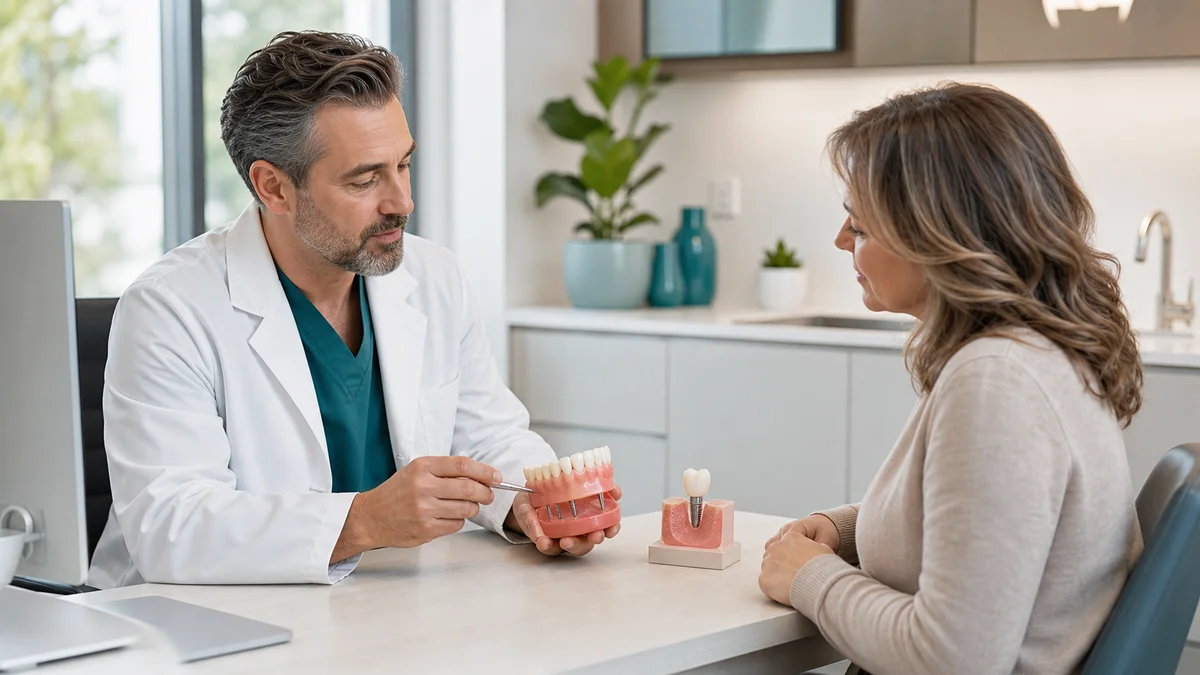
Quick answer: denture implants vs dental implants is not a simple contest between two devices. “Denture implants” usually means a removable or fixed full-arch prosthesis supported by implants, while a dental implant can support one crown, a bridge, or a denture. The safer choice depends on missing-tooth pattern, bone and gum health, medical history, cleaning ability, expectations, and a clinician’s examination.
People searching denture implants vs dental implants are often trying to solve different problems with similar words. One person may have a loose complete denture and want more stability. Another may have one missing tooth and want to avoid a removable appliance. A third may need reconstruction of an entire arch. These situations cannot be compared by advertising labels alone, because the number of missing teeth, remaining teeth, jaw anatomy, bite, speech, dexterity, health conditions, and maintenance needs change the treatment plan.
The U.S. Food and Drug Administration explains that a dental implant is a medical device surgically placed in the jaw. It can support an artificial tooth, bridge, or denture. That definition is important: a denture supported by implants still uses dental implants. The useful comparison is therefore between restoration designs, not between supposedly unrelated implant categories. This guide explains denture implants vs dental implants without promising candidacy, a fixed timeline, a permanent result, or a universal “best” option.
This article is general education, not a diagnosis or an individual treatment recommendation. An in-person assessment is needed before any implant or denture decision. If you are comparing care in Türkiye, you can review the English Redent Klinik information hub and use the Redent Klinik contact page to ask what records are needed for a clinical consultation. Online information cannot replace examination, imaging when indicated, or discussion of alternatives.
What “denture implants” and dental implants actually mean
In a denture implants vs dental implants search, the phrase “denture implants” is common but can be misleading. Implants are the components placed in bone; the denture is the prosthetic teeth and base that attach to, rest on, or are retained by those implants. Depending on the design, a patient may remove the denture for cleaning, or only a dental professional may remove the prosthesis. The number and position of implants are individualized. A photo or package name does not reveal whether a design is appropriate.
By contrast, “dental implant” describes the implanted device, not the final tooth replacement. A single implant may support a crown for one missing tooth. Several implants may support a fixed bridge. Multiple implants may also stabilize a removable overdenture or support a fixed full-arch prosthesis. When reviewing denture implants vs dental implants, ask the clinic to name both parts: the implant system in bone and the restoration that will be connected to it.
- Conventional complete denture: removable teeth supported mainly by oral tissues, without implants.
- Implant-retained overdenture: removable by the patient and connected to implants for added retention.
- Implant-supported fixed full arch: attached to implants and normally removed only by a dental professional.
- Single implant crown: one implant and restoration replacing one tooth, when clinically suitable.
- Implant-supported bridge: a fixed restoration replacing several teeth with support from more than one implant.
Denture implants vs dental implants: the central difference
The central difference in denture implants vs dental implants is the scale and design of the prosthesis. A single implant restoration addresses a local space. An implant-retained or implant-supported denture replaces many or all teeth in an arch and may also replace lost gum volume with prosthetic material. Full-arch treatment therefore involves more than placing a larger version of a single tooth. Lip support, speech, smile display, bite forces, hygiene access, and repair strategy all influence the design.
In practical denture implants vs dental implants discussions, patients should separate three questions. First, how many teeth and tissues must be replaced? Second, should the final restoration be removable by the patient or fixed? Third, what implant distribution can the anatomy and health status safely support? A clinician may also recommend preserving treatable natural teeth, using a conventional denture, choosing a tooth-supported bridge, or delaying surgery while disease is managed.
For denture implants vs dental implants, neither a removable overdenture nor a fixed implant restoration is automatically superior. Removability can make cleaning easier for some people and undesirable for others. Fixed restorations can feel more integrated, but they require space for cleaning tools and professional maintenance. The correct decision is the design a patient can use, clean, repair, and monitor safely—not the design with the strongest marketing language.
Who may be evaluated for each option
Candidacy for either side of denture implants vs dental implants begins with the mouth and the whole person. The dentist reviews missing and remaining teeth, decay, periodontal condition, available bone, gum tissue, bite, jaw relationship, smile and speech goals, prior restorations, pain, and the condition of any current denture. Medical history, medicines, smoking or nicotine use, diabetes control, healing history, allergies, and previous head or neck treatment may alter risk or timing. None of these factors should be assessed through a short online quiz.
The FDA advises patients to discuss overall health, potential benefits, risks, healing, and whether they are candidates. It also notes that smoking can affect healing and that implant healing may take several months or longer. For denture implants vs dental implants, the relevant question is not “Am I healthy enough for implants?” in the abstract. It is whether the proposed number, location, surgery, loading schedule, and restoration are reasonable for that individual.
When a single implant crown may enter the discussion
Within denture implants vs dental implants, a single implant crown may be considered when one tooth is missing, adjacent teeth and tissues are assessed, and sufficient support can be achieved. The plan must account for the space, bone, gum contour, bite, esthetic zone, and relation to anatomical structures. It is not a substitute for treating active gum disease or uncontrolled decay elsewhere. A bridge or removable option may sometimes be more appropriate.
When an implant-retained denture may enter the discussion
An implant-retained removable denture may be evaluated when a conventional denture lacks retention or when the patient wants improved stability while retaining the ability to remove the prosthesis for cleaning. The denture still requires maintenance. Attachments can wear, the base can need adjustment, and oral tissues and implants must be reviewed. In denture implants vs dental implants, removable does not mean temporary or low quality; it describes how the prosthesis is managed.
When a fixed full-arch design may enter the discussion
On the full-arch side of denture implants vs dental implants, a fixed design may be discussed for extensive tooth loss when anatomy, health, hygiene capacity, expectations, and restorative space support that approach. It involves a coordinated surgical and prosthetic plan. Immediate provisional teeth may be possible in selected cases, but “same-day teeth” should never be interpreted as final healing or guaranteed immediate loading. Stability and risk must be assessed at treatment time.
Examination and planning before choosing
A safe denture implants vs dental implants plan usually starts with history, clinical examination, periodontal evaluation, bite analysis, and appropriate imaging. Three-dimensional imaging may be indicated when it will influence implant planning, but it should not be ordered merely because a clinic owns a scanner. The team should explain what information is needed, the radiation considerations, and how the result changes the plan. Existing dentures can also provide useful information about tooth position, speech, facial support, and tolerances.
For a meaningful denture implants vs dental implants consultation, ask for a diagnosis and options before asking for a package. The plan should identify teeth to preserve or remove, disease to treat, grafting that may be considered, provisional restoration, final restoration, hygiene pathway, and likely repair points. If another clinician will perform part of the care, roles and communication should be clear.
- What diagnosis explains the tooth loss, looseness, pain, or denture instability?
- Which natural teeth have a reasonable prognosis, and why?
- What removable, fixed, implant, and non-implant alternatives are reasonable?
- Is grafting being proposed, and what problem is it intended to solve?
- Who plans the prosthesis, who places implants, and who handles complications?
- What will I wear during healing, and what limits apply during that phase?
- How will I clean the final design with my current dexterity and home support?
- Which components, records, and implant identifiers will I receive?
Surgery, healing, and temporary teeth
Both pathways in denture implants vs dental implants include a surgical component when implants are placed. Depending on the case, treatment may involve extraction, implant placement, bone or soft-tissue procedures, uncovering, impression or scanning appointments, provisional teeth, and final restoration. These steps may be combined or separated. The schedule depends on biology and stability, not only convenience. A temporary restoration may look complete while the implants and tissues are still healing.
The FDA lists potential implant complications including injury to nearby teeth or tissues, sinus perforation, jaw injury, altered bite, screw loosening, infection, difficulty cleaning, nerve symptoms, and implant failure. These risks do not mean implants are inappropriate; they mean consent and follow-up matter. A balanced denture implants vs dental implants explanation includes both expected benefits and what happens if healing or a component does not proceed as planned.
Before choosing in denture implants vs dental implants, ask what symptoms are expected after surgery and which require prompt contact. Increasing swelling, fever, persistent bleeding, a loose implant-related component, worsening pain, altered sensation, or difficulty breathing should not be managed through internet advice. Clinics should provide an emergency pathway. Patients traveling for care need a written plan for urgent assessment after returning home.
Stability, chewing, speech, and appearance
Function in denture implants vs dental implants must be discussed realistically. Implant support can improve retention and chewing compared with an unstable conventional denture, but individual outcomes vary. A removable overdenture may still move slightly because its design can share support with oral tissues. A fixed full-arch prosthesis does not lift out during normal use, but it can feel different from natural teeth. Single implant crowns also lack the ligament sensation of a natural tooth. Adaptation and bite adjustment may be needed.
When comparing denture implants vs dental implants, describe the desired function precisely. “I want to eat normally” can mean different things. Ask which food textures are realistic during healing and after delivery, whether speech changes are expected, and how the restoration affects lip and cheek support. A trial denture or digital preview may help communication, but a preview is not a guaranteed biological or cosmetic outcome.
Appearance depends on tooth shape, color, position, gum display, facial support, and the transition between prosthesis and natural tissue. A fixed full arch can require prosthetic gum material when significant tissue has been lost. A single implant in a high-smile area may demand careful soft-tissue planning. Photos should supplement, not replace, clinical measurements and informed consent.
Cleaning and maintenance are part of treatment
Neither option in denture implants vs dental implants is immune to plaque-related inflammation, mechanical wear, or changes in surrounding tissues. Daily cleaning and professional review remain essential. A removable implant overdenture is taken out for cleaning according to the clinician’s instructions; its attachments and fitting surface also need care. A fixed full-arch prosthesis requires cleaning beneath the restoration with tools selected for the access spaces. A single implant crown needs cleaning around the gumline and between adjacent teeth.
The best-looking denture implants vs dental implants proposal can become unsuitable if the patient cannot clean it. Arthritis, visual impairment, tremor, cognitive change, caregiver availability, and mouth opening can affect maintenance. These are design considerations, not personal failings. A removable design may be easier for one person, while another may manage a fixed design well with adapted brushes, floss threaders, interdental brushes, or an oral irrigator as advised.
Maintenance after denture implants vs dental implants may include hygiene visits, bite checks, imaging when clinically indicated, attachment replacement, screw evaluation, relining, repair of chipped materials, or replacement of worn prosthetic teeth. No restoration should be sold as maintenance-free. Ask who provides long-term care, what is included in a guarantee, what is excluded, and how repairs are handled if the original clinic is far away.
Decision table: compare designs, not slogans
This table provides a structured way to discuss denture implants vs dental implants. It is not a prescription; the final plan must follow examination and informed consent.
| Decision point | Implant-retained removable denture | Fixed implant restoration | Question to ask |
|---|---|---|---|
| Who removes it? | Patient removes it for cleaning | Usually only a dental professional | Can I safely manage the required cleaning? |
| Scale | Usually replaces most or all teeth in an arch | May replace one tooth, several teeth, or a full arch | What tissues and teeth are being replaced? |
| Support | May share support between implants and oral tissues | Supported by implants according to its design | How is load distributed in my plan? |
| Hygiene access | Direct access after removal | Requires access beneath and around the restoration | Show me the daily cleaning technique |
| Repair pathway | Attachments, base, or teeth may need service | Screws, veneering material, or prosthesis may need service | Who handles urgent and routine repairs? |
| Planning | Implant position and denture design must be coordinated | Surgical and restorative positions must be coordinated | Who owns the complete treatment plan? |
| Patient experience | Removable but often more retentive than conventional dentures | Does not normally lift out in daily use | Which compromise matters most to me? |
| Cost structure | Surgery, denture, attachments, and maintenance | Surgery, components, provisional and final restoration, maintenance | Is the written estimate itemized? |
Costs, insurance, and written estimates
Costs vary with diagnosis, number and type of implants, imaging, extractions, grafting, anesthesia or sedation, provisional teeth, laboratory design, restoration material, location, professional fees, and follow-up. A fixed headline price cannot represent every case. An advertisement may omit disease treatment, temporary teeth, components, repairs, or maintenance. For denture implants vs dental implants, compare the complete care pathway rather than a price per implant.
For denture implants vs dental implants, ask for an itemized written estimate that distinguishes diagnostic work, surgery, implant components, prosthetic components, provisional restoration, final restoration, and follow-up. Clarify what happens if an implant cannot be placed, fails to integrate, or changes the restorative plan. A warranty is a contractual promise with conditions; it is not a medical outcome guarantee. Understand travel, accommodation, time away from work, and local follow-up costs if care occurs abroad.
Insurance for denture implants vs dental implants depends on the specific contract, exclusions, annual maximum, waiting rules, network rules, prior authorization, and documentation. A pre-treatment estimate can help but may not be a final guarantee of payment. The American Dental Association notes that dental plans commonly use limitations and maximums. Treatment decisions should remain clinical decisions shared by the dentist and patient, even when benefits influence affordability.
Risks and reasons a plan may change
Planning denture implants vs dental implants is based on information available at the time. Findings during extraction or surgery, infection, bone quality, implant stability, healing response, bite, or patient preferences can require modification. A responsible consent process explains fallback options. For example, a provisional removable appliance may be needed even when the original goal was a fixed restoration.
In denture implants vs dental implants, risk is not determined only by the number of implants. A complex single implant near important anatomy may be demanding, while a carefully planned removable overdenture may involve multiple surgical sites. Conversely, full-arch reconstruction can have significant surgical, prosthetic, hygiene, and repair considerations. Individual risk assessment matters more than broad labels.
Patients should disclose medicines and health changes, follow hygiene and diet instructions, attend reviews, and report looseness or pain promptly. The FDA specifically advises patients to keep the implant brand and model information for their records. This becomes particularly useful if care is transferred, a component requires identification, or the original clinic is unavailable.
Questions to ask at a second opinion
A second opinion about denture implants vs dental implants is especially useful when all remaining teeth are proposed for extraction, grafting is extensive, the proposed design is difficult to clean, or the explanation relies on one branded package. Bring recent records if you are authorized to share them, but expect the second clinician to decide which examination and imaging are still needed. Two reasonable plans may differ because priorities and risk tolerances differ.
Use the exact denture implants vs dental implants question to open the conversation, then move to specifics:
- Which teeth can be predictably maintained, and what evidence supports extraction?
- Why is the proposed restoration removable or fixed for my anatomy and hygiene?
- What are the non-implant alternatives and the consequences of no treatment?
- What complications are most relevant to my health and the proposed sites?
- What provisional restoration will I use if healing takes longer than expected?
- How do I clean the design, and can I practice before treatment?
- What records and implant identifiers will be provided at completion?
- Which maintenance and repair services are available near my home?
Frequently asked questions
Are denture implants the same as dental implants?
Not exactly. “Denture implants” is an informal phrase usually referring to dental implants used to retain or support a denture. The implants are placed in bone; the denture or full-arch restoration is the prosthetic component attached to them. Dental implants can also support a single crown or a bridge. That is why denture implants vs dental implants should be reframed as a comparison of restoration designs.
Do implant dentures always stay fixed in the mouth?
No. Some implant overdentures are intentionally removable by the patient for cleaning. Other full-arch restorations are fixed and usually removed only by a professional. The terms “snap-in,” “fixed,” and “permanent” are used inconsistently in advertising. Ask who removes the restoration, how it is cleaned, and what components connect it to the implants.
How many implants are needed for an implant denture?
There is no safe universal number. The plan depends on the arch, bone distribution, implant positions, restoration design, bite forces, medical and dental findings, and the implant system. A clinician must evaluate the complete case. A commercial phrase or before-and-after image cannot establish the number needed for an individual.
Is a fixed full arch always better than a removable overdenture?
No. Each has advantages, limitations, hygiene requirements, and repair pathways. A removable overdenture may provide easier direct cleaning and useful facial support. A fixed design may feel more integrated but needs carefully planned hygiene access. In denture implants vs dental implants, “better” means clinically appropriate and maintainable for that person.
Can implants be placed and teeth fitted on the same day?
A provisional restoration may be placed promptly in selected cases when the clinical conditions and implant stability support it. This is not suitable for everyone, and it does not mean healing is complete. Loading instructions, diet, follow-up, and contingency plans are essential. The final restoration may be delivered later after tissues stabilize.
Do dental implants last forever?
No clinician can guarantee lifelong survival. Implants and restorations can experience biological or mechanical complications, and prosthetic parts can wear or need repair. Long-term care includes daily cleaning, professional review, and prompt assessment of pain or looseness. Health changes, smoking, disease control, bite forces, and maintenance can affect outcomes.
What if I do not have enough bone?
The answer requires examination and appropriate imaging. Options may include a different implant position or restoration design, a grafting procedure, a removable non-implant solution, or another staged approach. Grafting has its own benefits, risks, timing, and alternatives. “Not enough bone” should be explained with the specific anatomical finding and its relevance.
Can I travel for implant or denture treatment?
Travel is possible for some patients, but continuity planning is essential. Ask how many visits are expected, who manages complications after you return home, whether local clinicians can obtain compatible components, and which records you receive. Compare the entire denture implants vs dental implants pathway, including review and repair, not only the surgical appointment.
Bottom line
The search denture implants vs dental implants becomes clearer once the terminology is corrected. Dental implants are the devices in bone. They may support a crown, bridge, removable overdenture, or fixed full-arch restoration. The meaningful decision is which overall restoration, if any, fits the pattern of tooth loss, anatomy, health, hygiene capacity, functional goals, maintenance access, and informed preferences.
Choose a plan only after diagnosis, explanation of alternatives, individualized risk discussion, and a written surgical-prosthetic pathway. Ask how temporary teeth, cleaning, repairs, records, and urgent care will work. A premium appearance, dramatic promise, or low headline price cannot replace patient-safe planning. Denture implants vs dental implants is ultimately a shared clinical decision, not a product popularity contest.
Sources and further reading
- U.S. Food and Drug Administration — Dental Implants: What You Should Know
- U.S. Food and Drug Administration — Implants and Prosthetics
- American Dental Association — Denture Care and Maintenance
- American Dental Association — Clinical Practice Guidelines and Dental Evidence
- American Dental Association
- World Health Organization — Oral Health Fact Sheet