
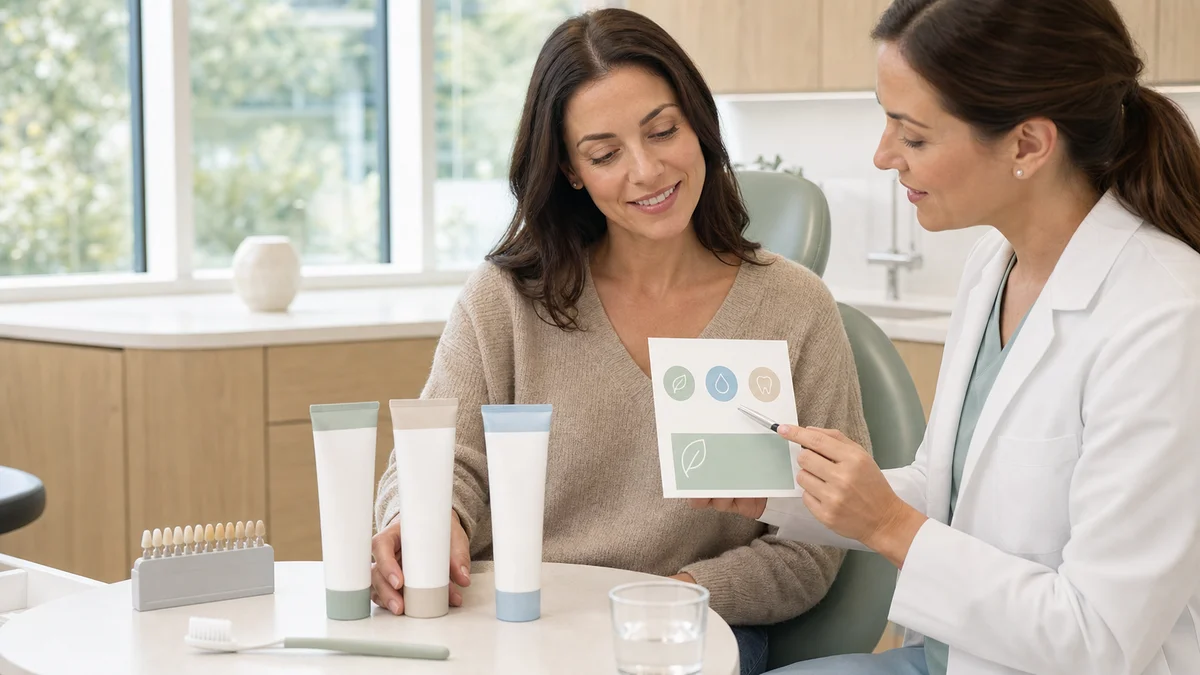
The best teeth whitening toothpaste for sensitive teeth should protect against decay with fluoride, carry a credible sensitivity claim, and remove surface stains without promising to bleach the internal tooth colour. Look for evidence-backed desensitising actives, follow the label twice daily, use a soft brush and low pressure, and arrange a dental examination if pain is new, severe, persistent or limited to one tooth.
Choosing the best teeth whitening toothpaste for sensitive teeth is less about finding the strongest “white” claim and more about balancing three separate jobs: preventing decay, reducing dentine hypersensitivity and cleaning external stains. One tube may make claims in all three areas, but those claims do not mean the same thing. A whitening toothpaste usually polishes or chemically loosens surface stain; it does not necessarily contain bleach or change the colour deep inside the tooth.
Sensitivity also needs context. A brief sharp response to cold, air, touch or sweet food can occur when dentine is exposed, but similar pain can come from decay, a cracked tooth, a leaking filling, gum recession, erosion, grinding or inflammation inside the tooth. Toothpaste cannot diagnose these causes. The best teeth whitening toothpaste for sensitive teeth for one person may therefore be inappropriate for another person whose pain needs treatment.
This guide does not rank commercial brands or guarantee a whiter shade. Formulas and accepted product claims can change, and availability differs by country. Instead, it gives an evidence-based label-reading method using current information from the American Dental Association, the US Food and Drug Administration, the NHS and other health authorities. It is written for review by Dentist Esma Çevrük Çakır and does not replace an examination.
1. What “best” should mean for sensitive teeth
The word “best” should describe suitability, not intensity. For a person with sensitivity, daily caries protection and comfort take priority over rapid cosmetic change. A sensible product has a clear fluoride anticavity claim, an active sensitivity claim supported by the formula, directions that fit daily use and a stain-removal claim that does not depend on harsh home mixing.
The best teeth whitening toothpaste for sensitive teeth should also be tolerable enough to use consistently. A product that causes burning, ulcers, peeling, increased cold pain or a strong aversion to flavour is unlikely to support good brushing. Fragrance, foam and a tingling sensation do not measure cleaning power. “Natural,” “professional,” “enamel safe” and “extra white” are marketing phrases unless the package connects them to an evaluated claim.
Think of product selection as a hierarchy: first identify or rule out disease, then protect against decay, then address sensitivity, and finally consider surface stain. This order keeps the search for the best teeth whitening toothpaste for sensitive teeth from hiding a problem beneath a cosmetic label.
2. Check the cause before changing toothpaste
Dentine contains microscopic tubules that can transmit a stimulus toward the nerve when the protective enamel or root covering is lost. Gum recession, erosion and wear can expose these surfaces. However, pain is not automatically “sensitive teeth.” The NHS lists decay, dental abscess, a cracked or damaged tooth, broken fillings, gum disease and grinding among causes of toothache, and notes that sensitive teeth can also cause pain.
Before buying the best teeth whitening toothpaste for sensitive teeth, notice the pattern. Is the pain on many teeth or one? Is it triggered briefly by cold, or does it linger? Did it start after a whitening treatment, a new abrasive powder, a restoration or an injury? Does biting hurt? Are there dark spots, swelling, bleeding or a bad taste? These observations help the dental team decide whether toothpaste is a reasonable first measure.
- Book a dental assessment for new, unexplained or worsening sensitivity.
- Seek prompt care for pain that lingers, wakes you, occurs on biting or is focused on one tooth.
- Do not cover swelling, fever, pus, facial enlargement or a broken tooth with repeated desensitising paste.
- Get urgent help for spreading swelling, difficulty breathing or difficulty swallowing.
A toothpaste can support symptom control after serious causes have been considered. It cannot repair a cavity, seal a crack or treat an abscess. In those situations, even the best teeth whitening toothpaste for sensitive teeth is an adjunct, not the solution.
3. Understand what whitening toothpaste can actually do
Whitening toothpastes commonly use mild abrasives, polishing agents or chemicals that help lift stain from the outer surface. The ADA explains that these products can remove more surface stain than ordinary toothpaste. ADA-accepted whitening toothpastes with a stain-removal claim do not change the intrinsic colour because they act on the surface rather than bleaching the tooth.
This distinction matters when evaluating the best teeth whitening toothpaste for sensitive teeth. Coffee, tea, red wine and tobacco may leave external deposits that respond to cleaning. A naturally yellow dentine shade, age-related colour change, a dark root-treated tooth, fluorosis, developmental marks or colour inside a restoration will not respond in the same way.
No toothpaste can promise a fixed number of shades for every user. Lighting, dehydration, phone filters and the colour of lips and skin alter appearance. Take any comparison photo under the same conditions, without a beauty filter, and do not scrub harder because one photograph looks darker. The best teeth whitening toothpaste for sensitive teeth aims for gradual surface-stain control while preserving comfort and tooth structure.
4. Make fluoride the non-negotiable foundation
Fluoride strengthens enamel and supports remineralisation in early decay. The ADA requires fluoride in toothpastes accepted for anticavity claims, and the NHS advises adults to brush twice daily with a toothpaste containing at least 1,350 parts per million fluoride. Local recommendations and prescription strengths vary, so check the package for your age and country rather than copying a social-media dose.
The best teeth whitening toothpaste for sensitive teeth should not sacrifice proven decay protection merely to advertise charcoal, botanicals or a novel mineral. A product may have interesting cosmetic ingredients yet lack a recognised anticavity active. If you have a high decay risk, dry mouth, exposed roots, orthodontic appliances or a history of many restorations, a dentist may recommend a different fluoride strength.
Prescription-strength fluoride toothpaste should be used only for the person and schedule prescribed. More is not automatically better, and toothpaste is not meant to be swallowed. For routine adult use, follow the label, spit after brushing and store the tube away from young children. These basic behaviours remain part of choosing the best teeth whitening toothpaste for sensitive teeth.
5. Read the desensitising active ingredient
Sensitivity formulas may use potassium compounds, stannous fluoride, arginine or other agents depending on the jurisdiction and product. Their mechanisms differ: some reduce nerve response, while others help block or occlude pathways in exposed dentine. The ADA’s 2026 toothpaste review cites evidence supporting twice-daily self-application of stannous, potassium with or without stannous, or arginine formulations for reducing dentine hypersensitivity pain.
For the best teeth whitening toothpaste for sensitive teeth, read the active-ingredient panel and the exact package claim. A formula containing stannous fluoride may combine anticavity and sensitivity functions, while another product may pair sodium fluoride with a separate desensitising active. The ingredient name alone does not reveal concentration, availability, delivery system or the evidence for that exact finished formula.
Do not rotate between several sensitivity products every few days. Many formulas need consistent label-directed use before response can be judged, and improvement is not guaranteed. If symptoms remain unchanged, worsen or return immediately, reassessment is more useful than buying an increasingly aggressive “white” paste. The best teeth whitening toothpaste for sensitive teeth is one whose role is clear in a wider care plan.
6. Abrasivity: use the number carefully
All conventional toothpastes use some abrasive action to remove debris and stain. Relative Dentin Abrasivity, or RDA, is a laboratory measure used in product evaluation. The ADA notes that toothpastes earning its Seal must have an RDA of 250 or less. It also cautions that values below 250 should not be used as a simple quantitative ranking of clinical safety because they do not directly predict changes to enamel in a person’s mouth.
That means the best teeth whitening toothpaste for sensitive teeth cannot be selected from an unofficial RDA chart alone. Formula, brushing pressure, frequency, brush stiffness, exposed root surfaces and dietary acid exposure all affect wear. A lower printed number does not prove superior stain removal, and a higher number within an accepted limit does not tell you how your exposed dentine will feel.
Be cautious with loose charcoal, baking soda mixtures, salt and powders that do not provide a complete fluoride toothpaste formula or a verified stain-removal claim. Combining an acidic home remedy with an abrasive and forceful brushing increases risk. A product intended as the best teeth whitening toothpaste for sensitive teeth should reduce uncertainty, not create an uncontrolled experiment.
7. Decision table for choosing a formula
Use this table to narrow the best teeth whitening toothpaste for sensitive teeth by need rather than by package colour or influencer ranking.
| Your main finding | Label features to prioritise | Realistic benefit | Reason to pause and seek advice |
|---|---|---|---|
| General cold sensitivity plus surface coffee or tea stain | Fluoride, evaluated sensitivity claim and evaluated stain-removal claim | Possible pain reduction and gradual removal of external stain | Pain lingers or is limited to one tooth |
| Exposed roots or gum recession | Fluoride and desensitising formula; gentle brush instructions | Symptom support and decay protection | Recession is progressing, bleeding or difficult to clean |
| High decay risk or dry mouth | Clinician-selected fluoride strength; sensitivity claim if needed | Prevention takes priority over cosmetic stain removal | New cavities, persistent dryness or swallowing difficulty |
| Crowns, veneers or fillings appear darker | Routine fluoride cleaning; material-safe professional advice | Surface deposits may reduce, material shade will not bleach | Dark margin, roughness, fracture or food trapping |
| Sensitivity began during peroxide whitening | Stop or adjust whitening as directed; desensitising toothpaste may support care | Temporary sensitivity may settle | Severe, persistent, spontaneous or localised pain |
One tube may not carry every evaluated claim. In that case, the best teeth whitening toothpaste for sensitive teeth may be a sensitivity-focused fluoride paste, with stain managed through professional cleaning and habit changes rather than stronger daily polishing.
8. Verify seals and claims, not just logos
The ADA Seal of Acceptance is awarded after the Council on Scientific Affairs evaluates submitted safety and effectiveness evidence for a stated category. Categories are separate: fluoride dentifrice, stain removal and dentinal hypersensitivity are distinct claims. The approved statement beside the Seal indicates what was evaluated. A Seal for cavity prevention should not be silently interpreted as proof of whitening or sensitivity control.
When shopping for the best teeth whitening toothpaste for sensitive teeth, use the current ADA database rather than an old list or a screenshot. Product names and formulations may change, and a brand can sell several tubes with different claims. Outside the United States, check the relevant regulator, dental association or authorised package information for your market.
FDA anticaries rules govern eligible active ingredients and labelling for over-the-counter fluoride products in the US, but the ADA notes that the FDA does not individually test every toothpaste for compliance. A company’s clinical data on a finished formula, a recognised acceptance programme and clear instructions provide more useful context. The best teeth whitening toothpaste for sensitive teeth should make specific, checkable claims.
9. Foaming agents, flavour and mouth irritation
Some people experience burning, peeling or recurrent irritation with a particular flavouring, detergent or other ingredient. Sodium lauryl sulphate is a common foaming agent, but foam does not determine cleaning effectiveness. Choosing an SLS-free or mildly flavoured product may improve comfort for an individual, yet it is not a universal treatment for dentine hypersensitivity.
The best teeth whitening toothpaste for sensitive teeth should not sting in order to “prove” it is working. Stop a new product if it causes swelling, hives, breathing difficulty, marked oral peeling or worsening ulcers; severe allergic symptoms require urgent help. Bring the tube or ingredient list to a clinician so the suspected trigger can be distinguished from infection or another condition.
Strong mint, cinnamon and essential-oil flavours can feel refreshing but are optional. A low-foam paste may still deliver fluoride and desensitising actives effectively when used as directed. Tolerability is a valid selection criterion for the best teeth whitening toothpaste for sensitive teeth.
10. Brushing technique can matter as much as the tube
Hard brushing does not force a desensitising ingredient to work faster. Excess pressure, stiff bristles and horizontal scrubbing at the gumline can worsen wear and recession. The NHS recommends brushing for about two minutes twice daily; soft or medium bristles suit most adults. A compact brush head and systematic route help cover all surfaces.
Use the best teeth whitening toothpaste for sensitive teeth with gentle pressure and follow its instructions. Spit after brushing and do not immediately rinse away the paste if local guidance advises against rinsing. Do not layer several toothpastes on the brush or add charcoal powder. Clean between teeth with floss or an appropriately sized interdental brush because toothpaste and a toothbrush do not fully reach these areas.
- Use a soft or suitable medium brush and replace it when bristles splay.
- Brush every accessible surface rather than repeatedly polishing only the front teeth.
- Avoid brushing aggressively immediately after frequent acidic exposure.
- Follow the product’s age, amount, frequency and swallowing warnings.
- Ask for a technique review if roots are exposed or sensitivity is increasing.
A powered brush with pressure feedback may help some users, but it is not required for everyone. Consistent gentle technique is the partner to the best teeth whitening toothpaste for sensitive teeth, not an optional extra.
11. Give one formula a fair, monitored trial
Desensitising ingredients are usually assessed with regular use, not a single brush. Follow the label’s frequency and do not increase the amount to chase a faster effect. Keep the rest of the routine stable so you can identify benefit or irritation. Record triggers such as cold water, air and brushing rather than repeatedly testing the tooth with ice.
A fair trial of the best teeth whitening toothpaste for sensitive teeth does not mean ignoring warning signs for weeks. Stop and obtain advice if pain becomes spontaneous, lingers after the trigger, occurs on biting, wakes you at night, or is accompanied by swelling. If sensitivity improves, continue preventive care and attend routine examinations; improvement does not prove that every underlying issue has disappeared.
Do not use several whitening products at once. Strips, gels, pens and peroxide rinses can add exposure and make it difficult to identify the cause of pain. Toothpaste should be the controlled daily variable. The best teeth whitening toothpaste for sensitive teeth is not a licence to combine every whitening category.
12. Crowns, veneers, bonding and implants will not change shade
Restorative materials do not respond like natural enamel and dentine. A whitening toothpaste may remove superficial deposits from some restorations, but it cannot reliably change the base shade of a crown, veneer, composite filling, denture tooth or implant crown. Excess polishing may roughen certain materials, making later staining more noticeable.
If restorations are visible, the best teeth whitening toothpaste for sensitive teeth should be selected with their surfaces and margins in mind. A dark line may reflect stain, a material interface, gum recession, decay or a restoration problem. Do not try to file, sand or polish it at home.
People planning bleaching or new front-tooth restorations should coordinate shade timing with a dentist. Whitening natural teeth after matching a crown can create a mismatch. Daily toothpaste maintains hygiene, but the best teeth whitening toothpaste for sensitive teeth cannot guarantee a uniform colour across different materials.
13. Manage staining habits without extreme restrictions
Coffee, tea, red wine and tobacco can contribute to external stain. Frequency and contact time matter, but total avoidance is not the only strategy. Water after a staining drink, regular oral hygiene and reduced tobacco exposure can help. Stopping smoking benefits oral and general health far beyond cosmetic colour.
The best teeth whitening toothpaste for sensitive teeth cannot fully offset smoking or continuous sipping over many hours. Nor should it lead to immediate hard brushing after every coloured drink. Acidic beverages can soften the surface temporarily; adding strong brushing can increase wear. Use water and return to the normal routine at an appropriate time.
Professional cleaning may remove deposits that home toothpaste cannot. That is different from bleaching. If surface stain remains despite good care, ask whether cleaning, polishing or no treatment is appropriate. The best teeth whitening toothpaste for sensitive teeth should support realistic habits, not create anxiety about every meal.
14. Avoid DIY powders, acids and household peroxide
Lemon juice, vinegar, charcoal powder, salt, turmeric, baking-soda mixtures and household hydrogen peroxide are promoted online as “natural” whitening. Natural origin does not define pH, particle size, concentration or safety. Acid can contribute to erosion, while abrasive powders and forceful brushing can increase surface loss. Household peroxide is not a substitute for a regulated oral-care product.
The ADA reports no reliable evidence that oil pulling or turmeric whitens teeth and warns that charcoal DIY approaches may cause harm. Someone seeking the best teeth whitening toothpaste for sensitive teeth should choose a complete, labelled fluoride formulation rather than mixing kitchen ingredients into it.
Never use a product because the short-term roughness or dryness makes the tooth look lighter in a photograph. Lost tooth structure does not regrow like skin. For sensitive teeth, avoiding uncontrolled acid and abrasion is part of the benefit of the best teeth whitening toothpaste for sensitive teeth.
15. When toothpaste is not enough
A dental examination can identify decay, cracks, exposed roots, faulty restorations, gum disease, erosion or bite-related wear. Treatment may involve prevention advice, fluoride application, bonding exposed areas, restoration repair, gum treatment or another cause-specific intervention. There is no single procedure for every sensitive tooth.
Even after selecting the best teeth whitening toothpaste for sensitive teeth, professional cleaning may be considered when hard deposits or external stain persist. Cleaning reveals the natural surface; it does not bleach intrinsic colour. If a person still wants a lighter shade, bleaching should be discussed separately because peroxide whitening can itself cause temporary sensitivity.
The ADA advises talking to a dentist before whitening and following instructions. A clinician can identify restorations that will not lighten and decide whether oral health is stable enough. Toothpaste, professional stain removal and bleaching are different interventions. The best teeth whitening toothpaste for sensitive teeth is the least invasive option only when its expected effect matches the cause.
16. A practical two-tube comparison method
Do not buy a shelf of products. Compare two plausible options on the same criteria: anticavity active, sensitivity active, evaluated stain-removal claim, directions, warnings, flavour, package size and cost per standard amount. Ignore visual tricks such as silver boxes, shade ladders without methods and oversized before-and-after images.
For the best teeth whitening toothpaste for sensitive teeth, write the exact accepted claims from each package. “Helps prevent cavities,” “helps reduce tooth sensitivity” and “helps remove surface stain” are distinct. If one tube carries only two of the three, decide which unmet need can be managed another way. A sensitivity-first paste plus professional stain management may be preferable to a harsher-feeling multi-claim product.
Price does not prove quality, and a higher concentration of an unverified ingredient does not prove better performance. Check the current regulator or professional acceptance database and the complete formula. The best teeth whitening toothpaste for sensitive teeth is the product that meets the individual priority with credible evidence and tolerable daily use.
17. Buying online and travelling with toothpaste
Marketplace listings may show old packaging, imported formulations or a different product under a similar name. Confirm the seller, market authorisation where applicable, seal integrity, expiry information and full ingredient panel. Do not buy a prescription-strength fluoride paste without a prescription or share one prescribed for another person.
When purchasing the best teeth whitening toothpaste for sensitive teeth abroad, remember that fluoride units, active names and claims may be presented differently. A familiar brand can use different formulas by country. Keep the original packaging so a dentist can identify the product if irritation occurs.
Redent Klinik provides general oral-care information through its English-language clinic page. If you need an individual assessment before travel or treatment, use the English contact page; photographs and product labels can support triage but cannot diagnose the cause of sensitivity. The best teeth whitening toothpaste for sensitive teeth still depends on an in-person finding when symptoms are unexplained.
18. Final checklist before you buy
Use this short checklist when evaluating the best teeth whitening toothpaste for sensitive teeth:
- Does it contain an appropriate fluoride anticavity active for the intended user?
- Is the sensitivity claim linked to an identified active ingredient and clear directions?
- Does “whitening” mean evaluated surface-stain removal rather than a promised internal shade change?
- Is an acceptance mark current, and which exact claims does it cover?
- Is the formula tolerable in flavour, foam and mouth feel?
- Are you using a gentle brush and pressure rather than relying on stronger abrasion?
- Have crowns, exposed roots, decay risk and gum condition been considered?
- Do you know the red flags that require a dental assessment?
If several answers are unknown, save the package photos and ask a dental professional. That is often more efficient than buying multiple products. The best teeth whitening toothpaste for sensitive teeth is a reasoned choice within preventive care, not a universal winner.
Frequently asked questions about the best teeth whitening toothpaste for sensitive teeth
Can a whitening toothpaste make sensitive teeth worse?
It can feel worse if the formula, brushing pressure or existing condition is unsuitable. Increased pain is not proof of stronger whitening. Stop the new product and seek advice if symptoms persist. The best teeth whitening toothpaste for sensitive teeth should be tolerable with gentle, label-directed use.
Which sensitivity ingredient works fastest?
No single ingredient is guaranteed to work fastest for every person. Evidence supports several types, including stannous, potassium-containing and arginine formulas, but finished formulations and causes differ. The best teeth whitening toothpaste for sensitive teeth is chosen by claim, formula, tolerance and diagnosis rather than speed marketing.
Does whitening toothpaste contain bleach?
Many whitening toothpastes mainly remove surface stain with polishing or chemical agents and do not bleach intrinsic tooth colour. Some products or markets may use different ingredients, so read the label. The best teeth whitening toothpaste for sensitive teeth should state exactly what its whitening claim means.
Is a lower RDA always better?
Not necessarily. RDA is a laboratory measure, and the ADA cautions against using values below its accepted ceiling as a direct clinical safety ranking. Technique and exposed roots matter. The best teeth whitening toothpaste for sensitive teeth cannot be identified from one unofficial RDA number.
Can I place desensitising toothpaste directly on a sore tooth?
Some labels or clinicians may recommend local application, but follow the specific product directions and individual advice. Do not use paste to delay diagnosis of focal pain. The best teeth whitening toothpaste for sensitive teeth remains supportive care, not a filling or crack repair.
How many shades will whitening toothpaste change?
No fixed number can be promised. Surface-stain removal depends on the stain, formula, use and starting condition, while intrinsic colour may not change. The best teeth whitening toothpaste for sensitive teeth should be evaluated by comfort, decay protection and realistic surface cleaning.
Will it whiten crowns or veneers?
It will not change their underlying material shade. It may remove some surface deposits, but excessive polishing can damage a surface. The best teeth whitening toothpaste for sensitive teeth should be checked for compatibility when visible restorations are present.
Should I rinse after brushing?
The NHS advises spitting after fluoride toothpaste and not rinsing immediately, so fluoride remains available. Follow local and product directions, especially for prescription formulas. The best teeth whitening toothpaste for sensitive teeth works only when used according to its instructions.
Can I use whitening strips at the same time?
Combining whitening products can increase sensitivity and confuse the cause of symptoms. Discuss peroxide products with a dentist and follow one controlled plan. The best teeth whitening toothpaste for sensitive teeth does not automatically make simultaneous strips appropriate.
When is sensitivity an emergency?
Difficulty breathing or swallowing, rapidly spreading facial swelling, uncontrolled bleeding or severe systemic illness needs urgent help. Persistent focal tooth pain also requires assessment. No best teeth whitening toothpaste for sensitive teeth should delay care for these signs.
Conclusion: choose protection first and whitening second
The best teeth whitening toothpaste for sensitive teeth starts with fluoride caries protection and a credible desensitising claim. A verified stain-removal claim can then help with external deposits, but it cannot guarantee an intrinsic shade change. Product seals should be read by category, and an RDA number should not be treated as a complete safety score.
Use a soft brush, low pressure and one consistent formula. Avoid acids, charcoal powders and household peroxide. If pain is new, severe, persistent, localised or associated with swelling, obtain a diagnosis. The best teeth whitening toothpaste for sensitive teeth is the formula that supports health and comfort while setting an honest limit on cosmetic results.
Authoritative sources for the best teeth whitening toothpaste for sensitive teeth
- American Dental Association: toothpastes, fluoride, sensitivity ingredients and RDA interpretation
- American Dental Association: Seal of Acceptance process
- American Dental Association: separate categories for fluoride, stain removal and sensitivity
- ADA MouthHealthy: whitening toothpaste removes surface stains and bleaching can cause sensitivity
- NHS: fluoride toothpaste and brushing guidance
- NHS: decay, tooth sensitivity and warning signs
- US Food and Drug Administration: OTC anticaries toothpaste monograph
- World Health Organization: oral health fact sheet