
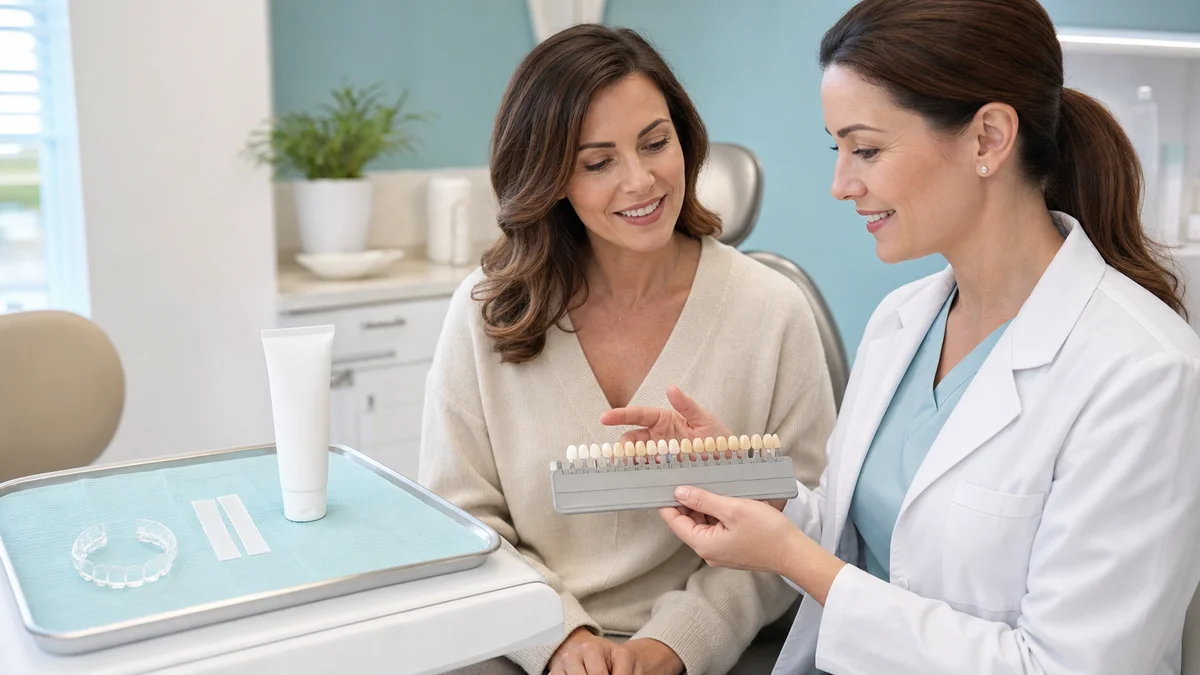
Quick answer: The best at home teeth whitening option is one that matches the cause of discoloration, has clear instructions, limits gum contact, and is used only after dental problems are ruled out. Peroxide strips can lighten natural teeth; dentist-supervised custom trays offer a more tailored fit; whitening toothpaste mainly removes surface stain. Stop and seek dental advice for persistent pain or irritation.
Searching for the best at home teeth whitening product can feel like comparing promises rather than evidence. Packages use terms such as “professional,” “instant,” “enamel safe,” and “LED,” but those words do not tell you whether the product suits your teeth. The useful questions are different: Is the discoloration on the surface or inside the tooth? Are there cavities, cracks, recession, crowns, veneers, bonding, or existing sensitivity? Does the delivery method keep gel on the teeth and away from the gums? Can you follow the stated schedule without adding extra gel, time, or applications?
This patient guide does not rank brands or promise a particular shade. It explains how common home methods work, how to compare them, and when a dentist should assess the mouth first. It is based on current information from the American Dental Association and the NHS, and is prepared for clinical review by Dentist Esma Çevrük Çakır. Individual diagnosis and treatment planning still require an examination.
1. What “best at home teeth whitening” should mean
The best at home teeth whitening plan is not necessarily the strongest or fastest. A reasonable plan produces a gradual, realistic change while keeping sensitivity and gum irritation manageable. It should identify the active ingredient, provide legible instructions, state how often and how long to use it, and explain what to do if discomfort occurs. The method should also fit the type and location of your stain.
The American Dental Association’s whitening overview distinguishes surface, or extrinsic, stains from intrinsic discoloration within enamel or dentin. Coffee, tea, red wine, tobacco, and pigmented foods commonly contribute to surface stain. Age, tooth development, trauma, some medicines, decay, old restorations, and changes within the pulp can create deeper or localized color changes. These causes do not respond in the same way.
A good result is also about color harmony. Natural teeth vary in shade and translucency, and canines are often a little darker than front teeth. Whitening does not need to produce an opaque paper-white appearance to be successful. The best at home teeth whitening goal is a healthy-looking, even improvement that respects the existing enamel and any visible restorations.
2. Why diagnosis comes before best at home teeth whitening
A whitening product can temporarily distract from a problem without treating it. A single tooth that suddenly darkens, a white or brown spot, a visible cavity, a broken filling, gum bleeding, spontaneous pain, or lingering sensitivity deserves assessment. Bleaching gel does not repair decay, seal a crack, treat gum disease, or restore an injured pulp. Applying peroxide to an untreated problem may increase discomfort and delay appropriate care.
According to the ADA, a clinical examination—plus radiographs or other tests when indicated—can help identify the cause of discoloration and relevant risk factors. The dentist may review previous sensitivity, allergies, medications, restorations, tooth wear, gum recession, and the patient’s expectations. For someone with several competing factors, the best at home teeth whitening pathway may be a supervised tray, a shorter schedule, surface-stain removal first, or no bleaching until the mouth is stable.
- Arrange an examination first if one tooth is darker than the others or the color change is new.
- Discuss whitening before planned bonding, veneers, crowns, or shade-matched fillings.
- Treat active decay, leaking restorations, significant gum inflammation, and unexplained pain before elective bleaching.
- Tell the dentist about pregnancy, breastfeeding, allergies, medicines, previous whitening reactions, and existing sensitivity.
- Ask whether a professional cleaning could remove deposits or external stain before chemical whitening is considered.
3. Best at home teeth whitening decision table
No single category is the best at home teeth whitening choice for every person. The table compares what each method mainly does, its practical advantage, and the limitation that should influence the decision. It is a screening tool rather than an individual prescription.
| Home method | Main action | May suit | Main limitation or caution |
|---|---|---|---|
| Peroxide whitening strips | Chemically lightens natural tooth structure where the strip contacts it | Adults seeking a convenient, measured OTC course for broadly distributed stain | May miss rotated or crowded areas; gum contact and sensitivity can occur |
| Dentist-supervised custom trays | Delivers prescribed gel through a tray made to fit the teeth | People who benefit from tailored fit, dosing instructions, and professional monitoring | Requires dental visits; more gel or longer wear is not automatically better |
| Generic OTC gel trays | Holds bleaching gel against teeth using a standard-size tray | Selected users who can obtain a stable fit and follow the label exactly | Poor fit can increase gel leakage and uneven contact |
| Whitening toothpaste | Mostly removes external stain through abrasives; some formulas add low peroxide | Maintenance and mild surface stain | Does not predictably change deeper intrinsic tooth color; overbrushing can worsen wear |
| Whitening rinse or paint-on gel | Brief or targeted contact with an active formula | People prioritizing a simple format and modest expectations | Short or inconsistent contact can limit effect; evidence varies by product |
| Acidic fruit, vinegar, charcoal, or abrasive DIY mix | May abrade or chemically erode the surface rather than safely bleach it | No one as a recommended whitening strategy | Uncertain benefit and avoidable risk of wear, irritation, or permanent surface damage |
4. Best at home teeth whitening ingredients and contact time
Hydrogen peroxide and carbamide peroxide are common bleaching agents. Carbamide peroxide releases hydrogen peroxide over time. The ingredient, concentration, formulation, fit, application frequency, and contact time all influence exposure. That is why concentration alone cannot identify the best at home teeth whitening product. A lower-concentration system used as directed may be more tolerable than a stronger product used aggressively.
Peroxide moves through enamel and dentin and reacts with colored compounds. This chemical process differs from polishing away a stain on the outer surface. It also explains why users can develop temporary sensitivity: the tooth is biologically active, not an inert tile. Longer wear, repeated cycles, or extra product may increase exposure without producing a proportional improvement.
Do not combine regimens unless a dentist specifically coordinates them. Using strips in the morning, a gel tray at night, and a highly abrasive paste at every brushing makes it hard to identify the cause of irritation. It may also exceed the exposure intended by any one manufacturer. For the best at home teeth whitening experience, use one evidence-based course, record the starting shade under consistent lighting, and reassess before repeating.
5. Whitening strips in a best at home teeth whitening plan
Whitening strips place a thin layer of peroxide gel against the front surfaces of the teeth. Their advantages are convenience, premeasured applications, and relatively simple instructions. The ADA notes that some whitening strips carry its Seal of Acceptance, meaning the manufacturer has demonstrated compliance with the Seal program’s safety and effectiveness requirements for the stated claim when used as directed.
Strips may be a reasonable best at home teeth whitening candidate for an adult with healthy teeth and gums, broadly distributed stain, no major visible restorations in the smile zone, and the ability to apply the strip accurately. Results can be less even where teeth overlap, rotate, or sit outside the strip’s contact area. Saliva, movement, and an incorrect position can also affect contact.
Keep the material off the gums as much as possible and follow the exact wear time. Do not cut a strip into shapes that create sharp edges near soft tissue, sleep in a product not designed for overnight use, or reuse a single-use strip. If burning, white gum patches, sharp pain, or significant sensitivity develops, remove it, rinse as directed, and pause the course.
6. Dentist-supervised trays for best at home teeth whitening
Custom trays are made from impressions or digital scans and are intended to fit the patient’s teeth closely. A clinician selects or dispenses an appropriate gel, demonstrates the amount, explains wear time, and monitors the response. A close fit can limit excess material reaching the gums, although correct loading remains essential. The best at home teeth whitening method for a person with a complex smile may therefore be a home method supervised by a dentist rather than an unsupervised online purchase.
Supervision also helps with pacing. If sensitivity develops, the dentist can assess whether it is a temporary bleaching response or a sign of decay, recession, a crack, or another condition. The schedule can sometimes be modified, but patients should not invent a new dosing plan themselves. Keep the tray clean according to instructions, store gel safely, and never share a tray or bleaching material.
The NHS teeth-whitening guidance describes dentist-provided home kits as custom trays worn over a period of weeks and emphasizes that teeth and gums should be checked first. Regulations and product access differ between countries, so a traveler or international patient should follow local professional guidance rather than assuming that one country’s retail concentration or sales rule applies everywhere.
7. Toothpaste in a best at home teeth whitening routine
Whitening toothpaste is often called the best at home teeth whitening starting point because it is inexpensive and familiar. It can be helpful when discoloration is mainly external stain, but it usually works through polishing ingredients rather than deep bleaching. Some formulas contain low levels of peroxide, yet the brief brushing contact limits what they can do compared with a bleaching strip or tray.
A toothpaste should still protect routine oral health. Look for clear labeling, an appropriate fluoride formulation where recommended for you, and credible safety evidence. A product should not require hard scrubbing. Use a soft-bristled brush and gentle pressure; increasing force does not speed healthy whitening. People with exposed roots, significant erosion, or abrasion may need a different paste.
The best at home teeth whitening use of toothpaste may be stain control before or after a bleaching course rather than a promise to transform intrinsic shade. If the teeth look darker because deposits have accumulated, professional cleaning may produce a more appropriate improvement. Toothpaste cannot remove tartar and should not be used to grind away enamel.
8. Best at home teeth whitening buying checklist
Instead of choosing by influencer enthusiasm or a dramatic photo, evaluate the product as a health-related purchase. The best at home teeth whitening label should be earned by transparent instructions and suitability, not marketing volume.
- What is the purpose? Surface-stain control, chemical bleaching, or maintenance after a previous course?
- What is the active ingredient? The package should identify it and provide comprehensible directions.
- How is exposure controlled? Check application amount, wear time, frequency, total course length, and storage.
- Does the delivery method fit? Consider crowded teeth, gum recession, orthodontic attachments, and the likelihood of leakage.
- Is there independent evaluation? In the United States, an appropriate ADA Seal can support the specific accepted claim for an OTC product.
- Are warnings and support visible? Avoid products that hide ingredients, lack a responsible manufacturer, or encourage unlimited use.
- Are expectations realistic? No home product should guarantee an exact shade, permanent result, or color change in crowns and fillings.
9. How to use best at home teeth whitening methods safely
Read the full label before the first application. Brush and floss according to your normal routine, but follow the product’s timing instructions rather than assuming freshly brushed teeth are always required. Dry or prepare the teeth only if directed. Use the stated amount, position the strip or tray carefully, and remove excess gel from soft tissue as instructed. Wash your hands before and after handling the material.
A conservative best at home teeth whitening routine changes only one variable at a time. Do not extend the session because the first application seemed comfortable. Do not repeat the course early because the change looks subtle under warm indoor light. Shade is best compared in similar neutral lighting, and teeth can look temporarily different when dehydrated immediately after treatment.
Store products away from children and pets, observe temperature and expiration instructions, and do not transfer gel into an unlabeled container. Never swallow bleaching gel intentionally. If a substantial amount is swallowed or symptoms develop, follow the product advice and contact an appropriate poison or medical service. These precautions matter even when an item is sold without a prescription.
10. Best at home teeth whitening sensitivity and irritation
Temporary tooth sensitivity and gingival irritation are the most frequently reported adverse effects of vital-tooth whitening in the ADA overview. Sensitivity may feel like brief cold “zings” or generalized discomfort. Gum irritation can occur when gel escapes a tray or a strip overlaps the soft tissue. Higher exposure can increase risk, but individual response varies.
The best at home teeth whitening protocol is not one you must endure through escalating pain. Stop the product and contact a dentist if pain is spontaneous, severe, localized to one tooth, continues after the expected temporary period, wakes you at night, or is accompanied by swelling. Those features may point to a condition other than ordinary bleaching sensitivity.
Do not self-medicate by applying numbing agents to conceal warning symptoms or by taking medicines that are unsuitable for you. A dentist may suggest a modified schedule or a desensitizing approach after evaluating the cause. If gel contacts the gums and produces a transient pale area, discontinue exposure and follow the product instructions; persistent ulceration, bleeding, or swelling deserves professional review.
11. Who should postpone best at home teeth whitening?
Elective whitening should be postponed when the mouth is not healthy enough for predictable treatment. Active cavities, inflamed gums, leaking restorations, untreated cracks, exposed dentin, severe recession, and unexplained pain can all alter risk. People with extensive visible restorations may obtain an uneven result because natural enamel can lighten while crowns, veneers, implants, and tooth-colored fillings do not.
The best at home teeth whitening decision during pregnancy or breastfeeding should be discussed with a dentist or relevant health professional; because whitening is elective, deferral may be sensible. Children and adolescents require special assessment, and full-arch cosmetic bleaching is not simply an adult retail decision scaled down for a younger mouth. Follow local regulations and pediatric dental guidance.
Anyone with a history of significant sensitivity, enamel defects, eating-disorder-related erosion, dry mouth, oral lesions, or complex restorative treatment should seek tailored advice. Allergy to a product ingredient, inability to control swallowing, or difficulty placing a strip or tray accurately may also make an unsupervised method inappropriate.
12. Best at home teeth whitening versus DIY myths
Lemon juice, vinegar, strawberry mixtures, coarse salt, concentrated baking soda, and charcoal powders circulate as “natural” alternatives. Acid can soften mineralized tooth surfaces, while rough particles can remove surface material. A temporarily cleaner or brighter appearance does not prove safe bleaching; it may reflect stain removal, dehydration, or irreversible wear.
The ADA reports limited evidence for DIY and natural interventions and notes concerns about acidic fruit mixtures, abrasive charcoal combinations, and oil pulling. It states that evidence is insufficient to show that charcoal products provide whitening benefit with adequate safety and effectiveness. The best at home teeth whitening strategy therefore excludes improvised acids, household bleach, and unmeasured abrasive recipes.
Do not use chlorine bleach, hair-lightening products, cleaning peroxide, or any non-oral chemical in the mouth. “Peroxide” is not one interchangeable substance across industrial, cosmetic, and oral products. Only use a whitening product formulated and labeled for the intended oral application, and follow the specific instructions.
13. Crowns, veneers, bonding, fillings, and implants
Bleaching changes natural tooth structure, not the intrinsic shade of ceramic, composite, or other restorative materials. If a front crown or bonding already matches the current teeth, whitening the surrounding enamel may make the restoration look darker. Conversely, a new restoration chosen before whitening may no longer match if bleaching is done later.
For a restored smile, the best at home teeth whitening sequence is coordinated with the restorative plan. A dentist can identify which visible areas are natural teeth, estimate how a shade shift could affect symmetry, and decide whether cleaning, bleaching, repair, or replacement should occur first. Replacing sound restorations solely for color has cost and biological consequences, so the sequence should be deliberate.
Dental implants themselves do not whiten, and the crown attached to an implant retains its manufactured shade. Whitening gel is not a treatment for discoloration at a crown margin, a dark implant component showing through tissue, or inflammation around an implant. Those changes require assessment.
14. Keep results without chasing permanent whiteness
Whitening is not permanent. Diet, tobacco exposure, oral hygiene, aging, and the original cause of discoloration influence how the shade changes over time. Maintenance should begin with ordinary preventive care: brush twice daily with an appropriate fluoride toothpaste, clean between teeth, attend examinations and hygiene care as advised, and address tobacco use.
After the best at home teeth whitening course for you is complete, avoid automatic monthly retreatment. Photograph or document the result under similar lighting, follow the recommended review interval, and discuss touch-up timing before sensitivity accumulates. A small color change over time is normal and does not mean the first course failed.
Rinsing with water after deeply pigmented drinks and avoiding tobacco can reduce new surface stain. Do not brush aggressively immediately after acidic foods or drinks. If stain returns quickly, investigate the cause rather than increasing chemical exposure. Regular preventive care and stable gum health are more important than maintaining a fixed cosmetic shade.
Frequently asked questions about best at home teeth whitening
What is the best at home teeth whitening method for fast results?
Speed alone is not a safety measure. Peroxide strips can be convenient, while dentist-supervised trays provide a tailored fit and dosing plan. The appropriate option depends on stain type, tooth and gum health, restorations, sensitivity, and the ability to apply the product correctly. A very strong or prolonged regimen may increase adverse effects without guaranteeing a better final shade.
Are LED whitening kits better than strips alone?
A light does not automatically make a home kit the best at home teeth whitening choice. Evaluate the bleaching ingredient, evidence for the complete system, exposure instructions, fit, eye and tissue precautions, and credible manufacturer information. Do not assume that brightness, heat, or a blue glow proves extra efficacy. A dentist can help interpret the product’s claims.
Can yellow teeth become completely white at home?
Natural teeth may lighten, but response varies with the origin and depth of discoloration. No responsible method guarantees paper-white teeth or an exact shade. Some yellow appearance is the natural influence of dentin beneath translucent enamel. Crowns and fillings will not bleach, and certain intrinsic stains may need a different or longer professional strategy.
How long should I wait between whitening courses?
Follow the specific product directions and any dentist-provided schedule. There is no universal interval for every formula and patient. Repeating a course early can increase cumulative exposure and sensitivity. The best at home teeth whitening maintenance interval is based on the initial regimen, oral condition, response, adverse effects, diet, and professional advice.
Should I whiten before or after a dental cleaning?
A cleaning may remove plaque, calculus, and external stain, revealing the true baseline shade. An examination also identifies conditions that should be treated first. Ask the dental team about timing because gums may be temporarily tender after some procedures, and planned restorations need shade coordination. Do not assume every cleaning should be followed immediately by bleaching.
Can I use whitening products if I have sensitive teeth?
Possibly, but existing sensitivity should be evaluated first. It may arise from recession, decay, a crack, erosion, a restoration, or another problem. The best at home teeth whitening approach may use professional supervision, adjusted exposure, or no bleaching until the cause is managed. Stop if symptoms become severe, spontaneous, or localized.
Do whitening products damage enamel?
Appropriately formulated products used as directed have a different risk profile from overuse or DIY acids and abrasives. The main commonly reported effects are temporary sensitivity and gum irritation, but concentration, contact time, product pH, and individual oral health matter. More frequent, longer, or combined use is not proven safer simply because the products are sold over the counter.
How can I tell whether a whitening claim is trustworthy?
Look for a named active ingredient, precise instructions, warnings, responsible manufacturer, realistic shade language, and evidence relevant to the exact product. In the United States, an ADA Seal supports the accepted safety and effectiveness claim for that specific OTC product. The best at home teeth whitening claim should never depend only on testimonials, filters, or an unverified before-and-after image.
Final decision: choose the safest effective option
The best at home teeth whitening method begins with the right diagnosis and a realistic goal. For mild surface stain, cleaning and an appropriate toothpaste may be enough. Peroxide strips may suit a healthy, unrestored smile when used exactly as directed. Dentist-supervised custom trays add individualized fit, dosing instructions, and review. None of these choices can treat disease or change the shade of restorations.
If you have localized discoloration, pain, cracks, decay, recession, active gum problems, extensive visible restorations, or significant sensitivity, arrange an examination before bleaching. You can review general dental care information on the Redent Klinik English homepage or request an individualized assessment through the Redent Klinik contact page. A consultation does not guarantee suitability or a particular cosmetic result, but it can replace guesswork with a safer sequence.
Official sources for best at home teeth whitening
- American Dental Association — professional oral-health authority and ADA Seal program.
- American Dental Association: Whitening — stain types, bleaching agents, options, adverse effects, and DIY evidence.
- American Dental Association: What to know about the ADA Seal — independent testing and claim-review overview.
- NHS: Teeth whitening — suitability, professional assessment, home trays, and common side effects.
- World Health Organization: Oral health — global context on oral diseases, prevention, and access to care.