
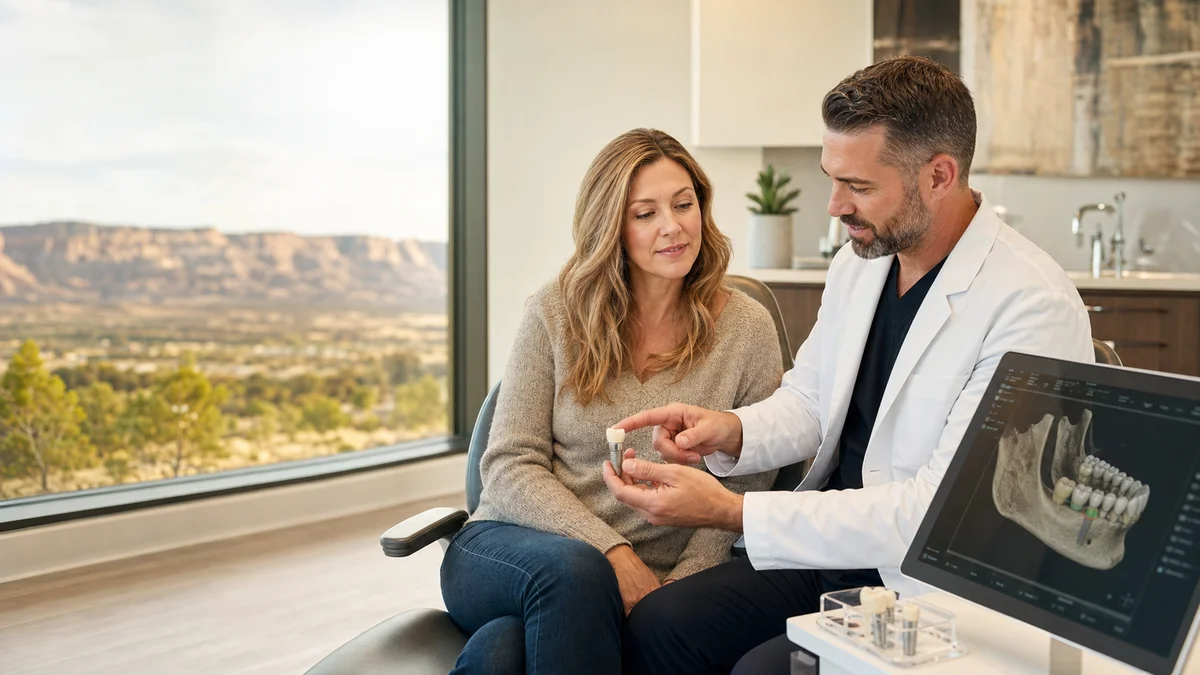
Quick answer: People comparing dental implants grand junction colorado providers should verify the dentist’s active license, proposed implant system, imaging plan, complete written estimate, healing schedule, and arrangements for urgent and long-term care. Suitability cannot be decided from an advertisement: it requires a clinical examination, medical and dental history, gum assessment, and appropriate imaging.
Searching for dental implants grand junction colorado often begins with a missing tooth, an uncomfortable removable denture, or a tooth that may not be maintainable. The search result that looks most convenient is not necessarily the most appropriate clinical choice. Implant treatment is a sequence—assessment, planning, surgery when indicated, healing, restoration, and maintenance—and the quality of every stage matters.
This guide is designed to help adults ask safer, more useful questions. It does not diagnose implant candidacy and does not rank individual clinicians. A dentist or appropriately qualified dental specialist must examine your mouth and consider your general health before advising whether an implant, bridge, denture, or another approach fits your circumstances. If pain, swelling, fever, uncontrolled bleeding, spreading facial swelling, or difficulty breathing is present, seek urgent professional care rather than relying on an online comparison.
Grand Junction serves patients from across Colorado’s Western Slope, so travel time, winter driving, work schedules, and access to unscheduled follow-up may affect the real convenience of care. When evaluating dental implants grand junction colorado, look beyond the day of placement and map every expected visit through the final crown and continuing maintenance.
1. Dental Implants Grand Junction Colorado: What a Plan Includes
A dental implant is a device placed in the jaw to support a prosthetic tooth or teeth. The visible crown is only one part of the restoration. A typical single-tooth plan may involve an implant body, an abutment, and a crown, while a full-arch plan may use several implants to support a fixed or removable prosthesis. The number of components, laboratory work, and appointments varies.
When reviewing dental implants grand junction colorado proposals, ask the clinician to identify each stage and who is responsible for it. One office may coordinate assessment, placement, and restoration; another may share care with an oral surgeon, periodontist, prosthodontist, or restorative dentist. Coordinated care can work well, but you should know where records are held, which clinician handles complications, and whom to call outside normal hours.
- Comprehensive examination and medical-history review
- Gum-health, tooth, bite, and available-space assessment
- Radiographs and, when clinically justified, three-dimensional imaging
- Removal of a tooth or management of infection when needed
- Bone or soft-tissue grafting when indicated
- Implant placement, healing checks, and restoration
- A personalized hygiene and long-term review schedule
A responsible plan should also explain alternatives and the consequences of delaying treatment. “Implant” is not a diagnosis, and it is not automatically better than maintaining a restorable natural tooth. Ask why the proposed option is reasonable for your mouth, not just why the device is available.
2. Dental Implants Grand Junction Colorado Candidacy Assessment
Suitability depends on more than age. The dentist evaluates bone and soft tissue, active decay or gum disease, oral hygiene, bite forces, space, smile demands, and the condition of neighboring teeth. General health, medications, previous radiation therapy, immune status, smoking or nicotine exposure, diabetes control, and a history of healing problems may change risk or timing. These factors do not always rule treatment out, but they require individualized discussion.
For dental implants grand junction colorado, bring an accurate medication list, allergies, relevant medical diagnoses, and the contact details of physicians involved in your care. Do not stop prescribed medicines—including anticoagulants or medicines affecting bone metabolism—unless the prescribing clinician and dental team give coordinated instructions. Withholding information can make a seemingly simple plan unsafe.
Questions to ask about your own risk profile
- Is there active periodontal disease or infection that should be stabilized first?
- Is the amount and shape of bone adequate, and how was that assessed?
- Could clenching, grinding, or the opposing bite overload the restoration?
- How might nicotine, diabetes, dry mouth, or medications affect healing?
- What would make the team pause, modify, or decline the proposed procedure?
The U.S. Food and Drug Administration advises patients to discuss health conditions and medications and notes that smoking can affect healing and long-term implant success. That is a reason for frank risk assessment, not a basis for an online promise about your outcome.
3. Compare Dental Implants Grand Junction Colorado With Alternatives
A missing tooth may be managed in several ways. Depending on the site, alternatives may include monitoring the space, orthodontic space management, a resin-bonded bridge, a conventional bridge, or a removable partial denture. For multiple missing teeth, an implant-supported bridge, overdenture, or fixed full-arch prosthesis may be considered. Each option changes cleaning needs, treatment time, repair pathways, cost, and effects on nearby teeth.
When a provider discussing dental implants grand junction colorado presents only one choice, ask for the clinically reasonable alternatives in writing. A bridge may avoid implant surgery but can require preparation of supporting teeth. A removable option can be less invasive but may feel different and require adaptation. An implant does not decay like a natural tooth, yet the surrounding tissues can become inflamed or lose supporting bone.
4. Imaging for Dental Implants Grand Junction Colorado
Two-dimensional radiographs can show teeth, bone levels, and some pathology. Cone-beam computed tomography may be useful when three-dimensional information is needed to assess anatomy, available bone, or implant positioning. More imaging is not automatically better; exposure should be justified by the clinical question and the result should influence the plan.
Patients comparing dental implants grand junction colorado can ask who interprets the scan, whether important findings outside the implant site will be communicated, and how the digital plan relates to the final tooth position. Restoratively driven planning starts with where the replacement tooth needs to function and look appropriate, then determines whether an implant can support that result safely.
A computer-generated guide may assist positioning, but it is a tool rather than a guarantee. Anatomy, mouth opening, tissue response, surgical access, and intraoperative findings can require clinical judgment. Ask what could cause the plan to change and how consent would be handled.
5. Verify Dental Implants Grand Junction Colorado Credentials
The Colorado Dental Board regulates dental professionals in the state and provides links for license verification, laws, rules, and disciplinary information. Before committing to dental implants grand junction colorado, check that the treating dentist’s license is active and confirm the professional’s identity. A polished website, testimonial, or marketplace profile is not a substitute for an official license record.
Implant care may involve several qualified professionals. Titles such as oral and maxillofacial surgeon, periodontist, or prosthodontist describe different training pathways, but the relevant question is how the clinician’s education, experience, facilities, and case selection match the proposed procedure. Ask who performs surgery, who designs and fits the restoration, who provides sedation if any, and who assumes responsibility for follow-up.
Credential checking is only one signal. It cannot prove that a treatment plan is right for you. Use the official record alongside a direct consultation, clear consent process, complete diagnosis, and willingness to discuss limitations.
6. Sedation for Dental Implants Grand Junction Colorado
Many implant procedures use local anesthesia. Depending on patient needs, procedure complexity, facility capabilities, and applicable rules, a clinician may discuss minimal, moderate, or deeper sedation. These options are not interchangeable. They involve different monitoring, fasting, escort, medication, recovery, and emergency-preparedness requirements.
For dental implants grand junction colorado, ask what level is proposed, why it is appropriate, who administers it, what credentials or permits are required, and which physiologic signs will be monitored. Disclose sleep apnea, breathing conditions, heart disease, past anesthesia problems, pregnancy possibility, alcohol or substance use, and all prescribed, over-the-counter, and herbal products.
Do not plan to drive if the care team requires an escort. If you travel from Fruita, Delta, Montrose, Rifle, Moab, or another community, decide in advance where you will recover and how you will reach the clinic if symptoms need review.
7. Dental Implants Grand Junction Colorado Cost Estimates
There is no responsible universal price for dental implants grand junction colorado. The total may vary with diagnostic records, the number and position of missing teeth, extractions, grafting, provisional teeth, implant components, laboratory design, sedation, the final restoration, and follow-up. Complex anatomy or a change discovered during treatment can alter the plan, but the consent and financial process should explain how changes are authorized.
Ask for an itemized estimate that distinguishes included care from possible additions. A low advertised figure may refer only to the implant body, while a comprehensive quote may include the abutment and crown. Conversely, a higher estimate is not evidence of superior care. Compare like with like and evaluate the clinical rationale.
Cost items worth clarifying in writing
- Consultation, radiographs, scans, and diagnostic models
- Tooth removal and management of existing infection
- Bone graft, membrane, soft-tissue graft, or sinus-related procedures
- Implant body, abutment, provisional, and definitive crown or prosthesis
- Sedation, prescriptions, laboratory fees, and surgical guide
- Routine reviews, urgent visits, adjustments, and repair terms
- What happens financially if placement is postponed or an implant does not integrate
A treatment guarantee should not replace informed consent. Biology is variable, and no ethical provider can promise lifetime performance. Ask instead how foreseeable risks are reduced and how an unfavorable outcome would be diagnosed and managed.
8. Insurance for Dental Implants Grand Junction Colorado
Dental benefit plans differ in exclusions, annual maximums, waiting periods, missing-tooth clauses, network rules, and coverage for grafts or restorations. A pre-treatment estimate from an insurer can be useful, but it is not always a guarantee of payment. Confirm both the clinical plan and the benefit details before relying on an expected reimbursement.
When budgeting for dental implants grand junction colorado, ask whether the quoted fee is tied to insurance assumptions, whether financing is offered by the office or a third party, and what interest, late fees, or cancellation terms apply. Consider future maintenance and possible restoration repair, not only the initial phase.
9. Dental Implants Grand Junction Colorado Decision Table
The table turns broad claims about dental implants grand junction colorado into questions that can be documented. A careful provider should be able to explain both the recommendation and its limits without pressuring you to decide immediately.
| Decision area | Ask the provider | Reassuring evidence | Reason to pause |
|---|---|---|---|
| Diagnosis | Why is an implant appropriate here? | Exam, history, imaging, and alternatives are connected | A plan is offered before adequate assessment |
| Credentials | Who performs each stage? | Names, roles, active licenses, and handoffs are clear | Responsibility is vague |
| Components | Which implant system will be used? | Manufacturer, model, and record access are explained | The device cannot be identified |
| Safety | How are infection control and emergencies handled? | Clear protocols, monitoring, and contact plan | Questions are dismissed |
| Cost | What is included and potentially additional? | Itemized written estimate and authorization process | A headline price obscures essential stages |
| Follow-up | Who provides maintenance and urgent review? | Named clinician, schedule, and after-hours route | No workable long-term plan |
10. Grafting for Dental Implants Grand Junction Colorado
Bone and soft-tissue grafting may be proposed to create a more favorable foundation or improve tissue contours. The need, material, timing, and expected benefit depend on the site and intended restoration. Some grafts occur before implant placement; others may be performed at the same visit. Healing can extend the overall timeline.
For dental implants grand junction colorado, ask the clinician to show where tissue is insufficient and explain the alternatives if you decline grafting. Discuss the source and type of graft material, foreseeable risks, postoperative care, and how healing will be assessed. Grafting is not a cosmetic add-on by default, but neither should it be accepted without a site-specific rationale.
11. Same-Day Dental Implants Grand Junction Colorado Claims
“Same day” can mean different things. Immediate placement means inserting an implant at the time a tooth is removed. Immediate loading means attaching a provisional restoration soon after placement. A temporary tooth may be designed to avoid heavy biting and is not the same as the definitive restoration.
Some sites and patients may be candidates; others benefit from staged healing. Bone quality, initial implant stability, infection, tissue contours, bite forces, and the prosthetic design all influence the decision. When an advertisement for dental implants grand junction colorado emphasizes speed, ask which stages actually happen that day and what biological conditions must be met.
A slower schedule is not evidence of poor treatment, and a faster schedule is not proof of advanced care. The appropriate timeline is the one supported by examination, risk assessment, and the needs of the final restoration.
12. Dental Implants Grand Junction Colorado Device Records
The FDA recommends asking about the brand and model of the implant system and keeping the information for your records. This can help future dentists identify compatible components if a screw, abutment, crown, or prosthesis later requires service. Request a written device record after placement.
When selecting dental implants grand junction colorado, ask how replacement parts are sourced and whether the system has established support. No brand eliminates biological or mechanical risk. The value of documentation is continuity: you should not be dependent on memory or a single office remaining unchanged for decades.
13. Dental Implants Grand Junction Colorado Infection Prevention
The Centers for Disease Control and Prevention describes standard precautions for dental settings, including hand hygiene, appropriate personal protective equipment, safe injection practices, sterile instruments and devices, and cleaned and disinfected environmental surfaces. Patients do not need to audit a sterilization room, but they can expect clear, respectful answers about safety procedures.
During a dental implants grand junction colorado consultation, notice whether the team reviews allergies and medications, uses barriers and protective equipment appropriately, and gives written postoperative instructions. Ask whom to contact for increasing swelling, drainage, fever, persistent bleeding, rash, breathing difficulty, or pain that is worsening rather than following the expected course.
Antibiotics are not a substitute for aseptic technique, accurate diagnosis, drainage when indicated, or appropriate follow-up. Whether medication is needed depends on the procedure and the individual; do not use leftover antibiotics or someone else’s prescription.
14. Dental Implants Grand Junction Colorado Healing and Travel
Healing is not a single deadline. Soft tissue may settle before bone integration is ready for the next stage, and the final restoration may require several visits for impressions or scans, try-ins, bite refinement, and hygiene instruction. The FDA notes that healing can take several months and may vary among patients.
If you are traveling for dental implants grand junction colorado, request a written appointment map with flexible windows rather than booking nonrefundable travel around an assumed date. Clarify limitations on work, exercise, driving, eating, and use of a removable provisional. Ask which symptoms are expected and which require same-day assessment.
Distance is especially important after surgery. A clinic that is convenient for the first visit may be difficult to reach from a mountain or rural community during adverse weather. Decide whether remote photo review is available, what it can and cannot evaluate, and which local emergency service you would use if direct return is impossible.
15. Understand Complications Without Assuming They Will Occur
Potential complications include infection, injury to nearby teeth or tissues, sinus involvement in upper-jaw sites, altered sensation from nerve injury, bite problems, component loosening or fracture, difficulty cleaning, loss of supporting bone, and failure of the implant to integrate or remain stable. The likelihood and relevance differ by site and patient.
A complete consent conversation for dental implants grand junction colorado should cover meaningful risks, expected benefits, alternatives, uncertainty, and the plan if treatment does not progress as intended. Ask what early signs the office monitors and how frequently imaging is clinically justified.
Symptoms that deserve prompt professional advice
- Swelling that is severe, spreading, or associated with fever
- Bleeding that does not respond to the instructions provided
- New or persistent numbness, tingling, or altered sensation
- A restoration or implant component that feels mobile
- Increasing pain, drainage, bad taste, or difficulty opening the mouth
- Difficulty swallowing or breathing, which warrants emergency assessment
This list is not a diagnostic tool. Follow the specific instructions from the treating team, because urgency depends on the procedure, timing, medical history, and examination.
16. Treat Maintenance as Part of the Procedure
Implants and their restorations require daily plaque control and professional review. The cleaning method may involve a soft toothbrush, interdental aids, floss or specialty products selected for the prosthesis, and sometimes a water irrigator. The correct tool depends on access, tissue health, dexterity, and restoration design.
Before choosing dental implants grand junction colorado, ask the hygienist or dentist to demonstrate how you will clean under and around the planned restoration. If the design cannot be maintained realistically, discuss changes before it is finalized. Professional visits may assess inflammation, bleeding, pocket depths when appropriate, bite, prosthetic stability, and radiographic bone levels when clinically indicated.
Smoking cessation support, diabetes management, treatment of periodontal disease, and control of damaging bite forces may be part of risk reduction. Maintenance cannot guarantee that complications will never occur, but it creates opportunities to identify change earlier.
17. Compare Local and International Options on the Same Criteria
Some patients compare dental implants grand junction colorado with treatment in another U.S. city or abroad. The fair comparison is not a headline package price. Put the diagnosis, implant and prosthetic components, clinician roles, number of visits, accommodation, time away from work, possible schedule changes, urgent care, and long-term maintenance on the same page.
If you are exploring treatment in Türkiye, the Redent Klinik English home page explains the clinic’s general approach, while the English contact page can be used to request an individual assessment. Remote records may support preliminary discussion, but they do not replace an in-person examination or guarantee that a proposed timeline will remain unchanged.
Ask how records will be transferred to your home dentist and who will manage a loose provisional, infection concern, bite adjustment, or component issue after you return. Whether treatment is local or international, continuity should be planned before surgery rather than improvised after a problem.
A Practical Consultation Checklist
Take this list to each dental implants grand junction colorado consultation. Written, comparable answers reduce the chance that convenience, fear, or a promotional deadline becomes the main decision-maker.
- Record the diagnosis and the reason an implant is being recommended.
- List alternatives, including the option of no immediate replacement when appropriate.
- Verify each clinician’s name, role, license, and responsibility for complications.
- Request the imaging rationale and a plain-language explanation of anatomy and risk.
- Document the implant system, restoration type, and device records you will receive.
- Compare itemized estimates and identify services that may be additional.
- Write down the anticipated schedule, healing checkpoints, and reasons for delay.
- Confirm urgent contact arrangements and long-term maintenance responsibility.
A second opinion can be useful when the diagnosis is uncertain, grafting or full-arch care is proposed, treatment is irreversible, or the options differ substantially. Share the same records where possible so the comparison is based on equivalent information.
Frequently Asked Questions About Dental Implants Grand Junction Colorado
How do I verify a Grand Junction dentist’s license?
Use the official Colorado Dental Board and Colorado professional-license lookup resources, and match the full name shown by the practice. Review the license status and available public disciplinary information. If a different clinician will perform surgery or sedation, check that person separately. Official verification is a starting point, not proof that a proposed treatment is suitable.
Am I too old for a dental implant?
Chronological age alone does not decide candidacy. Oral health, bone and soft tissue, medical stability, medications, ability to maintain hygiene, functional goals, and healing considerations matter. An individualized assessment for dental implants grand junction colorado should explain how your specific factors change benefits, risks, alternatives, and timing.
Can I receive a tooth on the same day?
Sometimes a provisional restoration can be provided promptly, but immediate placement and immediate loading are separate decisions. Initial stability, site anatomy, infection, bite forces, and prosthetic design influence eligibility. Ask whether the same-day tooth is removable or fixed, what you may eat, and when the definitive restoration is expected.
Will insurance cover dental implants?
Coverage depends on the plan and may differ for extraction, grafting, implant placement, abutment, and crown. Ask the insurer about exclusions, annual limits, network requirements, and preauthorization. A pre-treatment estimate can help but may not guarantee payment. Request an itemized clinical estimate before agreeing to care.
How long does the full process take?
Timing varies with the starting condition, extraction needs, infection control, grafting, implant stability, tissue healing, and restoration type. It may involve months rather than a single appointment. A provider discussing dental implants grand junction colorado should give a range, identify checkpoints, and explain what findings could extend it.
Do I need a bone graft?
Not everyone does. A graft may be recommended when available bone or tissue architecture is insufficient for the planned implant and restoration. Ask the clinician to show the concern, describe the material and timing, explain alternatives, and state how graft healing will be evaluated before the next stage.
Are dental implants guaranteed for life?
No treatment can responsibly be guaranteed for life. Biological complications, disease, trauma, changing health, hygiene, bite forces, and mechanical wear can affect implants and restorations. Ask about risk reduction, maintenance, component repair, and the office policy if integration does not occur rather than relying on a broad marketing promise.
What records should I receive?
Request copies of relevant imaging and treatment records, the implant manufacturer and model, component details when available, restorative information, and maintenance instructions. These records can help another clinician provide compatible care later. Confirm how long the practice retains digital records and how you can request them.
How often will an implant need professional review?
There is no single interval for every patient. The clinician should personalize recall based on periodontal history, hygiene, prosthesis design, medical risks, smoking or nicotine exposure, and clinical findings. Reviews for dental implants grand junction colorado should include both tissue health and the mechanical condition of the restoration.
When should I seek urgent help after surgery?
Follow the treating clinician’s written instructions. Contact the team promptly for severe or spreading swelling, fever, persistent bleeding, worsening pain, drainage, new altered sensation, or a mobile component. Difficulty breathing or swallowing requires emergency assessment. Do not wait for an online answer when symptoms may be urgent.
Make a Decision That Still Works After Surgery
The best comparison of dental implants grand junction colorado is built around diagnosis, clinician accountability, device documentation, infection prevention, transparent costs, realistic healing, and accessible maintenance. Price and speed matter, but neither can replace a site-specific examination and an informed discussion of alternatives.
Bring your questions, ask for records, and give yourself time to understand the plan. If the recommendation is complex or unclear, a second opinion is reasonable. A strong treatment relationship should make it easier—not harder—to discuss uncertainty, changing findings, and what happens if the original plan must be revised.
Authoritative Sources and Further Reading
- Colorado Dental Board — licensing, laws, rules, and consumer resources
- U.S. Food and Drug Administration — Dental Implants: What You Should Know
- Centers for Disease Control and Prevention — Summary of Infection Prevention Practices in Dental Settings
- American Dental Association
- World Health Organization — Oral health fact sheet
Sources were reviewed for patient-safety principles and official regulatory context. They do not replace an examination or individualized advice from a licensed dental professional.