
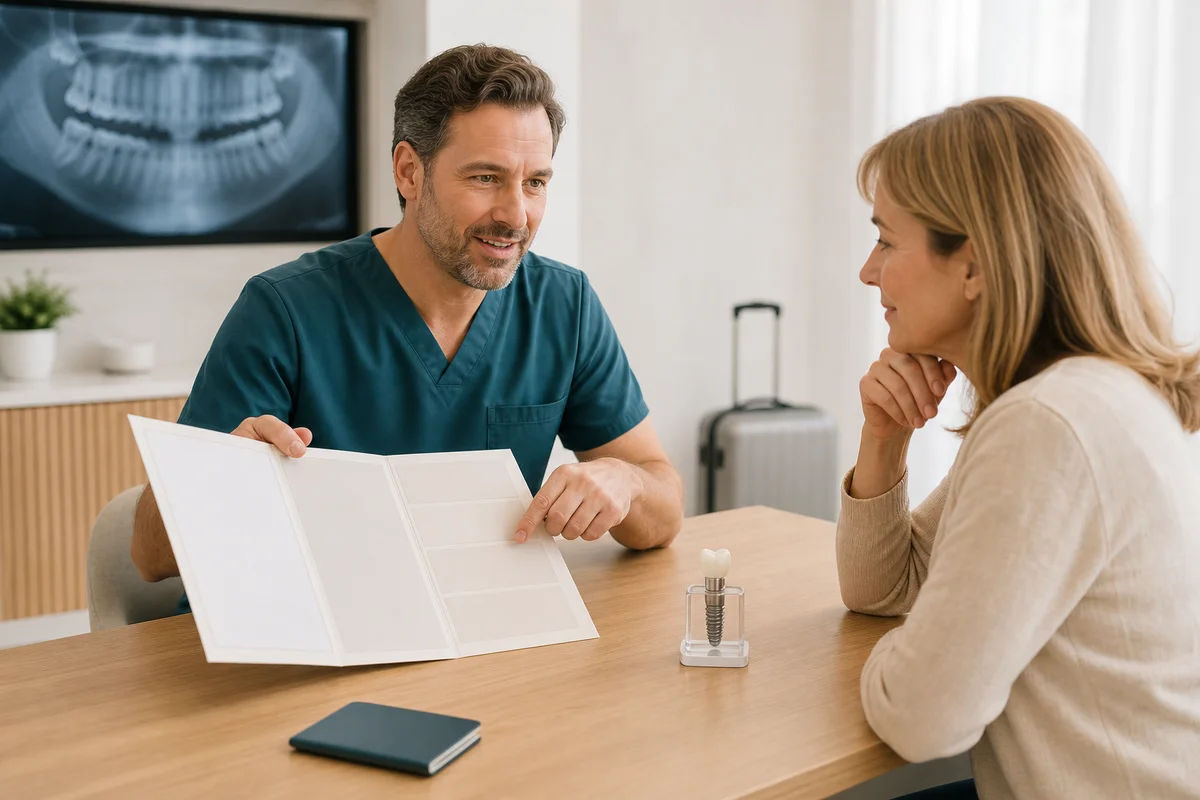
Searching for cheap dental implants abroad can reveal striking headline offers, bundled trips, and rapid treatment schedules. The useful question, however, is not simply which destination advertises the lowest implant fee. It is whether the proposed care is clinically appropriate, fully scoped, safely timed, traceable, affordable to complete, and supported after you return home. Dental implant treatment can involve diagnosis, surgery, healing, restorative work, hygiene, and later repairs; travel adds another layer of planning to every stage.
Quick answer: Compare overseas implant care only after an independent diagnosis and a written plan naming the final prosthesis. Verify the dentist and facility, all clinical stages, implant system, travel and healing schedule, emergency pathway, records, insurance exclusions, and local aftercare. Calculate the complete trip and possible revision costs—not just the advertised implant placement fee.
This evidence-informed guide is educational, not a diagnosis, price list, clinic ranking, or result guarantee. Candidacy, risks, treatment design, number of visits, healing, fees, and legal protections vary. Remote photographs may help an initial conversation but cannot establish a final plan. Before choosing cheap dental implants abroad, obtain an in-person assessment with appropriate imaging and discuss individual health, alternatives, uncertainties, and follow-up with qualified professionals.
What cheap dental implants abroad should include
A dental implant is not automatically a complete replacement tooth. The U.S. Food and Drug Administration explains that an implant system generally includes an implant body placed in bone and an abutment that supports a prosthesis; the visible crown, bridge, or denture is a restorative component. An advertisement may refer only to the implant body or surgery, while the abutment, temporary tooth, laboratory work, and final restoration are priced separately.
Safe cheap dental implants abroad planning therefore begins by naming the endpoint. A single implant crown, an implant-supported bridge, a removable overdenture, and a fixed full-arch prosthesis are different treatments. They can require different numbers and positions of implants, surgical steps, components, cleaning methods, appointment schedules, and repair pathways. Do not compare quotes until they describe the same intended result.
“Affordable” should mean that you can complete and maintain the entire pathway without an unplanned clinical gap. A low placement fee is not affordable if you later discover that the final teeth, necessary grafting, second visit, or local repair is excluded. The final amount cannot always be predicted before examination, but every cheap dental implants abroad provider should distinguish confirmed stages from contingent ones and explain how additions are authorized.
- The exact tooth or teeth being treated and the diagnosis for each site
- The final restoration: crown, bridge, overdenture, or fixed full-arch prosthesis
- The number, position, manufacturer, and product line of proposed implants
- Diagnostics, disease control, extractions, grafting, surgery, and anesthesia
- Temporary restorations, healing reviews, final laboratory work, and delivery
- Which clinician performs each stage and who coordinates the complete case
- Emergency access abroad, follow-up at home, maintenance, and possible repairs
Start with diagnosis and tooth-preserving alternatives
The first financial safeguard is an accurate diagnosis, not a coupon. If teeth are still present, ask whether they can reasonably be preserved and what their prognosis would be with appropriate care. Extraction is irreversible. Depending on the findings, alternatives may include periodontal treatment, root canal treatment and restoration, a tooth-supported bridge, a removable partial denture, an implant-retained removable prosthesis, or no immediate replacement. Each has limitations, but those limitations should be discussed before implants are presented as inevitable.
A responsible assessment for cheap dental implants abroad usually considers medical and dental history, gum health, active infection, available bone, nearby nerves or sinuses, bite, restorative space, hygiene ability, and relevant imaging. Smoking or nicotine exposure, diabetes, medicines that affect bone or bleeding, prior radiation, immune status, and grinding may change risk or timing. These factors do not all automatically prevent treatment, but they cannot be assessed safely through a sales message alone.
Ask for a copy of the findings and seek another qualified opinion before extensive extraction, full-arch reconstruction, major grafting, or a plan that remains unclear. Different cheap dental implants abroad clinicians may reasonably propose different designs, but each should explain the diagnosis, evidence, intended endpoint, alternatives, and uncertainties. A second opinion is not disloyal; it is a proportionate safeguard before irreversible care and international travel.
Build a complete cheap dental implants abroad estimate
Request a written, itemized plan in a language you understand. Separate items into included, potentially needed, and excluded. For each line, note when the fee is due, who provides the service, what records are required, and what happens if the item is no longer indicated. If a package combines clinical care, hotel, transfers, and interpretation, ask for the clinical and non-clinical parts to be listed separately.
When comparing cheap dental implants abroad, include the examination, diagnostic imaging, treatment of decay or gum disease, extractions, bone or sinus procedures if indicated, implant placement, components, local anesthesia or sedation, temporary restoration, final prosthesis, laboratory work, medications, reviews, adjustments, hygiene support, and warranty conditions. Also include travel, accommodation, meals, companion costs, time away from work or caregiving, and a reserve for delays.
Contingent treatment must be visible in every cheap dental implants abroad quote. If grafting might be needed after examination or extraction, ask how that decision is made and how the cost is approved. If the final prosthesis is delivered on a later trip, price that trip before the first procedure. If a provisional restoration can fracture or require adjustment, identify who provides that service and whether it is included. A headline becomes comparable only after these missing stages are restored to the calculation.
- Initial local examination, second opinion, records, and destination consultation
- Every outbound and return journey, including schedule changes and baggage
- Accommodation for the clinically recommended stay rather than the shortest package
- All surgical, restorative, laboratory, temporary, and medication stages
- Interpreter or coordinator services and their exact responsibilities
- Local follow-up, cleaning, adjustments, imaging, and potential component repairs
- Travel health cover, exclusions, emergency care, and possible medical evacuation
- Currency conversion, transfer charges, card fees, deposits, and refund terms
Use one decision table to compare care routes
No country, clinic type, or payment route wins every category. Use the table to expose unanswered questions, then verify current details directly. It is not a recommendation for or against cheap dental implants abroad.
| Care route | Possible affordability lever | What to verify | Often-missed cost or risk | May fit when |
|---|---|---|---|---|
| Local coordinated treatment | No international travel and easier continuity | Complete scope, benefits, financing, alternatives | Headline fees may still exclude restorative stages | Frequent reviews or complex medical coordination matter |
| Overseas single-tooth pathway | Different professional and laboratory fee structure | Number of visits, temporary tooth, components, local follow-up | Second journey and repair compatibility | The full timeline and aftercare are practical |
| Overseas full-arch pathway | Package may combine multiple clinical stages | Tooth prognosis, implant positions, provisional versus final teeth | Extensive extractions, maintenance, revisions, multiple trips | Independent assessment supports the design and travel plan |
| University or teaching clinic | Educational fee structure | Case acceptance, visit duration, all stages, waiting time | Academic scheduling and separate departments | Time is flexible and the case fits training needs |
| Phased or removable alternative | May reduce surgical complexity or spread clinically safe stages | Function, cleaning, safe stopping points, future work | Relines, temporary care, repeated records, ongoing maintenance | The alternative meets health and personal priorities |
Verify the dentist, clinic and legal authorization
Do not treat a polished website, coordinator, or social-media following as proof of professional status. Ask every cheap dental implants abroad provider for the treating dentist’s full name, registration number, role, and the regulator that holds the current record. Verify these details through an official source in the destination country. If different dentists perform surgery and restoration, verify both and ask who owns clinical coordination.
For every cheap dental implants abroad option, confirm the facility’s current license or authorization, not only an accreditation logo. Accreditation, professional registration, facility authorization, and commercial awards are different claims. Ask which regulator handles complaints, what consent law applies, what professional indemnity cover exists, and whether a broker or intermediary is separately authorized.
In Türkiye, the Ministry of Health’s Health Tourism Department publishes lists of healthcare providers authorized by the Ministry. The site was updated in 2026 and separates hospitals, medical centers, private practices, and other providers. Patients should check the current official list and confirm the exact legal entity and address; a name on a marketing page is not a substitute for the Ministry record.
The UK General Dental Council guidance on treatment abroad recommends speaking with your own dentist and asking the cheap dental implants abroad provider about qualifications, regulation, complaints, aftercare, and what happens if something goes wrong. These principles are useful regardless of where you live or travel, though legal rights and regulators differ by jurisdiction.
Check the implant system and preserve traceable records
An implant can remain in place for years while clinicians, addresses, and distributors change. Traceability matters if a screw loosens, a component fractures, a restoration needs replacement, or another dentist must identify compatible parts. Ask the cheap dental implants abroad clinic for the manufacturer, product line, implant site and dimensions, placement date, relevant lot or reference details, abutment information, and final restorative components.
The FDA advises patients to ask for the brand and model of an implant system and to keep that information. Before choosing cheap dental implants abroad, ask whether the system has an established supply chain in your home country and whether a local dentist can access compatible original components. “Premium implant” is a marketing phrase unless the exact system and documentation are named.
Request cheap dental implants abroad records in a usable language and digital format: medical and dental history, consent, clinical notes, pre- and post-treatment images, radiographs or scans in their original diagnostic format where available, prescriptions, implant labels, laboratory details, final design, occlusal information, complications, and maintenance instructions. Store copies securely and provide them to professionals who later manage your care.
Plan travel around biology, not a holiday timetable
Cheap dental implants abroad are a clinical pathway, not a tourism itinerary. Some patients may receive a temporary restoration soon after implant placement, while the final prosthesis may require healing and another visit. “Immediate” or “same-day” teeth do not necessarily mean the definitive restoration, and immediate loading is not suitable in every situation. The dentist should explain which prosthesis is temporary, what loading limits apply, and how stability and healing will be reviewed.
The U.S. Centers for Disease Control and Prevention’s 2026 Yellow Book describes dental care as a common form of medical tourism and recommends considering the destination, facility, and treating professional—not just the procedure. Its medical tourism guidance advises discussing plans with a home clinician and travel-medicine professional in advance, planning for complications, obtaining records, checking insurance, and avoiding routine vacation activities that could impede recovery.
When scheduling cheap dental implants abroad, ask how long to remain near the clinic after each stage and what clinical finding determines safe departure. Do not book the shortest possible return solely because a package ends. Alcohol, strenuous activity, swimming, sun exposure, long tours, missed medication, dehydration, and sleep disruption can interfere with recovery. Follow individualized instructions from the treating team.
Air travel after cheap dental implants abroad can add risks that are not specific to dentistry. The appropriate interval depends on the procedure, anesthesia or sedation, medical history, symptoms, and travel duration. Discuss the itinerary in advance; seek prompt care rather than boarding if you develop increasing swelling, uncontrolled bleeding, fever, breathing or swallowing difficulty, severe or worsening pain, persistent vomiting, chest symptoms, or another concerning change.
Prepare for infection, medicines and unexpected illness
All surgery carries risk wherever it occurs. Potential implant-related problems can include infection, injury to nearby structures, poor integration, altered sensation, inflammation around an implant, mechanical loosening, fracture, or dissatisfaction with function or appearance. Individual likelihood depends on health, anatomy, habits, procedure, prosthetic design, and maintenance. No clinic can guarantee integration or lifetime function.
The CDC notes that infection-related problems are common complications among medical tourists and that infection-control standards can vary. It also warns about antimicrobial-resistant infections in some regions. This does not mean that a particular country or clinic is unsafe. It means that cheap dental implants abroad should be evaluated through the specific facility’s infection-prevention systems, clinician qualifications, documentation, and follow-up—not national stereotypes or assurances.
Bring a current medication list to the cheap dental implants abroad team and disclose allergies, anticoagulants, diabetes medicines, immune-modifying drugs, and relevant conditions. Do not start, stop, or substitute prescribed medicines without professional advice. Carry regular medicines in original packaging and check destination rules. Ask who prescribes postoperative medicines, how adverse reactions are handled, and whether the same product is available at home.
Review routine and destination-specific vaccination and travel-health needs well before departure for cheap dental implants abroad. The CDC suggests that medical tourists consult a travel-medicine specialist 4–6 weeks before travel and be current with routine vaccines, especially hepatitis B considerations. Advice depends on destination and individual risk; use official travel-health guidance rather than treating vaccination as a generic package item.
Arrange local aftercare before paying a deposit
Continuity is one of the most easily underestimated cheap dental implants abroad costs. Before travel, identify a qualified clinician near home who is willing to review records and provide routine maintenance. Do not assume a local dentist must accept responsibility for another team’s plan or can service every implant system. Ask what information and components they would need and how urgent care would be arranged.
A written cheap dental implants abroad plan should distinguish scheduled overseas reviews, remote check-ins, local examinations, professional cleaning, imaging when clinically indicated, temporary adjustments, and prosthetic repairs. Clarify who pays if a return visit is required, whether travel is included, and what the clinic means by “guarantee” or “warranty.” Such terms may depend on maintenance, smoking, hygiene, attendance, or returning to the original clinic.
Ask both cheap dental implants abroad and home teams to define urgent symptoms and communication channels. After surgery, increasing swelling, fever, difficulty breathing or swallowing, uncontrolled bleeding, severe or worsening pain, an allergic reaction, or new persistent altered sensation deserves prompt professional assessment. A video call cannot replace emergency examination. If symptoms are life-threatening, contact local emergency services.
Read insurance, payment and refund terms line by line
Domestic dental insurance may exclude elective cheap dental implants abroad, while travel insurance often excludes planned treatment, pre-existing conditions, complications of elective procedures, or a trip undertaken primarily for care. Do not rely on “travel insurance included” without reading the policy wording. Ask about emergency treatment, trip interruption, additional accommodation, medical evacuation, companion expenses, and complications after planned dental procedures.
The CDC’s travel insurance guidance distinguishes travel insurance, travel health insurance, and medical evacuation insurance and notes that policies vary. Contact the insurer directly, describe the planned dental treatment accurately, obtain answers in writing, and record exclusions. Insurance is a financial contract, not a clinical endorsement of cheap dental implants abroad.
Before paying for cheap dental implants abroad, identify the legal payee, currency, deposit, payment milestones, card or transfer charges, cancellation rules, refund process, and what happens if the final plan changes after examination. Avoid sending money to an unrelated personal account. Keep invoices and receipts. If financing is offered, compare the cash price, financed amount, annual percentage rate, fees, payment schedule, and total repayment rather than the monthly figure.
Legal recourse may differ from your home country. Ask which country’s law governs the contract, whether mediation or a complaints pathway exists, what records a complaint requires, and whether an intermediary shares responsibility. Do not assume that a local consumer remedy, professional compensation system, or domestic insurer will apply overseas.
Compare Turkey implant care with the complete pathway
Türkiye is one destination considered by people researching cheap dental implants abroad. A responsible comparison should still be individual: diagnosis, tooth preservation, clinician registration, Ministry authorization, exact implant system, visit sequence, temporary and final prostheses, travel recovery, aftercare, and total cost. The destination alone cannot establish whether a plan is clinically appropriate or affordable for a particular patient.
Redent Klinik provides information for international patients on the Redent Klinik English website. Use the Redent Klinik contact page to ask which records are useful for preliminary review, which decisions require in-person examination, who performs each stage, how many visits may be needed, what the estimate includes, and how follow-up is coordinated. A remote exchange should remain provisional until clinical assessment.
When discussing cheap dental implants abroad with any Turkish clinic, request the current Ministry authorization record and treating dentists’ professional details. Ask for a written plan that separates clinical treatment from hotel or transfer services. Confirm how consent, interpretation, records, billing, emergency access, and complaints are handled. A premium experience is defined by transparent and safe coordination, not by hospitality alone.
Recognize advertising and consent warning signs
Low cheap dental implants abroad fees can reflect real differences in operating costs and do not automatically mean poor care. Likewise, a high fee does not guarantee a good outcome. Warning signs concern process: a final diagnosis based only on photographs, pressure to extract many teeth quickly, a promise that everyone is suitable, refusal to name the clinician or implant system, or a requirement to commit before receiving a complete written plan.
Be cautious when cheap dental implants abroad are described as risk-free, painless, permanent, maintenance-free, or guaranteed for life. Ask whether testimonials are verified and whether before-and-after images show the same treatment type. Patient stories cannot predict your result. A responsible clinician describes benefits and uncertainties, adjusts the plan after examination, and respects the right to pause or decline.
- A package price without a named final prosthesis or number of required visits
- Extensive irreversible treatment recommended before adequate records and examination
- Unverifiable dentist identity, facility authorization, implant brand, or component source
- Pressure to combine surgery with a tightly scheduled holiday or immediate long flight
- No written plan for complications, local aftercare, records, repairs, or emergency access
- A warranty that hides exclusions, mandatory return travel, or maintenance conditions
- Payment to an unrelated account or unclear cancellation and refund language
Frequently asked questions about cheap dental implants abroad
Are cheap dental implants abroad automatically lower quality?
No. Fees can reflect currency, operating costs, professional fees, laboratory arrangements, and package structure. Price alone cannot prove quality or safety. Compare diagnosis, clinician registration, facility authorization, complete scope, implant traceability, infection prevention, consent, records, travel timing, aftercare, and maintenance. An incomplete low quote can be more expensive than a transparent higher estimate.
Can I receive a final implant quote from photographs?
Photographs and existing scans can support a preliminary conversation, but they cannot establish a reliable final plan on their own. Gum health, active disease, bone, anatomy, bite, medications, restorative space, and imaging quality require clinical assessment. Treat a remote cheap dental implants abroad estimate as provisional and avoid irreversible commitments before an in-person diagnosis.
How many trips will overseas implants require?
There is no universal number. The schedule depends on diagnosis, extractions, grafting, implant stability, healing, temporary restoration, final prosthesis, and individual response. Ask for the purpose and minimum clinically recommended stay for every visit, which milestones determine progress, and what happens if healing changes the timetable.
Does same-day treatment mean I receive final teeth?
Not necessarily. “Same-day teeth” may describe a provisional restoration delivered near the time of implant placement. The definitive prosthesis may follow after healing and further records. Ask whether the teeth are temporary or final, what diet and loading restrictions apply, how fit and bite are reviewed, and what later visits or fees remain.
Will my local dentist maintain implants placed abroad?
Possibly, but do not assume it. A local dentist may need complete records, compatible components, appropriate expertise, and willingness to share cheap dental implants abroad care. Arrange this before travel. Ask the overseas clinic for implant labels, component details, imaging, clinical notes, and maintenance instructions, and budget separately for local reviews and repairs.
Does travel insurance cover implant complications?
Policies vary and often contain exclusions for planned treatment, pre-existing conditions, or complications of elective procedures. Contact the insurer before booking, disclose the purpose of travel accurately, and ask about emergency care, additional accommodation, trip changes, evacuation, and treatment after returning. Obtain the answer in writing.
What should I do if I develop symptoms after returning?
Contact the treating team and seek prompt local professional assessment. Do not delay care while waiting for a remote reply. Increasing swelling, fever, breathing or swallowing difficulty, uncontrolled bleeding, severe worsening pain, allergic symptoms, or persistent altered sensation can require urgent evaluation. Tell the clinician about the overseas treatment and provide records.
Can I compare two cheap dental implants abroad packages by implant count?
Implant count alone is not enough. Compare the diagnosis, teeth being retained or removed, implant positions, grafting, temporary and final prostheses, materials, hygiene access, number of trips, laboratory stages, repairs, and long-term plan. Different designs can use the same number of implants but have very different clinical endpoints and maintenance needs.
What records should I bring home?
Request consent and treatment notes, implant manufacturer and component labels, implant sites and dimensions, imaging, prescriptions, laboratory and prosthesis details, bite or design information, complications, invoices, and written maintenance guidance. Records should be readable and shareable with a home clinician. Keep secure backups rather than relying on a clinic portal indefinitely.
Your final cheap dental implants abroad checklist
A careful cheap dental implants abroad decision begins with diagnosis and ends with maintainable care. Preserve treatable teeth where clinically reasonable, define the final prosthesis, verify every professional and facility, and compare equivalent written scopes. Include every trip, healing interval, temporary stage, insurance exclusion, aftercare visit, and possible repair in the total-cost calculation.
Do not let a countdown offer compress informed consent or biology. Keep records, know the implant system, arrange local follow-up, understand urgent symptoms, and maintain a financial reserve. Seek another qualified opinion when a plan is extensive, irreversible, unusually rapid, or unclear. The affordable route is the one you can safely complete and support over time—not simply the lowest number on the first screen.
Sources
- U.S. Centers for Disease Control and Prevention: Medical Tourism, Yellow Book 2026
- U.S. Centers for Disease Control and Prevention: Travel Insurance and Medical Evacuation Insurance
- General Dental Council: Going Abroad for Dental Treatment
- Republic of Türkiye Ministry of Health: Healthcare Providers Authorized by the Ministry
- U.S. Food and Drug Administration: Dental Implants—What You Should Know
- American Dental Association
- World Health Organization: Oral Health Fact Sheet