
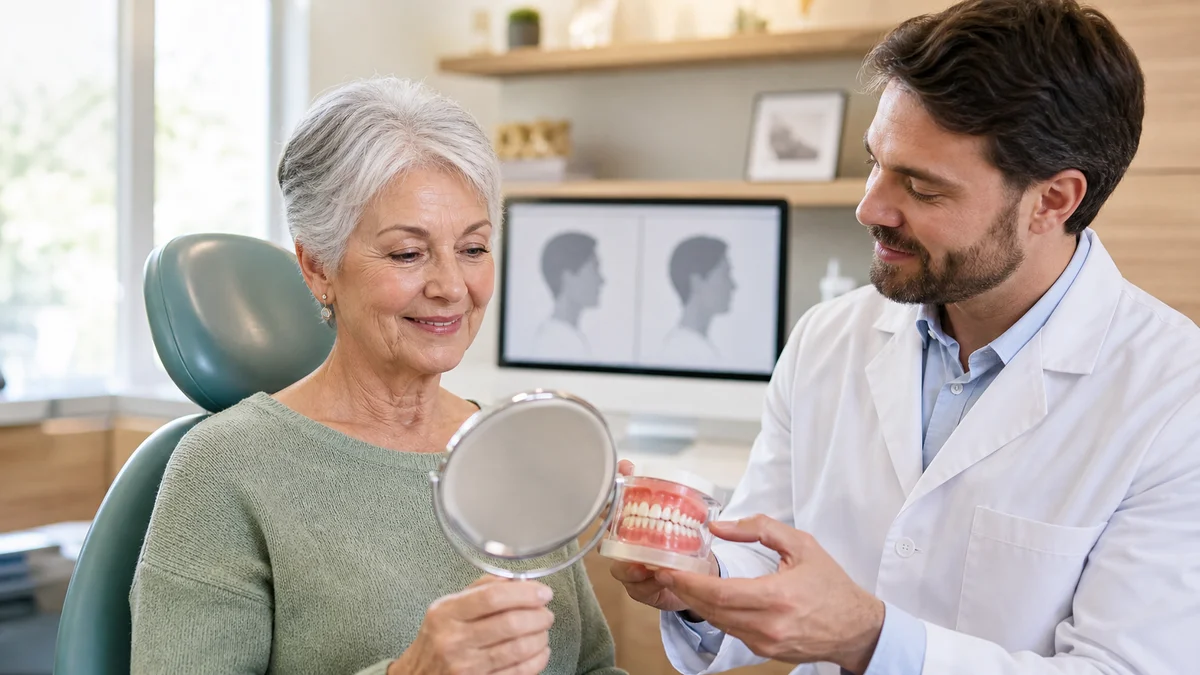
Searches for dentures before and after often focus on a dramatic smile transformation. A clinically useful comparison is broader. It asks how a denture affects comfort, speech, chewing, facial support, hygiene, confidence, and the health of any remaining teeth and oral tissues. It also recognizes that the fitting-day result is not necessarily the settled result, especially after extractions.
Individual photographs can illustrate possibilities, but they cannot predict your outcome. Jaw shape, ridge anatomy, saliva, muscle control, remaining teeth, bite, healing, dexterity, medical history, and expectations all influence adaptation. This guide explains what a responsible before-and-after review should show, what changes take time, and when a denture needs adjustment rather than more adhesive.
Quick answer: dentures may improve tooth appearance, lip and cheek support, speech, and chewing, but results vary. New dentures often feel bulky and may need adjustments while tissues adapt. Immediate dentures can loosen as extraction sites heal. Judge the outcome by fit, function, tissue health, cleanability, and natural appearance—not a filtered smile photo alone.
dentures before and after: what a fair comparison should include
A fair comparison begins with the same question in both states: what can the person do comfortably and safely? Before treatment, note missing teeth, unstable teeth, pain, sores, chewing limits, speech concerns, facial support, and social goals. After treatment, review retention, stability, bite, pressure areas, speech, eating, cleaning, and appearance under ordinary conditions.
Many online dentures before and after images show only a close smile. That crop cannot reveal whether the denture moves during speech, causes ulcers, is difficult to clean, or supports a comfortable bite. A comprehensive result includes the patient’s experience and a professional examination. A natural-looking photograph is evidence of appearance at one moment, not proof of health, longevity, or guaranteed satisfaction.
- same camera angle, distance, lighting, head position, and expression;
- no whitening filters, skin retouching, lip reshaping, or altered tooth proportions;
- clear timing: fitting day, first review, post-healing, or long-term follow-up;
- identification of complete, partial, immediate, or implant-retained dentures;
- patient consent and privacy protection;
- an explanation that individual anatomy and healing make outcomes non-transferable.
dentures before and after: the examination that comes first
Dentures should be prescribed after a dental assessment, not ordered from a selfie or home impression alone. The clinician evaluates the oral lining, ridges, remaining teeth, gums, bite, jaw relationships, saliva, movement of lips and tongue, and relevant medical history. Suspicious lesions, active infection, decay, gum disease, or poorly controlled health conditions may need attention before definitive treatment.
A responsible dentures before and after plan also records what the current denture does well. Replacing everything without understanding a person’s established speech and muscle patterns can introduce avoidable problems. Existing dentures, photographs from before tooth loss, facial measurements, and the patient’s preferences may help guide tooth position and appearance, but none replaces examination.
dentures before and after: decision table for the main denture types
The table below supports an informed discussion; it is not a diagnosis or a promise. The right option depends on the number and condition of teeth, bone and soft tissues, general health, preferences, maintenance capacity, and budget.
| Denture pathway | Typical “before” situation | What may change after | Important limitation or follow-up |
|---|---|---|---|
| Conventional complete denture | All teeth in one arch are missing and tissues are sufficiently healed | Restored tooth display, facial support, speech and chewing surface | Retention depends on anatomy and muscle control; periodic reline or replacement may be needed |
| Immediate complete denture | Remaining teeth are planned for extraction | A denture is inserted around the extraction period so the person is not without teeth | Rapid tissue change can alter fit; adjustments, relining or later replacement are expected possibilities |
| Removable partial denture | Some natural teeth remain | Gaps are filled and chewing support may improve | Supporting teeth and gums require meticulous care and regular review |
| Implant-retained removable denture | Conventional retention is limited or additional stability is desired | Attachments may improve retention in selected patients | Surgery, healing, implant hygiene, attachment wear and maintenance add complexity |
| Repair, reline or remake | An existing denture is worn, loose, damaged or no longer matches the mouth | Fit, stability, bite or appearance may improve | A repair cannot correct every design or tissue problem; the cause of failure must be identified |
dentures before and after: complete dentures and facial support
Complete dentures replace teeth and part of the lost gum contour. Proper tooth position and flange shape may support the lips and cheeks and help restore the lower facial profile. Too little support can look collapsed; too much can appear strained or bulky. The goal is a balanced, individualized result rather than the largest possible smile.
When reviewing dentures before and after, look at relaxed facial posture as well as a full smile. Check whether the lips close comfortably, whether speech remains natural, and whether the profile is harmonious. A before image taken without any denture and an after image taken with exaggerated makeup, lighting, or head position is not a clinically fair comparison.
dentures before and after: partial dentures and remaining teeth
A removable partial denture may use clasps, rests, precision components, or other design features to gain support and stability from remaining teeth and oral tissues. Its success depends on more than hiding gaps. The design should control movement, distribute forces, permit cleaning, and protect the teeth and gums that remain.
In dentures before and after for partial dentures, ask whether supporting teeth were restored, whether visible clasps were discussed, and how the patient removes and inserts the device without damage. New plaque-retentive areas require a tailored hygiene routine. A cosmetic improvement that accelerates decay or gum problems around abutment teeth is not a successful long-term result.
dentures before and after: immediate dentures change during healing
Immediate dentures are made before or around the time teeth are removed. They help a person avoid a period without teeth and may assist with appearance and early function. The trade-off is that the dental team cannot evaluate the final healed ridge at the initial impression. Extraction sites and supporting tissues change shape as they heal.
That is why immediate dentures before and after should be labeled by date. A fitting-day image may differ from the appearance and fit weeks or months later. Adjustments, temporary liners, relining, or a new definitive denture may become appropriate. This is not automatically a manufacturing failure; it can reflect normal biological change, although persistent pain or instability must still be assessed.
dentures before and after: fitting day is the start, not the finish
New dentures may initially feel bulky, increase saliva, alter certain sounds, or create pressure points. Adaptation varies. A dentist may arrange an early review to identify sore areas and refine the bite. Do not grind or bend the denture yourself. Home modification can damage the device, mask the original pressure pattern, and create sharp or unstable surfaces.
For useful dentures before and after documentation, record the fitting date, adjustment visits, and functional milestones. A polished photo on day one does not show whether the person can eat or speak comfortably. Equally, a minor early difficulty does not prove failure. The trend, examination, and response to adjustment matter.
dentures before and after: speech changes and practice
Tooth position, palate thickness, tongue space, and vertical relationship can affect speech. Sounds may feel unfamiliar during the first days or weeks. Reading aloud, speaking slowly, and practicing difficult words can help the tongue adapt, but persistent clicking, whistling, or slurring should be reviewed rather than accepted indefinitely.
A clinically honest dentures before and after comparison may include a short, consented speech sample using the same words and recording conditions. It should not imply that every speech problem is caused by dentures. Neurological, hearing, muscular, or other health factors may need separate evaluation.
dentures before and after: eating safely during adaptation
Many people begin with softer foods cut into small pieces, then progress as control improves. Chewing slowly on both sides may reduce tipping. Very sticky, sharp, or hard foods can be difficult early on. Nutritional needs should still be met; people with weight loss, swallowing difficulty, frailty, or medical dietary restrictions may need coordinated advice.
Do not judge dentures before and after solely by whether a person can bite a hard food in a promotional video. Front biting can destabilize some dentures, and staged adaptation is normal. Report coughing, choking, repeated chest infections, inability to swallow, or substantial unintended weight loss to an appropriate healthcare professional promptly.
dentures before and after: sore spots, pain and urgent signs
Mild pressure areas can occur with new dentures and often need targeted adjustment. Persistent ulcers, bleeding, severe pain, swelling, pus, fever, a rapidly changing lump, unexplained numbness, or a sore that does not heal require professional assessment. Difficulty breathing or swallowing is an emergency. A denture should never be used to cover a suspicious lesion without examination.
For an adjustment appointment, the dental team may advise wearing the denture beforehand so pressure areas are visible, unless pain is severe or different instructions were given. Do not force wear through significant injury merely to produce favorable dentures before and after photos. Tissue health takes priority over presentation.
dentures before and after: fit, retention and stability are different
Retention describes resistance to lifting away from tissues; stability describes resistance to side-to-side or rocking movement; support describes resistance to movement toward the tissues. A denture can seem retentive at rest but move while chewing. Upper and lower complete dentures also behave differently because of anatomy and tongue movement.
A meaningful dentures before and after review tests speaking, swallowing and controlled jaw movement, not just suction created for a photograph. If a denture clicks, slips, rocks, repeatedly traps food, or requires increasing adhesive, the dentist should reassess fit, bite, tissue condition, and design.
dentures before and after: adhesives are not a permanent refit
Denture adhesive can improve confidence for some wearers when used according to instructions, but it does not correct an ill-fitting denture. The FDA notes that mouth tissues and underlying bone can change over time, making a previously fitting denture loose. Excess adhesive may mask the need for relining or replacement.
Some adhesives contain zinc. The FDA advises following the label, using no more than recommended, tracking usage, and seeking advice if there is uncertainty. Chronic overuse of zinc-containing products has been associated in reports with numbness or tingling. In dentures before and after, a “stable after” state achieved only with excessive adhesive should not be marketed as a successful fit.
dentures before and after: daily cleaning protects tissues and appearance
Removable dentures collect plaque, stains, calculus, and microorganisms. The ADA recommends daily care with an effective nonabrasive denture cleanser, together with cleaning of the mouth, tongue, gums, and any remaining teeth. Denture cleanser should be used according to its instructions and not in the mouth. Hot or boiling water can warp many denture materials.
Unless a dentist gives different instructions for a specific clinical reason, dentures are generally removed for a period such as overnight so tissues can rest. Store them as recommended so they do not dry or distort. In long-term dentures before and after, cleanliness, absence of inflammation, and condition of supporting teeth are more important than surface whiteness alone.
- clean over a folded towel or basin of water to reduce breakage if dropped;
- remove food debris and old adhesive gently every day;
- use a denture brush and nonabrasive product recommended for the material;
- clean gums, tongue, palate, implants, and remaining teeth separately;
- follow the cleanser’s soaking time and rinse thoroughly;
- avoid bleach, hot water, toothpaste, or household products unless specifically approved for the denture.
dentures before and after: when relining, repair or replacement is considered
Oral tissues and jaw ridges can change, while denture teeth and bases wear. A reline changes the fitting surface; a repair addresses a specific fracture or component; a remake can redesign fit, bite, appearance and function. The correct option depends on why the denture is failing. Repeated repairs may not solve a distorted base, worn bite, unstable design, or diseased supporting tissue.
The ADA notes signs that merit professional evaluation for replacement, including chronic irritation, inability to wear the denture, deterioration, instability, poor fit, damage, changed supporting teeth, or reliance on adhesive to eat or retain the denture socially. These criteria make dentures before and after clinically meaningful rather than purely cosmetic.
dentures before and after: implant-retained dentures
Implants may help retain selected removable dentures, but they add surgical assessment, healing, components, maintenance and cost. The denture may still be removable and require daily cleaning around attachments. Retention can improve without recreating natural teeth or eliminating all movement. Attachment inserts can wear and may need replacement.
When viewing implant-retained dentures before and after, determine whether the “before” was a conventional denture and whether the “after” included new implants, a redesigned denture, grafting, or new attachments. A photograph cannot communicate surgical risks, bone requirements, health factors, treatment time, or future service needs.
dentures before and after: choosing tooth shape, shade and smile character
Denture teeth can be arranged to suit facial proportions, age, personality, old photographs and patient preferences. The whitest shade or most symmetrical arrangement is not automatically the most natural. Small controlled variations in tooth position and texture may produce a more lifelike result, but the bite and cleansability remain essential.
During the try-in, assess lip support, tooth display at rest, smile line, midline, speech, facial profile, and the relationship between upper and lower teeth. A patient should have time to comment before final processing when the workflow allows. Ethical dentures before and after content should not shame the “before” appearance or imply that dignity depends on perfect teeth.
dentures before and after: photographs, consent and advertising ethics
Clinical images require explicit informed permission for their intended use. Consent for treatment photography is not automatically consent for public advertising. Patients should understand where images will appear, whether they can be identified, how long they may remain online, and how withdrawal requests are handled under applicable rules.
Edited dentures before and after advertising can mislead when lighting, lipstick, facial expression, camera angle, filters, or image scale changes. Ask whether the cases are real, whether the provider treated them, and how long after fitting the second image was taken. A single outstanding case should never be presented as the typical or guaranteed result.
dentures before and after: digital workflows do not remove biological limits
Digital scans, design software, milling, and printed try-ins may support efficient records and reproducible fabrication. They can make it easier to preserve a design or remake a denture. However, scanning does not eliminate the need to assess tissues, jaw relationships, functional movements, aesthetics, and patient adaptation. Some mouths and workflows still require conventional impressions or combined techniques.
In digital dentures before and after promotions, ask which steps were digital, what material was used, who prescribed and delivered the device, and how adjustments are made. “Computer designed” is not a guarantee of fit. A licensed dentist remains responsible for diagnosis, prescription, delivery, and follow-up within local regulations.
dentures before and after: avoid direct-to-consumer self-impressions
The American Dental Association strongly discourages direct-to-consumer prosthetic services that bypass a dentist because of the potential for irreversible harm. A home impression cannot screen for oral cancer, infection, unstable teeth, poor bite relationships, or tissue disease. It may also be inaccurate or unsafe for someone with swallowing or dexterity problems.
Do not let inexpensive online dentures before and after pictures replace an examination. A dental laboratory fabricates a device from a prescription; it does not diagnose the patient. Ask who is legally accountable, who checks the mouth, who confirms fit and bite, and where adjustments occur.
dentures before and after: treatment abroad and continuity of care
Dentures may require multiple visits for records, try-in, delivery and adjustment. Immediate dentures can require additional appointments as tissues heal. If treatment is planned abroad, include travel, accommodation, time away from work, return visits, relining, repairs, record transfer and local follow-up in the decision. A low laboratory quote may not reflect the total pathway.
The English Redent Klinik overview describes the clinic’s general approach, while the Redent Klinik contact page can be used to request an individualized discussion. Neither page predicts candidacy or outcome. Before relying on international dentures before and after, confirm who treated the patient, the denture type, follow-up interval and aftercare plan.
dentures before and after: cost and insurance without shortcuts
Cost varies with complete or partial design, immediate or definitive timing, materials, tooth and base characterization, metal frameworks, attachments, implants, laboratory work, extractions, relines, and follow-up. Insurance definitions, networks, waiting periods, annual limits, and replacement intervals differ. Obtain a written plan and predetermination where applicable.
A package price attached to dentures before and after may omit extractions, temporary liners, post-delivery adjustments or a later definitive denture. Ask which stage the quote covers and what happens if healing changes the plan. Financing can spread payments but may add interest; compare total repayment, not only the monthly amount.
dentures before and after: a practical review checklist
- Complete a dental and oral-tissue examination before fabrication.
- Identify complete, partial, immediate, conventional or implant-retained design.
- Discuss alternatives, limitations, material, laboratory and expected visits.
- Agree on tooth display, shade, lip support and smile character at try-in when possible.
- Record the delivery date and planned adjustment schedule.
- Learn insertion, removal, eating, speech, cleaning and storage.
- Know which soreness is expected and which signs require prompt review.
- Use adhesive only as directed and never to conceal a persistently poor fit.
- Compare photos under the same conditions and reject filters or guarantees.
- Plan long-term oral examinations, relines, repairs and eventual replacement.
Frequently asked questions about dentures before and after
dentures before and after: will my face look younger?
Dentures may restore lost tooth and gum contour and can improve lip or cheek support. The extent depends on anatomy and design. Excessive support can look unnatural and feel bulky. A clinician should aim for comfortable closure, balanced profile, speech and function—not promise a particular age reduction.
dentures before and after: why do new dentures feel big?
The tongue, cheeks and lips need time to adapt to new contours. Thickness, tooth position, saliva and altered sensory feedback can make a correctly made denture feel unfamiliar at first. Persistent gagging, pain, speech difficulty or instability deserves adjustment rather than forced wear.
How soon can I eat normally after getting dentures?
Adaptation varies. Many people begin with softer foods cut small, chew slowly on both sides and progress as control improves. Follow individual surgical instructions after extractions. Seek advice if eating remains impossible, weight falls, swallowing feels unsafe or the denture repeatedly tips and injures tissue.
dentures before and after: are immediate dentures the final set?
Not always. Immediate dentures are made before tissues fully heal and may loosen as gums and jaw ridges change. Adjustments and liners can help during healing, while a reline or new definitive denture may later be appropriate. Your treatment plan should explain the expected pathway and cost.
Should new dentures hurt?
Minor pressure areas can occur, but significant or worsening pain is not something to ignore. Contact the dental team for adjustment. Severe swelling, fever, pus, uncontrolled bleeding, difficulty breathing or swallowing, new numbness, or a non-healing ulcer requires prompt or urgent assessment.
dentures before and after: can adhesive make a loose denture fit?
Adhesive may temporarily improve retention, but it cannot correct an inaccurate or deteriorated fit. Increasing amounts, use more than directed, or adhesive needed to eat can signal that professional reassessment, relining or replacement is needed. Follow the label and ask about zinc content.
How often should dentures be replaced?
There is no single expiration date for every person. Fit, stability, wear, damage, tissue irritation, appearance, changes in supporting teeth and reliance on adhesive matter. The ADA cites professional evaluation when red flags occur and notes that a denture older than five years merits assessment rather than automatic replacement.
dentures before and after: can I sleep in my dentures?
Most removable denture wearers are advised to remove them for a daily rest period, often overnight, unless their dentist gives different instructions for a specific reason. Removal supports cleaning and tissue rest. Store the denture as advised so it does not dry or warp.
Can I clean dentures with toothpaste or boiling water?
Many toothpastes are too abrasive for denture materials, and hot or boiling water can distort them. Use a soft denture brush and a nonabrasive product recommended for the device, follow cleanser instructions, rinse well, and clean the mouth and remaining teeth separately.
dentures before and after: do implant dentures never move?
Implant attachments can improve retention in selected patients, but removable implant dentures may still have controlled movement and require maintenance. Attachments can wear, implants and tissues need cleaning, and surgical risks remain. Ask which movement is expected and how replacement parts are serviced.
Conclusion: evaluate dentures before and after beyond the smile photo
The best dentures before and after result combines natural appearance with comfortable tissues, stable function, intelligible speech, manageable hygiene and realistic follow-up. It accepts that adaptation takes time and that immediate dentures change as healing progresses. It never hides soreness, instability or excessive adhesive behind a filtered image.
Choose a clinician-led process with examination, shared design decisions, a documented adjustment plan and ongoing oral checks. Before-and-after cases can help you discuss preferences, but they are not promises. Your anatomy, health, goals and ability to maintain the prosthesis determine the appropriate plan.
Authoritative sources
- American Dental Association — Denture Care and Maintenance
- American Dental Association — Oral health and professional resources
- U.S. Food and Drug Administration — Denture Adhesives
- NHS — Dentures: types, adaptation, care and problems
- American Dental Association — Direct-to-Consumer Dental Services Policy
- World Health Organization — Oral Health Fact Sheet
Editorial source review: July 30, 2026. Individual instructions, products, regulations and coverage can vary. Follow the advice of the dentist who examined you and the directions supplied with your specific denture and care products.