
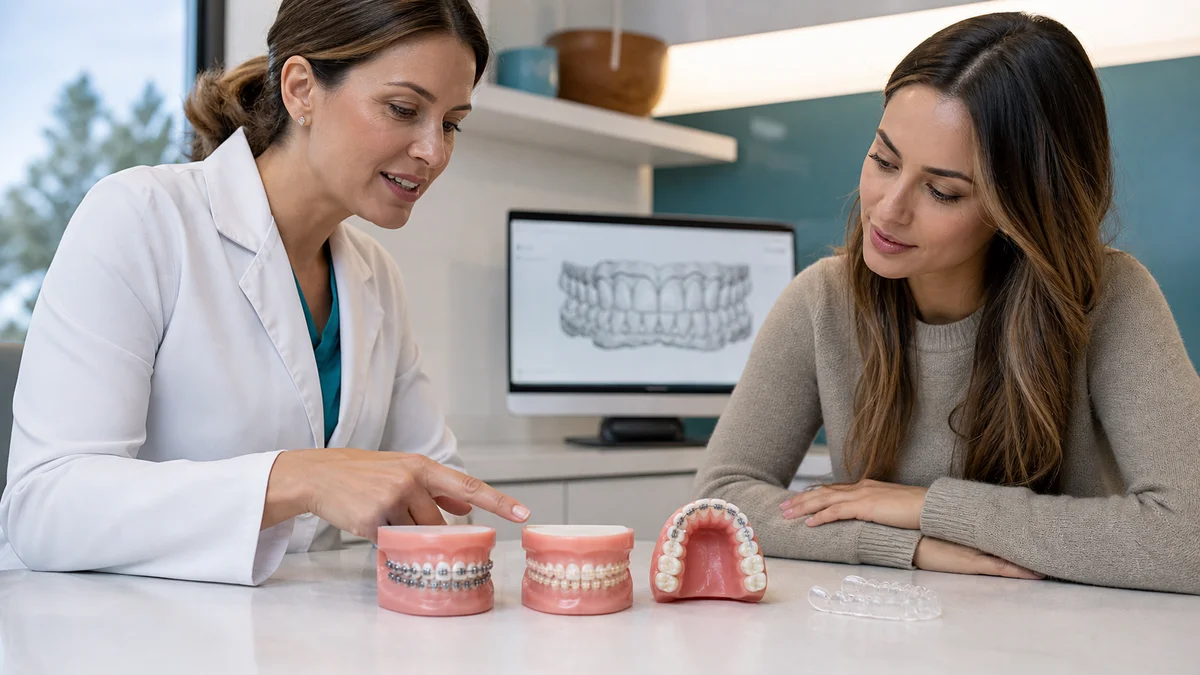
People researching clear aligners alternatives may be concerned about tray wear, predictability, cost, visibility, speech, lost appliances or remote monitoring. There is no universal runner-up. A fixed brace can offer valuable control for one movement but create greater cleaning demands. A lingual appliance can reduce front-facing visibility yet require adaptation and specialist expertise. A veneer may change visible shape but cannot correct root position or a skeletal bite.
The comparison must therefore start with the diagnosed problem rather than the appliance catalogue. Crowding, spacing, an open bite, deep bite, crossbite, impacted teeth and jaw discrepancy require different mechanics. Supporting bone, gum health, previous trauma, restorations, missing teeth, growth and daily cooperation can change which options are reasonable.
This guide provides general education, not an individual diagnosis, fixed quote or outcome guarantee. An examination and appropriate records are needed before teeth move. Increasing facial swelling, fever, pus, trauma, breathing or swallowing difficulty requires urgent local assessment rather than an online appliance comparison.
1. Why orthodontic alternatives are not interchangeable products
Clear aligners are removable, sequential prescription devices that apply staged forces to move teeth. Fixed braces use bonded brackets and wires. Lingual braces place fixed components behind the teeth. Functional appliances can influence selected tooth and jaw relationships in growing patients. Orthognathic surgery changes a skeletal relationship and is planned with orthodontics. These are different treatment pathways, not cosmetic versions of the same product.
Two methods can pursue the same broad goal while controlling specific movements differently. Rotation, root torque, vertical movement, space closure and management of impacted teeth may require attachments, elastics, fixed mechanics or temporary anchorage. The clinician should explain which movement is expected from each component and what would trigger a change.
A commercial simulation shows a proposed sequence; it is not a biological guarantee. Teeth may respond differently from the plan. Good treatment includes monitoring, refinements and contingencies rather than assuming the first digital setup will occur exactly.
2. How to compare clear aligners alternatives safely
A safe shortlist is created after medical and dental history, clinical examination and diagnosis. Records may include photographs, scans or models and radiographs when indicated. A surface scan records the visible shape of crowns but cannot by itself disclose every root, bone level, impacted tooth, cavity or periodontal problem.
Active decay and uncontrolled gum inflammation should be managed before elective movement. The treatment plan should define whether one or both arches need care, how the bite will change, which teeth and roots move, whether space will be created and which compromises may remain. A front-tooth alignment package is not automatically comprehensive bite treatment.
- What is the complete orthodontic and periodontal diagnosis?
- Which concern is cosmetic, functional, dental or skeletal?
- Which teeth and roots must move, and in which directions?
- Does the plan involve interproximal reduction, expansion, extraction or distal movement?
- Which movements are least predictable with the preferred appliance?
- What records and monitoring are needed for this individual?
- What would cause the clinician to revise or stop treatment?
- What retention is expected after active movement?
3. Decision table for the main treatment pathways
| Pathway | Potential advantage | Main trade-off | Essential question |
|---|---|---|---|
| Metal fixed braces | Continuous fixed mechanics and broad versatility | Visible; detailed hygiene and food precautions required | Which movements benefit from fixed control? |
| Ceramic fixed braces | Fixed mechanics with lower color contrast | Still visible; material and opposing-tooth considerations | Where is ceramic clinically suitable? |
| Lingual fixed braces | Components positioned behind the teeth | Speech, tongue comfort, cleaning, access and expertise | Can this system deliver the required movements? |
| Hybrid mechanics | Assigns different tasks to different appliances | More phases and responsibilities to understand | What does each phase accomplish? |
| Functional appliance | Can address selected growth-related relationships | Timing, growth and cooperation determine relevance | What growth remains and what change is realistic? |
| Orthodontics with jaw surgery | Addresses substantial skeletal discrepancy | Major multidisciplinary pathway with surgical risks | What cannot be corrected by tooth movement alone? |
| Restorative camouflage | May alter shape, proportion or color quickly | Does not move roots; may remove healthy tooth tissue | Would orthodontics preserve more structure? |
| Observation or no treatment | Avoids elective intervention now | Concern remains and may change; prevention continues | What are the realistic consequences of waiting? |
The table identifies categories, not prescriptions. Availability and expertise vary, and the same appliance can be designed differently. Only options that can address the same agreed treatment objective should be compared on visibility, lifestyle and total cost.
4. Metal fixed braces
Metal braces use brackets bonded to the teeth and wires adjusted during treatment. Because the appliance remains attached, force delivery does not depend on remembering to reinsert trays after meals. The clinician can combine wires, elastics, coils and other auxiliaries for a wide range of dental and bite movements.
Fixed mechanics may be considered when detailed root control, complex space management, impacted-tooth traction or consistent force is useful. This does not mean metal braces are required for every complex case or that aligners only treat minor problems. Suitability depends on the actual diagnosis and the clinician’s planned mechanics.
The main compromises are visibility, cleaning demands, food restrictions and possible irritation from brackets or wires. Plaque around brackets can increase the risk of enamel changes, decay and gum inflammation if hygiene is poor. Patients still need cooperation with appointments, elastics, cleaning and emergency instructions.
5. Ceramic fixed braces
Ceramic braces use tooth-colored or translucent front-surface brackets, usually connected by a visible wire. They offer fixed-appliance control with less contrast than metal brackets. For a patient who dislikes tray discipline but wants a quieter appearance, they may be a practical middle ground.
Ceramic does not mean invisible. Brackets, wires and modules remain visible at conversational distance, and some components may discolor. Material, bracket size and friction characteristics differ by system. Ceramic can be brittle, and contact with opposing teeth may affect where it is appropriate.
Ask whether ceramic is planned on both arches or only the visible upper teeth, whether mechanics differ from metal, how breakages are handled and how the fee changes. A cosmetic material preference should not compromise control or enamel protection.
6. Lingual braces behind the teeth
Lingual braces attach to the tongue-facing surfaces of teeth. They are difficult to see from the front and remain fixed between appointments. For selected patients, they combine discreet appearance with fixed mechanics.
The position creates distinct challenges. Tongue soreness and speech changes may occur during adaptation. Cleaning is less direct, emergency access can be harder and not every clinic offers the technique. Tooth shape, bite depth, available bonding surface and treatment goal influence suitability.
Patients should ask about the clinician’s experience with the specific lingual system, expected speech adaptation, hygiene tools, repair access and movements that may require another appliance. Lingual treatment is a separate technical method, not simply ordinary braces turned around.
7. Hybrid treatment and prescribed auxiliaries
A hybrid plan uses more than one method to match mechanics to the problem. A short fixed-brace phase may manage a difficult rotation or impacted tooth before aligners. Clear trays may be combined with elastics, bonded buttons, sectional wires or temporary anchorage. Periodontal or restorative care can also be coordinated around movement.
When planned from the beginning, a second appliance is not evidence of failure. It can be the most conservative way to achieve a defined task. A change can also become necessary if teeth do not track, attachments fail repeatedly or biology differs from the forecast.
- Which phase is fixed and which is removable?
- What movement does each appliance or auxiliary perform?
- Which phase depends most on patient cooperation?
- What clinical finding triggers the transition?
- Are all components, visits and repairs included in the quote?
- How are hygiene and urgent issues managed in each phase?
8. Functional and removable appliances for selected cases
Removable acrylic appliances can achieve limited tooth movements or support another phase of treatment. Functional appliances are used mainly in selected growing patients with particular jaw relationships. Their purpose and timing differ from adult clear aligner treatment.
For a child or adolescent, the clinician should explain remaining growth, the expected dental and skeletal effects, daily wear responsibilities and whether later comprehensive braces or aligners are likely. Early treatment does not automatically eliminate a second phase.
Adults should be cautious when a simple removable device is advertised as guaranteed jaw remodeling. Dental expansion, tooth tipping, skeletal expansion and jaw surgery are different concepts. Ask for the precise diagnosis, device name, intended tissue effect and evidence supporting its use at the patient’s age.
9. Orthodontics combined with jaw surgery
When the central problem is a substantial discrepancy between the upper and lower jaws, tooth movement alone may not create the desired function or facial balance. Orthognathic surgery can be considered in selected adults with orthodontic treatment before and after the operation. Assessment is multidisciplinary and usually involves an orthodontist and oral and maxillofacial surgeon.
Dental camouflage may be another option, moving teeth within the existing jaw relationship while accepting limits. Some patients choose no treatment after understanding consequences. None of these pathways is a simple brace style, and none can be selected from smile photographs alone.
A responsible consultation separates skeletal and dental components, explains alternatives and describes sequence, recovery, material risks and retention without guaranteeing a facial or bite result.
10. Restorative camouflage does not move teeth
Bonding, veneers and crowns can alter the visible shape, width, length and color of teeth. They do not reposition roots, correct an impacted tooth or change the relationship of the jaws. They may camouflage a small gap or proportion issue, but the biological cost can include irreversible enamel preparation and future replacement.
Restorative treatment can be appropriate when the primary problem is tooth shape or structure rather than position. It may also follow orthodontics to refine proportions. Before preparing healthy teeth, ask whether limited orthodontic movement or additive bonding could reach the goal with less tissue removal.
A fast cosmetic proposal should not be described as equivalent to bite correction. Compare what changes, what remains unchanged and what maintenance each pathway creates over time.
11. Observation is a legitimate informed option
Not every alignment concern requires immediate elective treatment. A person may choose monitoring after understanding function, hygiene, trauma risk, progression and aesthetic impact. No treatment still includes routine dental care and review of any condition that could worsen.
Observation is different from ignoring active disease. Decay, periodontal inflammation, an impacted tooth causing harm or progressive tooth wear may need management even when comprehensive orthodontics is declined. The clinician should explain likely consequences without using fear or promising that waiting is risk-free.
A documented no-treatment option helps patients distinguish health needs from preferences. It also provides a baseline if priorities change later.
12. Fixed control versus removable cooperation
Clear aligners are removed for eating, drinking anything other than permitted liquids and cleaning. Their advantages depend on wearing them exactly as prescribed. Frequent snacking, long work events, travel or difficulty maintaining routines can reduce practical wear. Attachments and elastics may still be visible.
Fixed braces remain in place, removing the tray-reinsertion decision. They do not remove all cooperation: cleaning, appointments, food precautions and prescribed elastics still matter. Lingual appliances may be discreet but can add speech and tongue adaptation.
When comparing clear aligners alternatives, imagine an ordinary week rather than an ideal week. The most visually appealing appliance may not be the most workable. A realistic routine supports both safety and treatment completion.
13. Oral-health requirements before movement
NHS guidance emphasizes a good standard of oral hygiene before orthodontic treatment because appliances can increase the risk of decay and gum problems. Fixed brackets create additional plaque-retentive areas. Aligners allow normal brushing when removed, but enclosing sugar, acid or plaque against teeth can still be harmful.
Patients should continue routine dental examinations and professional care during orthodontics. Brushing with fluoride toothpaste and appropriate interdental cleaning should follow individualized advice. Active periodontitis, significant gum inflammation or untreated decay may require stabilization first.
Tell the clinician about dry mouth, nicotine use, diabetes, pregnancy, bone conditions, relevant medicines, previous dental trauma, root canal treatment and gum disease. These factors do not always rule out movement, but they can alter risk, force selection and monitoring.
14. Why self-directed mail-order treatment is not a safer alternative
The American Dental Association strongly discourages direct-to-consumer laboratory services that remove the dentist from diagnosis, treatment planning and ongoing management because unsupervised care can cause irreversible harm. The concern is not simply where trays are delivered. It is whether an accountable licensed clinician evaluates oral health, prescribes movement, monitors progress and manages complications.
The FDA classifies sequential aligners as prescription dental devices. A scan, impression or set of selfies does not independently diagnose periodontal support, root position, active decay or every bite problem. A remote component can be part of legitimate care, but it should not erase professional responsibility, access to records or urgent support.
- Who is the named licensed treating dentist or orthodontist?
- Where are they licensed for the patient’s location?
- What examination and diagnostic records are required?
- How are gums, roots, bone and bite assessed?
- How often does a clinician review actual progress?
- What happens if trays stop fitting or symptoms develop?
- Can the patient obtain records and transfer care?
- Who provides retainers and relapse management?
15. Comfort, visibility and daily maintenance
No orthodontic appliance is completely invisible or comfortable for every person. Clear trays can create pressure and edge irritation. Attachments may be visible. Metal braces are most noticeable but stay in place. Ceramic brackets reduce contrast. Lingual braces are hidden from the front but may affect speech and tongue comfort.
Fixed braces need careful brushing around brackets and wires, interdental cleaning and food precautions. Removable appliances need safe storage, cleaning and disciplined wear. Lost trays, loose brackets and broken wires require different responses and may involve fees.
Ask the clinic to explain urgent-contact arrangements, travel support and likely adaptation. Comfort claims should be presented as individual possibilities, not guarantees.
16. Treatment time, refinements and switching methods
No category is always fastest. Duration depends on the starting diagnosis, number and type of movements, biological response, attendance, tray wear, breakages and refinement needs. A fixed method may control selected movements efficiently; an aligner can be efficient for another case. Headline timelines rarely show these assumptions.
Digital treatment setups are planning tools. Teeth may lag behind a simulated position, and the bite can evolve differently. New scans, additional aligners, attachment changes, wire adjustments or a planned switch may be needed. The quote and consent should state how these changes are handled.
Faster force is not automatically safer. Roots, bone and gums set biological limits. Avoid offers that guarantee completion by a fixed event date or claim to bypass normal tissue response.
17. Compare complete cost, not the appliance headline
Fees vary by diagnosis, records, clinician time, appliance, laboratory, monitoring, repairs, refinements and retention. A limited front-tooth aligner plan, a comprehensive fixed-brace plan and a cosmetic veneer proposal may carry similar prices while delivering different outcomes. This guide does not provide a fixed price.
A written comparison should normalize the scope:
- consultation, examination, photographs, scans and radiographs;
- one or both arches and the intended bite correction;
- appliance placement, manufacturing or initial series;
- attachments, elastics, interproximal reduction and auxiliaries;
- routine, remote and urgent reviews;
- lost trays, broken brackets and repairs;
- refinements or additional treatment phases;
- removal, finishing records and retainers;
- pause, transfer, cancellation and refund rules.
A low monthly installment does not prove a lower total. Compare deposit, financed amount, interest or fees, total repayment and what occurs if treatment changes. Insurance coverage depends on the individual policy and should be confirmed directly in writing.
18. Retention is part of every active pathway
Retainers are not unique to clear aligners. Teeth can move after metal, ceramic and lingual braces, hybrid treatment and aligners. Retention allows tissues to adapt and manages the lifelong tendency for tooth position to change.
A retainer can be removable, fixed or combined. Type, wear schedule and review are individualized. Fixed retainers require cleaning and checks; removable retainers can distort, crack or be lost. Ask how many are included, when they are fitted, who monitors them and what replacements cost.
Any alternatives comparison that ends on appliance-removal day is incomplete. Retention responsibility and relapse management belong in the original plan and budget.
19. Red flags and a practical shortlist
- One appliance is declared best before examination.
- A final plan or guaranteed result is offered from selfies alone.
- Gum health, roots, bone or bite are dismissed as irrelevant.
- A surface scan is presented as a complete diagnosis.
- The responsible treating clinician cannot be identified.
- A limited front-tooth plan is marketed as comprehensive correction.
- Veneers or crowns are described as moving roots.
- Adult jaw-remodeling claims use vague, undefined language.
- Risks, observation and retention are minimized.
- Only a monthly payment is shown, without complete scope or repayment.
- Urgent care, refinements, repairs and transfer are unexplained.
- Payment is pressured before written consent is available.
Start the shortlist with clinically reasonable options, then compare routine, visibility, monitoring and cost. Ask each clinician what the preferred method cannot predictably do and what would trigger another phase. This reveals more than a generic claim that one appliance is best.
The Redent Klinik English overview provides general information about dental services. The English contact page can be used to ask which records are useful for a preliminary review. A remote opinion remains provisional until clinical examination and appropriate records confirm the findings.
Frequently asked questions about clear aligners alternatives
Are fixed braces the most reliable clear aligners alternatives?
Fixed braces can offer valuable continuous control and support a broad range of mechanics, but they are not automatically best for every patient. Diagnosis, required root and bite movement, gum health, hygiene, lifestyle and clinician experience determine whether fixed or removable treatment is more appropriate.
Are metal braces better than clear aligners?
Neither category is universally better. Metal braces do not depend on tray reinsertion and may help with selected complex movements. Aligners are removable and less visible but need disciplined wear. The better option is the one that safely meets the same defined treatment objective.
Do ceramic braces work like metal braces?
Both are fixed bracket-and-wire appliances, but materials and handling differ. Ceramic brackets reduce visual contrast, while brittleness, friction, staining and contact with opposing teeth can influence where they are used. The clinician should explain any mechanical or fee difference.
Are lingual braces invisible?
They sit behind the teeth and are difficult to see from the front, but no appliance is invisible in every situation. Speech adaptation, tongue comfort, hygiene, tooth shape, bite and access affect suitability. Clinician experience with the system is important.
Can veneers replace clear aligners?
Veneers can change visible shape and color but do not move roots or correct a jaw relationship. They may require irreversible enamel preparation and future replacement. Compare conservative orthodontic movement and additive bonding before preparing healthy teeth.
Is a retainer an alternative to active orthodontics?
A passive retainer maintains a position after treatment; it does not usually correct untreated malocclusion. Some removable appliances include active components, but their limited movements require a specific diagnosis, prescription and monitoring.
Are mail-order braces a cheaper safe option?
Price alone cannot establish safety. The ADA discourages self-directed services that remove the dentist from diagnosis and management. Patients need an accountable licensed clinician, suitable records, progress monitoring, urgent support and retention.
Which orthodontic alternative is fastest?
No category is always fastest. Starting complexity, movement type, biology, attendance, appliance wear, breakages and refinements affect time. Request an individualized range with assumptions rather than a guaranteed completion date.
What works if I cannot wear trays consistently?
A fixed appliance removes the need to reinsert trays, but it still demands brushing, food precautions, visits and sometimes elastics. The clinician should confirm that fixed mechanics suit the diagnosis and that the remaining responsibilities are realistic.
Do all clear aligners alternatives need retainers?
Active orthodontic treatment generally requires retention because teeth can move afterward. Fixed and removable retainer options, wear schedule, reviews, maintenance and replacement should be discussed before treatment starts.
Which symptoms require prompt review?
Contact the treating team for worsening pain, a broken appliance, persistent ulcer, non-seating tray, significant gum bleeding, unexpected bite change or unusual mobility. Seek urgent local care for facial swelling, fever, pus, trauma, breathing or swallowing difficulty or a severe allergic-type reaction.
Conclusion: choose the clinical pathway, not the quietest appliance
The strongest review of clear aligners alternatives starts with diagnosis and ends with retention. Metal, ceramic and lingual braces, hybrid mechanics, growth-related appliances and orthodontic-surgical care can each be appropriate. Restorative camouflage and observation address different goals and should not be presented as equivalent tooth movement.
Ask which options can deliver the required crown, root and bite changes; what daily cooperation each needs; how progress is monitored; and what happens if treatment diverges from the forecast. Compare full costs through retainers, not appliance-only advertisements. A safe recommendation explains both why a method fits and where its limits begin.
Official sources and evidence notes
- American Association of Orthodontists: Orthodontic Treatment Methods
- American Association of Orthodontists: Braces
- American Association of Orthodontists: Clear Aligners
- NHS: Orthodontic Treatments
- NHS: Braces, Aligners, Oral Hygiene and Retention
- American Dental Association: Direct-to-Consumer Dental Services Policy
- American Dental Association: Home Oral Care and At-Home Orthodontic Safety
- American Dental Association
- U.S. Food and Drug Administration: Sequential Aligner Device Classification
- World Health Organization: Oral Health Fact Sheet
Sources reviewed July 19, 2026. This article provides general education, not an individual diagnosis, treatment plan, quote or result guarantee. Device indications, professional titles, insurance and regulatory requirements vary by country and must be confirmed locally.