
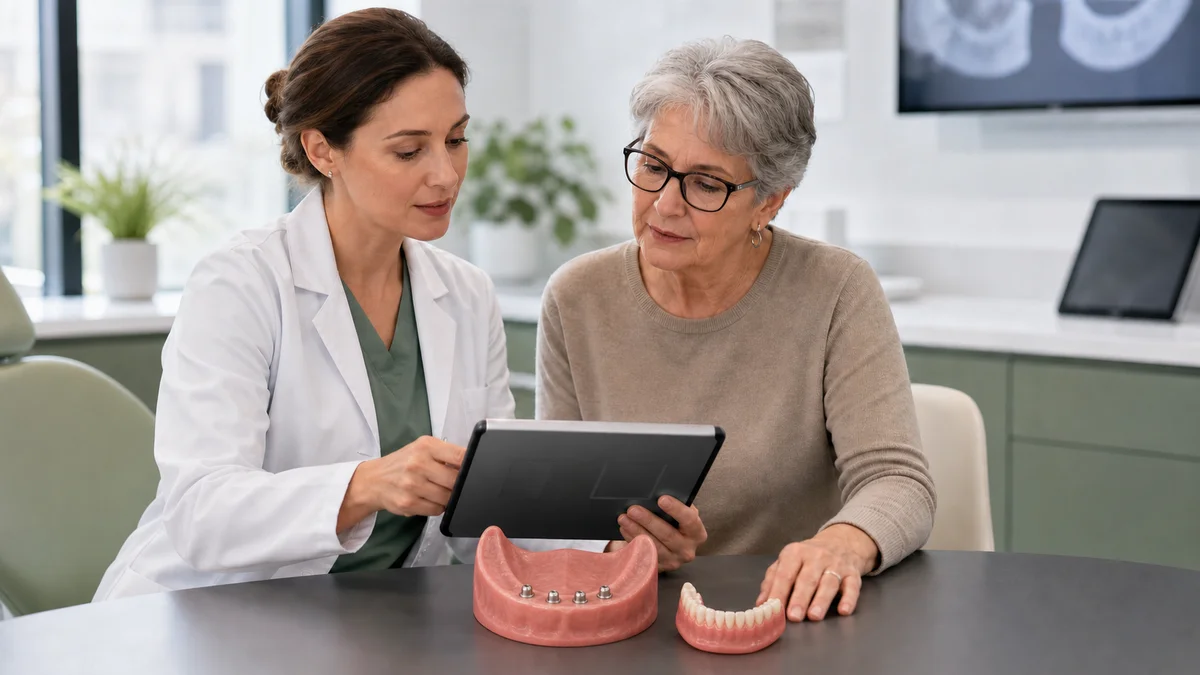
Quick answer: There is no safe universal answer to how much does it cost for mini dental implants. A complete fee depends on the exact device and indication, implant number, imaging, surgery, whether an existing denture can be adapted or a new prosthesis is needed, follow-up and maintenance. “Mini” is not one standard treatment; request the manufacturer, diameter, intended use and an itemised total after clinical and radiographic assessment.
People searching how much does it cost for mini dental implants are often comparing a loose lower denture, a missing tooth and the cost of standard implants. Those are not interchangeable situations. A small-diameter implant used to retain a removable mandibular overdenture has a different mechanical task, component set and evidence base from an implant supporting a single crown. An orthodontic temporary anchorage screw is different again and should not be included in the same price comparison.
“Mini dental implant” is also not a perfectly uniform scientific category. Reviews often define mini implants as less than 3.0 mm in diameter, but manufacturers and regulatory documents may use trade names across other dimensions and designs. Some devices are one-piece; others have separate abutments. Some are cleared for removable denture stabilisation, while another device may have a limited anterior single-tooth indication. The price is meaningful only after the clinician identifies the missing-tooth problem, available bone, restoration, implant system and loading plan.
This guide does not invent a Redent Klinik price, promise that mini implants avoid grafting or claim a personal success percentage. It uses current official device documents, professional patient guidance and systematic reviews to show what a written quote should contain. Suitability requires examination, medical and dental history, appropriate imaging and a discussion of standard-diameter implants, conventional dentures, bridges, grafting where indicated and no treatment.
1. “Mini” describes size, but not one universal treatment
Dental implants are posts surgically placed in jawbone to anchor a replacement tooth or prosthesis. The American Dental Association explains that implant treatment generally includes surgical placement, healing as bone integrates around the implant and fabrication or attachment of the replacement teeth. The sequence can be combined in selected conditions, but a smaller implant does not remove the need for diagnosis, restorative planning or long-term maintenance.
Scientific reviews commonly separate narrow-diameter implants into categories. One frequently used framework calls implants under 3.0 mm “mini implants,” distinguishes 3.0 to 3.25 mm devices and places 3.3 to 3.5 mm devices in another narrow category. A later consensus used slightly different cut-offs. This inconsistency is not merely academic: diameter, implant construction, restoration and site affect what evidence can reasonably be applied.
FDA 510(k) summaries demonstrate the device-specific nature of intended use. A 2.4 mm mini system is described for stabilising removable dentures. A different system with 3.2 and 3.5 mm fixtures is described for limited anterior regions where horizontal space is restricted, subject to stated loading conditions. A clearance document establishes the specific device and intended-use pathway; it does not mean every product called “mini” is suitable for every missing tooth.
2. The intended restoration is the largest cost driver
The first financial question is not “How many screws?” but “What will the implants retain or support?” The prosthesis often accounts for substantial planning, laboratory and maintenance work. Common discussions include:
- Stabilising an existing removable denture: the denture may be adapted with attachment housings if its fit, tooth position, strength and vertical relationship remain acceptable.
- Making a new implant-retained overdenture: the fee may include impressions or scans, bite records, trial stages, the denture, attachment housings and adjustments.
- Replacing a selected small anterior tooth: only a device specifically intended and mechanically suitable for that site should be considered, with a crown and related components.
- Supporting a fixed bridge or full-arch restoration: this is not automatically an appropriate mini-implant indication and requires a separate evidence and load analysis.
- Temporary stabilisation or orthodontic anchorage: these are distinct treatment categories with different devices, goals and removal plans.
An advertisement priced “per implant” can omit the denture, crown, attachment inserts, laboratory conversion, temporary prosthesis or repair of an unsuitable existing denture. Compare the completed treatment pathway, not the implant fixture alone.
3. A decision table for comparing mini implant quotes
| Quote component | What to ask | Why it changes cost | Evidence to request |
|---|---|---|---|
| Diagnosis and records | Are examination, scans, photographs and clinically justified radiographs included? | A consultation price may exclude cross-sectional imaging or restorative records. | A dated list of included records and findings. |
| Device identity | What are the manufacturer, model, diameter, length and one- or two-piece design? | Systems have different indications, components and future availability. | Product label and intended-use documentation. |
| Number and location | How many implants, in which jaw and why? | Surgical time, components, load distribution and prosthesis design change. | A tooth/jaw-specific plan, not a generic package. |
| Surgical procedure | Are local anaesthesia, surgical guide, sterile kit and postoperative reviews included? | Technique and complexity differ with anatomy and primary stability. | Itemised surgical scope and contingency terms. |
| Bone or soft-tissue care | Is grafting expected, genuinely avoidable or only potentially needed? | Mini implants may fit narrow ridges in selected cases but do not guarantee graft-free care. | Anatomical rationale and alternatives. |
| Existing denture conversion | Can the current denture safely receive housings? | Weak, worn or poorly fitting dentures may need repair or replacement. | Denture assessment and conversion laboratory fee. |
| New prosthesis or crown | Which final restoration, materials and trial stages are included? | The visible and functional replacement is a separate custom device. | Laboratory specification, warranty and remake terms. |
| Attachments and inserts | Which housings, matrices or retentive inserts are used? | Wear parts need adjustment and periodic replacement. | Initial quantity and current replacement charges. |
| Immediate loading | Is same-day connection planned, and under what stability and bite conditions? | A same-day plan can require conversion work and may change if stability is insufficient. | Written backup plan without a guaranteed promise. |
| Follow-up and maintenance | How many reviews and hygiene visits are included? | Implants and prostheses need continuing monitoring and professional care. | Recall schedule and fees after the included period. |
| Complications | Who pays for a loose attachment, fracture, failed implant or remake? | Warranty scope and clinical responsibility vary. | Written repair, replacement and exclusion terms. |
| Finance and travel | What is the total payable amount, and are travel or transfer costs likely? | Monthly marketing figures can exclude interest, repeat visits and final prosthetic stages. | Repayment schedule and full treatment timeline. |
A fair comparison marks every line as included, excluded, estimated, optional or triggered only by a defined clinical event. If two quotes use different restorations or implant systems, the totals are not directly comparable even when the implant count is the same.
4. Imaging and planning are not optional sales extras
The clinician must assess bone width, height and shape; distance to nerves, sinuses and adjacent roots; gum condition; bite forces; denture space; and the proposed path of insertion. A panoramic image can provide an overview, while cross-sectional imaging may be indicated when three-dimensional anatomy cannot be safely determined otherwise. Radiation should be justified for the patient and procedure, not ordered by package habit.
Planning may include:
- medical history, medication and healing-risk review;
- assessment of remaining teeth, decay, infection and gum disease;
- evaluation of the current denture, jaw relationship and available restorative space;
- photographs, impressions or digital scans;
- appropriate two- or three-dimensional radiographs;
- implant position, length, diameter and load distribution;
- discussion of immediate versus delayed prosthetic connection;
- a maintenance and contingency plan.
Skipping records can make the headline fee look lower while increasing the chance of an unsuitable position or prosthesis. Conversely, more imaging is not automatically better. Ask why each record is needed and whether its interpretation is included.
5. Existing denture conversion versus a new overdenture
Mini implants are frequently discussed for stabilising a loose lower complete denture. If the denture is relatively recent, structurally sound, appropriately extended and has a satisfactory bite, a laboratory or chairside conversion may place attachment housings into it. The quote should specify whether reinforcement, relining, pickup material and later adjustments are included.
An old denture may be worn, thin, cracked, poorly fitting or arranged in a way that leaves inadequate room over the attachments. Converting it can weaken the base or preserve an already poor bite. A new overdenture then adds impressions or scans, jaw records, tooth setup trials, processing, attachment incorporation and post-delivery adjustments. This can cost more initially but may be the safer restorative route.
Ask the clinician to separate:
- implant surgery;
- temporary soft lining or healing modifications;
- conversion of the current denture;
- a reline, rebase or repair;
- a completely new overdenture;
- attachment housings and retentive inserts;
- future insert replacement and denture maintenance.
A low implant-only figure says little about what the patient will actually wear, chew with and clean.
6. Implant number is a clinical decision, not a shopping quantity
More implants create more surgical and component costs, but the number cannot be chosen solely to fit a budget. Jaw anatomy, bone quality, prosthesis design, implant dimensions, distribution and loading determine what is reasonable. A system’s labelling may specify or imply use of multiple implants for denture stabilisation, and immediate function may depend on adequate primary stability.
Placing too few or poorly distributed implants may concentrate forces, allow rocking or overload a narrow component. Adding implants without restorative space or hygiene access can also create problems. The clinician should explain why the proposed number is appropriate for the exact system and denture, and what the backup plan is if one site cannot be used at surgery.
A quote should state whether an additional implant, abandoned site or change in prosthetic design changes the fee. Consent should distinguish a foreseeable alternative plan from a surprise charge presented while the patient is committed.
7. Mini implants may reduce some surgery, but do not guarantee no graft
A smaller diameter can be useful where horizontal bone width or tooth space is limited. Some mini systems use a one-piece design and can be placed through a less extensive flap in selected anatomy. These features may reduce surgical steps, but “minimally invasive” does not mean risk-free, painless, flapless in every case or suitable without imaging.
Mini implants do not create bone where height, quality or safe anatomical distance is inadequate. A narrow ridge may still have an unfavourable contour, sharp crest, insufficient keratinised tissue or proximity to a nerve. A clinician may recommend ridge modification, another implant position, standard implants with augmentation, a conventional denture or no surgery.
Do not accept “no bone graft ever” as a universal promise. Ask whether the proposed mini implant is selected because it is best for the restoration and evidence, or only because it can fit available bone. Avoiding grafting may reduce cost and morbidity in an appropriate case; using an undersized implant for an unsupported indication can create a larger downstream cost.
8. Immediate loading can change the treatment day and quote
Some mini implant systems allow immediate function when good primary stability and appropriate loading conditions are achieved. That wording is conditional. Bone density, insertion stability, implant distribution, denture fit, bite and patient habits affect whether the prosthesis can be connected on the day of surgery.
An immediate-load quote may include denture conversion, attachment pickup and additional chair time on the surgical day. If stability is lower than expected, the safer plan may be a soft liner, delayed connection or another temporary arrangement. The financial terms should explain that backup pathway before treatment begins.
“Teeth in a day” language can be misleading when the treatment is actually a removable denture stabilised by implants. The patient should understand whether the restoration is removable, who removes it for cleaning, when it is first loaded and what diet or review instructions apply. Same-day function is not a guarantee of long-term integration.
9. What current evidence can and cannot tell you
A 2024 systematic review and meta-analysis of randomised trials examined mini implants under 3 mm and standard-diameter implants for retaining mandibular complete overdentures. The focused question concerned mechanical stability in that specific use. Another 2023 systematic review found no significant difference in implant survival or marginal bone loss between narrow- and regular-diameter implants for mandibular overdentures across its included studies, while patient-reported outcomes favoured the narrow group. These findings do not establish that every mini system equals every standard implant in every jaw or restoration.
A broader 2018 meta-analysis classified implants by diameter and reported lower survival for the smallest category compared with standard-diameter implants, while larger narrow categories did not show the same statistical difference. The authors highlighted high risk of bias and missing resilient long-term data for some complications. Earlier evidence likewise documented sub-3.0 mm devices mainly in edentulous arches and non-load-bearing anterior regions, not as universal posterior fixed replacements.
For posterior fixed restorations, newer reviews often study “narrow-diameter” implants with definitions extending up to 3.75 mm. Those results must not be silently transferred to a one-piece 2.4 mm mini implant retaining a denture. Whenever a success rate appears in marketing, ask:
- What exact diameter and design were studied?
- Was the restoration removable or fixed?
- Which jaw and region were treated?
- How many implants supported each prosthesis?
- What counted as survival, success and complication?
- How long was follow-up, and how many patients remained?
- Was the study randomised, prospective or a case series?
Study survival is not a personal guarantee and does not mean freedom from attachment wear, denture fracture, gum inflammation or maintenance.
10. Device clearance and intended use matter
Regulatory documents are useful because they identify a specific product, dimensions, materials and intended use. They should be read at the product level. The FDA summary for one 2.4 mm mini implant describes removable denture stabilisation. Another recent mini-named system includes 3.2 and 3.5 mm fixtures and limited anterior placement where horizontal space is restricted. The shared word “mini” does not make those devices clinically identical.
Ask the clinic for:
- manufacturer and product name;
- implant diameter and length proposed for each site;
- one-piece or two-piece construction;
- the intended restoration and whether it matches device labelling;
- component availability for repairs and future prostheses;
- implant lot and traceability records after placement;
- applicable national regulatory status in the country of treatment.
FDA clearance in the United States is not a worldwide licence, a superiority award or a guarantee of outcome. Other countries have their own device rules. A branded system may have useful documentation and components, but clinician training, diagnosis and maintenance remain essential.
11. Medical, gum and habit risks affect suitability and cost
The ADA notes that general health can matter more than age for implant candidacy. Diabetes and other chronic conditions may interfere with healing, and tobacco use can slow it. Medication, previous radiotherapy, immune status, bleeding risk and history of implant failure may alter preparation, timing or whether surgery is advisable. Medical consultation can add time or cost when clinically needed.
Active gum disease and poor plaque control should be addressed. The American Academy of Periodontology explains that bacterial inflammation can affect soft tissue around implants and progress to bone loss. Previous periodontitis, smoking, diabetes and inadequate plaque control are recognised risk factors. Mini implants are not immune because they are smaller.
Clenching, grinding, very strong bite forces and chewing habits can increase technical load on narrow components and dentures. The plan may need bite adjustment, a different prosthesis, more cautious loading or another treatment. A protective appliance is not automatically appropriate over every overdenture and cannot guarantee against fracture. Individual risk should be explained rather than hidden in a warranty exclusion.
12. Maintenance creates a lifetime cost beyond surgery
Implants need brushing, cleaning around attachments and regular professional review. Overdenture housings contain retentive elements that wear and may become loose. These inserts can require replacement. The denture base and teeth also wear, and jaw ridges continue to change with time, which can lead to relining, rebasing, repair or a new denture.
Long-term budget items can include:
- professional implant and gum reviews;
- hygiene care and individual cleaning aids;
- replacement of attachment inserts or housings;
- denture adjustments for sore areas;
- reline, rebase, fracture repair or tooth replacement;
- radiographs when clinically indicated;
- management of peri-implant mucositis or peri-implantitis;
- prosthesis remake after wear or anatomical change;
- treatment if an implant loosens, fractures or fails.
Ask which maintenance visits are included in the first year and what fees apply later. A “lifetime warranty” may cover only a device defect, not gum disease, trauma, worn denture teeth, attachment inserts, professional time or failure to attend reviews. Read conditions and exclusions before treating warranty language as financial protection.
13. Insurance and finance should be checked separately
Dental benefit plans vary by country, policy, missing-tooth clause, annual maximum, waiting period and medical-necessity rule. Coverage may classify implant surgery, attachment components and the denture as separate benefits. A plan may cover a conventional denture while excluding implants, or pay a limited allowance without covering the balance.
Request procedure codes and a pre-treatment estimate where available, but understand that pre-authorisation is not always a guarantee. Confirm whether overseas treatment, cross-border invoices or a non-network provider are eligible. If insurance changes during a staged case, future payments may change.
For finance, compare the cash price and total payable amount. Check deposit, interest, fees, number of payments, late terms, early settlement, cancellation and what happens if the surgical or prosthetic plan changes. A low monthly payment does not show the total clinical cost. Credit consent and surgical consent are separate.
14. Travel can alter the apparent saving
For treatment in another city or country, include flights or ground transport, accommodation, time away from work, companion expenses and repeat visits. Same-day denture connection does not end follow-up. Tissue healing, attachment wear, denture adjustment and hygiene still require review.
Before travelling, clarify:
- which visits must be in person and approximate timing;
- how long to remain locally after surgery;
- who handles pain, swelling, a loose implant or denture fracture at home;
- whether a local dentist can obtain compatible components;
- how records and implant traceability details will be released;
- who pays for travel if corrective care is required;
- currency, quote-validity and refund terms.
A lower clinic invoice may still be good value, but only the full care pathway can show that. Emergency access and component availability matter more than a tourism package.
15. Alternatives belong in a fair cost discussion
A patient should not be led to believe that mini implants are the only affordable option. Depending on diagnosis, alternatives may include relining or replacing a conventional denture, adhesive or tooth-supported bridges, standard-diameter implants, narrow two-piece implants, grafting, an implant overdenture with another system, a fixed restoration, or no treatment. Each has different surgery, maintenance, longevity and biological cost.
For a loose lower denture, improving extension, bite and fit may help even without implants. For a single missing tooth, an adhesive bridge may avoid surgery in selected situations; a conventional bridge uses adjacent teeth; a standard implant may offer a broader restorative platform if bone and space allow. No option is universally cheapest over a lifetime.
Ask for at least two reasonable plans when they exist, each with:
- clinical goal and limitations;
- surgical and prosthetic stages;
- expected maintenance;
- effect on remaining teeth and tissues;
- likely total fee and foreseeable conditional costs;
- what happens if the first plan cannot be completed.
16. Red flags in a mini implant price advertisement
Pause when a price is offered without identifying the restoration or implant system. “Four mini implants” is not a complete treatment description. A safe plan should explain device indication, anatomy, prosthesis and follow-up.
Other warning signs include:
- guaranteed graft-free, painless or lifetime treatment;
- one success percentage applied to every diameter and restoration;
- no medical, gum or radiographic assessment;
- posterior fixed use justified only by evidence on overdentures;
- immediate loading promised regardless of primary stability;
- an existing denture assumed suitable without examination;
- no named licensed clinician responsible for surgery and restoration;
- missing manufacturer, lot traceability or component information;
- implant-only pricing that excludes the final denture or crown;
- pressure to pay before alternatives and written terms are explained.
17. A complete budget checklist
- Write down the diagnosis and whether the goal is denture retention or tooth replacement.
- Record the implant manufacturer, model, diameter, length and intended use.
- Confirm implant number and planned positions.
- List examination, scans, photographs and radiographs.
- Identify gum, decay, extraction or medical preparation.
- Separate local anaesthesia, guide, surgery and postoperative reviews.
- State the immediate- or delayed-loading plan and backup pathway.
- Assess whether the existing denture can be converted.
- Price a new denture, crown or other final restoration where needed.
- Include housings, inserts and initial adjustments.
- Write down repair, replacement and warranty exclusions.
- Add long-term maintenance and likely prosthesis replacement.
- Verify insurance directly and compare the financed total.
- Add travel, accommodation and transfer risk.
- Keep a contingency for a clinically justified change without treating it as a guaranteed charge.
A transparent clinic will explain which costs are certain now and which depend on findings during treatment. It should update the estimate before non-urgent additional work and provide implant identification records after placement.
how much does it cost for mini dental implants: frequently asked questions
Are mini dental implants always cheaper than standard implants?
No. They may involve fewer surgical steps or avoid augmentation in selected cases, but the final cost includes imaging, implant number, prosthesis, attachments and maintenance. A mini-implant overdenture and a standard single crown are different treatments, so per-implant prices are misleading.
How many mini implants are needed for a lower denture?
There is no safe universal number. The device system, jaw anatomy, implant dimensions, distribution, bone quality, denture design and loading plan matter. The clinician should justify the number using the specific product’s indication and a restorative plan.
Can mini implants be used for one missing tooth?
Some narrow or mini-named systems have specific anterior single-tooth indications, while other true mini systems are intended for removable denture stabilisation. Device name alone is insufficient. Site, space, load, restoration and regulatory labelling must all match.
Do mini dental implants avoid bone grafting?
They can fit selected narrow ridges and may reduce the need for augmentation in some patients. They cannot correct inadequate height, unsafe anatomy, poor bone quality or every ridge shape. No-graft treatment should be a diagnosis-based option, not a guarantee.
Can the denture be attached on the same day?
Some systems allow immediate function when good primary stability and appropriate loading are achieved. If those conditions are not met, delayed connection may be safer. The quote and consent should include the backup prosthetic plan.
Is an existing denture always reusable?
No. It must have adequate fit, strength, space, tooth position and bite. A worn, thin or poorly fitting denture may need a reline, reinforcement, repair or complete replacement. Ask for that assessment before comparing prices.
Does insurance cover mini dental implants?
Coverage varies. Surgery, attachments and the denture may be classified separately, and implants may be excluded even when conventional dentures are covered. Obtain codes and verify benefits, annual limits, overseas rules and pre-authorisation directly with the insurer.
What maintenance costs should I expect?
Budget for implant reviews, hygiene, replacement retentive inserts, denture adjustments, relines, repairs and eventual prosthesis replacement. Gum inflammation or implant complications may require additional treatment. Ask for current fees and which first-year visits are included.
Are mini implants as successful as standard implants?
Evidence depends on diameter, design, site and restoration. Reviews of mandibular overdentures can show competitive outcomes for selected narrow implants, while broader analyses have found lower survival in the smallest category. No pooled result guarantees an individual’s outcome.
When should I seek a second opinion?
Consider one when the device and restoration are not identified, graft-free or lifetime success is guaranteed, no imaging or gum assessment is planned, a posterior fixed restoration is proposed from overdenture evidence, or the quote excludes the final prosthesis and maintenance.
Conclusion: price the implant, prosthesis and maintenance together
The responsible answer to how much does it cost for mini dental implants begins with a definition. Which device, diameter, jaw, site and intended restoration are being proposed? A removable denture stabilised by several one-piece mini implants is not equivalent to an anterior crown on a narrow two-piece implant, even if both advertisements use “mini.”
After assessment, compare the complete pathway: records, surgery, implant components, existing-denture conversion or new prosthesis, reviews, attachment wear, repair and long-term maintenance. Add finance and travel where relevant. Check device intended use and keep traceability records. Most importantly, compare reasonable alternatives and do not let an implant-only headline price decide a surgical treatment.
Learn about the clinic and treatment approach on the Redent Klinik English website. To request an individual evaluation and dated written scope, use the Redent Klinik contact page. An online article cannot determine bone anatomy, device suitability, implant number or personal cost.
Sources
- US FDA 510(k) summary: 2.4 mm mini implants intended for removable denture stabilisation
- US FDA 510(k) summary: mini-named narrow implant system and limited anterior indications
- PubMed: 2024 systematic review and meta-analysis of mini and standard implants for mandibular overdenture retention
- PubMed: narrow- versus regular-diameter implants for mandibular overdentures
- PubMed: systematic review and meta-analysis of narrow-diameter implant categories
- PubMed: indications and evidence limits for narrow and mini implants
- American Dental Association MouthHealthy: dental implant stages and health considerations
- American Academy of Periodontology: peri-implant disease and maintenance
- American Dental Association official website
- World Health Organization: oral health fact sheet
Sources and device documents were checked in July 2026. Product indications, components, prices and clinical evidence can change; use current device labelling and individual assessment.