
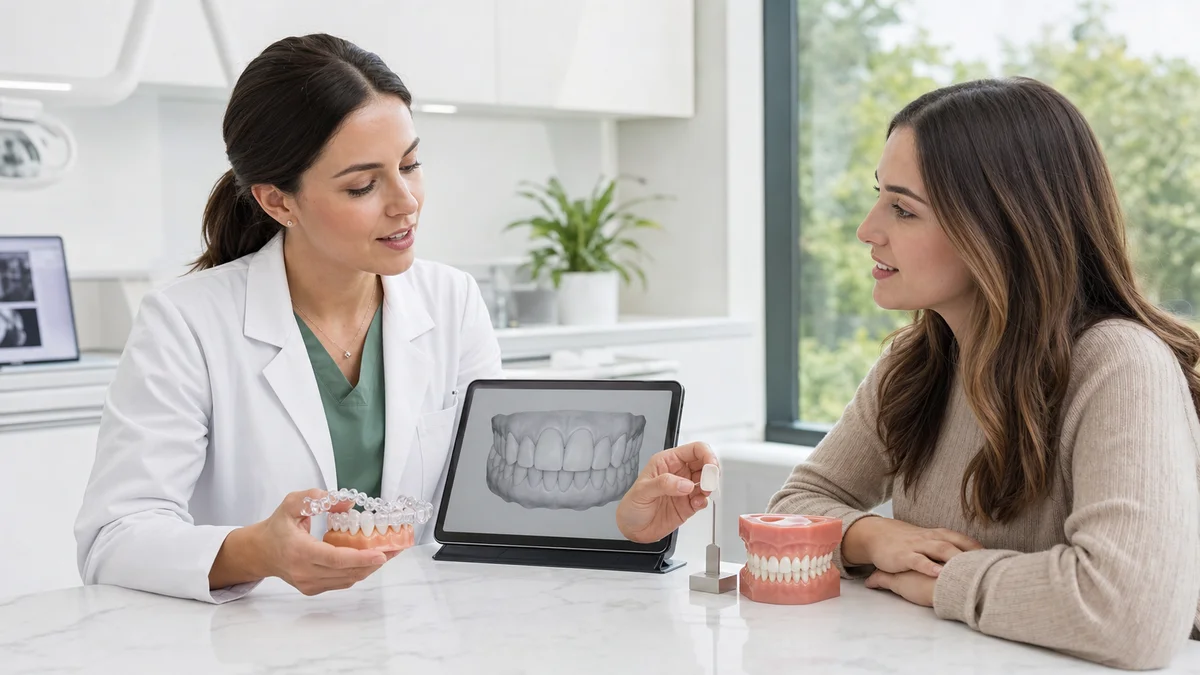
Short answer: Clear aligners move natural teeth and can improve spacing, crowding and some bite problems; veneers cover the front surface to change colour, shape or limited visual irregularities. Aligners preserve enamel but require wear time and lifelong retention. Veneers can be faster but usually involve irreversible enamel removal and future maintenance. Choose by diagnosis, not speed: healthy, movable teeth generally deserve an orthodontic assessment before irreversible masking.
The search clear aligners or veneers which is better places two very different treatments in the same contest. Aligners apply planned forces to reposition teeth within bone. Veneers are thin restorations bonded to the visible tooth surface. They can alter appearance, but they do not move roots into a healthier position or correct every bite discrepancy.
A person with crowding may need orthodontic movement. A person with well-positioned teeth but a fractured edge, resistant discolouration or shape discrepancy may be considering a restorative solution. Some people benefit from a staged combination: align first, then whiten or use minimal additive bonding, and reserve veneers for defects that remain. The most conservative route is the one that meets the goal while removing the least healthy tissue.
This guide offers a structured comparison, not a personal recommendation. Gum health, decay, root condition, enamel thickness, bite, jaw relationship, habits and expectations must be assessed before treatment.
Clear Aligners or Veneers Which Is Better: Start With the Problem
For clear aligners or veneers which is better, the first question is not “Which looks faster?” It is “Is the concern mainly position, surface, colour, shape or a combination?” A photograph of the front teeth cannot show root health, bone support or how the back teeth meet. An in-person examination and appropriate records help separate these causes.
- Crowding or rotation: usually requires tooth movement if the goal is to change position.
- Spacing: may be managed orthodontically, restoratively or with a planned combination depending on tooth proportions and cause.
- Bite problem: needs an orthodontic and functional assessment; veneers cannot reposition roots or jaws.
- Localised chip or small shape defect: polishing, composite bonding or a veneer may be considered.
- Colour concern: professional whitening may be more conservative when teeth are otherwise healthy.
- Worn or heavily restored teeth: requires diagnosis of the cause before cosmetic coverage.
Choosing veneers to make crowded teeth appear straight can require uneven tooth reduction. Choosing aligners to solve a colour or shape defect may move teeth without addressing the actual concern. The diagnosis should select the tool.
How Clear Aligners Work
In the comparison clear aligners or veneers which is better, aligners are the orthodontic option. A sequence of custom trays applies controlled forces to guide teeth toward planned positions. Tooth-coloured attachments, elastic wear or other auxiliaries may be required. The trays are removable, but treatment depends on wearing them for the prescribed time and sequence.
Aligners can treat many mild and moderate alignment problems, and selected more complex problems under appropriate supervision. They are not suitable for every movement or every jaw relationship. Fixed braces or a combined plan may offer more predictable control in some situations. The appliance should not be chosen before the bite and roots are assessed.
Moving a tooth means remodelling the supporting bone and ligament; it is not simply pushing the visible crown. The American Association of Orthodontists emphasises that in-person examination and radiographs can reveal root, bone and unerupted-tooth conditions that photographs and surface scans cannot show.
How Veneers Work
For clear aligners or veneers which is better, veneers are the restorative option. A ceramic or composite layer is bonded to the front and sometimes part of the side or biting edge of a tooth. It can modify visible colour, contour, length, symmetry and selected minor discrepancies.
Ceramic veneers commonly require enamel preparation so the final tooth does not look bulky and the margin can be controlled. The American Dental Association notes that treatment is not reversible when enamel is removed. “Minimal-prep” and “no-prep” are not guarantees that every tooth will remain untouched; tooth position, volume and desired result determine preparation.
Composite veneers or additive bonding may require less enamel removal and can be repaired more directly, but they have different wear, stain and maintenance characteristics. Neither material should be placed over untreated decay or active gum disease. A veneer can chip, debond, wear or need replacement, and the underlying tooth can still develop decay.
The Enamel Question: Reversible Versus Irreversible
The most important difference in clear aligners or veneers which is better is biological cost. Aligners do not normally require broad removal of the front enamel surface, although small attachments may be bonded and limited interproximal enamel reduction may be prescribed in selected cases. These steps should be explained and documented.
Veneers may require permanent enamel removal. Once prepared, the tooth will generally need an ongoing restoration. Future replacements can involve additional work, especially if margins, gum levels or the bite change. This does not make veneers inherently wrong; it means the benefit must justify the irreversible step.
When healthy but crowded teeth can be moved into better positions, orthodontics may reduce or avoid restorative reduction. When alignment is already acceptable and the main issue is a structural surface defect, a conservative restoration may be the direct solution. Ask the clinician to show, tooth by tooth, how much tissue is expected to be removed.
Decision Table: Match the Treatment to the Clinical Goal
This table turns clear aligners or veneers which is better into a diagnosis-led comparison. It is a starting point rather than a prescription.
| Decision area | Clear aligners | Veneers |
|---|---|---|
| Main action | Move teeth and influence alignment or selected bite relationships | Cover the visible surface and alter colour or shape |
| Root position | Can change under planned orthodontic movement | Does not move the root |
| Enamel | Usually preserved; selected interproximal reduction may be planned | Often permanently reduced for ceramic placement |
| Time pattern | Active movement over time, followed by retention | Usually fewer active appointments, followed by restorative maintenance |
| Patient role | Consistent tray wear, hygiene and appointments | Careful use, hygiene, bite protection where indicated |
| Common limitations | Not every movement or skeletal problem suits aligners | Cannot correct root position or major bite problems |
| Long-term need | Retainers and monitoring for relapse | Repair or replacement if wear, fracture or margin change occurs |
| Typical insurance status | Depends on orthodontic benefit and plan | Often considered cosmetic unless medically justified |
Can Veneers Fix Crooked Teeth?
People asking clear aligners or veneers which is better often want a fast correction for rotated front teeth. Veneers can create the appearance of a straighter outline in limited cases, but the roots and bite remain where they were. A tooth projecting outward may need substantial reduction to fit within the desired contour, increasing biological cost.
Masking may be reasonable only after the bite, tooth position and enamel have been assessed and the patient understands alternatives. It is not equivalent to orthodontic correction. If crowding makes cleaning difficult or creates harmful contacts, changing only the visible surface may fail to address function.
Ask for a wax-up or digital preview, but remember that a simulation cannot show exactly how much enamel will be removed or guarantee gum response. A mock-up can help evaluate shape and speech before irreversible preparation.
Can Aligners Fix Colour, Chips or Tooth Proportions?
In clear aligners or veneers which is better, aligners do not whiten teeth, replace missing enamel or rebuild a fractured edge. They may improve symmetry by moving teeth into positions where conservative whitening or bonding can work better. This can reduce the number or thickness of restorations needed.
If the concern is only colour, supervised whitening may be considered before veneers. Existing fillings, crowns and veneers do not whiten like natural teeth, so sequencing matters. If a small lateral incisor is disproportionately narrow, orthodontics can distribute space first, followed by additive bonding or a limited veneer.
A combined plan should be agreed before orthodontics begins. The final tooth positions, spaces, gum contours and restoration dimensions affect one another. Separate providers need shared records and a clear handover.
Oral Health Checks Before Either Treatment
No responsible answer to clear aligners or veneers which is better begins with a tray scan or shade selection alone. Decay, gum inflammation, active periodontitis, enamel defects, root problems and jaw symptoms need attention first. Moving teeth with poor periodontal support can worsen mobility or recession; placing veneers over disease can conceal and aggravate problems.
- Complete dental and medical history
- Clinical examination of teeth, gums, bite and jaw function
- Periodontal measurements where indicated
- Radiographs based on clinical need
- Photographs and digital scans for records and planning
- Assessment of clenching, grinding and deep bite
- Discussion of expectations, alternatives and no-treatment option
Severe grinding or a deep overbite can increase veneer risk. Aligners may be part of bite management in some cases, but they are not a universal treatment for jaw pain or bruxism.
Time, Convenience and Daily Commitment
When comparing clear aligners or veneers which is better, “fast” has different meanings. Veneers may change visible appearance over fewer appointments, but planning, preparation, temporaries, laboratory work and reviews still take time. Rushing can compromise tissue assessment and consent.
Aligner treatment progresses through a series of trays and monitored stages. The FDA explains that trays are worn according to a personalised plan and that retention follows active treatment. Wear time, missed trays, broken attachments and biological response can change the timeline. A predicted completion date is an estimate, not a guarantee.
Aligners are removed for eating and cleaning, which can support hygiene, but this convenience requires discipline. Veneers are fixed, but they do not eliminate the need for careful brushing, interdental cleaning and review. Choose the commitment you can realistically maintain.
Risks and Side Effects Compared
A balanced response to clear aligners or veneers which is better explains both risk profiles. With aligners, temporary pressure and soreness are common. Potential concerns include gum irritation, decay or demineralisation with poor hygiene, unwanted movement, bite changes, root shortening, gum recession and relapse. Supervision allows the plan to be adjusted when tracking or biology differs from the simulation.
With veneers, potential concerns include sensitivity, pulp irritation, gum inflammation, margin staining, recurrent decay, chipping, fracture, debonding and the need for repair or replacement. If too much enamel is removed, bonding conditions and tooth health can be affected. Aggressive reduction cannot be undone.
Neither route guarantees a particular celebrity smile or lifetime result. Natural ageing, gum changes, wear and tooth movement continue. Written consent should distinguish predictable goals from uncertainties.
Retention Versus Restorative Replacement
The long-term answer to clear aligners or veneers which is better includes what happens after the active phase. Orthodontically moved teeth tend to shift over time. The AAO advises retention because bone and soft tissues remodel and teeth continue to move. Retainer type and wear schedule are individual, but some form of long-term retention is usually expected.
Veneers do not require orthodontic retainers unless teeth have also been moved, but they are not maintenance-free. Their margins, bite and surrounding gums need monitoring. A damaged veneer may be repaired or replaced depending on material and extent. Replacement can become more complex if additional tooth structure is lost.
Ask for the cost and schedule of replacement retainers, refinement trays, veneer repairs, night guards and future replacement. The initial quote is not the entire lifetime cost.
Cost and Insurance: Compare Complete Pathways
For clear aligners or veneers which is better, a per-tray or per-tooth price is not enough. An aligner quote should explain records, attachments, interproximal reduction, refinements, retainers and follow-up. A veneer quote should state preparation, provisional restorations, material, laboratory, bonding, adjustments and review.
- How many arches or teeth are included?
- Are diagnostic records and necessary radiographs included?
- How many refinement rounds or replacement trays are covered?
- How many retainers and future replacements are included?
- Does the veneer fee include temporaries and a diagnostic mock-up?
- What happens financially if the plan changes after examination?
- Which repairs or reviews are included, and for how long?
Insurance treatment varies by country and policy. Veneers are often treated as cosmetic; orthodontic benefits may have age limits, waiting periods or lifetime caps. Obtain a written estimate from the provider and insurer instead of relying on a percentage stated by phone.
Combining Aligners and Veneers Conservatively
Sometimes the best response to clear aligners or veneers which is better is a carefully sequenced combination, not either/or. Aligners can correct position and distribute space. Whitening can then establish the natural tooth shade. Composite bonding or minimal veneers can address residual shape or structural differences.
A conservative sequence might be:
- Treat decay and gum disease.
- Plan final tooth positions and restoration dimensions together.
- Complete supervised orthodontic movement.
- Provide and stabilise retention.
- Whiten natural teeth if desired and appropriate.
- Allow shade to stabilise according to clinical guidance.
- Add limited bonding or veneers only where still necessary.
- Design retainers around the final restorations.
This sequence can take longer than instant masking, but may preserve more enamel and produce a more stable restorative design. It is not mandatory for every patient; it is one framework to discuss.
Direct-to-Consumer Aligners and Unlicensed “Veneer Technicians”
Safety matters when searching clear aligners or veneers which is better online. A surface scan cannot assess everything below the gum line. The AAO states that in-person examination and radiographs are important for detecting root and bone problems and monitoring tooth movement.
The ADA warns against veneer services from unlicensed individuals because untreated disease, infection and nerve damage can be missed or caused. A cosmetic label does not make tooth preparation a non-medical procedure. Only appropriately licensed clinicians should diagnose, prepare and bond restorations.
- Be cautious of treatment approved from selfies alone.
- Do not accept filing or bonding by an unlicensed provider.
- Reject guarantees of zero enamel removal without tooth-by-tooth assessment.
- Ask who monitors aligner movement and handles complications.
- Ask what happens if the trays do not track or the bite worsens.
- Do not let a same-day discount rush irreversible preparation.
Planning Treatment in Turkey
International patients comparing clear aligners or veneers which is better should add continuity of care to the decision. Aligners require monitoring, possible refinements and retention. Veneers require accurate diagnostics, laboratory communication, bonding, bite checks and a plan for repairs after travel.
You can review the clinical approach on the Redent Klinik English website and send records or questions through the English contact page. A remote review can identify questions and possible pathways, but the final plan requires an in-person examination and appropriate imaging.
Before travel, clarify the number of visits, length of stay, temporary restorations, aligner shipping, refinement policy, retainer delivery and emergency contact. Ask for copies of scans, radiographs, treatment notes, materials and retention instructions for your home dentist.
Frequently Asked Questions
Clear aligners or veneers which is better for crooked teeth?
Aligners address tooth position and can improve selected bite relationships, so they are generally the relevant category for healthy but crooked teeth. Veneers can mask limited visual irregularity without moving roots and may require enamel removal. An orthodontic assessment should precede irreversible masking.
Are veneers faster than clear aligners?
Veneers can change visible shape and colour in fewer active appointments, but faster does not mean more conservative or better suited. Aligners take time because teeth and supporting tissues move biologically. The right timeframe follows the diagnosis and safety requirements.
Can clear aligners whiten teeth?
No. Aligners move teeth; they do not chemically change tooth colour. Whitening may be planned separately under dental supervision. Existing restorations will not whiten like natural enamel, so the order of treatments matters.
Do veneers straighten the bite?
Veneers can alter the visible contour and selected contacts but do not move roots or correct a skeletal jaw discrepancy. Using them to mask significant crowding or bite problems can require aggressive preparation and may not address function.
Are no-prep veneers fully reversible?
Not automatically. Some additive cases may need little or no enamel reduction, while others require contouring to avoid bulk or manage margins. The term is a technique description, not a guarantee. Ask for a tooth-by-tooth preparation plan.
Will I need retainers after clear aligners?
Yes, retention is a standard part of orthodontic care because teeth can move after treatment. Your clinician determines removable or fixed retention and the wear schedule. Lost, broken or poorly fitting retainers should be assessed promptly.
Can I get aligners first and veneers later?
Yes, when both position and shape need treatment, orthodontics can be planned first to reduce restorative work. The restorative dentist and orthodontic clinician should agree on final spaces and contours before movement starts, and retainers must fit the completed restorations.
Which option lasts longer?
Neither has a universal lifetime. Aligner results depend on retention, periodontal health and ongoing changes. Veneers depend on enamel, bonding, bite, habits, hygiene and material. Retainers, repairs or replacements may be needed, so compare long-term maintenance rather than a single durability claim.
Final Checklist Before You Decide
The most useful conclusion to clear aligners or veneers which is better is a checklist:
- Define whether the concern is position, bite, colour, shape or damage.
- Treat decay and gum disease first.
- Review roots and bone with appropriate records.
- Ask whether orthodontics can avoid enamel removal.
- Request the amount of planned preparation for every veneer.
- Understand aligner wear, refinements and lifelong retention.
- Compare complete costs, including future maintenance.
- Seek a second opinion before extensive irreversible work.
Clear aligners are generally the logical route when healthy teeth need movement. Veneers are a restorative option when position is acceptable but colour, shape or structural surface concerns remain. A combined sequence can be appropriate when it reduces the number or thickness of restorations.
Use clear aligners or veneers which is better as a prompt for diagnosis and tissue preservation, not as a vote for the quickest cosmetic change.
This evidence-informed patient guide is prepared for clinical review by Dentist Esma Çevrük Çakır. It does not replace an examination, personalised diagnosis, orthodontic plan, restorative consent or insurance decision.
Authoritative Sources
- American Dental Association, MouthHealthy: Veneers – enamel removal, irreversibility, oral health checks, risks and maintenance.
- American Association of Orthodontists: Orthodontic FAQs – aligner indications, incremental movement and attachments.
- American Association of Orthodontists: Retainers after orthodontics – tissue remodelling, relapse and retention.
- American Association of Orthodontists: Adult treatment questions – in-person assessment, radiographs and periodontal safety.
- US Food and Drug Administration: Braces and clear aligners – how aligners move teeth, wear and retainer guidance.
- American Dental Association – professional and patient oral-health guidance.
- World Health Organization: Oral health fact sheet – prevention and global oral-health context.
Disclosure: this page may contain affiliate links. We may earn a commission if you use them, at no extra cost to you.