
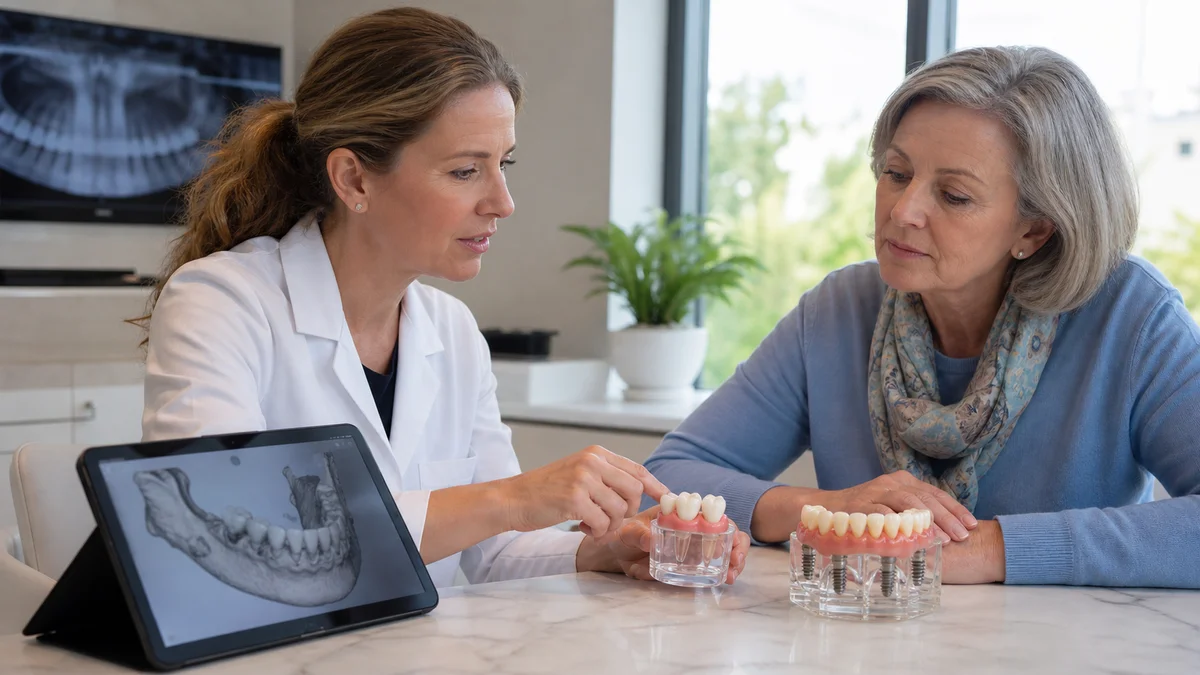
Short answer: For all on 4 dental implants or dental crowns which is better, preserve restorable natural teeth when prognosis and maintenance are reasonable. Crowns repair selected damaged teeth; a four-implant full-arch prosthesis replaces an entire failing or missing arch after extractions. Full-arch implants are not an upgrade for healthy teeth. The decision requires tooth-by-tooth prognosis, gum assessment, imaging, alternatives and long-term maintenance planning.
A crown and a four-implant full-arch restoration belong to very different levels of treatment. A crown covers one natural tooth that remains in the mouth. A full-arch implant concept replaces all teeth in an upper or lower arch with one prosthesis supported by implants, often four in a commonly marketed design. Comparing them as interchangeable cosmetic packages can place restorable teeth at unnecessary risk.
The search all on 4 dental implants or dental crowns which is better should therefore begin with a more important question: which teeth can predictably be kept, and what is the prognosis of the arch as a whole? A person with two broken but restorable teeth is not the same as a person with severe generalized decay, advanced periodontal destruction, repeated prosthetic failure or an already toothless arch.
This guide explains a structured decision. It does not diagnose teeth, recommend extraction from photographs, promise immediate fixed teeth or guarantee an implant outcome. Clinical examination, appropriate imaging and informed consent are essential.
All on 4 Dental Implants or Dental Crowns Which Is Better Starts With Prognosis
Tooth prognosis considers decay, cracks, remaining structure, root condition, bone support, gum attachment, mobility, previous treatment, bite force, hygiene and the patient’s health. Each tooth should be assessed, not grouped into “bad teeth” because the smile looks uneven.
A crown can be appropriate when enough tooth and root support remain after disease is controlled. Root canal treatment, a core or periodontal care may be needed in selected cases. A crown does not cure active gum disease or make a hopeless root healthy.
A full-arch implant restoration becomes relevant when teeth are absent or the remaining teeth have a poor collective prognosis that cannot reasonably support a maintainable result. Extracting teeth is irreversible. The clinician should document why each planned extraction is necessary and which alternatives were considered.
- Ask for a tooth-by-tooth written prognosis.
- Separate active disease from appearance concerns.
- Ask which teeth could be preserved with reasonable care.
- Ask how uncertain teeth affect the whole plan.
- Seek a second opinion before removing multiple restorable teeth.
What Dental Crowns Can Do
A crown is a custom restoration that covers the visible part of a prepared tooth. The ADA notes that a crown may strengthen a tooth with a large filling, protect a weak tooth from fracture, restore a broken tooth, support a bridge or cover an implant.
Crowns can restore shape, contact, bite and appearance. They rely on the remaining tooth or, in an implant crown, on the implant and connecting components. Natural-tooth crowns preserve the root and periodontal ligament, which provide sensation and biological connection to the jaw.
Preparation removes tooth structure and is irreversible. The margin can develop decay or gum inflammation. Ceramic can chip, cement can fail and the underlying tooth can crack. NIDCR explains that crowns do not last a lifetime and may need replacement.
Crowns are not a sensible answer for teeth with untreatable fracture, inadequate support or uncontrolled disease. They are also not a complete full-arch plan simply because several teeth receive crowns. Occlusion, gum health and cleansability must work together.
What a Four-Implant Full-Arch Concept Can Do
A dental implant is a post placed surgically in jawbone to support replacement teeth. In a full-arch concept, several implants support a prosthesis that replaces the visible teeth and often part of the missing gum volume. “All-on-4” is a commercialized name commonly used for a full arch supported by four strategically placed implants; other designs and implant numbers may be more appropriate.
The treatment can provide a fixed restoration for selected toothless patients or patients whose remaining arch cannot be maintained. It avoids using failing natural teeth as supports. However, it requires surgery, adequate implant stability, prosthetic space, hygiene access and a plan for component repair.
Four implants are not automatically enough for every anatomy or loading condition. Bone distribution, jaw relationship, opposing teeth, parafunction, medical history and prosthesis design influence planning. Additional implants, grafting, a removable overdenture or a conventional denture may be considered.
For all on 4 dental implants or dental crowns which is better, a four-implant arch is replacement after tooth loss or extraction; it is not a way to “cap” existing healthy teeth.
Preserving Natural Teeth Is a Clinical Priority
Natural teeth should not be extracted merely because an implant package is faster to market. A restorable tooth can provide function and preserve natural tissues. Once removed, it cannot be returned, and implant treatment introduces new biological and mechanical risks.
Preservation is not absolute at any cost. A tooth with a vertical root fracture, severe non-restorable decay or inadequate periodontal support may have a hopeless prognosis. Repeated treatment with little chance of maintainability can create pain, delay and expense.
The decision should compare realistic prognoses, not idealized claims. A questionable natural tooth and an implant can both fail. The relevant questions are expected function, disease control, maintenance burden, repair pathway and patient values.
If all on 4 dental implants or dental crowns which is better is being answered without periodontal charting, X-rays and an explanation of why teeth cannot be saved, the assessment is incomplete.
Extractions Change the Decision Permanently
Removing all remaining teeth transforms an elective restorative plan into irreversible surgery. Consent should identify each extraction, the reason, alternatives, expected healing, bone changes and the provisional prosthesis.
Teeth may look damaged but still be restorable; other teeth may look acceptable while having poor bone support or hidden fractures. Photographs alone cannot establish prognosis. A panoramic image can provide an overview, while focused images, periodontal measurements and sometimes three-dimensional imaging answer specific questions.
Patients should have time to review the plan. A same-day discount should not determine extractions. When uncertainty exists, stabilization, temporary restorations or a specialist opinion can preserve options while information is gathered.
- Which teeth are hopeless, questionable or restorable?
- What treatment would be needed to keep the questionable teeth?
- What happens if only hopeless teeth are removed?
- Could a removable prosthesis provide a reversible interim option?
- How would extraction affect bone, speech and facial support?
All on 4 Dental Implants or Dental Crowns Which Is Better for Gum Disease?
Advanced periodontitis can destroy support around natural teeth. Treatment may include oral-hygiene improvement, risk-factor control, nonsurgical therapy and, in selected cases, surgery or extraction. The goal is a stable, maintainable mouth.
Extracting teeth removes those periodontal pockets, but it does not remove the patient’s susceptibility to inflammation. Implants can develop peri-implant mucositis and peri-implantitis, with inflammation and bone loss around implants. Poor plaque control and smoking remain relevant.
Crowns placed before gum disease is controlled can create difficult margins and a poor long-term environment. Full-arch prostheses designed without cleaning space can trap plaque around implants. Either plan fails if maintenance is treated as optional.
The answer to all on 4 dental implants or dental crowns which is better for a periodontal patient depends on remaining support, response to therapy, risk factors and ability to maintain the chosen design.
Bone, Grafting and Implant Position
Implants need adequate bone at prosthetically useful positions. Three-dimensional imaging may be indicated to assess volume and nearby anatomy. A full-arch plan should start with the intended tooth positions, not merely with where four implants happen to fit.
Angled posterior implants can sometimes avoid anatomic limitations and reduce grafting, but the approach is not universally suitable. Bone quality, implant length, primary stability and prosthetic loading matter. Grafting may still be recommended.
A claim of “no bone needed” or “no graft ever” should be questioned. A patient may instead receive a different prosthetic contour or implant distribution, with tradeoffs that deserve explanation.
Crowns on natural teeth do not require implant bone, but they need healthy roots and periodontal support. Bone loss around teeth affects crown prognosis just as bone conditions affect implants.
Immediate Teeth Are Usually Provisional
Some patients can receive a fixed provisional prosthesis soon after implants are placed. This is commonly described as immediate loading. It does not mean the implants have completed biological integration or that the first bridge is the final restoration.
Immediate loading depends on implant stability, bone, bite, opposing arch, surgical findings and patient behavior. A removable provisional or delayed loading may be safer when conditions are unfavorable.
The provisional may have dietary limits and can fracture or need adjustment. After healing, a definitive prosthesis is made according to the confirmed implant positions and tissue changes. Ask whether both provisional and final restorations are included.
In all on 4 dental implants or dental crowns which is better, crown treatment may also use temporaries, but the biological process is different. Marketing should not collapse these stages into a promise of permanent teeth in one day.
Decision Table: Natural-Tooth Crowns vs Full-Arch Implants
This table compares treatment roles, not guaranteed outcomes.
| Decision factor | Crowns on natural teeth | Four-implant full-arch prosthesis |
|---|---|---|
| Primary purpose | Repairs selected restorable teeth | Replaces an entire missing or failing arch |
| Natural roots | Preserved when prognosis is acceptable | Remaining teeth in the arch are extracted |
| Surgery | Usually restorative; other treatment may be needed | Requires implant surgery and extractions when teeth remain |
| Bone requirement | Needs periodontal support around roots | Needs adequate implant-supporting bone and anatomy |
| Provisional care | Temporary individual crowns may be used | Fixed or removable provisional may be used during integration |
| Hygiene | Clean each tooth and crown margin | Clean around implants and beneath the full-arch prosthesis |
| Mechanical repair | Individual crown can often be treated separately | A problem can affect part or all of the connected arch |
| Biological risk | Decay, root fracture and periodontal disease | Failure to integrate, peri-implant disease and bone loss |
| Irreversibility | Tooth preparation is irreversible | Extractions and implant surgery are irreversible |
A mixed plan can also be appropriate, preserving strong teeth in one region while replacing missing teeth elsewhere. Full-mouth care does not have to use one method everywhere.
Crowns, Bridges and Partial Alternatives
The comparison is not limited to individual crowns or extraction of an entire arch. A patient may be suitable for fillings, onlays, root canal treatment, crowns, a tooth-supported bridge, removable partial denture, selected implants or a combination.
Strategic teeth can sometimes support an overdenture. In other cases, keeping isolated weak teeth under a complex bridge creates poor prognosis. The plan must show why an intermediate option is or is not maintainable.
Conventional dentures remain a valid option for some patients, particularly when surgery is unsuitable or a reversible, lower-complexity route is preferred. Implant overdentures may improve stability while remaining removable for cleaning.
For all on 4 dental implants or dental crowns which is better, asking about these middle paths can prevent false binary decisions.
Materials and Prosthesis Design
Natural-tooth crowns may use different ceramics, metal-ceramic or metal according to location and need. A full-arch restoration may use acrylic, composite, zirconia, titanium frameworks or combinations. No material is best for every patient.
Material affects weight, fracture behavior, repairability, opposing-tooth wear, aesthetics and laboratory workflow. A highly rigid material is not automatically safer if implant distribution, bite or hygiene design is poor.
Full-arch prostheses can be screw-retained and removed by a professional for maintenance. Access holes, prosthetic contours and the junction between prosthesis and gum influence appearance and cleaning. The patient should see and understand the proposed design.
Ask for implant manufacturer, components, framework and tooth material in writing. Traceability supports future repair when a screw, clip or prosthetic part wears.
Hygiene and Daily Maintenance
Crowns on natural teeth require brushing with fluoride toothpaste, interdental cleaning and attention to margins. A crown does not protect the root from decay. Gum bleeding or a food trap should be assessed.
A full-arch fixed prosthesis requires cleaning around every implant and beneath the bridge. Special floss, interdental brushes, water irrigation or other tools may be recommended according to design. The patient should demonstrate that the method is practical before final delivery.
- Ask where food and plaque can collect.
- Practice cleaning around a model or provisional.
- Confirm professional maintenance intervals.
- Report bleeding, swelling, bad taste, looseness or fracture.
- Do not assume a fixed prosthesis can never be removed for service.
The best answer to all on 4 dental implants or dental crowns which is better includes the option the patient can actually clean and maintain.
Biological and Mechanical Complications
Crowned teeth can develop decay, pulp problems, root fracture, gum recession, margin leakage or crown fracture. Implant treatment can involve infection, nerve or sinus injury, failure to integrate, peri-implant inflammation and bone loss. Individual risk depends on anatomy, health and treatment.
Mechanical problems differ. An individual crown can chip or loosen without disabling an entire arch. A connected full-arch prosthesis can fracture, wear, lose a screw or develop a problem at one implant that affects function more broadly.
Implant parts and prosthetic teeth can need refurbishment. NHS hospital guidance notes that clips, screws, crowns, bridges and dentures on implants may wear and require replacement. Long-term access to components matters.
A guarantee cannot remove biological uncertainty. Written commercial terms should state maintenance requirements, excluded events, repair location and who pays travel or laboratory costs.
Speech, Appearance and Sensation
Natural-tooth crowns generally preserve the patient’s roots and familiar gum architecture, although shape changes can affect bite and speech. A full-arch prosthesis replaces teeth and often lost gum volume, which changes contours and the tongue’s space.
Patients may need time to adapt to speech and chewing. A provisional can be used to test tooth position, lip support, smile line and cleanability before final manufacture. Digital previews are useful but cannot duplicate sensation or function.
An implant-supported arch does not reproduce the periodontal ligament sensation of natural teeth. Bite-force perception differs, so careful occlusion and maintenance are important. The result should be described as a prosthetic replacement, not “better than natural teeth.”
All on 4 Dental Implants or Dental Crowns Which Is Better for Older Adults?
Age alone does not decide implant suitability. General health, healing, medicines, manual ability, oral hygiene, bone, fall risk and access to maintenance are more relevant. Some older adults are excellent implant candidates; others prefer a removable design that is easier to clean and repair.
Natural teeth with acceptable prognosis should not be removed solely because a person is older. Conversely, repeated emergency treatment of multiple hopeless teeth can reduce comfort and function. The plan should match health priorities and support.
Discuss who will help with cleaning if dexterity declines, how the prosthesis can be repaired and whether local providers can service the implant system. Long-term care should remain practical even if travel becomes difficult.
Costs and Insurance: Compare Complete Pathways
A crown pathway can include periodontal treatment, root canal care, posts or cores, individual crowns, laboratory work and maintenance. A full-arch pathway can include extractions, imaging, sedation, implants, grafting, provisional teeth, definitive prosthesis and follow-up.
Insurance may classify disease-related crowns differently from implants or full-arch prostheses. Deductibles, annual limits, missing-tooth clauses, waiting periods and network rules vary. A benefit for extraction does not guarantee a benefit for the chosen replacement.
- Request itemized plans for both pathways.
- Include all teeth, surgery, provisional and definitive prosthetics.
- Ask which possible additions are not included.
- Obtain written insurer responses before irreversible treatment.
- Include future professional maintenance and repair.
The all on 4 dental implants or dental crowns which is better budget should cover the full episode, not compare a single crown fee with an incomplete implant advertisement.
Treatment Abroad and Continuity of Care
International treatment can add travel, but the clinical threshold for extractions should not change. A remote quote cannot confirm periodontal support, fractures, bite or bone quality. Final consent must follow examination.
At Redent Klinik, an initial review can organize available images, medical information, current restorations and travel dates. For an individual discussion and document transfer, use the Redent Klinik contact page.
Ask how many visits are needed, how healing affects the schedule, what provisional is supplied and who handles urgent care after return. Keep implant identifiers, scans, extraction records, prosthesis material, screw information and invoices.
For all on 4 dental implants or dental crowns which is better abroad, add flights, accommodation, possible return visits and local maintenance to both plans. Travel insurance often excludes planned dental treatment.
Red Flags Before Full-Arch Extraction
- A full-arch plan based only on photographs or one panoramic image
- No tooth-by-tooth prognosis
- Healthy or restorable teeth labeled disposable without explanation
- Guaranteed same-day final teeth for every patient
- No discussion of removable or tooth-preserving alternatives
- No implant-system or component documentation
- No cleaning demonstration or maintenance plan
- Pressure from a short discount deadline
- Lifetime guarantee language without written conditions
A second opinion is especially valuable before multiple extractions. The goal is not to delay necessary care but to confirm that irreversible treatment is justified.
Questions to Ask Before Consent
- Which teeth are restorable, questionable or hopeless?
- What evidence supports each planned extraction?
- What would be required to preserve the restorable teeth?
- Why are four implants proposed rather than another number or design?
- Is grafting possible or likely?
- Will the immediate teeth be provisional?
- What is the definitive prosthesis material and design?
- How will I clean beneath it?
- What components are most likely to need repair?
- Who provides local long-term maintenance?
Written answers improve informed consent and make a second opinion more meaningful.
All on 4 Dental Implants or Dental Crowns Which Is Better Checklist
Before deciding, confirm that your file contains:
- Complete dental and medical history
- Periodontal charting and appropriate imaging
- Tooth-by-tooth prognosis
- Alternatives including preservation and removable options
- Extraction list with reasons
- Implant number, position and system
- Provisional and definitive prosthesis details
- Hygiene and maintenance instructions
- Itemized costs and insurance response
- Repair, follow-up and urgent-contact plan
This checklist makes all on 4 dental implants or dental crowns which is better a prognosis and preservation decision rather than a comparison of two advertising packages.
Frequently Asked Questions
Are All-on-4 implants better than natural teeth with crowns?
Not when natural teeth remain restorable and maintainable. Full-arch implants replace missing or hopeless teeth; they should not be presented as an automatic upgrade. Compare documented prognosis, disease control, maintenance and patient priorities.
Can crowns save teeth that were recommended for extraction?
Sometimes, but not every tooth. A crown needs sufficient remaining structure, root and periodontal support. Vertical root fracture, non-restorable decay or severe support loss may make extraction appropriate. A second opinion can clarify prognosis.
Does All-on-4 mean permanent teeth in one day?
Some patients receive a fixed provisional soon after surgery when stability and risk permit. Implant integration still takes time, and a definitive prosthesis is commonly made later. Immediate loading is not suitable for everyone.
Can four implants support every full arch?
No universal implant number fits every patient. Bone, anatomy, bite, prosthesis design, opposing teeth and risk factors influence planning. Four implants are one concept; another distribution or removable option may be more appropriate.
What happens if one implant fails under a full-arch bridge?
The effect depends on timing, position, remaining implants and prosthesis design. Treatment may involve unloading, repair, implant replacement or redesign. One problem can affect the connected arch, so contingency planning matters.
Do crowns or full-arch implants last forever?
No. Crowns can decay at margins, fracture or loosen. Implant components and prosthetic teeth can wear, while peri-implant inflammation can threaten bone. Both require hygiene, monitoring and possible repair or replacement.
Which option is easier to clean?
It depends on design, dexterity and oral anatomy. Individual crowns require cleaning around each tooth. A fixed full-arch bridge requires access beneath the prosthesis and around implants. The patient should practice the planned method.
Does insurance cover crowns or All-on-4 implants?
Coverage varies by diagnosis and policy. Disease-related crowns may receive different benefits from implants or full-arch prostheses. Obtain itemized plans and written insurer responses before extractions or implant surgery.
Conclusion: Preserve When Predictable, Replace When Necessary
The answer to all on 4 dental implants or dental crowns which is better depends on prognosis, not fashion. Crowns repair selected restorable natural teeth. A four-implant full-arch prosthesis replaces an entire missing or failing arch after irreversible extraction decisions.
Ask for periodontal assessment, imaging and tooth-by-tooth prognosis. Compare preservation, partial and removable alternatives before choosing full-arch extraction. Include surgery, provisional care, definitive prosthesis, hygiene, component repair and local maintenance.
Using all on 4 dental implants or dental crowns which is better as a preservation checklist supports safer informed consent. This content is prepared for review in Redent Klinik’s medical editorial process by Diş Hekimi Esma Çevrük Çakır; editorial review does not replace a personal examination.
Official Sources and Further Reading
- American Dental Association MouthHealthy: Implants
- American Dental Association MouthHealthy: Crowns
- National Institute of Dental and Craniofacial Research: Fillings and Crowns
- NIDCR: Dental Materials and Restoration Maintenance
- Guy’s and St Thomas’ NHS Foundation Trust: Dental Implants
- Cambridge University Hospitals: Dental Implants in Restorative Dentistry
- American Dental Association
- World Health Organization: Oral Health Fact Sheet
Disclosure: this page may contain affiliate links. We may earn a commission if you use them, at no extra cost to you.