
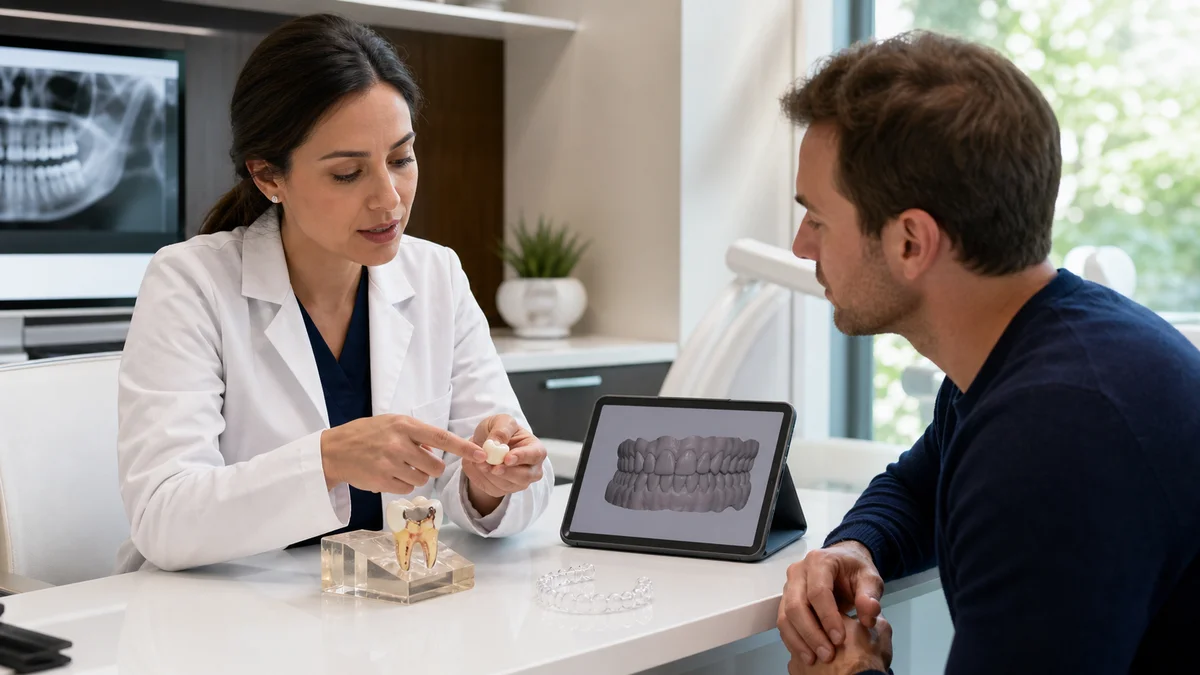
Short answer: Dental crowns vs invisalign is not a direct contest. A crown covers and strengthens a damaged or heavily restored tooth; Invisalign, a clear-aligner brand, moves teeth gradually in suitable orthodontic cases. A crown cannot correct root position or a jaw relationship, while aligners cannot rebuild a fractured tooth. Some patients need one, both in sequence, or a more conservative alternative.
Crowns and clear aligners can both change the appearance of a smile, yet their primary purposes differ. A crown restores a particular tooth by covering it with a custom-made restoration. Clear aligners apply controlled force to move teeth and may improve selected alignment or bite problems. Comparing them only by speed, visibility or package price can miss the disease or structural problem that should drive treatment.
The phrase dental crowns vs invisalign also compares a general restoration category with a brand. Invisalign is one clear-aligner system; other systems exist. The meaningful clinical comparison is between a diagnosed restorative plan and a diagnosed orthodontic plan under professional supervision.
This guide helps patients prepare for that conversation. It does not diagnose a cracked tooth, promise that aligners can move a particular tooth or guarantee how long a crown will last. Examination, appropriate imaging and bite assessment are required.
Dental Crowns vs Invisalign Begins With the Diagnosis
A crown may be recommended when a tooth has a very large filling, substantial fracture, weakness, severe wear, root canal treatment or another condition that leaves insufficient structure for a simpler restoration. The ADA explains that crowns can strengthen a tooth, protect a weak tooth from breaking, restore a broken tooth, cover an implant or support a bridge.
Clear aligners are orthodontic appliances. They may treat selected crowding, spacing, overbite, underbite, open bite or crossbite by moving teeth through supporting tissues. The American Association of Orthodontists emphasizes that aligners are not right for everyone and that some cases are treated more predictably with braces or combined methods.
Before discussing products, ask which diagnosis is present:
- Is a tooth structurally damaged, decayed or heavily restored?
- Are otherwise restorable teeth in unhealthy positions?
- Is the concern mainly tooth color or shape rather than position?
- Does the bite place damaging force on a tooth or restoration?
- Could a filling, onlay, bonding, veneer, braces or monitoring be more conservative?
Treatment should solve the diagnosed problem with the least appropriate biological cost. A digital smile image does not replace this analysis.
What a Dental Crown Does
A crown is a restoration that covers the visible portion of a prepared tooth. It can be made from ceramic, metal-ceramic, metal or other approved materials. Material selection depends on remaining tooth structure, location, bite force, appearance, allergy history, laboratory design and repair strategy.
To place a conventional crown, the dentist removes compromised material and shapes the tooth to create space and retention. An impression or digital scan records the preparation. A temporary crown may protect the tooth while a laboratory makes the final restoration, unless an appropriate same-day workflow is used.
A crown can restore form, protect a weakened tooth and change visible shape or color. It does not move the root, correct generalized crowding or change a jaw relationship. If a tooth is out of position, making the crown look straight can sometimes require greater reduction or create a bulky contour.
A crowned tooth is not immune to problems. Decay can occur at the margin, gum inflammation can develop, the crown can chip or loosen and the underlying tooth can fracture. Cleaning and routine review remain essential.
What Clear Aligners Do
Clear aligners are thin, custom trays worn in sequence. Each stage applies pressure intended to move teeth incrementally. Small tooth-colored attachments, elastics or other auxiliaries may be used. Treatment depends on diagnosis, tray design, wear, biology and monitoring.
Aligners can reposition a healthy natural tooth and can sometimes move crowned teeth, but existing restorations change planning. An attachment may bond differently to ceramic than to enamel. Crown shape may affect tray fit. A compromised tooth may need stabilization before orthodontic force is applied.
Aligners do not repair decay, replace missing tooth structure or strengthen a cracked tooth. They also do not whiten restorations. If the tooth is structurally unsound, postponing necessary restoration solely to begin aligners may be inappropriate.
For dental crowns vs invisalign, aligners address position; crowns address structure and surface form. A patient may need both for different reasons.
Can Invisalign Move a Crowned Tooth?
A crowned tooth can often be moved orthodontically if the root, supporting bone, gums and restoration are suitable. The crown is not the anchor of movement; force is transmitted to the tooth and periodontal ligament. The clinician must assess the tooth’s prognosis and the crown’s fit.
Potential planning issues include:
- The crown contour may reduce aligner grip or create tracking problems.
- Attachments may require a specific bonding protocol and can damage a restoration when removed.
- A bridge unit cannot move like separate natural teeth because connected crowns link teeth together.
- An implant crown cannot be moved orthodontically because the implant is fused to bone without a periodontal ligament.
- A temporary crown may need reshaping or replacement during movement.
Tell the orthodontic team which teeth have crowns, root canal treatment, posts, implants or large fillings. Existing records and new images may be needed. A crown that looks acceptable can still have a marginal or structural issue that affects treatment.
Should the Crown or Aligners Come First?
Sequencing depends on urgency and the final tooth position. Active decay, infection, a painful fracture or an unstable temporary often requires treatment before elective orthodontics. Health and function come first.
When a tooth is stable but needs a final crown mainly for form, the team may consider orthodontic movement first. Moving the tooth can create space, improve angulation and allow the final crown to be designed more conservatively. A durable temporary restoration may protect the tooth during treatment.
In other cases, a definitive crown must be completed before aligners because the tooth cannot safely wait. The scan and aligner design must then account for the final crown contour. Coordination between restorative dentist and orthodontist is crucial.
The dental crowns vs invisalign decision should be documented as a sequence, not just a choice. Ask which stage is urgent, which is elective and how one affects the other.
Bite, Tooth Position and Crown Longevity
A crown functions inside a bite. If a tooth receives excessive force, the restoration or underlying tooth may fracture, wear or become uncomfortable. High contacts can often be adjusted, but a broader bite problem cannot always be solved by grinding one crown.
Orthodontic movement may redistribute contacts or create restorative space in selected cases. It can upright a tilted tooth or align a tooth before a crown. However, moving teeth is not a guaranteed cure for clenching, jaw pain or every type of wear.
Patients who grind or clench need an individualized plan. A night guard may be recommended after treatment, but it cannot eliminate all risk. During aligner treatment, muscle symptoms and tooth contacts should be monitored rather than assumed to improve.
In dental crowns vs invisalign, the better plan is the one that establishes a maintainable bite while preserving viable tooth structure. Appearance is one outcome, not the only one.
Tooth Preparation and Irreversibility
A conventional crown requires circumferential tooth preparation. The amount depends on material, damage, existing fillings, desired form and clearance. Preparation is irreversible, and the tooth will require ongoing restorative maintenance.
Clear aligners do not require whole-tooth preparation, but they are not intervention-free. Plans may use attachments bonded to enamel and selected interproximal reduction between teeth. These steps should be explained tooth by tooth.
If a relatively intact tooth is being considered for a crown only to make it look straighter, orthodontic movement, bonding or a veneer may preserve more tissue. If a tooth is severely compromised, movement alone leaves the structural problem untreated.
Ask to see photographs, images and the proposed preparation. A crown should not be presented as a reversible cosmetic cover. Aligners should not be presented as a risk-free digital product.
Dental Crowns vs Invisalign Decision Table
This table compares core treatment functions, not brands or guaranteed outcomes.
| Decision factor | Dental crown pathway | Clear aligner pathway |
|---|---|---|
| Primary purpose | Restores and covers a damaged or weakened tooth | Moves teeth and may improve selected bite relationships |
| Problem treated | Fracture, large restoration, weakness, shape or coverage need | Crowding, spacing or suitable orthodontic malocclusion |
| Tooth structure | Requires irreversible preparation | May use attachments and selected interproximal reduction |
| Time | Often completed in fewer active stages | Movement occurs gradually; refinements may be needed |
| Daily responsibility | Normal hygiene and protection from damaging habits | Consistent tray wear, removal for meals and cleaning |
| Long-term maintenance | Margin care, repair and eventual replacement | Retainer wear and possible replacement |
| Bite correction | Changes one tooth’s surface contacts | Can move teeth in suitable cases |
| Cannot do | Cannot reposition roots or jaws | Cannot rebuild a damaged tooth |
For some patients, the treatments are complementary. For others, one is irrelevant to the actual problem. A diagnosis prevents an unnecessary either-or comparison.
Common Scenarios
Large filling and crowding: the tooth may need stabilization and the arch may need orthodontic planning. Timing of the final crown depends on prognosis and desired position.
Broken front tooth that is otherwise aligned: bonding, veneer or crown may restore structure depending on the damage. Aligners do not replace missing enamel or dentin.
Tilted tooth next to a missing space: orthodontic movement may improve position before an implant, bridge or crown is designed. Restoring the tilted tooth first can compromise space or contour.
Implant crown appears crooked: the implant cannot be moved with aligners. The surrounding natural teeth may be moved in selected cases, while the implant restoration may require redesign.
Deep bite with chipped crowns: simply replacing crowns may repeat damage if force is not addressed. Orthodontic and restorative assessment may both be needed.
Discolored crown with straight teeth: aligners will not change ceramic color. Crown replacement or neighboring-tooth shade planning is the relevant discussion.
These scenarios show why dental crowns vs invisalign cannot be answered from a front-facing selfie.
Crown Materials and Aligner Attachments
Crown material affects strength, translucency, thickness, wear against opposing teeth and bonding behavior. Ceramic is not one single material. Metal-ceramic and full-metal options also have roles. The dentist should explain why a material fits the tooth, bite and aesthetic zone.
If an aligner attachment is planned on a crown, the restorative material matters. Bonding to glazed ceramic differs from bonding to natural enamel and may require surface treatment. Removing the attachment can scratch or damage the crown if not handled carefully.
A new crown contour should support the planned aligner fit. If the crown changes after aligners are manufactured, trays may no longer seat properly. New scans or trays can be required. Coordination avoids paying for avoidable remakes.
The written dental crowns vs invisalign plan should identify existing crowns, proposed new restorations, attachment locations and who is responsible if the restorative contour changes during treatment.
Root Canal Treatment, Posts and Cracked Teeth
A root-treated tooth may be recommended for a crown depending on remaining structure, location and fracture risk. Root canal treatment itself does not make orthodontic movement impossible, but prognosis and root condition must be assessed.
Posts are used in selected teeth to retain a core; they do not strengthen roots universally. A tooth with a post, large restoration or crack requires careful force planning. Pain, swelling, biting tenderness or a deep crack can change priorities.
Aligners should not be used to postpone urgent treatment of infection or structural failure. Conversely, a crown should not be placed before movement if doing so creates an unfavorable final shape, unless health or stability requires immediate restoration.
Emergency care, disease control and elective orthodontics should be separated in the estimate and consent process.
Hygiene During Crowns and Clear Aligners
Both pathways depend on plaque control. A crown margin can develop decay or gum inflammation if plaque accumulates. Aligners cover tooth surfaces for much of the day and can trap food or sugary liquid if oral hygiene is poor.
- Brush twice daily with fluoride toothpaste.
- Clean between teeth every day using an appropriate method.
- Remove aligners for meals and for drinks other than water, following professional instructions.
- Clean trays and retainers without hot water that can distort them.
- Report a loose crown, broken tray, swelling or persistent pain promptly.
Active decay or gum disease should be stabilized before elective movement or final crown work. Straight teeth and attractive crowns do not substitute for a healthy, cleanable mouth.
Treatment Time, Refinements and Temporary Crowns
A crown can often be delivered over one or more restorative visits. Laboratory-made treatment may involve a temporary crown. The temporary must protect the tooth and maintain space, but it is not designed for indefinite use.
Aligner treatment occurs over a series of stages. If teeth do not track or finishing goals remain, refinement scans and additional trays may be recommended. Treatment length is influenced by complexity, biology, wear and attendance.
When both are planned, a temporary crown may need a shape that supports aligner seating and later final restoration. It can wear or debond during treatment and may need repair. The final crown is often designed after movement and stabilization, although individual sequencing differs.
Ask whether refinement trays, temporary crown repairs and new scans are included. These details affect the real dental crowns vs invisalign timeline and budget.
Retention and Future Crown Replacement
Teeth can shift after orthodontic movement. Retainers help maintain corrected positions, and long-term wear is commonly advised. Retainers can wear, crack, warp or be lost and may need replacement.
A crown can also require replacement because of decay, fracture, wear, gum changes or loss of retention. If a crown is replaced after orthodontic treatment, even a small contour change can affect retainer fit. A new retainer may be required.
Patients should keep digital scans, tooth information and retainer instructions. The restorative dentist and orthodontic team should coordinate before changing a crowned tooth that supports a retainer.
Long-term dental crowns vs invisalign planning therefore includes crown maintenance, retainer replacement and the interaction between them, not only the active treatment fee.
Costs and Insurance
A crown estimate may include examination, imaging, core restoration, post if indicated, preparation, temporary crown, laboratory fee, final crown and follow-up. Aligners may include records, attachments, trays, monitoring, refinements and retainers.
Insurance benefits vary. A crown may be covered partly when clinically necessary, subject to deductibles, frequency limits, missing-tooth rules or material allowances. Adult orthodontic treatment may be excluded or subject to a lifetime maximum. Cosmetic changes can be treated differently from disease-related care.
- Request an itemized plan with tooth numbers and diagnosis.
- Separate urgent restorative treatment from elective orthodontics.
- Ask whether core, post, temporary and laboratory are included in the crown plan.
- Ask whether records, refinements and retainers are included in the aligner plan.
- Send both coordinated plans to the insurer before treatment.
“Covered” is not the same as paid in full. Obtain a written explanation for the exact services and do not let a benefit deadline override clinical sequence.
Direct-to-Consumer Aligner and Cosmetic Crown Risks
The ADA opposes direct-to-consumer dentistry that removes licensed professional diagnosis and supervision. Moving teeth without evaluating roots, bone, gum health and existing crowns can contribute to permanent harm.
Similarly, offering crowns for healthy teeth without discussing conservative alternatives can create unnecessary irreversible preparation. A digital preview cannot show pulp health, root fractures or long-term margin quality.
- Avoid tooth movement planned only from selfies or home impressions.
- Do not accept a crown without understanding why simpler repair is insufficient.
- Verify the treating professional’s license and role.
- Require a written bite, restoration and follow-up plan.
- Reject guaranteed results or lifetime restoration promises.
Treatment Abroad and Care Coordination
International treatment adds travel and continuity. A crown can require temporary care, laboratory work and bite adjustment. An aligner course continues for months and needs monitoring, refinements and retention after the patient returns home.
At Redent Klinik, an initial review can organize current images, information about existing crowns, alignment concerns and travel timing. The plan remains provisional until an examination confirms tooth and gum health. For an individual question, use the Redent Klinik contact page.
Before booking travel, clarify:
- Which treatment must occur first and why
- How many visits and laboratory days are required
- Who monitors aligners after return
- How refinement trays or temporary crown problems are handled
- What crown material, scans and records will be supplied
- How a home dentist can contact the treating team
Flights and accommodation should not force immediate final crown delivery or shorten an orthodontic stage. A flexible, documented sequence is safer than a compressed package.
Questions to Ask Before Consent
Use these questions to turn the comparison into a coordinated plan:
- What diagnosis makes a crown necessary?
- Could a filling, onlay, bonding or monitoring preserve more tooth?
- What alignment or bite problem are the aligners treating?
- Can the crowned tooth be moved safely?
- Should orthodontics occur before the final crown?
- How much tooth structure will be removed?
- Which attachments will be bonded to restorations?
- What are the refinement and retainer plans?
- How will the final bite be checked?
- What repairs, replacements or extra scans may be needed?
A second opinion is reasonable when one plan removes substantially more tooth structure or proposes very different sequencing.
Dental Crowns vs Invisalign Checklist
Before starting, confirm that your record includes:
- A tooth-by-tooth diagnosis and periodontal assessment
- Appropriate images of roots, bone and existing restorations
- The structural reason for each proposed crown
- The movement and bite goals for aligners
- A written sequence for temporary and final crowns
- Attachment and bonding plans on restored teeth
- Refinement and retainer responsibilities
- Crown material, laboratory and maintenance information
- Itemized costs and written insurance response
- Follow-up and urgent-contact arrangements
This checklist makes dental crowns vs invisalign a diagnosis and sequencing decision rather than a choice between two product labels.
Document the dental crowns vs invisalign decision tooth by tooth: structural prognosis, planned movement, temporary protection, final restoration and retention. This prevents an urgent repair from being confused with an elective alignment goal.
If two clinicians recommend different dental crowns vs invisalign sequences, compare their findings about decay, cracks, roots, bone, gum stability and final crown space. A second opinion can clarify whether the difference reflects diagnosis or preference.
Frequently Asked Questions
Can Invisalign move a tooth with a crown?
Often, yes, if the root, bone, gums and restoration are suitable. Crown contour and attachment bonding can affect tray fit. An implant crown cannot move because the implant is fused to bone.
Should I replace a crown before clear aligners?
It depends on urgency and final position. Active decay, fracture or infection may need treatment first. A stable tooth may use a temporary restoration during movement so the final crown can match the corrected position.
Can a crown straighten a crooked tooth?
A crown can alter visible contour, but it does not reposition the root or correct a bite. Camouflaging major misalignment may require excessive preparation or create a bulky restoration. Orthodontic assessment is appropriate.
Do clear aligners repair cracked teeth?
No. Aligners move teeth but do not replace missing structure or protect a significant crack. A damaged tooth needs restorative diagnosis. Orthodontic force may be delayed or modified according to prognosis.
Will aligners damage a crown?
Well-planned treatment can include crowned teeth, but attachments, tray forces and removal techniques require care. A crown can debond or chip for many reasons. Report movement, pain or a loose restoration promptly.
Do I need a new retainer after crown replacement?
Possibly. Even a small contour change can stop an existing retainer from fitting. Coordinate crown design with the orthodontic team and never force a retainer over a new restoration.
Which is faster, a crown or clear aligners?
A crown is usually completed in fewer active stages, but the treatments solve different problems. Speed cannot make a crown appropriate for an alignment problem or aligners appropriate for structural damage.
Does insurance cover crowns or Invisalign?
Policies vary. A medically necessary crown may receive restorative benefits, while adult orthodontic coverage can be limited or excluded. Deductibles, frequency rules and lifetime maximums apply. Obtain written estimates for both plans.
Conclusion: Restore Damage and Move Teeth for the Right Reasons
Dental crowns vs invisalign is a comparison of different tools. Crowns cover and strengthen selected damaged teeth. Clear aligners move teeth and may improve selected alignment and bite problems. One does not replace the other’s core function.
Begin with tooth prognosis, gum health, roots and bite. When both treatments are useful, coordinate sequence so the tooth is protected without compromising final position, crown contour, tray fit or retainer design.
Using dental crowns vs invisalign as a structured checklist supports conservative care and informed consent. This content is prepared for review in Redent Klinik’s medical editorial process by Diş Hekimi Esma Çevrük Çakır; editorial review does not replace a personal examination.
Official Sources and Further Reading
- American Dental Association MouthHealthy: Crowns
- American Association of Orthodontists: Clear Aligners
- American Association of Orthodontists: Dental Retainers
- American Dental Association: Direct-to-Consumer Dentistry Policy
- NHS: Orthodontics
- American Dental Association
- World Health Organization: Oral Health Fact Sheet
Disclosure: this page may contain affiliate links. We may earn a commission if you use them, at no extra cost to you.