
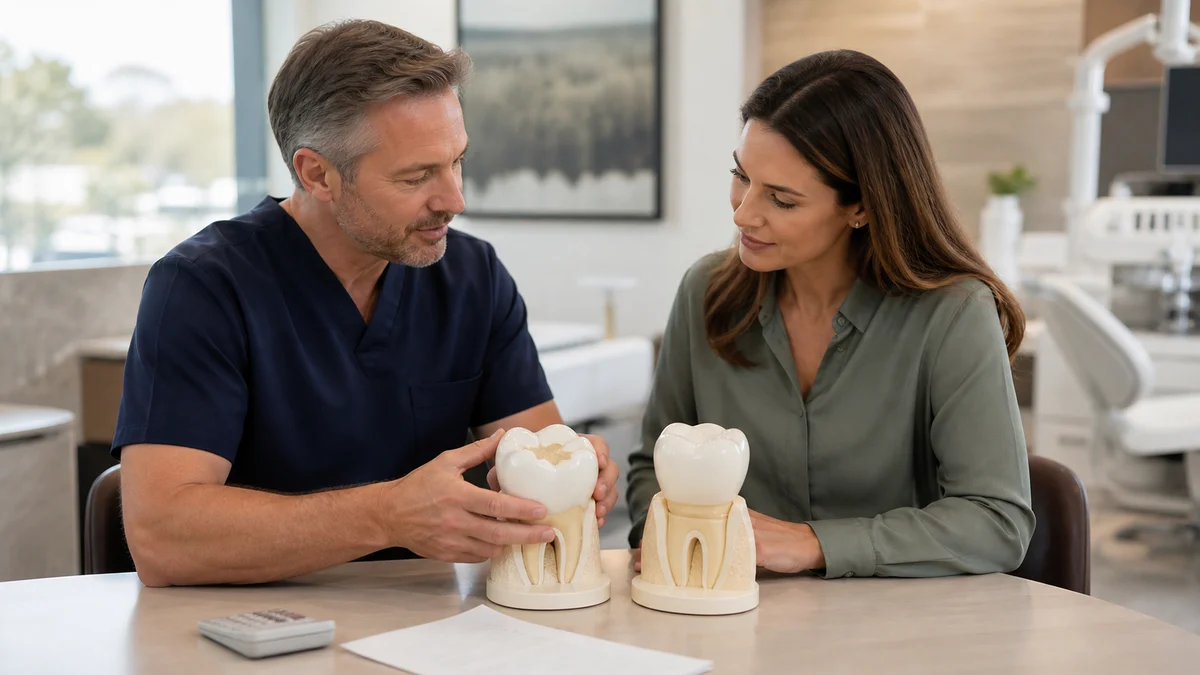
Quick answer: A reliable crown filling cost comparison begins with diagnosis, not a price list. Ask how much healthy tooth remains, whether a filling, onlay, or crown is indicated, and which examinations, materials, buildup, temporary restoration, laboratory work, root-canal care, follow-up, insurance assumptions, and repair terms are included. Fixed prices cannot reflect every tooth or complication.
The search for crown filling cost often appears after a dentist finds decay, a filling breaks, or a tooth cracks. Patients may be told that a small restoration is possible, that a crown is safer, or that the decision can wait. Because a crown usually removes more tooth structure and involves more stages than a direct filling, the clinical reason matters as much as the estimate.
A filling and a crown are not interchangeable products selected by budget alone. A filling replaces a limited area of lost tooth structure. A crown covers most or all of the visible tooth and can protect a tooth weakened by extensive damage, a large existing restoration, fracture, wear, or prior treatment. Between them are options such as an inlay, onlay, or partial-coverage restoration.
This guide explains how to assess crown filling cost without inventing a universal amount. It does not diagnose one tooth, rank materials, predict lifespan, promise insurance payment, or guarantee a painless result. Fees, benefit rules, laboratory arrangements, clinician availability, and clinical findings vary, so obtain a personal examination and written plan.
1. What crown filling cost actually compares
The phrase can mean several different things. Some people are comparing a direct filling with a full crown. Others have been quoted for a “crown filling,” which may refer to a core buildup under a crown, a temporary filling before crown treatment, or a repair of the access opening in a crown after root-canal treatment. Those procedures have different purposes.
Before comparing crown filling cost, ask the clinic to write the exact diagnosis and procedure names. Identify the tooth, surfaces involved, material, whether the restoration is temporary or definitive, and whether laboratory work is included. Procedure codes can help organize an insurance question, but they do not replace a clinical explanation.
Ask the dentist to show the relevant finding on an image, photograph, or tooth diagram when possible. A sound crown filling cost comparison identifies whether the concern is active decay, a defective margin, structural fracture, wear, an old restoration, pulp disease, or appearance. A clear problem statement reduces misunderstandings.
2. Filling, onlay, or crown: how the choice is made
A direct filling is placed and shaped in the mouth. It may be appropriate when the damaged area is limited and the remaining tooth can support function. A crown surrounds the prepared tooth and is often made indirectly in a laboratory or through an in-office digital workflow. It may be considered when the tooth needs broader coverage or structural protection.
An inlay fits within the cusps, while an onlay or partial crown covers one or more cusps without necessarily covering the entire tooth. These options can sometimes preserve more tooth structure than a full crown while providing more coverage than a filling. Suitability depends on defect size, crack pattern, bite forces, margins, material, and isolation.
A trustworthy crown filling cost discussion should include reasonable alternatives and their tradeoffs. The least expensive immediate option is not automatically the least costly over time, and the most extensive restoration is not automatically the safest. Ask what evidence supports the recommended amount of tooth coverage.
3. Tooth condition drives crown filling cost
The amount and location of healthy enamel and dentin influence whether a restoration can be retained and withstand chewing. A small defect away from a heavily loaded cusp differs from a large defect that undermines several walls. Cracks, previous fillings, root-canal access, decay below the gumline, and limited remaining height can make treatment more complex.
The quoted crown filling cost may also change if old material must be removed before the true extent of damage can be seen. A dentist should explain which parts of the plan are confirmed and which remain conditional. A contingency might include a larger restoration, a buildup, root-canal evaluation, gum treatment, extraction, or referral.
Conditional planning is not necessarily poor planning; some defects remain hidden until old material or decay is removed. The safeguard in a crown filling cost plan is informed consent. Ask how the team will pause, communicate findings, obtain authorization, and document changes before proceeding whenever clinically feasible.
4. Diagnosis and imaging belong in the estimate
A diagnosis may use medical and dental histories, symptom questions, visual and tactile examination, bite tests, pulp tests, periodontal measurements, photographs, and appropriate radiographs. Not every tooth requires every test. Imaging should answer a clinical question and be interpreted with the examination rather than used as a stand-alone sales image.
When reviewing crown filling cost, confirm whether the consultation, necessary radiographs, photographs, digital scan, bite analysis, or specialist evaluation are included. Repeat imaging should have a reason. A remote photograph may help triage an appointment, but it cannot fully determine crack depth, pulp health, decay extent, or restorability.
For an accurate crown filling cost plan, report pain, temperature sensitivity, biting discomfort, swelling, trauma, previous treatment, grinding, and symptom changes. Also disclose medications, allergies, pregnancy possibility, bleeding conditions, and relevant medical history because these details can alter diagnosis, anesthesia, materials, timing, or coordination.
5. Use a decision table, not a price shortcut
| Option | Typical role | Potential advantage | Question before consent |
|---|---|---|---|
| Direct filling | Repairs a limited defect directly in the mouth | Often preserves more tooth and may be completed in one visit | Can the remaining tooth safely support this size and bite? |
| Inlay or onlay | Indirectly replaces or covers selected areas | May provide broader coverage without a full crown | Why is partial coverage suitable for this crack or defect? |
| Full crown | Covers the prepared visible tooth | Can protect a substantially weakened tooth | How much sound tooth remains and why is full coverage indicated? |
| Repair or monitoring | Addresses a localized defect or watches a stable finding | May avoid immediate replacement when clinically reasonable | What finding would trigger more treatment? |
| Root-canal care plus restoration | Treats diseased pulp before definitive restoration | May retain a tooth when the pulp is irreversibly affected | Is pulp disease diagnosed or only a possible contingency? |
| Extraction and replacement planning | Removes a tooth with an unfavorable prognosis | May be appropriate when predictable restoration is not possible | What tooth-preserving and replacement alternatives were considered? |
This table cannot select treatment. Use it to ask whether a crown filling cost estimate reflects the least invasive predictable option for the actual diagnosis. Tooth position, crack direction, decay, remaining structure, gum level, bite, hygiene, personal preferences, and ability to attend follow-up all matter.
6. Material changes both treatment and price
Common direct filling materials include tooth-colored resin composite and, in some settings, dental amalgam or glass-ionomer-based materials. Indirect restorations may use ceramics, zirconia, metal alloys, resin-based materials, or combinations. Each material has different handling, thickness, bonding, appearance, wear, repair, and laboratory requirements.
Material alone should not determine crown filling cost. A premium label does not guarantee fit, bite, margins, or durability. Ask why the material fits the tooth location, remaining structure, moisture control, opposing teeth, grinding risk, esthetic priorities, allergies, and future repair pathway.
For tooth-colored fillings, adequate isolation can influence bonding. A complete crown filling cost estimate should clarify preparation design, impressions or scans, provisional protection, laboratory communication, final cementation, and who performs each step. Technique and case selection can be as important as the named material.
7. Buildup, post, and root-canal treatment are separate
A core buildup replaces missing tooth structure so a crown can be supported. It is not simply an optional “filling” added to every crown. The need depends on how much structure remains after decay and old materials are removed. Ask the dentist to distinguish the crown fee from any buildup and explain the indication.
A post may be placed inside a root-canal-treated tooth when additional retention for the core is needed; it does not strengthen every tooth. In a crown filling cost estimate, ask whether a post is confirmed or conditional and how material, length, remaining dentin, and fracture risk affect the decision.
Root-canal treatment addresses disease of the dental pulp. It should not be presented as a routine prerequisite for every crown. A crown filling cost proposal should state whether root-canal care has already been diagnosed, may become necessary, or is not expected. If symptoms or tests are unclear, an endodontic opinion may help.
8. Laboratory and same-day workflows affect crown filling cost
Traditional indirect crowns may involve a prepared tooth, impression or scan, temporary crown, laboratory fabrication, try-in, and final cementation at a later visit. Some practices use chairside design and milling to make selected restorations in one appointment. Neither workflow is universally superior for every tooth.
For a laboratory crown, ask whether the crown filling cost includes the provisional, scan or impression, laboratory, shade work, try-in, adjustments, cementation, and early review. If a remake becomes necessary because of fit, shade, or damage, clarify who pays and what time limits apply.
For same-day treatment, ask how the crown filling cost includes verification of fit, contacts, bite, anatomy, shade, and material processing. Faster delivery can be convenient but should not override suitability or quality checks. A same-day advertisement should not imply every patient can safely finish in one visit.
9. Clinician, facility, and complexity matter
Fees can reflect clinician time, training, location, staffing, sterilization, equipment, materials, laboratory relationships, and the complexity of managing one tooth. A difficult margin, limited mouth opening, strong gag reflex, severe wear, high esthetic demand, or medically complex history can require more planning or referral.
When comparing crown filling cost between practices, verify the dentist’s active license and any claimed specialty through the appropriate regulator. Ask who performs the diagnosis, tooth preparation, provisional, laboratory communication, and final placement. A clinic brand or celebrity testimonial does not identify the treating professional.
Experience can be relevant, but no case count guarantees a result. A clinician should explain limitations, referral thresholds, and what happens if the tooth proves unrestorable. Pressure to start before questions are answered is a reason to pause and seek another opinion.
10. Insurance estimates are not payment guarantees
Dental plans vary in deductibles, copayments, annual limits, waiting periods, frequency rules, network arrangements, material substitutions, downgrades, exclusions, and preauthorization. A plan may classify a filling and crown differently or base payment on an alternative material. Benefit language should be verified directly with the insurer.
Ask the clinic for codes and supporting documents for the proposed crown filling cost, then request a written benefit estimate. The insurer may still decide after receiving the claim. Keep clinical need separate from coverage: denial does not itself prove care is unnecessary, and approval does not prove it is the best option.
For people with Medicare, official federal guidance explains that most routine dental care is generally excluded, subject to limited circumstances where dental services are linked to covered medical care. A crown filling cost estimate should not assume Medicare payment without case-specific verification.
- Confirm the tooth number, procedure, material, and treating provider with the insurer.
- Ask about deductible, annual maximum, waiting period, frequency, and network status.
- Clarify whether preauthorization is required and whether it guarantees payment.
- Request the plan’s written reason and appeal process if coverage is denied.
- Do not let benefit timing delay urgent evaluation of pain, swelling, or infection.
11. Read the written estimate line by line
A complete estimate can separate examination, imaging, removal of the old restoration, decay treatment, filling or buildup, crown, laboratory, provisional, anesthesia, specialist care, adjustments, and follow-up. It should distinguish confirmed services from possible additions and identify taxes or administrative charges where applicable.
Before accepting a crown filling cost, ask what happens if the defect is smaller or larger than expected, the tooth needs root-canal treatment, the crown does not fit, or the tooth fractures before completion. Confirm how changes are authorized and how deposits, cancellations, refunds, and financing are handled.
Read credit terms for any financed crown filling cost independently of the clinical discussion. Check the lender, annual percentage rate, deferred interest, fees, start date, cancellation rules, and dispute process. Do not sign blank documents or let an expiring discount force an irreversible decision.
- Require the diagnosis, tooth number, procedures, materials, and stages in writing.
- Separate confirmed treatment from conditional services and specialist referrals.
- Identify the provisional, laboratory, adjustment, and review arrangements.
- Compare estimates only after matching the clinical scope line by line.
- Keep signed consent, financing, warranty, receipts, images, and treatment records.
12. Longevity cannot be reduced to one number
Fillings and crowns can function for many years, but individual longevity varies. Important factors include defect size, remaining tooth, crack behavior, material, bonding or cementation, fit, bite forces, grinding, diet, decay risk, saliva, hygiene, gum health, and professional maintenance. The tooth can also develop disease unrelated to the restoration material.
A salesperson-like claim that one option “lasts forever” should not drive crown filling cost. Ask what complications are possible: recurrent decay, sensitivity, loss of retention, fracture, chipping, wear, open contacts, gum inflammation, pulp disease, or root fracture. Discuss which problems may be repaired and which may require replacement or further treatment.
Warranty terms are business policies, not biological guarantees. Read what is covered, for how long, by which clinic, and under what maintenance conditions. Clarify exclusions for trauma, grinding, new decay, missed visits, or treatment by another provider. A warranty cannot eliminate clinical uncertainty.
13. Follow-up and maintenance protect the investment
Follow-up should be included in the crown filling cost discussion. Temporary sensitivity can occur, but persistent pain, worsening temperature response, swelling, or a high bite needs review. After crown preparation, protect the temporary as instructed and contact the clinic if it loosens, breaks, or causes sharp edges.
Following final placement, the dentist may check contacts, bite, margins, appearance, and comfort. Daily brushing with fluoride toothpaste, cleaning between teeth, diet guidance based on decay risk, and professional examinations remain important. A crown does not make the underlying tooth immune to decay or gum disease.
The long-term crown filling cost discussion should include maintenance and possible repair, not only the placement appointment. Ask whether an early review is included, how urgent concerns are assessed, and whether the practice can provide records if you move or need care elsewhere.
14. Warning signs that need prompt dental assessment
Dental pain can arise from decay, a crack, pulp inflammation, infection, bite trauma, gum disease, or another source. A price comparison should not delay examination when symptoms are escalating. Increasing pain, facial or gum swelling, fever, drainage, bad taste, difficulty opening the mouth, or a broken tooth warrants prompt contact with a dental professional.
Seek emergency medical care for breathing or swallowing difficulty, rapidly spreading swelling, severe allergic symptoms, chest pain, fainting, or uncontrolled bleeding. These symptoms are not appropriate for an online crown filling cost quote. Local emergency services can address immediate medical risk before definitive dental care.
Do not place aspirin on the gum, attempt to drill or glue a tooth, or repeatedly exceed medicine directions. If you use pain medication, follow the label and ask a pharmacist or clinician about contraindications, pregnancy, anticoagulants, kidney or liver disease, allergies, and interactions.
15. Compare local and travel treatment consistently
Nearby treatment can simplify provisional care, adjustments, urgent visits, and future records. Treatment elsewhere may offer different expertise, materials, timing, or fees but adds travel, communication, laboratory, return-visit, and continuity considerations. Location alone does not prove quality or value.
Redent Klinik provides general service information through its English-language homepage and accepts organizational questions through its English contact page. An online inquiry cannot determine restorability. Compare any travel proposal with a local crown filling cost estimate using the same diagnosis, tooth, material, stages, laboratory, contingency, and follow-up assumptions.
If traveling, ask whether the tooth needs stabilization before departure, how long to remain near the clinic, who manages a temporary crown, when final cementation occurs, and what happens if a laboratory remake or root-canal review is needed. A prepaid itinerary should never force a biologically unsuitable schedule.
A practical crown filling cost checklist
Use this checklist to compare two examination-based plans. A responsible crown filling cost estimate may take time to complete because the team must define scope, laboratory work, insurance assumptions, and contingencies. Clarity is more useful than a headline price.
- Obtain the diagnosis and ask to see the relevant clinical finding.
- Confirm whether the proposal is a filling, buildup, inlay, onlay, or full crown.
- Ask how much healthy tooth remains and why that coverage is indicated.
- Review alternatives, including repair, monitoring, or specialist opinion.
- Identify confirmed and conditional imaging, root-canal, post, and gum procedures.
- Understand the material choice, isolation, provisional, laboratory, and fit checks.
- Compare itemized estimates using the same tooth, scope, and materials.
- Verify insurance directly and read financing terms without time pressure.
- Clarify remakes, repairs, warranties, emergency access, and early review.
- Reject fixed-lifespan, pain-free, or complication-free guarantees.
Frequently asked questions about crown filling cost
Is a crown always more expensive than a filling?
A crown often involves more preparation, provisional care, indirect fabrication, laboratory or milling work, and multiple quality checks, so its fee structure may be broader. That does not mean a crown is always indicated. Compare options only after the dentist defines the diagnosis, remaining tooth structure, material, and full scope.
Why did my crown filling cost change after treatment started?
Removing old material can reveal deeper decay, a crack, limited remaining tooth, or pulp exposure that was not fully visible beforehand. The clinic should explain what was known, what was conditional, what changed, and which alternatives remain. Changes should be documented and authorized whenever the clinical situation allows.
Does a crown price include a buildup?
Not necessarily. A buildup replaces missing tooth structure needed to support the crown and may be billed separately when clinically indicated. Ask the practice to itemize it and explain why it is necessary for that tooth. A buildup should not be treated as an automatic addition to every crown.
Will I need a root canal before a crown?
Not every crowned tooth needs root-canal treatment. The decision depends on symptoms, pulp tests, decay, cracks, previous treatment, and clinical findings. Ask whether root-canal care is diagnosed, a possible contingency, or not expected. Uncertainty or complex symptoms may justify an endodontic opinion.
Can a large filling replace a crown?
Sometimes a filling or partial-coverage restoration may be appropriate, but a very large direct filling can leave weakened cusps or margins under heavy load. The correct choice depends on remaining structure, crack pattern, bite, isolation, and material. Ask the dentist to explain why the proposed coverage is predictable.
Does insurance cover crown filling cost?
Coverage depends on the plan, diagnosis, procedure, material, network, deductible, annual limit, waiting period, and frequency rules. Obtain codes and a benefit estimate, then verify directly with the insurer. Preauthorization or an estimate may not guarantee final payment.
How long should a crown or filling last?
No universal lifespan applies. Size, remaining tooth, material, technique, bite, grinding, hygiene, diet, decay risk, gum health, trauma, and maintenance all influence outcomes. Ask about likely complications, repair options, and follow-up rather than accepting a lifetime promise.
When is tooth pain an emergency?
Increasing pain, swelling, fever, drainage, a broken tooth, or difficulty opening the mouth needs prompt dental assessment. Breathing or swallowing difficulty, rapidly spreading swelling, severe allergy symptoms, fainting, chest pain, or uncontrolled bleeding requires emergency medical care.
Sources and official guidance
- American Dental Association: Oral Health and Evidence Resources
- World Health Organization: Oral Health Fact Sheet
- World Health Organization: Prevention and Treatment of Dental Caries with Mercury-Free Products and Minimal Intervention
- NHS: Dental Treatments, Including Crowns and Fillings
- Centers for Medicare & Medicaid Services: Items and Services Not Covered Under Medicare
Source review date: August 20, 2026. Fees, coverage, materials, and guidance can change. Confirm current clinical and financial details with the treating dentist, insurer, and responsible authority.
Clinical review note: This evidence-informed patient education article is prepared for review by Dentist Esma Çevrük Çakır. It supports safer questions and does not replace a personal examination, diagnosis, urgent assessment, or individualized financial and treatment plan.