
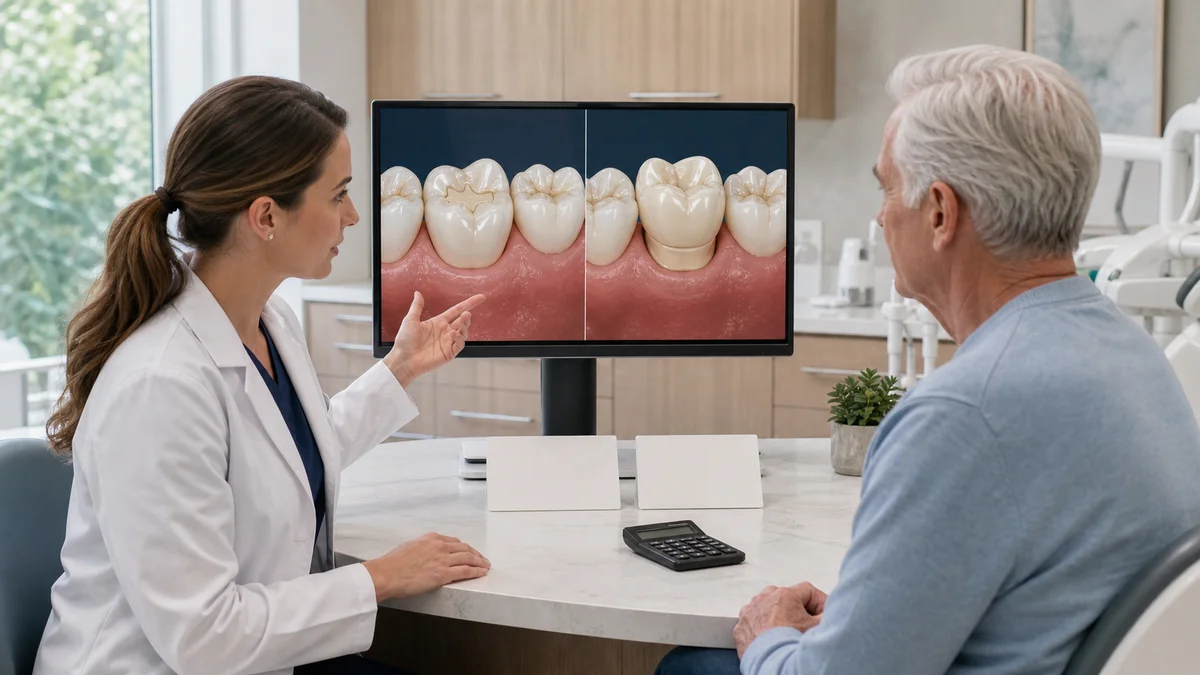
Quick answer: A filling and crown cost quote may cover different teeth, a core buildup beneath one crown, a temporary restoration, or closure of a root-canal access opening. Ask for the tooth number, diagnosis, exact procedure, material, stages, laboratory work, insurance assumptions, contingencies, and follow-up on every line. Only an examination can show whether both items are clinically justified.
Seeing both a filling and a crown on one estimate can be confusing. The treatment may involve two separate teeth, or the “filling” may be a buildup that replaces missing structure before a crown is fitted. It could also be a temporary seal, a repair, or the restoration used to close an opening after root-canal treatment. The words alone do not define the plan.
That is why a filling and crown cost comparison should begin with scope rather than the final total. A filling repairs a limited defect directly in the tooth. A crown covers most or all of the prepared visible tooth and normally involves an indirect restoration. Each has different clinical indications, materials, steps, risks, and maintenance requirements.
This guide explains how to audit a filling and crown cost proposal without supplying a fixed price or diagnosing one tooth. It does not promise insurance payment, a particular lifespan, pain-free treatment, or a guaranteed result. Fees and coverage change, while hidden decay or a crack can change treatment after work begins. Obtain a personal examination and written consent.
1. Translate every line in the filling and crown cost quote
A useful estimate identifies the tooth or teeth, the diagnosis, and the exact procedure. “Filling” may refer to a direct restoration placed to treat decay, a core buildup under a crown, a temporary restoration, or a repair. “Crown” may refer to a provisional, a definitive full-coverage restoration, or occasionally an implant-supported crown. These are not financial equivalents.
Ask the practice to annotate the filling and crown cost estimate in plain language. Which line treats disease? Which restores missing tooth structure? Which is temporary? Which involves a laboratory? Which is confirmed, and which is only a possible addition? Request procedure codes for insurance purposes, but still require a clinical explanation.
The filling and crown cost document should say whether the estimate is for one course of treatment or several stages. Consultation, radiographs, filling, buildup, crown preparation, temporary crown, laboratory fabrication, placement, and review may occur on different dates. Payment timing should not be mistaken for treatment timing.
2. The filling and crown may belong to different teeth
The simplest explanation is that one tooth has a small or moderate defect suitable for a filling, while another is weakened enough to need a crown. A treatment plan may therefore list both procedures even though neither is performed on the same tooth. Tooth numbers and surfaces prevent confusion.
When multiple teeth are involved, compare the filling and crown cost line by line. Ask the dentist to show each finding on photographs, radiographs, or a tooth diagram when appropriate. You should understand whether the issue is active decay, a defective restoration, fracture, wear, root-canal access, or a cosmetic concern.
Do not assume every filling and crown cost item has the same urgency. One tooth may be painful or at risk of fracture, while another stable defect may be monitored. Ask which items are urgent, which can be staged, what symptoms require faster care, and whether delay changes prognosis.
3. A buildup under a crown is not an ordinary filling
A core buildup replaces missing tooth structure so that a crown can be supported and retained. It is placed after decay, old material, or weakened tissue is removed. Although it may use a filling-like material, its purpose and coding can differ from a direct filling that is intended as the final restoration.
A buildup should not appear automatically in every filling and crown cost plan. Ask how much healthy tooth is expected to remain and why the crown needs additional foundation. The clinician may not know the full extent until old material is removed, so the buildup may be a confirmed service or a documented contingency.
A post is another separate concept in a filling and crown cost plan. It may be placed within a root-canal-treated tooth when the core needs additional retention, but it does not strengthen every tooth and is not routinely necessary. Request its indication, material, risks, and alternatives.
4. A crown after root-canal treatment can create several lines
Root-canal treatment addresses diseased or injured pulp inside the tooth. The access opening is sealed, and the tooth receives an appropriate final restoration. Depending on the tooth and remaining structure, that restoration may be a filling, an onlay, or a crown. Root-canal therapy does not make every crown identical.
A post-treatment filling and crown cost estimate may list the access restoration, core buildup, post, temporary crown, and final crown separately. Ask which provider performs the root canal and which restores the tooth. Specialist and general dental fees may arrive as separate estimates even when care is coordinated.
Not every filling and crown cost plan needs root-canal treatment. Pulp testing, symptoms, decay, cracks, and prior treatment guide that decision. Ask whether root-canal care is diagnosed, a possible contingency, or not anticipated. When findings are uncertain, an endodontic opinion may reduce avoidable treatment.
5. Diagnosis comes before the price comparison
The clinical assessment can include medical and dental history, symptom review, visual and tactile examination, bite tests, pulp tests, periodontal measurements, photographs, and appropriate radiographs. Tests should be selected for a reason. A photograph sent online may help triage a visit but cannot fully establish crack depth, pulp condition, or restorability.
For an accurate filling and crown cost, tell the dentist about pain, temperature sensitivity, biting discomfort, swelling, trauma, grinding, previous treatment, allergies, medications, pregnancy possibility, and medical conditions. These details can affect diagnosis, anesthesia, material choice, timing, and the need for specialist or physician coordination.
Before accepting filling and crown cost, ask how much sound enamel and dentin remain, which cusps are supported, whether a crack is suspected, and where the margin would be. A large defect does not require the same solution in every tooth; position, bite, isolation, and priorities matter.
6. Compare the clinical pathways with a decision table
| Pathway | What it does | Why two quote lines may appear | Question to resolve |
|---|---|---|---|
| Direct filling only | Repairs a limited defect in one visit | Usually one definitive restorative line | Can the remaining tooth safely support the filling? |
| Core buildup plus crown | Rebuilds the foundation, then covers the tooth | Buildup and crown are distinct procedures | How much structure will remain after cleanup? |
| Root canal, buildup, and crown | Treats pulp disease and restores a weakened tooth | Several providers or stages may bill separately | Which parts are diagnosed versus conditional? |
| Filling on one tooth, crown on another | Treats different defects appropriately | Both appear in one multi-tooth plan | What is the diagnosis and urgency for each tooth? |
| Onlay or partial crown | Covers selected weakened areas | May replace a planned filling or full crown | Can partial coverage preserve more tooth predictably? |
| Repair or monitoring | Addresses a localized problem or watches a stable finding | May avoid immediate full replacement | What change would trigger definitive treatment? |
Use the table to interpret filling and crown cost, not to choose your own procedure. The most conservative option is the least invasive option that can predictably meet the clinical need, not automatically the smallest or cheapest restoration. Personal examination, clinician judgment, evidence, and patient preferences must be integrated.
7. Material choices affect both lines differently
Direct fillings may use resin composite, glass-ionomer-based materials, or other materials appropriate to the case and jurisdiction. Crowns can use ceramic, zirconia, metal alloys, porcelain fused to metal, resin-based materials, or combinations. Each material has different space, bonding, cementation, appearance, wear, repair, and laboratory requirements.
The material component of filling and crown cost should be explained without implying that one premium label guarantees success. Ask why the selected material fits the defect, tooth position, moisture control, opposing teeth, grinding risk, appearance priorities, allergy history, and future repair route.
The World Health Organization’s 2026 caries guideline supports prevention, shared decision-making, and less invasive, mercury-free approaches where appropriate. A filling and crown cost quote still needs individual diagnosis because no guideline selects one material for every patient. Local standards and clinical factors remain important.
8. Laboratory, scan, temporary, and placement stages
A direct filling is usually shaped and finished in the mouth. A traditional crown often involves tooth preparation, an impression or digital scan, a temporary crown, laboratory fabrication, try-in, adjustments, and final cementation. Some suitable cases use an in-office design and milling workflow to deliver a crown in one appointment.
Ask whether the filling and crown cost includes the scan or impression, provisional restoration, laboratory fee, shade customization, delivery, bite adjustment, and early review. Confirm what happens if the temporary breaks or the definitive crown requires a remake for fit, contact, shade, or damage.
Speed may affect filling and crown cost, but it is a convenience rather than a quality guarantee. Same-day care must verify margins, contacts, bite, anatomy, processing, and comfort. Laboratory fabrication also does not guarantee a better result by itself; the workflow should suit the tooth.
9. Why the estimate can change after treatment begins
Radiographs and examination reveal much, but the full extent of decay, a crack, or unsupported structure may become clear only after an old restoration is removed. The final defect may be smaller or larger than expected. The pulp may be exposed, or the tooth may prove difficult to restore predictably.
A responsible filling and crown cost proposal separates confirmed services from possible contingencies. It should explain how the team will stop when practical, show or document the new finding, discuss alternatives, obtain authorization, and update the estimate before continuing.
Possible changes to filling and crown cost include a larger filling, onlay, buildup, crown, root-canal evaluation, gum treatment, extraction, or referral. Conditional planning is not automatically a warning sign; vague consent allowing unlimited undisclosed changes is. Ask for the decision process in advance.
10. Insurance may process filling and crown lines differently
Dental plans differ in deductible, copayment, annual maximum, waiting period, network, frequency, replacement rules, missing-tooth clauses, and material allowances. A plan may cover a filling but apply stricter criteria to a crown, or base payment on a less costly alternative material. Benefit design is not the same as clinical judgment.
For each filling and crown cost line, obtain the tooth number, procedure code, material, treating provider, and supporting records. Verify benefits directly with the insurer and ask whether preauthorization is required. A pre-treatment estimate may not guarantee final payment because the claim is reviewed against the completed service and plan rules.
Medicare generally excludes most routine dental care, subject to limited circumstances in which dental services are inextricably linked to covered medical care. People with Medicare Advantage may have supplemental dental benefits that vary by plan. Never assume coverage for a filling or crown without case-specific verification.
- Ask the insurer how it classifies the filling, buildup, post, temporary, and crown.
- Confirm the deductible, annual maximum, waiting period, and network status.
- Request written reasons and appeal instructions for an adverse determination.
- Check whether treatment by two providers requires separate authorizations.
- Do not let benefit timing delay urgent assessment of swelling, fever, or severe pain.
11. Compare complete estimates rather than totals
Two plans are comparable only when they address the same tooth, diagnosis, procedure, material, stages, and contingency assumptions. One quote may bundle the provisional and laboratory, while another lists them separately. One may include a buildup based on expected tooth structure, while the other treats it as conditional.
Before choosing a filling and crown cost, ask the clinic to identify included and excluded examination, imaging, anesthesia, old-restoration removal, filling, buildup, post, root canal, gum treatment, provisional, laboratory, final placement, adjustment, review, and record fees.
Clarify deposits, cancellations, refunds, and financing for the filling and crown cost, including what happens if the tooth cannot receive the crown. Read lender terms separately from clinical consent: annual percentage rate, deferred interest, fees, and dispute process. An expiring discount should not force care.
- Match every proposal to the same tooth and diagnosis.
- Separate confirmed treatment from condition-dependent services.
- Identify which provider bills each stage and where payment is made.
- Confirm laboratory, temporary, remake, adjustment, and review terms.
- Keep signed estimates, consent, receipts, finance documents, and records.
12. Repair, replacement, and warranty terms need context
A new restoration can develop sensitivity, lose retention, chip, fracture, wear, create a food trap, feel high in the bite, or develop decay at the margin. The tooth itself can develop pulp disease or a new crack. These complications do not all have the same cause or solution.
Ask how the filling and crown cost handles early bite adjustment, temporary-crown replacement, filling repair, laboratory remake, crown recementation, and management of a new diagnosis. Distinguish no-charge corrections from services that create a new fee. Obtain the policy in writing before treatment.
A warranty attached to filling and crown cost is a business policy, not a biological guarantee. Check duration, clinic location, provider, maintenance requirements, and exclusions for trauma, grinding, missed visits, new decay, or outside care. A warranty cannot prevent future disease or fracture.
13. Maintenance affects value after payment
After treatment, follow individualized instructions for eating, cleaning, and protecting a temporary restoration. Contact the clinic if the bite feels high, the temporary loosens, an edge becomes sharp, or symptoms worsen. Do not use household glue or try to reshape the restoration yourself.
The long-term filling and crown cost includes prevention and professional follow-up. Brush with fluoride toothpaste, clean between teeth, manage sugar frequency, and attend examinations based on personal risk. A crown covers a tooth but does not prevent decay at its margin or gum inflammation.
No fixed lifespan applies to either restoration. Size, remaining tooth, material, technique, bite, grinding, diet, saliva, hygiene, decay risk, gum health, trauma, and recall all matter. Ask about likely failure modes and repairability rather than accepting a lifetime promise.
14. Know when price comparison must pause
Pause the filling and crown cost comparison when pain, swelling, fever, drainage, bad taste, a broken tooth, or difficulty opening the mouth develops. These symptoms need prompt professional assessment and may indicate infection, inflammation, or structural damage. Delaying care for more quotes may worsen the condition.
Breathing or swallowing difficulty, rapidly spreading facial or neck swelling, severe allergic symptoms, chest pain, fainting, or uncontrolled bleeding requires emergency medical care. An online filling and crown cost answer cannot assess or manage these risks. Use local emergency services.
Do not put aspirin on the gum, exceed medicine directions, drill a tooth, or glue a restoration. Ask a pharmacist or clinician about pain medicine if you have allergies, pregnancy, anticoagulant use, kidney or liver disease, ulcers, or possible drug interactions.
15. Local treatment and dental travel have different costs
Nearby care may simplify examination, staged treatment, temporary-crown emergencies, laboratory remakes, and follow-up. Treatment elsewhere may offer different materials, expertise, timing, or fees but introduces travel, time away, accommodation, communication, records, and return-visit considerations.
Redent Klinik shares general information on its English-language homepage and accepts logistical questions through its English contact page. A remote inquiry cannot establish restorability. Compare travel and local filling and crown cost proposals using the same diagnosis, tooth, material, stages, laboratory, contingency, and follow-up assumptions.
If travelling, ask who manages a loose temporary after you return, how long to remain near the clinic, what happens if root-canal treatment or a remake becomes necessary, and whether another dentist can access the records. A prepaid itinerary should never set the clinical timeline.
A 12-point filling and crown cost checklist
Use the following list before paying a deposit. A reliable filling and crown cost proposal may take longer to prepare because clinical scope, laboratory details, insurance documentation, and contingencies require review. Clear uncertainty is safer than false precision.
- Confirm the tooth number and diagnosis for every line.
- Ask whether “filling” means definitive filling, buildup, temporary, or repair.
- Separate services for different teeth and different clinicians.
- Understand why a filling, onlay, or full crown is proposed.
- Identify root-canal, post, gum, and extraction contingencies.
- Review material, isolation, scan, temporary, laboratory, and fit steps.
- Ask which findings could change treatment after old material is removed.
- Compare estimates only after matching the same clinical scope.
- Verify insurer assumptions and appeal rights directly.
- Read deposits, financing, cancellation, and refund terms.
- Clarify adjustments, repairs, remakes, emergencies, and follow-up.
- Reject fixed-lifespan, pain-free, or complication-free guarantees.
Frequently asked questions about filling and crown cost
Why are a filling and crown billed on the same tooth?
The filling-like line may be a core buildup that replaces missing structure before the crown. It can also be a temporary seal or closure of a root-canal access opening. Ask for the exact procedure name, code, material, and indication; a definitive direct filling and full crown should not be treated as unexplained duplicates.
Is the buildup included in the crown price?
Practices and insurers may treat the buildup separately. Its clinical need depends on how much sound tooth remains after decay and old material are removed. Ask whether the buildup is confirmed or conditional, why it is needed, and how the estimate changes if sufficient structure remains.
Can I choose a large filling instead of a crown?
Sometimes a filling or partial-coverage restoration is appropriate, but a very large filling may leave weakened cusps under heavy load. The choice depends on crack pattern, remaining structure, bite, isolation, material, and patient factors. Ask the dentist to explain the predictable least-invasive option.
Does filling and crown cost include root-canal treatment?
Not automatically. Root-canal treatment is a separate procedure for diseased or injured pulp and may be performed by another clinician. The written plan should state whether it is diagnosed, a contingency, or not expected, plus who provides it and how it affects timing and fees.
Why can the final estimate change after drilling begins?
Old material can hide deeper decay, cracks, or inadequate remaining structure. The dentist should explain known and uncertain findings before treatment, document significant changes, discuss alternatives, and obtain authorization whenever the clinical situation permits. Ask about this process before consent.
Will insurance pay both a filling and a crown?
Coverage depends on why both services appear, plan rules, codes, documentation, frequency limits, network status, deductibles, and annual maximums. Verify each line directly. A pre-treatment estimate can help but may not guarantee payment after the insurer reviews the completed claim.
How long do fillings and crowns last?
There is no universal lifespan. Defect size, remaining tooth, material, technique, bite, grinding, hygiene, diet, decay risk, gum health, trauma, and maintenance influence outcomes. Ask about complications and repair routes rather than relying on a lifetime guarantee.
When does a broken filling or crown need urgent care?
A loose restoration, sharp edge, pain, swelling, fever, drainage, or bite change needs prompt dental advice. Breathing or swallowing difficulty, rapidly spreading swelling, severe allergy symptoms, fainting, chest pain, or uncontrolled bleeding requires emergency medical care.
Sources and official guidance
- American Dental Association: Oral Health and Evidence Resources
- American Dental Association: Materials for Indirect Restorations
- World Health Organization: Oral Health Fact Sheet
- World Health Organization: 2026 Guideline on Less Invasive Caries Care
- NHS: Dental Treatments, Including Fillings and Crowns
- Centers for Medicare & Medicaid Services: Items and Services Not Covered Under Medicare
Source review date: August 20, 2026. Fees, coverage, materials, and guidance can change. Confirm current details with the treating dentist, insurer, and relevant authority.
Clinical review note: This evidence-informed patient education article is prepared for review by Dentist Esma Çevrük Çakır. It supports informed questions and does not replace a personal examination, diagnosis, urgent assessment, or individualized treatment and financial plan.