
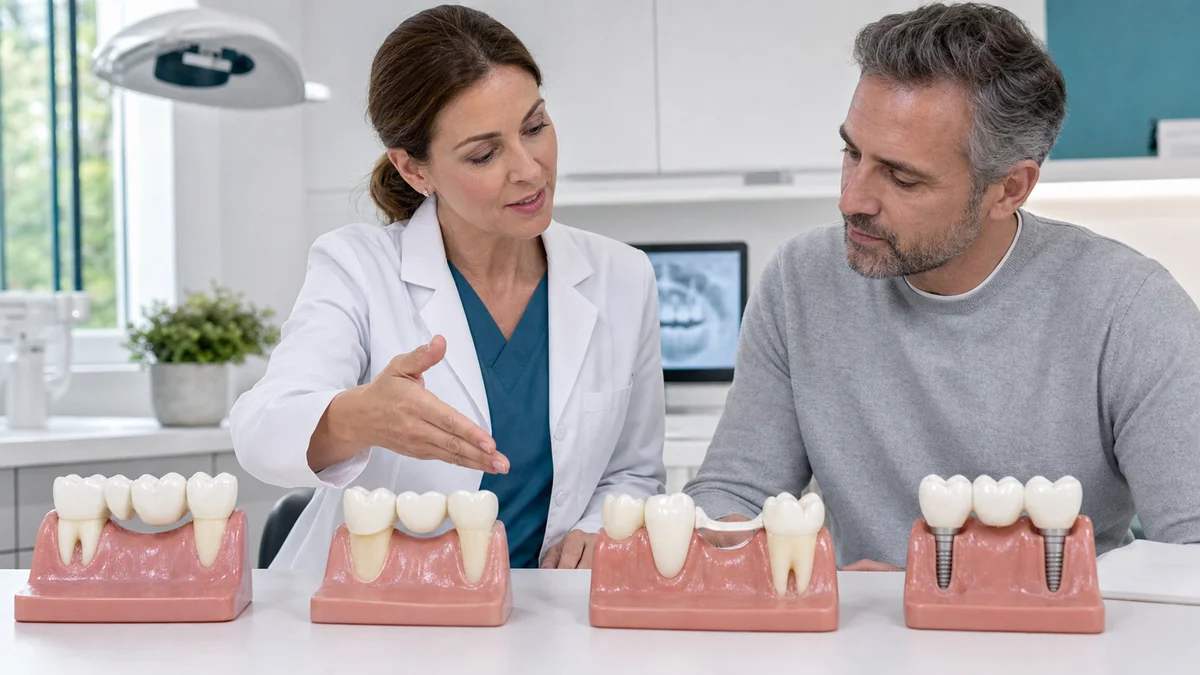
Quick answer: A safe dental bridge comparison begins with the gap, not a preferred product. Conventional, cantilever, resin-bonded, and implant-supported bridges differ in support, tooth preparation, surgery, cleanability, retrievability, and repair. The condition of neighboring teeth, gums, bone, bite, span, growth, medical history, and maintenance ability determines which options deserve consideration. Sometimes an implant crown, removable denture, orthodontic space closure, or no replacement is more appropriate.
A missing tooth creates a visible space, but the clinical problem is larger than the space. The tooth may have been lost through decay, fracture, gum disease, trauma, failed treatment, or developmental absence. The remaining teeth may be untouched, heavily restored, tilted, mobile, or already crowned. Bone, gums, bite, speech, appearance, age, health, and future treatment plans can all change the safest replacement strategy.
People searching dental bridge comparison are often shown a short list of “traditional, cantilever, Maryland, and implant-supported” products. That list is useful only when paired with the questions that select among them. A bridge that avoids surgery may require preparation of sound neighboring teeth. A conservative resin-bonded design may preserve enamel but may not suit every bite or span. An implant-supported bridge avoids natural-tooth abutments but introduces surgery, bone, healing, and implant-maintenance considerations.
This guide compares treatment concepts without diagnosing a particular gap, quoting a fixed price, assigning a universal lifespan, or guaranteeing a result. It is intended to support an informed examination and consent discussion with a licensed dental team.
1. dental bridge comparison starts with the cause, position, and purpose of the gap
The first decision is whether the space should be restored at all, and if so, why. Replacement may support appearance, chewing, speech, occlusal stability, or a broader rehabilitation. In selected mouths with enough functional teeth and no unacceptable movement or aesthetic concern, monitoring a space may be reasonable. In other situations, delay can make later care more complex because teeth drift, the bite changes, or available space is lost.
Diagnosis should identify active disease before a definitive prosthesis is designed. The 2026 NHS England dental care pathways guidance states that fixed prosthodontic treatment is generally postponed while active disease and risk factors are being managed. It also emphasizes personalised planning based on disease and risk profiles. A fixed bridge should not seal over unresolved decay, depend on uncontrolled periodontal disease, or be selected before the extraction site and supporting tissues are understood.
A useful assessment asks:
- Why is the tooth absent or planned for extraction?
- Is the gap in the front, premolar, or molar region?
- How many teeth are missing, and how long is the span?
- What is the condition of each potential supporting tooth?
- Are there active caries, gum inflammation, mobility, cracks, or endodontic concerns?
- Is growth complete if implant treatment is being considered?
- What outcome matters most to the patient, and what maintenance can they manage?
2. The four main fixed bridge concepts are not interchangeable
A bridge replaces one or more absent teeth with artificial teeth called pontics, retained by teeth, implants, or a bonded framework. The ADA describes a fixed bridge as a replacement attached to surrounding teeth for support, while an implant bridge attaches artificial teeth to implants in the jaw. “Fixed” means the patient does not remove it for routine cleaning; it does not mean the restoration is permanent or maintenance-free.
The four labels describe support designs rather than quality grades:
- Conventional tooth-supported bridge: crowns on prepared abutment teeth are joined to one or more pontics.
- Cantilever bridge: the pontic is supported from one side rather than both sides of the gap.
- Resin-bonded bridge: one or more thin retainers bond mainly to the back of neighboring teeth, often with limited preparation.
- Implant-supported bridge: two or more implants support multiple replacement teeth without using natural teeth as abutments.
A “Maryland bridge” is commonly used as a name for a resin-bonded design, but framework, wing number, preparation, material, and connector design still matter. Likewise, “implant bridge” can refer to different numbers of implants and replacement teeth. A treatment plan should describe the actual structure, not rely on the category name.
3. A 12-factor decision table for comparing bridge options
This matrix shows how questions change the discussion. A dental bridge comparison becomes useful when the same clinical factors are applied to every design rather than when one product is promoted in isolation. It is not a remote treatment selector. The same design can be appropriate in one mouth and unsafe in another.
| Decision factor | Conventional bridge | Resin-bonded or cantilever | Implant-supported bridge | What must be verified |
|---|---|---|---|---|
| 1. Support source | Prepared natural teeth | Bonded enamel or one-sided tooth support | Implants integrated with jaw bone | Foundation health and load path |
| 2. Neighboring teeth | May be favorable if already heavily restored or crowned | Often attractive when enamel is suitable for bonding | Avoids using adjacent teeth as retainers | Restorations, enamel, roots, pulp, and prognosis |
| 3. Tooth preparation | Usually substantial crown preparation | Often limited, but design-specific | No preparation of neighboring teeth for support | Exact tooth-by-tooth reduction plan |
| 4. Surgery | No implant surgery | No implant surgery | Requires implant surgery and healing | Medical, anatomical, and bone suitability |
| 5. Span | Depends on abutment and span mechanics | Often more selective for short spans or locations | Can replace several teeth with planned implant distribution | Number and position of missing teeth |
| 6. Bite forces | Distributed through abutment teeth | Connector and one-sided loading need care | Distributed through implants and framework | Contacts, bruxism, opposing teeth, and leverage |
| 7. Cleaning | Under-pontic and abutment margins need access | Wing, pontic, and connector require tailored access | Implant surfaces and pontics require specific access | Can the patient clean every surface daily? |
| 8. Tissue contour | Pontic shape must respect the ridge and gums | Especially important in visible front sites | Bone and soft-tissue anatomy affect emergence | Ridge volume, smile line, and cleanable contour |
| 9. Retrievability | Cemented units can be difficult to remove intact | Debonding may be repairable in selected cases | Screw-retained designs may aid access in some plans | How will future repair or access be managed? |
| 10. Treatment sequence | Preparation, temporary, laboratory, fit | Assessment, limited preparation, laboratory, bonding | Surgery, healing, restorative stages | Realistic timing without shortcuts |
| 11. Future change | Abutment failure can affect the connected unit | May preserve more future options | Implant position influences later prostheses | Repair, replacement, and loss-of-support plan |
| 12. Financial pathway | Includes abutment and laboratory care | Includes bonding and possible rebonding/remake | Includes surgery, components, and prosthesis | Itemised total pathway and exclusions |
4. Conventional tooth-supported bridges: when preparation may be justified
In a conventional bridge, one or more teeth next to the gap are prepared for crowns that are connected to the replacement tooth. The American College of Prosthodontists describes the classic design as crowns on teeth on both sides of a space joined to a false tooth. This can provide a fixed replacement without implant surgery.
The biological question is whether preparing the abutments adds reasonable benefit. If neighboring teeth already need full-coverage restorations because of major structural loss, a bridge may combine restoration and replacement. If those teeth are healthy and untouched, preparation removes tissue that does not regrow and commits them to a connected prosthesis. Neither fact automatically decides the case, but both belong in consent.
Potential abutments should be assessed individually for periodontal support, mobility, root form, crown-to-root relationship, caries, cracks, pulp and root-canal status, existing posts, ferrule, alignment, and ability to retain a crown. The bridge then asks those teeth to support themselves and the pontic under function. A good-looking margin cannot compensate for a poor foundation.
Conventional bridges may also complicate later access. If one abutment develops disease, the connected restoration may need sectioning, repair, or replacement. The plan should explain whether future root-canal access is possible, what happens if one support becomes non-restorable, and whether the design allows a practical repair.
5. Cantilever bridges: one-sided support means selective use
A cantilever bridge supports a pontic from one side of the gap. It may avoid preparing a tooth on the other side or permit replacement where two-sided support is unavailable. The tradeoff is mechanics: the pontic can act as a lever on its supporting retainer, so location, span, connector, contact pattern, and magnitude and direction of force matter.
“One supporting tooth” does not make a cantilever automatically conservative. A full-coverage cantilever can still require substantial preparation, while a resin-bonded cantilever may use a different enamel-bonded concept. These designs should not be grouped merely because both have support on one side.
Questions include whether the pontic is in a high-load region, whether the supporting tooth is stable, whether the opposing contact can be controlled, and whether bruxism or parafunction increases risk. A design that works for a selected front-tooth space may be inappropriate for a long posterior span. The recommendation must be site-specific.
6. Resin-bonded bridges: preserving tissue without pretending there are no limits
A resin-bonded bridge uses a thin retainer bonded primarily to enamel on an adjacent tooth, often behind the visible surface. NHS hospital guidance describes resin bridges as being glued to neighboring teeth, in contrast with conventional bridges that require those teeth to be filed for crowns. This can preserve more tooth tissue and may be attractive for selected short spaces, especially when adjacent enamel is healthy.
Conservation does not mean universal suitability or zero preparation. Small preparations, grooves, rests, or surface modifications may be used depending on the design. Bonding quality depends on the available substrate, isolation, framework fit, surface treatment, connector design, and occlusion. Large restorations on the supporting surface or limited enamel can change the calculation.
Debonding may sometimes act as a visible complication rather than a hidden fracture, and rebonding may be possible in selected situations. However, recurrent debonding is not simply an inconvenience to ignore; it may signal a design, fit, substrate, or bite problem that requires reassessment. A loose wing can also trap plaque if the bridge appears to remain in place.
The patient should know whether the plan uses one wing or more, which tooth carries it, how contacts are managed, and what to do if the bridge moves. “Maryland bridge” alone does not answer those questions.
7. Implant-supported bridges: natural teeth are spared, but surgery enters the plan
An implant-supported bridge uses implants rather than natural teeth as abutments. It can replace several missing teeth without preparing adjacent teeth for support. Unlike a single implant crown for one missing tooth, it connects multiple replacement teeth across two or more implant supports.
The NHS describes implants as screws placed in jaw bone to support crowns, bridges, or dentures. Suitability depends on anatomy, bone volume and quality, soft tissues, growth, oral hygiene, disease control, smoking or other relevant risk factors, medications, medical history, and ability to attend maintenance. Some sites may need grafting or other procedures, while some patients may be better served by a non-surgical option.
Implant distribution and prosthetic design should be planned together. More replacement teeth do not necessarily require one implant per tooth, but using too few or poorly positioned supports can create mechanical and cleaning challenges. The dentist or specialist should explain the proposed number and location of implants, whether the prosthesis is screw- or cement-retained, and how access for hygiene and future repair is built in.
An implant does not have the same attachment and sensory behavior as a natural tooth. That does not make implants inferior; it means mixed natural-tooth and implant support requires careful planning and is not assumed to behave like two identical pillars.
8. Bridge alternatives belong inside every dental bridge comparison
Choosing a bridge without comparing alternatives weakens consent. Depending on the gap and the patient, alternatives may include a single implant crown, removable partial denture, orthodontic space closure, transplantation in rare specialist contexts, delayed replacement, or accepting the space. The Cambridge University Hospitals patient guidance explicitly lists resin bridges, conventional bridges, dentures, alternative implant strategies, and no replacement among options considered when implant procedures are not pursued.
A single implant crown may replace one tooth without preparing adjacent teeth, but requires surgical and anatomical suitability and creates its own maintenance needs. A removable partial denture can replace one or several teeth, may be easier to modify if the dentition changes, and avoids fixed preparation in some cases, but it is removable and can affect comfort, plaque control, and adaptation.
Orthodontic space closure may eliminate the need for a prosthetic tooth in selected developmental or positional cases, but changes tooth positions and requires orthodontic planning. No replacement may be reasonable when function, stability, appearance, and patient preference permit, but it should follow assessment of likely movement and occlusal consequences.
The safest option is not automatically the most technologically advanced or the least expensive. It is the option whose biological cost, function, maintenance, risks, and future pathway best match the individual case.
9. Adjacent-tooth condition is often the pivotal decision
Healthy, unrestored neighboring teeth create a different decision from heavily filled, crowned, cracked, or root-treated teeth. A conventional bridge can consume sound tissue when used solely to replace the gap. On the other hand, if adjacent teeth independently require crowns, incorporating them into a bridge may be a coherent plan, provided their prognosis and support are adequate.
Do not judge the abutment by its visible crown alone. A tooth can look intact while having limited periodontal support, a short clinical crown, a crack, a large hidden restoration, root-canal complications, or unfavorable alignment. Conversely, a root-treated tooth is not automatically unsuitable; its remaining structure, ferrule, root, periodontal support, and restorative prognosis matter.
Ask the clinician to present a tooth-by-tooth prognosis and to separate treatment the support teeth need anyway from preparation performed only to retain the bridge. This distinction makes the biological cost visible.
10. Span, location, ridge anatomy, and bite control the mechanics
A bridge that replaces one small front tooth is not mechanically equivalent to a long posterior span. Longer spans can flex more and increase demands on connectors and supports. Posterior regions generally experience different forces and access challenges from anterior regions. The shape and height of the residual ridge influence pontic form and appearance.
Occlusal planning considers opposing teeth or prostheses, contact position, guidance, parafunction, missing teeth elsewhere, and whether the patient clenches or grinds. A bridge should not be designed as an isolated object. It joins a system that moves under load.
Soft-tissue contour also matters. In a visible region, loss of bone and gum volume can make a replacement tooth appear long or create dark spaces. Trying to hide a large tissue deficit with an over-bulky pontic can impair cleaning. Alternatives may include a different prosthetic contour, soft-tissue-colored material, grafting in selected cases, or a removable design. Aesthetic preference must remain compatible with hygiene.
11. Periodontal health, caries risk, and hygiene can overrule a preferred design
The ADA notes that bridge success depends on the foundation and emphasizes keeping remaining teeth healthy and strong. The WHO identifies caries and periodontal disease among the main oral diseases. These conditions matter because bridge margins, retainers, connectors, and pontics create surfaces that require consistent plaque control and professional review.
Active gum inflammation, poor plaque control, uncontrolled decay risk, dry mouth, smoking, and irregular attendance can change prognosis and design. The answer is not always to refuse fixed treatment forever. It may be to control disease, demonstrate cleaning, stabilize risk, and reassess before committing to a definitive prosthesis.
FDI’s minimal-intervention principles support preserving healthy and remineralisable tooth structure. That principle is relevant when deciding whether to prepare sound abutments, repair an existing restoration, or select a more conservative support design. Conservation must still be balanced against reliable retention, function, and cleanability.
12. Cleaning access should be designed before the bridge is made
A fixed bridge cannot be flossed like separate natural teeth because the units are connected. The area beneath the pontic and around abutment or implant surfaces requires a planned route for cleaning. Floss threaders, super floss, interdental brushes, water irrigation, or other aids may be suggested according to the space and the dental team’s instructions.
The prosthesis should not force the patient to use a tool that physically cannot pass through the designed embrasure. Ask to see where the cleaning aid enters, how it moves beneath the pontic, and which surfaces need special attention. The demonstration should happen at delivery and be reviewed after the patient has tried it at home.
Report persistent bleeding, swelling, bad taste, odor, food trapping, tenderness, or difficulty cleaning. These findings do not identify one cause, but they warrant assessment rather than stronger home cleaning alone. A bridge can look stable while disease develops at a margin or around a support.
13. Material choice comes after support and design
Bridge frameworks and visible surfaces may use ceramics, metal-ceramic combinations, metals, polymers, or other dental materials depending on the design and jurisdiction. Material affects available thickness, connector dimensions, bonding, repair, appearance, wear against opposing teeth, imaging, and laboratory workflow.
No single material is “best” independently of span, support, clearance, bite, aesthetic zone, preparation, and laboratory execution. A highly translucent material may not mask a dark substrate. A strong framework still needs adequate connector design and support. A beautiful ceramic surface does not make an unhealthy abutment safe.
Ask for the material name, manufacturer information where available, framework design, expected maintenance, and repair options in writing. Avoid choosing based only on broad labels such as “porcelain,” “zirconia,” or “metal-free.”
14. Procedure and provisional care differ across bridge types
A conventional bridge often involves examination, tooth preparation, records or scanning, a temporary bridge, laboratory manufacture, trial, adjustment, and cementation. A resin-bonded bridge may require little preparation but still depends on meticulous records, fit, isolation, surface treatment, and bonding. Implant-supported bridges add surgical assessment, implant placement, healing, impression or scan stages, components, and prosthetic delivery.
Temporary care is part of treatment rather than dead time. A provisional bridge may protect prepared teeth, maintain space, test contour, support appearance, and reveal bite or cleaning problems. It is not identical to the final restoration and can loosen or fracture, so patients need clear instructions and contact routes.
Timelines vary with disease control, extraction healing, laboratory work, implant integration, grafting, soft-tissue management, and the need for adjustment. A travel date or promotional deadline should not determine biology. The plan should include contingencies if a support tooth, implant site, or provisional stage does not behave as expected.
15. Repair, removal, and future failure should be planned before treatment
Bridges may experience loss of retention, ceramic chipping, connector fracture, framework problems, wear, caries at a tooth margin, periodontal disease, implant complications, or failure of a supporting tooth. Listing possibilities does not predict that they will happen. It allows the patient to understand whether a problem can be repaired locally or requires sectioning, removal, surgery, or remake.
The NHS England guidance highlights retrievability and adaptability when future access or changes may be important. Removable prostheses are inherently retrievable, while fixed designs vary. Screw-retained implant prostheses may offer access advantages in selected cases, but screw channels and mechanics also need planning. Cemented bridges may be difficult to remove without damage.
Ask three questions: What is the most likely maintenance event? Can the bridge be removed or repaired without sacrificing a healthy support? What is the backup plan if one support is lost? A design with a clear exit strategy can be more valuable than one optimized only for the day of placement.
16. Cost and insurance: compare the whole pathway, not the unit price
There is no responsible fixed price for a bridge without an examination and defined scope. For finances, a dental bridge comparison should cover the whole care pathway rather than a single advertised unit. Cost can vary with location, number of units, support type, material, laboratory, scans or impressions, abutment treatment, temporary restorations, extraction, periodontal care, implant surgery, grafting, sedation where appropriate, and follow-up.
A lower initial fee may exclude necessary preliminary or maintenance care. A higher fee does not prove better diagnosis or execution. Request an itemised written plan that distinguishes required treatment from optional upgrades and states what happens if findings change after examination.
Insurance rules and public funding vary by country, policy, clinical indication, network, material, and prior authorization. Confirm coverage directly with the payer and ask whether the quoted restoration, supporting treatment, temporary care, repairs, and follow-up are included. Do not let a benefit category substitute for clinical suitability.
17. Comparing dental bridges in Turkey requires a continuity plan
International dental care adds travel, record transfer, laboratory coordination, and remote follow-up to the clinical decision. A short visit should not compress disease control, tooth preparation, implant healing, provisional testing, or review beyond what the case permits. The final plan may change after in-person examination.
When contacting Redent Klinik, provide a medical and dental history, medications, allergies, smoking status, symptoms, date and cause of tooth loss, previous imaging, and information about existing restorations. Remote photographs and scans can support preliminary communication but cannot confirm periodontal support, decay, cracks, pulp status, bone, or bite.
Before travel, ask the Redent Klinik contact team for the proposed stages, likely provisional plan, records supplied at completion, material and component documentation, and routes for urgent and routine follow-up. Clarify which problems require return to the treating clinic and which can be managed by a local dentist.
18. Red flags and symptoms that need assessment
Pause when a provider recommends a definitive bridge from photographs alone, refuses to compare no treatment or removable options, describes healthy-tooth preparation as reversible, guarantees a lifetime result, or uses one fixed design for every gap. Pressure to select a material or tooth count before diagnosis is another warning sign.
Seek dental assessment if an existing bridge becomes loose, fractures, traps food suddenly, develops a bad taste, causes persistent gum bleeding, or feels high when biting. Pain, swelling, a draining spot, facial trauma, or a support tooth that feels mobile also needs professional review. Do not glue a bridge back with household adhesive.
Severe swelling, difficulty breathing or swallowing, uncontrolled bleeding, or significant facial injury can require urgent care under local emergency pathways. A detached small component may create an aspiration risk; obtain prompt advice rather than continuing to wear an unstable prosthesis.
Frequently asked questions about dental bridge comparison
Which type of dental bridge is best?
There is no universal best design. The answer depends on gap position and length, neighboring teeth, enamel, gums, bone, bite, medical factors, cleaning ability, appearance, and future repair. The best-supported recommendation is the one that follows examination and a comparison of reasonable alternatives.
Is a resin-bonded bridge better than a conventional bridge?
It often preserves more tooth tissue, but it has selective bonding, span, and bite requirements. A conventional bridge may be reasonable when adjacent teeth independently need crowns. “Better” depends on the biological cost and mechanical suitability of the actual supports.
What is the difference between a cantilever and a Maryland bridge?
Cantilever describes one-sided support. Maryland commonly describes a resin-bonded retainer. A bridge can therefore be both resin-bonded and cantilevered. Ask about the exact retainer, support tooth, preparation, connector, and contact design rather than relying on names.
Does a traditional bridge damage neighboring teeth?
Traditional crown-supported bridges require preparation of abutment teeth, which removes tooth structure. Whether that is an acceptable biological cost depends on the existing condition of those teeth and the alternatives. Preparation is not equivalent to deliberate damage, but it is irreversible intervention that needs consent.
Is an implant bridge always better because it does not use natural teeth?
No. It avoids natural-tooth abutment preparation but requires surgery, suitable anatomy and health, healing, components, and implant maintenance. Some patients or sites favor a tooth-supported or removable option. Implant and prosthetic plans must be assessed together.
Can one bridge replace several missing teeth?
Sometimes, but span length, support distribution, bite, connector dimensions, ridge shape, and cleanability limit design. A long space may need additional tooth or implant supports, a removable prosthesis, or a different plan. The number of pontics alone cannot decide suitability.
Can a dental bridge be removed and reused?
It depends on retention and design. Some bridges cannot be removed intact, while selected screw-retained implant prostheses may be retrievable. A resin-bonded bridge may sometimes be rebonded. Reuse is never guaranteed; the bridge, supports, fit, and reason for removal must be assessed.
How do I clean under a fixed bridge?
Cleaning usually requires access beneath the pontic with a floss threader, super floss, interdental brush, water irrigator, or another aid selected by the dental team. Technique depends on contour and space. Ask for a demonstration and report areas that cannot be reached.
Do dental bridges last forever?
No fixed restoration should be promised to last forever. Its service depends on support health, design, material, bite, hygiene, risk factors, accidents, and maintenance. Ask about reviews, likely repairs, and the backup plan rather than relying on a universal lifespan.
Is leaving a gap ever reasonable?
Yes, in selected cases with acceptable function, stability, appearance, and patient preference. In other cases, movement, bite change, food trapping, or appearance may favor treatment. “No replacement” should be a considered option after assessment, not neglect.
Final decision: make the foundation visible
A useful dental bridge comparison does not rank four products from best to worst. It makes the support system visible: which teeth or implants carry the load, what tissue must be altered, how the pontic will be cleaned, what surgery or healing is required, and what happens if one component later needs care.
Ask for a diagnosis, support-by-support prognosis, alternative comparison, actual material and design, cleaning demonstration, itemised pathway, and repair strategy. The safest choice is the one that meets the clinical objective with an acceptable biological cost and a realistic maintenance plan, not the option with the strongest marketing label.
Sources and evidence
- American Dental Association: Official website
- American Dental Association, MouthHealthy: Bridges
- NHS England: NHS dentistry care pathways guidance, 8 July 2026
- NHS: Dental treatments, bridges, implants, and dentures
- NHS: Dentures and alternatives for missing teeth
- American College of Prosthodontists: Bridges
- Cambridge University Hospitals NHS: Alternatives including resin, conventional, implant, and removable options
- FDI World Dental Federation: Minimal Intervention Dentistry
- World Health Organization: Oral health fact sheet