
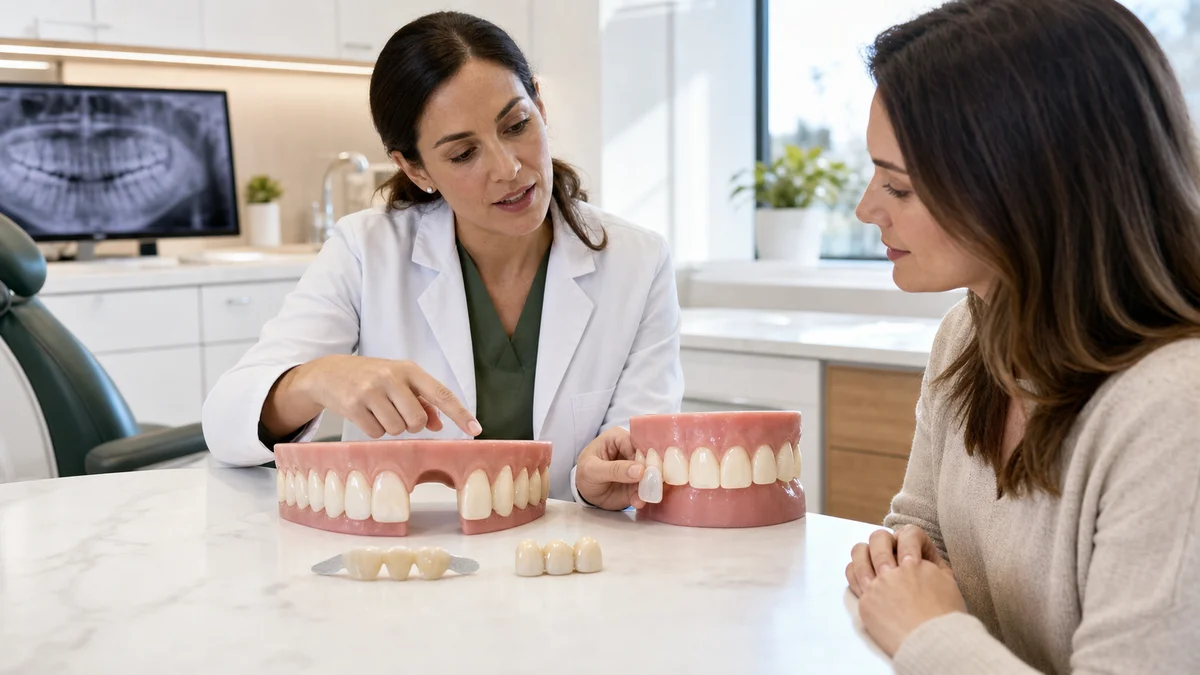
Quick answer: A dental bridge replaces a tooth that is missing; a veneer changes the visible surface of a tooth that is still present. They are rarely direct substitutes. The better option is the one that matches the diagnosis while preserving healthy tissue, supporting the bite, allowing daily cleaning, and fitting a realistic maintenance plan after a licensed dentist assesses the teeth and gums.
When people ask dental bridge or veneers which is better, the most important detail is often missing from the question: is there a natural tooth in the space? A bridge includes an artificial tooth that spans a gap. A veneer is a thin restoration bonded to the front or visible surface of an existing tooth. If the tooth is absent, there is no surface for a veneer to restore. If the tooth is present and healthy, preparing neighbouring teeth for a conventional bridge solely to change its appearance would usually solve the wrong problem.
This anatomy-first distinction sounds simple, yet real cases are more nuanced. A very small tooth can resemble a gap. A retained baby tooth, congenitally absent tooth, fractured crown, root remnant, failed implant, or space created by gum recession can look similar in a photograph. The options also differ according to supporting teeth, bite, ridge shape, disease risk, tooth vitality, existing restorations, smile line, and the patient’s ability to clean beneath a fixed replacement.
The guide below uses 12 clinical questions to organise a consultation. It is not a diagnostic tool and does not recommend treatment for an individual. A licensed dentist may need an oral examination, periodontal measurements, vitality tests, radiographs selected for clinical need, photographs, scans, and bite analysis. Disease and urgent problems should be stabilised before elective definitive restorations.
1. Is the Tooth Present, Missing, or Not Restorable?
The first checkpoint is not colour, material, or cost. It is the status of the tooth. A natural tooth may be present but small, rotated, dark, worn, chipped, or partly hidden. Another tooth may be present only as a root or be so structurally compromised that retaining it is uncertain. A true missing-tooth space has no crown to veneer, but the bone and gum architecture still influence how a replacement can look and function.
If the tooth is present, the dentist asks whether its pulp, root, enamel, dentine, periodontal support, and existing restorations are healthy enough for conservative treatment. If it is absent, the questions change: must the space be replaced, can orthodontics close it, are adjacent teeth suitable bridge supports, is an implant appropriate, or would a removable option be safer and more adaptable?
A useful opening checklist is:
- Is a complete natural tooth present in the area of concern?
- Is there active decay, a crack, trauma history, infection, or a large restoration?
- How much healthy enamel remains?
- Are the neighbouring teeth intact, crowned, filled, mobile, or periodontally reduced?
- Is the “gap” caused by a missing tooth, spacing, tooth size, tooth position, or gum contour?
At Redent Klinik, this diagnosis should be established before a restoration is chosen from a photograph or promoted package.
2. What Is a Dental Bridge Actually Replacing?
A bridge is a fixed prosthesis that replaces one or more missing teeth. The replacement tooth, called a pontic, is joined to one or more retainers. Those retainers may be crowns on neighbouring teeth, bonded wings on the back of a supporting tooth, or components attached to implants. Each design has different preparation, support, hygiene, aesthetic, and repair considerations.
A bridge can restore a continuous dental arch, provide a chewing surface, improve appearance, and help manage a space. It does not create a new natural root, pulp, or periodontal ligament for the artificial tooth. Forces travel through the retainers and their supporting structures. The condition of those supports therefore matters as much as the visible gap.
The dentist evaluates span length, bite, gum and bone support, root form, remaining tooth structure, vitality, tooth position, existing fillings or crowns, and the ridge beneath the intended pontic. A bridge that looks attractive at delivery can still be a poor design if the supports are weak, the span flexes, the pontic traps plaque, or the patient cannot clean it.
3. Which Bridge Design Preserves the Most Appropriate Tissue?
“A bridge” is not one procedure. A conventional bridge commonly requires significant preparation of an adjacent tooth or teeth for crowns. This can be reasonable when those teeth already have large restorations or need crowns for independent reasons. It is a more serious biological trade-off when both neighbours are intact. Leeds Teaching Hospitals notes that conventional bridge preparation can affect supporting teeth and their pulps, which is why the pre-existing condition of those teeth belongs in the consent discussion.
An adhesive or resin-retained bridge uses a wing bonded to the back of a supporting tooth and may require little preparation in selected cases. It can debond, and design, bite, enamel quality, space, and tooth position influence suitability. A cantilever design uses support on one side of the gap, while other configurations distribute support differently. Longer spans and heavy forces require particular caution.
Ask the dentist to name and draw the proposed design. The comparison should include:
- which teeth support the bridge;
- which surfaces will be prepared and by how much;
- whether the supporting teeth already need restorations;
- how the pontic will contact or approach the gum;
- where floss or an interdental tool will pass;
- what a debond, fracture, decay, or support-tooth problem would mean;
- which replacement alternatives preserve more future options.
4. What Is a Veneer Actually Changing?
A veneer is a thin layer of porcelain or composite placed over the visible surface of a tooth. It may change shade, texture, apparent width, length, contour, or limited aspects of visual alignment. Because it depends on an existing tooth, bonding substrate and tooth position are central. Strong enamel bonding is valuable; large fillings, cracks, severe wear, deep discolouration, limited enamel, or an unfavourable bite can change the plan.
The American Dental Association explains that porcelain veneer placement typically includes removing a small amount of enamel from the front and sides, and it warns that treatment is irreversible when enamel is removed. Minimal-preparation or additive approaches may be possible in selected positions, but adding material to a prominent tooth can create bulk. “No-prep” should therefore be a finding from planning, not a marketing guarantee.
A veneer cannot replace a missing root, rebuild an absent tooth in open space by itself, or correct every bite or root-position problem. It should not be bonded over untreated decay or gum disease. It can chip, crack, wear, loosen, or need replacement, and the tooth can still develop decay at or beneath margins. The patient should understand both the initial design and the restoration’s future life cycle.
5. Dental Bridge or Veneers Which Is Better for This Starting Point?
The table translates starting anatomy into a discussion pathway. It is not a prescription; examination findings can make another option more appropriate.
| Starting point | Usually relevant discussion | Why | Risk to clarify |
|---|---|---|---|
| One tooth is truly absent | Bridge, implant, removable replacement, orthodontic closure, or accepting the space | A veneer has no natural tooth to bond to | Support, bone and gum anatomy, bite, cleaning, preparation, and future adaptability |
| Tooth is present and healthy but its shape or intrinsic colour is the concern | Whitening, contouring, composite bonding, orthodontics, or veneer assessment | The problem involves a present tooth’s visible surface | Enamel removal, shade masking, margin health, fracture, and replacement |
| A very small tooth creates apparent spacing | Orthodontic space distribution plus additive restoration may be considered | Balanced space can reduce preparation and improve proportions | Final tooth widths and gumline should guide movement before restoration |
| Tooth is badly broken but the root remains | Restorability, pulp, periodontal, crown, extraction, and replacement assessment | Neither a simple veneer nor an automatic bridge diagnosis is sufficient | Cracks, ferrule, root health, bone support, and long-term seal |
| Gap exists beside two untouched healthy teeth | Compare adhesive bridge, implant, orthodontic, removable, and no-treatment options carefully | Preparing both neighbours for conventional crowns has a meaningful biological cost | Whether a lower-preparation option can meet function and appearance goals |
| Active decay, gum disease, or unstable hygiene | Disease control before definitive fixed treatment | Both bridge margins and veneers depend on a maintainable environment | What signs will demonstrate stability before proceeding? |
The decision is not won by the restoration with the most ceramic or the shortest appointment schedule. “Better” means correctly matched to anatomy and disease while leaving a manageable path for cleaning, repair, and future change.
6. Do You Need to Replace the Missing Tooth at All?
Not every space automatically requires a fixed replacement. The impact depends on location, chewing function, speech, appearance, bite stability, remaining teeth, risk of unwanted movement, and patient preference. In some mouths, accepting a stable gap is reasonable. In others, the space affects function or the patient strongly values replacement. The option of no treatment should be discussed when clinically defensible rather than omitted from consent.
Orthodontic closure may move neighbouring teeth into the space, sometimes followed by reshaping to create appropriate proportions. An implant-supported crown replaces a tooth without preparing adjacent teeth but involves surgery, bone and gum requirements, healing, and its own maintenance. A removable partial denture can replace one or several teeth and may be easier to modify if the mouth changes. Each pathway has trade-offs.
The latest NHS England care pathway guidance emphasises personalised risk and disease profiles and the retrievability or adaptability of prostheses during active disease management. A fixed restoration should not be presented as the inevitable next step while decay, periodontal instability, or future tooth loss remains uncontrolled.
7. How Much Healthy Tooth Will Be Changed?
Tissue preservation should be measured across every tooth involved. A single veneer may require facial and proximal preparation on one tooth. Multiple veneers multiply exposure. A conventional bridge may prepare one or two neighbouring teeth around much of their circumference. An adhesive bridge may alter very little enamel. Counting only the visible replacement can hide the total biological footprint.
Ask for a tooth-by-tooth map of preparation. A dentist can explain whether each supporting tooth is intact, filled, crowned, or already in need of restoration. Preparing an intact tooth for support differs from placing a crown where a large failing filling already requires coverage. Similarly, a minimally prepared veneer on a recessed tooth differs from reducing a prominent, dark tooth to mask its position and shade.
Conservative treatment is not merely the smallest object. It is the plan that solves the diagnosed problem with the lowest reasonable cumulative harm. An under-designed adhesive bridge that repeatedly debonds may not meet the patient’s functional needs; an extensive conventional bridge may sacrifice healthy supports unnecessarily. A veneer that cannot mask colour without over-preparation is not conservative simply because it is thin at delivery.
8. Will the Result Work With Your Bite?
A bridge transfers force through its supports. Span length, connector dimensions, pontic position, opposing teeth, clenching, grinding, and lateral contacts influence design. A cantilever in a heavily loaded area behaves differently from a short anterior adhesive bridge. The dentist should assess not only where teeth touch when the mouth closes but also contacts during forward and sideways movement.
Veneers also participate in the bite. Lengthening front teeth or changing palatal contours can affect guidance, speech, and ceramic stress. A deep overbite, edge-to-edge contact, or heavy parafunction can increase chipping or debonding risk. The ADA notes that people who clench or grind, or who have a deep overbite, may not be good veneer candidates without further assessment.
A nightguard may be discussed for diagnosed grinding, but it does not transform an unsuitable design into a suitable one. The restoration should first be planned for the actual bite. Protective appliances themselves need fit checks, cleaning, and replacement when worn or distorted.
9. Can You Clean Every Margin and the Area Under the Bridge?
Maintenance is a design requirement. A bridge connects units, so ordinary floss cannot drop vertically through those contacts. Plaque must be removed along retainers and beneath the pontic using a threader, super floss, interdental brush, water-flossing device, or another tool suited to the individual design. The pontic should support appearance and comfort without creating an inaccessible plaque trap.
Veneers are generally brushed and cleaned between like natural teeth, but margins and gumlines still require attention. Over-contoured restorations can make plaque control harder. Recession may expose a margin or root surface. Abrasive habits and using teeth to open packages or bite hard objects can damage ceramic.
NIDCR recommends brushing twice daily with fluoride toothpaste and cleaning between teeth regularly. Before choosing a fixed restoration, ask the dental team to demonstrate the exact tool and path you will use. If arthritis, limited dexterity, gagging, or another barrier makes a method unrealistic, the design or maintenance plan should adapt.
10. What Appearance Can Be Achieved Without Overpromising?
A bridge must make an artificial tooth appear to emerge naturally from a ridge that may have shrunk after extraction. Gum contour, space height and width, smile line, pontic design, and the colour of supports influence the result. If tissue loss is substantial, simply making a longer tooth can create unnatural proportions. Soft-tissue or alternative prosthetic strategies may be discussed, but healing and appearance cannot be guaranteed.
A veneer must harmonise with the underlying tooth, neighbouring teeth, lips, and gums. Ceramic translucency, thickness, cement, surface texture, and lighting affect shade. A severely dark tooth may not be masked by an ultrathin veneer without compromise. Matching one tooth can be technically demanding; treating many healthy teeth merely to make matching easier increases irreversible intervention.
Planning tools can include photographs, digital scans, diagnostic wax-ups, provisional restorations, and trial mock-ups. They improve communication but remain simulations. Ask which elements are predictable, which depend on tissue response or laboratory interpretation, and how shape can be adjusted before final bonding or cementation.
11. What Can Fail, and What Happens Next?
Bridges can debond, fracture, loosen, develop decay at margins, irritate gums, or be compromised by problems in supporting teeth. A conventional bridge may be difficult to treat if one retainer tooth later needs endodontic care or becomes non-restorable. An adhesive bridge often has a simpler debonding failure, but repeated loss can signal an unsuitable bite or design. Removal may damage the restoration or supporting structure.
Veneers can chip, crack, wear, debond, stain at margins, or require replacement. The underlying tooth can decay or fracture. Gum recession can alter the visual margin. A veneer that fails does not necessarily return the tooth to its pre-treatment state because preparation may have been irreversible.
Informed consent should include realistic failure modes rather than a fixed lifespan promise. Ask:
- Can this restoration be repaired, rebonded, or must it be replaced?
- What happens to supporting teeth if one part of a bridge fails?
- How would decay or root canal treatment be managed through or beneath the restoration?
- What options remain if bone, gums, or neighbouring teeth change?
- Which symptoms require prompt review?
No ethical provider can guarantee that a restoration will never need intervention. Diagnosis, preparation, laboratory quality, bonding or cementation, bite, habits, hygiene, health, and follow-up all influence service.
12. Are the Quote and Insurance Comparison Truly Like for Like?
A bridge quote may involve several units, diagnostic work, treatment of support teeth, temporary restorations, laboratory stages, and follow-up. A veneer quote may be per tooth and may or may not include wax-ups, provisionals, gum treatment, whitening, bite protection, or replacement of old restorations. Comparing only one headline number can hide different scopes.
Insurance classification varies. Veneers are commonly considered cosmetic unless a recognised restorative indication applies. Bridge coverage can depend on missing-tooth clauses, waiting periods, exclusions, frequency limits, network arrangements, alternative-benefit rules, and pre-existing conditions. Written preauthorisation is useful but is not a clinical guarantee or a promise of payment.
Request a written plan that separates diagnosis, disease control, preparation, provisional care, laboratory work, definitive restoration, maintenance, and possible additional procedures. For an individual examination and treatment sequence, use the Redent Klinik contact page.
A 12-Question Consultation Checklist
- Is the tooth present, absent, or non-restorable?
- What diagnosis is the restoration addressing?
- Is disease controlled before definitive treatment?
- Which teeth and surfaces will be prepared?
- Do neighbouring teeth independently need crowns or restorations?
- What bridge design or veneer material is proposed, and why?
- How does the bite affect the design?
- How will every margin and pontic be cleaned?
- What alternatives include no treatment, bonding, orthodontics, implant, or removable care?
- What are the likely failure modes and repair pathways?
- Which parts of the appearance are simulations rather than guarantees?
- What is included in the written estimate and long-term maintenance?
Be cautious if a provider recommends irreversible work without examining the teeth and gums, cannot identify support teeth or cleaning access, promises permanent results, or offers veneers through an unlicensed operator. The ADA warns that unlicensed veneer services can miss disease and cause harm.
Frequently Asked Questions
Can veneers replace a tooth that is completely missing?
No. A veneer needs an existing tooth surface for bonding. It can change the apparent shape of present teeth or close selected small spaces, but it does not create a root-supported artificial tooth in a genuine missing-tooth gap. Replacement options can include a bridge, implant-supported crown, removable denture, orthodontic closure, or no treatment depending on findings.
Dental bridge or veneers which is better for one visible front gap?
The cause of the gap decides the pathway. If a tooth is absent, a bridge may be one replacement option and a veneer alone cannot replace it. If all teeth are present but small or spaced, orthodontics, bonding, reshaping, or veneers may be considered. The dentist should confirm tooth number, root and bone status, space distribution, bite, and gum contour before recommending treatment.
Is an adhesive bridge always better than a conventional bridge?
No. An adhesive bridge may preserve more tooth tissue and can be attractive when a suitable enamel support and favourable bite are present. It can debond and may not suit every space or force pattern. A conventional bridge may be appropriate when support teeth already need crowns or have large restorations. Design should follow clinical conditions, not a universal ranking.
Can a bridge be supported by veneered teeth?
A veneer is not the same as a full bridge retainer. Support depends on the planned bridge design, underlying tooth structure, restoration condition, bonding surface, bite, and periodontal health. Existing veneers can complicate bonding or preparation decisions. The dentist must assess the actual teeth and may discuss replacing, preserving, or avoiding those restorations.
Which treatment removes more enamel?
It depends on the number of teeth and design. A conventional bridge can require extensive preparation of one or more support teeth, while an adhesive bridge may require little. A veneer usually prepares a visible surface but multiple veneers multiply treatment. Ask for a tooth-by-tooth preparation map rather than assuming from the treatment name.
Which is easier to clean, a bridge or veneers?
Veneers are generally cleaned like natural teeth, including around margins and between contacts. A bridge needs additional cleaning beneath the artificial tooth because connected units block ordinary vertical flossing. Many patients manage this well with threaders, interdental brushes, or water flossers, but the design must provide access and the method must fit the patient’s abilities.
Can I get veneers on the teeth beside a missing-tooth gap?
Possibly, but veneers on neighbouring teeth do not themselves replace the absent tooth. A combined aesthetic and replacement plan may be considered, yet each additional restored tooth increases intervention. Space, bridge or implant design, shade, support, gum contour, and future maintenance should be planned together before any enamel is prepared.
Should gum disease be treated before either option?
Yes. Active gum disease and uncontrolled plaque can compromise support, tissue levels, margin predictability, and daily maintenance. Fixed definitive restorations are generally planned after disease control and reassessment. A bridge does not stabilise periodontally weak supports, and a veneer does not cover away gum inflammation.
Do bridges or veneers last forever?
No. Both can need maintenance, repair, or replacement. Bridges may be affected by debonding, fracture, decay, gums, or support-tooth problems. Veneers may chip, debond, wear, or develop margin issues. Service varies with diagnosis, design, material, technique, bite, habits, hygiene, health, and follow-up, so fixed guarantees are inappropriate.
Is a bridge always necessary after an extraction?
No. The need to replace a tooth depends on location, function, stability, appearance, bite, health, and patient preference. Options may include accepting the space, orthodontic closure, implant-supported replacement, a removable appliance, or a bridge. The dentist should explain expected consequences and uncertainties for each reasonable pathway.
Can a photograph determine dental bridge or veneers which is better?
No. Photographs can aid communication but cannot show roots, bone support, hidden decay, pulp health, cracks, or all bite contacts. A clinical examination and justified diagnostic records are needed before irreversible treatment. Remote images are especially limited when it is unclear whether a tooth is absent, retained, fractured, or simply undersized.
What is the safest next step if I am undecided?
Arrange an examination with a licensed dentist and ask for a diagnosis-based written comparison. Request the proposed preparation, support, cleaning method, alternatives, risks, repair pathway, and total estimate. If several healthy teeth would be prepared or the diagnosis remains unclear, a second professional opinion can support informed consent.
Conclusion: The Better Option Is the One That Treats the Right Anatomy
The answer to dental bridge or veneers which is better begins with a physical fact: a bridge replaces a missing tooth, while a veneer modifies a tooth that exists. The next decision depends on restorability, support teeth, bridge design, enamel, gum and bone health, bite forces, appearance goals, cleaning access, alternatives, and future repair.
A careful plan protects healthy tissue and avoids treating a photograph rather than a diagnosis. Sometimes the correct choice is a conservative bridge, sometimes a veneer, sometimes another restorative or orthodontic path, and sometimes no treatment. Examination and informed consent turn those possibilities into an individual decision without promising a guaranteed result.
Sources
- Leeds Teaching Hospitals NHS Trust: Bridges
- NHS England Digital: Dental Treatment Definitions
- NHS England: Dentistry Care Pathways Guidance
- American Dental Association MouthHealthy: Veneers
- American Dental Association
- National Institute of Dental and Craniofacial Research: Oral Hygiene
- World Health Organization: Oral Health