
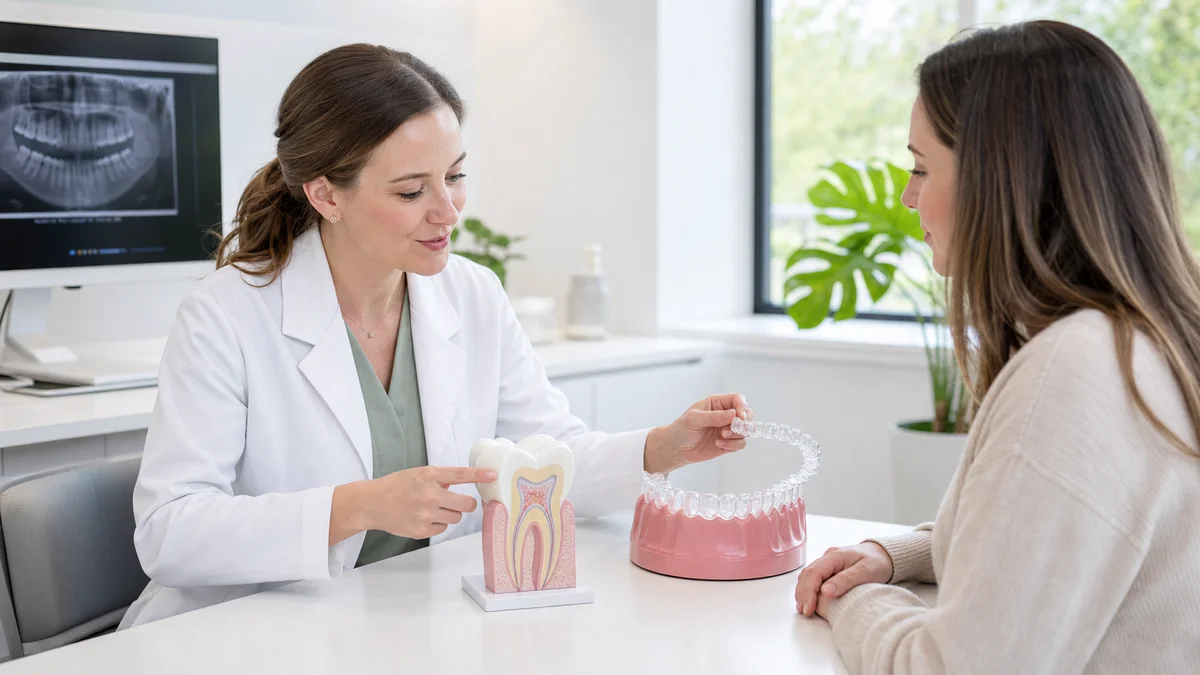
Quick answer: A root canal and Invisalign are not competing treatments. Root canal therapy treats inflamed or infected tissue inside a tooth; Invisalign is a brand of clear aligner treatment used to move teeth. If infection, severe decay, or pulpal disease is present, it is usually diagnosed and stabilised before aligner scanning or movement. Treatment order depends on restoration and orthodontic planning.
The search root canal vs Invisalign often appears when someone has tooth pain but also wants straighter teeth, or when a dentist discovers deep decay during orthodontic planning. These treatments act on completely different parts of the dental system. Root canal treatment addresses the pulp and root canal space inside a specific tooth. Invisalign uses a prescribed sequence of transparent trays to apply controlled forces and reposition teeth through the supporting tissues.
One does not substitute for the other. An aligner cannot disinfect an infected pulp, drain an abscess, seal a root canal, or restore a structurally damaged tooth. A root canal cannot straighten crowding, close orthodontic spaces, rotate teeth, or correct a bite relationship. A patient may need one treatment, neither treatment, or both in a carefully planned sequence.
The safe decision starts with diagnosis. Pain can arise from decay, a cracked tooth, pulp inflammation, gum disease, bite trauma, sinus-related discomfort, jaw-muscle problems, or temporary pressure from orthodontic movement. Symptoms alone do not identify the source. A licensed dentist may use an examination, radiographs selected for clinical need, vitality tests, percussion, periodontal measurements, and bite assessment. This article provides educational guidance and cannot determine whether an individual needs endodontic or orthodontic care.
1. Root Canal vs Invisalign: They Solve Different Problems
Root canal treatment, also called endodontic treatment, is considered when the soft tissue inside a tooth is irreversibly inflamed, infected, or necrotic. The clinician removes affected tissue, cleans and shapes the internal canal system, fills and seals it, and then ensures the tooth receives an appropriate final restoration. The goal is to control disease and retain a restorable natural tooth, not to change the tooth’s position.
Invisalign is a commercial clear aligner system. Like other professionally prescribed aligners, it uses staged trays designed to move teeth gradually. Attachments, elastics, interproximal enamel reduction, or other auxiliaries may form part of the plan. Clear aligner suitability depends on the orthodontic problem, periodontal support, root and bone findings, existing restorations, the bite, and the patient’s ability to follow wear and review instructions.
A simple triage separates the intentions:
- Deep decay, lingering thermal pain, spontaneous pain, swelling, or a suspected abscess: investigate pulpal and periapical health promptly.
- Crowding, spacing, rotation, or a bite concern without acute disease: obtain an orthodontic assessment.
- A damaged tooth within a crowded arch: coordinate disease control, restoration, and movement before either plan is finalised.
- Uncertain pain during aligner treatment: pause assumptions and ask the treating clinician to diagnose the source.
At Redent Klinik, cosmetic or orthodontic objectives should not outrank active disease. A stable oral environment is the foundation for predictable scanning, appliance fit, and long-term maintenance.
2. What Root Canal Treatment Is Designed to Do
Under enamel and dentine, the tooth contains pulp tissue with nerves, blood vessels, and connective tissue. Deep decay, repeated procedures, cracks, fractures, or trauma can inflame or infect this tissue. The NHS describes root canal treatment as removing infection from inside a tooth, cleaning and filling the space to help prevent reinfection. The American Association of Endodontists similarly explains that treatment removes inflamed or infected pulp, shapes the canals, and seals the internal system.
A root canal recommendation is not made merely because a tooth hurts. Some reversible sensitivity can settle when its cause is managed, while some severely damaged pulps produce little pain. A previously injured tooth can lose vitality without an obvious crack. Diagnosis therefore combines history, clinical tests, and imaging rather than relying on one symptom or an online checklist.
After endodontic treatment, the tooth still needs a sound coronal seal and adequate structural protection. Depending on tooth type, the amount of remaining tissue, cracks, and biting load, the final restoration may be a filling, onlay, or crown. A temporary filling is not intended to serve indefinitely. The condition and shape of the final restoration also matter to clear aligner planning because trays are manufactured to fit the scanned tooth surfaces closely.
3. What Invisalign and Other Clear Aligners Are Designed to Do
Clear aligners are transparent, removable trays custom formed for planned stages of tooth movement. They may treat selected crowding, spacing, rotations, tipping, arch coordination, and bite problems. Not every case can be treated predictably with aligners, and some require braces, additional appliances, restorative coordination, surgery, or no orthodontic treatment. A simulation shows intended movement; it is not a guarantee that the biology will track exactly.
The American Association of Orthodontists advises completing necessary dental work before the clear aligner scan because the trays are made to the exact shape of the teeth. A new filling, crown, extraction, or significant contour change after scanning can make an appliance fit poorly. This does not mean every future possibility must be predicted, but known disease and planned restoration should be incorporated before manufacturing a sequence.
Patient participation is essential. Trays are worn according to the prescriber’s schedule, removed for eating and oral hygiene, and changed only as directed. Teeth and gums require monitoring. Poor fit, severe pain, unexpected mobility, gum injury, swelling, or an abrupt bite change should prompt professional review. Continuing to advance trays without understanding a problem can delay diagnosis.
4. Decision Table: Which Pathway Applies First?
This table is a navigation aid, not a diagnosis. It shows why disease urgency, restorability, and appliance fit influence sequence.
| Clinical situation | Likely first step | Why | Planning question |
|---|---|---|---|
| Severe spontaneous pain, swelling, or suspected dental infection before aligner treatment | Urgent dental diagnosis; endodontic or other disease care if indicated | Orthodontic trays do not treat infection | Is the tooth restorable, and what definitive seal or restoration is required? |
| Healthy teeth with crowding or spacing and no pulpal concern | Orthodontic assessment | The problem primarily involves tooth position | Are aligners appropriate for the required movements and bite correction? |
| Root canal completed but final crown not yet placed | Coordinate restorative and orthodontic teams before scanning | The final tooth contour can affect tray fit and movement | Should the definitive restoration be completed before the scan, or intentionally timed within the orthodontic plan? |
| Tooth pain begins during active Invisalign treatment | Clinical assessment before assuming normal aligner pressure | Pulpal, periodontal, crack-related, and bite causes can mimic treatment discomfort | Is the pain localised, persistent, thermal, swelling-related, or associated with a particular tray? |
| A cracked or heavily restored tooth is planned to move | Restorability and risk assessment | Movement and appliance loading must be compatible with remaining structure | Does the tooth need stabilisation, endodontic care, restoration, altered movement, or exclusion from active force? |
| Dental abscess or facial swelling with systemic symptoms | Urgent local dental or medical care | Potentially spreading infection takes priority over elective orthodontics | Are there breathing, swallowing, fever, or rapidly progressing swelling concerns? |
The key principle is that elective tooth movement generally follows control of active disease. That does not require every root-filled tooth to receive identical treatment, and it does not mean orthodontics is impossible afterward. It means the teams need a stable diagnosis, a restorable tooth, and a deliberate sequence.
5. Symptoms That Need Diagnosis Before Aligner Movement
Mild pressure or tenderness can occur when a new aligner begins moving teeth. It is usually diffuse, related to biting, and settles as the patient adapts. However, symptom patterns vary, and a patient should not use this description to dismiss persistent or severe pain. Endodontic symptoms can include lingering sensitivity to heat or cold, severe pain on biting, spontaneous throbbing, a gum swelling or “pimple,” darkening after trauma, or local tenderness. Some infected teeth may have few symptoms.
Contact a dental professional promptly if pain is intense, worsening, lasting beyond the expected adjustment period, focused on one tooth, accompanied by swelling, or associated with a cracked restoration. Facial swelling, fever, difficulty swallowing, difficulty breathing, eye involvement, or rapidly spreading symptoms may indicate an emergency and require urgent local care. Do not wait for the next routine orthodontic appointment.
Self-treatment with leftover antibiotics is not an alternative to diagnosis and source control. Medication choices depend on medical history, allergy, infection pattern, and local guidance. Antibiotics alone do not clean and seal an infected root canal. Likewise, stopping or changing aligners without professional advice can affect movement. The right response is coordinated evaluation, not improvisation.
6. Why Dental Disease Is Usually Treated Before the Invisalign Scan
An aligner must fit the crowns and attachments accurately. Deep decay may require a filling, onlay, crown, or root canal followed by restoration. Each can alter the tooth surface captured by the scan. If trays are manufactured first and the tooth contour later changes, the aligner may rock, fail to seat, or apply forces differently from the plan. A new scan and revised sequence may be needed.
Disease control also protects the biological foundation for movement. Active gum inflammation, periodontal bone loss, uncontrolled plaque, and pulpal disease affect treatment risk. The orthodontic clinician needs current information about restorations, root-treated teeth, implants, missing teeth, gum support, and previous trauma. The general dentist remains important during orthodontics for examinations, professional care, and management of new disease.
Before scanning, a useful checklist includes:
- complete a dental examination and hygiene assessment;
- manage active decay and unstable restorations;
- diagnose unexplained pain or sensitivity;
- finish known root canal and restorative steps unless a coordinated plan specifies otherwise;
- record crowns, implants, bridges, root-filled teeth, and trauma history;
- agree which restorative changes should happen before, during, or after movement;
- confirm that the planned final tooth shapes match the orthodontic space plan.
This sequence reduces avoidable remakes, but it cannot eliminate every unexpected event. A tooth may develop symptoms during a long course even when the initial examination was sound. The system should be able to pause, diagnose, revise, and resume when appropriate.
7. Can a Root-Canal-Treated Tooth Move With Invisalign?
A mature tooth that has had root canal treatment remains attached to the jaw through its periodontal ligament and supporting tissues. It may be moved orthodontically in selected cases. The absence of vital pulp does not automatically fix the tooth in place. However, the tooth’s endodontic quality, root anatomy, previous infection, periapical healing, structural restoration, periodontal support, and movement requirements need assessment.
A clinician may want current radiographic information and may monitor a previously treated tooth during movement. Persistent apical disease, root resorption, cracks, an inadequate seal, a loose crown, or poor periodontal support can alter the plan. If a tooth has had trauma, orthodontic force decisions can require particular care because the injury history may affect pulp, root, or supporting tissues.
The word “successful” should not be assumed from the absence of pain alone. Some post-treatment findings need time to heal and radiographic follow-up. Conversely, a root-filled tooth does not automatically need retreatment simply because aligners are planned. An endodontist and orthodontic clinician can coordinate when the diagnosis or prognosis is uncertain.
8. Crown Timing, Attachments, and Aligner Fit
After root canal therapy, a tooth often requires a definitive restoration to restore seal and function. Whether this is a filling, onlay, or crown depends on tooth location, remaining structure, cracks, and bite. The American Association of Endodontists notes that posterior teeth often need greater protective coverage because of chewing demands, while the need varies for anterior teeth. The treating dentist decides based on individual findings.
If a crown is placed before scanning, the aligners and any attachment can be planned around its final shape. Bonding attachments to ceramic can require specific surface treatment and may have different retention considerations from enamel. If a temporary crown is scanned and later replaced, even a small contour change can affect fit. In some complex cases, a provisional restoration may be deliberately used during movement and the definitive crown made after the tooth reaches its final position. That requires explicit coordination.
Do not delay a necessary seal or protective restoration simply to avoid disrupting an aligner sequence without discussing the risk. A weak or temporarily sealed tooth can fracture or become contaminated. The biological need of the tooth comes before preserving a set of trays. If the contour must change, rescanning is preferable to forcing a poorly fitting appliance.
9. What If Tooth Pain Starts During Invisalign Treatment?
First, do not diagnose the pain from the brand name of the appliance. Note when it began, whether it is one tooth or several, how long it lasts, whether hot or cold triggers it, whether biting releases or worsens it, and whether there is swelling, a bad taste, mobility, or trauma. Record which tray you are wearing and whether it fully seats. Contact the treating orthodontic provider and general dentist so responsibilities are clear.
The clinician may inspect tray fit, contacts, attachments, gums, restorations, and the tooth itself. Tests can distinguish ordinary movement tenderness from decay, a cracked tooth, pulp disease, periodontal inflammation, or excessive contact. If endodontic treatment is needed, the orthodontic sequence may pause. The current tray might be modified or used as a passive retainer only if the clinicians advise it. After restoration, a new scan may be required.
Never drill, cut, or heat a tray at home to make it fit a newly restored tooth. Do not advance to the next tray to “push through” focal pain. Heat can distort clear plastic, and uncontrolled modifications can change force delivery. Professional adjustment or replacement is safer.
10. A Safe Combined Treatment Sequence
When both endodontic and orthodontic care are relevant, planning can follow a staged pathway. The exact timing changes by tooth and diagnosis, but a common logic is:
- Diagnose: identify the source of pain, pulpal status, restorability, periodontal support, and orthodontic problem.
- Control urgent disease: address infection, acute pain, decay, or unstable restorations.
- Complete endodontic care when indicated: clean, shape, fill, and seal the canal system.
- Protect the tooth: place the appropriate interim or definitive restoration according to the coordinated plan.
- Reassess: confirm symptoms, seal, structural stability, and any healing needed before active movement.
- Plan orthodontics: scan the actual tooth contours, incorporate restorations and attachments, and define monitoring.
- Move and monitor: attend reviews and report new focal symptoms promptly.
- Retain and maintain: wear retainers as prescribed and continue routine dental care.
There are exceptions. Urgent access through an existing crown may preserve enough contour for the current tray, or a definitive crown may be intentionally postponed when future tooth position determines its shape. Those decisions belong to the clinicians treating the actual tooth, not to a universal timeline.
11. Root Canal vs Invisalign Risks, Alternatives, and Informed Consent
Root canal therapy has limitations. Complex anatomy, persistent infection, cracks, inadequate restoration, or later leakage can lead to symptoms, retreatment, surgery, or extraction. The alternative may include monitoring in limited circumstances, extraction, or another endodontic approach depending on diagnosis and prognosis. No outcome should be guaranteed.
Clear aligner treatment can involve discomfort, poor tracking, attachment loss, gum irritation, decay risk if hygiene is poor, root changes, recession, incomplete correction, refinements, or relapse without retention. Alternatives can include braces, other appliances, restorative camouflage in selected cases, or no treatment. Invisalign is one brand; a brand choice does not replace a qualified orthodontic diagnosis.
Before consent, ask:
- What is the diagnosis for the painful or damaged tooth?
- Is the tooth restorable, and what is its endodontic and structural prognosis?
- Which restoration will follow the root canal, and when?
- Will the final contour change the scan, attachments, or tray fit?
- Can the tooth be moved safely, and how will it be monitored?
- What findings would pause or change orthodontic treatment?
- What alternatives exist for both the tooth and the alignment goal?
- What maintenance, follow-up, and retention will be required?
12. Cost and Insurance Are Separate From Clinical Priority
Root canal and Invisalign estimates should not be compared as if they purchase the same outcome. Endodontic cost can vary with tooth type, canal complexity, specialist involvement, imaging, temporary care, and the final restoration. Aligner cost can vary with diagnostic records, complexity, trays, monitoring, refinements, replacements, attachments, and retainers. A written plan should show which services are included and which are estimates.
Insurance policies may classify endodontic and orthodontic services differently. There may be waiting periods, deductibles, annual or lifetime limits, age restrictions, exclusions, preauthorisation requirements, or network rules. An insurer’s decision does not determine whether infection is clinically urgent. Obtain written benefit information but prioritise diagnosis and source control when disease is suspected.
For an examination-based sequence and an individual written estimate, use the Redent Klinik contact page. Bring existing radiographs, reports, current tray numbers, and details of temporary or final restorations so the teams can coordinate efficiently.
Frequently Asked Questions
Is root canal vs Invisalign a real either-or decision?
Usually no. Root canal therapy treats disease inside a tooth, while Invisalign moves teeth. If a tooth has infected or irreversibly inflamed pulp, aligners cannot replace endodontic care. If teeth are crowded but healthy, a root canal does not straighten them. A patient may need both, but disease control and restoration are commonly coordinated before active movement.
Can Invisalign cause a tooth to need a root canal?
Orthodontic movement normally applies controlled forces within biological limits, and needing a root canal is not an expected goal. However, a tooth may have pre-existing decay, trauma, cracks, large restorations, or compromised pulp that becomes symptomatic during treatment. Excessive or inappropriate forces can also create risk. Focal or persistent pain requires diagnosis rather than an assumption that the aligner caused or did not cause it.
Can I start Invisalign with an infected tooth?
Active infection should be assessed and treated before elective movement. A scan cannot disinfect a tooth, and the restoration required after endodontic care may change tray fit. The orthodontic and dental teams should decide when the tooth is stable enough to scan or resume movement. Swelling, fever, or spreading symptoms require prompt local care.
How soon after a root canal can Invisalign begin?
There is no universal number of days. Timing depends on symptoms, seal, structural restoration, bite, periapical condition, healing, and the planned movement. Some teeth can enter an orthodontic plan after appropriate restoration and review; others need further observation or specialist input. The treating dentist or endodontist and orthodontic clinician should agree on readiness.
Will Invisalign fit after a crown is placed?
If the crown was present in the scan and its contour has not changed, the planned tray may fit. A new or replaced crown made after scanning can differ enough to prevent seating. The clinician may adjust the appliance professionally or order a new scan and trays. Do not force, heat, or cut an aligner at home.
Can a root-filled tooth have an Invisalign attachment?
It may be possible, but the surface material and restoration determine bonding technique and reliability. Bonding to enamel differs from bonding to ceramic or composite. The tooth’s structural and endodontic condition also matters. The clinician decides whether an attachment is needed, where it should be placed, and how to remove it without damaging the restoration.
Is pressure from a new aligner the same as root canal pain?
Not necessarily. Aligner tenderness is often temporary and affects several moving teeth, while pulpal pain may be spontaneous, lingering after temperature, focused on one tooth, severe on biting, or associated with swelling. Patterns overlap, and some infected teeth have little pain. Persistent, severe, or localised symptoms should be examined and tested.
Do I keep wearing my aligner during root canal treatment?
Follow the instructions of the clinicians treating you. They may pause active movement, use the current tray passively, modify it professionally, or rescan after restoration. The decision depends on fit, swelling, temporary materials, tooth stability, and the wider orthodontic plan. Do not advance trays or alter them yourself without advice.
Does every root canal need a crown before Invisalign?
No. The final restoration depends on tooth type, remaining structure, cracks, function, and restorative risk. Posterior teeth often need greater protection, but not every anterior tooth has the same need. What matters for aligners is that the tooth is adequately sealed and protected and that the planned contour is coordinated with tray manufacture.
Can tooth movement make a previous root canal fail?
A well-treated, well-restored tooth may be moved in selected cases, but no tooth is risk-free. Persistent infection, a leaking restoration, cracks, poor periodontal support, root changes, or previous trauma can affect prognosis. The team may use imaging and follow-up to monitor the tooth. Symptoms or concerning findings require reassessment rather than automatic continuation.
What should I do if my face swells during Invisalign treatment?
Remove assumptions about the aligner and seek prompt local dental assessment. Facial swelling can arise from infection and may need urgent treatment. Difficulty breathing or swallowing, fever, eye involvement, or rapidly increasing swelling requires emergency care. Do not rely on remote advice, leftover antibiotics, or the next scheduled orthodontic visit.
Which specialist may be involved?
A general dentist may diagnose and coordinate care. An endodontist specialises in tooth pain and root canal treatment; an orthodontist specialises in tooth and jaw movement. Complex cases may benefit from communication among them and a restorative dentist. The appropriate referral depends on diagnosis and complexity, not on the commercial name of the aligner.
Conclusion: Treat Disease First, Then Move Teeth on a Stable Plan
The central answer to root canal vs Invisalign is that the treatments are not rivals. Root canal therapy manages diseased tissue inside a tooth and helps retain a restorable tooth. Invisalign and other clear aligners move teeth to address selected alignment and bite goals. If both are relevant, infection control, structural restoration, scanning, movement, and retention must be sequenced deliberately.
Do not let an orthodontic timeline delay assessment of significant pain or swelling, and do not assume every aligner-related sensation is an infection. A licensed examination establishes the diagnosis. Coordinated care then protects both the tooth and the orthodontic result without promising certainty that biology cannot provide.
Sources
- NHS: Root Canal Treatment
- American Association of Endodontists: Root Canal Explained
- American Association of Endodontists: Post-Treatment Care
- American Association of Orthodontists: Clear Aligners
- American Dental Association MouthHealthy: Root Canals
- American Dental Association
- National Institute of Dental and Craniofacial Research: Oral Hygiene
- World Health Organization: Oral Health